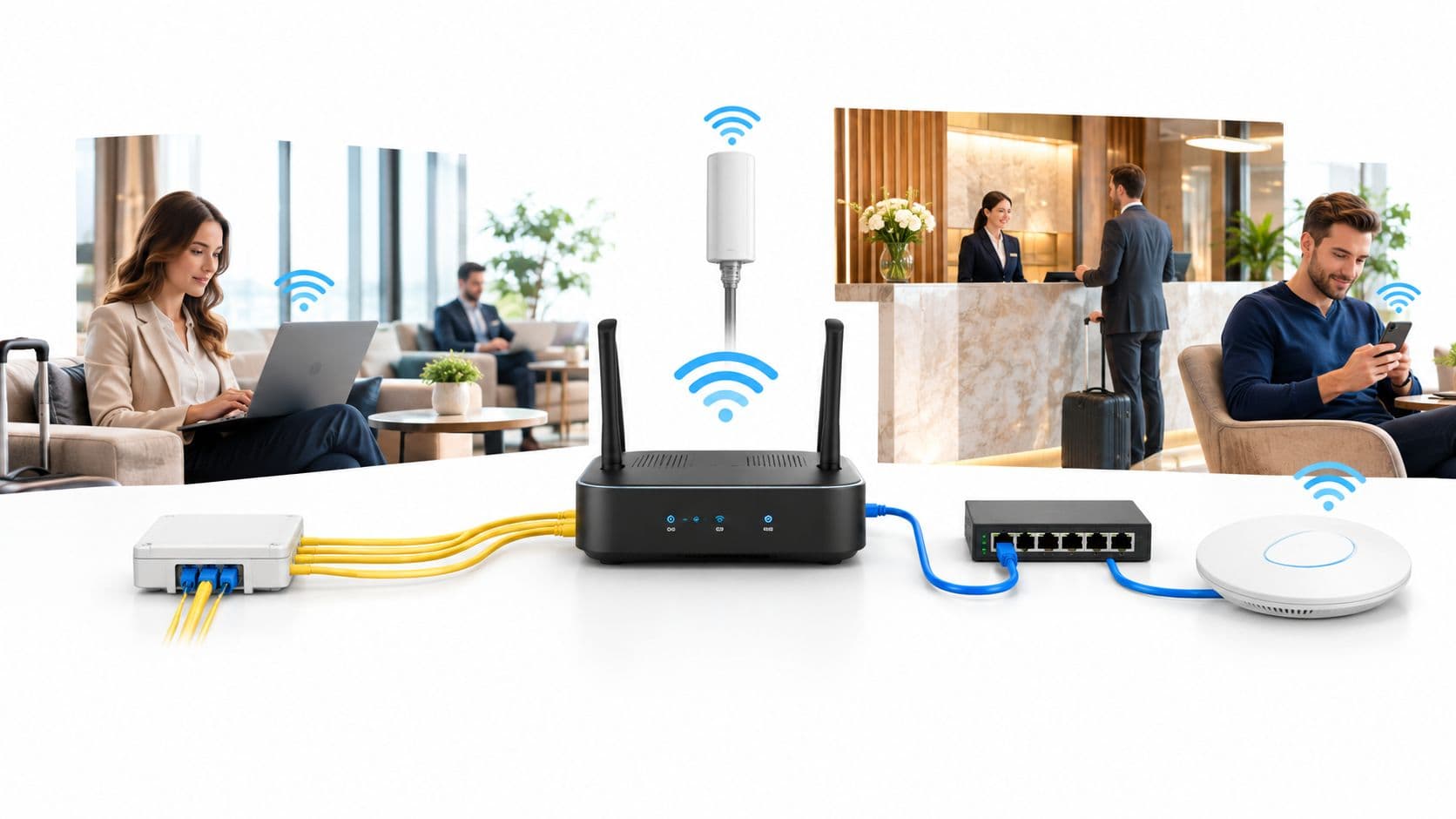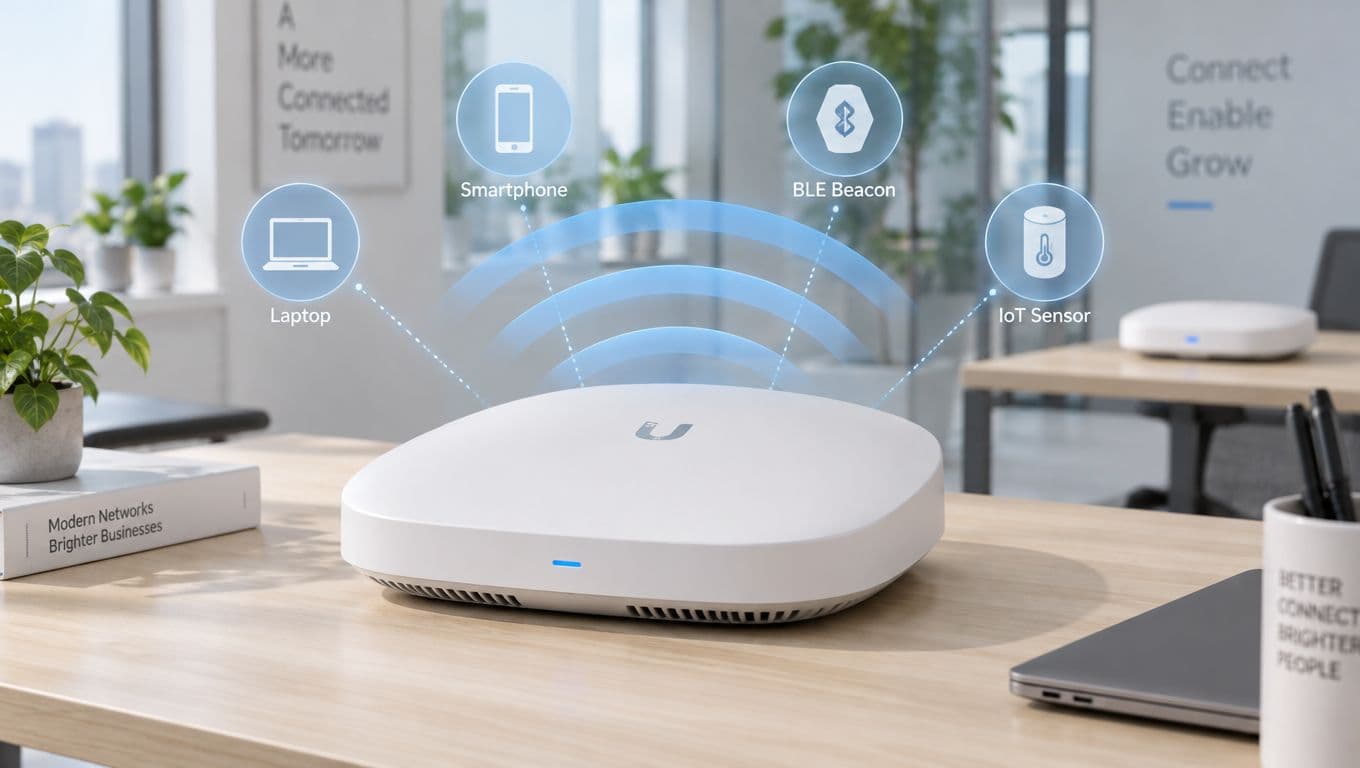

FTTH enterprise bandwidth and architecture advisor
Model concurrent streaming demand, size passive optical network (PON) contention ratios, and design private WiFi bubbles for multi-tenant residential, hospitality, and student estates.
Under the selected configuration, each unit is allocated a guaranteed contention floor of 55.6 Mbps down during peak evening draw. Recommended delivery for this estate profile is Dedicated Internet Access (DIA) 10 Gbps Leased Line.
Deploy private resident WiFi bubbles on fiber infrastructure
Purple transforms shared FTTH and leased line connectivity into private resident WiFi networks, handling captive portal onboarding, Passpoint profiles, and IoT device isolation seamlessly.
Muchos equipos de TI se encuentran en la misma situación en este momento. La propiedad ha actualizado los puntos de acceso, ha implementado procesos de acceso de invitados más inteligentes, ha añadido dispositivos para el personal, ha integrado Smart TVs, cerraduras, sensores, cámaras, tabletas y aplicaciones en la nube y, sin embargo, la entrega de banda ancha en el edificio sigue siendo la parte más débil de la infraestructura.
Esa falta de alineación se hace patente rápidamente en las operaciones reales. Los huéspedes se quejan de las interrupciones por almacenamiento en búfer en el salón de un hotel. Los residentes de un bloque de viviendas de alquiler pueden descargar con suficiente rapidez, pero las videollamadas siguen fallando cuando todo el mundo empieza a subir contenidos a la vez. Los equipos de retail quieren señalización digital, analíticas y un WiFi para invitados fiable, pero el extremo de la WAN sigue comportándose como un servicio heredado que nunca se diseñó para un establecimiento moderno.
Por eso el ftth fiber to the home es importante para el departamento de TI de las empresas. No es solo un término de banda ancha de consumo. En entornos comerciales y multiinquilino, es la capa de acceso la que determina si su plataforma WiFi puede ofrecer un rendimiento estable, si los controles de acceso basados en la identidad funcionan correctamente y si los usuarios perciben su red como fluida o frustrante.
El fin del internet "suficientemente bueno"
Un hotel boutique ya no puede permitirse un "suficientemente rápido la mayor parte del tiempo". Tampoco puede hacerlo una residencia de estudiantes, un bloque residencial o una tienda insignia. Los usuarios no juzgan la red por lo que el proveedor vendió sobre el papel. La juzgan por si las llamadas de Teams se cortan, si las televisiones de las habitaciones reproducen streaming sin tirones, si la incorporación de usuarios es sencilla y si el acceso seguro funciona sin peticiones repetidas.

Ahí es donde se desmorona la vieja idea de tener una "conexión a internet aceptable". Los servicios heredados de última milla suelen aguantar hasta que el espacio se llena. Es entonces cuando aparecen las grietas. El tráfico con gran carga de subida, los ciclos de autenticación, las aplicaciones de back-office en la nube, el backhaul de CCTV y la densidad de dispositivos de los invitados compiten por la misma ruta limitada.
Por qué ha cambiado el punto de partida
El mercado del Reino Unido ya ha superado con creces la fase de adopción minoritaria. A partir de 2025, las redes de fibra completa darán cobertura a más de 16 millones de instalaciones en el Reino Unido, lo que representa aproximadamente el 45% de los hogares y empresas, con tasas de adopción que alcanzan el 25% en las zonas con cobertura. Esto supone un aumento con respecto al 6% de 2020, impulsado por 8000 millones de libras de inversión privada, según el informe Connected Nations de Ofcom.
Para los equipos de TI y de gestión de propiedades, esto es importante porque las expectativas de los usuarios ahora se corresponden con el rendimiento de la era de la fibra. Un inquilino que compara dos edificios nota la diferencia. Un invitado que decide si volver también lo nota. Cuando la capa de acceso es débil, cada inversión realizada aguas arriba en WiFi 6, seguridad en la nube, analíticas y captación de clientes se ve arrastrada por ella.
Regla práctica: si su espacio depende de aplicaciones en la nube, un WiFi denso y un proceso de incorporación sin fricciones, su banda ancha ya no es una partida de servicios públicos. Es parte de la pila de experiencia del usuario.
Cómo suele ser un rendimiento "suficientemente bueno" en la práctica
In la mayoría de los sitios con problemas, los síntomas son familiares:
- Fricción para los invitados: las contraseñas compartidas, los reintentos en el portal y las transferencias de red inconsistentes generan una mala primera impresión.
- Lastre operativo: los dispositivos inteligentes se conectan, pero no con la fiabilidad suficiente como para confiar en ellos en las horas punta.
- Brechas de seguridad: los equipos mantienen modelos de acceso antiguos porque la red subyacente no es compatible con enfoques basados en la identidad más limpios y seguros.
- Atribución de culpas: el proveedor de WiFi culpa al ISP, el ISP culpa al diseño de la LAN interna, y el establecimiento se queda atrapado en el medio.
FTTH cambia esa discusión porque elimina el cuello de botella de la última milla que los servicios de cobre heredados no dejan de reintroducir.
Qué es FTTH Fiber to the Home
En su definición más simple, ftth fiber to the home significa que la conexión en las instalaciones sigue siendo de fibra hasta el punto final, en lugar de cambiar a cobre antiguo para el tramo final. Ese último tramo es donde muchos servicios de "fibra" pierden su ventaja.
Una forma útil de explicarlo a los equipos que no son de redes es la siguiente. El cobre es como una carretera rural estrecha con curvas, baches y puntos de embotellamiento de tráfico. La fibra es una autopista recta de varios carriles diseñada para una capacidad mucho mayor y un trayecto más fluido. Ambos mueven el tráfico. No lo hacen con la misma consistencia.
FTTH transporta datos como pulsos de luz a través de cables de fibra óptica. Esto hace que sea intrínsecamente menos vulnerable a las interferencias eléctricas, la degradación por distancia y los límites prácticos de ancho de banda que afectan a las tecnologías de acceso basadas en cobre.
Qué diferencia a FTTH de otros servicios comercializados como fibra
Muchos servicios incluyen fibra en algún punto de la red del proveedor. Eso no significa que el edificio tenga una ruta de acceso de fibra real. Para los compradores de empresas, la pregunta importante no es "¿Hay fibra en la red?", sino "¿Cuál es la conexión final en mi sitio?".
Si la respuesta sigue siendo el cobre para el último tramo, mantiene el cuello de botella. Esto suele traducirse en un rendimiento menos predecible bajo carga, una capacidad de subida más débil y una mayor sensibilidad a la calidad de la línea.
FTTH evita esto al llevar la fibra directamente a las instalaciones y terminarla en los equipos del lado del cliente diseñados para entrega óptica. Esa conexión directa es la clave. Es lo que otorga al servicio su ventaja práctica para entornos densos, siempre activos y con un uso intensivo de la nube.
Por qué el medio físico importa para los resultados del negocio
Para un usuario doméstico, FTTH suele venderse como velocidad. Para el operador de un espacio, debe evaluarse como capacidad más consistencia.
Esa diferencia afecta a aspectos como:
- Incorporación a la WiFi para invitados: los flujos de trabajo de autenticación resultan más fluidos cuando el enlace de retorno no se congestiona ante la demanda simultánea.
- Dependencia de la nube: las plataformas PMS, EPOS, los sistemas de videovigilancia y las herramientas de colaboración se benefician de una capa de acceso más estable.
- Crecimiento de dispositivos en todo el edificio: cada nueva cerradura inteligente, punto final de IPTV o sensor IoT añade una presión que los diseños de última milla más antiguos gestionan con dificultad.
- Actualizaciones futuras: una ruta de acceso basada en fibra ofrece más margen para mejorar la WiFi y la seguridad más adelante sin tener que reemplazar toda la estrategia de acceso.
Si su equipo necesita una base sobre la capa física antes de planificar un despliegue, esta guía práctica de cableado de fibra óptica es una referencia útil porque explica consideraciones prácticas de cableado sin ahogar al lector en la teoría.
La versión corta
La FTTH no es simplemente "banda ancha más rápida". Es una clase diferente de infraestructura de acceso. En el contexto de un recinto, esto se traduce en menos limitaciones heredadas del cobre antiguo y una base mucho mejor para WiFi de alta densidad, servicios en la nube y un control de acceso moderno.
Comprensión de las arquitecturas de red FTTH
Bajo la superficie, la mayoría de los despliegues de fibra completa en el Reino Unido se basan en una red óptica pasiva, habitualmente abreviada como PON. La palabra "pasiva" es importante. Entre el equipamiento activo del proveedor y el punto final del cliente, la ruta de distribución utiliza componentes ópticos pasivos en lugar de electrónica de campo alimentada por energía eléctrica.
Esa arquitectura es una de las razones por las que FTTH escala tan bien. Reduce la cantidad de dispositivos activos que deben alojarse, alimentarse, refrigerarse y mantenerse en la planta exterior.
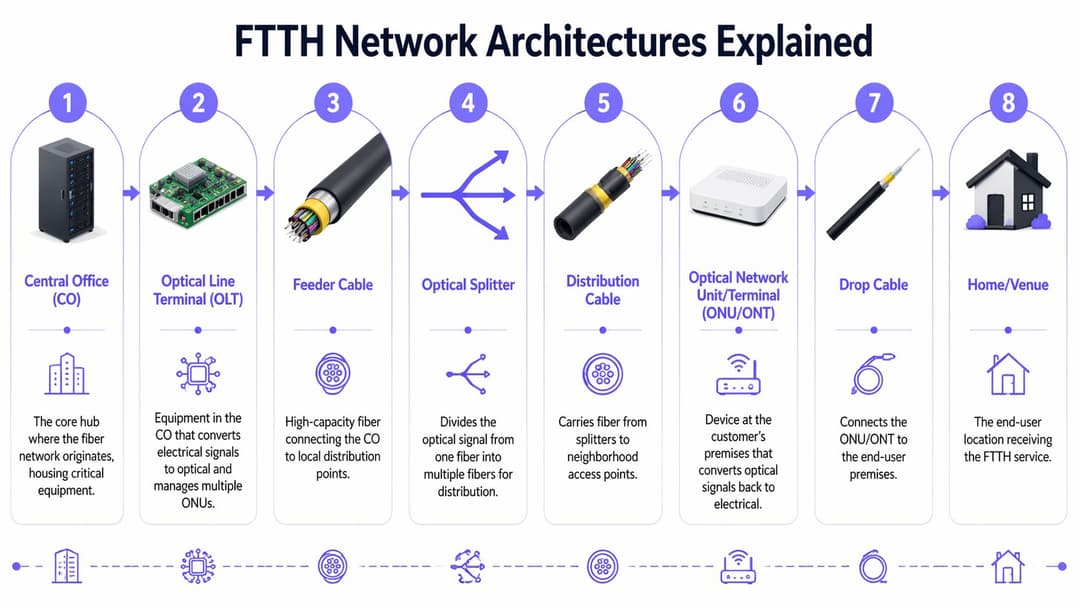
Los componentes principales
La mayoría de los responsables de TI de las empresas no necesitan diseñar la planta externa, pero sí necesitan conocer las partes móviles:
- Terminal de línea óptica u OLT: se ubica en el lado del proveedor y gestiona el servicio óptico presentado a múltiples extremos de conexión.
- Divisores pasivos: dividen la señal óptica a través de múltiples instalaciones atendidas sin necesidad de introducir equipos con alimentación activa en el terreno.
- Fibra de alimentación y distribución: transporta el servicio desde la red del proveedor hasta las zonas de servicio locales y, a continuación, hacia cada propiedad.
- Terminal de red óptica u ONT: se ubica en las instalaciones del cliente y convierte la señal óptica en una entrega eléctrica para la red local.
En términos prácticos, el ONT es su punto de demarcación. Todo lo que viene después pertenece a la misma conversación de diseño que su cortafuegos, conmutación, SSIDs, comportamiento de itinerancia y pila de autenticación.
Por qué PON se ha convertido en el estándar por defecto
En los despliegues de FTTH modernos en el Reino Unido, la autenticación OLT-ONT mediante cifrado AES-256 es el estándar dentro de la encapsulación GPON, lo que permite políticas de zero-trust sin necesidad de servidores RADIUS locales. Estos despliegues suelen utilizar relaciones de división de 1:32 en terminales de acceso de fibra para un diseño escalable de última milla, tal como se describe en el trabajo de Altman Solon sobre planificación de redes y soluciones de redes digitales.
Esto es importante para los entornos empresariales porque la red de acceso ya no es solo una tubería tonta. La forma en que la capa óptica autentica y escala afecta a la limpieza con la que se puede construir un acceso seguro sobre ella.
En proyectos de espacios, los mejores resultados suelen obtenerse cuando las capas WAN, LAN e identidad se diseñan de forma conjunta. Tratar la entrega de la fibra como el problema de otra persona suele generar costosas modificaciones más adelante.
GPON, EPON y XGS-PON en un lenguaje sencillo
Escuchará muchas siglas en las conversaciones con los proveedores. Las diferencias prácticas son más importantes que las etiquetas.
GPON
GPON es el motor de muchas implementaciones. Se utiliza ampliamente porque equilibra bien el coste y el rendimiento. Si su espacio necesita un servicio de fibra óptica completa fiable para aplicaciones empresariales, acceso de invitados y un número razonable de dispositivos simultáneos, GPON suele ser totalmente suficiente.
También es la arquitectura que muchos operadores conocen mejor desde el punto de vista operativo. Eso puede traducirse en un aprovisionamiento más fluido y un soporte más sencillo.
EPON
EPON está orientada a Ethernet en su filosofía de diseño. En algunos entornos, esto la hace atractiva desde una perspectiva de estándares u operativa, pero para la mayoría de los compradores de empresas del Reino Unido la discusión comercial no se centra tanto en EPON frente a GPON, sino en lo que el proveedor puede entregar, soportar y escalar en la propiedad.
Para muchos responsables de TI, EPON no es un criterio de compra por sí solo. Las características del servicio y la competencia del proveedor importan más.
XGS-PON y despliegues más nuevos
XGS-PON cobra relevancia cuando los establecimientos necesitan más margen de maniobra, especialmente cuando la demanda de subida es alta y se prevé un crecimiento a largo plazo. En los despliegues actuales en el Reino Unido, la fibra óptica completa puede permitir velocidades simétricas de hasta 10 Gbps a través de la tecnología XGS-PON de acuerdo con la descripción general de FTTH de Vetro FiberMap.
Para un hotel, una propiedad de uso mixto o una promoción residencial, ese margen adicional de maniobra no es para presumir, sino para evitar tener que rediseñar la red cuando cambien los patrones de tráfico. El personal sube cada vez tanta información como la que descarga. Las cámaras de seguridad envían tráfico de subida. La colaboración por vídeo es constante. El tráfico de identidad, la sincronización en la nube y la analítica no encajan bien en las antiguas hipótesis de asimetría.
Qué preguntar a un proveedor o socio de despliegue
Al evaluar una opción de FTTH para una propiedad comercial o multiinquilino, haga preguntas directas:
- ¿Qué estándar óptico dará servicio a este centro? GPON suele ser suficiente. XGS-PON puede ser la mejor opción para un crecimiento de mayor densidad.
- ¿Dónde se ubica la ONT? La ubicación influye en el cableado interno, la resiliencia y la forma en que se segmenta el tráfico tras la entrega.
- ¿Cómo se gestiona la conmutación por error? El acceso a la fibra es potente, pero su establecimiento sigue necesitando un plan de resiliencia.
- ¿Cómo es la entrega para el equipo de LAN? No acepte respuestas ambiguas. Aclare las interfaces, la demarcación y la responsabilidad del soporte.
- ¿Cómo apoyará el diseño a la red WiFi basada en la identidad? Si el proveedor no puede explicar esa entrega con claridad, el proyecto sigue estando demasiado aislado.
La verdadera compensación
El equilibrio en la arquitectura FTTH no suele ser entre "bueno o malo". Se trata de capacidad ahora frente a flexibilidad más adelante, y un menor coste inicial frente a un menor rediseño a lo largo del tiempo. GPON puede ser la respuesta correcta. XGS-PON también puede ser la respuesta correcta. Lo que no funciona es comprar el servicio óptico más barato sin comprobar si se alinea con la forma en que su establecimiento utiliza el WiFi y las plataformas en la nube.
Cómo se compara la tecnología FTTH con otras opciones de banda ancha
Para los compradores de tecnología empresarial, la comparación incorrecta es "¿Pueden todas estas tecnologías conectarme a Internet?". La comparación correcta es "¿Cuál de ellas sigue rindiendo cuando el edificio está lleno, las aplicaciones están basadas en la nube y los usuarios esperan que el WiFi parezca invisible?".
Ahí es donde FTTH se diferencia de los tipos de acceso más antiguos. La fibra hasta las instalaciones elimina el tramo más débil de la última milla. Otros modelos FTTx mantienen alguna versión de ese tramo débil.
La mayor diferencia no es la velocidad nominal
Sobre el papel, los servicios más antiguos pueden parecer aceptables. En entornos reales, a menudo se quedan cortos en las métricas que los usuarios perciben. La consistencia de la subida, la latencia, el comportamiento ante la congestión y la tolerancia a fallos importan más que una etiqueta de marketing.
Según los datos de referencia de Ofcom, FTTH ofrece una reducción de la latencia de entre el 30 y el 50 por ciento en comparación con FTTC basado en cobre, con una latencia media de FTTH de 5 a 10 ms frente a los 20 a 40 ms de FTTC, tal como resume Vetro FiberMap. Para un establecimiento hotelero o residencial, esto mejora las videollamadas, el acceso a la nube y cualquier aplicación que dependa de respuestas rápidas en lugar de ráfagas de descarga puras.
FTTH frente a modelos de última milla más antiguos
| Tecnología | Conexión final | Velocidades simétricas típicas | Latencia media | Fiabilidad |
|---|---|---|---|---|
| FTTH | Fibra directa hasta las instalaciones | Gran compatibilidad con servicios simétricos, especialmente en los estándares PON más recientes | De 5 a 10 ms en escenarios FTTH evaluados por Ofcom | Alta. Inmune a los problemas de cobre del último tramo que afectan a los tipos de acceso más antiguos |
| FTTC | Fibra hasta la cabina, cobre hasta las instalaciones | Normalmente más lenta para las subidas porque el segmento final sigue siendo de cobre | De 20 a 40 ms en escenarios FTTC evaluados por Ofcom | Moderada. El rendimiento depende en gran medida del estado del cobre y de la distancia |
| FTTN | Fibra hasta el nodo, cobre para un tramo final más largo | A menudo menos adecuada cuando el rendimiento de subida estable es prioritario | Más alta y menos predecible en la práctica que la fibra completa | Menor que FTTH porque una mayor parte del último tramo sigue siendo infraestructura heredada |
| HFC | Fibra más cable coaxial | Puede ser rápida de bajada, pero la simetría y la consistencia varían | Puede ofrecer un buen rendimiento, pero el comportamiento bajo demanda compartida es menos predecible | Mejor que el cobre antiguo en algunos escenarios, pero sigue sin ser igual que la fibra de extremo a extremo |
Qué significa esto para el departamento de TI del espacio
FTTC y FTTN aún pueden ser utilizables en sitios de baja demanda o de transición. No son ideales cuando la propiedad depende de:
- Uso concurrente denso: muchos invitados o residentes conectados a la vez
- Operaciones que priorizan la nube: aplicaciones que se comunican constantemente tanto de subida como de bajada
- Control de acceso moderno: comprobaciones de identidad y flujos de roaming que se ven afectados cuando fluctúa la latencia
- Futuras actualizaciones de red: un mejor WiFi solo ayuda si la red de retorno puede mantener el ritmo
El HFC puede ser un servicio razonable en algunos lugares, pero los equipos empresariales deben tener cuidado de no tratar el marketing de «tecnología de fibra» como equivalente a la fibra hasta las instalaciones. El medio final sigue importando.
Un prisma de decisión práctico
Si está comparando opciones de banda ancha para un espacio, haga una pregunta primero: «¿Qué falla primero cuando la ocupación es alta?». Si la respuesta son las subidas, las aplicaciones interactivas o la capacidad de respuesta de la autenticación, FTTH suele ser la respuesta a largo plazo más limpia.
Esa misma lógica también es importante cuando se evalúa la arquitectura WAN más amplia. Si la sede depende de aplicaciones en la nube y de tráfico segmentado, vale la pena entender dónde encaja el acceso de banda ancha en una estrategia de extremo más amplia, como los beneficios de SD-WAN para sedes distribuidas.
El servicio de acceso más barato suele convertirse en el más caro una vez que los tickets de soporte, las quejas de los usuarios y los proyectos de soluciones temporales empiezan a acumularse.
El impacto transformador en los espacios modernos
Los argumentos técnicos a favor de la fibra completa son sencillos. El impacto operativo es donde los equipos suelen notar la diferencia en primer lugar.
Un recinto no adquiere FTTH porque alguien quiera un diagrama de red más vistoso. Adquiere FTTH porque el negocio ha superado una infraestructura que se comporta de forma impredecible cada vez que aumenta la ocupación, se multiplican los dispositivos o la seguridad se vuelve más rigurosa.

Hostelería
En hoteles, bares y apartamentos con servicios incluidos, la conectividad es parte del producto. Los huéspedes no separan la experiencia de la habitación de la experiencia de la red. Si la transmisión por streaming es inestable, si los controles de la habitación se retrasan o si la configuración de guest WiFi resulta engorrosa, lo interpretarán como una falta de calidad operativa.
FTTH ayuda al proporcionar a la propiedad una capa de acceso más sólida para:
- Streaming de invitados y videollamadas
- Sistemas de habitaciones inteligentes y servicios para edificios conectados
- Aplicaciones para el personal que dependen del acceso a la nube durante los periodos de mayor actividad
- Una itinerancia más fluida entre espacios públicos y privados
El mayor cambio operativo es la consistencia. La red deja de dar la sensación de tener "días buenos" y "días malos".
Viviendas de alquiler protegido (build-to-rent) y residencias de estudiantes
Los operadores residenciales se enfrentan a una presión diferente. Los inquilinos esperan cada vez más que la conectividad del hogar soporte el trabajo, el estudio, el streaming, los videojuegos y los dispositivos conectados, todo al mismo tiempo. También esperan que el proceso de incorporación sea sencillo. Las contraseñas compartidas y los incómodos Captive Portal resultan anticuados en entornos residenciales de alta gama.
Para estas propiedades, la FTTH permite una mejor propuesta para los inquilinos. Proporciona al edificio la capacidad de acceso suficiente para respaldar expectativas similares a las de un hogar, al tiempo que permite al operador diseñar una segmentación más limpia entre residentes, personal, visitantes y dispositivos compartidos.
Un entorno de fibra completa bien diseñado también es más fácil de comercializar. La propiedad puede presentar la conectividad como una característica del servicio en lugar de como una queja recurrente.
Espacios comerciales y de uso mixto
Los equipos de retail a menudo se centran en el WiFi de cara al público y en las experiencias digitales, pero la demanda de infraestructura entre bastidores es más amplia. Las tiendas modernas y los espacios de uso mixto dependen de plataformas de analíticas, herramientas de colaboración del personal, cartelería digital, cajas registradoras conectadas, dispositivos de mano y una conectividad de invitados que no interrumpa el recorrido del cliente.
FTTH no resuelve mágicamente un mal diseño de WiFi, pero elimina una fuente importante de inestabilidad. Eso permite que el espacio soporte:
- Acceso de invitados fiable sin la penalización de la saturación del backhaul
- Operaciones gestionadas en la nube a través de ubicaciones distribuidas
- Visibilidad de datos en tiempo real de los sistemas de las tiendas
- Mayor confianza a la hora de añadir nuevos servicios conectados
Qué funciona y qué no
Lo que funciona es tratar la FTTH como la capa base para un diseño de red de recinto más amplio. Eso significa adaptar el servicio de acceso a la densidad y el comportamiento del sitio, planificar correctamente la ubicación de las ONT y diseñar la pila de LAN y WiFi en función del comportamiento real de los usuarios.
Lo que no funciona es asumir que la instalación de fibra completa por sí sola resolverá todos los problemas de experiencia. Si la distribución de los puntos de acceso es deficiente, si el registro de usuarios es engorroso, si el tráfico de empleados y huéspedes se mezcla de forma inadecuada o si la segmentación de IoT se deja para el final, los usuarios seguirán culpando a "la WiFi".
Una mejor banda ancha no rescata un diseño inalámbrico deficiente. Le da al diseño inalámbrico robusto el espacio necesario para rendir adecuadamente.
El beneficio menos obvio
Uno de los mayores beneficios de FTTH en espacios comerciales y residenciales es organizativo, no solo técnico. Las conversaciones de soporte se vuelven más claras. El extremo de la WAN se vuelve menos misterioso. Los equipos pasan menos tiempo discutiendo si el problema es del ISP, de la pila de switches, del Captive Portal o de la densidad de usuarios.
Esa claridad importa. Acorta los tiempos de resolución de problemas y hace que sea mucho más fácil justificar la siguiente fase de mejora.
Cómo abordar el despliegue y los costes de FTTH
Para cuando un equipo decide que FTTH es la dirección correcta, la siguiente pregunta suele ser práctica. ¿Cómo de difícil va a ser esto y cuánto nos va a costar en dinero, tiempo y molestias?
La respuesta depende en gran medida de si se trata de una nueva construcción o de una propiedad existente.
Proyectos desde cero (greenfield)
En un desarrollo desde cero (greenfield), es mucho más fácil implementar FTTH de forma correcta. Los conductos, montantes, salas de equipos, espacios de comunicaciones y canalizaciones internas se pueden diseñar pensando en la fibra desde el principio. Esto elimina gran parte de la mano de obra y las concesiones que complican las adaptaciones posteriores.
Para los equipos de TI y de gestión de propiedades, el éxito en proyectos nuevos suele depender de una coordinación temprana:
- Defina la estrategia de acceso con antelación: no deje la decisión del ISP para cuando la estructura del edificio esté terminada.
- Diseñe correctamente la demarcación y los espacios de comunicaciones: la ubicación de la ONT y el diseño de la transferencia afectan a toda la red interna.
- Planifique las canalizaciones internas para cambios futuros: la capacidad de reserva en los montantes y la contención es fundamental.
- Defina las responsabilidades con claridad: el proveedor, el contratista, el equipo de M&E y el equipo de TI necesitan límites de actuación bien definidos.
Adaptaciones en edificios existentes (brownfield)
Los despliegues en entornos brownfield es donde las concesiones se vuelven reales. Los edificios existentes pueden tener canalizaciones deficientes, espacio restringido en montantes, problemas de edificios protegidos, aprobaciones complejas de los propietarios o preocupaciones por las molestias a los inquilinos. En estos proyectos, la pregunta de diseño a menudo no es "¿Qué es lo ideal?" sino "¿Qué podemos desplegar limpiamente sin crear un problema de mantenimiento?".
Por eso los estudios del terreno son importantes. Antes de que nadie prometa plazos o ahorros, los equipos deben entender la ruta de entrada al edificio, dónde se puede ubicar la terminación, qué distribución interna es viable y dónde es mayor el riesgo de interrupción.
Un proyecto en una instalación existente suele tener éxito cuando el equipo es disciplinado en tres aspectos:
- Realidad del trazado: Las rutas existentes rara vez son tan utilizables como sugieren los planos antiguos.
- Impacto en los inquilinos: Las ventanas de acceso, la comunicación con los residentes y los trabajos en zonas comunes requieren una gestión activa.
- Pensamiento en el ciclo de vida: Las soluciones rápidas que parecen baratas el primer día suelen resultar caras una vez que empiezan el soporte y los cambios, adiciones o traslados.
El contexto del despliegue en el Reino Unido
El mercado en general está ayudando. En el Reino Unido, los proveedores como Nexfibre superaron el millón de instalaciones en 14 meses, y más de 5000 millones de libras de financiación pública a través de programas como Project Gigabit están respaldando la expansión a zonas desatendidas, ayudando a fomentar una competencia que puede reducir los precios entre un 15 y un 20 por ciento, según el informe de mercado FTTH de SNS Insider.
Esto no significa que todos los establecimientos obtengan un acceso sin esfuerzo. Significa que la disponibilidad está mejorando y que las opciones comerciales son más amplias que hace unos años.
Decisiones de costes que importan más que la tarifa
Los equipos a menudo pasan demasiado tiempo comparando las tarifas de acceso mensuales y no el tiempo suficiente analizando el impacto operativo total. Un servicio de última milla incorrecto puede costar más en soporte, proyectos de solución temporal y pérdida de clientes que un servicio de fibra de mayor calidad.
Si está intentando estructurar los aspectos económicos de forma adecuada, resulta útil comparar el enfoque de FTTH con otros modelos de acceso dedicado y comprender dónde encaja cada uno. Este desglose de consideraciones de costes de líneas dedicadas es útil porque ofrece a los responsables de la toma de decisiones una mejor perspectiva para analizar el gasto en acceso en el contexto de las necesidades empresariales, y no solo del precio de catálogo.
Un enfoque de despliegue sensato
Considere FTTH como una infraestructura con una larga vida útil, no como un parche de conectividad a corto plazo. Esto cambia los criterios de compra. Las mejores decisiones suelen surgir al preguntarse cómo operará la propiedad durante los próximos años, en lugar de buscar lo que parezca más barato en la hoja de cálculo de este trimestre.
Combinar FTTH con WiFi corporativo seguro
Esta es la parte que muchas organizaciones pasan por alto. La instalación de fibra óptica completa proporciona una línea potente hacia el edificio. No crea, por sí sola, una experiencia de usuario segura y fluida. Si la capa WiFi sigue dependiendo de contraseñas compartidas, Captive Portals inestables y supuestos de acceso plano, los usuarios nunca percibirán todo el valor de la fibra que hay debajo.
Por eso FTTH debe combinarse con un diseño de WiFi corporativo que esté centrado en la identidad desde el principio.
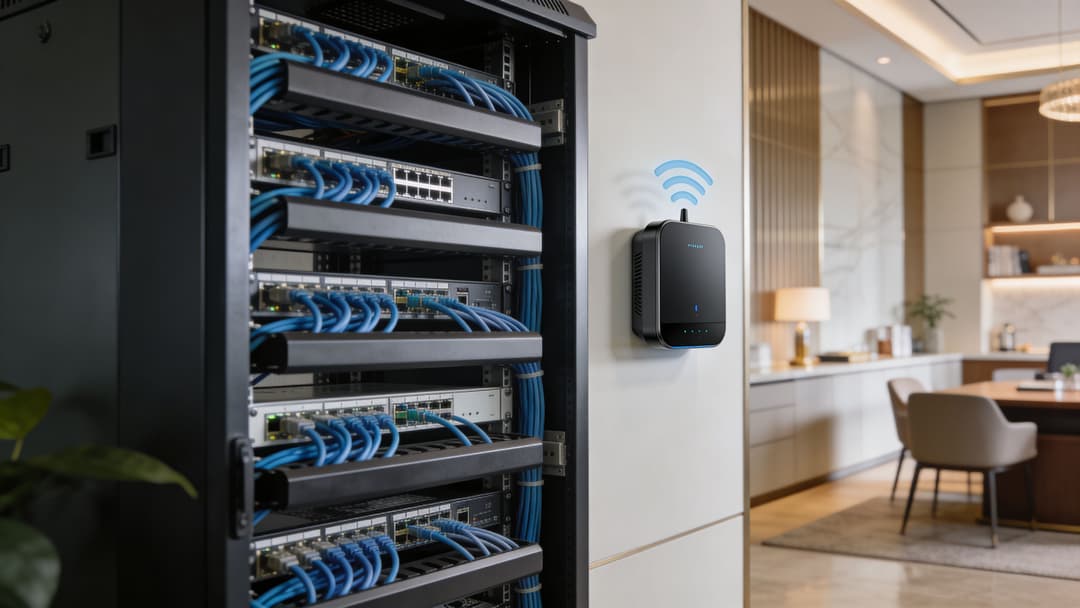
Por qué el backhaul sigue importando para el WiFi
Muchas quejas sobre el WiFi de un recinto se atribuyen al diseño de radio cuando el problema está en la restricción de subida. Los puntos de acceso pueden ser modernos. La señal puede ser buena. Pero una vez que muchos usuarios se autentican, realizan itinerancia, transmiten contenido, se sincronizan y realizan cargas al mismo tiempo, el backhaul débil empieza a notarse.
La fibra óptica completa reduce ese riesgo al proporcionar a la red WiFi suficiente capacidad libre para comportarse de forma predecible. Esto resulta especialmente importante en entornos con:
- Alta concurrencia de huéspedes
- Flujos de trabajo del personal basados en la nube
- Registro y reautenticación de dispositivos frecuentes
- Tratamiento de políticas diferenciado para huéspedes, personal, residentes e IoT
El resultado no es solo más velocidad. Es menos fricción.
Por qué los modelos de incorporación antiguos desperdician una buena conexión de fibra
Los sistemas de Captive Portal tradicionales y las credenciales compartidas crean dos problemas a la vez. Hacen que el acceso sea engorroso para los usuarios y desperdician la calidad de la conexión subyacente con más fricción y una seguridad más débil.
Según los recursos del blog de Purple, los establecimientos que combinan FTTH con OpenRoaming logran un 92% de cifrado en el primer paquete y una retención de clientes un 25% mayor. Los mismos datos también señalan un cuello de botella común por el cual las velocidades medias de WiFi pueden ser un 30% inferiores a la velocidad de la línea FTTH debido a la ineficacia de los Captive Portal.
Eso coincide con lo que muchos equipos de red ya ven en la práctica. No basta con llevar la fibra a la propiedad si la experiencia de autenticación sigue introduciendo retrasos, reintentos y abandonos.
Un buen WiFi para espacios se siente invisible. Los usuarios se conectan rápidamente, el tráfico se cifra de inmediato y la política de acceso sigue a la identidad en lugar de a cualquier contraseña que alguien haya escrito en un cartel.
Cómo es una combinación moderna
Un modelo más sólido consiste en combinar el backhaul FTTH con métodos de acceso WiFi basados en la identidad y las políticas:
- Para invitados: Passpoint y OpenRoaming pueden reducir las fricciones y transferir a los usuarios a un acceso cifrado desde el primer paquete.
- Para el personal: la integración con proveedores de identidad admite un control de acceso más limpio que el uso de credenciales compartidas reutilizadas.
- Para dispositivos heredados y fijos: técnicas como iPSK permiten a los equipos mantener el aislamiento sin generar una carga de soporte adicional.
- Para propiedades multiinquilino: los diferentes grupos de usuarios pueden disfrutar de una sencillez similar a la de un hogar sin necesidad de colapsar todo en una única red insegura.
Por eso FTTH no es solo una historia de velocidad. Es la base de acceso que hace que estos modelos de WiFi sean prácticos a gran escala.
No se salte la planificación de radiofrecuencia
Incluso con una excelente fibra, el diseño inalámbrico sigue determinando si los usuarios experimentan la red como excelente o como normal. La ubicación de los AP, la atenuación de las paredes, el comportamiento de itinerancia y el diseño de los canales son importantes. Especialmente en las modernizaciones, los equipos deben validar las hipótesis con un estudio de cobertura adecuado en lugar de basarse en conjeturas sobre los planos de planta.
Un estudio detallado de cobertura de red WiFi es uno de los pasos previos al despliegue más útiles, ya que conecta la decisión de acceso a la fibra con las condiciones reales de RF dentro del edificio.
El resultado comercial
Para el departamento de TI de la empresa, la combinación ganadora es sencilla. La fibra completa proporciona al sitio la capacidad de acceso y la consistencia que necesita. El WiFi basado en identidad convierte esa capacidad bruta en una experiencia segura y fluida para invitados, personal y residentes.
Si su equipo está evaluando cómo construir esa capa inalámbrica sobre un mejor acceso, este análisis general de las soluciones WiFi empresariales es un buen punto de partida porque enfoca el problema en torno a la seguridad, la incorporación y el control operativo en lugar de limitarse a los mapas de cobertura.
Si está actualizando la infraestructura de acceso y desea que la experiencia del usuario mejore al mismo tiempo, Purple ayuda a transformar la conectividad de fibra completa en un WiFi seguro y sin contraseñas para invitados, personal y entornos multiinquilino. Esto se traduce en una menor dependencia de las contraseñas compartidas, una incorporación más fluida con OpenRoaming y Passpoint, un acceso basado en la identidad más limpio para el personal y una mejor visibilidad de cómo se utiliza su red.