
Gestión de WiFi para huéspedes de hoteles: Integración de PMS, portales y estándares de marca
Esta guía técnica detalla cómo diseñar redes de WiFi para hoteles de nivel empresarial, enfocándose en la segmentación de VLAN, la integración de PMS para la gestión automatizada de sesiones y la optimización de Captive Portal para la captura de datos de conformidad con el GDPR.
Escucha esta guía
Ver transcripción del podcast
Resumen ejecutivo
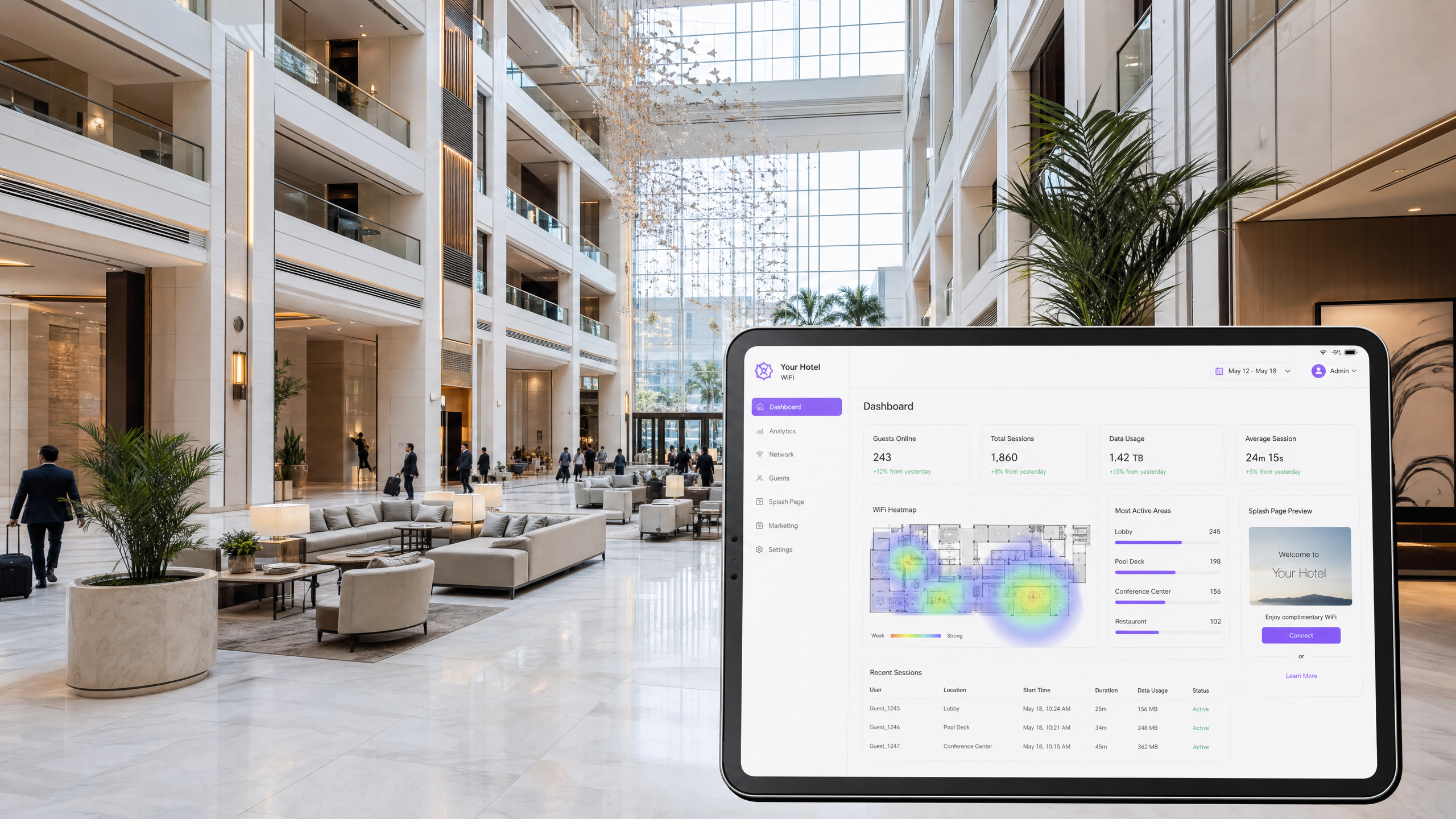
El WiFi para huéspedes de hoteles ya no es un servicio básico; es un sistema operativo crítico y un canal principal para la captura de datos de primera mano. Esta guía de referencia técnica detalla cómo diseñar, implementar y gestionar WiFi de nivel empresarial en entornos hoteleros. Cubre la segmentación de red, la integración con Sistemas de Gestión de Propiedades (PMS), la optimización de Captive Portal y el cumplimiento de los estándares de marca en toda la cadena. Para los directores de TI, arquitectos de red y directores de operaciones de establecimientos, el objetivo es claro: ofrecer una conexión rápida y segura que se integre a la perfección con su infraestructura de Guest WiFi mientras se capturan datos conformes para alimentar su plataforma de WiFi Analytics .
Ya sea que gestione un hotel boutique o una cartera global de 500 propiedades, los requisitos técnicos son los mismos: aislar el tráfico, automatizar la gestión de sesiones a través del PMS y aplicar políticas de seguridad consistentes. Purple proporciona la capa de nube independiente del hardware que hace esto posible en implementaciones de Cisco Meraki, HPE Aruba, Ruckus, Juniper Mist, Ubiquiti UniFi, Cambium, Extreme y Fortinet.
Análisis técnico profundo
Segmentación de red y arquitectura VLAN
Una red plana en un entorno hotelero es una vulnerabilidad de seguridad grave y un fallo de cumplimiento. Una red hotelera debe dar servicio a diferentes grupos: huéspedes, personal, sistemas de gestión de edificios y dispositivos IoT. La base de un WiFi hotelero seguro es la segmentación lógica mediante redes de área local virtuales (VLAN) según lo definido por IEEE 802.1Q.
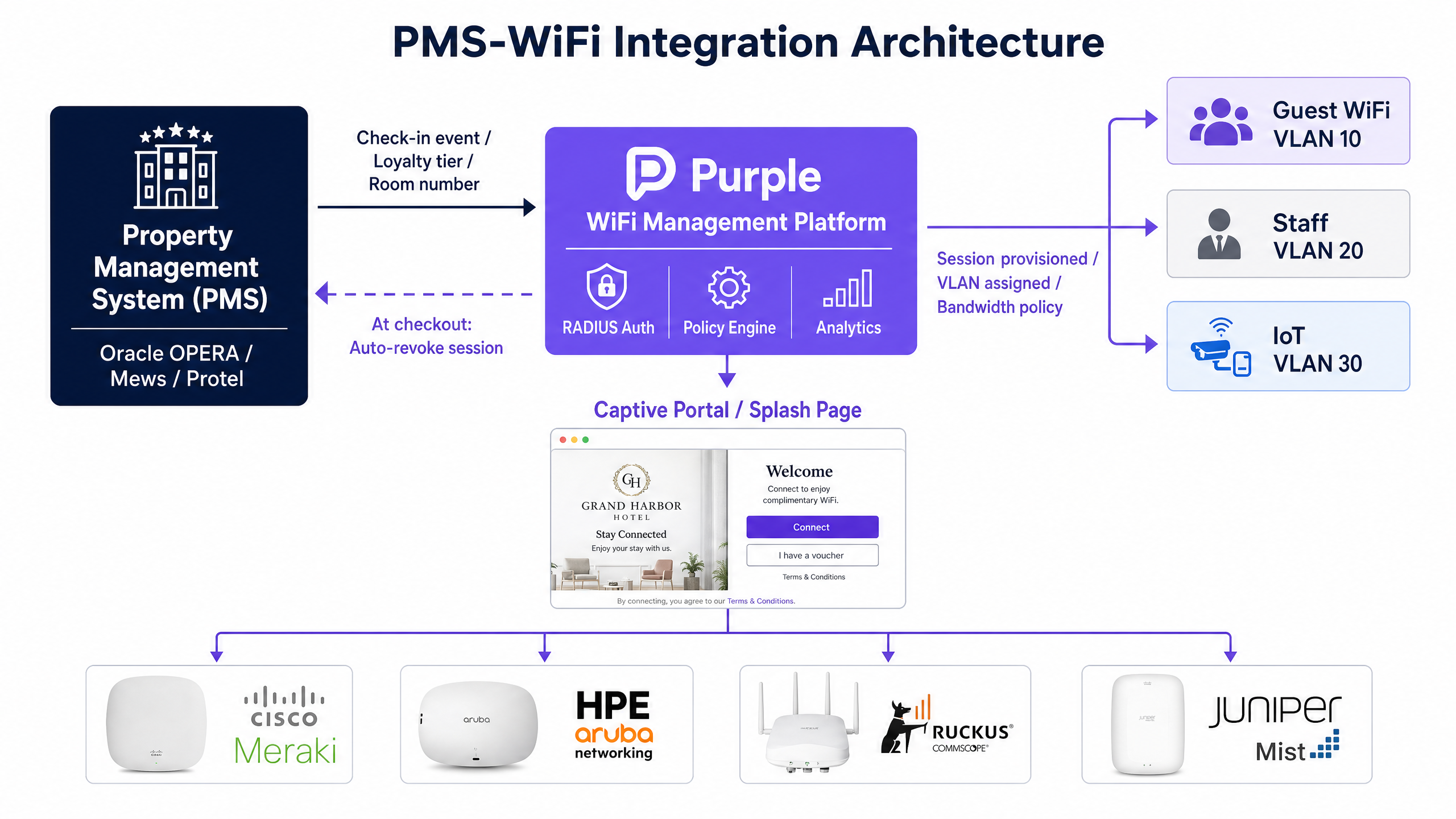
Debe asignar una VLAN dedicada a cada clase de tráfico. Una implementación estándar requiere al menos cuatro VLAN: Guest WiFi, Personal, IoT/Sistemas de edificios y una red dentro del alcance de PCI para terminales de pago. Su firewall debe aplicar una política de denegación por defecto entre estos segmentos. El tráfico de los huéspedes debe enrutarse directamente a internet, completamente aislado del sistema de gestión de la propiedad, las terminales de punto de venta (POS) y las comunicaciones del personal.
Para el extremo inalámbrico, cada identificador de conjunto de servicios (SSID) se asigna a una VLAN específica. En el SSID de huéspedes, debe habilitar el aislamiento de clientes. El aislamiento de clientes evita que los dispositivos en el mismo SSID se comuniquen directamente entre sí, lo que mitiga el riesgo de que un dispositivo comprometido sondee a otros huéspedes.
Integración de PMS y gestión automatizada de sesiones
La integración entre su plataforma de gestión de WiFi y su Sistema de Gestión de Propiedades (PMS) —como Oracle OPERA, Mews o Protel— es el eje central de una red de hospitalidad moderna. El PMS contiene la fuente única de verdad sobre la identidad del huésped, la asignación de habitaciones, el estado de check-in y el nivel de lealtad.
Cuando un huésped realiza el check-in, el PMS envía una llamada de API o un webhook a la plataforma de WiFi. La plataforma preconfigura la sesión del huésped, aplicando la política de ancho de banda correcta según su nivel de lealtad. Cuando el huésped se conecta, la autenticación es fluida. De manera crucial, cuando el huésped realiza el check-out, el PMS indica a la plataforma de WiFi que revoque el acceso de inmediato. Esto elimina el riesgo de seguridad de las credenciales activas y evita que los antiguos huéspedes consuman ancho de banda.
Captive Portals y captura de datos de primera mano
El Captive Portal es la puerta de enlace donde la inversión en infraestructura se convierte en valor comercial. No es simplemente un mecanismo de control de acceso; es su motor principal para la captura de datos de primera mano.
Los huéspedes se autentican mediante correo electrónico, inicio de sesión social o verificación por SMS. Esto captura una identidad verificada, que luego se vincula a la dirección MAC de su dispositivo, la marca de tiempo de la visita y el tiempo de permanencia. Estos datos se alimentan directamente a su CRM, lo que permite enviar correos electrónicos dirigidos antes de la estancia, encuestas posteriores a la estancia y ofertas basadas en la ubicación.
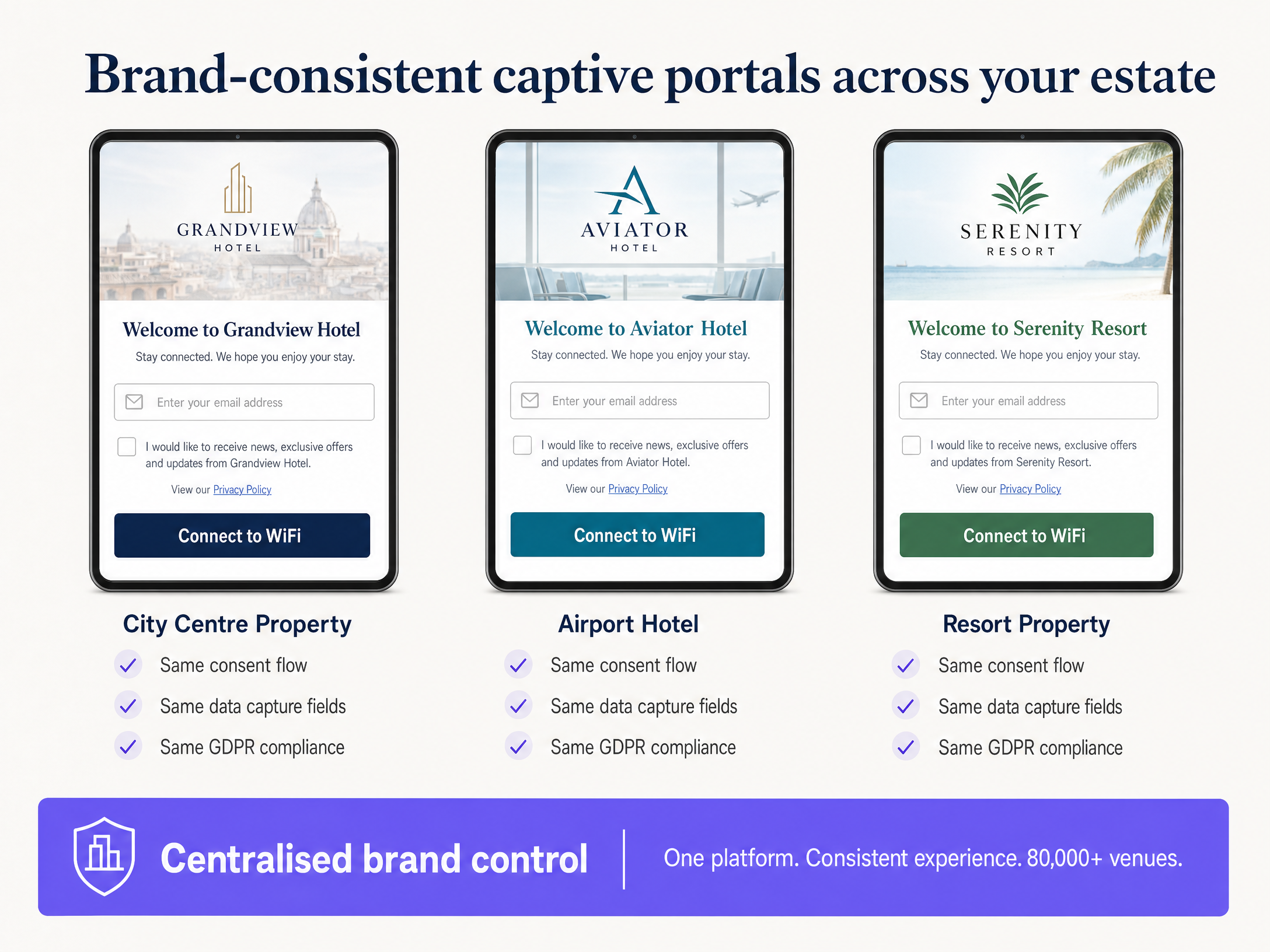
El cumplimiento no es negociable. Un Captive Portal que cumpla con el GDPR debe presentar un aviso de privacidad claro y capturar un consentimiento explícito y desagregado para las comunicaciones de marketing. El consentimiento para acceder al WiFi no debe estar condicionado al consentimiento para recibir marketing. Purple maneja esto de forma nativa, manteniendo registros de auditoría detallados para cada perfil de usuario.
Guía de implementación
Fase 1: Estudio del sitio y planificación de capacidad
Antes de configurar cualquier hardware, realice un estudio de sitio de RF exhaustivo utilizando herramientas de modelado predictivo. Para entornos hoteleros, el objetivo es la cobertura dentro de las habitaciones. Implemente un punto de acceso (AP) por habitación, o un AP por cada dos habitaciones como mínimo. Evite la colocación en pasillos, lo que crea sombras de cobertura y degrada el rendimiento. Dimensione su enlace de subida a internet para el uso simultáneo en horas pico. Planifique de 5 a 10 Mbps por habitación; una propiedad de 200 habitaciones requiere una línea arrendada dedicada de 800 Mbps a 1.6 Gbps.
Fase 2: Diseño de arquitectura y políticas
Asigne cada tipo de dispositivo a una VLAN dedicada. Documente sus reglas de enrutamiento inter-VLAN y las políticas de firewall de denegación por defecto. Determine sus estándares de autenticación: WPA3-Enterprise con IEEE 802.1X para redes del personal, y WPA3-Personal o una red abierta con aplicación de HTTPS e aislamiento de clientes para huéspedes.
Fase 3: Integración de PMS y portal
Configure la conexión de la API entre su PMS y la plataforma de WiFi. Diseñe el Captive Portal para alinearlo con los estándares de marca. Pruebe el recorrido de extremo a extremo del huésped en dispositivos iOS, Android y Windows. Verifique que la revocación de la sesión se active correctamente al realizar el check-out en el PMS.
Mejores prácticas
- Aplicar el aislamiento de clientes Aislamiento: Habilite siempre el aislamiento de clientes en los SSIDs orientados a huéspedes para evitar el movimiento lateral entre dispositivos.
- Automatice el acceso basado en roles: Utilice la autenticación IEEE 802.1X y RADIUS para las redes del personal. Intégrelo con Microsoft Entra ID, Okta o Google Workspace para asignar VLANs y políticas de QoS de forma dinámica según los roles de los usuarios.
- Centralice los estándares de marca: Utilice una plataforma gestionada en la nube con un motor de políticas jerárquico. Defina SSIDs, protocolos de seguridad y la identidad de marca del captive portal a nivel corporativo, lo que permite la herencia a nivel regional o de propiedad sin romper los estándares de marca.
- Separe el tráfico de IoT: Aísle las smart TVs, termostatos y asistentes de voz en una VLAN de IoT dedicada con un filtrado de salida estricto.
Resolución de problemas y mitigación de riesgos
- Velocidades lentas: La causa más común de un WiFi lento en los hoteles es un enlace ascendente (uplink) WAN con capacidad insuficiente, no la interferencia de RF. Monitoree la utilización de su circuito de internet. Si el enlace ascendente está saturado, actualizar los puntos de acceso no mejorará la experiencia del huésped.
- Fallo de segmentación: Los puertos troncales del switch mal configurados pueden colapsar múltiples VLANs en un solo dominio de difusión (broadcast), rompiendo silenciosamente su segmentación. Audite las configuraciones de los switches con regularidad.
- Fricción en la autenticación: Un captive portal que requiera un ingreso excesivo de datos hará que los huéspedes abandonen el proceso de conexión. Mantenga el formulario conciso.
ROI e impacto comercial
Una red WiFi hotelera correctamente diseñada ofrece retornos medibles. Reduce los tickets de soporte de TI relacionados con problemas de conectividad, lo que impulsa la eficiencia operativa. Mejora las puntuaciones de satisfacción de los huéspedes, que se correlacionan directamente con el RevPAR. Lo más importante es que genera una base de datos de origen (first-party) de huéspedes verificados que cumple con las normativas, lo que reduce la dependencia de las agencias de viajes en línea (OTAs) y potencia las campañas de marketing de reserva directa.
Definiciones clave
VLAN (Virtual Local Area Network)
A logical subnetwork that groups a collection of devices from different physical LANs. Essential for isolating guest traffic from operational systems.
Used to separate guest WiFi, staff devices, IoT hardware, and payment terminals onto isolated broadcast domains for security and PCI compliance.
PMS (Property Management System)
The central software platform used by hotels to manage reservations, check-ins, billing, and room status.
Integrating the PMS with the WiFi platform allows for automated session provisioning, loyalty tier bandwidth allocation, and immediate access revocation upon checkout.
Captive Portal
A web page that users must view and interact with before access is granted to a public WiFi network.
Used in hospitality to authenticate guests, present terms of service, and capture first-party marketing data.
Client Isolation
A wireless network security feature that prevents connected devices from communicating directly with each other.
Mandatory on guest SSIDs to stop a compromised device from scanning or attacking other guests on the same network.
IEEE 802.1X
An IEEE Standard for port-based Network Access Control, providing an authentication mechanism to devices wishing to attach to a LAN or WLAN.
The gold standard for staff network authentication, allowing dynamic VLAN assignment based on the user's role defined in an identity provider like Microsoft Entra ID.
RADIUS (Remote Authentication Dial-In User Service)
A networking protocol that provides centralized Authentication, Authorization, and Accounting management for users who connect and use a network service.
Used in conjunction with 802.1X to verify staff credentials and apply specific network policies.
SSID (Service Set Identifier)
The public name of a wireless network.
Hotels typically broadcast multiple SSIDs (e.g., 'Guest WiFi', 'Staff Network'), each mapped to a specific VLAN.
WPA3-Enterprise
The highest level of Wi-Fi security, requiring each user to authenticate with unique credentials rather than a shared password.
Required for staff and operational networks to ensure individual accountability and enable dynamic policy enforcement.
Ejemplos resueltos
A 150-room boutique hotel using Oracle OPERA requires a secure WiFi deployment that differentiates bandwidth for loyalty members and automatically revokes access at checkout.
Deploy one Wi-Fi 6 access point per room. Configure four VLANs: Guest (VLAN 10), Staff (VLAN 20), IoT (VLAN 30), and POS (VLAN 40). Integrate the Purple platform with Oracle OPERA via API. When a guest checks in, OPERA sends the loyalty tier to Purple. Purple provisions the session, applying a 50 Mbps policy for standard guests and a 100 Mbps policy for premium members. At checkout, OPERA triggers an API call that immediately revokes the MAC address session in Purple.
A global hotel brand with 400 properties needs to ensure consistent captive portal branding and GDPR compliance across all venues, despite using different local ISPs and hardware vendors (Cisco Meraki, HPE Aruba, and Ruckus).
Implement a cloud overlay platform like Purple above the heterogeneous hardware layer. Define a global policy template at Brand HQ that dictates the SSID name, the captive portal design, and the specific GDPR consent checkboxes. Apply this template hierarchically to all 400 properties. Local IT teams can manage their specific APs and switches, but they cannot alter the captive portal flow or data capture requirements.
Preguntas de práctica
Q1. A hotel is upgrading its network to support mobile check-in and digital room keys. The IT team plans to put the electronic door locks on the same VLAN as the guest WiFi to simplify routing. What is the primary risk of this approach?
Sugerencia: Consider the principle of logical segmentation and lateral movement.
Ver respuesta modelo
Placing IoT devices like electronic locks on the guest VLAN exposes critical building infrastructure to untrusted devices. A compromised guest smartphone could attempt to probe or attack the locks. The correct approach is to place the locks on a dedicated IoT VLAN (e.g., VLAN 30) with strict ingress/egress filtering, entirely isolated from the guest VLAN.
Q2. A regional manager reports that the WiFi at a 300-room property is 'too slow', despite recent upgrades to Wi-Fi 6 access points in the corridors. What are the two most likely architectural causes of this poor performance?
Sugerencia: Consider both WAN capacity and RF propagation principles.
Ver respuesta modelo
First, the internet uplink is likely under-provisioned. A 300-room property requires a committed leased line of at least 1.5 Gbps to handle peak concurrent streaming. Second, corridor AP placement is a flawed design; the RF signal degrades significantly when passing through heavy fire doors and bathroom plumbing. APs should be relocated to the guest rooms.
Q3. The marketing team wants to automatically assign returning guests to a higher bandwidth tier to reward loyalty. How should the network architecture be designed to support this requirement?
Sugerencia: What system holds the source of truth for guest identity, and how does it communicate with the network?
Ver respuesta modelo
The architecture requires an API integration between the Property Management System (PMS) and the WiFi management platform. When the guest connects, the WiFi platform queries the PMS using the device MAC address or authenticated email. The PMS returns the guest's loyalty status, and the WiFi platform dynamically applies a QoS policy to allocate higher bandwidth.
Continúe leyendo esta serie
Cómo configurar un Captive Portal en Starlink: Una guía para establecimientos remotos y marítimos
Esta guía detalla cómo omitir el hardware nativo de Starlink e integrar un captive portal gestionado en la nube utilizando equipos de enrutamiento empresariales. Aprenderá a superar la limitación de CGNAT, aplicar la segmentación de VLAN, gestionar las restricciones de ancho de banda satelital y garantizar el cumplimiento normativo.
Mejores prácticas de Captive Portal: Diseñando para una alta conversión y cumplimiento
Esta guía técnica ofrece a los gerentes de TI, arquitectos de red y directores de operaciones de establecimientos un plan completo para implementar captive portals que equilibren la seguridad de la red con una alta conversión de usuarios. Cubre toda la arquitectura, desde la segmentación de VLAN y la autenticación RADIUS hasta el diseño de consentimiento en cumplimiento con el GDPR y la selección del método de autenticación. Basada en la experiencia operativa de Purple en más de 80,000 establecimientos y 440 millones de inicios de sesión en 2024, cada recomendación se fundamenta en datos reales de implementación.
Cómo optimizar Captive Portals para una máxima seguridad de red y conversión de usuarios
Esta guía proporciona un plan técnico completo para optimizar Captive Portals en entornos empresariales, abarcando la arquitectura de segmentación de red, la selección del método de autenticación, el diseño de consentimiento en cumplimiento con el GDPR y la optimización de la conversión. Está dirigida a gerentes de TI, arquitectos de red y CTOs en hoteles, cadenas de retail, estadios y organizaciones del sector público que necesitan equilibrar la seguridad de la red con la captura de datos de primera fuente. Purple opera la infraestructura de Captive Portal en más de 80,000 establecimientos con 440 millones de inicios de sesión en 2024, y los marcos de trabajo presentados aquí reflejan esa experiencia operativa.