
Integración de la autenticación de WeChat con Captive Portals de WiFi para invitados
Esta guía explica cómo integrar la autenticación OAuth 2.0 de WeChat en Captive Portals de WiFi para invitados empresariales. Cubre los requisitos de registro en dos plataformas, la selección de alcances (scopes) para la captura de datos de primera mano, la aplicación de políticas de red a través de RADIUS Change of Authorization y el cumplimiento con GDPR y la PIPL de China. Los operadores de establecimientos en los sectores de hotelería, retail y eventos encontrarán pasos concretos de implementación, casos de estudio del mundo real y orientación para el fortalecimiento de la seguridad para implementar el inicio de sesión con WeChat en redes WiFi para invitados a escala.
Escucha esta guía
Ver transcripción del podcast
Resumen ejecutivo
Cuando un visitante chino se conecta a su red empresarial y se encuentra con un Captive Portal que solo ofrece correo electrónico, Facebook o un código de cupón, se genera una fricción inmediata. WeChat tiene 1,380 millones de usuarios activos mensuales, según datos de Tencent de 2024. Integrar capacidades de inicio de sesión de WeChat en redes WiFi para invitados no es solo una comodidad de cortesía: es un requisito técnico para capturar datos de primera mano de este grupo demográfico sin fricciones.
Esta guía detalla la arquitectura técnica para integrar la autenticación OAuth 2.0 de WeChat en Captive Portals. Explica el registro en dos plataformas requerido para admitir tanto los navegadores móviles estándar como el navegador integrado de WeChat, evalúa las ventajas y desventajas entre los alcances (scopes) snsapi_base y snsapi_userinfo para la recopilación de datos, y describe cómo aplicar el acceso a la red mediante RADIUS Change of Authorization (CoA) o la omisión de autenticación MAC (MAC authentication bypass). También cubre las configuraciones de seguridad y los mandatos de cumplimiento (GDPR y la PIPL de China) requeridos para implementar esto a escala en infraestructuras de Cisco Meraki, HPE Aruba, Ruckus, Juniper Mist, Ubiquiti UniFi, Cambium, Extreme y Fortinet.
Análisis técnico profundo: Arquitectura OAuth 2.0 de WeChat
Un Captive Portal intercepta el tráfico HTTP de un dispositivo no autenticado y lo redirige a una página de inicio de sesión alojada en un servidor de portal. Agregar la autenticación de WeChat inserta un proveedor de identidad de terceros en este flujo utilizando el protocolo OAuth 2.0, el mismo estándar utilizado por Google, Microsoft Entra ID y Okta para la identidad federada.
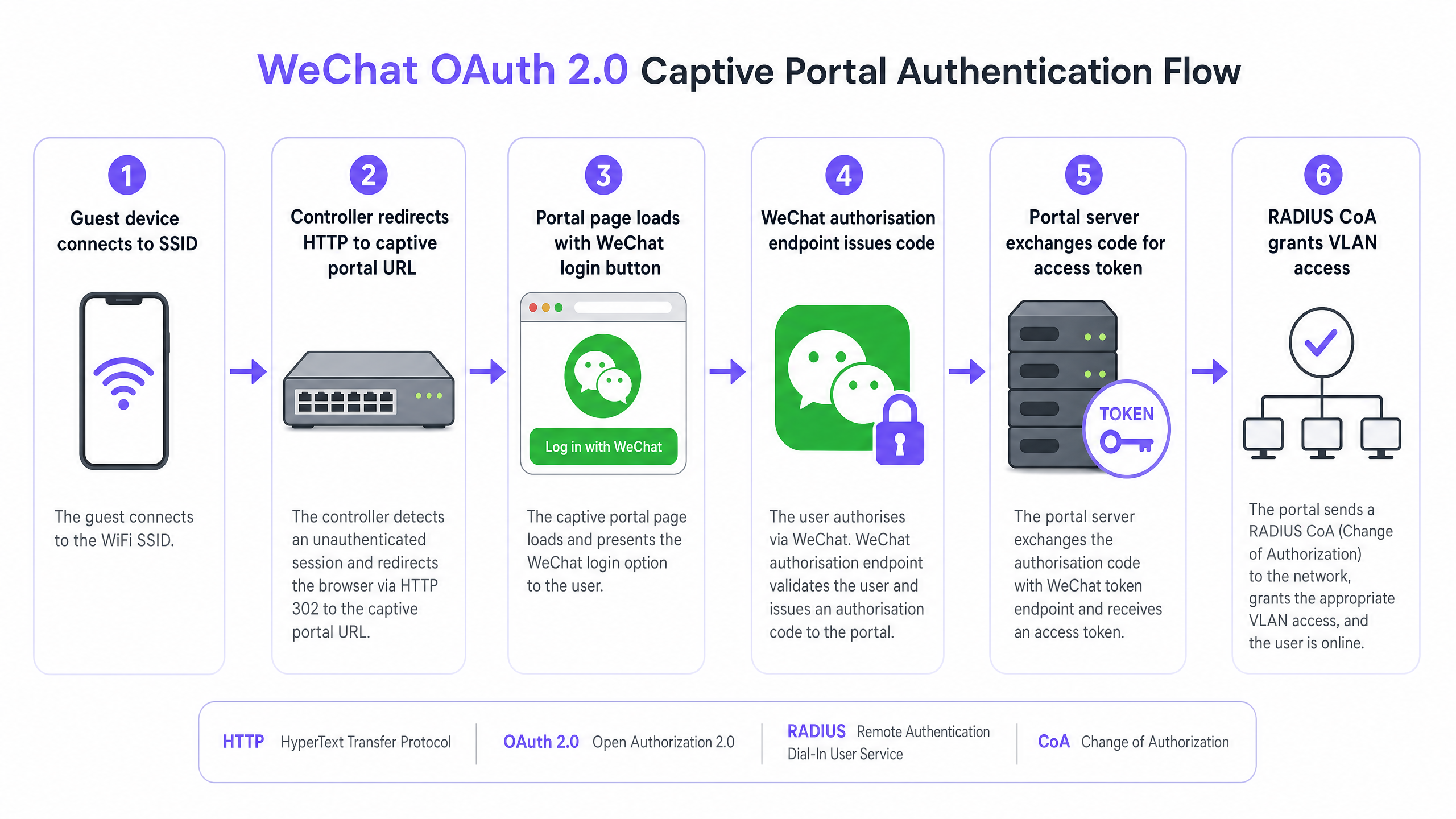
La secuencia de autenticación funciona de la siguiente manera. El invitado se conecta al SSID. El punto de acceso o controlador inalámbrico detecta la sesión no autenticada y redirige el tráfico HTTP a la URL del Captive Portal. El invitado selecciona el inicio de sesión de WeChat en la página del portal. El servidor del portal redirige el navegador al endpoint de autorización de WeChat en open.weixin.qq.com, pasando el AppID, la URI de redireccionamiento, el tipo de respuesta code y el alcance (scope) solicitado. WeChat gestiona la autenticación en sus propios servidores. Si el invitado utiliza el navegador integrado de WeChat con el alcance snsapi_base, la autenticación es silenciosa: no aparece ninguna solicitud de consentimiento. Si se utiliza snsapi_userinfo, WeChat presenta una pantalla de consentimiento. Luego, WeChat redirige de vuelta a la URI de redireccionamiento del portal con un código de autorización temporal. El servidor del portal intercambia este código por un token de acceso llamando a api.weixin.qq.com/sns/oauth2/access_token, pasando el AppID, AppSecret, el código y un tipo de concesión (grant type) de authorization_code. WeChat devuelve un token de acceso, un token de actualización (refresh token), el OpenID del usuario y el alcance otorgado. Si se otorgó snsapi_userinfo, el servidor realiza una segunda llamada a la API para recuperar el apodo, el avatar, el género y la ciudad del usuario.
El requisito de registro en dos plataformas
La mayoría de las implementaciones fallan en la etapa de registro. WeChat opera dos plataformas de desarrollo independientes y las implementaciones empresariales suelen requerir ambas.
| Plataforma | URL | Tipo de cuenta requerido | Alcance (scope) admitido | Contexto del navegador |
|---|---|---|---|---|
| Official Accounts Platform | mp.weixin.qq.com | Cuenta de servicio (Service Account) | snsapi_base, snsapi_userinfo | Navegador integrado de WeChat |
| Open Platform | open.weixin.qq.com | Aplicación web (Website Application) | snsapi_login | Navegador móvil estándar |
Para los invitados que acceden al portal dentro del navegador integrado de WeChat, se necesita una Cuenta de servicio (Service Account) en la Official Accounts Platform. Una Cuenta de suscripción (Subscription Account) no funcionará: carece de permisos de autorización de páginas web de OAuth. Para los invitados que acceden al portal desde Chrome en Android o Safari en iOS, se necesita una Aplicación web (Website Application) en la Open Platform, que utiliza el alcance snsapi_login y presenta un código QR para que el usuario lo escanee.
En la práctica, la mayoría de las implementaciones en establecimientos utilizan ambas. Un invitado en un hotel podría abrir el portal en Chrome, ver un código QR, escanearlo con WeChat, y autenticarse. O bien, podrían seguir un enlace dentro del propio WeChat, llegar al navegador integrado y autenticarse silenciosamente con snsapi_base.
Selección de alcances (scopes): captura de datos frente a fricción
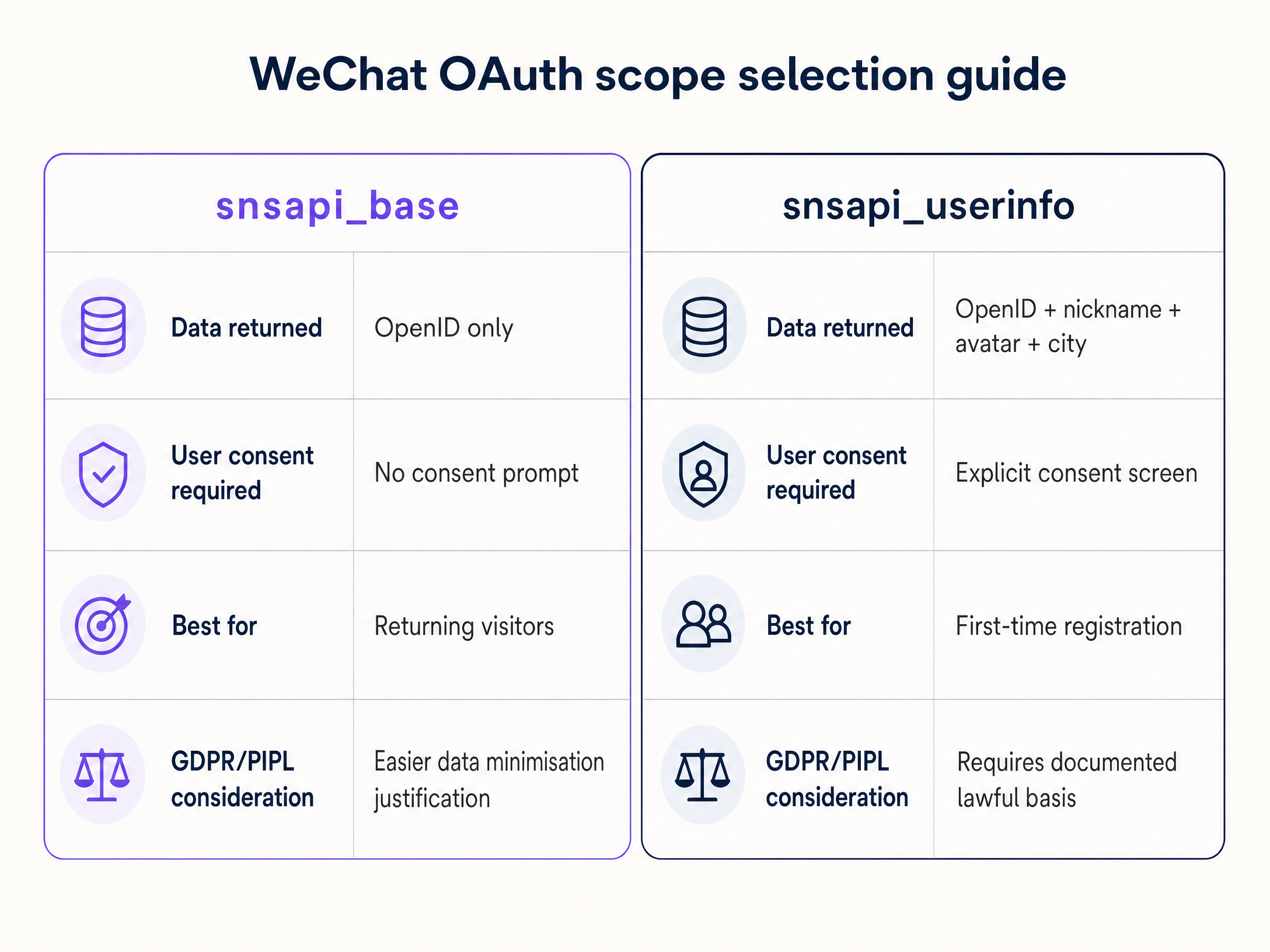
El alcance (scope) que solicite determina qué datos recopila y la fricción que experimenta el invitado. Este es un punto de decisión real con implicaciones de cumplimiento.
snsapi_base devuelve solo el OpenID: un identificador único para ese usuario dentro de su Cuenta oficial (Official Account). No requiere ninguna solicitud de consentimiento del usuario. La autenticación es invisible para el invitado. Utilice esto para invitados recurrentes cuyos perfiles ya posea, o cuando priorice un acceso sin fricciones. Bajo los principios de minimización de datos de GDPR y PIPL, snsapi_base es más fácil de justificar.
snsapi_userinfo devuelve el OpenID más el apodo, la foto de perfil, el género y la ciudad del usuario. Requiere una pantalla de consentimiento explícita. Utilice esto para el registro de invitados por primera vez cuando necesite crear un perfil, combinado con una capa de consentimiento que cumpla con las normativas en la página de su portal.
UnionID para implementaciones en múltiples propiedades
El OpenID es único para la combinación de un usuario y una Cuenta oficial (Official Account) específica. Un grupo hotelero con 20 propiedades, cada una con su propia Cuenta oficial, verá 20 OpenIDs diferentes para el mismo invitado. El UnionID resuelve esto. Es un identificador único que representa a un usuario en todas las Cuentas oficiales y aplicaciones vinculadas a la misma cuenta de Open Platform. Vincule sus Cuentas oficiales a su cuenta de Open Platform y el UnionID se devolverá en la respuesta de OAuth. Esta es la base de la crreconocimiento de huéspedes de oss-property.
Guía de implementación
Mecanismos de aplicación de red
Obtener un token de OAuth demuestra la identidad. No abre la red. Debe enviar una señal al controlador para permitir el tráfico.
RADIUS Change of Authorization (CoA), definido en RFC 3576, es el enfoque empresarial recomendado. Tras un OAuth exitoso, el servidor del portal envía una solicitud de CoA al controlador de red. El controlador mueve el dispositivo de la VLAN de preautenticación a la VLAN de invitados. Esto funciona con Cisco Meraki, HPE Aruba, Ruckus, Juniper Mist, Ubiquiti UniFi, Cambium, Extreme y Fortinet.
MAC Authentication Bypass (MAB) registra la dirección MAC del dispositivo como un cliente autorizado en la base de datos de RADIUS. El controlador permite el acceso basándose en esa MAC. MAB es más sencillo de implementar pero poco confiable: los dispositivos iOS y Android modernos aleatorizan las direcciones MAC de forma predeterminada, lo que rompe la asociación de la sesión al volver a conectarse.
La plataforma Guest WiFi de Purple automatiza esta traducción. Una vez completado el OAuth de WeChat, la superposición en la nube de Purple envía la señal CoA o MAB adecuada al hardware subyacente, eliminando la configuración manual de la VLAN.
Seguridad de la configuración
Tres configuraciones son no negociables.
- Proteger el AppSecret. El
AppSecretnunca debe aparecer en el JavaScript del lado del cliente. Debe permanecer en su servidor. Si se expone, los atacantes pueden suplantar su aplicación y realizar llamadas a las API de WeChat en su nombre. - Implementar protección CSRF. Genere un valor
statecriptográficamente aleatorio, almacénelo en la sesión del usuario y valídelo cuando WeChat redireccione de vuelta. Esto evita ataques de falsificación de solicitud en sitios cruzados (CSRF) según lo definido en RFC 6749. - Registrar todas las variantes de URI de redireccionamiento. WeChat valida la URI de redireccionamiento con su dominio registrado. Registre cada subdominio y variante de ruta que utilice, incluidos los entornos de prueba (staging), para evitar el error 40029 (código no válido).
Detección de navegador integrado en la aplicación
El navegador integrado de WeChat establece una cadena de agente de usuario que contiene MicroMessenger. Su portal debe detectar esta cadena y enrutar en consecuencia: flujo de Cuenta Oficial para el navegador integrado, flujo de código QR de Plataforma Abierta para navegadores estándar. No detectar esto produce experiencias rotas o errores de autenticación.
Mejores prácticas y cumplimiento
Cumplimiento de GDPR
Si atiende a visitantes europeos u opera en Europa, el GDPR se aplica a los datos que recopila a través de WeChat OAuth. Debe establecer una base legal para el procesamiento, que suele ser el consentimiento o los intereses legítimos. Debe proporcionar un aviso de privacidad claro en el Captive Portal antes de la autenticación. Debe atender las solicitudes de acceso y de eliminación de los interesados. Para obtener un marco de cumplimiento detallado, consulte The Compliance Playbook: GDPR and Guest WiFi Data Privacy .
Cumplimiento de PIPL
La Ley de Protección de Información Personal de China (PIPL) se aplica cuando procesa datos personales de ciudadanos chinos. Al igual que el GDPR, la PIPL exige una limitación clara de la finalidad, la minimización de datos y una base legal documentada. snsapi_base es más fácil de justificar bajo la minimización de datos que snsapi_userinfo. Independientemente de lo que recopile, documente su base legal y el período de retención antes del lanzamiento.
Segmentación de red
Aísle el tráfico de WiFi de invitados de su red corporativa mediante la segmentación de VLAN. Los invitados autenticados a través de WeChat deben dirigirse a una VLAN de invitados dedicada con acceso exclusivo a Internet, sin acceso a los sistemas internos. Esto se alinea con los requisitos de PCI DSS para el aislamiento del entorno de datos de titulares de tarjetas y la práctica general de seguridad empresarial. Para obtener más información sobre la arquitectura de segmentación, consulte Gestión de ancho de banda: una guía práctica para 2026 .
Autenticación de respaldo
Si la API de WeChat no está disponible, su portal debe redireccionar a un método de inicio de sesión alternativo. No deje a los invitados con una pantalla en blanco. Una alternativa a correo electrónico o SMS garantiza la continuidad. Esto es especialmente importante para establecimientos en entornos de Transporte y Atención médica donde la conectividad es una obligación del servicio.
Casos de estudio reales
Hotelería: grupo de hoteles de lujo
Un hotel de lujo de 400 habitaciones en Londres atiende a una proporción significativa de huéspedes de China continental. Su Captive Portal existente requería una dirección de correo electrónico y verificación por SMS. Los números de teléfono móvil chinos con frecuencia no reciben los SMS de los proveedores europeos, y muchos huéspedes no tienen un correo electrónico local configurado en su dispositivo. El resultado fue una tasa de abandono del 60% en el portal.
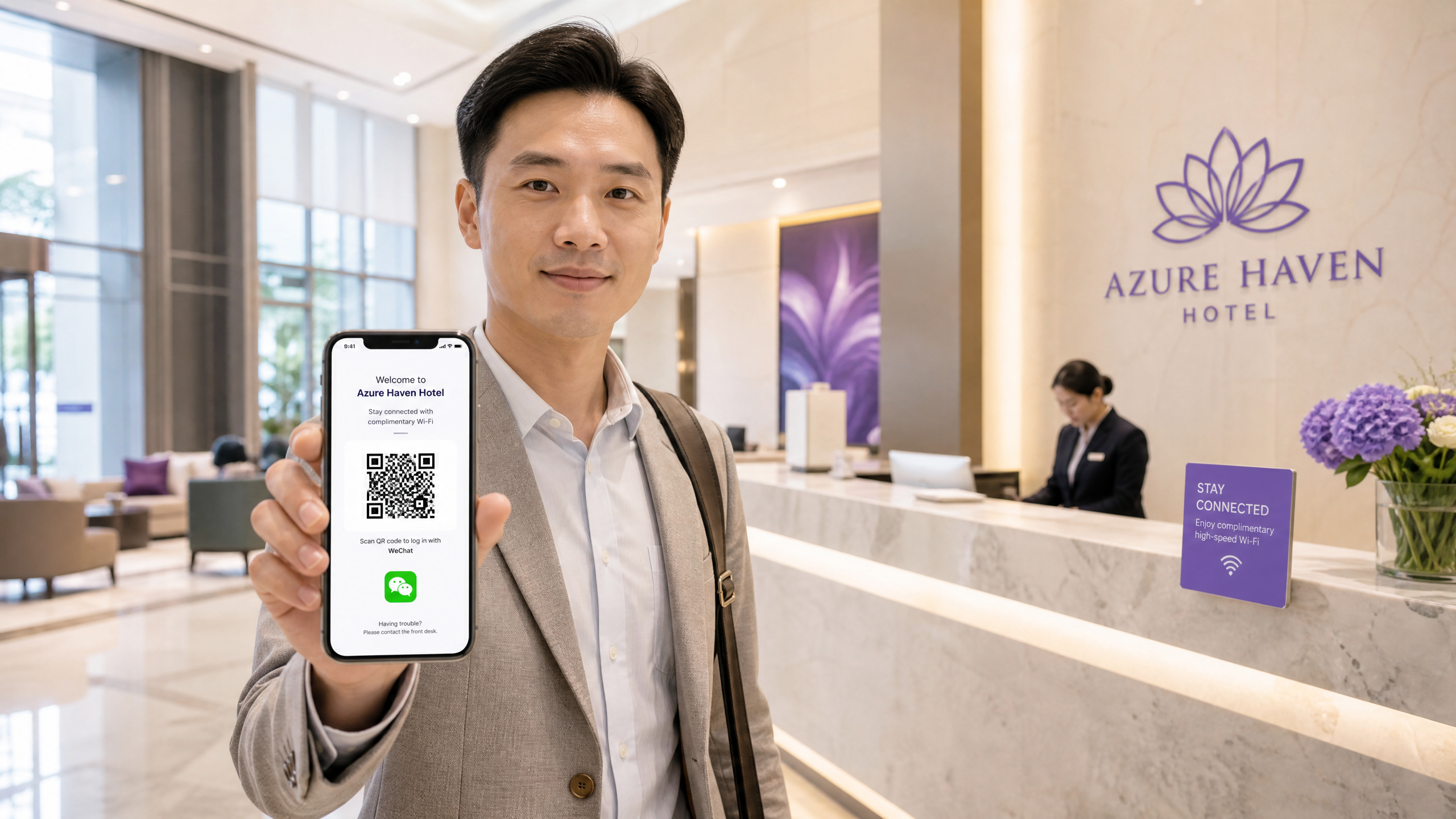
El hotel registró una Cuenta de Servicio en la Plataforma de Cuentas Oficiales y una Aplicación Web en la Plataforma Abierta. El portal detecta el agente de usuario MicroMessenger y activa snsapi_base para los usuarios del navegador integrado, conectándolos en menos de tres segundos sin pantalla de consentimiento. Los huéspedes que llegan a través de Chrome o Safari ven un código QR. En estancias posteriores, se reconoce el mismo OpenID y el huésped se vuelve a autenticar de forma silenciosa. El CRM del hotel registra la visita de regreso, lo que permite comunicaciones personalizadas antes de la llegada. Para obtener más información sobre la implementación de WiFi en entornos hoteleros, consulte Hotelería .
Comercio minorista: análisis de centros comerciales
Un gran centro comercial quiere recopilar datos demográficos de los compradores chinos para fundamentar la combinación de inquilinos y las decisiones de marketing. Necesitan la ciudad de origen, el género y la frecuencia de las visitas. snsapi_base es insuficiente: necesitan snsapi_userinfo. El portal solicita el alcance completo de userinfo. El invitado ve una pantalla de consentimiento de WeChat y toca Permitir. La plataforma de análisis del centro comercial, integrada con WiFi Analytics de Purple, recibe un flujo de datos demográficos verificados. Los sábados por la tarde, el 40% de los usuarios de WiFi provienen de una región específica. Esos datos directle informa a qué marcas dirigirse para eventos emergentes. Para más información sobre implementaciones de WiFi en el sector minorista, consulte Retail .
Resolución de problemas y mitigación de riesgos
Los cinco modos de falla más comunes en las implementaciones de Captive Portal con OAuth de WeChat son los siguientes.
Discrepancia de URI de redireccionamiento (error 40029). WeChat valida la URI de redireccionamiento con el dominio registrado. Cualquier discrepancia en el subdominio, la ruta o el protocolo hace que falle el intercambio de códigos. Registre cada variante, incluidos los entornos de prueba (staging).
Exposición de AppSecret. Integrar el AppSecret en el código del lado del cliente es el error de seguridad más grave. Mueva toda la lógica de intercambio de tokens al servidor.
Falta de protección CSRF. Omitir la validación del parámetro state deja al portal vulnerable a la falsificación de solicitudes entre sitios (CSRF). Genere un valor criptográficamente aleatorio por sesión y valídelo en la llamada de retorno (callback).
Falla en la detección del navegador integrado (in-app). No detectar MicroMessenger en el agente de usuario (user agent) significa que a los usuarios del navegador integrado se les ofrece el flujo de OAuth incorrecto, lo que genera errores.
La aleatorización de direcciones MAC interrumpe las sesiones MAB. Los sistemas operativos móviles modernos aleatorizan las direcciones MAC. Los invitados que utilicen la autenticación basada en MAB perderán su sesión al volver a conectarse. Actualice a RADIUS CoA para una gestión de sesiones confiable. Para obtener orientación sobre la configuración segura de WiFi, consulte ¿Qué es WiFi seguro?: Guía esencial para empresas 2026 .
ROI e impacto comercial
Implementar la funcionalidad de WiFi para invitados con inicio de sesión de WeChat tiene tres impactos medibles.
Mayor tasa de autenticación. Eliminar el punto de falla de la verificación por SMS y el requisito de ingresar el correo electrónico aumenta el porcentaje de visitantes chinos que se conectan con éxito. Una tasa de abandono del 60% es una base de referencia realista para los portales que no son compatibles con WeChat.
Calidad de datos de primera mano (first-party data). Los perfiles autenticados con WeChat incluyen un OpenID verificado y, con snsapi_userinfo, atributos demográficos obtenidos directamente de la plataforma social. Estos datos se integran en las plataformas de analítica para impulsar el marketing dirigido sin depender de cookies de terceros.
Reducción de los costos operativos de soporte. El inicio de sesión sin fricciones reduce las llamadas de soporte a la recepción y al departamento de TI por parte de huéspedes internacionales que intentan resolver problemas de conexión.
Purple opera en más de 80,000 establecimientos y procesó 440 millones de inicios de sesión en 2024 (datos internos de Purple). La plataforma cuenta con la certificación ISO 27001, cumple con GDPR y CCPA, y mantiene un tiempo de actividad (uptime) del 99.999%. Para los establecimientos en Retail y Hospitality , la autenticación de WeChat transforma la red de un centro de costos a un canal confiable de adquisición de datos de primera mano.
Definiciones clave
Captive portal
A web page that intercepts HTTP traffic from an unauthenticated device and requires the user to interact with it before network access is granted.
The primary interface where the WeChat login option is presented to the guest. The portal server hosts this page and orchestrates the OAuth flow.
OAuth 2.0
An industry-standard authorisation protocol (RFC 6749) that allows a third-party application to obtain limited access to an HTTP service on behalf of a user.
The underlying protocol WeChat uses to pass authentication tokens to the portal server without exposing user credentials. The same protocol used by Microsoft Entra ID, Okta, and Google Workspace.
OpenID
A unique alphanumeric identifier assigned to a specific WeChat user for a specific Official Account.
Used as the primary key to identify returning guests in the WiFi analytics database. Changes per Official Account - use UnionID for cross-property recognition.
UnionID
A single WeChat identifier representing a user across all Official Accounts and apps linked to the same Open Platform account.
Essential for hotel groups, retail chains, and stadium operators with multiple venues who need to recognise the same guest across their entire estate.
RADIUS CoA (Change of Authorization)
An extension to the RADIUS protocol (RFC 3576) that allows a RADIUS server to dynamically change the authorisation attributes of an active session.
The secure method used to move a guest device from an isolated pre-authentication VLAN to the active internet VLAN after successful WeChat login. Supported by Cisco Meraki, HPE Aruba, Ruckus, Juniper Mist, Ubiquiti UniFi, Cambium, Extreme, and Fortinet.
snsapi_base
A WeChat OAuth scope that returns only the user's OpenID and requires no consent prompt from the user.
The recommended scope for returning guest re-authentication. Easier to justify under GDPR and PIPL data minimisation principles.
snsapi_userinfo
A WeChat OAuth scope that returns the user's OpenID, nickname, avatar, gender, and city, and requires an explicit consent screen.
Used for first-time guest registration where demographic data is required for analytics. Requires documented lawful basis under GDPR and PIPL.
PIPL (Personal Information Protection Law)
China's comprehensive data privacy legislation, effective November 2021, regulating the processing of personal information of natural persons located in China.
Applies when venues process data from Chinese citizens via WeChat OAuth. Requires clear consent, purpose limitation, data minimisation, and a deletion mechanism.
AppSecret
A confidential cryptographic key issued by WeChat during application registration, used to authenticate API calls from the portal server.
Must be stored exclusively on the server side. Exposure in client-side JavaScript allows attackers to impersonate the application and call WeChat APIs maliciously.
Ejemplos resueltos
A 400-room luxury hotel in London has a 60% portal drop-off rate among guests from mainland China. The current portal requires email and SMS verification. The IT Director needs to implement WeChat authentication while maintaining GDPR compliance and network security.
Step 1: Register a Service Account on the WeChat Official Accounts Platform (mp.weixin.qq.com) and a Website Application on the WeChat Open Platform (open.weixin.qq.com). Step 2: Configure the portal to detect the MicroMessenger user agent string. If detected, trigger the snsapi_base OAuth flow for silent authentication. If not detected, present the QR code flow. Step 3: Add a GDPR-compliant privacy notice and consent checkbox to the portal page before the WeChat login button becomes active. The notice must state: data collected (OpenID only), purpose (guest WiFi access and return visit recognition), and retention period. Step 4: After successful OAuth token exchange, the portal server issues a RADIUS CoA request to the Cisco Meraki controller, moving the guest device from the pre-auth VLAN to the segmented guest VLAN. Step 5: Store the OpenID against the device MAC address in the guest database. On subsequent visits, the returning OpenID triggers silent re-authentication.
A retail mall wants to capture gender and city data from Chinese shoppers via guest WiFi to feed into their analytics platform. They currently use MAC Authentication Bypass for their existing portal running on HPE Aruba hardware.
Step 1: Register a Service Account on the WeChat Official Accounts Platform. Step 2: Configure the portal to use snsapi_userinfo scope to retrieve gender and city. Step 3: Add a clear consent screen explaining the value exchange: free WiFi in return for profile data access. The consent must be explicit and granular under both GDPR and PIPL. Step 4: After authentication, the portal server registers the device's MAC address in the RADIUS database. The HPE Aruba controller permits access via MAB. Step 5: Document the lawful basis (consent), purpose (venue analytics and marketing), and retention period (24 months) in a data processing register. Provide a data deletion mechanism.
Preguntas de práctica
Q1. You are deploying a captive portal at a stadium. You want returning season ticket holders who have previously authenticated to connect automatically without seeing a login screen on subsequent visits. Which WeChat OAuth scope should you implement for the re-authentication flow, and why?
Sugerencia: Consider which scope allows for silent authentication without prompting the user for consent on each visit.
Ver respuesta modelo
Use snsapi_base. This scope returns only the user's OpenID and requires no consent prompt, enabling silent re-authentication. On the first visit, you store the OpenID against the fan's profile. On subsequent visits, the portal detects the returning OpenID via snsapi_base, confirms the match, and issues a RADIUS CoA to grant access - all without the fan seeing a login screen. This also aligns with GDPR data minimisation principles, as you are not collecting additional data beyond what is needed for the authentication function.
Q2. During testing, your portal successfully redirects to WeChat, the user grants consent, and WeChat redirects back to your portal. However, the portal server logs show OAuth error 40029 (invalid code). What is the most likely configuration error, and how do you resolve it?
Sugerencia: WeChat strictly validates the destination it sends the authorisation code to against a registered list.
Ver respuesta modelo
The most likely cause is a redirect URI mismatch. WeChat validates the redirect URI in the OAuth request against the authorised domain registered on the platform. If the portal server uses a different subdomain, a different path, or HTTP instead of HTTPS, the code exchange fails with error 40029. Resolution: log into the WeChat developer platform, navigate to your Service Account or Website Application settings, and add every redirect URI variant you use - including staging subdomains, different paths, and HTTPS versions. Ensure the redirect_uri parameter in your OAuth request exactly matches one of the registered URIs, including URL encoding.
Q3. An IT manager proposes embedding the WeChat AppSecret in the captive portal's front-end JavaScript to speed up the token exchange process directly from the client browser. Why must you reject this proposal, and what is the correct architecture?
Sugerencia: Consider the security implications of exposing cryptographic keys in publicly accessible code.
Ver respuesta modelo
Reject this proposal. The AppSecret is a confidential cryptographic key. Embedding it in client-side JavaScript exposes it to anyone who views the page source or intercepts network traffic. An attacker can extract the AppSecret and impersonate the application, calling WeChat APIs on the venue's behalf, accessing user data, and potentially compromising the entire Official Account. The correct architecture: the client-side portal page receives the authorisation code from WeChat and forwards it to the portal server via a server-side API call. The portal server holds the AppSecret in a secure environment variable and performs the token exchange with WeChat's API. The AppSecret never leaves the server.
Q4. A hotel group with 15 properties across Europe wants to build a unified guest profile that recognises when the same Chinese guest stays at different properties. Each property has its own WeChat Official Account. What WeChat identifier should they use, and what configuration is required?
Sugerencia: The OpenID is account-specific. There is a different identifier designed for cross-account recognition.
Ver respuesta modelo
Use the UnionID. The OpenID changes per Official Account, so the same guest will have 15 different OpenIDs across 15 accounts. The UnionID is a stable identifier representing a user across all Official Accounts and apps linked to the same Open Platform account. Configuration required: link all 15 Official Accounts to a single WeChat Open Platform account. Once linked, the UnionID is returned in the OAuth response when the user has authorised at least one of the linked accounts. Use the UnionID as the primary key in the guest CRM to build cross-property profiles and recognise returning guests regardless of which property they visit.
Continúe leyendo esta serie
El manual de cumplimiento: GDPR y la privacidad de datos en WiFi para invitados
Esta guía completa proporciona a los gerentes de TI y operadores de recintos un marco técnico para diseñar redes de WiFi para invitados que cumplan con el GDPR. Detalla los mecanismos de consentimiento, la segmentación de red, la retención automatizada de datos y cómo transformar el cumplimiento de una responsabilidad regulatoria en un activo defendible de datos de primera mano.
Guía paso a paso: Configuración de controladores inalámbricos Ruijie para Captive Portals de WiFi de invitados
Esta guía proporciona un recorrido técnico completo para configurar controladores inalámbricos y gateways Ruijie para implementar Captive Portals de WiFi de invitados de nivel empresarial. Cubre la segmentación de VLAN, la autenticación RADIUS externa a través del protocolo WISPr, la configuración de walled garden y la integración perfecta con la plataforma de Redes Basadas en Identidad de Purple para capturar datos de primera mano y generar un valor comercial medible en entornos de hotelería, retail y sector público.
Cómo configurar SCEP para un BYOD seguro y autenticación de red 802.1X
Esta guía proporciona una referencia técnica completa para configurar SCEP con el fin de implementar la autenticación de red 802.1X basada en certificados. Cubre la transición arquitectónica de contraseñas compartidas a EAP-TLS, la integración de Mobile Device Management y una segmentación de red estricta para un acceso BYOD seguro en entornos empresariales.