

गेस्ट WiFi डेटा को मार्केटिंग ऑटोमेशन ट्रिगर्स में बदलना
यह संदर्भ मार्गदर्शिका कच्चे गेस्ट WiFi डेटा को इवेंट-ड्रिवन मार्केटिंग ऑटोमेशन ट्रिगर्स में बदलने के लिए एक तकनीकी प्लेबुक प्रदान करती है। इसमें कैप्टिव पोर्टल डेटा कैप्चर और LogicFlow नियमों से लेकर वेबहुक डिस्पैच और CRM इंटीग्रेशन तक की पूरी वास्तुकला शामिल है — जिसमें हॉस्पिटैलिटी और रिटेल के लिए वास्तविक-विश्व कार्यान्वयन परिदृश्य भी शामिल हैं। IT टीमें और मार्केटिंग ऑटोमेशन विशेषज्ञ वेलकम फ्लो, ड्वेल-टाइम ऑफर और लैप्स्ड-विज़िटर विन-बैक सहित उपस्थिति-आधारित अभियान बनाने के लिए एक ठोस, परिनियोजित करने योग्य फ्रेमवर्क के साथ जाएंगे।
🎧 इस गाइड को सुनें
ट्रांसक्रिप्ट देखें
कार्यकारी सारांश
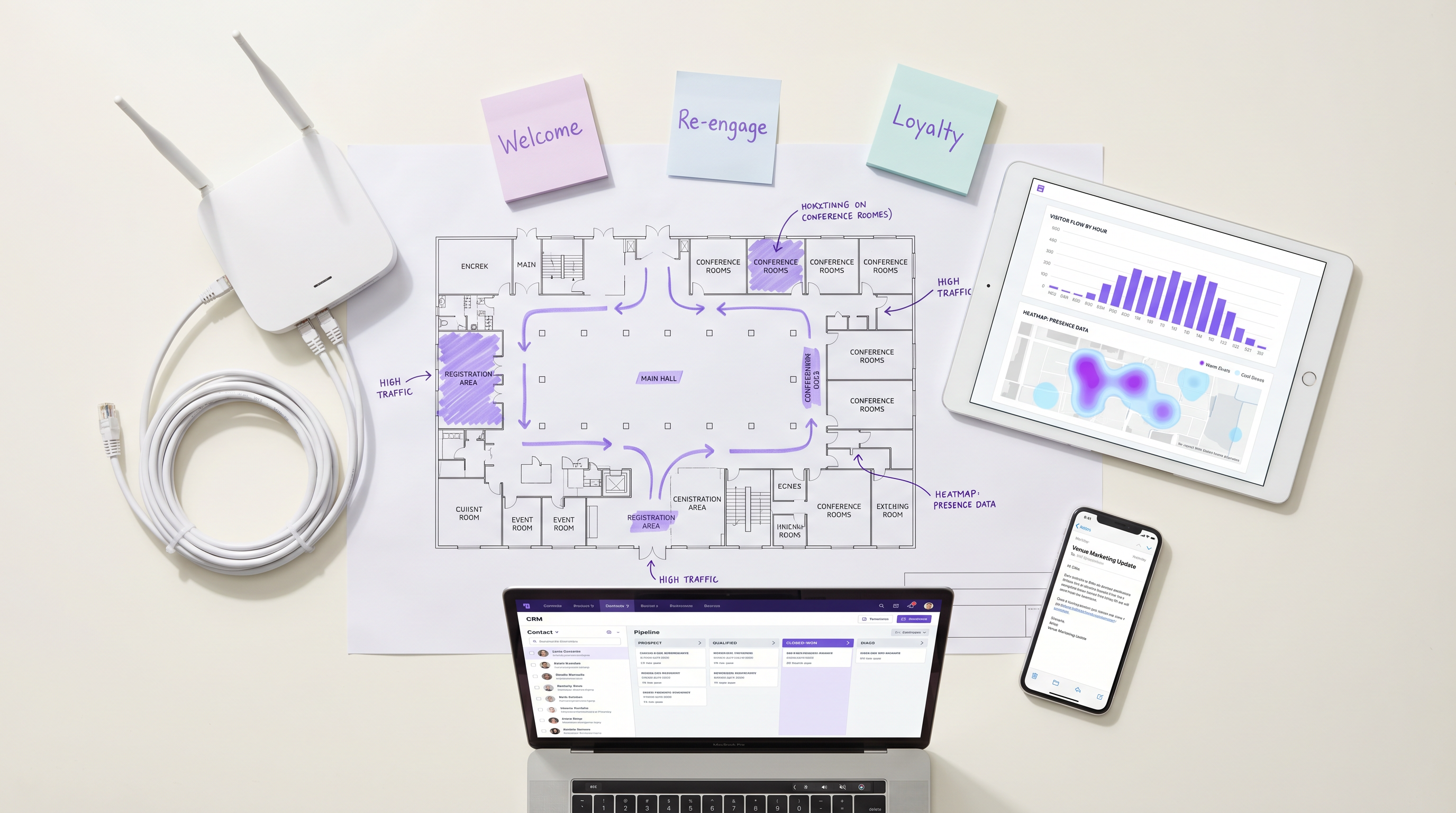
एंटरप्राइज़ स्थानों के लिए, गेस्ट WiFi अब केवल एक कनेक्टिविटी लागत केंद्र नहीं है; यह पूरे ग्राहक जीवनचक्र के लिए मूलभूत डेटा परत है। जब सही ढंग से कॉन्फ़िगर किया जाता है, तो एक्सेस पॉइंट इंफ्रास्ट्रक्चर सटीक उपस्थिति, ठहरने और वापसी डेटा को कैप्चर करता है जो अत्यधिक लक्षित मार्केटिंग ऑटोमेशन वर्कफ़्लो को ट्रिगर कर सकता है। यह मार्गदर्शिका कच्चे नेटवर्क इवेंट्स — जिसमें 802.11 प्रमाणीकरण हैंडशेक और कैप्टिव पोर्टल लॉगिन शामिल हैं — को कार्रवाई योग्य CRM ट्रिगर्स में बदलने के लिए आवश्यक तकनीकी वास्तुकला की रूपरेखा प्रस्तुत करती है। Guest WiFi और वेबहुक इंटीग्रेशन का लाभ उठाकर, IT और मार्केटिंग टीमें नेटवर्क प्रदर्शन या डेटा गोपनीयता अनुपालन से समझौता किए बिना इवेंट-ड्रिवन अभियान — वास्तविक समय के ड्वेल-टाइम ऑफ़र से लेकर लैप्स्ड-विज़िटर विन-बैक तक — तैनात कर सकती हैं। इसका परिणाम अभियान प्रासंगिकता, रूपांतरण दरों और ग्राहक आजीवन मूल्य में एक मापने योग्य वृद्धि है, जो सभी आपके स्वामित्व वाले इंफ्रास्ट्रक्चर द्वारा संचालित हैं।
तकनीकी गहन-विश्लेषण
WiFi इवेंट्स को मार्केटिंग ऑटोमेशन ट्रिगर्स में बदलना एक स्तरित वास्तुकला पर निर्भर करता है जो नेटवर्क इंफ्रास्ट्रक्चर और मार्केटिंग स्टैक को जोड़ता है। किसी भी इंटीग्रेशन कार्य शुरू करने से पहले प्रत्येक परत को समझना आवश्यक है।
डेटा कैप्चर परत
जब कोई डिवाइस किसी स्थान में प्रवेश करता है और WiFi नेटवर्क से जुड़ता है, तो एक साथ दो अलग-अलग डेटा स्ट्रीम उत्पन्न होती हैं। पहली है उपस्थिति डेटा: एक्सेस पॉइंट एक प्रोब रिक्वेस्ट या एसोसिएशन इवेंट को लॉग करता है, जिसमें डिवाइस का MAC एड्रेस, सिग्नल स्ट्रेंथ (RSSI), और एक सटीक टाइमस्टैम्प कैप्चर होता है। यह स्ट्रीम निष्क्रिय और निरंतर होती है — इसमें गेस्ट से किसी कार्रवाई की आवश्यकता नहीं होती है। दूसरी है पहचान डेटा: जब गेस्ट कैप्टिव पोर्टल के माध्यम से प्रमाणित होता है, तो प्लेटफ़ॉर्म उनकी घोषित पहचान (ईमेल पता या फ़ोन नंबर), यदि एकत्र किया गया हो तो उनकी जनसांख्यिकीय प्रोफ़ाइल, और महत्वपूर्ण रूप से, उनकी स्पष्ट मार्केटिंग सहमति को कैप्चर करता है।
Retail या Hospitality में स्थानों के लिए, यह दोहरी-स्ट्रीम दृष्टिकोण ग्राहक व्यवहार का एक नियतात्मक दृश्य प्रदान करता है जिसे कोई अन्य चैनल दोहरा नहीं सकता। कैप्टिव पोर्टल फर्स्ट-पार्टी डेटा के लिए प्राथमिक अंतर्ग्रहण बिंदु के रूप में कार्य करता है, और इसके कॉन्फ़िगरेशन को अनुपालन-महत्वपूर्ण घटक के रूप में माना जाना चाहिए। GDPR के तहत, सहमति स्वतंत्र रूप से दी जानी चाहिए, विशिष्ट, सूचित और स्पष्ट होनी चाहिए। CCPA के तहत, उपयोगकर्ताओं को ऑप्ट-आउट करने का अधिकार दिया जाना चाहिए। विस्तृत कॉन्फ़िगरेशन आवश्यकताओं के लिए CCPA vs GDPR: Global Privacy Compliance for Guest WiFi Data मार्गदर्शिका से परामर्श करें।
इवेंट प्रोसेसिंग और LogicFlow इंजन
कच्चे नेटवर्क इवेंट्स सीधे कार्रवाई योग्य नहीं होते हैं। उन्हें सामान्यीकृत किया जाना चाहिए, पूर्वनिर्धारित नियमों के विरुद्ध मूल्यांकन किया जाना चाहिए, और व्यावसायिक रूप से सार्थक ट्रिगर्स में अनुवादित किया जाना चाहिए। Purple का LogicFlow इंजन इस मध्यवर्ती परत के रूप में कार्य करता है। यह एक्सेस पॉइंट और कैप्टिव पोर्टल से इवेंट स्ट्रीम को ग्रहण करता है, प्रत्येक इवेंट का एक नियम सेट के विरुद्ध मूल्यांकन करता है, और निर्धारित करता है कि क्या कोई ट्रिगर शर्त पूरी हुई है।
एक LogicFlow नियम तीन तत्वों से बना होता है: एक शर्त (नेटवर्क इवेंट या स्थिति), एक क्वालीफायर (अतिरिक्त पैरामीटर जैसे विज़िट काउंट, ड्वेल अवधि, या पिछली विज़िट के बाद के दिन), और एक कार्रवाई (आमतौर पर एक वेबहुक डिस्पैच)। उदाहरण के लिए: शर्त = 'सेशन स्टार्ट', क्वालीफायर = 'पहली विज़िट और मार्केटिंग सहमति = सही', कार्रवाई = '15 मिनट की देरी के बाद CRM को वेबहुक POST करें'। यह घोषणात्मक मॉडल मार्केटिंग ऑपरेशंस टीमों को प्रत्येक अभियान परिवर्तन के लिए नेटवर्क इंजीनियरिंग की भागीदारी की आवश्यकता के बिना ट्रिगर लॉजिक को परिभाषित करने की अनुमति देता है।
वेबहुक डिस्पैच और CRM इंटीग्रेशन
जब एक LogicFlow नियम मेल खाता है, तो वेबहुक डिस्पैचर कॉन्फ़िगर किए गए एंडपॉइंट पर एक संरचित JSON पेलोड भेजता है। पेलोड में, न्यूनतम रूप से, उपयोगकर्ता का अद्वितीय पहचानकर्ता (ईमेल या फ़ोन), इवेंट प्रकार, स्थान पहचानकर्ता, इवेंट टाइमस्टैम्प, और कोई भी प्रासंगिक प्रासंगिक डेटा जैसे ड्वेल अवधि या विज़िट काउंट शामिल होना चाहिए। प्राप्त करने वाला सिस्टम — चाहे Salesforce, HubSpot, Klaviyo, या एक कस्टम CDP हो — फिर संबंधित ऑटोमेशन फ्लो को निष्पादित करता है।
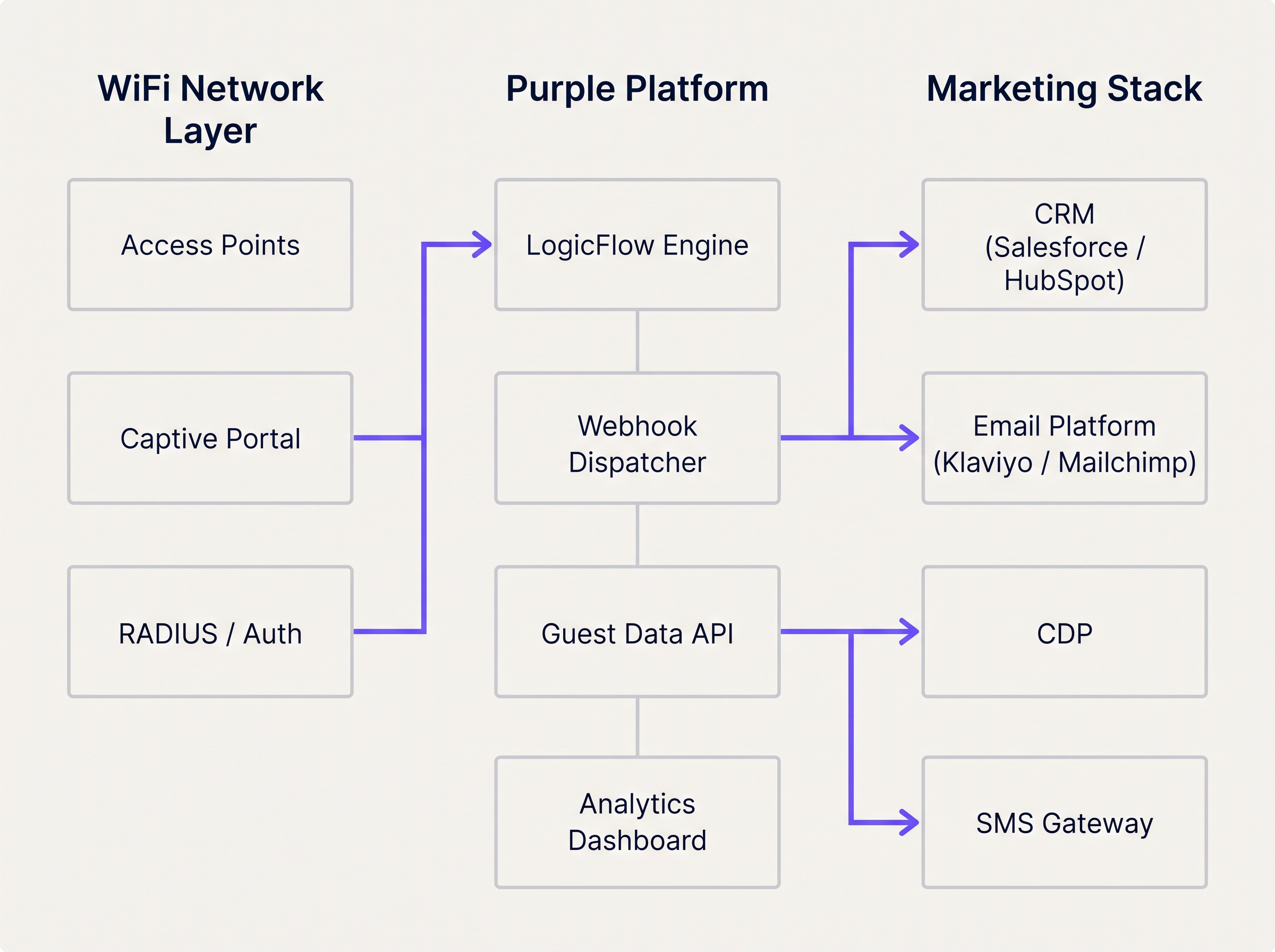
WiFi Analytics प्लेटफ़ॉर्म ऑब्जर्वेबिलिटी परत प्रदान करता है, जिससे टीमें एक एकीकृत डैशबोर्ड में इवेंट वॉल्यूम, ट्रिगर दरें और डिलीवरी सफलता मेट्रिक्स की निगरानी कर सकती हैं। यह इंटीग्रेशन समस्याओं का निदान करने और ट्रिगर थ्रेशोल्ड को अनुकूलित करने के लिए आवश्यक है।
कार्यान्वयन मार्गदर्शिका
WiFi-ट्रिगर किए गए मार्केटिंग ऑटोमेशन फ्लो को तैनात करने के लिए नेटवर्क इंजीनियरिंग और मार्केटिंग ऑपरेशंस के बीच घनिष्ठ समन्वय की आवश्यकता होती है। निम्नलिखित चरण-दर-चरण दृष्टिकोण पहले दिन से विश्वसनीय डिलीवरी और सटीक एट्रिब्यूशन सुनिश्चित करता है।
चरण 1: ट्रिगर टैक्सोनॉमी को परिभाषित करें
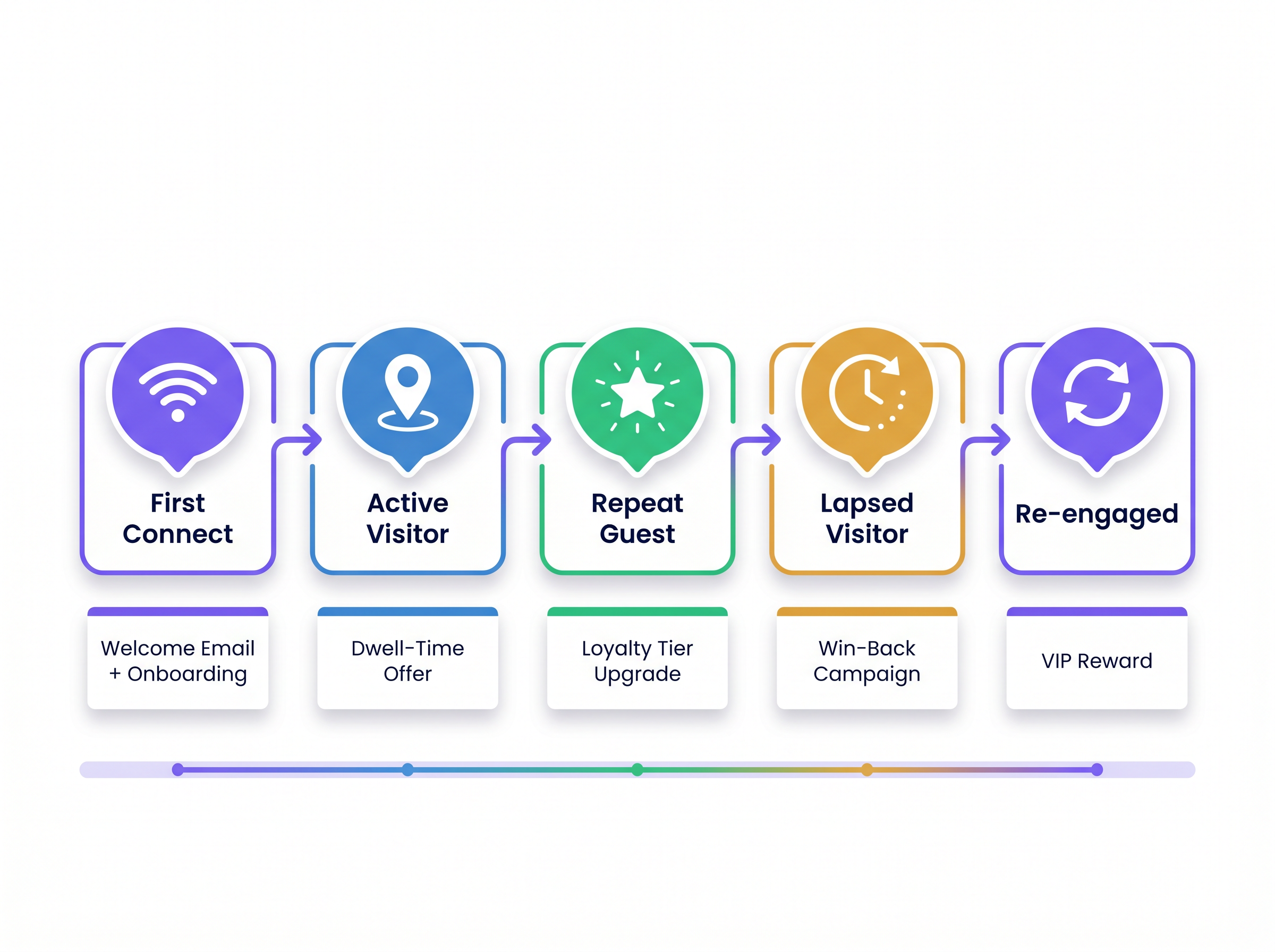
कोई भी तकनीकी कॉन्फ़िगरेशन शुरू करने से पहले, नेटवर्क इवेंट्स को ग्राहक जीवनचक्र चरणों में मैप करें। यह टैक्सोनॉमी नेटवर्क टीम और मार्केटिंग टीम के बीच अनुबंध बन जाती है। नीचे दी गई तालिका एक मानक प्रारंभिक बिंदु प्रदान करती है।
| जीवनचक्र चरण | नेटवर्क इवेंट | ट्रिगर शर्त | अनुशंसित कार्रवाई |
|---|---|---|---|
| पहली बार आने वाला विज़िटर | सेशन शुरू | पहला प्रमाणीकरण, सहमति = सही | वेलकम ईमेल + लॉयल्टी ऑनबोर्डिंग |
| सक्रिय विज़िटर | ड्वेल उपस्थिति | ड्वेल समय > 45 मिनट | SMS ऑफ़र या इन-ऐप सूचना |
| बार-बार आने वाला गेस्ट | सेशन शुरू | विज़िट काउंट = 5 या 10 | लॉयल्टी टियर अपग्रेड सूचना |
| लैप्स्ड विज़िटर | अनुपस्थिति | 60-90 दिनों तक कोई उपस्थिति इवेंट नहीं | विन-बैक ईमेल या SMS अभियान |
| फिर से जुड़ा हुआ विज़िटर | सेशन शुरू | लैप्स्ड अभियान के बाद पहली विज़िट | VIP इनाम या व्यक्तिगत ऑफ़र |
चरण 2: Captive Portal कॉन्फ़िगर करें
सुनिश्चित करें कि पोर्टल न्यूनतम आवश्यक फ़ील्ड एकत्र करता है: ईमेल पता (या फ़ोन), मार्केटिंग सहमति चेकबॉक्स, और वैकल्पिक रूप से एक लॉयल्टी प्रोग्राम पहचानकर्ता। फ़ॉर्म को संक्षिप्त रखें — प्रत्येक अतिरिक्त फ़ील्ड पूर्णता दरों को कम करता है। पोर्टल को कॉन्फ़िगर करें ताकि सहमति फ़्लैग को एनालिटिक्स प्लेटफ़ॉर्म तक पहुँचाया जा सके ताकि इसे LogicFlow नियमों द्वारा मूल्यांकित किया जा सके।
चरण 3: LogicFlow नियम बनाएँ और उनका परीक्षण करें
नियमों को धीरे-धीरे बनाएँ, उच्चतम-मूल्य वाले ट्रिगर (आमतौर पर First Connect) से शुरू करें। उत्पादन में तैनात करने से पहले प्रत्येक नियम का एक स्टेजिंग वातावरण में परीक्षण करें। सत्यापित करें कि webhook पेलोड सही ढंग से संरचित है और प्राप्त करने वाला CRM एंडपॉइंट 200 OK प्रतिक्रिया देता है। किसी भी पेलोड को कैप्चर करने के लिए एक डेड-लेटर क्यू लागू करें जो क्षणिक आउटेज के दौरान वितरित होने में विफल रहता है।
चरण 4: डेटा फ़ील्ड मैप करें और स्कीमा को मान्य करें
WiFi प्लेटफ़ॉर्म और CRM के बीच डेटा स्कीमा को संरेखित करें। पोर्टल पर कैप्चर किया गया अद्वितीय पहचानकर्ता CRM में प्राथमिक कुंजी से मेल खाना चाहिए। फ़ील्ड नामों, डेटा प्रकारों या एन्कोडिंग में बेमेल होने से ऐसी मौन विफलताएँ होती हैं जहाँ webhook प्राप्त होता है लेकिन स्वचालन ट्रिगर नहीं होता है। पूर्ण फ़ील्ड मैपिंग का दस्तावेजीकरण करें और जब भी कोई सिस्टम अपडेट हो तो उसकी समीक्षा करें।
चरण 5: फ़्रीक्वेंसी कैपिंग तैनात करें
अत्यधिक मैसेजिंग को रोकने के लिए CRM स्तर पर फ़्रीक्वेंसी कैपिंग कॉन्फ़िगर करें। प्रत्येक अभियान प्रकार के लिए अधिकतम भेजने की आवृत्तियों को परिभाषित करें — उदाहरण के लिए, एक स्वागत ईमेल प्रति उपयोगकर्ता केवल एक बार भेजा जा सकता है, और एक ठहरने-समय का ऑफ़र प्रति 7-दिवसीय अवधि में केवल एक बार भेजा जा सकता है। यह तर्क CRM में लागू किया जाना चाहिए, न कि केवल LogicFlow में, ताकि उन किनारे के मामलों का हिसाब रखा जा सके जहाँ कई ट्रिगर तेजी से एक के बाद एक सक्रिय होते हैं।
सर्वोत्तम अभ्यास
निम्नलिखित सिफारिशें आतिथ्य, खुदरा और परिवहन वातावरण में तैनाती से ली गई हैं और उपस्थिति-आधारित मार्केटिंग स्वचालन के लिए वर्तमान उद्योग मानक का प्रतिनिधित्व करती हैं।
स्थिति परिवर्तन पर ट्रिगर करें, निरंतर उपस्थिति पर नहीं। सबसे आम वास्तुशिल्प गलती हर AP हार्टबीट पर उपस्थिति का मूल्यांकन करने के लिए नियमों को कॉन्फ़िगर करना है। यह नियम इंजन को भर देता है और CRM को अत्यधिक API कॉल उत्पन्न करता है। नियमों को स्थिति संक्रमणों का मूल्यांकन करना चाहिए: 'उपस्थित नहीं' से 'उपस्थित' तक, 'सक्रिय' से 'समाप्त' तक, या 'अनाम' से 'पहचाना गया' तक। यह दृष्टिकोण सिस्टम लोड को कम करता है और सुनिश्चित करता है कि प्रत्येक ट्रिगर सार्थक है।
दीर्घकालिक ट्रैकिंग के लिए प्रमाणित पहचान पर भरोसा करें। आधुनिक मोबाइल ऑपरेटिंग सिस्टम उपयोगकर्ता की गोपनीयता की रक्षा के लिए MAC एड्रेस रैंडमाइजेशन का उपयोग करते हैं। iOS 14 के बाद से iOS में MAC एड्रेस रैंडमाइज्ड हैं, और Android ने संस्करण 10 से इसका पालन किया। कोई भी आर्किटेक्चर जो प्राथमिक CRM पहचानकर्ता के रूप में हार्डवेयर MAC एड्रेस पर निर्भर करता है, बार-बार आने वाले आगंतुक की पहचान में महत्वपूर्ण गिरावट का अनुभव करेगा। Captive Portal पर कैप्चर की गई प्रमाणित पहचान — ईमेल या फ़ोन — सभी दीर्घकालिक ट्रैकिंग और एट्रिब्यूशन के लिए प्रामाणिक पहचानकर्ता होनी चाहिए।
प्रत्येक पेलोड में स्थान संदर्भ शामिल करें। बहु-स्थान संचालकों के लिए, स्थान पहचानकर्ता एक महत्वपूर्ण रूटिंग पैरामीटर है। इसके बिना, CRM यह निर्धारित नहीं कर सकता कि कौन सा टेम्पलेट, ऑफ़र या अभियान लागू करना है। प्रत्येक webhook पेलोड में स्थान ID, स्थान का नाम, और वैकल्पिक रूप से ज़ोन या फ़्लोर शामिल करें।
Webhook स्वास्थ्य की लगातार निगरानी करें। Webhook वितरण विफलताएँ डिफ़ॉल्ट रूप से मौन होती हैं। भेजने वाले प्लेटफ़ॉर्म (एक परिभाषित सीमा से ऊपर वितरण विफलता दरों पर अलर्ट) और प्राप्त करने वाले CRM (आने वाले ट्रिगर वॉल्यूम में अप्रत्याशित गिरावट पर अलर्ट) दोनों पर निगरानी लागू करें। स्वास्थ्य सेवा तैनाती के लिए, जहाँ परिचालन संचार सुरक्षा-महत्वपूर्ण हो सकते हैं, यह निगरानी गैर-परक्राम्य है।
नेटवर्क अपग्रेड को एकीकरण आवश्यकताओं के साथ संरेखित करें। नेटवर्क आधुनिकीकरण की योजना बनाते समय — उदाहरण के लिए, आधुनिक व्यवसायों के लिए कोर SD WAN लाभ का मूल्यांकन करते समय — सुनिश्चित करें कि WiFi प्लेटफ़ॉर्म की एनालिटिक्स और webhook क्षमताओं को आर्किटेक्चर समीक्षा में शामिल किया गया है। SD-WAN तैनाती किनारे के स्थानों से वास्तविक समय की घटना स्ट्रीमिंग की विलंबता और विश्वसनीयता को प्रभावित कर सकती है।
समस्या निवारण और जोखिम न्यूनीकरण
एक मजबूत आर्किटेक्चर के साथ भी, एकीकरण विफलताएँ होती हैं। उत्पादन तैनाती में निम्नलिखित विफलता मोड सबसे अधिक बार सामने आते हैं।
पेलोड वितरण विफलताएँ। HTTP 4xx त्रुटियाँ आमतौर पर webhook एंडपॉइंट के साथ प्रमाणीकरण या स्कीमा समस्या का संकेत देती हैं। HTTP 5xx त्रुटियाँ प्राप्त करने वाले सिस्टम पर एक समस्या का संकेत देती हैं। घातीय बैकऑफ़ (30 सेकंड पर प्रारंभिक पुनः प्रयास, फिर 2 मिनट, फिर 10 मिनट) के साथ पुनः प्रयास तर्क लागू करें और मैन्युअल समीक्षा के लिए अविश्वसनीय पेलोड को डेड-लेटर क्यू में रूट करें।
डुप्लिकेट ट्रिगर सक्रिय होते हैं। यदि कोई उपयोगकर्ता कम समय में कई बार WiFi से फिर से जुड़ता है — उदाहरण के लिए, एक बहु-AP तैनाती में फ़्लोर के बीच घूमना — तो 'Session Start' इवेंट कई बार सक्रिय हो सकता है। webhook पेलोड में आइडेंपोटेंसी कुंजी (उपयोगकर्ता पहचानकर्ता और एक टाइमस्टैम्प से बना एक अद्वितीय इवेंट ID) लागू करें और CRM को इस कुंजी पर डुप्लिकेट हटाने के लिए कॉन्फ़िगर करें।
सहमति फ़्लैग प्रसार में देरी। उच्च-थ्रूपुट वातावरण में, उपयोगकर्ता द्वारा पोर्टल फ़ॉर्म जमा करने और LogicFlow इंजन के लिए सहमति फ़्लैग उपलब्ध होने के बीच एक संक्षिप्त देरी हो सकती है। सभी First Connect ट्रिगर पर न्यूनतम 60 सेकंड की देरी कॉन्फ़िगर करें ताकि यह सुनिश्चित हो सके कि webhook सक्रिय होने से पहले सहमति स्थिति प्रसारित हो गई है।
CRM संपर्क रिकॉर्ड विरोध। जब एक webhook CRM में एक नया संपर्क बनाता है, तो यह एक मौजूदा रिकॉर्ड के साथ विरोध कर सकता है यदि उपयोगकर्ता ने पहले किसी भिन्न चैनल के माध्यम से इंटरैक्ट किया है। CRM में एक विलय रणनीति लागू करें जो WiFi-कैप्चर की गई पहचान को प्राथमिकता देती है और डुप्लिकेट बनाने के बजाय मौजूदा रिकॉर्ड को समृद्ध करती है।
ROI और व्यावसायिक प्रभाव
WiFi-ट्रिगर किए गए मार्केटिंग स्वचालन के लिए व्यावसायिक मामला विभिन्न स्थान श्रेणियों में अच्छी तरह से स्थापित है। उपस्थिति-आधारित ट्रिगर वाणिज्यिक ऑपरेटरों के लिए सबसे महत्वपूर्ण मेट्रिक्स पर बैच अभियानों से लगातार बेहतर प्रदर्शन करते हैं।
एक व्यापक के लिएइस ROI को मापने और वरिष्ठ हितधारकों के सामने प्रस्तुत करने के लिए एक व्यापक ढाँचे के लिए, गेस्ट WiFi पर ROI मापना: CMOs के लिए एक ढाँचा देखें। ट्रैक किए जाने वाले प्रमुख प्रदर्शन संकेतक इस प्रकार हैं।
| KPI | विवरण | विशिष्ट बेंचमार्क |
|---|---|---|
| ट्रिगर-टू-ओपन दर | प्राप्तकर्ताओं द्वारा खोले गए ट्रिगर किए गए ईमेल का % | 35–55% (बैच के लिए 15–25% के मुकाबले) |
| ऑफर रिडेम्पशन दर | स्थान पर भुनाए गए ट्रिगर किए गए ऑफ़र का % | 8–15% (बैच के लिए 2–4% के मुकाबले) |
| विन-बैक रूपांतरण | अभियान के बाद लौटने वाले छूटे हुए आगंतुकों का % | 12–20% |
| डेटा कैप्चर दर | पोर्टल पंजीकरण पूरा करने वाले WiFi उपयोगकर्ताओं का % | अनुकूलित पोर्टल के साथ 60–80% |
| औसत विज़िट आवृत्ति में वृद्धि | प्रति ग्राहक प्रति तिमाही विज़िट में वृद्धि | निष्ठा-पंजीकृत मेहमानों के लिए 15–25% |
इन मेट्रिक्स का चक्रवृद्धि प्रभाव महत्वपूर्ण है। 50 स्थानों वाली एक खुदरा श्रृंखला, प्रत्येक प्रति सप्ताह 500 WiFi पंजीकरण कैप्चर करती है, प्रति सप्ताह 25,000 नए CRM संपर्क उत्पन्न करती है। 90-दिवसीय छूटे हुए सेगमेंट पर 15% विन-बैक रूपांतरण दर, ड्वेल-टाइम ट्रिगर्स पर 10% ऑफर रिडेम्पशन दर के साथ संयुक्त, एक मापने योग्य और जिम्मेदार राजस्व वृद्धि उत्पन्न करता है जो एक ही तिमाही के भीतर एकीकरण निवेश को उचित ठहराता है।
मुख्य शब्द और परिभाषाएं
LogicFlow
Purple's event rules engine that evaluates incoming network events against predefined conditions to determine whether a marketing trigger action should be executed.
IT teams configure LogicFlow to define the exact conditions under which a webhook fires, without requiring code changes to the marketing stack.
Webhook
An HTTP callback mechanism that automatically sends a structured JSON payload to a specified URL endpoint when a defined event occurs on the source system.
The primary integration mechanism for transmitting real-time WiFi presence events to CRM, email, and SMS platforms.
Captive Portal
A web-based authentication page that users must interact with before being granted access to a public WiFi network. Used to capture identity and marketing consent.
The compliance-critical touchpoint for first-party data collection. Portal configuration directly determines the quality and legality of downstream marketing triggers.
Presence Data
Network telemetry derived from wireless device probe requests and association events, indicating that a device is physically within the coverage area of an access point.
Enables passive tracking of dwell time and return visit frequency without requiring active user authentication on every visit.
MAC Address Randomisation
A privacy feature implemented in iOS (since version 14) and Android (since version 10) that periodically rotates the device's MAC address to prevent persistent tracking by network operators.
Requires all long-term customer identification and CRM matching to be based on authenticated identity (email/phone) rather than hardware device addresses.
Dwell Time
The total duration a device remains within the detectable coverage area of a venue's WiFi network during a single session.
A key trigger qualifier for in-venue offers. A dwell time threshold (e.g., 45 minutes) indicates genuine engagement and increases offer relevance and redemption rates.
First-Party Data
Customer information collected directly by the venue from the customer, with their explicit consent, through owned channels such as the captive portal.
Increasingly valuable as third-party cookies are deprecated and data privacy regulations tighten. WiFi-captured first-party data is among the highest-quality inputs available to venue operators.
Dead-Letter Queue (DLQ)
A message storage buffer that captures webhook payloads that could not be successfully delivered to the target endpoint after all retry attempts have been exhausted.
Essential for ensuring marketing triggers are not permanently lost during CRM outages or endpoint failures. DLQ contents should be reviewed and replayed once the receiving system recovers.
Idempotency Key
A unique identifier included in each webhook payload that allows the receiving system to detect and discard duplicate requests, ensuring a trigger is processed exactly once.
Critical in high-availability deployments where webhook retry logic may cause the same event to be delivered multiple times, potentially resulting in duplicate emails or SMS messages.
Frequency Capping
A constraint applied at the CRM or marketing automation layer that limits how many times a given user can receive a specific campaign type within a defined time window.
Prevents over-messaging and subscriber fatigue. Must be configured independently of the LogicFlow trigger rules, as the rules engine does not have visibility into CRM send history.
केस स्टडीज
A 200-room hotel wants to trigger a personalised welcome email offering a spa discount 15 minutes after a guest authenticates on the guest WiFi for the first time during their stay. The hotel uses Salesforce as its CRM and Klaviyo for email delivery.
Configure the captive portal to capture the guest's email address and a GDPR-compliant marketing consent checkbox. Ensure the consent flag is passed to the Purple analytics platform in real time.
In LogicFlow, create a rule with the following parameters: Condition = 'Session Start', Qualifier = 'First authentication at this venue AND marketing consent = True', Delay = '15 minutes', Action = 'POST webhook to Salesforce endpoint'.
Configure the webhook payload to include: user_email, user_first_name, venue_id, event_type ('first_connect'), event_timestamp, and a unique event_id for idempotency.
In Salesforce, create a process builder flow that triggers on receipt of the webhook. The flow checks whether a contact record exists for the email address. If yes, it enriches the record with the WiFi visit data. If no, it creates a new contact.
The Salesforce flow then triggers a Klaviyo transactional email via the Klaviyo API, passing the venue_id as a dynamic variable to select the correct spa offer template for that property.
Configure a suppression list in Klaviyo to ensure the welcome email is only sent once per guest per stay (keyed on email + check-in date).
A fashion retail chain with 80 UK stores wants to send a 'We miss you' SMS with a 20% discount code to loyalty members who have not visited any store in over 90 days. The chain uses a custom CDP and an SMS gateway.
In the Purple platform, configure a 'Lapsed Visitor' rule: Condition = 'Absence', Qualifier = 'No presence event recorded for this user across any venue in the estate for 90 consecutive days AND loyalty_member = True', Action = 'POST webhook to CDP endpoint'.
The rule evaluates the absence condition daily at 02:00 UTC against the full estate's presence data. This batch evaluation approach is more efficient than real-time evaluation for absence-based triggers.
The webhook payload includes: user_phone, user_email, loyalty_tier, days_since_last_visit, last_visited_venue_id, and a campaign_id.
The CDP receives the payload and generates a unique discount code for the user, then passes the code and the user's phone number to the SMS gateway.
The SMS gateway sends the win-back message. The CDP updates the user's record with a 'win_back_sent' flag and the send timestamp to prevent duplicate sends.
When the user next connects to any store's WiFi, the 'Re-engaged Visitor' trigger fires, the CDP clears the lapsed flag, and the user is enrolled in a re-engagement nurture sequence.
परिदृश्य विश्लेषण
Q1. A retail client reports that their CRM is hitting API rate limits during peak trading hours on Saturdays. Investigation reveals the WiFi platform is sending thousands of webhooks per hour. The current LogicFlow rule fires every time any device is detected by an access point. How should the IT manager reconfigure the system to resolve the issue without losing marketing trigger coverage?
💡 संकेत:Consider the difference between continuous presence detection and meaningful state transitions. Also consider whether every device detection event has marketing value.
अनुशंसित दृष्टिकोण दिखाएं
The IT manager should reconfigure the LogicFlow rule to trigger only on state change events — specifically 'Session Start' (device transitions from Not Present to Present) and 'Session End' — rather than on every AP detection heartbeat. Additionally, a frequency cap should be applied at the rule level to ensure a single device only generates a webhook once per 24-hour period. For anonymous devices (those without an authenticated identity), webhooks should be suppressed entirely, as they cannot be actioned by the CRM. These three changes — state-change triggers, frequency capping, and identity filtering — will reduce webhook volume by an estimated 90% while preserving all commercially relevant trigger events.
Q2. A hospital trust wants to send a wayfinding SMS to outpatients when they connect to the guest WiFi, directing them to their appointment department. However, the trust has multiple buildings on the same network estate, and the wayfinding message must be specific to the building where the patient connected. How is this achieved architecturally?
💡 संकेत:Think about how physical location is represented within the WiFi platform's data model and how it can be included in the webhook payload.
अनुशंसित दृष्टिकोण दिखाएं
The solution requires zone-based trigger configuration. Each building's access points must be assigned to a named zone within the Purple platform (e.g., 'Main Hospital', 'Outpatients Wing', 'Oncology Centre'). The LogicFlow rule is configured to evaluate the zone of the authenticating access point and include the zone identifier in the webhook payload. The SMS gateway or CRM then uses the zone identifier to select the appropriate wayfinding message template for that building. This approach ensures the SMS is contextually accurate regardless of which building the patient enters first. For a healthcare deployment, the IT team should also ensure the trigger only fires for users who have authenticated (not anonymous presence) and that the data handling complies with applicable healthcare data regulations.
Q3. Following an iOS 17 update rolled out across a venue's visitor base, the marketing team reports a significant drop in repeat visitor identification, causing loyalty tier upgrade triggers to stop firing for a large segment of their customer base. What is the technical root cause, and what architectural changes are required to restore accurate repeat visitor tracking?
💡 संकेत:Consider what changed in iOS 17's networking behaviour and which identifier the current architecture relies upon for repeat visitor recognition.
अनुशंसित दृष्टिकोण दिखाएं
The root cause is MAC address randomisation. iOS 17 introduced per-network MAC randomisation, meaning the device presents a unique, randomised MAC address for each WiFi network it connects to, even if it has connected to that network before. Any architecture that uses the MAC address as the primary identifier for repeat visitor recognition will fail to match the returning device to the existing CRM record. The required architectural change is to shift the primary identifier from the MAC address to the authenticated identity captured at the captive portal — specifically the email address or phone number. The CRM must be updated to use this authenticated identity as the canonical customer key. For users who have previously been tracked by MAC address only, a re-authentication campaign (prompting users to log in via the portal again) will be required to re-establish the identity link. Going forward, the MAC address should be used only for session-level analytics within a single visit, not for cross-visit customer recognition.
मुख्य निष्कर्ष
- ✓Guest WiFi infrastructure generates two distinct and complementary data streams: presence data (from access points) and identity data (from the captive portal). Both are required for effective marketing automation.
- ✓LogicFlow rules should evaluate state transitions — not continuous presence — to prevent API rate limit issues and ensure every trigger is commercially meaningful.
- ✓MAC address randomisation in iOS 14+ and Android 10+ makes hardware device addresses unreliable for long-term customer identification. Authenticated email or phone must be the canonical CRM key.
- ✓Webhook payloads must include venue context (venue ID, zone, timestamp) to enable accurate routing and personalisation in multi-venue deployments.
- ✓Frequency capping must be enforced at the CRM level, not solely in the rules engine, to prevent over-messaging when multiple triggers fire in close succession.
- ✓Dead-letter queues and idempotency keys are non-negotiable in production deployments to ensure trigger reliability and prevent duplicate communications.
- ✓The compounding ROI of presence-based triggers — higher open rates, redemption rates, and win-back conversions — typically justifies the integration investment within a single quarter for estate-scale deployments.




