
Canales DFS: Qué son y cuándo evitarlos
Esta guía autorizada detalla las realidades técnicas y operativas de los canales de Selección de Frecuencia Dinámica (DFS) en la banda de 5 GHz. Los operadores de recintos y los equipos de TI aprenderán a evaluar el riesgo de radar, configurar las Verificaciones de Disponibilidad de Canal (CAC) y desplegar planes de respaldo robustos para proteger los entornos inalámbricos de alta densidad contra caídas repentinas de conectividad.
Escucha esta guía
Ver transcripción del podcast

Resumen Ejecutivo
Para los gerentes de TI y arquitectos de red responsables de entornos de alta densidad - como estadios, centros de conferencias y grandes implementaciones de retail - el espectro es la limitante más crítica. La banda de 5 GHz ofrece una capacidad significativa, pero liberar todo su potencial requiere dominar la Selección Dinámica de Frecuencia (DFS). Los canales DFS (52–144) proporcionan un espectro adicional de 475 MHz, el cual es esencial para lograr un alto rendimiento en entornos de clientes densos. Sin embargo, este espectro viene con obligaciones regulatorias estrictas diseñadas para proteger a los usuarios primarios, como los sistemas de radar meteorológico y militar.
Cuando un punto de acceso que opera en un canal DFS detecta un radar, las regulaciones (como las aplicadas por Ofcom, la FCC y ETSI) exigen que desocupe el canal de inmediato. Esto obliga a todos los clientes conectados a desconectarse y volver a asociarse, impactando directamente la experiencia del usuario. Para los lugares que dependen del WiFi para invitados para impulsar la interacción, o entornos de retail que dependen de una conectividad de punto de venta estable, estas interrupciones repentinas representan un riesgo operativo inaceptable. Esta guía proporciona un marco técnico neutral del proveedor para decidir cuándo aprovechar los canales DFS y cuándo evitarlos, asegurando que maximice la capacidad sin comprometer la confiabilidad.
Análisis Técnico Profundo: Cómo Funciona DFS
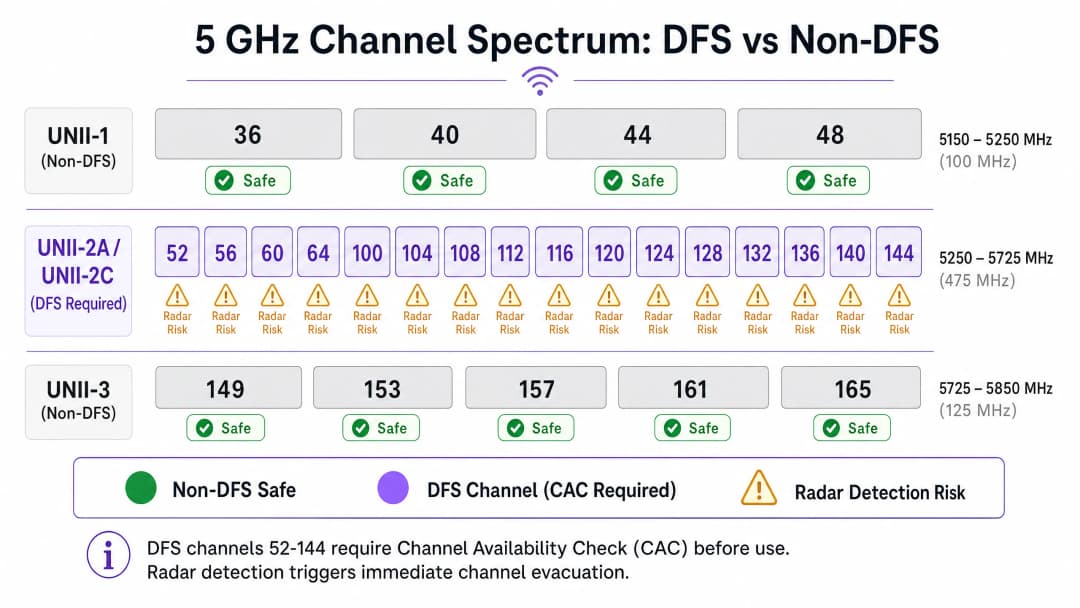
La Selección Dinámica de Frecuencia está definida en el estándar IEEE 802.11h. Su función principal es evitar que las redes WiFi de 5 GHz interfieran con los sistemas de radar existentes. El espectro de 5 GHz se divide en bandas de Infraestructura de Información Nacional No Licenciada (UNII). UNII-1 (canales 36–48) y UNII-3 (canales 149–165) generalmente están libres de DFS, proporcionando nueve canales de 20 MHz que no se traslapan. Por el contrario, UNII-2A y UNII-2C (canales 52–144) requieren DFS.
La Verificación de Disponibilidad de Canal (CAC)
Antes de que un punto de acceso (AP) pueda transmitir en un canal DFS, debe realizar una Verificación de Disponibilidad de Canal (CAC). Durante esta fase, el AP escucha pasivamente las señales de radar. No puede enviar beacons ni atender clientes.
- CAC Estándar: Para la mayoría de los canales DFS, la CAC dura 60 segundos.
- CAC Extendida: Para los canales que se traslapan con el radar meteorológico (típicamente los canales 120, 124 y 128), la CAC se extiende a 600 segundos (10 minutos).
Si se detecta un radar durante la CAC, o en cualquier momento durante la operación, el AP debe ejecutar un cambio de canal dentro del plazo obligatorio (típicamente 10 segundos) y no debe regresar a ese canal durante al menos 30 minutos (el período de no ocupación).
Falsos Positivos y EDFS
Los algoritmos de detección en los AP son sumamente sensibles. Aunque los AP modernos de nivel empresarial aprovechan el DFS Mejorado (EDFS) para distinguir mejor los pulsos de radar reales del ruido de RF de fondo, los falsos positivos siguen siendo un problema importante. Las fuentes de falsos positivos incluyen hornos de microondas mal blindados, ciertos dispositivos FHSS y equipos industriales. Ya sea que la detección sea real o un falso positivo, la respuesta regulatoria es idéntica: la evacuación inmediata del canal.
¿Tiene preguntas sobre su configuración específica?
Nuestro equipo trabaja con gestores de espacios, responsables de TI e ingenieros de redes en 80 000 establecimientos. Reserve una llamada de 20 minutos y le mostraremos cómo lo resolvieron otros profesionales como usted.
Guía de implementación: un marco de trabajo para el despliegue
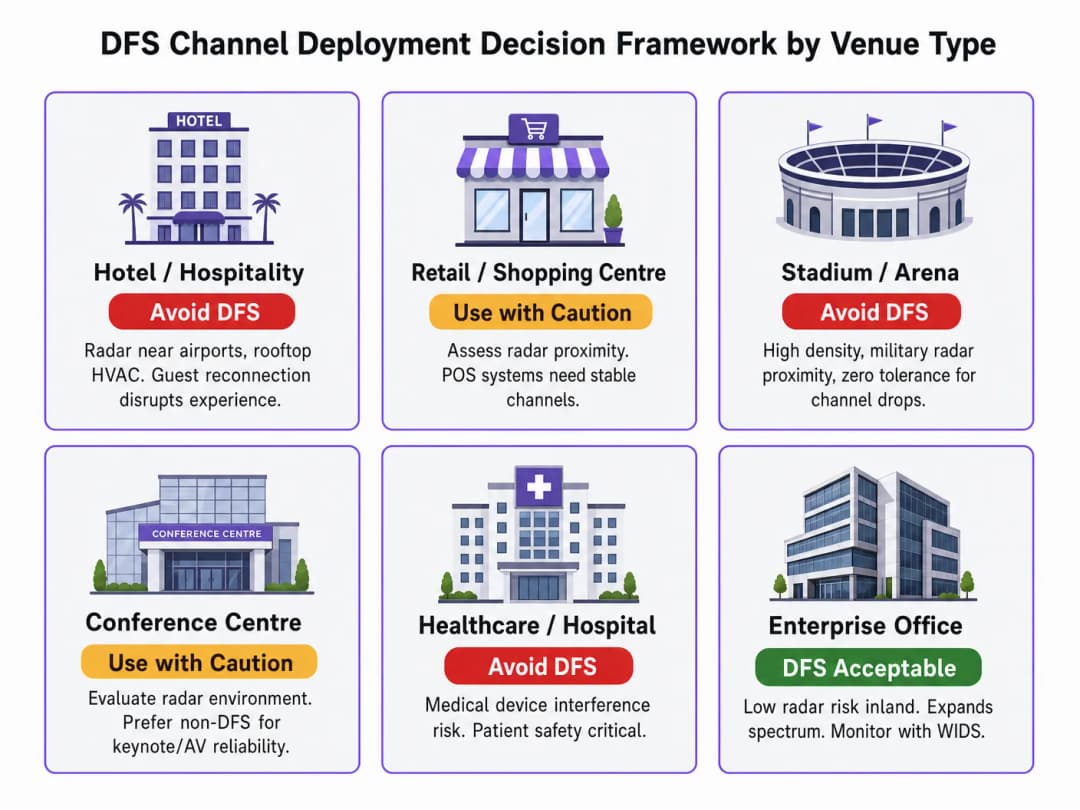
El despliegue de canales DFS requiere un enfoque considerado basado en la ubicación física del lugar y su tolerancia operativa a las interrupciones.
Paso 1: Evaluación del entorno de radar
Antes de diseñar un plan de canales, debe analizar el entorno de RF. Si su establecimiento se encuentra a una distancia de entre 30 y 50 km de un aeropuerto, una base militar o una instalación de radar meteorológico, los canales DFS representan un riesgo alto. Utilice bases de datos nacionales (como la de Ofcom en el Reino Unido) para cotejar las instalaciones de radar locales con las coordenadas de su establecimiento.
Paso 2: Establecer una línea base sin DFS
En entornos de alta densidad como centros de hospitalidad o de transporte , cree su plan de celdas fundamental utilizando canales UNII-1 y UNII-3. Introduzca canales DFS solo cuando la densidad de clientes exija estrictamente más espectro del que pueden proporcionar las bandas que no son DFS.
Paso 3: Implementar mecanismos de respaldo
Si se deben utilizar canales DFS, asegúrese de que cada AP esté configurado con un canal de respaldo sin DFS predefinido. Esto minimiza el tiempo de inactividad del cliente durante un evento DFS. Los controladores empresariales le permiten definir estos parámetros de respaldo, lo que garantiza que los AP cambien a un canal seguro conocido en lugar de escanear el espectro de forma aleatoria.
Paso 4: Limitar el ancho de canal
Buscar alcanzar objetivos de rendimiento de Wi-Fi 6/6E con canales de 80 MHz o 160 MHz aumenta el riesgo de activar un evento DFS. Un canal de 80 MHz abarca cuatro subcanales de 20 MHz; si se detecta radar en cualquiera de esos subcanales, se debe evacuar todo el bloque de 80 MHz. En entornos densos, suele ser más seguro limitar los canales DFS a anchos de 20 MHz o 40 MHz para reducir la superficie de detección de radar.
Mejores prácticas y estándares de la industria
- Cumplimiento regulatorio: Asegúrese siempre de que sus AP estén configurados con el dominio regulatorio correcto (por ejemplo, Reino Unido, UE, EE. UU.). El uso de una configuración predeterminada "Mundial" puede dar lugar al incumplimiento de los límites locales de potencia de transmisión y de las reglas de aplicación de DFS.
- Monitoreo continuo: Despliegue una plataforma robusta de WiFi Analytics para registrar los eventos DFS. Debe ser capaz de correlacionar los cambios de canal de los AP con las métricas de desconexión de los clientes para diagnosticar con precisión los problemas relacionados con DFS.* Estrategia de Wi-Fi 6E: La banda de 6 GHz no requiere DFS. Para los recintos que se enfrentan al agotamiento del espectro de 5 GHz y a una alta interferencia de radar, acelerar la adopción de Wi-Fi 6E es la solución arquitectónica más eficaz. Como destacan los acontecimientos recientes del sector — tales como Purple Appoints Iain Fox as VP of Public Sector Growth to Drive Digital Inclusion and Smart City Innovation — la planeación de la infraestructura moderna depende cada vez más de un espectro limpio para los despliegues de ciudades inteligentes.
Solución de Problemas y Mitigación de Riesgos
Cuando los usuarios reportan caídas repentinas de conexión, DFS es el principal sospechoso.
- Verifique el tiempo de actividad del AP frente al tiempo de actividad de la radio: Si un AP ha estado en línea durante 30 días pero el tiempo de actividad de la radio de 5 GHz es de solo 15 minutos, es probable que la radio se haya reiniciado o haya cambiado de canal debido a un evento DFS.
- Analice los datos de syslog: Busque entradas de registro específicas que indiquen "radar detectado" o "CAC iniciado".
- Revise el entorno: Si encuentra con frecuencia activadores de DFS en canales que no suelen estar asociados con radares meteorológicos (como el canal 52), investigue las fuentes locales de interferencia de RF, como cocinas comerciales o sistemas inalámbricos antiguos, que puedan estar provocando falsos positivos.
Para conocer más a fondo las herramientas que pueden ayudar con esto, consulte nuestra guía: The Best WiFi Analyzer Tools for Troubleshooting Channel Overlap .
ROI e Impacto en el Negocio
El impacto comercial de un despliegue de DFS mal planeado es inmediato y medible. En entornos de healthcare , una desconexión puede interrumpir la telemetría médica crítica. En el comercio minorista, significa transacciones estancadas.
Al gestionar proactivamente el riesgo de DFS, los equipos de TI protegen la integridad de la red. El ROI se materializa a través de la reducción de tickets de soporte técnico, la mejora en las puntuaciones de satisfacción del usuario y la confianza para desplegar servicios de gran ancho de banda. Además, a medida que los recintos avanzan hacia métodos de autenticación avanzados — como los que se detallan en How WiFi Assistant Enables Password-Free Access in 2026 — y servicios basados en la ubicación como Purple Launches Offline Map Mode for Seamless, Secure Navigation to WiFi Hotspots , una base de RF estable se vuelve indispensable.
Breve Informativo de Audio: Análisis Profundo de Canales DFS
Escuche a nuestro equipo de asesores senior desglosar las realidades operativas de los canales DFS en este informe técnico de diez minutos.
Definiciones clave
Selección de Frecuencia Dinámica (DFS)
Un mecanismo regulatorio que requiere que los dispositivos WiFi de 5 GHz detecten y eviten interferir con los usuarios primarios, como los radares militares y meteorológicos.
Los equipos de TI deben tener en cuenta el DFS al planificar las asignaciones de canales, ya que la detección de radar obliga a realizar cambios inmediatos de canal en el AP y desconecta a los clientes conectados.
Verificación de Disponibilidad de Canal (CAC)
Un período de escucha pasiva obligatorio (normalmente de 60 o 600 segundos) que un AP debe completar antes de transmitir en un canal DFS.
Durante el CAC, el AP no puede dar servicio a los clientes, lo que resulta en una zona sin cobertura localizada si no hay AP superpuestos disponibles.
Período de No Ocupación (NOP)
Un intervalo obligatorio de 30 minutos durante el cual un AP no puede regresar a un canal DFS después de detectar un radar.
Esto evita que los AP regresen rápidamente a un canal que está siendo utilizado activamente por un radar, lo que obliga a la red a depender de canales de respaldo.
UNII-1
El segmento inferior de la banda de 5 GHz (canales 36 - 48) que no requiere DFS.
Este es el espectro más seguro para implementaciones de WiFi de misión crítica, aunque solo ofrece cuatro canales de 20 MHz.
UNII-2A / UNII-2C
Los segmentos medios de la banda de 5 GHz (canales 52 - 144) que exigen el cumplimiento de DFS.
Estas bandas proporcionan la mayor parte de la capacidad de 5 GHz, pero conllevan el riesgo operativo de cambios de canal inducidos por radar.
UNII-3
El segmento superior de la banda de 5 GHz (canales 149 - 165) que normalmente está libre de DFS en muchas regiones reguladoras.
Combinado con UNII-1, esto proporciona la base para un plan de canales estable y sin DFS.
DFS Mejorado (EDFS)
Algoritmos avanzados utilizados por los AP de nivel empresarial para distinguir de mejor manera entre los pulsos de radar reales y el ruido de RF.
Aunque el EDFS reduce los falsos positivos (por ejemplo, de hornos de microondas), no elimina el requisito normativo de abandonar el canal si se sospecha la presencia de radares.
Falso positivo
Cuando un AP identifica erróneamente la interferencia de RF que no es de radar como una firma de radar, lo que activa una evacuación de canal DFS.
Común en entornos con maquinaria pesada, cocinas comerciales o equipos inalámbricos heredados, lo que provoca una inestabilidad innecesaria en la red.
Ejemplos resueltos
Un hotel de 300 habitaciones ubicado a 15 millas de un aeropuerto regional importante está experimentando quejas intermitentes de los huéspedes acerca de que el WiFi se cae por completo durante 1 a 2 minutos, principalmente por las noches. El diseño actual utiliza canales de 80 MHz en todo el espectro de 5 GHz para maximizar el rendimiento anunciado.
- Audite los registros del controlador para confirmar eventos de detección de radar DFS en los AP que dan servicio a las áreas afectadas.
- Reduzca el ancho de canal de 80 MHz a 40 MHz (o 20 MHz dependiendo de la densidad) para reducir la huella de RF expuesta al radar.
- Elimine por completo los canales de radar meteorológico (120 - 128) del grupo de canales, ya que el CAC de 10 minutos es inaceptable para el sector hotelero.
- Configure canales de respaldo explícitos que no sean DFS para cualquier AP que permanezca en canales DFS.
Un gran centro de conferencias del sector público se está preparando para una importante presentación tecnológica. El auditorio tiene capacidad para 2,000 asistentes. El equipo de TI necesita maximizar la capacidad, pero le preocupa la estabilidad durante la transmisión en vivo.
- Para los AP que cubren físicamente los asientos del auditorio y el escenario del presentador, asigne estáticamente canales UNII-1 y UNII-3 (que no sean DFS).
- Utilice canales DFS (por ejemplo, 52 - 64) solo para los AP que cubren las áreas periféricas (vestíbulos, pasillos) donde una breve interrupción es menos crítica.
- Asegúrese de que el SSID dedicado del presentador se transmita únicamente en un canal que no sea DFS.
Preguntas de práctica
Q1. Está implementando WiFi en un hospital ubicado a 5 millas de un aeropuerto regional. El hospital depende de WiFi para las comunicaciones VoIP y los carritos médicos móviles. El proveedor recomienda utilizar canales de 80 MHz en toda la banda de 5 GHz para garantizar el máximo rendimiento. ¿Acepta esta recomendación?
Sugerencia: Considere el impacto de una evacuación de canal DFS en las llamadas VoIP y la probabilidad de detección de radar cerca de un aeropuerto.
Ver respuesta modelo
No. Dada la proximidad al aeropuerto, los impactos de radar DFS son altamente probables. El uso de canales de 80 MHz aumenta la probabilidad de un impacto (ya que abarca cuatro subcanales). Un evento DFS provocará un cambio repentino de canal, interrumpiendo las llamadas VoIP activas y desconectando los carritos médicos. El diseño debe restringir los canales a 20 MHz o 40 MHz y priorizar los canales UNII-1 y UNII-3 (que no son DFS) para los SSID clínicos críticos.
Q2. Un AP que brinda servicio a un espacio minorista de alta densidad está asignado estáticamente al canal 124. El gerente de la tienda informa que el WiFi en esa zona se cae por completo durante exactamente 10 minutos cada pocos días antes de recuperarse. ¿Cuál es la causa probable?
Sugerencia: Verifique los requisitos específicos de CAC para los canales 120-128.
Ver respuesta modelo
El canal 124 está en la banda de radar meteorológico. Cuando el AP detecta una firma de radar (o un falso positivo), abandona el canal. Si el AP intenta regresar a un canal de radar meteorológico, debe realizar un Channel Availability Check extendido de 10 minutos (600 segundos), durante el cual no puede brindar servicio a los clientes. La solución es mover el AP a un canal que no sea DFS o a un canal DFS estándar con un CAC de solo 60 segundos.
Q3. Está configurando una nueva implementación de WiFi 6E en una oficina corporativa. El arquitecto de red sugiere desactivar por completo el DFS en las radios de 5 GHz y confiar en la banda de 6 GHz para el tráfico de clientes de alta capacidad. ¿Es esta una estrategia válida?
Sugerencia: Considere los requisitos normativos para la banda de 6 GHz en comparación con la de 5 GHz.
Ver respuesta modelo
Sí, esta es una estrategia muy eficaz. La banda de 6 GHz no tiene requisitos de DFS, lo que significa que puede ejecutar canales anchos (80 MHz o 160 MHz) sin el riesgo de evacuaciones de canales inducidas por radar. Al restringir las radios de 5 GHz a canales que no sean DFS (UNII-1 y UNII-3), proporciona un respaldo altamente estable para los clientes heredados, al tiempo que empuja a los clientes con capacidades a la banda limpia de 6 GHz libre de DFS.
Continúe leyendo esta serie
Comprensión de RSSI y la intensidad de señal para una planificación de canales óptima
Esta guía ofrece un análisis técnico detallado sobre RSSI, la relación señal/ruido (SNR) y los principios de propagación de RF para una planificación de canales óptima. Equipa a gerentes de TI, arquitectos de red y directores de operaciones de establecimientos con estrategias prácticas para mitigar la interferencia de canal adyacente y cocanal, optimizar la ubicación de AP y aprovechar el análisis de datos para lograr un impacto empresarial medible en entornos de hotelería, comercio minorista y sector público.
20MHz vs 40MHz vs 80MHz: ¿Qué ancho de canal debería usar?
Esta guía proporciona una referencia técnica definitiva e independiente del proveedor para gerentes de TI, arquitectos de red y directores de operaciones de instalaciones sobre cómo seleccionar el ancho de canal de WiFi correcto - 20MHz, 40MHz u 80MHz - en implementaciones empresariales de hotelería, retail, eventos y entornos del sector público. Cubre la mecánica subyacente de IEEE 802.11, las compensaciones de capacidad en el mundo real y una guía de implementación paso a paso para ayudar a los equipos a tomar la decisión correcta este trimestre. Comprender la selección del ancho de canal es una de las decisiones de mayor impacto en cualquier diseño de LAN inalámbrica, ya que afecta directamente al rendimiento, la interferencia, el soporte de densidad de clientes y la confiabilidad de los servicios orientados a los huéspedes.
WiFi 6 vs WiFi 5: ¿resuelve la interferencia de canales?
Esta guía ofrece un análisis técnico profundo sobre cómo WiFi 6 (802.11ax) aborda la interferencia de canales en entornos empresariales de alta densidad mediante OFDMA y BSS Coloring. Proporciona a los gerentes de TI, arquitectos de red y CTO estrategias de implementación prácticas, casos de estudio reales de hotelería y salud, y un marco para evaluar el ROI de las actualizaciones de infraestructura en lugares donde el rendimiento inalámbrico es crítico para el negocio.
¿Tiene preguntas sobre su configuración específica?
Nuestro equipo trabaja con gestores de espacios, responsables de TI e ingenieros de redes en 80 000 establecimientos. Reserve una llamada de 20 minutos y le mostraremos cómo lo resolvieron otros profesionales como usted.