
Gestión de la Seguridad de Dispositivos IoT con NAC y MPSK
Esta guía técnica detalla cómo los recintos empresariales pueden proteger los dispositivos IoT headless mediante una arquitectura de Clave Única Precompartida Múltiple (MPSK) y Control de Acceso a la Red (NAC). Proporciona pasos de implementación prácticos para lograr la microsegmentación, contener el radio de impacto de seguridad y mantener el cumplimiento sin sacrificar la escalabilidad.
Video overview
Escucha esta guía
Ver transcripción del podcast
Parte de nuestra serie principal: Guía de Seguridad de WiFi Empresarial →

Resumen Ejecutivo
Las redes empresariales en sectores como Retail, Hospitality y Transport están experimentando una expansión masiva de dispositivos IoT sin interfaz de usuario (headless) - desde sensores ambientales y termostatos inteligentes hasta cámaras IP y terminales de punto de venta. El desafío fundamental para los administradores de TI y los arquitectos de red es que la mayoría de estos dispositivos no admiten la autenticación IEEE 802.1X de nivel empresarial.
Históricamente, las organizaciones han dependido de una única clave precompartida (PSK) global para todo su SSID de IoT. Esto genera una postura de seguridad inaceptable, donde un solo dispositivo comprometido o una contraseña filtrada vulnera todo el segmento de la red de IoT.
Esta guía de referencia técnica detalla cómo la implementación de una arquitectura de Clave Precompartida Múltiple (MPSK) con un motor de políticas de Control de Acceso a la Red (NAC) robusto resuelve este desafío. Al emitir credenciales únicas por dispositivo y aprovechar la asignación dinámica de VLAN, los equipos de red pueden lograr una microsegmentación, limitar el radio de impacto de una brecha y mantener un estricto cumplimiento (como PCI-DSS) sin comprometer la escalabilidad requerida para miles de puntos finales. Al integrarse con plataformas como el Guest WiFi y WiFi Analytics de Purple, este enfoque garantiza operaciones de red fluidas, seguras y altamente visibles.
Análisis Técnico Detallado
Limitaciones de PSK Tradicional y 802.1X
En un entorno empresarial estándar, los dispositivos se autentican a través de IEEE 802.1X utilizando certificados de dispositivo (EAP-TLS) o credenciales (PEAP). Sin embargo, los dispositivos IoT sin interfaz de usuario suelen carecer del software suplicante requerido para 802.1X. Tradicionalmente, la alternativa ha sido WPA2/WPA3-Personal utilizando una única PSK.
La realidad operativa de una PSK global es crítica:
- Segmentación Cero: Todos los dispositivos en la PSK comparten el mismo dominio de difusión a menos que se mapeen manualmente por dirección MAC, lo cual es operativamente insostenible.
- Alto Radio de Impacto: Una sola bombilla inteligente comprometida proporciona acceso de movimiento lateral a toda la VLAN.
- Desafío de Rotación de Claves: Revocar el acceso de un dispositivo comprometido requiere cambiar la PSK global y actualizar manualmente cada uno de los demás dispositivos en la red.
Arquitectura de MPSK y NAC
MPSK (también conocida como PSK de identidad o iPSK por algunos proveedores) cambia fundamentalmente este paradigma. Permite que un solo SSID acepte miles de contraseñas únicas. Sin embargo, su inteligencia radica en su integración con un servidor NAC o RADIUS.
Cuando un dispositivo se conecta al SSID de MPSK, el controlador de LAN inalámbrica (WLC) reenvía la solicitud de autenticación al NAC. El motor del NAC evalúa la contraseña específica utilizada, la correlaciona con la identidad del dispositivo (dirección MAC, datos de perfilado) y devuelve un mensaje RADIUS Access-Accept que contiene atributos específicos - en particular, el VLAN ID y las políticas de la lista de control de acceso (ACL).
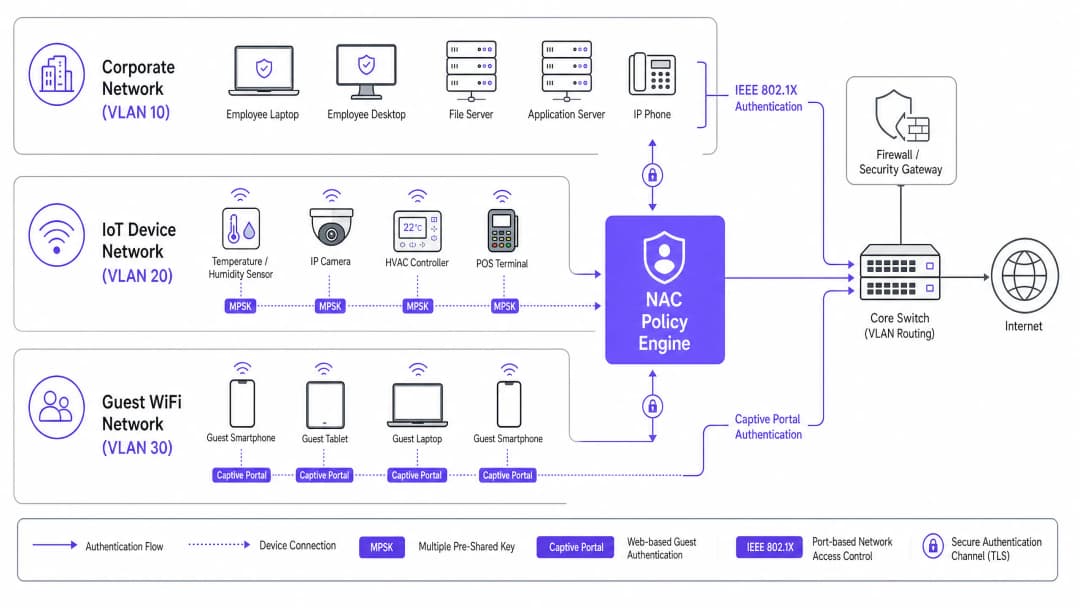
Esta arquitectura permite la asignación dinámica de VLAN. Un termostato inteligente y una cámara IP pueden conectarse exactamente al mismo SSID utilizando contraseñas diferentes, y la infraestructura de red colocará al termostato en la VLAN 50 (restringida al acceso de la puerta de enlace en la nube) y a la cámara en la VLAN 40 (restringida al servidor NVR local).

Resumen en audio
Escuche un resumen técnico sobre esta arquitectura de la mano de nuestro consultor sénior:
¿Tiene preguntas sobre su configuración específica?
Nuestro equipo trabaja con gestores de espacios, responsables de TI e ingenieros de redes en 80 000 establecimientos. Reserve una llamada de 20 minutos y le mostraremos cómo lo resolvieron otros profesionales como usted.
Guía de implementación
La implementación de MPSK con NAC requiere una planeación cuidadosa para garantizar la escalabilidad y la seguridad. Siga estos pasos para una implementación exitosa.
Paso 1: Evaluación de la preparación de la infraestructura
Asegúrese de que sus controladores inalámbricos y puntos de acceso sean compatibles con MPSK o iPSK. La mayoría de los proveedores de redes empresariales modernos (Cisco, Aruba, Meraki, Ruckus) admiten esto de forma nativa, siempre que el firmware esté actualizado. Verifique que su solución NAC pueda manejar la carga esperada de solicitudes RADIUS y que admita la asignación dinámica de VLAN basada en la coincidencia de contraseñas.
Paso 2: Definir políticas de microsegmentación
Antes de generar una sola clave, defina su arquitectura de VLAN. Agrupe los dispositivos IoT según su función y el acceso requerido.
- VLAN 40 (Cámaras de seguridad): Solo permita el tráfico a la IP del NVR local y a servidores NTP específicos. Bloquee el acceso a internet.
- VLAN 50 (Sensores ambientales): Permita el tráfico HTTPS saliente a endpoints específicos de la nube del proveedor. Bloquee el enrutamiento entre VLAN.
- VLAN 60 (Punto de venta): Cumplimiento estricto de PCI-DSS. Deniegue todo el tráfico entrante; solo permita el tráfico saliente a la pasarela de pago.
Paso 3: Perfilado de dispositivos y generación de claves
No genere claves manualmente. Utilice las API del NAC o el portal de autoservicio para generar claves únicas por dispositivo. Vincule cada clave a la dirección MAC del dispositivo. Esto garantiza que incluso si se extrae una MPSK de un termostato, no pueda ser utilizada por una computadora portátil no autorizada que intente suplantar la identidad en la red.
Paso 4: Integración con analíticas y red de invitados
Aunque las redes de IoT estén aisladas, la gestión general debe estar unificada. Asegúrese de que su implementación de NAC se alinee con su estrategia de red más amplia, incluyendo la provisión de Guest WiFi. Las plataformas que proporcionan WiFi Analytics pueden ofrecer información valiosa sobre la densidad de dispositivos y la salud de la red en todos los segmentos. Para obtener más información sobre los fundamentos de red, consulte WiFi Frequencies: A Guide to WiFi Frequencies in 2026.
Mejores prácticas
- Forzar vinculación de MAC: Siempre vincule la MPSK a la dirección MAC específica del dispositivo. Si una MAC diferente intenta usar la clave, el NAC debe rechazar la autenticación.
- Implementar huellas dactilares DHCP: Utilice el perfilado DHCP dentro del NAC para verificar los tipos de dispositivos. Si una MPSK asignada a una "Smart TV" es utilizada de repente por un dispositivo cuya huella dactilar se identifica como "Windows 11", active una cuarentena automática.
- Automatizar la gestión del ciclo de vida: Integre la generación de MPSK con su plataforma de gestión de servicios de TI (ITSM). Cuando un dispositivo se dé de baja en el registro de activos, la MPSK asociada debe revocarse automáticamente a través de la API.
- Auditorías periódicas: Realice auditorías trimestrales de las MPSK activas contra su inventario de activos para identificar y eliminar claves huérfanas.
Solución de problemas y mitigación de riesgos
Modos de falla comunes
- Problemas de tiempo de espera de RADIUS: si hay una carga excesiva en el motor NAC o la latencia es alta, los dispositivos sin interfaz de usuario (headless) pueden agotar el tiempo de espera y no conectarse.
- Mitigación: garantice una alta disponibilidad y proxies RADIUS localizados si trabaja con entornos muy distribuidos como grandes cadenas de retail.
- Suplantación de MAC (MAC Spoofing): un atacante clona la dirección MAC de un dispositivo IoT autorizado y extrae su MPSK.
- Mitigación: recurra a la inspección profunda de paquetes y al perfilado de comportamiento. Si un "termostato" comienza de repente a escanear la red en el puerto 22 (SSH), el NAC o el IDS deben aislar el puerto de inmediato.
- Desconexiones por roaming: algunos dispositivos IoT mal diseñados pierden la conexión al realizar roaming entre AP que utilizan MPSK.
- Mitigación: ajuste las tarifas básicas mínimas y garantice una superposición adecuada de las celdas de RF. Para conocer consideraciones detalladas sobre el diseño inalámbrico, consulte Explicación de BLE de bajo consumo para empresas.
ROI e impacto empresarial
La transición a una arquitectura MPSK/NAC ofrece un valor empresarial medible:
- Reducción del gasto operativo (OpEx): elimina cientos de horas dedicadas por los equipos de TI a actualizar manualmente las PSK globales cuando un solo dispositivo se ve comprometido o se reemplaza.
- Garantía de cumplimiento: para los establecimientos de retail y hotelería, la microsegmentación estricta es un requisito principal de PCI-DSS. MPSK proporciona un mecanismo probado y auditable para aislar las terminales de pago, evitando costosas multas por incumplimiento.
- Mitigación de riesgos: al limitar el radio de impacto de cualquier dispositivo comprometido a su microsegmento específico, se reduce significativamente el daño financiero y reputacional potencial de un ataque de ransomware de movimiento lateral.
- Preparación para el futuro: a medida que las redes empresariales evolucionan, la integración de la seguridad de IoT con estrategias de WAN más amplias se vuelve fundamental. Para obtener contexto sobre arquitecturas de red más amplias, consulte SD WAN vs MPLS: la guía de red empresarial de 2026 y El papel de SCEP y NAC en la infraestructura de MDM moderna.
Definiciones clave
MPSK (Clave Única Precompartida Múltiple)
Una función de seguridad inalámbrica que permite utilizar múltiples contraseñas únicas en un solo SSID, donde cada contraseña es capaz de activar diferentes políticas de red.
Crucial para proteger dispositivos IoT headless que no admiten la autenticación empresarial 802.1X.
NAC (Control de Acceso a la Red)
Una solución de seguridad que aplica políticas en los dispositivos que intentan acceder a la red, garantizando que cumplan con los requisitos de seguridad antes de concederles el acceso.
Actúa como el motor de inteligencia detrás de MPSK, determinando la asignación de VLAN según la contraseña utilizada.
Asignación Dinámica de VLAN
El proceso mediante el cual un switch de red o controlador inalámbrico asigna un dispositivo a una VLAN específica en función de las credenciales de autenticación, en lugar del puerto físico o SSID.
Permite la microsegmentación de los dispositivos IoT que transmiten en la misma red inalámbrica.
Radio de Impacto
La magnitud del daño o del movimiento lateral que un atacante puede lograr después de comprometer un solo dispositivo o sistema.
MPSK y NAC reducen drásticamente el radio de impacto al aislar los dispositivos IoT comprometidos dentro de microsegmentos estrictos.
Dispositivo Headless
Un dispositivo informático, típico en implementaciones de IoT, que funciona sin monitor, teclado ni interfaz de usuario.
Estos dispositivos no pueden solicitar credenciales al usuario, lo que hace imposible la autenticación tradicional 802.1X.
Vinculación de MAC
Un control de seguridad que restringe el uso de una credencial específica (como una MPSK) a una sola dirección MAC autorizada.
Evita que un atacante robe una MPSK de un foco inteligente y la utilice en una laptop maliciosa.
Huella dactilar DHCP
Una técnica de perfilamiento utilizada por los sistemas NAC para identificar el sistema operativo y el tipo de un dispositivo basándose en la secuencia específica de opciones DHCP que solicita.
Utilizado para verificar que un dispositivo que se conecta con un MPSK de IoT sea realmente un dispositivo IoT y no un endpoint falsificado.
Micro-segmentación
Una técnica de seguridad que divide la red en zonas granulares y aisladas para mantener un control de acceso estricto y limitar el movimiento lateral.
El objetivo arquitectónico principal al implementar MPSK y NAC para la seguridad de IoT.
Ejemplos resueltos
Un hotel de 300 habitaciones está implementando nuevas pantallas inteligentes, cerraduras de puertas basadas en IP y sensores ambientales. La infraestructura actual utiliza una única PSK global para todos los dispositivos que no son corporativos. ¿Cómo debería el arquitecto de red rediseñar esto para optimizar la seguridad y la capacidad de gestión?
El arquitecto debe implementar un SSID MPSK ('Hotel-IoT'). El motor de políticas NAC debe configurarse con tres perfiles de dispositivo distintos. Las pantallas inteligentes reciben MPSKs únicas y se asignan dinámicamente a la VLAN 100 (solo Internet, con aislamiento de cliente habilitado). Las cerraduras de las puertas reciben MPSKs únicas, se vinculan a sus direcciones MAC específicas y se asignan a la VLAN 110 (acceso restringido únicamente al servidor de seguridad local). Los sensores reciben MPSKs únicas y se asignan a la VLAN 120 (acceso únicamente a la nube de gestión de HVAC). Todas las claves se generan mediante API durante la incorporación de los dispositivos.
Una gran cadena minorista necesita conectar cientos de escáneres inalámbricos de Punto de Venta (POS) y pantallas de señalización digital en 50 ubicaciones. ¿Cómo pueden garantizar el cumplimiento de PCI-DSS minimizando al mismo tiempo los costos operativos de TI?
Implementar una arquitectura NAC centralizada con MPSK. A los escáneres POS se les asignan MPSKs únicas y se perfilan en una VLAN compatible con PCI sumamente restringida que deniega todo el tráfico lateral y solo permite conexiones salientes a la pasarela de procesamiento de pagos. Las pantallas de señalización digital utilizan MPSKs independientes y se colocan en una VLAN diferente con acceso exclusivo a internet para actualizaciones de contenido. La gestión del ciclo de vida de las claves se integra con el sistema central de gestión de activos.
Preguntas de práctica
Q1. El equipo de TI de un estadio necesita desplegar 200 nuevas terminales inalámbricas de punto de venta. Planean usar MPSK. Para garantizar la máxima seguridad, ¿qué dos comprobaciones de perfilamiento debe realizar el NAC antes de asignar la terminal de punto de venta a la VLAN segura?
Sugerencia: Considere cómo evitar que un MPSK robado sea utilizado en un dispositivo que no sea de punto de venta.
Ver respuesta modelo
El NAC debe realizar el MAC Binding (verificando que el MPSK específico esté siendo utilizado por la dirección MAC autorizada) y el DHCP Fingerprinting (verificando que el dispositivo que solicita una dirección IP exhiba las características del sistema operativo esperado para la terminal de punto de venta, y no las de una laptop o smartphone genérico).
Q2. Durante una auditoría, se descubre que un MPSK asignado a un termostato inteligente fue utilizado con éxito por la laptop de un contratista para obtener acceso a la red. El NAC asignó la laptop a la VLAN del termostato. ¿Qué falla de configuración permitió esto?
Sugerencia: Piense en la relación entre la clave y la identidad del dispositivo.
Ver respuesta modelo
La falla principal fue la falta de MAC Binding. El MPSK no estaba restringido a la dirección MAC específica del termostato. Además, el NAC no aplicó el perfilamiento de dispositivos (por ejemplo, DHCP fingerprinting), lo cual habría identificado la laptop del contratista como un tipo de dispositivo anómalo para esa clave y VLAN específicas.
Q3. Una cadena minorista está migrando de una PSK global a MPSK. Tienen 5,000 escáneres de códigos de barras heredados que admiten WPA2-Personal pero no se pueden actualizar para admitir protocolos más nuevos. ¿Se puede usar MPSK para proteger estos dispositivos y, de ser así, cómo?
Sugerencia: Considere los requisitos del lado del cliente para MPSK.
Ver respuesta modelo
Sí, se puede usar MPSK. Desde la perspectiva del dispositivo cliente (el escáner de códigos de barras), MPSK es idéntico a una PSK estándar de WPA2-Personal. La inteligencia y la diferenciación ocurren por completo del lado de la infraestructura (WLC y NAC). Los escáneres simplemente necesitan configurarse con sus contraseñas únicas recién asignadas.
Continúe leyendo esta serie
Cómo segmentar de forma segura las redes WiFi del personal y de invitados: mejores prácticas para LAN empresariales
Esta guía proporciona a los administradores de TI y arquitectos de red un modelo técnico e independiente de proveedores para proteger las LAN empresariales mediante la segmentación adecuada del tráfico de WiFi del personal y de invitados. Abarca la autenticación 802.1X, RADIUS en la nube, el aislamiento de VLAN y la gestión del ciclo de vida de las credenciales necesaria para eliminar las contraseñas compartidas y proteger los activos corporativos.
El mejor filtrado de DNS: una guía completa para empresas
Esta guía de referencia técnica explica cómo el filtrado de DNS empresarial protege las redes públicas al bloquear dominios maliciosos en la capa de resolución, antes de que se establezca una conexión. Proporciona a los directores de TI, arquitectos de red y equipos de operaciones de establecimientos la arquitectura de implementación, la configuración del firewall y el contexto de cumplimiento que necesitan para proteger el WiFi de invitados en entornos de hotelería, comercio minorista y sector público. Purple Shield bloquea malware, botnets y contenido inapropiado a nivel de DNS en más de 80,000 establecimientos activos.
Comprensión de Cisco SUDI: Identidad anclada por hardware en el control de acceso seguro a la red
Esta guía explica cómo Cisco SUDI proporciona una identidad criptográficamente segura y anclada por hardware para la infraestructura de red empresarial. Aprenda cómo reemplazar las direcciones MAC vulnerables a la suplantación por certificados 802.1AR inmutables para proteger el control de acceso a la red de su recinto.
¿Tiene preguntas sobre su configuración específica?
Nuestro equipo trabaja con gestores de espacios, responsables de TI e ingenieros de redes en 80 000 establecimientos. Reserve una llamada de 20 minutos y le mostraremos cómo lo resolvieron otros profesionales como usted.