
Evaluación de postura NAC: Garantizando el cumplimiento de dispositivos gestionados antes del acceso a la red
Esta guía de referencia técnica ofrece un análisis profundo de la evaluación de postura NAC, detallando la arquitectura, los estándares y las estrategias de implementación necesarias para hacer cumplir el cumplimiento de los dispositivos gestionados. Equipa a los gerentes de TI y arquitectos de red con información práctica para mitigar riesgos y garantizar un acceso seguro a la red en entornos empresariales multisitio.
Escucha esta guía
Ver transcripción del podcast
Parte de nuestra serie principal: Enterprise WiFi Security Guide →
Executive Summary
For enterprise IT leaders managing complex and multi-site environments, identity alone is no longer a sufficient metric for network access. Knowing who is connecting is less critical than knowing the security state of the device they are using. Network Access Control (NAC) posture assessment is the mechanism that bridges this gap, ensuring that only managed and compliant devices gain access to corporate infrastructure before a single packet of production traffic is transmitted.
This guide provides a comprehensive technical reference for designing, deploying, and managing NAC posture assessment. We explore its underlying architecture, including 802.1X, RADIUS, and EAP-TLS, evaluate the pros and cons of agent-based versus agentless interrogation, and outline a phased deployment strategy that minimises operational disruption. Whether you are securing a corporate headquarters, a distributed retail estate, or hospitality back-office operations, implementing a robust posture assessment is a critical step in mitigating risk and enforcing compliance.
Listen to our 10-minute technical briefing podcast below for an executive overview of the key concepts and common deployment pitfalls.
Technical Deep-Dive
Posture Assessment Architecture
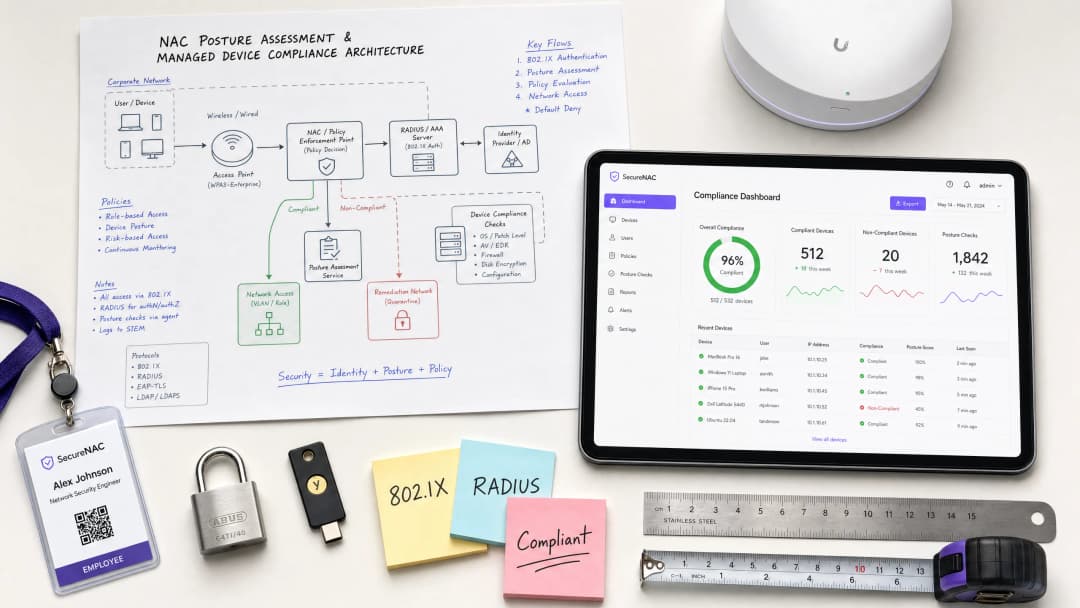
Network Access Control controls device connectivity, but posture assessment is the specific interrogation of a device's security health. Its architecture relies primarily on three main components working in unison:
- Policy Enforcement Point (PEP): This is the physical or logical gatekeeper - typically a wireless access point, switch port, or wireless LAN controller. The PEP physically controls the flow of traffic based on directives from the policy engine.
- Policy Decision Point (PDP): Often integrated with a RADIUS or AAA server, the PDP is the brains of the NAC architecture. It receives posture data, evaluates it against defined compliance policies, and issues enforcement directives to the PEP.
- Posture Assessment Engine: This component gathers the actual health data from the endpoint. This can be an agent running locally on the device, or an agentless mechanism using network protocols (such as SNMP, WMI) or API integration with a Mobile Device Management (MDM) platform.

The Role of IEEE 802.1X and EAP-TLS
The foundation of enterprise NAC is the IEEE 802.1X standard, which defines port-based network access control. Within this framework, three roles are defined:
- Supplicant: The endpoint device attempting to connect.
- Authenticator: The PEP (switch or access point) facilitating the connection.
- Authentication Server: The RADIUS server validating the credentials.
Communication between the Supplicant and the Authentication Server occurs via Extensible Authentication Protocol (EAP), tunnelled through the Authenticator. For managed corporate devices, EAP-TLS is the gold standard. It mandates mutual authentication using X.509 digital certificates, ensuring that both the device and the network cryptographically verify each other's identity. This prevents credential theft and rogue access point attacks.
Posture Check Categories
When a device attempts to connect, the posture assessment engine evaluates several critical vectors:
- OS and Patch Management: Verifying that the operating system is supported and that critical patches have been applied within defined SLAs.
- Endpoint Security (AV/EDR): Ensuring that approved anti-virus or Endpoint Detection and Response agents are installed, active, and running updated definitions.
- Firewall Status: Confirming that host-based firewalls are enabled and their policies have not been tampered with.
- Disk Encryption: Verifying that full-disk encryption (e.g., BitLocker, FileVault) is active and not suspended.
- Certificate Validation: Checking for the presence and validity of required machine certificates.
- Configuration Compliance: Ensuring the device's security baseline aligns with corporate policy (e.g., screen lock timers, disabled USB mass storage).

WPA3-Enterprise and Cryptographic Strength
As network security evolves, so do its underlying cryptographic standards. WPA3-Enterprise, particularly when operating in 192-bit mode, provides significant advancements over WPA2. It mandates the use of GCMP-256 for encryption and HMAC-SHA-384 for integrity. For organisations handling sensitive data - such as retail environments subject to PCI DSS or healthcare facilities under strict data governance - transitioning to WPA3-Enterprise is a necessary step to future-proof network infrastructure.
¿Tiene preguntas sobre su configuración específica?
Nuestro equipo trabaja con gestores de espacios, responsables de TI e ingenieros de redes en 80 000 establecimientos. Reserve una llamada de 20 minutos y le mostraremos cómo lo resolvieron otros profesionales como usted.
Implementation Guide
Deploying NAC posture assessment requires careful planning to avoid widespread network outages. The following phased approach is recommended for enterprise environments:
Phase 1: Infrastructure Readiness and PKI Design
Before enabling posture checks, ensure your underlying infrastructure can support the architecture. If deploying EAP-TLS, a robust Public Key Infrastructure (PKI) is essential. Certificates must be automatically provisioned and renewed via your MDM or Group Policy. Manual certificate management will inevitably lead to connectivity failures when certificates expire.
Phase 2: Monitor Mode (Visibility Phase)
The most critical phase of any NAC deployment is Monitor Mode. During this phase, the NAC system evaluates device posture and logs the results, but does not enforce policies. The PEP allows full access regardless of the posture outcome.
Run Monitor Mode for at least 2-4 weeks. This provides visibility into the actual compliance state of your estate. You will identify devices failing checks due to broken agents, pending reboots, or misconfigurations. Use this data to proactively remediate the estate.
Phase 3: Segmented Enforcement
Once the compliance baseline reaches an acceptable level, begin enforcement. Based on policy evaluation, devices are categorised into three states:
- Compliant: The device passes all critical checks and is assigned to the production VLAN with full required access.
- Conditional: The device fails a non-critical check (e.g., a minor OS update is pending). It may be granted restricted access (e.g., internet only) and the user is notified to remediate within a specified grace period.
- Non-Compliant: The device fails a critical check (e.g., AV is disabled). The PEP assigns the device to a quarantine VLAN.
Phase 4: Remediation Architecture
The quarantine VLAN must be strictly isolated. It should only permit traffic to the remediation portal, necessary update servers (e.g., Windows Update, AV definition servers), and internal IT support resources. If a quarantined device can route traffic to production subnets, the NAC architecture has failed.
Best Practices
- Continuous Assessment: Legacy NAC only evaluates posture at the time of connection. Modern deployments must support continuous assessment, re-evaluating posture at regular intervals or in response to events (e.g., an EDR alert) and dynamically updating the device's access level via Change of Authorization (CoA).
- Agent vs. Agentless: For managed corporate devices, an agent-based approach provides the deepest visibility and continuous monitoring capabilities. Agentless interrogation is suitable for unmanaged devices or environments where deploying an agent is administratively prohibited.
- MAC Authentication Bypass (MAB): MAB is required for devices incapable of 802.1X (e.g., legacy printers, IoT sensors). However, MAB is inherently insecure as MAC addresses can be spoofed. MAB devices must be deeply profiled and placed in strictly controlled, isolated VLANs.
- Aligning with Standards: Base your posture policies on established frameworks such as CIS Benchmarks. This ensures your compliance checks are vendor-neutral and aligned with industry best practices.
- Isolating Guest Traffic: Corporate NAC posture assessment should never intersect with public access networks. In venues where both are required, use a dedicated Guest WiFi platform to manage public access on entirely separate infrastructure, such as Purple's WiFi Analytics solution.
Troubleshooting and Risk Mitigation
Common Failure Modes
- 'Big Bang' Enforcement: Transitioning from open access to strict enforcement across the entire estate all at once is a guaranteed recipe for operational disruption. Always use a phased rollout by site or department.
- PKI Failure: Expired root or intermediate certificates, or failures in the Certificate Revocation List (CRL) / Online Certificate Status Protocol (OCSP) infrastructure, will cause widespread authentication failures. Implement robust monitoring for your PKI.
- Remediation Loops: Ensure that devices in the quarantine VLAN have sufficient network access to download the updates required to become compliant. If they cannot reach update servers, they will remain permanently quarantined.
ROI and Business Impact
Implementing NAC posture assessment delivers measurable business value beyond simple security metrics:
- Risk Mitigation: By ensuring only healthy devices gain access to the network, the lateral spread of malware and ransomware is significantly reduced, decreasing the likelihood of costly data breaches.
- Compliance Verification: For highly regulated sectors such as hospitality and transport, automated posture assessment provides continuous proof of compliance with standards like PCI DSS and GDPR, simplifying the audit process.
- Operational Efficiency: Automating the quarantine and remediation process reduces the burden on the IT helpdesk, allowing engineers to focus on strategic initiatives rather than manually cleaning infected endpoints.
Definiciones clave
802.1X
Un estándar IEEE para el control de acceso a la red basado en puertos que proporciona un mecanismo de autenticación a los dispositivos que desean conectarse a una LAN o WLAN.
El protocolo fundamental que garantiza que un dispositivo debe autenticarse antes de que el puerto del switch o el punto de acceso permita el paso de cualquier tráfico IP.
EAP-TLS
Extensible Authentication Protocol - Transport Layer Security (Protocolo de autenticación extensible - Seguridad de la capa de transporte). Un marco de autenticación que utiliza certificados digitales X.509 para la autenticación mutua.
El estándar recomendado para dispositivos corporativos administrados, ya que se basa en certificados criptográficos en lugar de contraseñas que se pueden comprometer fácilmente.
Evaluación de postura
El proceso de evaluar el estado de seguridad y la configuración de un dispositivo terminal frente a una política corporativa definida.
Garantiza que un dispositivo no solo esté autenticado, sino que también esté "sano" (con parches aplicados, cifrado, protegido) antes de que se le conceda acceso a la red.
Punto de aplicación de políticas (PEP)
El dispositivo de red (switch, controlador inalámbrico o punto de acceso) que bloquea o permite físicamente el tráfico según la política de NAC.
El componente que realmente ejecuta el comando de "permitir" o "poner en cuarentena" emitido por el servidor NAC.
Punto de decisión de políticas (PDP)
El servidor o motor central (a menudo un servidor RADIUS) que evalúa las solicitudes de autenticación y los datos de postura para determinar los derechos de acceso.
El cerebro de la operación que contiene la base de reglas y decide qué nivel de acceso debe recibir un dispositivo específico.
Bypass de autenticación MAC (MAB)
Un método de autenticación de respaldo que utiliza la dirección MAC de un dispositivo como su credencial cuando no puede realizar la autenticación 802.1X.
Se utiliza para dispositivos sin interfaz de usuario, como impresoras o sensores IoT. Es intrínsecamente débil y debe combinarse con una segmentación de red estricta.
Cambio de autorización (CoA)
Una extensión de RADIUS que permite al servidor NAC cambiar dinámicamente el estado de autorización de una sesión activa.
Crucial para la evaluación continua; si un dispositivo deja de cumplir con las políticas mientras está conectado, el CoA permite que el servidor NAC lo mueva instantáneamente a una VLAN de cuarentena sin necesidad de desconectarlo.
VLAN de cuarentena
Un segmento de red estrictamente aislado diseñado para contener dispositivos que no cumplen con las políticas, proporcionando acceso únicamente a los recursos de remediación.
Evita que un dispositivo infectado o vulnerable se comunique con los sistemas de producción mientras descarga las actualizaciones o parches necesarios.
Ejemplos resueltos
Un hotel de 400 habitaciones requiere que las laptops del personal corporativo accedan de forma segura al sistema de gestión de propiedades (PMS) interno. Sin embargo, el establecimiento también alberga numerosos dispositivos IoT no gestionados (termostatos inteligentes, señalización digital) que no pueden ejecutar un agente NAC.
Implementar una política 802.1X EAP-TLS para todas las laptops del personal corporativo, aplicando controles estrictos de postura (AV activo, disco cifrado, parches actualizados). Estos dispositivos se asignan dinámicamente a la VLAN corporativa tras un cumplimiento exitoso. Para los dispositivos IoT, implementar MAC Authentication Bypass (MAB) combinado con un perfilado profundo de dispositivos. Asegurar que estos dispositivos MAB se ubiquen en VLANs de IoT dedicadas y aisladas, con ACLs que restrinjan su acceso únicamente a los controladores específicos con los que necesitan comunicarse. Bajo ninguna circunstancia la VLAN de IoT debe enrutarse a la VLAN corporativa o al PMS.
Una cadena de tiendas de autoservicio está implementando nuevas terminales de punto de venta (POS) en 50 ubicaciones. El equipo de TI desea hacer cumplir el cumplimiento de postura para cumplir con los requisitos de PCI DSS, pero le preocupa interrumpir las operaciones de las tiendas durante el despliegue.
Implementar la arquitectura NAC en Modo de Monitoreo durante 30 días. Durante este período, el sistema NAC autenticará las terminales POS y evaluará su postura frente a la línea base de PCI DSS (por ejemplo, firewall activo, sin software no autorizado), pero registrará las fallas sin bloquear el acceso. El equipo de TI revisará los registros semanalmente, identificará las terminales que no superen las comprobaciones y las corregirá a través de la plataforma MDM. Una vez que la tasa de cumplimiento alcance el 100%, la política se cambiará a Modo de Ejecución sitio por sitio durante las ventanas de mantenimiento.
Preguntas de práctica
Q1. A recently deployed NAC solution in a corporate office is causing widespread connectivity issues. Devices that were compliant yesterday are now being placed in the Quarantine VLAN. The IT helpdesk reports that the devices appear healthy, with AV running and patches applied. What is the most likely architectural failure?
Sugerencia: Consider the lifecycle of the credentials used in EAP-TLS.
Ver respuesta modelo
The most likely cause is a failure in the Public Key Infrastructure (PKI). If the machine certificates used for EAP-TLS authentication have expired, or if the NAC server cannot reach the Certificate Revocation List (CRL) or OCSP responder, the authentication will fail regardless of the device's actual security posture. The NAC system defaults to a fail-closed or quarantine state.
Q2. You are designing the VLAN architecture for a new NAC deployment. The security team insists that the Quarantine VLAN must allow access to the corporate proxy server so users can browse the internet while their devices remediate. Is this a sound design?
Sugerencia: Evaluate the risk of allowing a potentially compromised device access to shared infrastructure.
Ver respuesta modelo
No, this is a flawed design. Allowing a quarantined device access to the corporate proxy introduces significant risk. If the device is infected with malware, it could use the proxy to establish command-and-control communication or attempt to pivot to other internal systems accessible via the proxy. The Quarantine VLAN must be strictly isolated, permitting access only to specific remediation servers (e.g., Windows Update, AV definition servers) and the remediation portal itself.
Q3. A hospital IT team needs to secure network access for a fleet of new wireless medical infusion pumps. These devices do not support 802.1X supplicants and cannot run a posture agent. How should network access be controlled for these devices?
Sugerencia: Consider alternative authentication methods and the principle of least privilege.
Ver respuesta modelo
The devices must be authenticated using MAC Authentication Bypass (MAB). Because MAB is inherently weak (MAC addresses can be spoofed), the network access must be heavily restricted. The infusion pumps should be placed in a dedicated, isolated Medical IoT VLAN. Access Control Lists (ACLs) must be applied to this VLAN, permitting communication only with the specific central management servers required for their operation, and blocking all other lateral movement or internet access.
Continúe leyendo esta serie
PPSK WPA3: comparación de características y modelos de implementación
Esta guía de referencia técnica compara PPSK y WPA3-SAE, explicando sus diferencias de arquitectura y modelos de implementación para entornos multiinquilino. Proporciona orientación práctica para gerentes de TI y desarrolladores inmobiliarios sobre cómo lograr redes WiFi seguras y aisladas mediante las soluciones basadas en la identidad de Purple.
Administración del ancho de banda para WiFi de personal: modelado, QoS y reducción de tráfico
Esta guía detalla métodos prácticos para administrar el ancho de banda del WiFi de personal en espacios corporativos. Cubre la implementación de modelado de tráfico y QoS, así como la manera en que el despliegue de Purple Shield reduce la carga de la red sin necesidad de actualizar la infraestructura.
Cómo reducir el número de SSIDs de WiFi utilizando PSK por dispositivo (iPSK, DPSK, MPSK)
Esta guía de referencia técnica autorizada explica cómo los equipos de TI pueden eliminar la degradación del rendimiento de WiFi causada por la sobrecarga de balizas (beacon overhead) de SSID mediante la unificación de múltiples redes dedicadas en un solo SSID utilizando PSK por dispositivo (xPSK). Cubre el panorama de proveedores que incluye Cisco iPSK, HPE Aruba MPSK, Ruckus DPSK, Juniper Mist PPSK y Ubiquiti UniFi PPSK, con orientación práctica de implementación sobre asignación dinámica de VLAN, incorporación de IoT y cumplimiento de PCI DSS. Los operadores de recintos en los sectores de hotelería, comercio minorista, estadios y organizaciones del sector público encontrarán orientación de arquitectura aplicable y ejemplos prácticos del mundo real.
¿Tiene preguntas sobre su configuración específica?
Nuestro equipo trabaja con gestores de espacios, responsables de TI e ingenieros de redes en 80 000 establecimientos. Reserve una llamada de 20 minutos y le mostraremos cómo lo resolvieron otros profesionales como usted.