

Incorporación WiFi impulsada por Webhooks: Automatización del Acceso de Invitados a Escala
Esta guía autorizada detalla cómo implementar la incorporación WiFi impulsada por webhooks para automatizar el acceso a la red de invitados. Cubre la arquitectura, estrategias de integración, mejores prácticas y el impacto comercial de implementar la entrega de credenciales sin contacto a escala.
🎧 Escucha esta guía
Ver transcripción
Resumen Ejecutivo
Para los establecimientos modernos de hostelería, comercio minorista y sector público, la experiencia WiFi del invitado comienza mucho antes de que el usuario pise las instalaciones. Depender de la distribución manual de credenciales —ya sea mediante tarjetas impresas en recepción o contraseñas genéricas compartidas— introduce fricción operativa, compromete la seguridad y crea una desconexión entre la identidad de reserva del invitado y su presencia en la red.
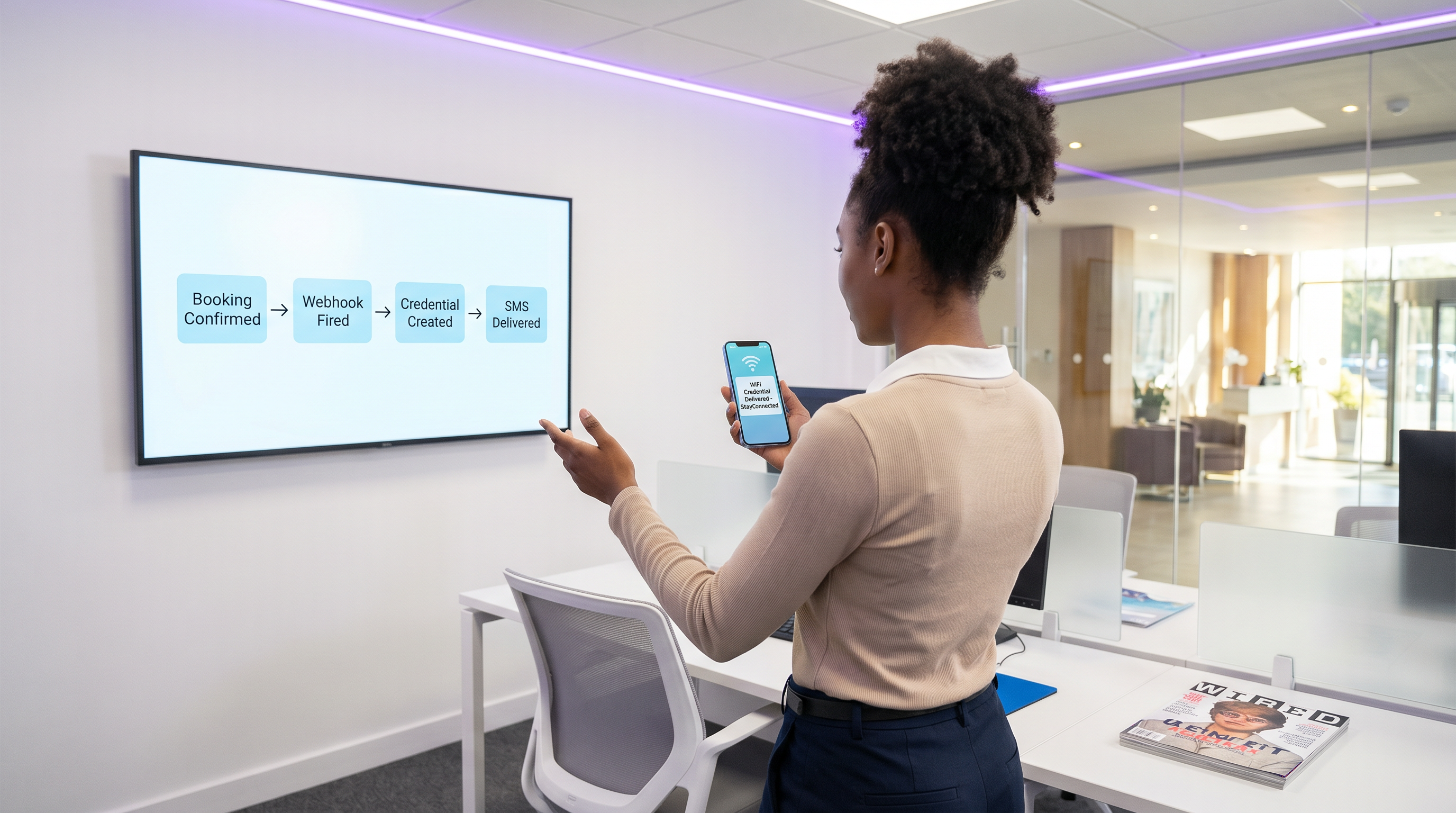
La automatización de la incorporación WiFi impulsada por webhooks elimina esta fricción. Al integrar sus sistemas de reserva existentes (como un Sistema de Gestión de Propiedades o CRM) con la capa de control de acceso a la red, puede generar y distribuir automáticamente credenciales WiFi seguras y con límite de tiempo en el momento en que se confirma una reserva. Este enfoque sin intervención reduce drásticamente los gastos generales de recepción, garantiza el cumplimiento de los estándares de privacidad de datos y proporciona una experiencia de incorporación sin interrupciones y sin contacto para el invitado.
Esta guía detalla la arquitectura, los pasos de implementación y las mejores prácticas para desplegar la incorporación impulsada por webhooks a escala, aprovechando el motor LogicFlow de Purple para cerrar la brecha entre los eventos comerciales y el acceso a la red.
Análisis Técnico Detallado: Arquitectura de Webhooks
En su esencia, un webhook es una solicitud HTTP POST activada por un evento específico en un sistema de origen. En el contexto de la automatización de la incorporación WiFi, el sistema de origen es típicamente un Sistema de Gestión de Propiedades (PMS), CRM o una plataforma de registro de eventos.
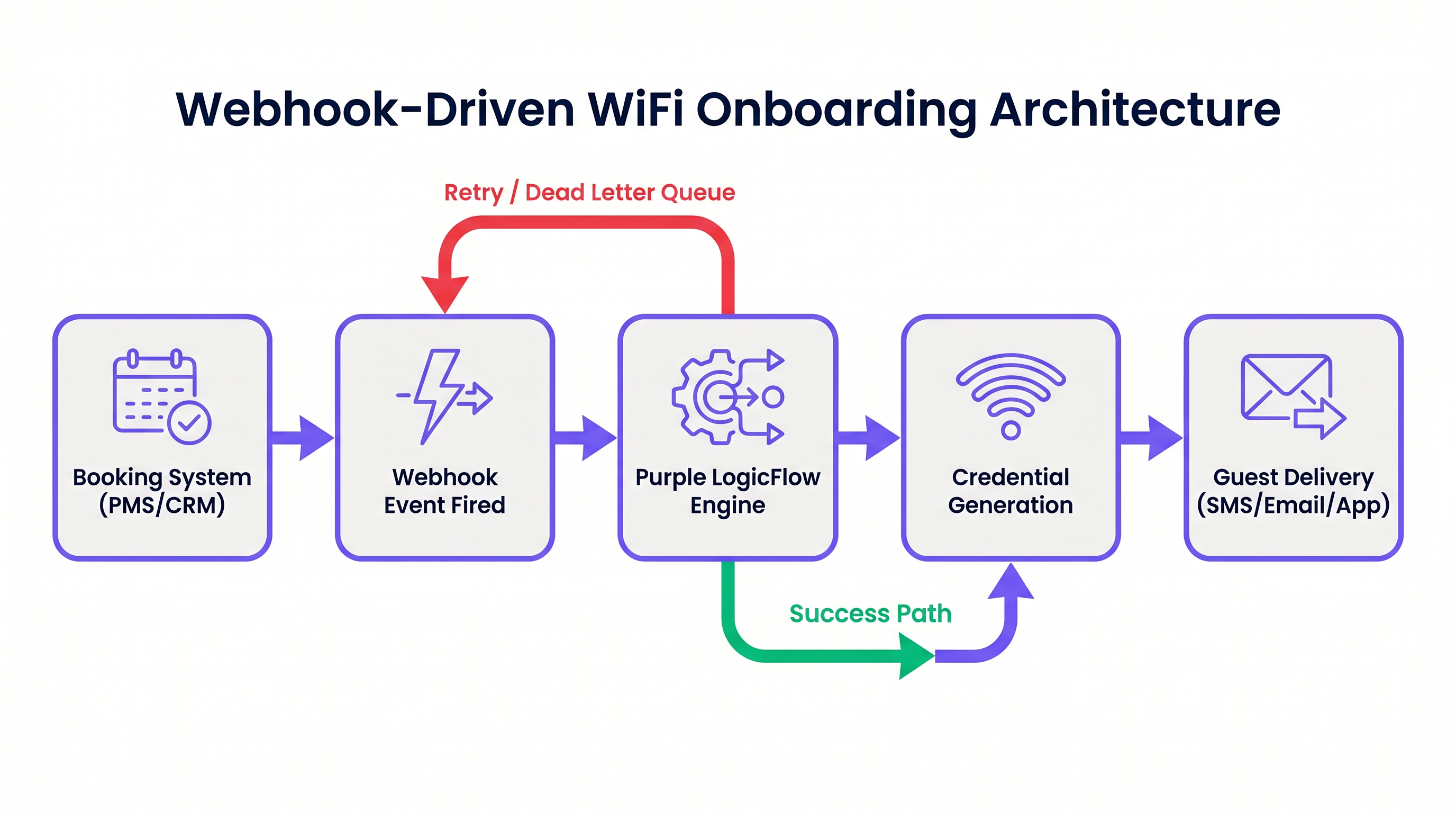
Cuando ocurre un evento —como una confirmación de reserva, check-in o modificación de estancia— el sistema de origen envía una carga útil JSON que contiene datos relevantes del invitado a un endpoint designado.
El Motor LogicFlow de Purple
El motor LogicFlow de Purple sirve como middleware inteligente en esta arquitectura. Recibe la carga útil del webhook, analiza los datos del invitado y ejecuta un flujo de trabajo predefinido para generar una credencial de red. Esta credencial puede tomar la forma de una Clave Pre-Compartida Única (PPSK) o una cuenta dinámica basada en RADIUS.
LogicFlow gestiona todo el ciclo de vida de las credenciales:
- Generación: Creación de una credencial segura y única vinculada a la identidad del invitado.
- Entrega: Envío de la credencial por SMS, correo electrónico o push de API a una aplicación móvil.
- Activación/Revocación: Habilitación de la credencial en el check-in y deshabilitación precisa en el check-out.
Esta integración transforma la red de una utilidad de TI aislada en un activo consciente del negocio, perfectamente alineado con el ritmo operativo del establecimiento. Para una perspectiva más amplia sobre arquitecturas de red modernas, considere Los Beneficios Clave de SD WAN para Empresas Modernas .
Guía de Implementación
Desplegar la incorporación impulsada por webhooks requiere un enfoque sistemático para garantizar la fiabilidad y la seguridad.
Paso 1: Definir el Esquema de Eventos
Antes de configurar cualquier flujo de trabajo, defina los eventos exactos que su sistema de reservas puede activar y la estructura de datos de las cargas útiles correspondientes. Debe asegurarse de que la carga útil contenga un identificador de invitado único, un método de entrega (correo electrónico o número de teléfono) y la duración de la estancia.
Paso 2: Configurar la Integración
Determine el método de integración basándose en las capacidades de su sistema de reservas.
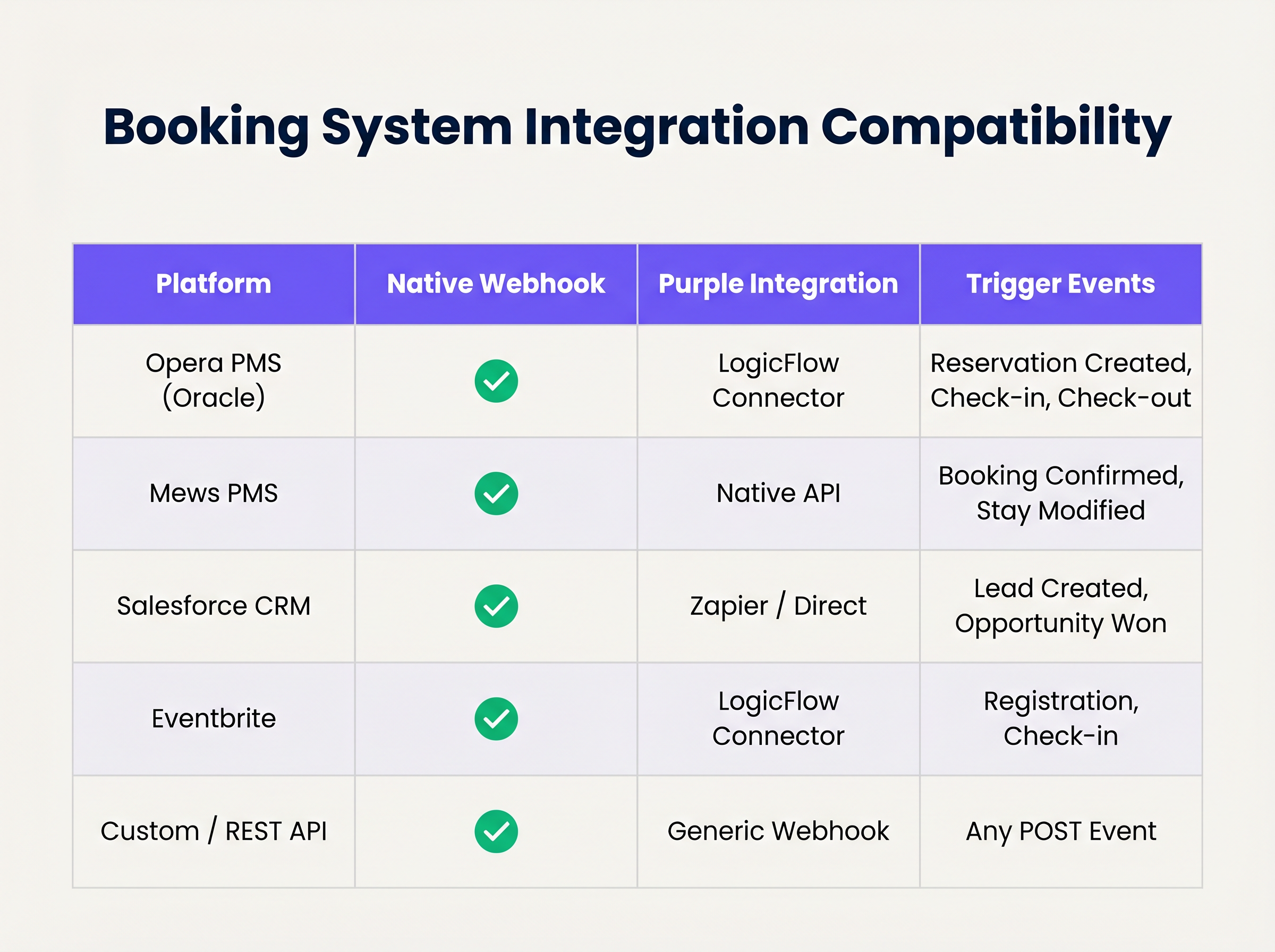
Si su sistema admite webhooks nativos, configúrelo para que apunte a su endpoint de LogicFlow. Para sistemas sin soporte nativo de webhooks, es posible que necesite utilizar los conectores de sondeo de Purple o una plataforma de integración intermediaria.
Paso 3: Diseñar el Ciclo de Vida de las Credenciales
Establezca las reglas para la validez de las credenciales. Una buena práctica es generar la credencial al confirmar la reserva, pero retrasar la entrega hasta 24-48 horas antes de la llegada. Asegúrese de que la credencial expire automáticamente a la hora programada de check-out.
Paso 4: Establecer la Gestión de Reintentos y Fallos
Las solicitudes de red pueden fallar. Implemente la idempotencia para manejar eventos de webhook duplicados de manera elegante. Configure las políticas de reintento de LogicFlow con retroceso exponencial, y establezca una cola de mensajes fallidos para los eventos que agoten sus límites de reintento, asegurando que sean marcados para revisión manual.
Mejores Prácticas
- Minimización de Datos: Adhiérase estrictamente a las regulaciones de privacidad. Solo extraiga y procese los datos mínimos necesarios para generar y entregar la credencial. Para una comparación detallada de los marcos regulatorios, revise CCPA vs GDPR: Cumplimiento Global de Privacidad para Datos WiFi de Invitados .
- Idempotencia: Asegúrese de que su lógica de procesamiento de webhooks sea idempotente. Procesar el mismo "reserva confirmada" evento varias veces no debe resultar en la generación de múltiples credenciales o el envío de correos electrónicos duplicados.
- Mecanismos de Respaldo: Mantenga siempre un proceso manual de generación de credenciales en la recepción. Aunque la automatización maneja la gran mayoría de los casos, los casos excepcionales (por ejemplo, datos de contacto incorrectos proporcionados en la reserva) requerirán intervención humana.
Solución de Problemas y Mitigación de Riesgos
Incluso los sistemas automatizados robustos encuentran problemas. Los modos de fallo comunes incluyen:
- Desajustes de Zona Horaria: Si el PMS opera en hora local mientras el controlador de red opera en UTC, las credenciales pueden expirar prematuramente o permanecer activas demasiado tiempo. Maneje explícitamente las conversiones de zona horaria en su configuración de LogicFlow.
- Cambios en el Esquema de la Carga Útil: Las actualizaciones del sistema de reservas pueden ocasionalmente alterar la estructura de la carga útil del webhook, causando errores de análisis. Implemente la validación de esquemas y alertas para detectar estos cambios de inmediato.
- Fallos de Entrega: Fallos en la entrega de SMS o correo electróLa entrega puede fallar debido a datos de contacto no válidos o problemas con el operador ascendente. Monitoree los recibos de entrega y configure alertas para altas tasas de falla.
ROI e Impacto Comercial
La transición a la incorporación automatizada de WiFi ofrece un valor comercial medible en varias dimensiones:
- Eficiencia Operativa: La eliminación de la distribución manual de credenciales ahorra una cantidad significativa de tiempo al personal. En un hotel de 200 habitaciones, ahorrar 3 minutos por huésped se traduce en cientos de horas de productividad recuperada anualmente.
- Experiencia del Huésped Mejorada: Los huéspedes esperan una conectividad sin interrupciones. La entrega de credenciales antes de la llegada elimina un punto de fricción en el registro, contribuyendo directamente a puntuaciones de satisfacción más altas.
- Integridad de Datos y Análisis: Al vincular el acceso a la red directamente con la identidad de la reserva, los establecimientos obtienen datos altamente precisos y deterministas sobre el comportamiento y el tiempo de permanencia de los huéspedes, impulsando iniciativas de marketing más efectivas. Para obtener información sobre cómo cuantificar este valor, consulte Medición del ROI en WiFi para Huéspedes: Un Marco para CMOs .
Escuche el resumen del podcast adjunto para una inmersión más profunda en estos conceptos:
Términos clave y definiciones
Webhook
An automated HTTP POST request sent from one application to another, triggered by a specific event, carrying a data payload.
The fundamental mechanism for real-time, event-driven integration between booking systems and network infrastructure.
PPSK (Private Pre-Shared Key)
A network security method where each user or device is assigned a unique passphrase for the same SSID.
The preferred credential type for automated hospitality onboarding, offering a balance of security and ease of use compared to standard WPA2-Personal.
Idempotency
A property of certain operations in computer science where applying the operation multiple times has the same effect as applying it once.
Critical for webhook endpoint design to prevent duplicate credential generation if a PMS retries a payload delivery.
Dead-Letter Queue (DLQ)
A holding queue for messages or events that cannot be processed successfully after a defined number of retries.
Essential for troubleshooting integration failures without losing the original booking event data.
LogicFlow
Purple's visual automation engine that receives external triggers, evaluates conditions, and executes actions like credential creation and messaging.
The middleware layer that translates business events from a PMS into network access commands.
RADIUS
Remote Authentication Dial-In User Service; a networking protocol that provides centralized Authentication, Authorization, and Accounting (AAA) management.
Used in high-security environments (like enterprise or healthcare) where 802.1X dynamic credentials are required instead of PPSK.
Payload Schema
The defined structure and format (typically JSON) of the data transmitted within a webhook request.
IT teams must map the PMS payload schema to ensure the automation engine extracts the correct fields for guest name, email, and dates.
Exponential Backoff
An algorithm that uses feedback to multiplicatively decrease the rate of some process, used in network retries.
Prevents overwhelming a recovering service by increasing the wait time between successive retry attempts of a failed webhook.
Casos de éxito
A 300-room resort uses Mews PMS and wants to automate WiFi access. They need credentials to be valid only from the official check-in time (15:00) to check-out time (11:00), but want to email the details to the guest the day before arrival.
Configure Mews to fire a 'Reservation Confirmed' webhook to Purple LogicFlow. LogicFlow parses the payload to extract the guest email, arrival date, and departure date. The workflow is configured to generate a PPSK credential immediately, setting the 'Valid From' attribute to 15:00 on the arrival date and 'Valid Until' to 11:00 on the departure date. A scheduled action is then queued in LogicFlow to dispatch the email template containing the PPSK exactly 24 hours prior to the arrival date.
A large conference centre uses Eventbrite for ticketing. They experience massive spikes in concurrent arrivals, causing bottlenecks at the registration desk where WiFi codes are currently handed out.
Integrate Eventbrite with Purple LogicFlow using a webhook triggered on 'Registration Confirmed'. LogicFlow generates a unique WiFi voucher code and immediately emails it to the attendee as part of their digital ticket package. The network controller is configured to activate the voucher upon first use, valid for the duration of the multi-day event.
Análisis de escenarios
Q1. Your hotel is migrating to a new PMS that sends stay dates in UTC, but your network controller is configured for local time (UTC+2). The webhook payload includes: `"checkout_time": "2024-05-10T10:00:00Z"`. If no timezone conversion is applied in the automation layer, what is the operational impact?
💡 Sugerencia:Consider when the guest expects to lose access versus when the system will actually revoke it.
Mostrar enfoque recomendado
The network controller will interpret the 10:00:00 time as local time. Because local time is UTC+2, 10:00:00 local time occurs two hours before 10:00:00 UTC. Therefore, the guest's WiFi credential will be revoked two hours before their actual checkout time, leading to connectivity complaints on the morning of departure. Timezone normalization must be explicitly handled in the LogicFlow configuration.
Q2. A stadium ticketing system fires a webhook for every ticket sold. You notice that your LogicFlow engine is processing 500 events per minute during an on-sale rush, but the downstream SMS gateway API is rate-limiting you to 100 requests per minute. How should you architect the automation to handle this?
💡 Sugerencia:Look at the decoupling of credential generation and credential delivery.
Mostrar enfoque recomendado
You must decouple the credential generation from the delivery mechanism. The webhook should trigger LogicFlow to generate the credential and place the delivery task into a managed queue. The queue should then process the SMS dispatches at a controlled rate (e.g., 90 per minute) to respect the SMS gateway's rate limits, utilizing exponential backoff for any throttled requests.
Q3. During a network audit, the compliance officer notes that webhook payloads containing guest names and phone numbers are being logged in plain text in your middleware diagnostic logs for 90 days. What is the recommended remediation?
💡 Sugerencia:Refer to the Data Minimisation best practice and GDPR Article 5.
Mostrar enfoque recomendado
Diagnostic logs should be configured to obfuscate or redact Personally Identifiable Information (PII) such as names and phone numbers. Only non-sensitive metadata (like event IDs or timestamp) should be retained for troubleshooting. Furthermore, the retention period for diagnostic logs should be reduced to the minimum necessary for operational monitoring (e.g., 7 to 14 days), rather than 90 days.
Conclusiones clave
- ✓Webhook automation eliminates manual WiFi credential distribution, reducing front-desk overhead and friction.
- ✓Integration relies on HTTP POST payloads triggered by PMS events like 'Reservation Confirmed'.
- ✓Purple's LogicFlow engine acts as the middleware, translating booking events into network access commands.
- ✓Idempotency is critical to prevent duplicate credential generation from retried webhook events.
- ✓Credentials should be generated early but activated strictly according to check-in/check-out times.
- ✓Proper handling of timezones and dead-letter queues is essential for robust, enterprise-grade deployments.




