

Webhook-gesteuertes WiFi Onboarding: Gästezugang im großen Maßstab automatisieren
Dieser maßgebliche Leitfaden beschreibt, wie ein Webhook-gesteuertes WiFi Onboarding implementiert wird, um den Gäste-Netzwerkzugang zu automatisieren. Er behandelt Architektur, Integrationsstrategien, Best Practices und die geschäftlichen Auswirkungen der Bereitstellung von Zero-Touch-Zugangsdaten im großen Maßstab.
🎧 Diesen Leitfaden anhören
Transkript anzeigen
Executive Summary
Für moderne Gastgewerbe-, Einzelhandels- und öffentliche Einrichtungen beginnt das Gäste-WiFi-Erlebnis lange bevor der Nutzer die Räumlichkeiten betritt. Das Vertrauen auf die manuelle Verteilung von Zugangsdaten – sei es über gedruckte Karten an der Rezeption oder generische, geteilte Passwörter – führt zu operativen Reibungsverlusten, beeinträchtigt die Sicherheit und schafft eine Trennung zwischen der Buchungsidentität des Gastes und seiner Netzwerkpräsenz.
Die Webhook-gesteuerte WiFi Onboarding-Automatisierung eliminiert diese Reibungsverluste. Durch die Integration Ihrer bestehenden Buchungssysteme (wie ein Property Management System oder CRM) mit der Netzwerkzugangskontrollschicht können Sie sichere, zeitlich begrenzte WiFi-Zugangsdaten automatisch generieren und verteilen, sobald eine Reservierung bestätigt wird. Dieser automatisierte Ansatz reduziert den Aufwand an der Rezeption drastisch, gewährleistet die Einhaltung von Datenschutzstandards und bietet dem Gast ein nahtloses Zero-Touch-Onboarding-Erlebnis.
Dieser Leitfaden beschreibt die Architektur, Implementierungsschritte und Best Practices für die Bereitstellung von Webhook-gesteuertem Onboarding im großen Maßstab, wobei Purple's LogicFlow-Engine genutzt wird, um die Lücke zwischen Geschäftsereignissen und Netzwerkzugang zu schließen.
Technischer Deep-Dive: Webhook-Architektur
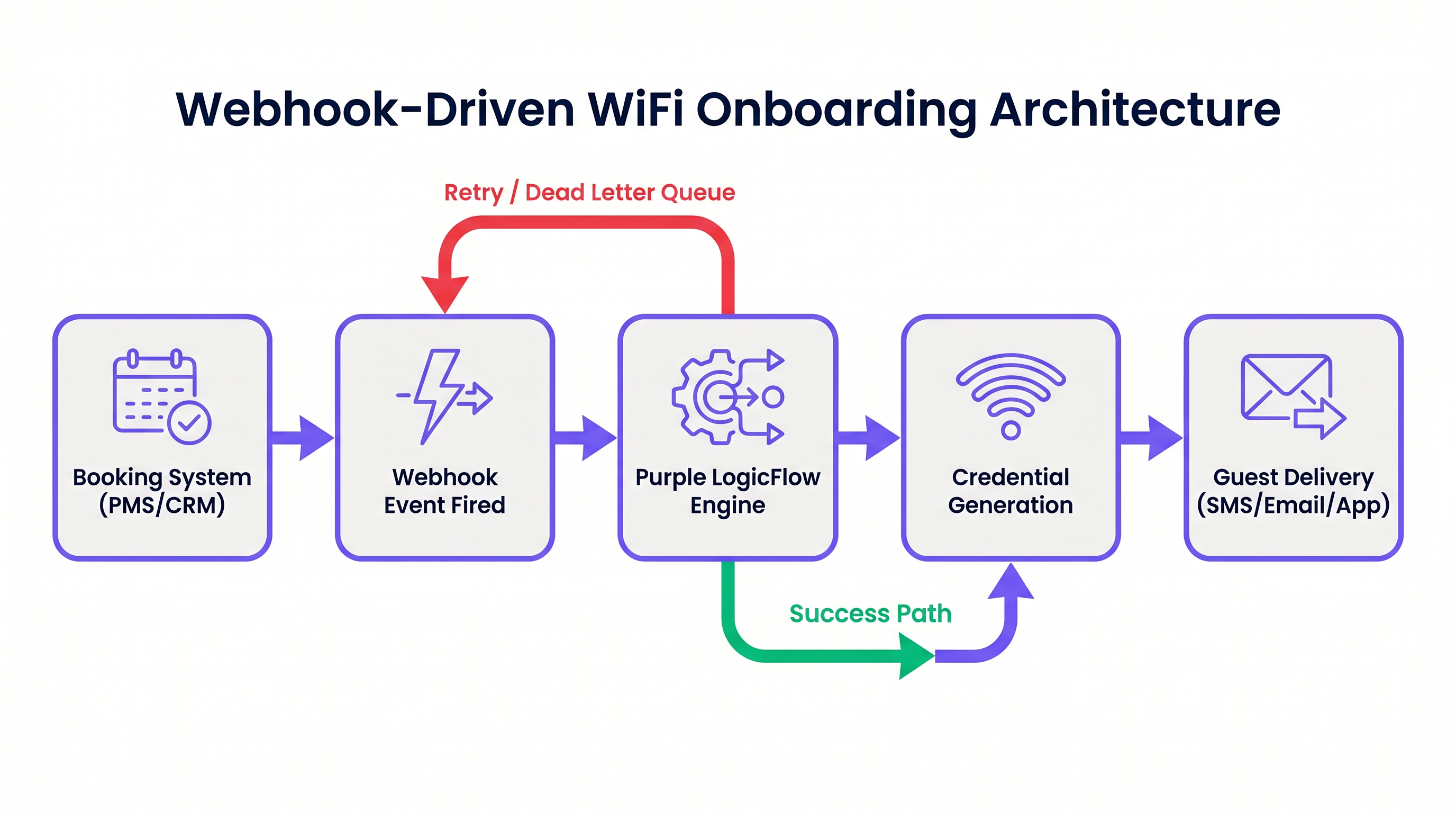
Im Kern ist ein Webhook eine HTTP-POST-Anfrage, die durch ein spezifisches Ereignis in einem Quellsystem ausgelöst wird. Im Kontext der WiFi Onboarding-Automatisierung ist das Quellsystem typischerweise ein Property Management System (PMS), CRM oder eine Event-Registrierungsplattform.
Wenn ein Ereignis eintritt – wie eine Buchungsbestätigung, ein Check-in oder eine Aufenthaltsänderung – sendet das Quellsystem eine JSON-Payload mit relevanten Gastdaten an einen bestimmten Endpunkt.
Die Purple LogicFlow Engine
Purple's LogicFlow-Engine dient in dieser Architektur als intelligente Middleware. Sie empfängt die Webhook-Payload, parst die Gastdaten und führt einen vordefinierten Workflow aus, um eine Netzwerkanmeldeinformation zu generieren. Diese Anmeldeinformation kann die Form eines eindeutigen Pre-Shared Key (PPSK) oder eines RADIUS-basierten dynamischen Kontos annehmen.
LogicFlow verwaltet den gesamten Lebenszyklus der Anmeldeinformationen:
- Generierung: Erstellung einer sicheren, eindeutigen Anmeldeinformation, die an die Identität des Gastes gebunden ist.
- Zustellung: Versand der Anmeldeinformationen per SMS, E-Mail oder API-Push an eine mobile App.
- Aktivierung/Widerruf: Aktivierung der Anmeldeinformationen beim Check-in und präzise Deaktivierung beim Check-out.
Diese Integration verwandelt das Netzwerk von einem isolierten IT-Dienstprogramm in ein geschäftsbewusstes Asset, das perfekt auf den Betriebsablauf des Veranstaltungsortes abgestimmt ist. Für eine breitere Perspektive auf moderne Netzwerkarchitekturen, lesen Sie Die wichtigsten SD WAN Vorteile für moderne Unternehmen .
Implementierungsleitfaden
Die Bereitstellung von Webhook-gesteuertem Onboarding erfordert einen systematischen Ansatz, um Zuverlässigkeit und Sicherheit zu gewährleisten.
Schritt 1: Das Ereignisschema definieren
Bevor Sie Workflows konfigurieren, legen Sie die genauen Ereignisse fest, die Ihr Buchungssystem auslösen kann, sowie die Datenstruktur der entsprechenden Payloads. Sie müssen sicherstellen, dass die Payload eine eindeutige Gastkennung, eine Zustellungsmethode (E-Mail oder Telefonnummer) und die Aufenthaltsdauer enthält.
Schritt 2: Die Integration konfigurieren
Bestimmen Sie die Integrationsmethode basierend auf den Funktionen Ihres Buchungssystems.
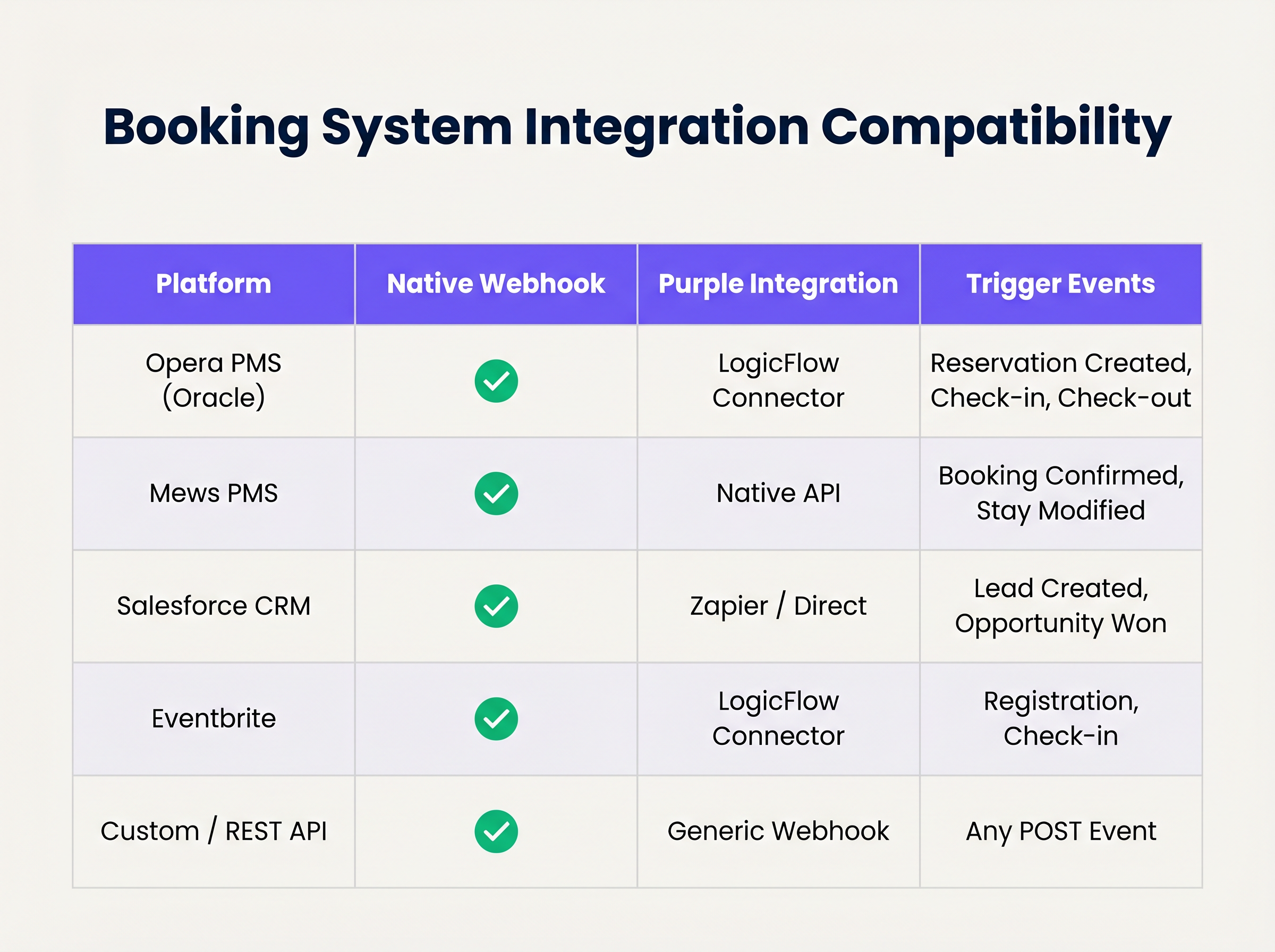
Wenn Ihr System native Webhooks unterstützt, konfigurieren Sie es so, dass es auf Ihren LogicFlow-Endpunkt verweist. Für Systeme ohne native Webhook-Unterstützung müssen Sie möglicherweise Purple's Polling-Konnektoren oder eine zwischengeschaltete Integrationsplattform nutzen.
Schritt 3: Den Lebenszyklus der Anmeldeinformationen gestalten
Legen Sie die Regeln für die Gültigkeit der Anmeldeinformationen fest. Eine Best Practice ist es, die Anmeldeinformationen bei Buchungsbestätigung zu generieren, die Zustellung jedoch bis 24-48 Stunden vor der Ankunft zu verzögern. Stellen Sie sicher, dass die Anmeldeinformationen zum geplanten Check-out-Zeitpunkt automatisch ablaufen.
Schritt 4: Wiederholungs- und Fehlerbehandlung einrichten
Netzwerkanfragen können fehlschlagen. Implementieren Sie Idempotenz, um doppelte Webhook-Ereignisse elegant zu behandeln. Konfigurieren Sie LogicFlows Wiederholungsrichtlinien mit exponentiellem Backoff und richten Sie eine Dead-Letter-Queue für Ereignisse ein, die ihre Wiederholungslimits erschöpfen, um sicherzustellen, dass sie für eine manuelle Überprüfung markiert werden.
Best Practices
- Datenminimierung: Halten Sie sich strikt an die Datenschutzbestimmungen. Extrahieren und verarbeiten Sie nur die Mindestdaten, die zur Generierung und Zustellung der Anmeldeinformationen erforderlich sind. Für einen detaillierten Vergleich der regulatorischen Rahmenbedingungen lesen Sie CCPA vs GDPR: Global Privacy Compliance for Guest WiFi Data .
- Idempotenz: Stellen Sie sicher, dass Ihre Webhook-Verarbeitungslogik idempotent ist. Die mehrfache Verarbeitung desselben Ereignisses "Reservierung bestätigt" darf nicht zur Generierung mehrerer Anmeldeinformationen oder zum Versand doppelter E-Mails führen.
- Fallback-Mechanismen: Halten Sie stets einen manuellen Prozess zur Generierung von Anmeldeinformationen an der Rezeption bereit. Während die Automatisierung die überwiegende Mehrheit der Fälle abdeckt, erfordern Randfälle (z. B. falsche Kontaktdaten bei der Buchung) menschliches Eingreifen.
Fehlerbehebung & Risikominderung
Auch robuste automatisierte Systeme stoßen auf Probleme. Häufige Fehlerursachen sind:
- Zeitzonen-Diskrepanzen: Wenn das PMS in lokaler Zeit arbeitet, während der Netzwerk-Controller in UTC arbeitet, können Anmeldeinformationen vorzeitig ablaufen oder zu lange aktiv bleiben. Behandeln Sie Zeitzonenumrechnungen explizit in Ihrer LogicFlow-Konfiguration.
- Änderungen des Payload-Schemas: Updates des Buchungssystems können gelegentlich die Struktur der Webhook-Payload ändern und Parsing-Fehler verursachen. Implementieren Sie eine Schema-Validierung und Alarmierung, um diese Änderungen sofort zu erkennen.
- Zustellungsfehler: SMS- oder E-Mail-Zustellkann aufgrund ungültiger Kontaktdaten oder Problemen mit dem vorgelagerten Netzbetreiber fehlschlagen. Überwachen Sie die Zustellbestätigungen und konfigurieren Sie Warnmeldungen für hohe Fehlerraten.
ROI & Geschäftlicher Nutzen
Der Übergang zu einem automatisierten WiFi-Onboarding bietet messbaren Geschäftswert in mehreren Dimensionen:
- Operative Effizienz: Die Eliminierung der manuellen Zugangsdatenverteilung spart erhebliche Personalzeit. In einem Hotel mit 200 Zimmern führt eine Einsparung von 3 Minuten pro Gast zu Hunderten von Stunden wiedergewonnener Produktivität pro Jahr.
- Verbessertes Gästeerlebnis: Gäste erwarten nahtlose Konnektivität. Die Bereitstellung von Zugangsdaten vor der Ankunft beseitigt einen Reibungspunkt beim Check-in und trägt direkt zu höheren Zufriedenheitswerten bei.
- Datenintegrität und Analysen: Durch die direkte Verknüpfung des Netzwerkzugangs mit der Buchungsidentität erhalten Veranstaltungsorte hochpräzise, deterministische Daten zum Gästeverhalten und zur Verweildauer, was effektivere Marketinginitiativen ermöglicht. Für Einblicke in die Quantifizierung dieses Wertes siehe Messung des ROI von Gäste-WiFi: Ein Framework für CMOs .
Hören Sie sich das begleitende Podcast-Briefing an, um tiefer in diese Konzepte einzutauchen:
Schlüsselbegriffe & Definitionen
Webhook
An automated HTTP POST request sent from one application to another, triggered by a specific event, carrying a data payload.
The fundamental mechanism for real-time, event-driven integration between booking systems and network infrastructure.
PPSK (Private Pre-Shared Key)
A network security method where each user or device is assigned a unique passphrase for the same SSID.
The preferred credential type for automated hospitality onboarding, offering a balance of security and ease of use compared to standard WPA2-Personal.
Idempotency
A property of certain operations in computer science where applying the operation multiple times has the same effect as applying it once.
Critical for webhook endpoint design to prevent duplicate credential generation if a PMS retries a payload delivery.
Dead-Letter Queue (DLQ)
A holding queue for messages or events that cannot be processed successfully after a defined number of retries.
Essential for troubleshooting integration failures without losing the original booking event data.
LogicFlow
Purple's visual automation engine that receives external triggers, evaluates conditions, and executes actions like credential creation and messaging.
The middleware layer that translates business events from a PMS into network access commands.
RADIUS
Remote Authentication Dial-In User Service; a networking protocol that provides centralized Authentication, Authorization, and Accounting (AAA) management.
Used in high-security environments (like enterprise or healthcare) where 802.1X dynamic credentials are required instead of PPSK.
Payload Schema
The defined structure and format (typically JSON) of the data transmitted within a webhook request.
IT teams must map the PMS payload schema to ensure the automation engine extracts the correct fields for guest name, email, and dates.
Exponential Backoff
An algorithm that uses feedback to multiplicatively decrease the rate of some process, used in network retries.
Prevents overwhelming a recovering service by increasing the wait time between successive retry attempts of a failed webhook.
Fallstudien
A 300-room resort uses Mews PMS and wants to automate WiFi access. They need credentials to be valid only from the official check-in time (15:00) to check-out time (11:00), but want to email the details to the guest the day before arrival.
Configure Mews to fire a 'Reservation Confirmed' webhook to Purple LogicFlow. LogicFlow parses the payload to extract the guest email, arrival date, and departure date. The workflow is configured to generate a PPSK credential immediately, setting the 'Valid From' attribute to 15:00 on the arrival date and 'Valid Until' to 11:00 on the departure date. A scheduled action is then queued in LogicFlow to dispatch the email template containing the PPSK exactly 24 hours prior to the arrival date.
A large conference centre uses Eventbrite for ticketing. They experience massive spikes in concurrent arrivals, causing bottlenecks at the registration desk where WiFi codes are currently handed out.
Integrate Eventbrite with Purple LogicFlow using a webhook triggered on 'Registration Confirmed'. LogicFlow generates a unique WiFi voucher code and immediately emails it to the attendee as part of their digital ticket package. The network controller is configured to activate the voucher upon first use, valid for the duration of the multi-day event.
Szenarioanalyse
Q1. Your hotel is migrating to a new PMS that sends stay dates in UTC, but your network controller is configured for local time (UTC+2). The webhook payload includes: `"checkout_time": "2024-05-10T10:00:00Z"`. If no timezone conversion is applied in the automation layer, what is the operational impact?
💡 Hinweis:Consider when the guest expects to lose access versus when the system will actually revoke it.
Empfohlenen Ansatz anzeigen
The network controller will interpret the 10:00:00 time as local time. Because local time is UTC+2, 10:00:00 local time occurs two hours before 10:00:00 UTC. Therefore, the guest's WiFi credential will be revoked two hours before their actual checkout time, leading to connectivity complaints on the morning of departure. Timezone normalization must be explicitly handled in the LogicFlow configuration.
Q2. A stadium ticketing system fires a webhook for every ticket sold. You notice that your LogicFlow engine is processing 500 events per minute during an on-sale rush, but the downstream SMS gateway API is rate-limiting you to 100 requests per minute. How should you architect the automation to handle this?
💡 Hinweis:Look at the decoupling of credential generation and credential delivery.
Empfohlenen Ansatz anzeigen
You must decouple the credential generation from the delivery mechanism. The webhook should trigger LogicFlow to generate the credential and place the delivery task into a managed queue. The queue should then process the SMS dispatches at a controlled rate (e.g., 90 per minute) to respect the SMS gateway's rate limits, utilizing exponential backoff for any throttled requests.
Q3. During a network audit, the compliance officer notes that webhook payloads containing guest names and phone numbers are being logged in plain text in your middleware diagnostic logs for 90 days. What is the recommended remediation?
💡 Hinweis:Refer to the Data Minimisation best practice and GDPR Article 5.
Empfohlenen Ansatz anzeigen
Diagnostic logs should be configured to obfuscate or redact Personally Identifiable Information (PII) such as names and phone numbers. Only non-sensitive metadata (like event IDs or timestamp) should be retained for troubleshooting. Furthermore, the retention period for diagnostic logs should be reduced to the minimum necessary for operational monitoring (e.g., 7 to 14 days), rather than 90 days.
Wichtigste Erkenntnisse
- ✓Webhook automation eliminates manual WiFi credential distribution, reducing front-desk overhead and friction.
- ✓Integration relies on HTTP POST payloads triggered by PMS events like 'Reservation Confirmed'.
- ✓Purple's LogicFlow engine acts as the middleware, translating booking events into network access commands.
- ✓Idempotency is critical to prevent duplicate credential generation from retried webhook events.
- ✓Credentials should be generated early but activated strictly according to check-in/check-out times.
- ✓Proper handling of timezones and dead-letter queues is essential for robust, enterprise-grade deployments.




