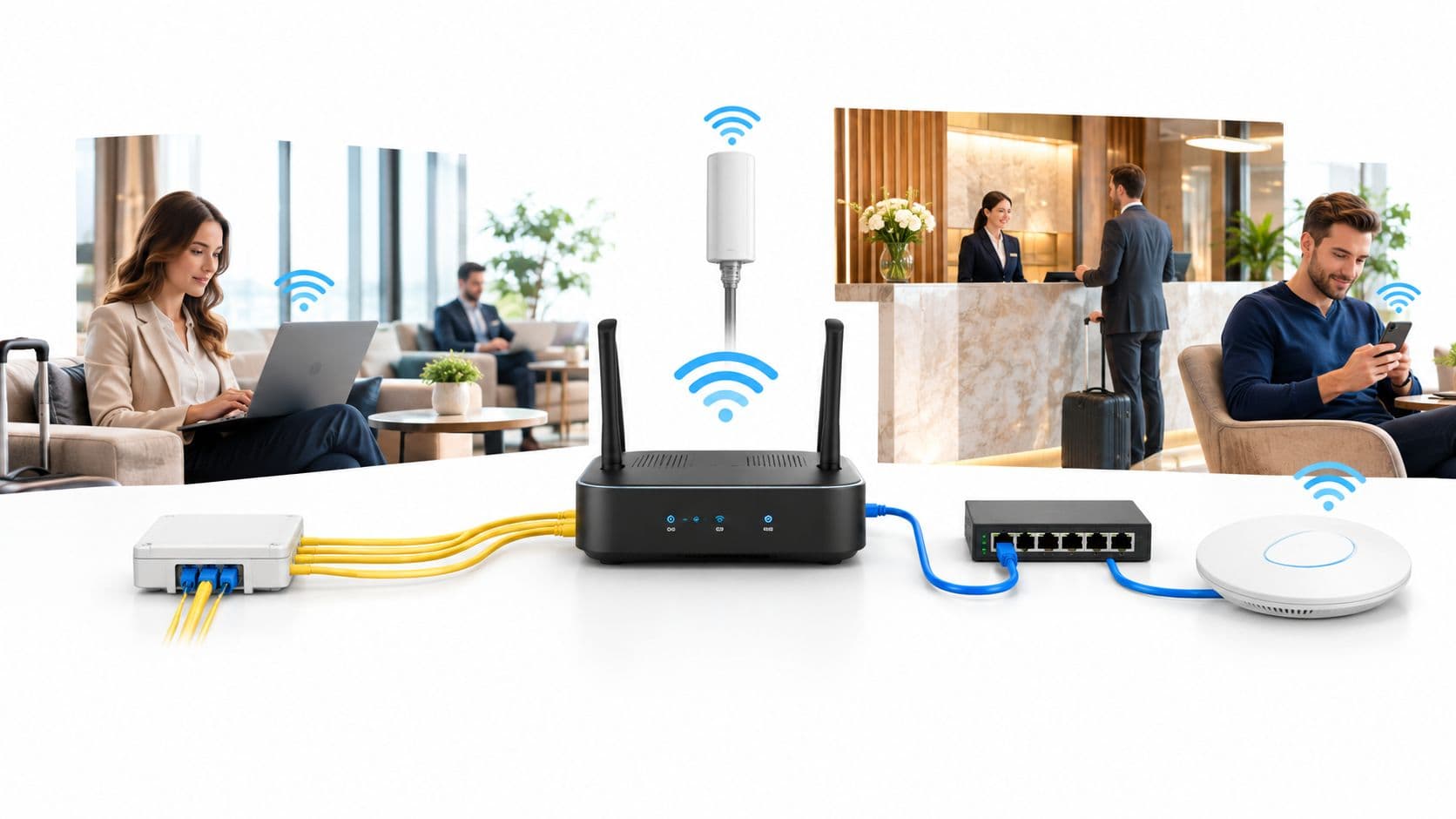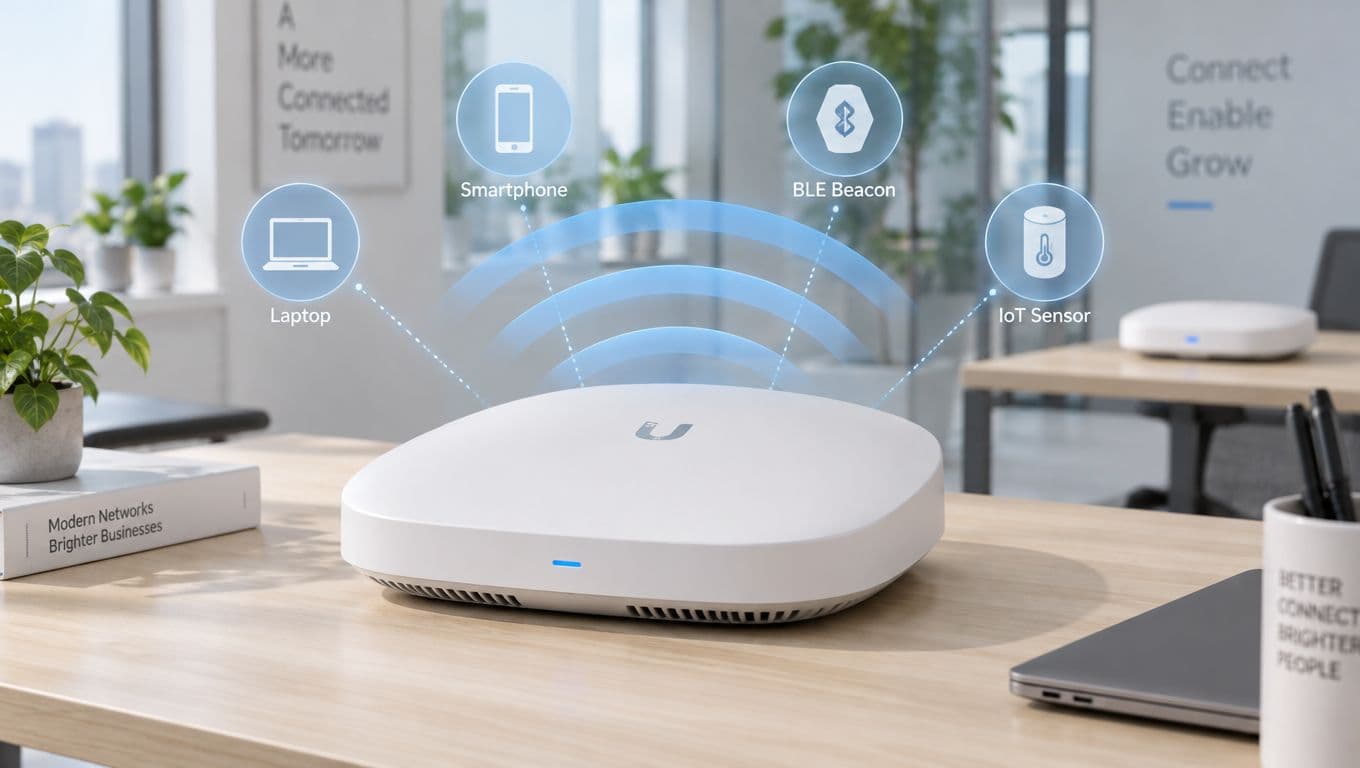
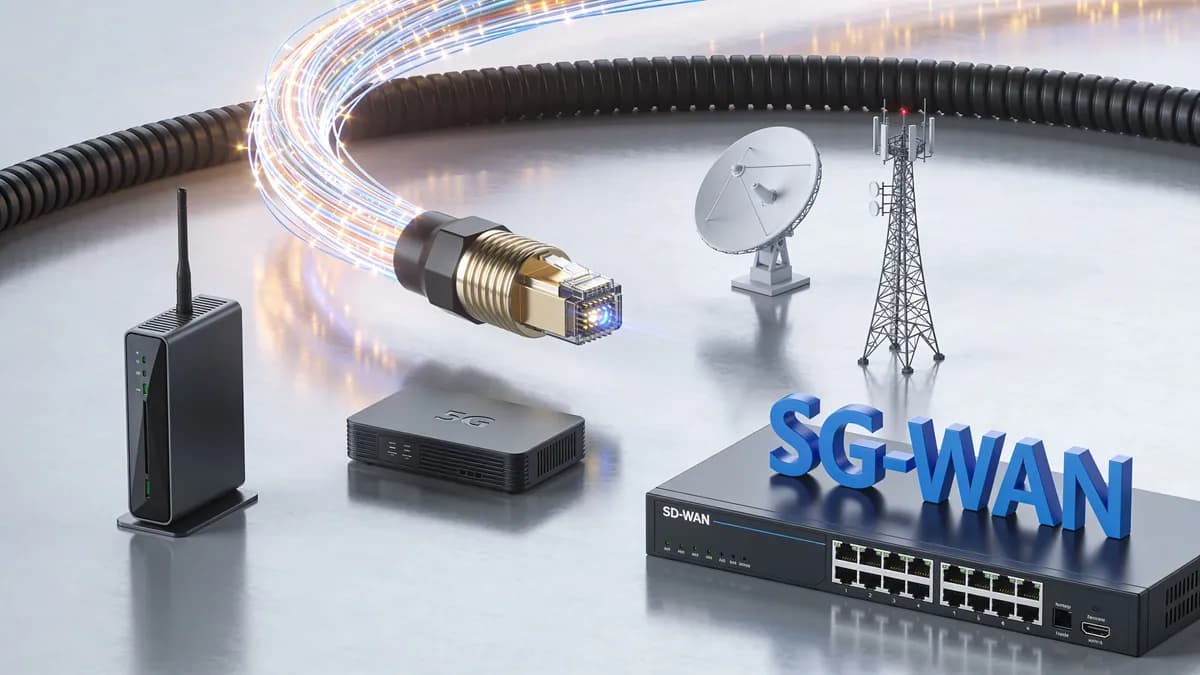
Business internet connection & backhaul advisor
Evaluate connection types against your venue profile. Compare bandwidth symmetry, latency, uptime SLAs, and guest WiFi performance.
Dedicated Internet Access (DIA / Leased Line)
Technology: Fibre Optic (Dedicated)Private fibre circuit delivering guaranteed symmetrical throughput and zero contention. Ideal for mission-critical operations, large guest WiFi footprints, and cloud RADIUS authentication.
Architectural analysis for selected venue
Planning backhaul and guest WiFi for your venue?
Purple pairs with your existing network infrastructure to deliver high-performance captive portals, dynamic bandwidth policing, and continuous guest analytics.
- ✓Dynamic bandwidth tiers and session rate limiting
- ✓Compatible with Cisco Meraki, HPE Aruba, Ruckus and Ubiquiti UniFi
- ✓Zero trust guest isolation and 802.1X enterprise security
Request a network connectivity assessment
Get expert guidance on sizing internet backhaul, configuring captive portals, and scaling multi-site WiFi.
A hotel group upgrades its guest WiFi journey. The login page is cleaner. Staff no longer share a single password. Roaming between the lobby, bar, and rooms should feel effortless. Then the complaints start. Check-in tablets lag. Guest devices connect, then stall. Analytics arrive late, so the operations team cannot trust what they see.
In many cases, the wireless platform is not the weak point. The bottleneck sits underneath it. Your internet connection type decides whether identity-based WiFi feels smooth, fragile, or impossible to scale.
That is why understanding the different types of internet connection matters far beyond headline speed. For a multi-site business, the line you buy affects guest experience, staff productivity, onboarding, roaming, resilience, and the practical reality of enforcing secure access across many locations. A fast-looking service can still fail under peak load. A slower service can still be the right fit if it is stable, predictable, and paired with the right design.
Your Internet Connection Is More Than Just Speed
A shopping centre can post excellent download results in a quiet morning test and still struggle at lunchtime. A care setting can have decent bandwidth on paper and still suffer delays that break login flows for clinical staff. A hotel can install modern access points and still see poor reviews because the backhaul line slows down when everyone streams at once.
That is the first point to lock in. Internet performance is multidimensional.
What businesses often miss
Most buyers start with one question. “How fast is it?” That matters, but it is not enough.
A better set of questions looks like this:
- How is bandwidth delivered? Is it over fibre, coaxial cable, copper, or radio?
- How is bandwidth shared? Do neighbouring premises compete for it at busy times?
- How does it behave under load? Stable lines protect logins, roaming, and real-time systems.
- What happens when it fails? Recovery speed matters as much as headline throughput.
For identity-based WiFi, these details have direct operational consequences. Staff authentication depends on timely communication with cloud services and directory platforms. Guest onboarding depends on pages loading quickly and consistently. Roaming depends on low delay and predictable packet delivery, not just raw download capacity.
Key takeaway: If your business relies on guest access, staff mobility, or real-time visibility, the right connection is the one that stays consistent when the building is busy.
The business lens
Senior IT teams rarely choose one line for one building in isolation. They choose a standard, then repeat it across hotels, stores, clinics, student housing, or transport sites. That means one poor assumption scales into many incidents.
The practical job is to match connection characteristics to outcomes:
- Guest experience: Fast onboarding, stable roaming, fewer complaints.
- Security: Reliable identity checks, certificate-based access, cleaner separation between users.
- Operations: Better support for cloud apps, payment systems, and reporting.
- Growth: A foundation that can absorb more devices without redesigning everything.
The 2026 Connectivity Environment A Modern Business Guide
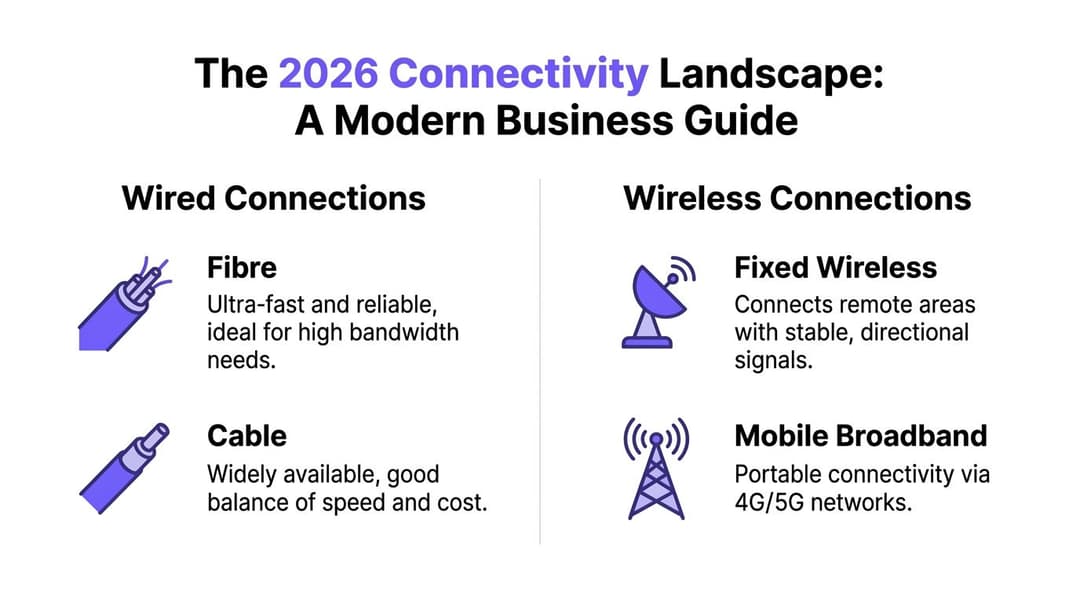
Most connection types fall into two simple families. Wired connections reach your building through a physical line. Wireless connections reach you through radio. That sounds basic, but it gives you a useful map for every buying decision that follows.
Wired versus wireless
Wired services usually offer more predictable performance because the path into the building is fixed. Fibre is the clearest example. Cable also sits in this family, though its shared neighbourhood architecture changes how it behaves at busy times. DSL remains relevant where newer infrastructure has not arrived yet.
Wireless services matter when speed of deployment, mobility, or site constraints make physical circuits difficult. Fixed wireless and mobile broadband can be strategic choices for satellite venues, temporary sites, or buildings where landlord access slows installation.
Shared versus dedicated
This distinction causes a lot of confusion.
A shared service means your performance can be influenced by other users on the same local network segment or radio resource. Cable often works this way. Some wireless options do too. These connections can perform well, but they can also become less predictable during busy periods.
A dedicated service gives your organisation a more controlled path and tighter service expectations. Leased lines sit in this category. They usually cost more, but they simplify planning for sites where failure is expensive.
The four performance metrics that matter
Speed
Download speed gets all the attention. Upload speed deserves equal scrutiny in business environments. Guest WiFi analytics, cloud backups, CCTV uplinks, collaboration tools, and synchronisation all rely on upstream capacity.
Latency
Latency is delay. It affects how responsive applications feel. Authentication handshakes, roaming decisions, and cloud-managed systems all benefit from lower latency.
Jitter
Jitter is variation in delay. A line with uneven delivery can feel worse than a slower line that is steady. Real-time analytics and login transactions are sensitive to this inconsistency.
Reliability
Reliability is whether the service behaves the same way throughout the day and recovers cleanly when something goes wrong, making connection choice a board-level issue for multi-site operators.
A simple planning model
Use this mental model when comparing different types of internet connection for a business site:
| Connection trait | What it means in practice | Business impact |
|---|---|---|
| Symmetrical performance | Upload and download capacity are closer together | Better cloud workflows and smoother identity traffic |
| Low latency | Faster response between site and service | Quicker onboarding and less user friction |
| Low jitter | More consistent packet timing | Fewer strange intermittent complaints |
| Predictable availability | Stable service throughout trading hours | Better support for staff tools and guest journeys |
A rural hotel, an urban clinic, and a flagship retail store can all need different access methods. They still need the same discipline: judge the line by how it supports user identity, device trust, and daily operations.
Wired Connections The Foundation of Performance
A multi-site business usually feels internet problems first at the edge of the customer journey. Guests hit the captive portal and wait. Staff tablets pause during sign-in. Security policies take longer to apply than they should. In most permanent locations, the root cause is not WiFi alone. It is the fixed line underneath it.

Wired access sets the operating ceiling for everything a modern platform like Purple is trying to do. If the line is stable, low-latency, and predictable, identity checks complete faster, zero-trust policies apply more cleanly, analytics arrive on time, and roaming between access points feels invisible to the user. If the line is inconsistent, even a well-designed WiFi estate can look unreliable.
Full fibre FTTP
Full fibre, or FTTP, brings fibre directly into the premises. For businesses deploying cloud-managed networking and identity-based WiFi, it is usually the cleanest option because it reduces the two constraints that cause the most friction: weak upstream capacity and inconsistent delay.
A good way to assess FTTP is to stop viewing it as a fast pipe for downloads. It is the main road between your site and the cloud services that handle authentication, policy, analytics, and device communication. Purple depends on that road being clear in both directions. Guest onboarding sends traffic upstream. Access decisions send traffic upstream. Real-time insight into visitor behaviour sends traffic upstream. A line that performs well only on downloads can still create poor user experience.
Where FTTP makes business sense
FTTP is a strong fit for sites where WiFi is tied closely to operations, security, and customer experience:
- Hotels and resorts: smooth guest login, better roaming across public areas, and fewer delays when many users connect at once
- Large retail stores: steadier support for cloud POS, digital displays, visitor analytics, and staff handheld devices
- Healthcare sites: cleaner separation between guest, staff, and managed-device traffic, with faster policy checks
- Student and residential schemes: better support for dense device populations and always-on resident expectations
For Purple deployments, FTTP is often the target standard because it supports the features businesses notice most. Seamless onboarding feels faster. OpenRoaming-style experiences are easier to sustain. Security controls that depend on identity and segmentation are less likely to be undermined by line delay or congestion.
One caveat matters. Fibre availability on paper does not always mean fibre readiness in practice. Landlord approvals, wayleaves, internal building routes, and installation lead times can all slow delivery. For portfolio planning, that makes FTTP both a technical decision and a procurement decision.
Cable internet
Cable broadband uses coaxial infrastructure. It can be a practical option for urban sites that need decent performance without the cost or lead time of a dedicated enterprise circuit.
The trade-off is consistency. Cable often shares capacity across a local area, so performance can vary more during busy periods. For a home user, that may be an annoyance. For a venue using Purple to manage guest access, collect live footfall data, and enforce identity-led policies, that variation can create a different operational picture.
Where cable works well
Cable can be a sensible choice for:
- Smaller urban sites that need service quickly
- Locations with moderate guest usage rather than dense, all-day demand
- Branches with limited cloud dependency beyond standard browsing, email, and basic SaaS tools
- Interim deployments while a higher-grade primary circuit is being arranged
Cable is often good enough when the business goal is broad internet access with reasonable downstream performance. It becomes less comfortable when the site depends on time-sensitive authentication and consistent cloud interaction. The issue is not raw speed alone. The issue is whether the line behaves the same way at 10 a.m. and 6 p.m.
That distinction matters for identity-based WiFi. A guest rarely complains that upstream bandwidth is low. They complain that login took too long, roaming dropped, or the experience felt unreliable. Cable can support a Purple deployment, but it should be sized and tested with peak occupancy in mind, not quiet-hour averages.
DSL
DSL runs over telephone lines, so it still appears in locations where better fixed options are unavailable or delayed. It remains usable for light office connectivity, but its limitations show up quickly in sites that expect strong guest WiFi, cloud management, or strict access control.
In practical terms, DSL is usually a compromise line. It can keep a small branch online. It can support admin traffic and low-density usage. It is far less comfortable as the foundation for a modern customer-facing wireless service. If your team is planning a broader rollout, Purple's guide to wireless connection types for business networks can help frame where fixed-line constraints start pushing you toward alternative access designs.
A useful test is simple. Ask whether the site needs to deliver a smooth experience for many transient users while also enforcing separate policies for guests, staff, and devices. If the answer is yes, DSL usually belongs in a fallback role, not as the long-term primary connection.
Leased lines and business Ethernet
Leased lines and business Ethernet are designed for organisations that care less about headline price and more about guaranteed behaviour. You are buying dedicated capacity, clearer service commitments, and a connection model built for accountability.
That matters most at sites where downtime or instability has a visible business cost. A flagship store losing guest engagement, a hospital delaying secure device access, or a large hotel struggling with conference traffic all face a bigger problem than slow browsing. They face disrupted operations, poorer service perception, and more support overhead.
When a leased line earns its cost
A leased line is often justified where a site needs:
- Predictable performance during trading hours, events, or seasonal peaks
- Stronger upload capacity for identity traffic, cloud apps, and analytics feeds
- Faster fault response and clearer SLAs than standard broadband products
- A standard design pattern that can be repeated across priority sites in the estate
For Purple customers, this connection type often supports the most mature model. Guest access, zero-trust enforcement, analytics collection, and roaming all benefit from a line that behaves consistently under load. That consistency is what operations teams buy when they move from consumer-style broadband to business Ethernet.
Do not stop at the circuit
The access line is only part of the path. Poor internal cabling can bottleneck access points, switching, and uplinks long before the WAN reaches its limit. If you are refreshing the LAN as part of a wider site upgrade, this guide to Cat6a Ethernet cable is a useful reference for planning cleaner standards across high-capacity sites.
A simple rule works well here. Choose the wired connection by the business outcome you need. Use FTTP where you want strong cloud performance at scale. Use cable where deployment speed and moderate demand matter more than perfect consistency. Use DSL only where options are limited. Use leased lines where guest experience, security posture, and operational continuity justify dedicated service.
Wireless Connections Extending Your Reach and Mobility
Wireless access is no longer only a fallback. In the right setting, it is a deliberate design choice. That is particularly true when site rollout speed, landlord restrictions, temporary operations, or hard-to-reach locations make fixed circuits slow to deploy.

Fixed wireless access
Fixed wireless access uses a radio link between your premises and a local network point. It is different from ordinary mobile tethering because it is designed as a site connection, not just a personal data service.
For businesses, fixed wireless is useful where trenching a line is too slow, too disruptive, or not commercially viable. It can also help standardise connectivity across smaller sites that do not justify full fibre immediately.
The UK context matters here. Many rural areas face major connectivity gaps. Verified data states that fixed wireless (5G Home) is emerging as a solution, with Vodafone and Three trials reporting 40% latency improvements over satellite, from 600ms to 20ms, enabling real-time analytics for retail footfall tracking (professormesser.com).
That is a practical business point, not just a network one. If a rural venue wants cloud-managed guest access, basic analytics, and responsive staff tools, fixed wireless may move it from “barely connected” to operationally viable.
Mobile broadband and 5G
5G changes the conversation because it can serve in three different roles:
- Primary access for smaller or fast-moving sites
- Interim access while waiting for a wired install
- Failover access when a primary circuit drops
This makes it attractive for pop-up retail, transport sites, sales offices, event spaces, and distributed portfolios where some locations cannot wait on civil works.
A useful background read on the wireless side of the network stack is Purple’s own explainer on what is wireless connection. It helps distinguish the internet bearer from the WiFi experience users touch inside the venue.
Where 5G is strongest
5G is a strategic option when the business values:
- Speed of rollout
- Portability between sites
- Backup resilience
- Coverage in places where fixed-line options lag
What to watch closely
Wireless links depend more on signal environment, local congestion, antenna placement, and building materials. That means two nearby sites can behave differently. A strong pilot and proper survey matter.
Satellite internet
Satellite still matters for the sites other technologies cannot reach. Think remote hospitality, isolated properties, and locations where neither wired nor terrestrial wireless is realistic.
The issue has long been latency. High delay makes real-time interactions feel sluggish. Authentication can still work, but user experience often suffers, and cloud-heavy operations can feel awkward.
That does not make satellite useless. It makes it specialised. Where no other option exists, the decision shifts from “Is this ideal?” to “What workflows can this support reliably?” In those cases, keep guest expectations modest, prioritise business-critical traffic, and avoid assuming that advanced identity flows will feel the same as they do on fibre or high-quality fixed wireless.
Practical advice: In difficult coverage areas, treat wireless as a design discipline. Antenna placement, failover rules, and traffic priorities matter as much as the tariff you buy.
Advanced Networking SD-WAN and Legacy Systems
Multi-site businesses rarely stay on one access type everywhere. One hotel gets fibre. Another gets cable. A small satellite branch relies on 5G. Managing those differences manually creates inconsistency, and inconsistency creates support burden.
What SD-WAN does
SD-WAN sits above the connection types themselves. It is a control layer that decides which path traffic should use based on policy and link conditions.
That means an organisation can route payment traffic differently from guest browsing, or move critical identity traffic away from a degraded line without waiting for a human to intervene. It turns a collection of circuits into a more coherent network.
For teams evaluating this model, Purple has a useful overview of SD-WAN benefits.
Why it matters for identity and user experience
In practical terms, SD-WAN helps with three recurring problems:
- Uneven site quality: one branch has strong fibre, another has variable wireless
- Application priority: staff access and payment systems matter more than casual guest traffic
- Resilience: failover becomes automated rather than improvised
This is especially useful where cloud-managed authentication and directory-driven access depend on stable paths. If one circuit becomes noisy or unstable, SD-WAN can steer higher-priority traffic onto the cleaner route.
A quick note on legacy access
Dial-up belongs in this discussion only as a reminder of how far expectations have moved. Modern businesses now expect persistent connectivity, secure segmentation, cloud control, roaming, and identity-aware access. Legacy access methods cannot support that operating model.
The broader lesson is simple. Choosing between different types of internet connection is no longer a procurement footnote. It is part of your security and operations architecture.
Building a Resilient and Secure Network Strategy
A regional hotel group offers a useful example. One site loses its primary circuit on a Friday check-in window, but the true damage is not the outage itself. It is the queue at reception, the payment retries, the failed guest onboarding journey, and the loss of visibility for the team monitoring access and security across the estate.

Resilience starts with service continuity
A resilient design protects the business functions that sit on top of the connection. For organisations deploying identity-based WiFi with Purple, that means keeping authentication, policy enforcement, guest access journeys, analytics, and roaming services available even when one line becomes unstable.
The practical answer is usually connection diversity. A wired primary with a wireless backup gives you two different paths, with different failure points. That matters far more than headline speed alone. If one provider has a local fault, or if a building access issue delays fibre installation, the site can still support guest connectivity and staff access without dropping into manual workarounds.
Coverage also varies by building type and geography, so planning should reflect forecasts rather than assumptions. Projections from Ofcom's 2025 connectivity reporting suggest full-fibre availability will continue to expand, but multi-tenant and hard-to-reach sites may still face delays and installation constraints. Forecasts for 5G fixed wireless adoption point to wider business use through 2026, which makes wireless a realistic part of a permanent resilience design, not just a temporary stopgap.
Security is shaped by connection quality
Security policy lives in software, but user experience depends heavily on the line underneath it.
A low-latency, stable connection helps identity checks complete quickly, keeps cloud policy updates consistent, and supports the steady exchange of telemetry that operations teams rely on. In a Purple deployment, those conditions directly affect how smoothly guests onboard, how reliably staff devices are validated, and how accurately teams can monitor usage patterns across multiple sites in real time.
Symmetry matters too. Many businesses focus on download speed because it is easy to market, but identity-based WiFi depends on healthy upstream performance as well. Access points, controllers, and cloud services are constantly sending authentication requests, session data, logs, and analytics. If the upstream path is weak or congested, zero-trust controls can feel slow even when browsing speed looks acceptable.
An easy comparison helps here. Raw bandwidth is the width of the motorway. Latency is the distance to the destination. Reliability is whether the road stays open during rush hour. Purple's cloud-managed services benefit from all three, because secure access and real-time analytics depend on consistent round trips, not just fast downloads.
A helpful non-technical companion resource for stakeholder education is this guide on how to protect online privacy. It can support broader discussions around user trust, data handling, and why secure access policies need a dependable network underneath them.
Match the design to the cost of failure
Different sites fail differently. A retail branch may survive a short guest WiFi interruption but not a payment outage. A healthcare site may tolerate slower guest access, but not delayed staff authentication. A student accommodation operator may care less about peak download benchmarks than about tenant isolation, simple onboarding, and fast fault recovery.
That is why line choice should map to a business consequence, not a generic speed tier.
| Site type | What must keep working | Sensible strategy |
|---|---|---|
| Hotel or venue | Guest onboarding, roaming, payments, support visibility | Stable primary line, independent backup path, clear traffic priority |
| Healthcare site | Staff identity checks, secure segmentation, continuous operations | High-quality primary service, automatic failover, strict policy separation |
| Retail chain | Consistent guest experience and repeatable security standards | Standardised mix of access types with central control and backup options |
| Multi-tenant property | Tenant isolation, easy onboarding, reliable cloud policy delivery | Strong segmentation, predictable upstream capacity, resilient secondary path |
For teams translating these priorities into architecture, Purple's guide on how to design a network for performance and control is a useful planning reference.
Key takeaway: A resilient network strategy protects business outcomes. For Purple deployments, that means preserving secure onboarding, identity-driven access, roaming continuity, and real-time visibility when a circuit is degraded or unavailable.
How to Choose and Integrate the Right Connection for Purple
A hotel group is rolling out Purple across city-centre properties, roadside sites, and a conference venue. On paper, each location already has "fast internet." In practice, one site struggles with guest onboarding at check-in, another has patchy roaming between floors, and a third loses visibility into live footfall data whenever the link becomes unstable. The difference is not the headline speed. It is how the connection behaves under real policy, identity, and user load.
For Purple deployments, the better starting point is simple. Choose the access method that protects the service you cannot afford to interrupt, then integrate it so authentication, analytics, and segmentation continue to work predictably.
Earlier sections explained why fibre often sets the strongest baseline for high-density sites. Here, the decision is less about naming a winner and more about matching connection characteristics to Purple's operating model. Symmetrical capacity helps when guest devices, staff logins, cloud policy checks, and analytics are all sending traffic upstream at the same time. Low latency shortens the delay between a user connecting and the network confirming identity and access rights. Stable performance matters because identity-based WiFi behaves more like a live security system than a simple internet pipe.
A practical decision framework
Hospitality
A hotel or venue should judge connectivity by the guest journey. Can visitors join quickly at reception. Does roaming stay smooth between lobby, room, and bar. Can staff devices authenticate without delay during busy periods.
That usually points to a high-quality primary wired connection, often fibre, with an independent backup path. Purple can support passwordless guest access, OpenRoaming, and staff access tied to identity providers, but those features depend on consistent response times from the underlying network.
Retail
Retail groups need repeatability. A flagship store may need dedicated capacity for dense footfall, POS resilience, and real-time reporting. A smaller branch may be better served by a standardised design that combines a dependable fixed line with wireless backup for continuity.
The useful question is not "What is the fastest service available here?" It is "Which service lets every store deliver the same login flow, policy enforcement, and reporting standard?" Purple's value increases when each site behaves predictably enough for central teams to apply the same access rules across the estate.
Healthcare
Healthcare sites should treat the line as part of the control plane for secure access. Staff identity checks, segmented guest access, and operational devices all rely on timely policy decisions. A connection with inconsistent latency can make authentication feel slow even if a speed test looks acceptable.
In these environments, clean failover matters as much as primary performance. If the main circuit drops, Purple still needs a path for policy updates, user sessions, and access controls to continue with minimal disruption.
Residential and student accommodation
Here the network works like a managed utility. Residents expect quick onboarding and room-to-room reliability. Operators need tenant separation, support visibility, and the ability to handle frequent device changes without falling back to shared passwords.
That makes upstream stability and predictable busy-hour behaviour more useful than a marketing claim about peak download speed. Purple's multi-tenant controls and identity-led access are strongest when the connection can handle many small, simultaneous authentication and analytics events without becoming erratic.
Match the connection to the outcome you need
A practical way to decide is to work backwards from the feature that matters most:
- Passwordless guest access and smooth roaming: choose a connection with low latency and consistent performance, typically a strong wired primary service
- Fast rollout across mixed property types: use a standard design with fixed access where available and wireless backup where install times or building constraints are harder to manage
- Secure staff access and zero-trust policies: prioritise stable upstream capacity so identity checks and policy enforcement happen quickly
- Real-time analytics and operational visibility: avoid links that vary heavily under peak demand, because delayed data reduces the value of live insight
Purple is relevant here as an identity-based WiFi platform. It replaces shared credentials and portal-heavy access with passwordless guest connectivity, directory-integrated staff access, OpenRoaming support, and multi-tenant controls. Those capabilities are not separate from the line choice. They sit on top of it. A well-chosen connection gives Purple the steady foundation it needs to deliver secure onboarding, seamless movement between access points, and reliable analytics across every site.
Frequently Asked Questions
The questions that shape a good connectivity decision usually appear after the shortlist is made. A hotel group may already know fibre is available at one site, cable at another, and 5G at a newly acquired property. The harder question is what happens when those links have to support passwordless guest onboarding, staff identity checks, roaming between access points, and live reporting in Purple at the same time.
That is the lens for the questions below. They focus less on headline speed and more on behaviour under real operating conditions, because a connection that looks fast on paper can still create friction for guests, gaps in visibility, or delays in policy enforcement.
Frequently Asked Questions about Internet Connections
| Question | Answer |
|---|---|
| Is fibre always the right answer for business? | Fibre is often the clearest fit for high-density sites because it usually offers better consistency, lower delay, and stronger upstream performance. The final decision still depends on installation timescales, local availability, budget, and whether the site also needs a separate backup path. |
| Why can a connection with high download speed still feel poor? | User experience depends on more than throughput. If latency or jitter rises, guest login pages load slowly, identity checks take longer, roaming feels less smooth, and cloud applications become inconsistent even when speed tests look acceptable. |
| Is cable good enough for guest WiFi? | It can be suitable for smaller venues, lower-density sites, or temporary deployments. For busier environments, the main question is whether performance stays predictable at peak times, because guest access and Purple analytics both rely on a line that stays steady under shared demand. |
| When does 5G make sense as primary access? | 5G works well when speed of deployment matters more than waiting for a fixed line, or when building constraints make wired installation difficult. It is also a strong choice for pop-up locations, newly opened sites, and failover design, especially where Purple services need to stay available during an outage on the primary circuit. |
| Is satellite suitable for modern identity-based WiFi? | Satellite is usually the access option for remote sites with limited alternatives. It can support basic connectivity, but higher delay can slow captive journeys, authentication steps, policy checks, and any workflow that depends on quick back-and-forth communication. |
| What matters most for staff authentication? | Predictability. Staff access often involves directory lookups, certificate validation, and policy decisions in real time. If the connection is unstable, those checks can feel slow or fail intermittently, which affects both productivity and security. |
| Do multi-site businesses need the same connection everywhere? | Multi-site organisations usually need the same service standard, not the same access method. A flagship hotel, a small retail branch, and a remote clinic can use different circuits underneath, while Purple still applies a consistent identity, guest access, and policy model across the estate. |
| What is the biggest procurement mistake? | Buying on advertised speed alone. A better buying question is whether the line supports the experience and control the business expects during busy periods, during failover, and during everyday security events such as guest onboarding or staff reauthentication. |
If you are reviewing connectivity options for hotels, retail estates, healthcare sites, or multi-tenant properties, Purple provides a practical way to align guest access, staff identity, and network experience with the infrastructure underneath. Assessing the connection strategy and the WiFi authentication model together usually leads to fewer deployment compromises later.