

Cumplimiento IWF para redes WiFi públicas en el Reino Unido
Esta guía autorizada detalla los requisitos técnicos, la arquitectura y las estrategias de implementación para redes WiFi públicas que cumplen con IWF en ubicaciones del Reino Unido. Proporciona a los líderes de TI marcos de acción para mitigar riesgos legales mientras mantienen un acceso a la red de alto rendimiento.
Escucha esta guía
Ver transcripción del podcast
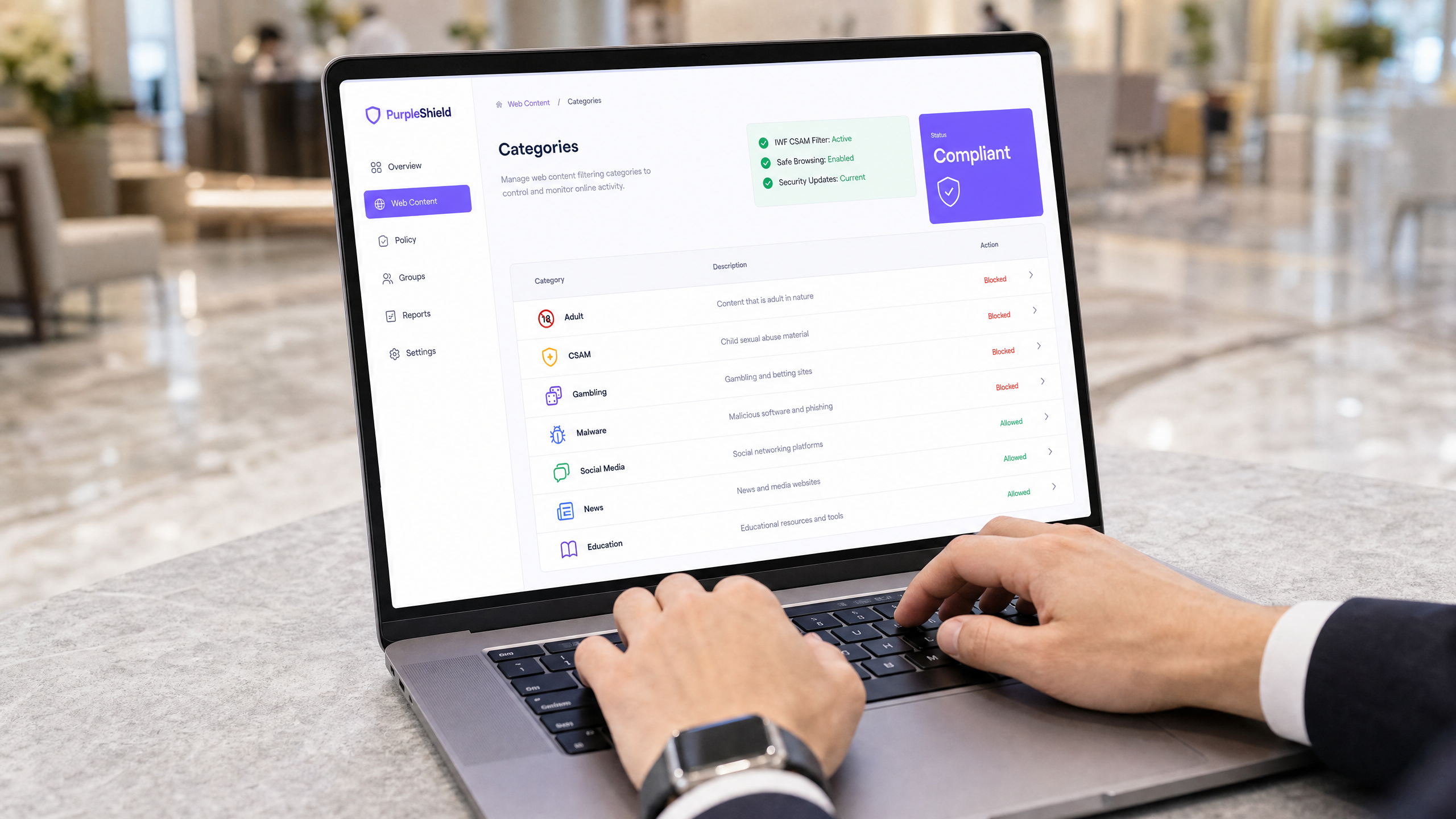
Resumen Ejecutivo
La provisión de WiFi público en el Reino Unido ha pasado de ser una comodidad para los huéspedes a un vector crítico de cumplimiento. Para los Directores de TI y CTOs que gestionan entornos de Retail , Hostelería y del sector público, implementar una red abierta sin un filtrado de contenido robusto expone a la organización a riesgos legales y reputacionales significativos. La Internet Watch Foundation (IWF) mantiene la lista de bloqueo definitiva para Material de Abuso Sexual Infantil (CSAM). Integrar esta lista en el borde de la red no es simplemente una buena práctica; es un requisito fundamental para la operación responsable de un establecimiento.
Esta guía describe la arquitectura técnica necesaria para lograr el cumplimiento IWF, detallando las estrategias de implementación en las capas DNS y HTTP. Elimina el ruido para proporcionar consejos prácticos y neutrales respecto al proveedor sobre la implementación de filtrado web certificado sin degradar el rendimiento de la red o la experiencia del usuario. Desde asegurar el WiFi para Invitados hasta la integración con estándares de autenticación modernos como IEEE 802.1X y OpenRoaming, exploramos cómo construir una red compatible y de alto rendimiento.
Análisis Técnico Detallado: Arquitectura de Cumplimiento IWF
La implementación del cumplimiento IWF requiere un enfoque de seguridad de red multicapa. El requisito principal es la integración dinámica de la lista de URLs de IWF en el motor de filtrado web del establecimiento.
Esta no puede ser una lista estática y actualizada manualmente; requiere una sincronización en tiempo real o casi en tiempo real con la base de datos de IWF.
Capa 1: Filtrado DNS
En el nivel más fundamental, el filtrado DNS intercepta las solicitudes a dominios CSAM conocidos y las resuelve a una página de bloqueo o a una ruta nula. Aunque es altamente eficiente y de baja latencia, el filtrado DNS por sí solo es insuficiente porque opera a nivel de dominio, mientras que la lista IWF a menudo especifica URLs exactas. Confiar únicamente en DNS puede llevar a un bloqueo excesivo (bloquear un dominio legítimo completo debido a una URL infractora) o a un bloqueo insuficiente (no bloquear el acceso basado en IP).
Capa 2: Inspección Profunda de Paquetes HTTP/HTTPS (DPI)
Para aplicar con precisión la lista de URLs de IWF, el motor de filtrado debe inspeccionar la ruta completa de la solicitud HTTP. Para el tráfico HTTPS cifrado, esto presenta un desafío. El enfoque moderno implica la inspección de Server Name Indication (SNI) combinada con el descifrado SSL dirigido para categorías específicas de alto riesgo. Sin embargo, implementar el descifrado SSL en redes públicas introduce graves problemas de privacidad y confianza en los certificados. Por lo tanto, el modelo de implementación estándar para establecimientos públicos se basa en el filtrado SNI avanzado y la categorización dinámica de IP, cotejados con la base de datos de URLs de IWF.
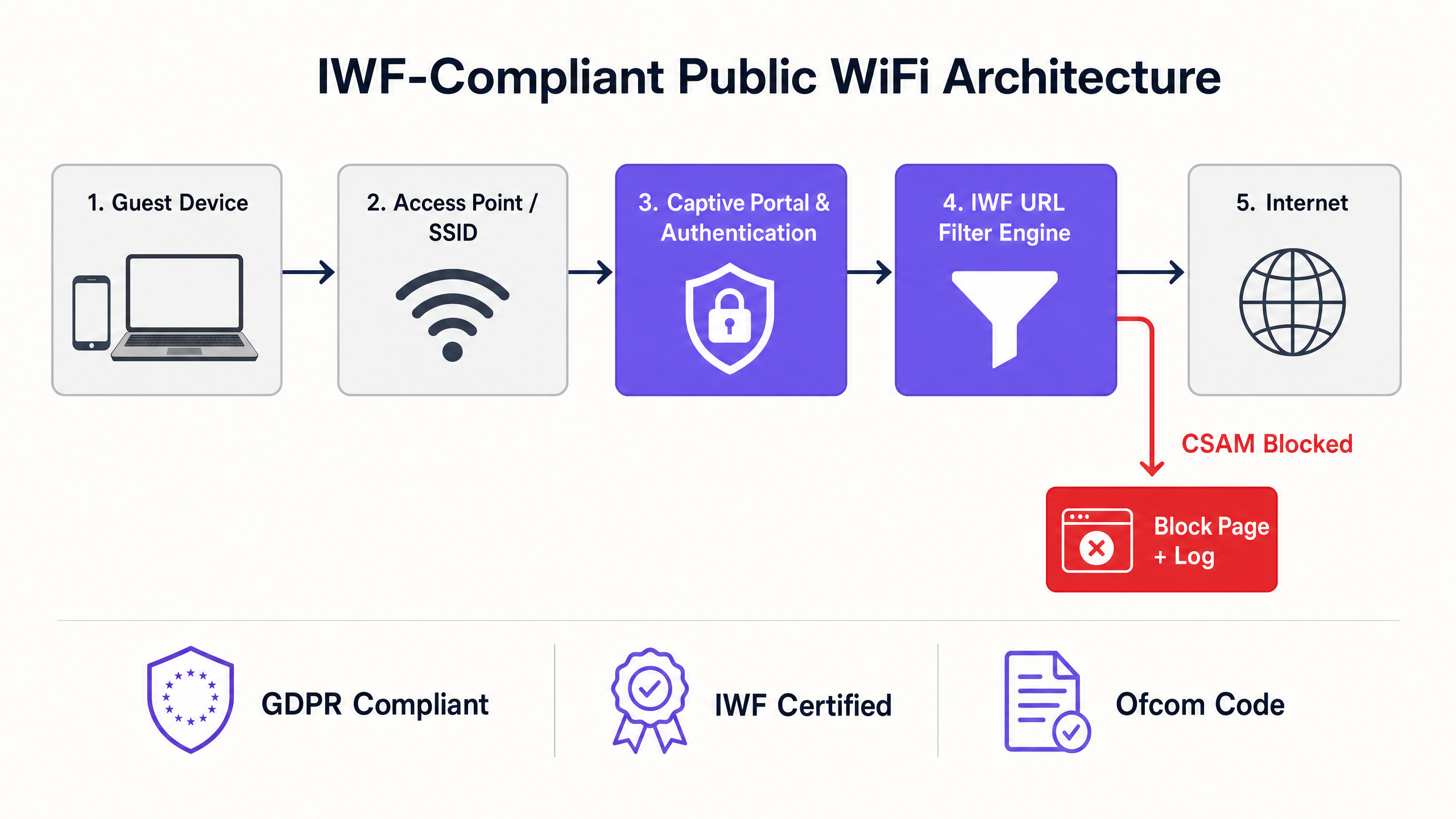
Integración con Autenticación y Analíticas
El cumplimiento va más allá del bloqueo; requiere rendición de cuentas. Integrar el motor de filtrado con el Captive Portal asegura que los usuarios acepten una Política de Uso Aceptable (AUP) antes de obtener acceso. Además, vincular el acceso a la red con Analíticas WiFi robustas permite a los equipos de TI monitorear eventos de bloqueo, identificar posibles incidentes de seguridad y demostrar el cumplimiento durante las auditorías. Comprender Frecuencias Wi-Fi: Una Guía de Frecuencias Wi-Fi en 2026 también es vital, ya que las diferentes bandas requieren configuraciones QoS específicas para manejar la ligera latencia introducida por la inspección profunda de paquetes.
Guía de Implementación: Despliegue de Filtrado IWF
Desplegar un filtrado compatible con IWF en entornos distribuidos —como un centro nacional de Transporte o una cadena de instalaciones de Salud — requiere un enfoque estructurado.
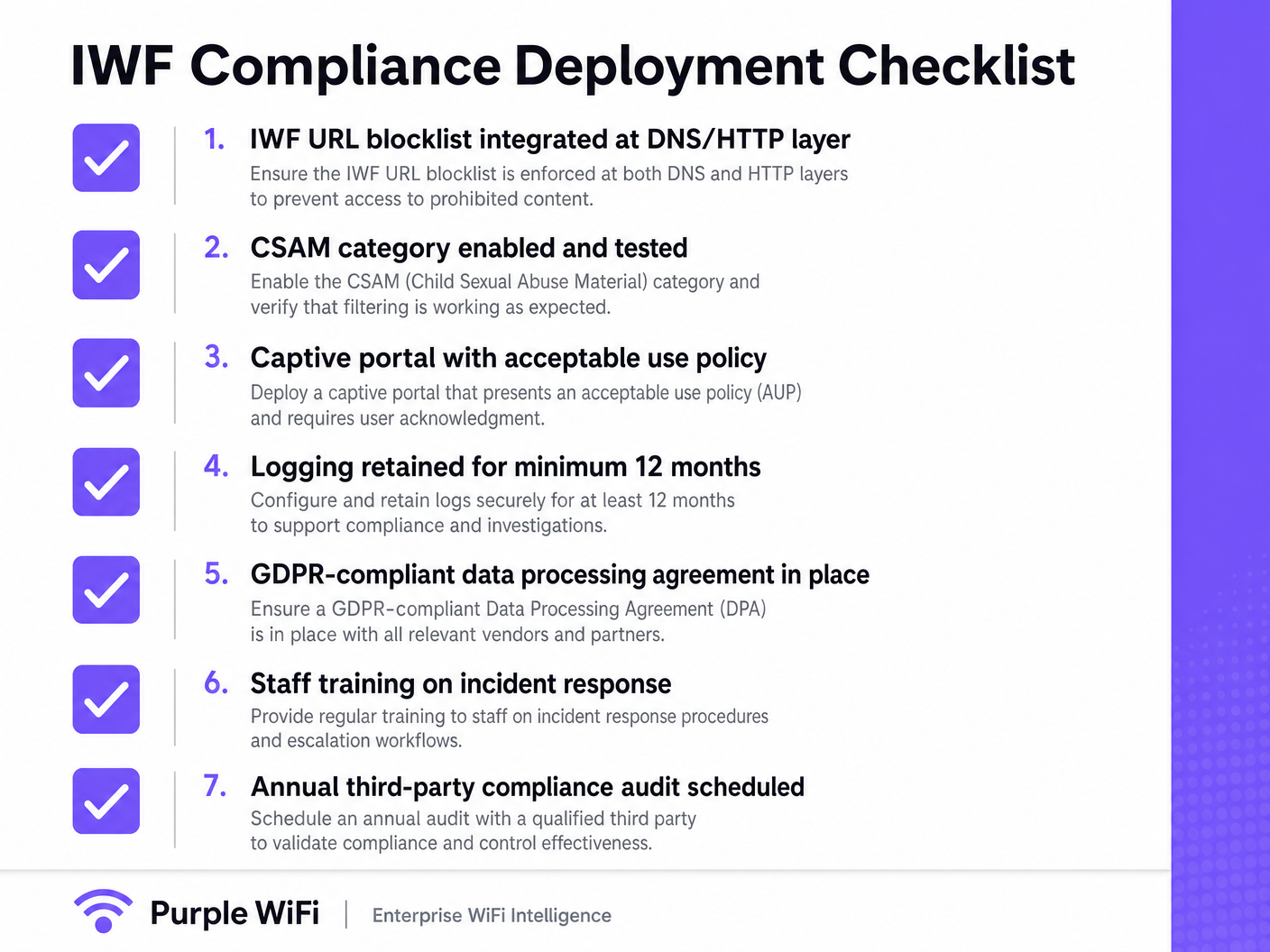
- Seleccione un Proveedor Certificado: Asegúrese de que su proveedor de filtrado web sea un miembro oficial de IWF y consuma su feed dinámico. No intente construir una integración a medida.
- Configuración del Borde de la Red: Configure los routers o puntos de acceso del establecimiento para forzar todo el tráfico DNS de invitados al servicio de filtrado compatible. Bloquee los puertos de salida 53 y 853 (DoT) para evitar que los usuarios eludan el filtro utilizando servidores DNS personalizados.
- Alineación del Captive Portal: Actualice la AUP del Captive Portal para establecer explícitamente que el filtrado de contenido está implementado y que el acceso a material ilegal es monitoreado y bloqueado.
- Pruebas y Validación: No utilice URLs reales de IWF para las pruebas. La IWF proporciona URLs de prueba específicas y seguras para validar que el motor de filtrado está interceptando y bloqueando correctamente el contenido restringido.
- Registro y Retención: Configure el firewall o el servicio de filtrado para retener registros de intentos de acceso bloqueados por un mínimo de 12 meses, en línea con los requisitos de GDPR y las autoridades locales.
Mejores Prácticas para Establecimientos Públicos
Al diseñar la arquitectura de red, los líderes de TI deben equilibrar la seguridad con la experiencia del usuario.
- Evite el Bloqueo Excesivo: Asegúrese de que la política de filtrado esté estrictamente dirigida a contenido ilegal (CSAM) y categorías altamente maliciosas (malware, phishing). Un filtrado excesivamente agresivo (por ejemplo, bloquear redes sociales legítimas o streaming) provoca frustración en el usuario y un aumento de los tickets de soporte.
- Maneje DNS Cifrado: Con el auge de DNS sobre HTTPS (DoH), los navegadores de los usuarios pueden intentar eludir los filtros DNS locales. Implemente políticas de red para bloquear resolutores DoH conocidos (como 8.8.8.8 o 1.1.1.1) a nivel de firewall, forzando el retorno al DNS seguro del establecimiento.
- Autenticación sin Interrupciones: Considere la transición de redes abiertas a marcos de autenticación seguros. Si bien Passpoint/OpenRoaming es el futuro, asegurar un filtrado robusto en estas redes es primordial. Para obtener información sobre la gestión de configuraciones empresariales complejas, consulte Resolución de problemas de roaming en WLANs corporativas .
Solución de Problemas y Mitigación de Riesgos
El modo de fallo más común en el cumplimiento de la normativa de WiFi público es el "bypass". Los usuarios, ya sea intencional o inadvertidamente, eluden los controles de filtrado.
- Puntos de Acceso Maliciosos: Las revisiones regulares de APs maliciosos son esenciales. Una red cableada que cumple con la normativa es inútil si un empleado conecta un router de consumo no gestionado y sin filtrar.
- Uso de VPN: Si bien bloquear todo el tráfico de VPN a menudo no es práctico en lugares como hoteles donde los viajeros de negocios necesitan acceso corporativo, los equipos de TI deben monitorear túneles cifrados excesivos y continuos que puedan indicar abuso.
- Picos de Latencia: Si el motor de filtrado está basado en la nube, asegúrese de que se utilicen POPs regionales. Enrutar el tráfico de un hotel de Londres a un servidor de filtrado con sede en EE. UU. introducirá una latencia inaceptable. Optimice el enrutamiento para mantener una experiencia fluida, de manera similar a cómo se haría con Office Wi Fi: Optimice su red Wi-Fi de oficina moderna .
ROI e Impacto Empresarial
Si bien el cumplimiento a menudo se considera un centro de costos, un filtrado IWF robusto protege la marca. El daño a la reputación de un lugar asociado con descargas ilegales o distribución de CSAM supera con creces los costos de implementación. Además, una red segura y compatible es un requisito previo para aprovechar tecnologías avanzadas como BLE Low Energy Explicado para Empresas para servicios basados en la ubicación, ya que los usuarios deben confiar en la infraestructura subyacente antes de optar por el seguimiento y el análisis. El éxito se mide por cero infracciones de cumplimiento, un mínimo de tickets de soporte de falsos positivos y un rendimiento de red impecable.
Definiciones clave
Internet Watch Foundation (IWF)
A UK-based organization that compiles a dynamic list of URLs containing Child Sexual Abuse Material (CSAM).
Integration with the IWF list is the baseline standard for public WiFi compliance in the UK.
Server Name Indication (SNI)
An extension to the TLS protocol that indicates which hostname the client is attempting to connect to at the start of the handshaking process.
SNI inspection allows IT teams to block specific malicious websites on HTTPS connections without needing to decrypt the entire traffic stream.
DNS over HTTPS (DoH)
A protocol for performing remote Domain Name System resolution via the HTTPS protocol, encrypting the DNS queries.
DoH can bypass traditional DNS-based web filters, requiring network administrators to block known DoH endpoints to enforce compliance.
Captive Portal
A web page that the user of a public-access network is obliged to view and interact with before access is granted.
Crucial for enforcing the Acceptable Use Policy (AUP) and establishing the legal framework for network usage.
Acceptable Use Policy (AUP)
A document stipulating constraints and practices that a user must agree to for access to a corporate network or the internet.
Provides the legal cover for venue operators to block content and terminate sessions for non-compliant users.
VLAN Segmentation
The practice of dividing a physical network into multiple logical networks.
Essential for separating untrusted guest traffic (which requires IWF filtering) from trusted corporate or POS traffic.
Deep Packet Inspection (DPI)
A form of computer network packet filtering that examines the data part of a packet as it passes an inspection point.
Used to identify and block specific applications or protocols (like BitTorrent or VPNs) that might be used to bypass standard filters.
False Positive
When a legitimate website is incorrectly categorized and blocked by the filtering engine.
High false-positive rates lead to user complaints and IT support overhead; selecting a highly accurate, IWF-certified vendor minimizes this.
Ejemplos resueltos
A 200-room hotel needs to implement IWF filtering but has noticed a high volume of guests using DNS over HTTPS (DoH) via modern browsers, bypassing the current DNS-based filter.
The IT team must implement a dual-layer approach. First, configure the edge firewall to block outbound traffic to known DoH providers (e.g., blocking IPs for Cloudflare, Google, and Quad9 DoH endpoints). Second, utilize SNI (Server Name Indication) inspection on the firewall to intercept the initial TLS handshake and block IWF-listed URLs before the encrypted session is established.
A large retail chain is rolling out free guest WiFi across 500 stores and needs to ensure compliance while minimizing latency at the Point of Sale (POS).
The network architect segments the VLANs. The Guest VLAN is routed through a cloud-based IWF-certified web filter using redundant regional POPs to minimize latency. The POS VLAN is strictly isolated, utilizing an explicit allow-list (whitelisting) for payment gateways and inventory systems, completely bypassing the web filter to ensure zero latency impact on transactions.
Preguntas de práctica
Q1. You are deploying guest WiFi at a major conference centre. The marketing team wants to use a generic, open SSID with no captive portal to reduce 'friction'. How do you respond from a compliance perspective?
Sugerencia: Consider the legal requirement for user consent and accountability.
Ver respuesta modelo
I would advise against an open, frictionless SSID. Without a captive portal, users cannot agree to the Acceptable Use Policy (AUP). This leaves the venue legally exposed if illegal activity occurs on the network. A captive portal is a mandatory control gate for enforcing terms of service and logging MAC addresses against accepted sessions, which is critical for incident response.
Q2. During a network audit, you discover that 15% of guest traffic is successfully bypassing the web filter using custom DNS servers configured on their devices. What is the immediate technical remediation?
Sugerencia: Look at edge firewall port configurations.
Ver respuesta modelo
The immediate remediation is to configure the edge firewall to block outbound traffic on UDP/TCP port 53 and TCP port 853 (DNS over TLS) from the Guest VLAN to any external IP address. All DNS requests must be forced (or transparently proxied) to the venue's secure, IWF-integrated DNS servers.
Q3. A hotel IT manager suggests using full SSL decryption (SSL Inspection/Termination) on the guest network to ensure 100% visibility into HTTPS traffic for IWF compliance. Why is this a flawed approach for public WiFi?
Sugerencia: Consider device trust and user privacy.
Ver respuesta modelo
Full SSL decryption requires installing a custom root certificate on every guest device. In a public WiFi scenario, this is impossible to enforce, will cause severe browser certificate errors for all users, and represents a massive privacy violation. The correct approach is to rely on DNS filtering combined with SNI (Server Name Indication) inspection, which allows categorization of encrypted traffic without breaking the TLS tunnel.