
El papel de SCEP y NAC en la infraestructura moderna de MDM
Esta guía ofrece un desglose técnico completo de cómo SCEP y NAC se integran con las plataformas MDM para ofrecer un acceso seguro a la red sin intervención (zero-touch) a escala empresarial. Abarca toda la arquitectura, desde la emisión de certificados hasta la aplicación de 802.1X, con escenarios de implementación reales en los sectores de hotelería y retail. Diseñada para líderes de TI en grandes recintos que necesitan eliminar las vulnerabilidades de las contraseñas, automatizar el aprovisionamiento de dispositivos y cumplir con los requisitos de conformidad este trimestre.
Escucha esta guía
Ver transcripción del podcast
执行摘要
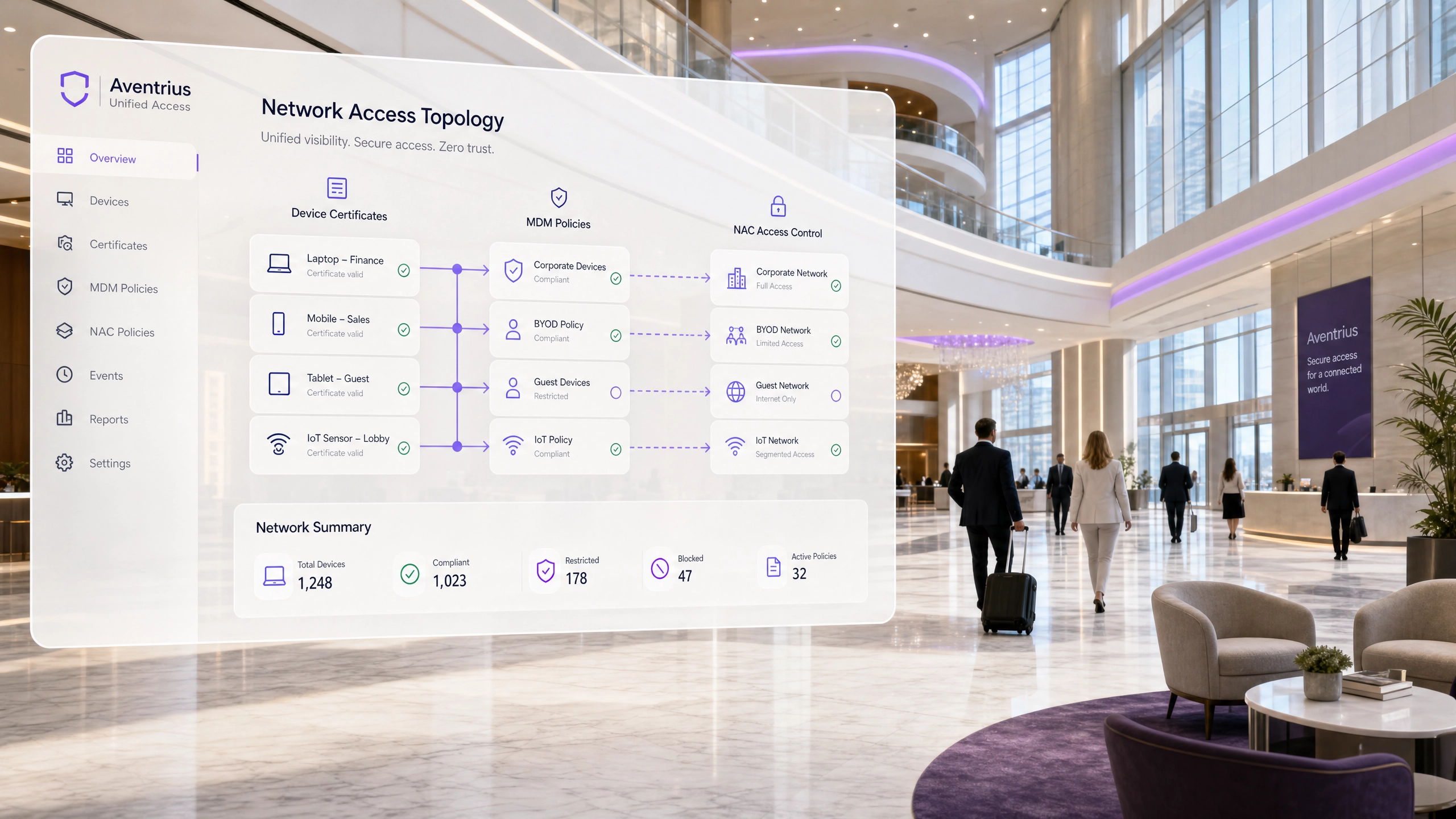
对于企业场所——从拥有 80,000 个座位的体育场到多站点零售连锁店——确保网络边缘的安全已果断地超越了预共享密钥和手动凭证管理。企业终端、BYOD 设备和物联网基础设施的激增要求采用零信任架构,该架构能够在不给 IT 服务台带来负担的情况下扩展。
本指南详细介绍了将简单证书注册协议(SCEP)和网络准入控制(NAC)与移动设备管理(MDM)基础设施集成的技术架构。通过利用 SCEP 自动分发 X.509 证书,并利用 NAC 强制执行 IEEE 802.1X EAP-TLS 身份验证,组织可以实现零接触配置、消除凭证窃取途径,并强制执行基于姿态的动态网络访问。虽然面向公众的访问通过专用的 Guest WiFi 解决方案进行管理,但此架构可确保关键的幕后操作安全,从而维持场所的正常运行。其结果是 IT 开销显著降低、PCI DSS 和 GDPR 下的合规性更强,以及网络边缘主动执行零信任原则。
技术深入探讨
三层架构
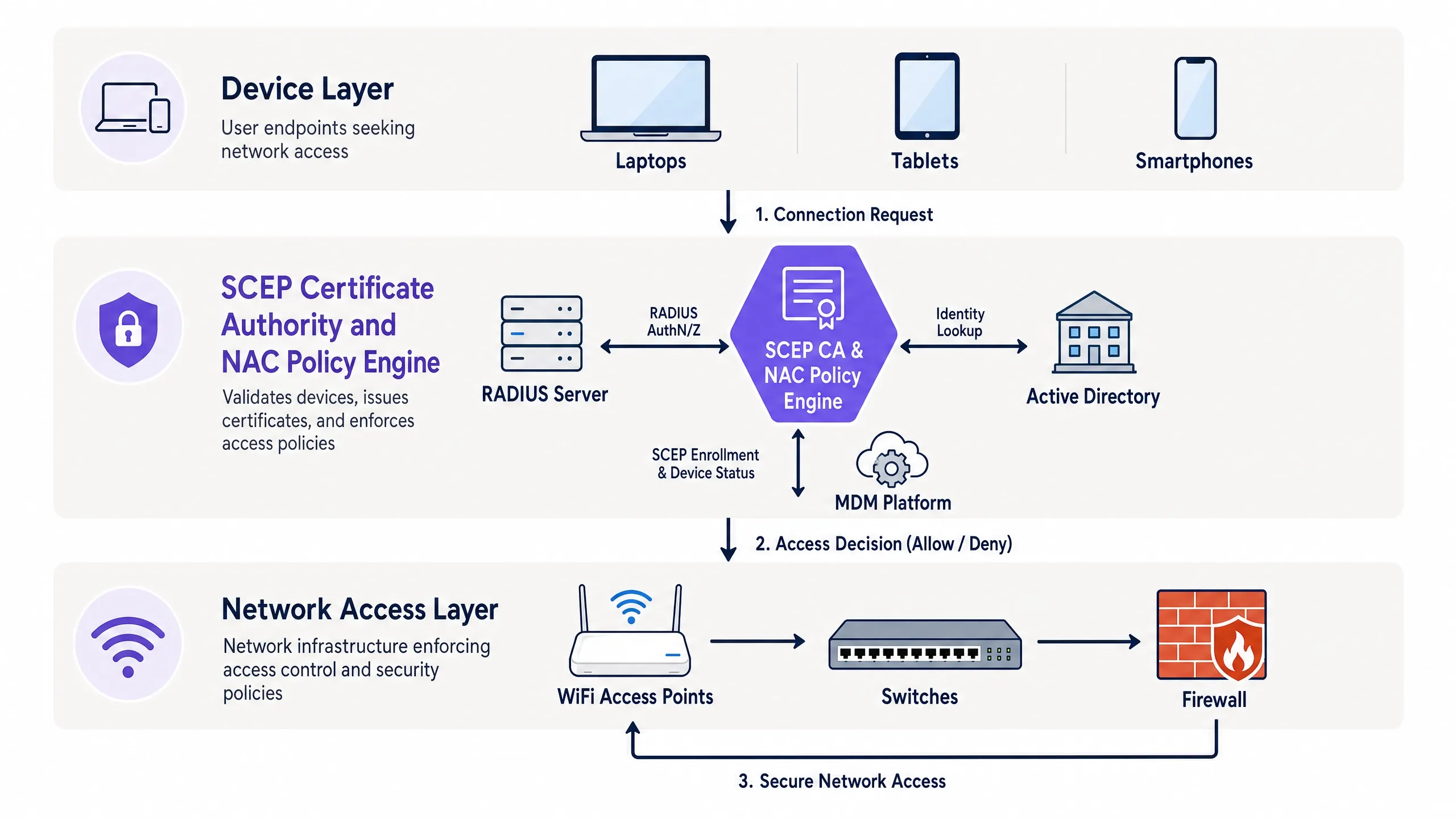
现代网络安全依赖于加密身份而非用户知识。SCEP-NAC-MDM 堆栈跨三个主要层面运行:
| 层面 | 组件 | 功能 |
|---|---|---|
| 设备管理 | MDM / UEM | 设备配置、合规性和生命周期的中央权威机构 |
| 身份与颁发 | PKI / SCEP / CA | 生成、颁发和管理数字证书 |
| 访问强制执行 | NAC / RADIUS | 在授予网络访问权限之前评估证书和设备姿态 |
这些层面并非顺序关系——它们在一个连续的反馈循环中运行。MDM 实时将合规性状态通知 NAC,而 NAC 可以在设备未通过姿态检查时触发 MDM 修复工作流。
SCEP 如何大规模自动化 PKI
手动部署证书在规模上操作上是不可能的。一个拥有 500 台设备的资产需要 IT 管理员为每台设备生成、签名和安装单独的 X.509 证书——这个过程每台设备需要几分钟,并且会引入重大的人为错误风险。SCEP 完全消除了这一点。
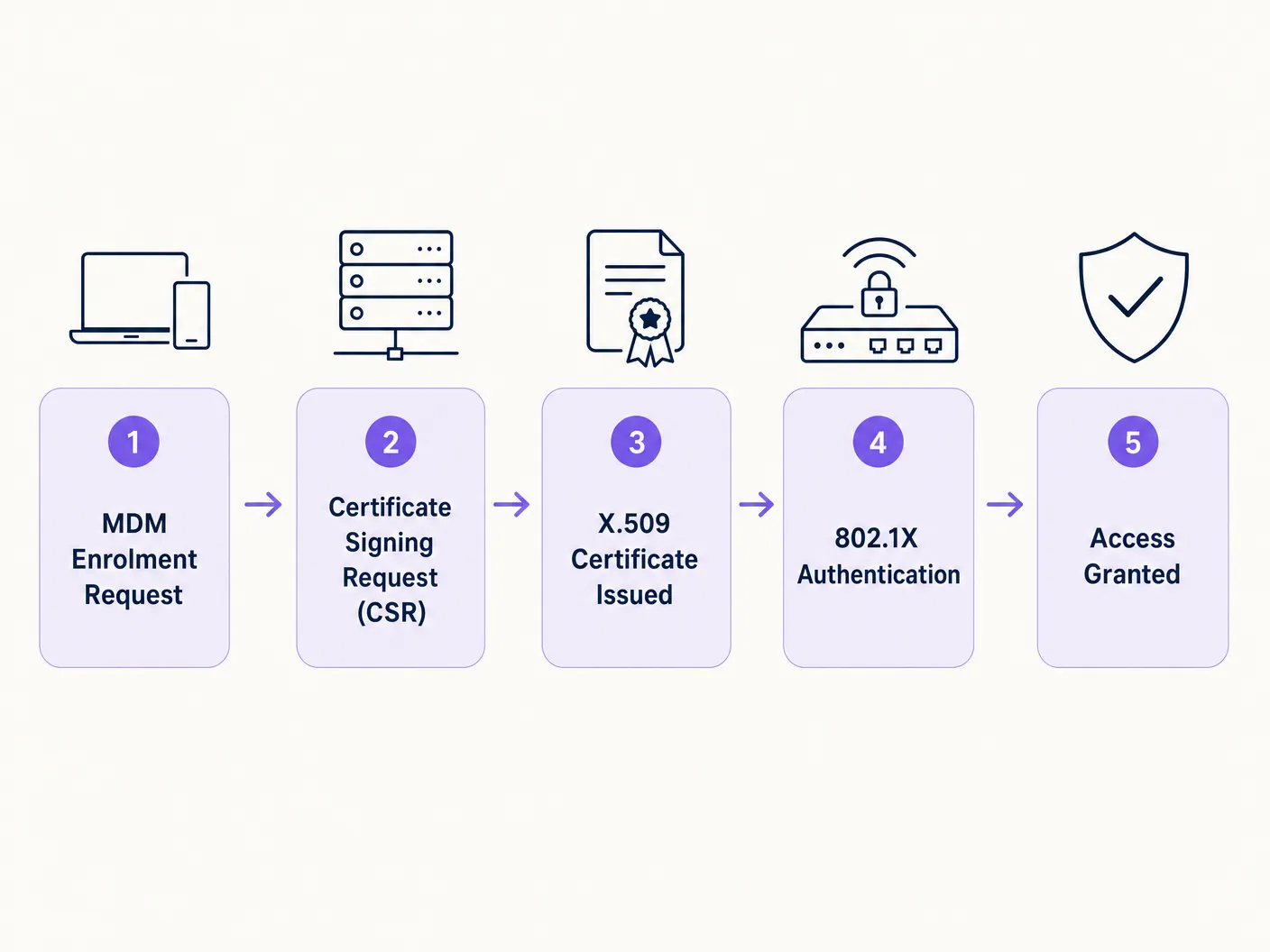
当设备在 MDM 中注册时,MDM 推送一个包含 SCEP 负载的配置描述文件。该负载指示设备在本地生成密钥对——关键的是,私钥永远不会离开设备——并向 SCEP 服务器提交证书签名请求(CSR)。SCEP 服务器(通常是微软的网络设备注册服务(NDES)或基于云的等效服务)根据 MDM 验证请求,以确认设备已获授权。然后,它将 CSR 转发给证书颁发机构(CA),CA 签发已签名的 X.509 证书。证书返回给设备并安装在其安全隔区或系统密钥库中。
整个过程静默地进行,通过无线方式完成,无需用户交互。对于部署 1,000 台设备,整个证书资产可以在 MDM 注册完成后的数小时内完成配置。
NAC 和 802.1X EAP-TLS:强制执行层
一旦设备持有有效证书,它就会尝试使用 IEEE 802.1X 连接到企业 SSID 或有线端口。接入点或交换机充当认证器,将请求转发给由 NAC 策略引擎控制的 RADIUS 服务器。最安全的 EAP 方法是 EAP-TLS,它要求相互认证——客户端和 RADIUS 服务器都必须提供有效证书,从而防止通过欺诈接入点进行的中间人攻击。 NAC 按顺序执行几项关键检查:
- **密码学验证:**证书在数学上是否有效,并且由受信任的根 CA 签名?
- **吊销检查:**证书是否列在证书吊销列表(CRL)中,或通过在线证书状态协议(OCSP)标记?
- **姿态评估:**通过 API 查询 MDM,NAC 询问:设备是否合规?操作系统是否达到所需的补丁级别?磁盘加密是否启用?
如果所有检查均通过,NAC 会发送 RADIUS 访问接受消息,通常附带供应商特定属性(VSA),这些属性动态地将设备分配到特定的 VLAN 或应用访问控制列表(ACL)。不合规的设备将被放入权限有限的修复 VLAN 中——通常仅足以触发 MDM 驱动的修复工作流。
访客网络隔离
在任何场所环境中,企业基础设施必须与面向公众的网络严格隔离。 Guest WiFi 平台完全运行在独立的 SSID 和 VLAN 上,没有路由到企业资源的路径。SCEP-NAC 架构管控企业层;访客层由强制门户认证和数据捕获工作流控制。对于部署 WiFi Analytics 的场所,这种隔离是前提条件——分析数据流经访客网络,而运营数据流经由证书认证的企业网络。有关支撑这两个网络的基础射频架构的更多背景信息,请参阅 Wi-Fi 频率:2026 年 Wi-Fi 频率指南 。
实施指南
部署此架构需要仔细排序,以避免在过渡期间将合法用户拒之门外。
第 1 步:PKI 和 SCEP 准备
建立强大的内部 PKI 或利用基于云的托管 PKI(mPKI)服务。部署并加固 SCEP 服务器——如果使用 Microsoft NDES,请确保它在专用服务器上运行,而不是与 CA 共置。配置 SCEP 服务器使用由 MDM 为每台设备生成的动态挑战口令,而不是静态共享密钥。这可以防止在发现 SCEP URL 时进行未经授权的证书请求。
第 2 步:MDM 配置
在您的 MDM 平台中创建 SCEP 负载。仔细定义主题备用名称(SAN)字段——SAN 必须包含唯一标识符(例如设备序列号或用户 UPN),NAC 将使用这些标识符进行策略决策。首先将配置文件推送到 IT 团队设备的测试组,并在更广泛推出之前验证完整的注册流程。
第 3 步:NAC 和 RADIUS 设置
配置您的 NAC 以信任签发了客户端证书的根 CA。在 RADIUS 服务器上安装服务器证书以进行 EAP-TLS 相互认证。根据证书属性和 MDM 合规性状态定义访问策略。实施动态 VLAN 分配规则:将合规的企业设备分配到企业 VLAN,将不合规的设备分配到修复 VLAN,将物联网设备分配到专用的、限制互联网访问的 VLAN。
第 4 步:网络基础设施集成
为 802.1X 配置交换机和无线接入点。对于 零售业 环境中拥有传统销售点硬件的场景,或 酒店业 场所中拥有智能房间控制器的场景,为无法参与 EAP-TLS 的设备实施 MAC 认证绕过(MAB)作为后备方案。将 MAB 限制到特定的交换机端口,并确保 MAC 地址数据库得到严格控制。对于 医疗保健 和 交通运输 环境,应配置姿态评估规则以满足特定行业的合规性要求。
第 5 步:并行部署和切换
切勿立即切换。与现有网络并行广播新的 802.1X SSID。通过 MDM 推送新的 WiFi 配置文件。监控采用情况并解决注册失败问题。一旦 95% 以上的设备在新的 SSID 上成功认证,就停用旧网络。
最佳实践
**强制使用 EAP-TLS。**绝不要接受 EAP-PEAP 或 EAP-TTLS 作为企业设备的主要认证方法。这些方法依赖于 TLS 隧道内的用户名/密码凭据,仍然容易受到凭据收集的攻击。EAP-TLS 完全消除了这种攻击面。
**实施实时吊销。**计划性的 CRL 下载会产生漏洞窗口。配置 NAC 实时执行 OCSP 检查。当设备被报告丢失或被盗时,在 CA 中吊销证书,设备将在下次认证尝试时失去网络访问权限——如果实施了更改授权(CoA),甚至可以立即断开。
**设置合理的证书有效期。**一年有效期,并在有效期届满前 30 天触发 SCEP 自动续订,这是行业标准。更长的有效期会增加证书被泄露时的漏洞窗口;更短的有效期会增加续订失败导致中断的风险。
**积极隔离物联网。**物联网设备绝不应与企业终端共享 VLAN。使用 NAC 在物联网 VLAN 上强制执行严格的 ACL,仅允许每个设备类型所需的特定协议和目的地。对于部署定位服务的场所,请参阅 室内 WiFi 定位系统:它们如何工作以及如何部署 ,以了解定位基础设施如何与更广泛的网络架构相集成。
**与 WPA3 保持一致。**在硬件支持的情况下,将企业 SSID 配置为使用 WPA3-Enterprise,该协议强制要求受保护的管理帧(PMF),并提供比 WPA2 更强的密码学保护。有关这如何融入更广泛的企业连接环境的详细信息,请参阅 SD-WAN 与 MPLS:2026 年企业网络指南 。
故障排除与风险缓解
| 故障模式 | 根本原因 | 缓解措施 |
|---|---|---|
| 设备在证书续订后 EAP-TLS 失败 | SCEP 续订静默失败 | 监控 SCEP 服务器日志;为失败的 CSR 提交设置警报 |
| 时钟偏差导致证书验证失败 | NTP 配置错误 | 在所有终端和基础设施上强制执行 NTP 同步 |
| 物联网设备无法认证 | 没有 802.1X 认证客户端 | 实施具有严格 MAC 地址控制和隔离 VLAN 的 MAB |
| CA 迁移后大量设备锁定 | 旧的根 CA 不受 NAC 信任 | 分阶段进行 CA 迁移;在吊销旧根 CA 之前,将新的根 CA 添加到 NAC 信任存储区 |
| 已吊销的设备仍保留网络访问权限 | 仅使用 CRL 吊销且下载间隔较长 | 实时实施 OCSP 和 CoA 以进行实时吊销 |
对于特定的基于 BLE 的物联网设备,认证架构与 WiFi 连接的终端有所不同。请参阅 面向企业的 BLE 低功耗解释 ,以了解适用于蓝牙低功耗基础设施的具体安全注意事项。
投资回报率与业务影响
当与替代方案的成本进行衡量时,SCEP-NAC-MDM 集成的商业案例是简单明了的。
| 指标 | 实施前 | 实施后 |
|---|---|---|
| IT 服务台工单(网络访问) | 高——密码重置、密钥轮换 | 接近零——自动化证书生命周期 |
| 吊销受损设备的平均时间 | 数小时(手动流程) | 数秒(OCSP + CoA) |
| PCI DSS 访问控制合规性 | 手动、审计密集 | 自动化、持续强制执行 |
| BYOD 入门时间 | 每台设备 15-30 分钟 | 不到 5 分钟,零 IT 参与 |
对于拥有 500 台设备的资产,消除手动证书管理和与密码相关的服务台工单,通常可将网络相关的 IT 支持开销降低 25-35%。风险缓解价值——避免一次基于凭据的泄露——通常超过整个实施成本。对于 GDPR 约束下的公共部门和医疗保健组织,能够展示自动化、可审计的访问控制是一项重要的合规资产。
Definiciones clave
SCEP (Simple Certificate Enrollment Protocol)
Un protocolo que automatiza la emisión y revocación de certificados digitales en dispositivos sin intervención del usuario, actuando como la capa de comunicación entre la plataforma de MDM y la Autoridad de Certificación.
Utilizado por las plataformas de MDM para implementar de manera fluida certificados X.509 en miles de endpoints a escala. Los equipos de TI se encuentran con SCEP al configurar perfiles de MDM para la autenticación WiFi 802.1X.
NAC (Network Access Control)
Una solución de seguridad que aplica políticas en los dispositivos que buscan acceder a la infraestructura de red, evaluando las credenciales de autenticación, la validez del certificado y el estado de cumplimiento del dispositivo antes de otorgar el acceso.
Actúa como el guardián en el límite de la red. Los equipos de TI configuran políticas de NAC para definir qué dispositivos obtienen acceso a qué VLANs en función de sus atributos de certificado y estado de cumplimiento de MDM.
MDM (Mobile Device Management)
Software utilizado por los departamentos de TI para monitorear, gestionar y asegurar los endpoints de los empleados en múltiples sistemas operativos, sirviendo como la fuente central de verdad para la identidad y el cumplimiento de los dispositivos.
El iniciador del proceso de inscripción SCEP y la fuente de datos de estado consultados por el NAC. Sin la integración con MDM, el NAC no puede realizar el control de acceso basado en el estado del dispositivo.
IEEE 802.1X
Un estándar IEEE para el control de acceso a la red basado en puertos que proporciona un mecanismo de autenticación a los dispositivos que desean conectarse a una LAN o WLAN, requiriendo una autenticación exitosa antes de que se abra el puerto.
El protocolo subyacente que obliga a los dispositivos a autenticarse antes de que el switch o punto de acceso permita el paso de cualquier tráfico. Se configura tanto en la infraestructura de red como en el suplicante 802.1X del dispositivo.
EAP-TLS (Extensible Authentication Protocol - Transport Layer Security)
El estándar EAP más seguro, que requiere autenticación mutua donde tanto el dispositivo cliente como el servidor RADIUS deben presentar certificados digitales válidos, eliminando los ataques a credenciales basados en contraseñas.
El estándar de oro para la seguridad inalámbrica empresarial. Los arquitectos de TI deben exigir EAP-TLS sobre PEAP o TTLS siempre que exista una infraestructura de certificados de dispositivo.
CSR (Certificate Signing Request)
Un bloque de texto codificado generado por un dispositivo que contiene su clave pública y detalles de identidad, enviado a la Autoridad de Certificación para solicitar un certificado X.509 firmado.
Generado automáticamente por el dispositivo durante el proceso de inscripción SCEP. La clave privada correspondiente al CSR nunca sale del dispositivo, lo que garantiza que el certificado no pueda duplicarse.
MAB (MAC Authentication Bypass)
Un método de autenticación de respaldo donde la red utiliza la dirección MAC de hardware del dispositivo como su credencial, utilizado para dispositivos que carecen de la capacidad de suplicante 802.1X.
Utilizado para dispositivos IoT heredados como impresoras, sensores y controladores de salas inteligentes que no pueden participar en EAP-TLS. Siempre debe resultar en la asignación a una VLAN altamente restringida.
OCSP (Online Certificate Status Protocol)
Un protocolo de internet utilizado para obtener el estado de revocación de un certificado digital X.509 en tiempo real, proporcionando una alternativa a la descarga y análisis de Listas de Revocación de Certificados.
Crítico para los sistemas NAC que necesitan bloquear inmediatamente el acceso a la red cuando un dispositivo está comprometido o se reporta como robado. OCSP proporciona el estado en tiempo real; las descargas de CRL crean una ventana de revocación.
CoA (Change of Authorization)
Una extensión de RADIUS (RFC 5176) que permite al NAC modificar o terminar dinámicamente una sesión de red activa sin esperar a que la sesión expire o que el dispositivo se vuelva a autenticar.
Utilizado para desconectar inmediatamente un dispositivo cuando se revoca su certificado o cambia su estado de cumplimiento de MDM. Esencial para la aplicación de zero-trust en tiempo real.
Ejemplos resueltos
Un resort de lujo de 500 habitaciones necesita proteger su red de operaciones internas. El personal utiliza tabletas compartidas para la gestión de limpieza y la administración utiliza laptops corporativas. La red WPA2-PSK actual ha sufrido filtraciones de la clave precompartida en múltiples ocasiones, lo que resultó en dos incidentes de seguridad el año pasado. ¿Cómo debería el equipo de TI realizar la transición a la autenticación basada en certificados sin interrumpir las operaciones?
Fase 1 — Preparación (Semanas 1–2): Implementar una solución RADIUS/NAC basada en la nube e integrarla con el MDM existente. Configurar un perfil SCEP en el MDM para enviar certificados basados en dispositivos a todas las tabletas y laptops. Utilizar certificados basados en dispositivos (vinculados al número de serie del dispositivo) en lugar de certificados basados en usuarios, de modo que las tabletas compartidas se autentiquen automáticamente sin importar qué miembro del personal las esté utilizando. Fase 2 — Implementación paralela (Semanas 3–4): Transmitir un nuevo SSID oculto configurado para 802.1X EAP-TLS. Enviar el nuevo perfil de WiFi a través de MDM a todos los dispositivos registrados. Monitorear el panel de control del NAC para verificar las autenticaciones exitosas. Fase 3 — Transición (Semana 5): Una vez que más del 95% de los dispositivos estén conectados al nuevo SSID, retirar la red WPA2-PSK heredada. Revocar la PSK anterior de toda la documentación y de los puntos de acceso.
Una cadena minorista nacional está implementando 3,000 nuevas terminales de Punto de Venta en 150 tiendas. El equipo de seguridad exige una segmentación estricta de la red PCI DSS y un acceso zero-trust. El plazo de implementación es de 8 semanas. ¿Cómo facilitan SCEP y NAC esto a escala sin requerir personal de TI en cada tienda?
Preimplementación: El proveedor de PDV registra previamente los 3,000 dispositivos en el MDM del minorista utilizando el programa de registro zero-touch del proveedor. El MDM se configura con un perfil SCEP que se activará automáticamente al primer arranque. Implementación: Cuando una terminal de PDV se enciende en la tienda, se conecta a un SSID de incorporación temporal (solo internet, sin acceso corporativo). Se envía el perfil de MDM, se activa la carga útil de SCEP, y el dispositivo solicita y recibe su certificado X.509 de la CA. Luego, el MDM envía el perfil de WiFi corporativo. Acceso a la red: Cuando el PDV se conecta al puerto del switch de la tienda, el switch inicia 802.1X. El NAC valida el certificado, consulta al MDM para confirmar que el PDV cumple con las políticas (cifrado habilitado, agente MDM activo, sin detección de jailbreak) y asigna dinámicamente el puerto del switch a la VLAN de PCI-DSS. El PDV ahora está operativo. No se requirió personal de TI en la tienda.
Preguntas de práctica
Q1. Su organización está migrando de WPA2-Enterprise usando PEAP-MSCHAPv2 a EAP-TLS. Durante el piloto, las laptops con Windows y los iPhones se conectan con éxito, pero 200 escáneres de códigos de barras de almacén fallan al autenticarse. Los escáneres son compatibles con 802.1X pero no pueden procesar la carga útil de SCEP desde el MDM; ejecutan un sistema operativo integrado propietario sin soporte para agentes MDM. ¿Cuál es la solución arquitectónica más segura que mantiene la segmentación de red sin requerir el reemplazo de los escáneres?
Sugerencia: Considere mecanismos alternativos de entrega de certificados que no requieran un agente MDM, y qué controles de segmentación de red deberían aplicarse a los dispositivos que no pueden participar en una evaluación completa de postura.
Ver respuesta modelo
Dado que los escáneres son compatibles con 802.1X pero no con SCEP ni con el registro en el MDM, el enfoque más seguro es aprovisionar manualmente los certificados de dispositivo utilizando una plantilla de certificado dedicada con un perfil de uso de clave restringido. Los certificados se instalan una sola vez durante una ventana de mantenimiento. El NAC se configura para aceptar estos certificados pero asigna los escáneres a una VLAN dedicada para operaciones de almacén con ACL estrictas (no a la VLAN corporativa completa), ya que no es posible realizar la evaluación de postura. Alternativamente, si el aprovisionamiento manual de certificados no es escalable operativamente, configure MAB como respaldo específicamente para las OUI de MAC del hardware del escáner, con el NAC asignándolos a la misma VLAN restringida. Documente esto como una excepción conocida en su registro de riesgos y programe el reemplazo de los escáneres en el próximo ciclo de renovación de hardware.
Q2. Un administrador de seguridad de red nota que cuando un empleado reporta una laptop como robada, el MDM envía un comando de borrado remoto, pero el dispositivo permanece conectado al WiFi corporativo hasta por 12 horas (el tiempo de espera de sesión RADIUS actual). Durante esta ventana, el dispositivo podría usarse para exfiltrar datos. ¿Cómo se debería modificar la arquitectura para terminar el acceso a la red inmediatamente después de que un dispositivo se reporte como robado?
Sugerencia: El NAC necesita ser informado del cambio de estado de forma instantánea en lugar de esperar al siguiente ciclo de autenticación. Considere tanto el mecanismo de terminación de sesión como el mecanismo de prevención de reautenticación.
Ver respuesta modelo
Implemente dos controles complementarios. Primero, configure el MDM para enviar un webhook al NAC inmediatamente después de que un dispositivo se marque como perdido o robado. Luego, el NAC envía un mensaje RADIUS Change of Authorization (CoA) Disconnect-Request al punto de acceso específico o puerto de switch, terminando la sesión activa de inmediato. Segundo, revoque el certificado del dispositivo en la CA y asegúrese de que el NAC esté configurado para la verificación OCSP en tiempo real en lugar de la revocación basada en CRL. Esto significa que incluso si el dispositivo se vuelve a conectar antes de que se procese el CoA, la autenticación EAP-TLS fallará en la verificación OCSP. Ambos controles juntos reducen la ventana de exposición de 12 horas a menos de 60 segundos.
Q3. Durante una auditoría de seguridad de la red de un gran centro de conferencias, se descubre que el servidor SCEP está expuesto a la internet pública utilizando una contraseña de desafío estática para permitir el registro de dispositivos remotos. El auditor señala esto como una vulnerabilidad crítica. ¿Cómo se debería rediseñar el proceso de registro SCEP para mantener la capacidad de registro remoto eliminando al mismo tiempo el riesgo de la contraseña estática?
Sugerencia: El servidor SCEP necesita una forma de verificar que el dispositivo que solicita un certificado está realmente autorizado por el MDM, sin depender de un secreto compartido que podría ser extraído de un dispositivo o interceptado.
Ver respuesta modelo
Reemplace la contraseña de desafío estática por contraseñas de desafío dinámicas de un solo uso por dispositivo generadas por el MDM. El flujo de trabajo se convierte en: (1) El MDM genera una contraseña de desafío única y de tiempo limitado para cada dispositivo durante el registro. (2) El MDM incluye este desafío en la carga útil de SCEP enviada al dispositivo. (3) El dispositivo incluye el desafío en su CSR. (4) El servidor SCEP valida el desafío contra el MDM a través de una API antes de reenviar el CSR a la CA. (5) El desafío se invalida inmediatamente después de su uso. Esto garantiza que solo los dispositivos administrados por el MDM puedan obtener un certificado con éxito, y que incluso si se descubre la URL de SCEP, un atacante no pueda generar certificados válidos sin un desafío de un solo uso válido. Adicionalmente, restrinja el servidor SCEP solo a HTTPS e implemente listas de permitidos de IP para las IP de salida del MDM donde sea posible.
Continúe leyendo esta serie
WiFi para personal vs. WiFi para invitados: mejores prácticas para la segmentación de redes corporativas
Una guía técnica completa para líderes de TI sobre la segmentación de redes WiFi para personal e invitados. Cubre la arquitectura VLAN, la autenticación 802.1X, las políticas de firewall y el impacto empresarial del diseño de redes seguras.
Soluciones de WiFi para departamentos: una guía completa para empresas
Esta guía cubre la arquitectura, la implementación y el caso de negocio de las soluciones de WiFi para departamentos en propiedades Build to Rent (BTR) y unidades multi-residenciales (MDU). Explica cómo la tecnología Identity Pre-Shared Key (iPSK) crea burbujas de red seguras y aisladas para cada residente, al tiempo que admite dispositivos inteligentes e IoT. Los desarrolladores inmobiliarios, arrendadores y operadores de BTR encontrarán orientación práctica para la implementación, datos de ROI y escenarios de implementación resueltos.
Cox business managed WiFi: una guía completa para empresas
Esta guía detalla cómo los desarrolladores inmobiliarios y operadores de BTR pueden implementar redes escalables y seguras utilizando Cox Business managed WiFi. Cubre la arquitectura de red, la implementación de hardware independiente del proveedor y el impacto comercial de transformar la conectividad de un dolor de cabeza operativo a una infraestructura confiable.