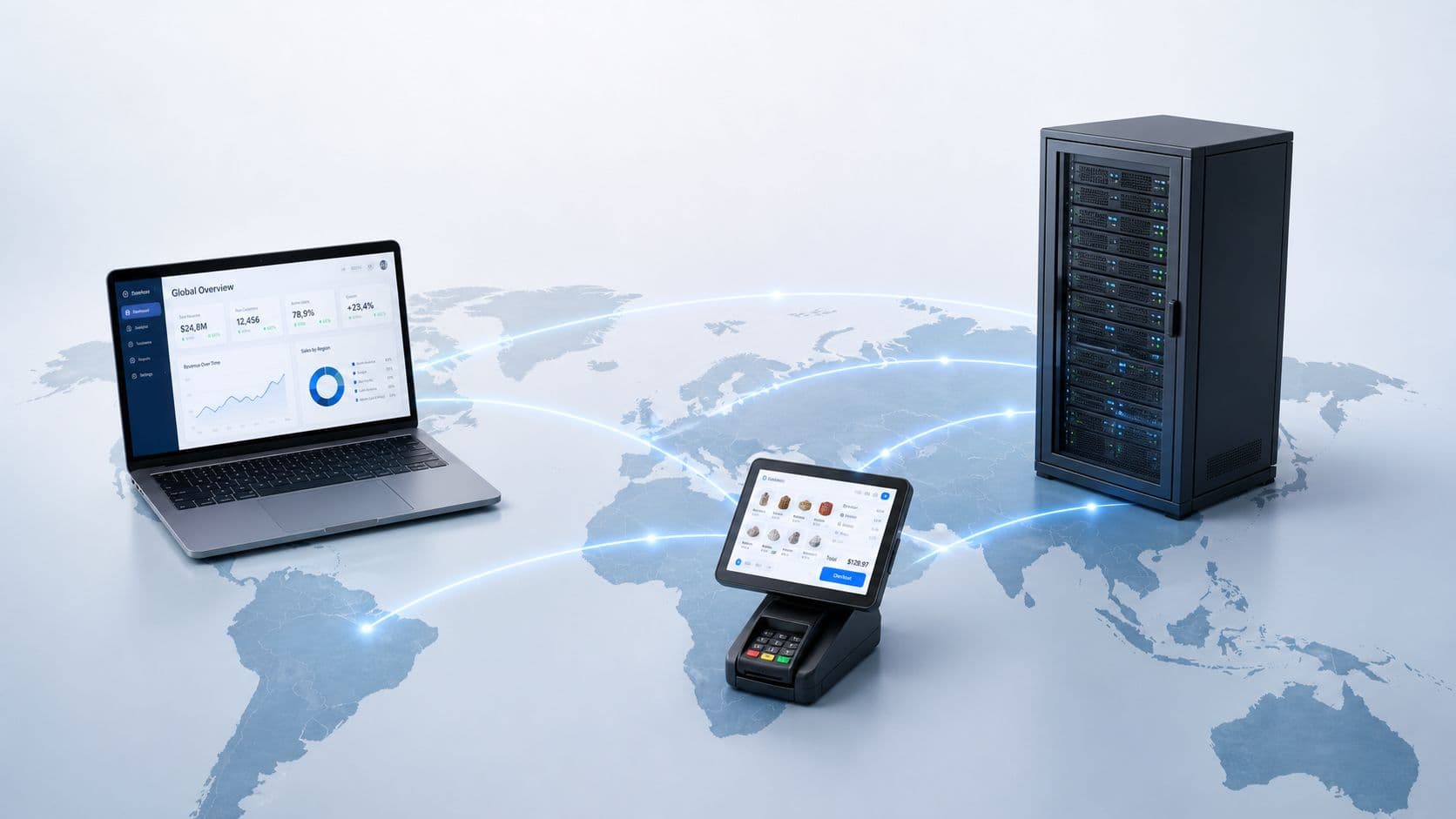
Vous êtes probablement confronté à une version de ce problème en ce moment même. Une nouvelle succursale, un hôtel, une clinique ou un point de vente doit être opérationnel rapidement. Un opérateur est en retard. Une autre liaison est active mais instable. Vos applications cloud ne se comportent pas de la même manière d'un site à l'autre. La qualité de la voix baisse aux heures de pointe. Un utilisateur dit que « le WiFi fonctionne bien » alors que Microsoft 365 est lent, ce qui ne vous apporte pratiquement aucune information utile.
C'est la réalité quotidienne qui rend la gestion du SD-WAN plus importante que le SD-WAN lui-même.
Le plus difficile n'est pas d'ajouter des circuits internet moins chers. C'est de contrôler un réseau distribué sans transformer votre équipe en chasseurs de paquets à plein temps. Vous avez besoin d'un endroit unique pour définir vos intentions, d'un endroit unique pour voir ce qui ne va pas et d'un endroit unique pour appliquer les mêmes normes sur chaque site. Dans les espaces multi-locataires, vous devez également faire en sorte que le réseau sache qui est l'utilisateur, et pas seulement quel canal le trafic a emprunté.
Au-delà du MPLS : l'essor d'une gestion intelligente du SD-WAN
Les WAN traditionnels échouent souvent de ces trois mêmes manières.
Premièrement, ils sont chers. Deuxièmement, ils sont rigides. Troisièmement, ils masquent les problèmes opérationnels derrière les frontières des opérateurs, les transferts et les fenêtres de modification manuelles.

Si vous avez géré des parcs à forte composante MPLS, vous connaissez le processus. Une succursale ouvre et quelqu'un vous demande à quel point vous pouvez la connecter rapidement. La réponse honnête dépend des délais de livraison des circuits, de la configuration des boîtiers, de la cohérence de la CLI et de la question de savoir si la conception d'origine est toujours pertinente pour le trafic SaaS. Pendant ce temps, la plupart des applications indispensables pour les utilisateurs ne se trouvent plus sagement dans un seul centre de données.
Pourquoi l'ancien modèle est devenu problématique
La conception traditionnelle du WAN supposait une centralisation. Le trafic retournait vers les sites centraux car c'est là que résidaient les applications et la sécurité.
Ce n'est plus ainsi que fonctionnent la plupart des organisations. Les équipes utilisent des services cloud, de la voix et de la vidéo, des outils basés sur un navigateur et des plateformes d'identité qui ne bénéficient pas d'un backhaul inutile. Le réseau doit prendre des décisions plus intelligentes en périphérie.
Selon les projections de Gartner citées dans des analyses du secteur, fin 2019, 30 % des entreprises dans le monde, y compris une adoption significative au Royaume-Uni, avaient déployé le SD-WAN dans leurs succursales, contre moins de 1 % auparavant. La même analyse note que les entreprises britanniques ont signalé des coûts MPLS moyens dépassant 500 £ par Mbps par mois, ce qui a poussé les organisations vers des liaisons internet que le SD-WAN pouvait gérer plus efficacement ( Cato Networks sur l'histoire du SD-WAN ).
Cette transition est importante car elle montre que le SD-WAN n'a pas été adopté par simple effet de mode. Il a résolu un décalage opérationnel.
Ce que change la gestion du SD-WAN
La valeur de la gestion SD-WAN ne réside pas dans le fait de "remplacer le MPLS par le haut débit". C'est une vision trop étroite.
Les changements clés comprennent :
- Vous définissez l'intention métier de manière centralisée. La voix, le trafic de paiement, l'accès invité, les applications cloud et les systèmes de back-office n'ont pas tous besoin du même traitement.
- Vous déployez les règles partout en même temps. La succursale ne devient pas une exception isolée.
- Vous visualisez la qualité de service, pas seulement l'état de la liaison. Une interface peut être active alors que l'expérience utilisateur est mauvaise.
- Vous réduisez la dépendance locale. Les nouveaux sites n'ont pas toujours besoin d'une configuration manuelle par un spécialiste.
Règle pratique : Si votre WAN dépend toujours d'exceptions site par site et de longs délais de modification, vous n'avez pas un problème de bande passante. Vous avez un problème de contrôle.
Un bon point de départ consiste à comprendre les gains opérationnels que les organisations recherchent lorsqu'elles modernisent la connectivité des succursales, tels que le contrôle centralisé des règles et de meilleures performances cloud, qui sont abordés dans cet aperçu des avantages du SD-WAN .
L'idée clé est simple. Le SD-WAN transforme le WAN d'un ensemble de circuits gérés individuellement en une architecture de services gérée de manière centralisée. Une fois que vous avez compris cela, le reste du modèle devient plus facile à appréhender.
Les trois piliers du contrôle de la gestion SD-WAN
Pensez à la gestion SD-WAN comme à un système de contrôle du trafic aérien.
Les avions continuent de voler sur les routes. En termes de réseau, ce sont vos équipements de succursale et vos liaisons de transport. Mais un mouvement sûr et efficace dépend d'une planification centrale, d'un contrôle actif et de règles claires. Sans ces trois éléments, vous obtenez des retards, des conflits et une intervention manuelle constante.
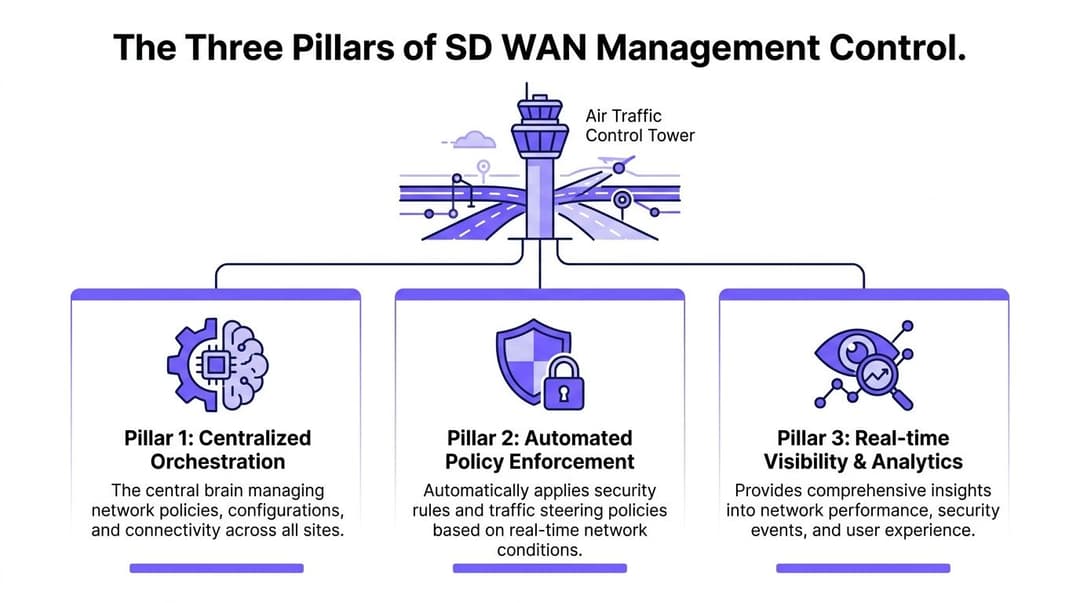
Orchestration centralisée
L'orchestrateur est le planificateur de vol.
C'est le système où votre équipe définit les modèles, les profils de site, la segmentation, l'intention métier et la logique de déploiement. Si vous utilisez Meraki, Aruba, VMware ou des plateformes similaires, c'est la partie qui vous apporte la répétabilité. Vous décidez à quoi doit ressembler une succursale de vente au détail, un hôtel ou un bureau régional, puis vous appliquez ce modèle à de nombreux sites.
C'est pourquoi le provisionnement sans contact (zero-touch provisioning) fonctionne. L'équipement de succursale arrive, se connecte, télécharge la bonne configuration et rejoint l'ensemble du parc sans qu'un ingénieur n'ait à saisir des commandes pour chaque site.
Pour les responsables informatiques, c'est crucial car la cohérence est une fonctionnalité de sécurité et de support, pas seulement un confort. Moins il y a de différences manuelles entre les sites, moins votre équipe passe de temps à essayer de se rappeler pourquoi un emplacement se comporte différemment.
Application automatisée des politiques
Le contrôleur est la tour de contrôle.
Il ne se contente pas de conserver un plan statique. Il réagit aux conditions changeantes et indique aux équipements d'extrémité ce qu'ils doivent faire. Le SD-WAN devient ici opérationnel et utile au lieu d'être simplement centralisé.
Dans les contrôleurs avancés, l'optimisation dynamique des chemins d'accès (DMPO) effectue une sélection de chemin en moins d'une seconde en surveillant la latence, la gigue et la perte de paquets. Avec un SLA d'intention de haute qualité, cela peut offrir une réduction de 40 % de la latence, et les mises à jour des politiques peuvent atteindre les équipements d'extrémité en quelques secondes plutôt qu'en plusieurs semaines ( Forcepoint sur la gestion du trafic et le contrôle des applications SD-WAN ).
Cette phrase contient beaucoup d'informations, alors décryptons-la.
Si la liaison MPLS est encombrée mais que la bande passante haut débit est fluide, le contrôleur peut déplacer le flux applicatif. Si une session vocale commence à subir de la gigue, le contrôleur peut l'orienter différemment. Si une politique change, la succursale n'attend pas l'intervention d'un technicien local.
C'est toute la différence entre "le réseau est configuré" et "le réseau est géré activement".
Un WAN statique suit des instructions. Un SD-WAN géré vérifie constamment si ces instructions produisent toujours le résultat souhaité.
Les politiques comme guide de règles
Les politiques sont le point d'achoppement de nombreux lecteurs car le terme semble abstrait.
Une politique est simplement une règle qui relie l'intention à l'action.
Par exemple :
- Intention applicative : Placer la VoIP et les systèmes de paiement sur le chemin le plus fluide.
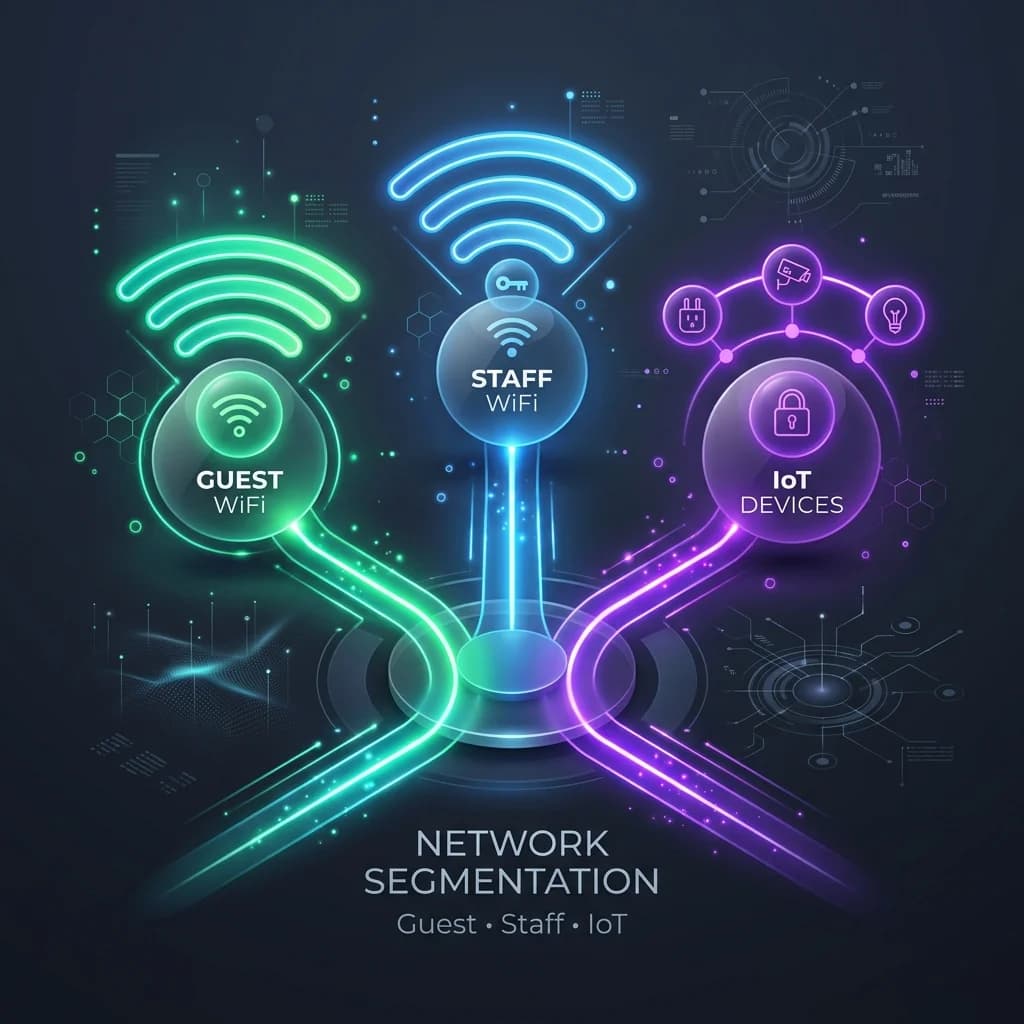
- Intention de sécurité : Séparer le trafic des invités des systèmes opérationnels.
- Intention commerciale : Permettre à un site temporaire de se connecter rapidement, tout en limitant strictement son accès.
- Intention opérationnelle : Si une liaison se dégrade, basculer sans attendre qu'un humain ne s'en aperçoive.
Certaines politiques sont globales. D'autres sont très spécifiques. Une bonne conception combine généralement les deux.
Comment les piliers fonctionnent ensemble
Voici la répartition pratique :
| Composant | Rôle | Ce que voit votre équipe |
|---|---|---|
| Orchestrateur | Définit les modèles et la logique de déploiement | Un endroit unique pour élaborer les normes des sites |
| Contrôleur | Prend des décisions d'orientation en temps réel | Adaptation rapide aux variations de qualité des liaisons |
| Politiques | Traduisent l'intention commerciale en règles applicables | Comportement prévisible sur l'ensemble des sites |
La confusion vient généralement du fait de traiter ces éléments comme un tout unique. Ce n'est pas le cas.
L'orchestrateur apporte la cohérence. Le contrôleur apporte la réactivité. Les politiques apportent la gouvernance.
Si l'un de ces éléments est faible, la gestion sd wan s'avère décevante. Vous réaliserez peut-être encore des économies sur le transport, mais vous n'obtiendrez pas le contrôle opérationnel qui rend ce modèle si pertinent.
Des alarmes réactives aux analyses prédictives
Une grande partie de la supervision WAN fonctionne encore comme une alarme anti-intrusion. Elle vous signale qu'un problème est survenu une fois que les utilisateurs sont déjà mécontents.
La gestion SD-WAN moderne devrait plutôt fonctionner comme une télémétrie continue provenant d'un système bien instrumenté. Vous ne vous demandez pas si un circuit est opérationnel. Vous vous demandez si les applications réelles bénéficient de l'expérience dont elles ont besoin.
Ce que le tableau de bord devrait vous indiquer
Une console utile doit afficher au moins quatre catégories d'informations :
- Santé des liaisons : latence, gigue, perte de paquets, utilisation
- Comportement des applications : quelle application est active, quel chemin elle a emprunté et si la politique l'a traitée correctement
- Contexte du site : si le problème est isolé à une seule agence ou s'il concerne l'ensemble du parc
- Impact utilisateur : si les flux voix, vidéo, SaaS ou transactionnels sont dégradés
À ce stade, de nombreuses équipes réalisent qu'elles naviguaient à vue. La mention « la liaison est opérationnelle » n'est d'aucune utilité lorsque la qualité de la voix est médiocre uniquement pendant les périodes d'activité intense, ou lorsqu'un fournisseur d'accès internet se comporte mal pour une application mais fonctionne correctement pour une autre.
Indicateurs clés de performance (KPI) pour la gestion SD-WAN
| Catégorie de KPI | Métrique | Bonne cible | Pourquoi c'est important |
|---|---|---|---|
| Qualité du chemin | Latence | La plus basse possible, et alignée sur les besoins des applications | Une latence élevée rend la voix, la vidéo et le SaaS lents |
| Qualité du chemin | Gigue | La plus basse possible pour le trafic en temps réel | La gigue provoque des performances instables pour la voix et la vidéo |
| Qualité du chemin | Perte de paquets | Le plus proche de zéro possible | La perte nuit à la qualité des appels et à la réactivité des applications |
| Capacité | Utilisation de la liaison | Surveiller l'utilisation élevée prolongée | La congestion apparaît souvent avant que les utilisateurs ne créent des tickets d'assistance |
| Expérience applicative | Débit par application | Adapté à l'application et au profil du site | Indique si le trafic métier bénéficie de la bande passante dont il a besoin |
| Opérations | Précision de la correspondance des politiques | Cohérence élevée sur l'ensemble des sites | Confirme que le trafic est correctement classifié et orienté |
| Disponibilité | Comportement de basculement | Restauration rapide | Indique si les pannes deviennent visibles pour les utilisateurs |
Les seuils exacts varient selon l'environnement. Un espace à forte affluence WiFi invités, une clinique et un centre d'appels ne définiront pas tous les mêmes tolérances.
Là où l'IA et le ML font leurs preuves
Les analyses SD-WAN améliorées par l'IA/ML peuvent prédire les pannes avec une précision de 95 % en combinant la télémétrie en temps réel avec des historiques de référence. Dans les environnements de vente au détail au Royaume-Uni, cela aide à atténuer 20 à 30 % de perte de paquets VoIP lors des pics de congestion sur des liaisons uniques, réduit les temps d'arrêt de 60 % et a été associé à une amélioration globale des performances de 58,20 % ( Broadcom AppNeta best practices for operating and monitoring an SD-WAN network ).
C'est utile car le système ne se contente pas d'afficher un voyant rouge. Il apprend à quoi ressemble un "vendredi après-midi normal dans ce type de succursale", puis signale les écarts avant que les utilisateurs n'envahissent le centre de services.
Une équipe opérationnelle performante utilise cela de trois manières :
- Établissement de profils de référence : apprendre à quoi ressemble un réseau sain par site et par application.
- Prédiction : repérer les risques croissants avant une panne totale.
- Ajustement : adapter les préférences de chemin, les seuils et les plans de capacité sur la base de données probantes.
Conseil opérationnel : Si toutes les alertes semblent d'égale urgence, votre surveillance n'est pas assez mature. Une bonne analyse SD-WAN doit aider votre équipe à séparer le bruit de fond des risques impactant réellement l'utilisateur.
Une meilleure approche du dépannage
Sans analyse, un ticket indique simplement "les appels sont de mauvaise qualité dans la succursale".
Avec une visibilité SD-WAN mature, la donne change. Vous pouvez voir si la perte de paquets a augmenté sur un circuit haut débit, si la voix est restée bloquée sur le mauvais chemin, si le basculement a été déclenché et si le problème a affecté toutes les applications en temps réel ou une seule.
Cela réduit le délai moyen de disculpation autant que le délai moyen de résolution. Parfois, le problème vient du réseau. Parfois, du fournisseur d'accès. Parfois, des performances de l'application en amont. Une bonne télémétrie vous aide à prouver ce qu'il en est.
Bâtir une architecture sécurisée, pas seulement un canal plus rapide
Une erreur fréquente consiste à traiter le SD-WAN comme un simple projet de transport. Acheter les équipements d'extrémité, activer les circuits, orienter le trafic, économiser de l'argent.
Cette approche laisse une faille. Si votre plan de gestion peut optimiser le trafic mais ne peut pas appliquer une posture de sécurité cohérente, vous avez simplement créé un moyen plus rapide de déplacer les risques.
La sécurité doit s'intégrer au même modèle opérationnel
Les opérations WAN modernes nécessitent des contrôles de sécurité qui évoluent au même rythme que les changements de connectivité.
Cela signifie généralement l'intégration de fonctions telles que le pare-feu de nouvelle génération, la prévention des intrusions, le filtrage web sécurisé, la segmentation et l'accès basé sur les politiques au sein du même workflow de gestion. Que ces contrôles se situent directement en périphérie, soient diffusés via le cloud ou combinent les deux, le point important reste l'unité opérationnelle.
Si votre équipe réseau met à jour la politique de chemin dans une console tandis que votre équipe de sécurité met à jour les contrôles d'accès internet ailleurs, les écarts sont presque garantis. Les succursales se retrouvent avec des règles incohérentes, les exceptions se multiplient et le dépannage devient politique.
Pourquoi le SASE est crucial en pratique
La vision SASE prend ici tout son sens. Non pas parce que l'acronyme est à la mode, mais parce qu'il reflète une réalité pratique. Les utilisateurs, les appareils, les succursales et les services cloud nécessitent tous un traitement cohérent.
Un utilisateur en succursale sur une connexion locale ne devrait pas bénéficier d'une posture de sécurité différente de celle d'un utilisateur distant par simple accident. Le modèle de gestion doit rendre la politique portable.
Cela implique :
- Une inspection cohérente : le trafic à destination d'internet doit être encadré même lorsqu'il ne traverse pas un centre de données central.
- Des zones de confiance segmentées : les invités, le personnel, l'IoT, les systèmes de paiement et les technologies opérationnelles ne doivent pas coexister dans un domaine unique et plat.
- Une logique de politique partagée : les décisions de routage et de sécurité doivent se soutenir mutuellement plutôt que d'entrer en conflit.
Le workflow opérateur souvent négligé
Au quotidien, les opérations sécurisées dépendent toujours des outils et des habitudes. Même avec des plateformes centralisées, les ingénieurs ont souvent besoin de méthodes d'accès rigoureuses pour la validation en périphérie, le contrôle des modifications et une administration simplifiée pour les audits. Si votre équipe perfectionne les workflows des terminaux, ce guide sur la gestion de réseau sécurisée avec des outils comme les clients SSH Mac constitue une référence opérationnelle utile.
Cela est important car les diagrammes d'architecture omettent souvent les aspects pratiques des fenêtres de modification et des voies d'accès humaines. Une bonne gestion SD-WAN réduit l'effort manuel, mais elle n'élimine pas le besoin de pratiques d'administration solides.
La sécurité n'est pas une fonctionnalité que l'on greffe sur le SD-WAN après son déploiement. Elle fait partie intégrante du modèle de contrôle dès le premier jour.
Le contrôle d'accès fait partie de l'infrastructure
De nombreuses équipes commencent par la segmentation des sites et les règles de pare-feu, puis réalisent qu'elles ont également besoin d'un contrôle plus strict sur les utilisateurs et les appareils autorisés à pénétrer dans chaque partie de l'environnement.
C'est là que des approches plus larges concernant les solutions de contrôle d'accès réseau deviennent pertinentes. Le WAN peut décider de la destination du trafic, mais le contrôle d'accès détermine si ce trafic doit être approuvé dès le départ.
S'il y a une chose à retenir de cette section, c'est celle-ci. Un WAN moderne n'est pas seulement un moteur de sélection de chemin. C'est un infrastructure sécurisée (secure fabric) qui doit acheminer le trafic de l'entreprise, isoler les risques et maintenir la cohérence des politiques entre les succursales, le cloud et les accès distants.
Connecter le réseau à l'utilisateur grâce à l'accès basé sur l'identité
C'est l'écart qui piège de nombreux déploiements SD-WAN par ailleurs solides.
Le réseau en sait beaucoup sur les applications, les chemins et les sites. Il en sait souvent bien moins sur la personne ou l'appareil réel qui demande l'accès. Dans un bureau classique, c'est déjà une limite. Dans un hôtel, un espace de vente, une résidence étudiante, une propriété à usage mixte ou un établissement de santé, cela devient un grave défaut de conception.

Pourquoi la seule politique de chemin ne suffit pas
Une politique SD-WAN traditionnelle pourrait dicter :
- prioriser Teams
- préférer le haut débit pour l'internet des invités
- maintenir le trafic de paiement sur la liaison la plus fiable
- isoler les appareils IoT
Ce sont de bonnes règles. Elles ne suffisent pas.
Elles ne répondent pas à des questions comme celles-ci :
- S'agit-il d'un membre du personnel, d'un invité, d'un prestataire ou d'un résident ?
- L'appareil est-il géré, inconnu ou hérité ?
- Cet utilisateur doit-il bénéficier d'un accès aux applications internes, d'un accès internet uniquement ou d'un accès segmenté aux services ?
- L'accès peut-il être révoqué immédiatement en cas de modification du statut dans l'annuaire ?
Sans accès basé sur l'identité, les équipes comblent souvent le manque par des mots de passe partagés, des solutions de contournement de Captive Portal , des exceptions locales ou des identifiants d'appareil statiques. Cela crée des frictions et affaiblit les objectifs de zero-trust.
La réalité du multi-locataire
Une enquête de 2025 auprès des FAI britanniques a révélé que 42 % des entreprises considèrent la gestion des identités comme l'un des principaux défis du SD-WAN. Le même document note une croissance de 28 % des points d'accès WiFi publics entre 2024 et 2025, avec 65 % de ces points d'accès dans l'hôtellerie et le commerce de détail, où la gestion cloisonnée entre le réseau et l'identité de l'utilisateur crée des failles de sécurité et ne répond pas aux attentes émergentes de la directive européenne NIS2 concernant l'accès chiffré dès le premier paquet ( Cisco SD-WAN ebook PDF ).
C'est tout le problème opérationnel résumé en un paragraphe. Le réseau de la succursale est peut-être orchestré de manière centralisée, mais l'accès des utilisateurs est souvent géré ailleurs, avec des outils différents, une logique de politique différente et des équipes différentes.
Dans un site multi-locataire, cette division cause de réels problèmes :
| Scénario | Vue réseau uniquement | Vue basée sur l'identité |
|---|---|---|
| L'invité se connecte au WiFi du lieu | Voit un trafic internet générique | Sait qu'il s'agit d'un invité avec des privilèges limités |
| Le membre du personnel se connecte | Voit le trafic des applications d'entreprise | Applique un accès personnel lié à l'identité du répertoire |
| Le sous-traitant arrive avec un appareil non géré | Voit un autre point de terminaison | Restreint l'accès en fonction du rôle et de la confiance de l'appareil |
| Un appareil hérité se connecte | Voit uniquement le MAC ou le segment | Place l'appareil dans une voie de politique étroitement contrôlée |
À quoi ressemble un modèle unifié
Le meilleur résultat est un modèle de contrôle interconnecté.
La couche SD-WAN gère la qualité du chemin, la segmentation, la connectivité des succursales et la distribution des politiques. La couche d'identité gère l'authentification, le rôle, le contexte de l'appareil et les décisions d'accès continu. Ensemble, elles produisent quelque chose de proche d'un véritable zero trust.
Cela transforme la politique de générique à précise.
Au lieu de "prioriser le trafic de collaboration", la politique devient "autoriser et prioriser le trafic de collaboration pour le personnel autorisé sur des appareils de confiance, tout en refusant cet accès aux invités et en isolant les points de terminaison hérités". C'est une bien meilleure instruction.
Principe de conception : La politique réseau indique au trafic où il peut aller. La politique d'identité indique au réseau qui doit être autorisé à y aller.
Pourquoi la confiance dès le premier paquet est importante
Les Captive Portals et les identifiants partagés appartiennent à un modèle d'accès plus ancien. Ils sont fastidieux pour les utilisateurs et fragiles pour les opérateurs.
L'accès basé sur l'identité, construit autour de l'intégration des annuaires, d'une confiance de niveau certificat et de normes telles que Passpoint et OpenRoaming , déplace la décision plus en amont. La session commence avec une assurance plus forte, et non après un transfert maladroit.
C'est particulièrement pertinent si vous alignez la connectivité des succursales avec des principes plus larges d'accès réseau zero trust ( zero trust network access ). Le zero trust cesse d'être un concept réservé à l'accès distant et devient quelque chose que vous appliquez également au sein des établissements.
La leçon pratique est simple. Le SD-WAN vous donne le contrôle sur le réseau. L'accès basé sur l'identité vous donne le contrôle sur qui peut l'utiliser, et à quelles conditions. Dans des environnements partagés, vous avez besoin des deux.
Mettre la théorie en pratique avec les manuels opérationnels SD WAN
Une bonne architecture n'a de valeur que si votre équipe peut l'exécuter de manière répétée sous pression.
C'est là que les manuels opérationnels sont utiles. Ils transforment la gestion SD-WAN d'un concept de conception en un ensemble d'actions fiables que les ingénieurs juniors peuvent suivre et auxquelles les ingénieurs seniors peuvent faire confiance.
Manuel pour la mise en ligne d'un nouveau site
Une nouvelle succursale, un café, une clinique ou un hôtel n'a pas besoin d'un processus de déploiement héroïque.
Un déploiement pratique ressemble généralement à ceci :
Attribuer le profil du site Associez l'emplacement à un modèle de conception standard. Le secteur du commerce de détail diffère de celui des bureaux d'entreprise. L'hôtellerie diffère du secteur de la santé. Le profil doit déjà définir la segmentation, les transports préférés et la sécurité de base.
Préparez l'accès réseau pour un déploiement sans contact (zero-touch provisioning) Enregistrez l'appareil dans l'orchestrateur, liez-le au bon modèle et confirmez ses liaisons montantes attendues ainsi que son groupe de politiques.
Validez le comportement du transport Une fois en ligne, vérifiez que les circuits sont correctement reconnus et que le contrôleur évalue la qualité du chemin au lieu de traiter chaque liaison de la même manière.
Confirmez la segmentation et les limites d'accès Le trafic des invités, du personnel, des opérations et des appareils doit immédiatement être dirigé vers les bonnes zones.
Exécutez des tests applicatifs Validez un échantillon restreint d'expériences critiques telles que la voix, les paiements, l'accès aux applications métiers et la sortie internet générale.
Une équipe expérimentée gère cela comme une liste de contrôle, non comme un projet d'artisanat.
Guide opérationnel pour déployer un changement de politique en toute sécurité
C'est lors des changements de politiques que la gestion centralisée démontre toute sa valeur.
Supposons que vous deviez restreindre l'accès internet pour une catégorie d'applications, ou modifier la préférence de chemin pour la voix sur tous les sites d'un certain type. La méthode de base est simple :
- Modifiez l'ensemble de politiques centralisé plutôt que de gérer des exceptions site par site.
- Ciblez le changement sur le bon groupe d'appareils ou la bonne classe de sites.
- Examinez l'ordre des politiques et les conflits avant le déploiement.
- Déployez durant une fenêtre contrôlée si le changement est visible par les utilisateurs.
- Surveillez la télémétrie en direct après le déploiement pour confirmer les correspondances attendues et l'absence d'effets secondaires indésirables.
Ce qui perturbe généralement les équipes n'est pas le déploiement lui-même. C'est le manque de rigueur dans la gestion des politiques : un trop grand nombre de règles redondantes, des noms flous et des exceptions d'urgence qui n'ont jamais été nettoyées.
Utilisez des noms de politiques clairs. « Retail-Guest-Internet-Default » est préférable à « Policy_27B_Final ».
Guide opérationnel pour résoudre un appel de mauvaise qualité ou une application lente
Lorsqu'un utilisateur signale une mauvaise réunion vidéo ou un appel saccadé, ne commencez pas par rejeter la faute de manière abstraite sur le WiFi ou le FAI.
Suivez un processus de décision simple :
| Vérification | Ce que vous recherchez | Prochaine action probable |
|---|---|---|
| Chemin applicatif | L'application a-t-elle emprunté le transport prévu ? | Corriger la correspondance de politique ou la préférence de chemin |
| Santé de la liaison | Y avait-il de la latence, de la gigue ou des pertes de paquets lors du problème ? | Rediriger le trafic ou remonter le problème à l'opérateur |
| Modèle de site | Un seul utilisateur, un seul site ou plusieurs sites ? | Isoler un problème local d'un problème systémique |
| Corrélation temporelle | La dégradation coïncide-t-elle avec un pic d'utilisation ? | Examiner la capacité ou la régulation du trafic (traffic shaping) |
| Impact de la politique de sécurité | Le trafic a-t-il été inspecté ou bloqué de manière inattendue ? | Ajuster l'ordre des règles ou la gestion des exceptions |
La visibilité centrale permet ici de gagner du temps. Vous ne devinez plus à partir de fragments. Vous tracez la politique, le chemin et l'impact utilisateur depuis un seul endroit.
L'habitude qui maintient les opérations propres
Les meilleurs guides d'exploitation incluent une dernière étape que les équipes ignorent souvent.
Après une correction, mettez à jour la norme. Si un site a nécessité un ajustement unique parce que votre profil d'origine était trop large, formalisez cela comme une variation prise en charge ou supprimez l'exception. Ne laissez pas de dérive non documentée en production.
Cette discipline importe plus que n'importe quelle fonctionnalité de tableau de bord. Au fil du temps, c'est ce qui sépare un parc SD-WAN qui reste gérable d'un autre qui recrée lentement le désordre qu'il était censé remplacer.
L'avenir du réseau unifié et conscient de l'identité
L'ancien modèle WAN posait une question étroite. Comment connecter les sites ?
Cela ne suffit plus. Les opérations modernes doivent répondre à un ensemble de questions plus larges en même temps. Comment connecter les sites, choisir les chemins de manière intelligente, appliquer la sécurité de manière cohérente, comprendre la santé des applications et prendre des décisions d'accès basées sur l'identité plutôt que sur la seule localisation ?
C'est pourquoi la gestion du SD-WAN importe plus que le mélange de transports sous-jacent.
Ce que les équipes matures construisent réellement
Le but ultime n'est pas un tableau de bord. C'est un modèle opérationnel.
Les environnements les plus solides combinent :
- Une orchestration centrale pour que les sites restent cohérents
- Un contrôle en temps réel pour que le réseau s'adapte aux conditions changeantes
- La télémétrie et les analyses pour que les équipes puissent agir avant que les utilisateurs ne se plaignent
- Une sécurité intégrée pour que l'accès local direct ne devienne pas un risque local
- Un accès conscient de l'identité pour que les utilisateurs et les appareils bénéficient du bon niveau de confiance dès la première connexion
Ces éléments se renforcent mutuellement. S'il en manque un, l'ensemble de la conception semble moins efficace.
Pourquoi l'identité est le prochain niveau de maturité
Un réseau qui ne comprend que les circuits et les applications est utile. Un réseau qui comprend également les utilisateurs, les rôles, les appareils et l'état de l'accès est beaucoup plus résilient.
Cela importe particulièrement dans les environnements où de nombreuses personnes partagent la même infrastructure physique mais ne doivent pas partager le même niveau de confiance. L'hôtellerie, le commerce de détail, le résidentiel, l'événementiel, les transports et la santé sont tous rapidement confrontés à ce problème.
Le futur WAN est défini par logiciel, mais ce n'est pas la ligne d'arrivée. Il doit également être conscient de l'identité.
Lorsque les équipes y parviennent, les opérations deviennent plus sereines. Les nouveaux sites sont plus faciles à lancer. Les changements de politique sont plus sûrs à déployer. Le dépannage devient plus rapide. La sécurité dépend moins des solutions de contournement. Les utilisateurs ne ressentent plus les transitions entre le réseau des succursales, l'intégration WiFi et le contrôle d'accès.
Cela offre une promesse de taille. Non seulement un meilleur WAN, mais un environnement plus cohérent pour tous ceux qui le gèrent et tous ceux qui en dépendent.
Si vous cherchez à combler le fossé entre le contrôle au niveau du réseau et l'accès au niveau de l'utilisateur, Purple aide les organisations à remplacer les mots de passe partagés et les Captive Portals fastidieux par un accès WiFi sans mot de passe, basé sur l'identité, pour les invités, le personnel et les environnements multi-locataires. C'est un moyen pratique d'étendre la philosophie zero-trust jusqu'à la périphérie, en particulier dans les lieux où le SD-WAN seul ne peut pas résoudre le problème d'identité des utilisateurs.