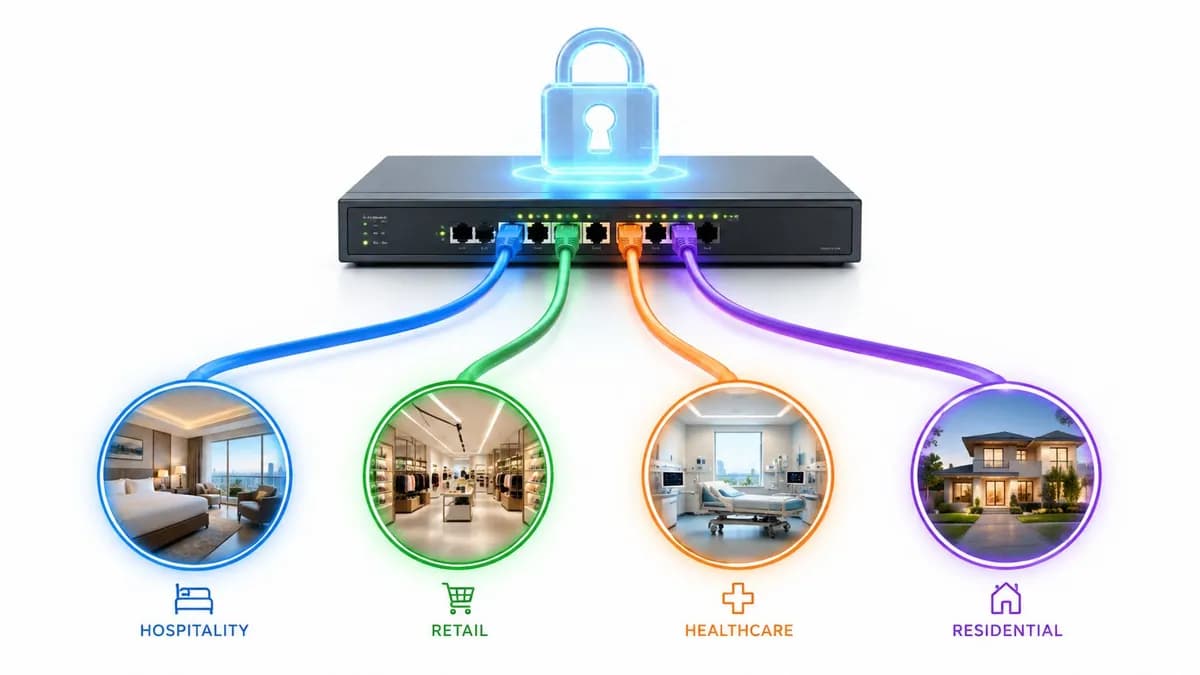

Calculate your multi-site SD-WAN savings and ROI
Compare legacy MPLS operational expenditure against modern SD-WAN transport aggregation. Sized for enterprise retail, hospitality, and corporate branch networks.
Figures are authored in GBP and converted at indicative rates for planning, not at a live exchange rate. Enter your own circuit costs for a quote-accurate model.
Multi-store retail estate requiring high uptime for POS terminals, digital signage, and guest WiFi data capture.
| Network metric | Legacy MPLS architecture | Software-defined WAN (SD-WAN) | Difference |
|---|---|---|---|
| Monthly circuit cost per site | £1,100 | £515 | -53% |
| Total annual WAN expenditure | £330,000 | £154,500 | -£175,500 / year |
| Average available bandwidth | 50 Mbps (rigid circuit) | 300 Mbps (bonded broadband + fiber) | +6.0x throughput |
| Path steering & failover | Manual BGP reconvergence (30 to 90 seconds) | Sub-second dynamic steering to prioritise critical apps | Zero dropped VoIP / video calls |
| Provisioning time per branch | 6 to 12 weeks for telco circuit install | Zero-touch deployment in under 2 hours | 98% faster rollout |
Ready to reduce multi-site WAN spend and elevate venue WiFi?
Our enterprise network architects assess your current telecom topology, model hybrid circuit economics, and design high-density wireless integration.
Software-Defined Wide Area Networking (SD-WAN) has transformed enterprise connectivity, enabling modern multi-site businesses to break free from costly, rigid legacy networks. By decoupling network management hardware from control mechanisms, SD-WAN intelligently routes traffic across multiple transport links, ensuring high availability, robust security, and cloud application performance.
Key takeaways: Core SD WAN benefits for enterprise networks
- Up to 50% WAN cost reduction: Aggregate commercial broadband, fiber, and 5G connections to replace expensive dedicated MPLS circuits without sacrificing reliability.
- Application-aware traffic steering: Dynamically prioritises mission-critical cloud traffic like Microsoft 365, POS transactions, and VoIP calls over guest browsing.
- Sub-second automated failover: Prevent network downtime across branch offices and retail venues with instantaneous packet-level failover across active circuits.
- Centralised cloud management: Simplify multi-site network administration with zero-touch provisioning and real-time path health monitoring.
- Seamless overlay compatibility: Deploy guest WiFi, captive portals, and location analytics via Purple on top of Cisco Meraki, HPE Aruba, Ruckus, Juniper Mist, and Fortinet SD-WAN deployments.
Why traditional WAN architectures no longer meet business needs
For decades, enterprise IT departments relied on Multiprotocol Label Switching (MPLS) circuits to connect branch offices, retail outlets, and regional venues back to a central corporate data center. In a pre-cloud era where business applications ran locally on corporate servers, backhauling all traffic through a central hub ensured consistent security enforcement.
However, the rapid migration to cloud services like Microsoft 365, Salesforce, and AWS rendered traditional WAN architectures inefficient. Backhauling cloud-bound traffic creates a severe bottleneck known as hair-pinning, increasing latency, consuming expensive MPLS bandwidth, and degrading user experience for both employees and guests.
For additional details on securing modern enterprise branch infrastructure, read our comprehensive enterprise WiFi security guide.
The 5 core SD WAN benefits for modern enterprise networks
1. Significant reduction in WAN transport costs
Dedicated MPLS lines are expensive to provision and scale, often costing up to ten times more per megabit than commercial broadband circuits. SD-WAN allows organizations to aggregate diverse connection types - including fiber, cable broadband, and 5G cellular - into a unified, resilient transport layer. By replacing or augmenting legacy MPLS links with cost-effective broadband, enterprises typically reduce WAN circuit spending by 30% to 50% while expanding overall bandwidth capacity.
2. Application-aware routing and dynamic path selection
SD-WAN controllers continuously monitor circuit health, measuring real-time latency, jitter, and packet loss across all active links. Using Deep Packet Inspection (DPI) and Layer 7 application identification, SD-WAN automatically routes high-priority traffic over the optimal path. Latency-sensitive applications like VoIP voice calls and video conferences travel over low-jitter links, while bulk data backups or public guest WiFi browsing use secondary internet circuits.
3. High availability with sub-second failover
Network downtime directly impacts venue revenue, point-of-sale processing, and operational efficiency. SD-WAN delivers high availability through active-active circuit bonding. If a primary fiber link experiences a outage or severe brownout, SD-WAN steers active sessions to secondary broadband or 5G connections in milliseconds without dropping established TCP connections or phone calls.
4. Centralised management and zero-touch provisioning
Managing branch routers across hundreds of locations via manual Command Line Interface (CLI) configurations is slow and prone to human error. SD-WAN introduces centralized cloud management, enabling network engineers to push firewall rules, QoS profiles, and routing policies across the entire branch network from a single dashboard. Zero-touch provisioning (ZTP) allows local staff to plug in pre-configured hardware at new venue openings, bringing branch networks online in minutes rather than weeks.
5. Integrated security and SASE convergence
As branch offices connect directly to cloud applications, securing internet breakout points becomes critical. Modern SD-WAN solutions integrate end-to-end IPsec encryption, next-generation firewall (NGFW) protection, intrusion prevention systems (IPS), and URL filtering. This integration forms the backbone of Secure Access Service Edge (SASE), ensuring consistent zero-trust security policies across all physical venues and remote workers.
Comparing SD-WAN against traditional WAN and direct internet access
Review the comparison table below to evaluate how SD-WAN compares against legacy networking models for multi-site deployments:
| Architecture | Transport Cost | Failover Speed | Cloud Application Performance | Deployment Speed |
|---|---|---|---|---|
| SD-WAN (Hybrid Transport) | Low to Moderate (Broadband + 5G) | Sub-second (Seamless) | Optimal (Direct breakout & dynamic SLA) | Rapid (Zero-touch provisioning) |
| Traditional MPLS WAN | High (Dedicated private circuits) | Slow (Manual or basic routing failover) | Poor (Backhauled hair-pinning latency) | Slow (Weeks/months circuit provisioning) |
| Direct Internet Access (DIA) | Low (Standard unmanaged broadband) | None (Single point of failure) | Variable (Unpredictable ISP routing) | Fast (Local broadband activation) |
Integrating guest WiFi and venue analytics over SD-WAN
Modern venue operators use SD-WAN to segment corporate operational traffic from public visitor usage. By configuring dedicated guest VLANs on top of SD-WAN transport, IT teams prevent public traffic from competing with critical business applications like point-of-sale systems or corporate ERPs.
When combined with cloud overlay services like Purple, SD-WAN enables venues to capture rich visitor demographics, track dwell times, and deliver customized captive portal experiences. To explore how location insights drive business growth, read our comprehensive WiFi analytics guide and our multi-tenant WiFi guide.
Frequently asked questions about SD WAN benefits
What is the main difference between SD-WAN and MPLS?
MPLS is a dedicated private network transport protocol that routes traffic through fixed, expensive circuits. SD-WAN is an intelligent software overlay that aggregates multiple transport types (such as fiber broadband, commercial internet, and 5G) to dynamically route traffic based on real-time application needs and circuit quality.
How much money can SD-WAN save a business?
Most enterprises achieve circuit cost reductions between 30% and 50% by augmenting or replacing expensive dedicated MPLS lines with bonded commercial broadband links. Additional savings result from automated zero-touch provisioning and reduced branch IT maintenance costs.
How does SD-WAN help manage guest WiFi in retail and hospitality venues?
SD-WAN enables clean network segmentation by isolating public guest WiFi traffic onto dedicated virtual networks (VLANs). It enforces Quality of Service (QoS) bandwidth caps, ensuring that guest web browsing never degrades core business applications like point-of-sale terminals or staff VoIP phones.
Does Purple work alongside SD-WAN network hardware?
Yes. Purple runs as a cloud overlay across all major SD-WAN hardware and wireless access point vendors, including Cisco Meraki, HPE Aruba, Ruckus, Juniper Mist, and Fortinet. Purple handles captive portal authentication, marketing consent capture, and spatial analytics without requiring network hardware replacements.
Is SD-WAN secure enough for cloud-first enterprises?
Yes. Modern SD-WAN incorporates robust end-to-end IPsec encryption, next-generation firewalling, and intrusion prevention. When deployed as part of a Secure Access Service Edge (SASE) framework, SD-WAN enforces strict zero-trust security policies across all venue endpoints and cloud connections.
Transform your venue network with Purple and SD-WAN
Combine intelligent SD-WAN transport with Purple's cloud-managed guest WiFi, automated compliance, and real-time location analytics across all your venues.