
Aruba ClearPass vs Cisco ISE: Comparativo de Plataformas NAC
Este guia de referência técnica oferece uma comparação detalhada e neutra entre Aruba ClearPass e Cisco ISE. Ele fornece a arquitetos de rede e gerentes de TI insights acionáveis sobre arquitetura, complexidade de implantação, licenciamento e ecossistemas de integração para impulsionar decisões informadas sobre plataformas NAC.
Ouça este guia
Ver transcrição do podcast

Resumo Executivo
Para arquitetos de rede corporativos e CTOs que avaliam plataformas de Network Access Control (NAC), a escolha frequentemente se resume a duas forças dominantes: Aruba ClearPass e Cisco Identity Services Engine (ISE). Ambas as plataformas fornecem recursos robustos de autenticação, autorização e contabilidade (AAA), garantindo que cada endpoint — de laptops corporativos a sensores IoT sem interface — seja seguramente perfilado e segmentado antes de obter acesso à rede. No entanto, suas filosofias arquitetônicas diferem significativamente. O Cisco ISE está profundamente integrado ao ecossistema Cisco, aproveitando protocolos proprietários como pxGrid e TrustSec para oferecer micro-segmentação incomparável em ambientes homogêneos. Por outro lado, o Aruba ClearPass é projetado desde o início como um motor de políticas agnóstico a fornecedores, utilizando padrões abertos como RADIUS e REST APIs para integrar-se perfeitamente em redes multi-fornecedores. Este guia oferece uma comparação pragmática e aprofundada de ambas as plataformas, explorando seus recursos, complexidades de implantação e modelos de licenciamento para ajudá-lo a alinhar sua estratégia NAC com as realidades operacionais e requisitos de conformidade de sua organização.
Análise Técnica Detalhada
Arquitetura e Integração de Ecossistemas
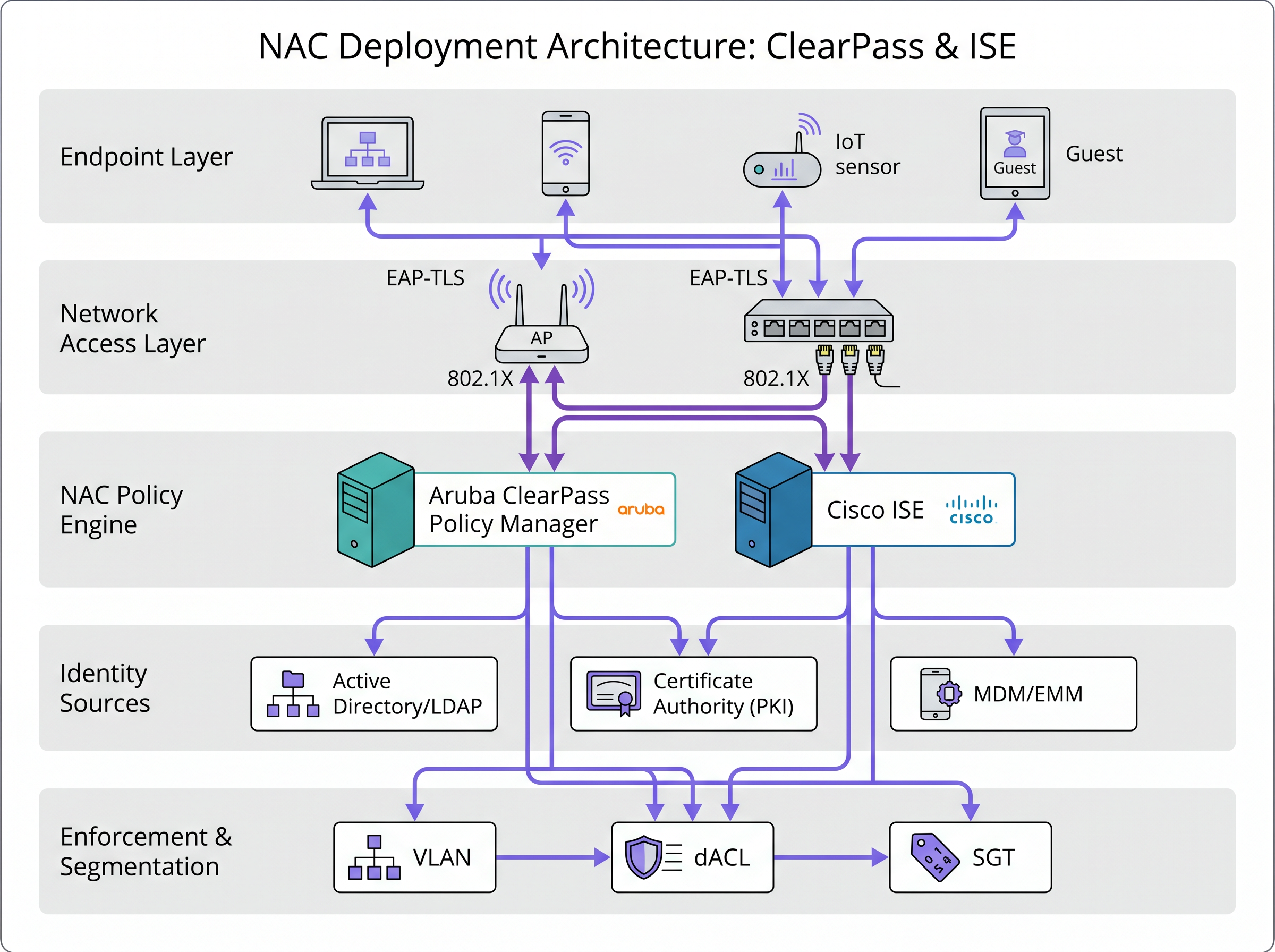
A divergência fundamental entre ClearPass e ISE reside em sua abordagem à integração de ecossistemas. O Cisco ISE prospera em um ambiente centrado na Cisco. Ele utiliza Security Group Tags (SGTs) dentro da estrutura Cisco TrustSec para impor controle de acesso granular e escalável em switches Catalyst, access points Meraki e firewalls Firepower, sem depender exclusivamente de Access Control Lists (ACLs) tradicionais baseadas em IP. O protocolo pxGrid (Platform Exchange Grid) aprimora ainda mais isso, permitindo que o ISE compartilhe dados contextuais ricos com soluções de segurança de terceiros, criando um ecossistema de resposta a ameaças coeso e automatizado.
O Aruba ClearPass, em contraste, adota uma filosofia de rede heterogênea. Ele atua como um tradutor universal, aplicando políticas consistentes em hardware Aruba, Cisco, Juniper e Palo Alto usando protocolos padrão RADIUS e TACACS+. Sua robusta REST API e amplo ecossistema de integração permitem que ele ingira contexto de plataformas Mobile Device Management (MDM), firewalls e agentes de segurança de endpoint sem esforço. Para locais com implantações de hardware mistas, o ClearPass frequentemente apresenta uma barreira de entrada menor para a aplicação unificada de políticas.
Motor de Políticas e Interface de Gerenciamento
A criação de políticas no ClearPass é altamente visual e orientada a serviços. Os administradores definem um 'Serviço' (por exemplo, '802.1X Corporativo') e empilham sequencialmente métodos de autenticação, fontes de autorização e perfis de aplicação. Essa abordagem modular e de cima para baixo é intuitiva e simplifica a solução de problemas.
O Cisco ISE utiliza uma matriz baseada em regras, semelhante à configuração de um firewall sofisticado. As políticas são construídas usando regras complexas e multi-condicionais que avaliam identidade, postura e contexto simultaneamente. Embora isso ofereça imensa flexibilidade e poder para cenários empresariais intrincados, exige uma curva de aprendizado mais acentuada e um gerenciamento meticuloso da configuração para evitar consequências indesejadas.
Criação de Perfil e Visibilidade de Dispositivos
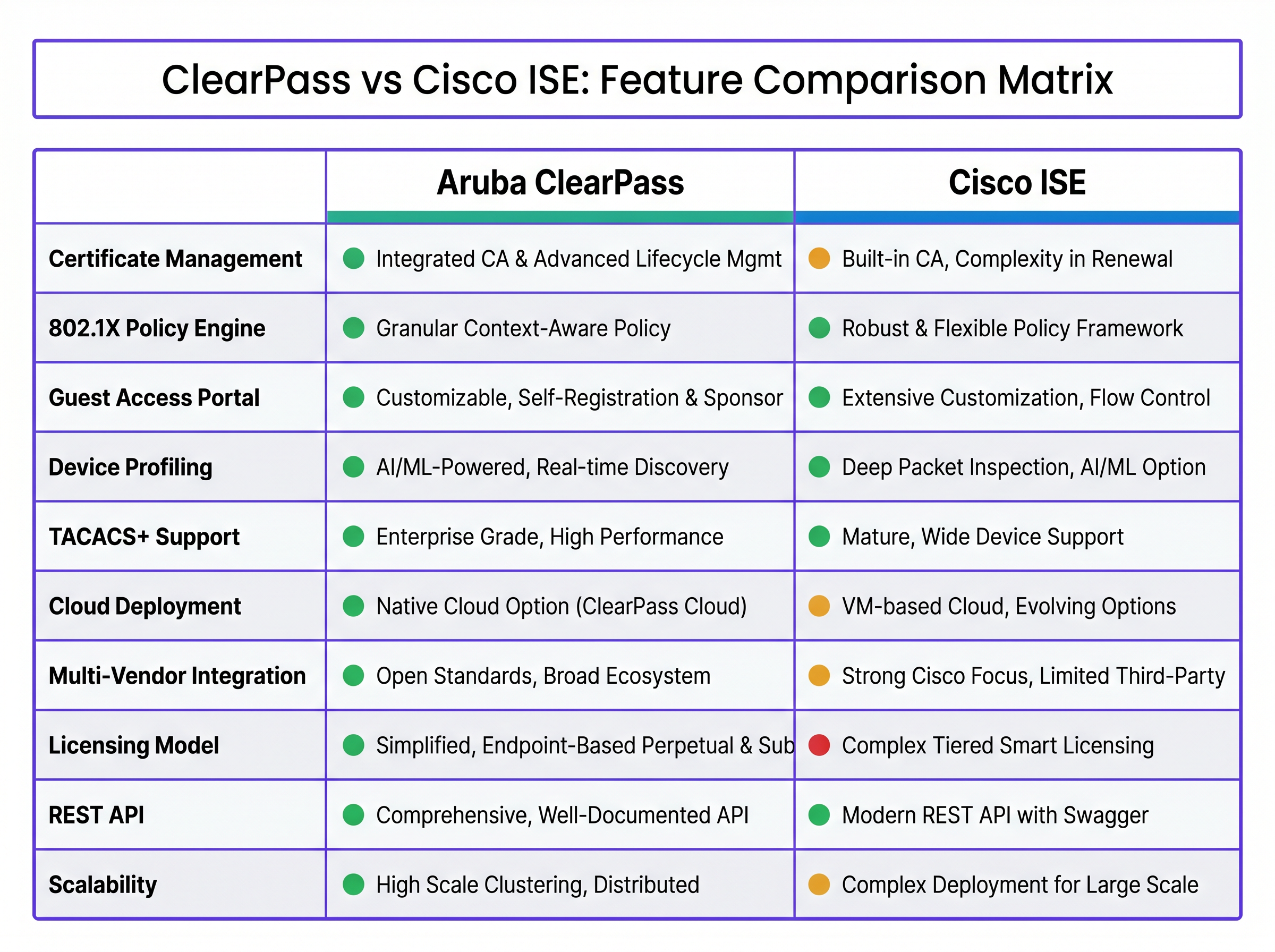
A criação precisa de perfis de dispositivos é crítica para o NAC moderno, especialmente com a proliferação de dispositivos IoT. Ambas as plataformas se destacam aqui, utilizando dados DHCP, HTTP, MAC OUI e SNMP. O ISE tem uma vantagem em ambientes Cisco através do Device Sensor, que alimenta dados de inspeção profunda de pacotes diretamente dos switches Cisco para o nó ISE. O ClearPass contrapõe isso com o ClearPass Device Insight, uma solução baseada em nuvem e alimentada por AI que utiliza aprendizado de máquina para identificar dispositivos obscuros ou falsificados que evadem as assinaturas de perfil padrão.
Guia de Implementação
Implantar uma plataforma NAC é uma operação de alto risco. Uma configuração incorreta pode bloquear usuários legítimos da rede, paralisando as operações comerciais.
- Comece com Visibilidade (Modo Monitor): Nunca implemente a aplicação no primeiro dia. Configure o NAC para perfilar dispositivos e registrar solicitações de autenticação sem bloquear o tráfego. Isso fornece uma imagem clara do que realmente está em sua rede e ajuda a identificar dispositivos que falharão na autenticação 802.1X.
- Aplique Primeiro na Rede Wireless: As redes Wireless são geralmente mais fáceis de proteger porque os dispositivos estão acostumados a autenticar (por exemplo, WPA3-Enterprise). Comece com laptops corporativos gerenciados pelo Active Directory ou um MDM, pois estes podem facilmente receber os certificados necessários.
- Lide com a Rede Wired: O Wired 802.1X é notoriamente difícil devido a impressoras legadas, dispositivos IoT não gerenciados e switches 'burros'. Use MAC Authentication Bypass (MAB) para dispositivos que não suportam 802.1X, mas limite estritamente seu acesso à rede usando atribuição dinâmica de VLAN ou dACLs.
- Implemente Acesso para Convidados: Para ambientes de hospitalidade e varejo, o acesso para convidados é uma preocupação primordial. O ClearPass Guest oferece um portal altamente personalizável com auto-registro e aprovação de patrocinador, integrando-se suavemente com plataformas como Guest WiFi para análises avançadas. O ISE também oferece recursos robustos para convidados, mas pode exigir mais esforço para alcançar uma experiência altamente personalizada.
Melhores Práticas
- Mantenha a Higiene do Diretório: Um NAC é tão eficaz quanto o armazenamento de identidade que ele consulta. Garanta que seu Active Directory ou LDAP esteja limpo, preciso e atualizado.
- Aproveite os Certificates: Evite a autenticação baseada em senha (PEAP-MSCHAPv2) sempre que possível. Deimplantar EAP-TLS usando certificados emitidos por uma Autoridade Certificadora (CA) confiável para segurança superior e uma experiência de usuário contínua.
- Planejamento para Alta Disponibilidade: O NAC é um componente crítico da infraestrutura. Implante nós redundantes em uma arquitetura distribuída para garantir acesso contínuo à rede durante manutenções ou falhas.
Solução de Problemas e Mitigação de Riscos
Modos de falha comuns geralmente giram em torno da expiração de certificados, ordem incorreta de políticas ou portas de switch mal configuradas.
- Expiração de Certificados: Implemente processos automatizados de renovação de certificados (por exemplo, SCEP/EST) para evitar falhas de autenticação súbitas e generalizadas.
- Ordem das Políticas: Tanto no ClearPass quanto no ISE, as políticas são avaliadas de cima para baixo. Garanta que regras mais específicas sejam colocadas acima de regras gerais para evitar acessos não intencionais.
- APs Maliciosos: Garanta que seu sistema de prevenção de intrusão sem fio (WIPS) esteja monitorando ativamente ataques de personificação. Consulte nosso guia sobre Detecção de APs Maliciosos: Protegendo o WiFi do Local contra Ataques de Personificação para estratégias detalhadas.
ROI e Impacto nos Negócios
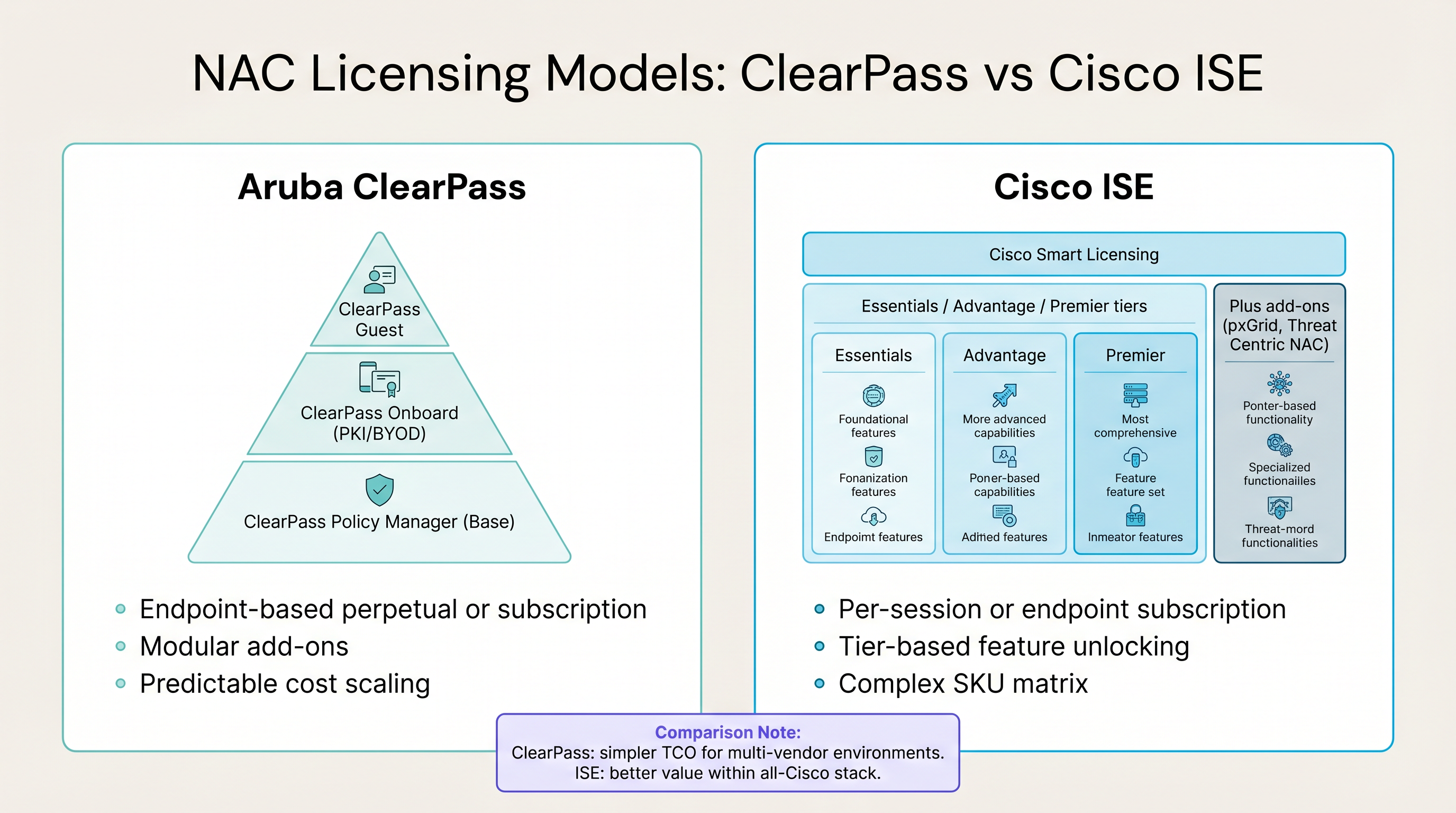
O impacto financeiro de uma implantação de NAC vai além dos custos iniciais de software e hardware.
- Aruba ClearPass: Oferece um modelo de licenciamento previsível, baseado em endpoint (perpétuo ou por assinatura) com módulos adicionais para Guest e Onboard. Essa simplicidade geralmente se traduz em um Custo Total de Propriedade (TCO) menor em ambientes multi-fornecedor.
- Cisco ISE: Utiliza um modelo complexo de Smart Licensing com níveis Essentials, Advantage e Premier. Embora potencialmente mais caro, ele oferece um ROI excepcional se você estiver aproveitando totalmente os recursos avançados de uma arquitetura de segurança unificada da Cisco.
Em última análise, uma implantação bem-sucedida de NAC mitiga o risco de violações de dados dispendiosas, garante a conformidade com padrões como PCI DSS e GDPR, e reduz a sobrecarga operacional do provisionamento manual de rede.
Definições principais
802.1X
An IEEE standard for port-based network access control that provides an authentication mechanism to devices wishing to attach to a LAN or WLAN.
The foundational protocol for secure enterprise network access, preventing unauthorized devices from communicating on the network.
RADIUS (Remote Authentication Dial-In User Service)
A networking protocol that provides centralized Authentication, Authorization, and Accounting (AAA) management for users who connect and use a network service.
The primary protocol used by both ClearPass and ISE to communicate with network switches and access points.
TACACS+ (Terminal Access Controller Access-Control System Plus)
A Cisco-developed protocol that provides access control for routers, network access servers, and other networked computing devices via one or more centralized servers.
Used primarily for device administration (authenticating IT staff logging into switches and routers), separating authentication from authorization.
MAC Authentication Bypass (MAB)
A method of authenticating devices that do not support 802.1X (like printers or legacy IoT devices) by using their MAC address as the identity credential.
A necessary workaround for headless devices, though inherently less secure than 802.1X as MAC addresses can be spoofed.
EAP-TLS (Extensible Authentication Protocol-Transport Layer Security)
An EAP method that relies on client and server certificates for mutual authentication.
Considered the gold standard for wireless and wired security, providing robust protection against credential theft.
TrustSec
A Cisco security architecture that uses Security Group Tags (SGTs) to enforce access control policies based on endpoint identity and context, rather than IP addresses.
A key differentiator for Cisco ISE in homogeneous Cisco environments, enabling scalable micro-segmentation.
pxGrid (Platform Exchange Grid)
A Cisco protocol that enables security platforms to share context and automate threat responses across the network infrastructure.
Allows ISE to act as a central intelligence hub, sharing user and device context with firewalls and endpoint security tools.
Device Profiling
The process of identifying the type, operating system, and capabilities of a device connecting to the network using various data sources (DHCP, HTTP, SNMP).
Essential for applying appropriate security policies to IoT and unmanaged devices that cannot authenticate via 802.1X.
Exemplos práticos
A large university campus with a mix of Aruba wireless controllers and legacy Juniper access switches needs to implement role-based access control for students, faculty, and IoT devices (projectors, smart locks). They currently use Active Directory for identity.
Given the multi-vendor environment, Aruba ClearPass is the recommended solution. The deployment would begin in monitor mode to profile the diverse range of IoT devices. Faculty and student laptops would be onboarded using ClearPass Onboard to provision EAP-TLS certificates, ensuring secure, password-less authentication. The legacy Juniper switches would be configured to use RADIUS for 802.1X authentication, with MAC Authentication Bypass (MAB) configured for the IoT devices. ClearPass policies would dynamically assign VLANs based on the user's AD group (Student vs. Faculty) or the device profile (IoT).
A global retail chain is standardizing its entire network infrastructure on Cisco Meraki (APs, switches, and MX security appliances). They need to enforce strict micro-segmentation to isolate point-of-sale (POS) terminals from the guest WiFi network and corporate devices to maintain PCI DSS compliance.
Cisco ISE is the optimal choice for this homogeneous Cisco environment. The deployment would leverage Cisco TrustSec to assign Security Group Tags (SGTs) to different endpoints. POS terminals would receive a specific SGT upon authentication (via MAB or 802.1X). ISE would then push Security Group Access Control Lists (SGACLs) to the Meraki switches and MX appliances, explicitly denying traffic between the POS SGT and the Guest or Corporate SGTs, regardless of the underlying IP addressing or VLAN structure.
Questões práticas
Q1. A hospital network requires strict isolation between medical devices (infusion pumps, patient monitors) and the guest WiFi network. The infrastructure consists of Aruba wireless access points and Cisco Catalyst switches. Which NAC platform is best suited for this environment and why?
Dica: Consider the multi-vendor nature of the network infrastructure.
Ver resposta modelo
Aruba ClearPass is the recommended platform. While Cisco ISE is powerful, its advanced segmentation features (TrustSec/SGTs) require end-to-end Cisco hardware to function optimally. ClearPass can effectively manage policies across both Aruba APs and Cisco switches using standard RADIUS attributes to dynamically assign VLANs or dACLs, ensuring the medical devices are securely isolated from guest traffic.
Q2. Your organization is migrating from a password-based PEAP-MSCHAPv2 wireless network to a certificate-based EAP-TLS deployment to improve security. You have a large BYOD (Bring Your Own Device) population. What is a critical feature you need from your NAC platform to support this transition?
Dica: Think about how certificates will be delivered to unmanaged personal devices.
Ver resposta modelo
You need a robust onboarding and certificate provisioning portal. In the Aruba ecosystem, this is ClearPass Onboard; in Cisco, it's the ISE BYOD portal. This feature allows users to self-provision their personal devices by connecting to an open provisioning network, authenticating with their corporate credentials, and automatically downloading and installing the required EAP-TLS certificate and network profile, minimizing helpdesk overhead.
Q3. During a phased NAC rollout, you configure a switch port for 802.1X enforcement. A user connects a legacy printer that does not support 802.1X. What mechanism should the NAC platform use to authenticate this device, and what is the primary security risk associated with it?
Dica: How do you identify a device that cannot provide a username or certificate?
Ver resposta modelo
The NAC platform should use MAC Authentication Bypass (MAB). The switch sends the printer's MAC address to the NAC server as the username and password. The primary security risk is MAC spoofing; an attacker can easily discover the printer's MAC address, clone it to their laptop, and gain unauthorized access to the network segment assigned to the printer. Therefore, MAB must be combined with strict profiling and network segmentation (e.g., placing printers in a highly restricted VLAN).
Continue a ler esta série
O Futuro da Segurança Wi-Fi: NAC Orientado por IA e Detecção de Ameaças
Este guia abrangente explora a evolução da segurança Wi-Fi empresarial, desde o WPA2 legado até o Network Access Control (NAC) orientado por IA e a detecção de ameaças. Projetado para líderes de TI, ele oferece estratégias de implantação acionáveis para proteger ambientes de alta densidade, como varejo, hotelaria e estádios, usando as redes baseadas em identidade da Purple.
Gerenciando a Segurança de Dispositivos IoT com NAC e MPSK
Este guia técnico detalha como ambientes corporativos podem proteger dispositivos IoT sem interface de usuário (headless) usando a arquitetura Multiple Pre-Shared Key (MPSK) e Network Access Control (NAC). Ele fornece etapas de implementação acionáveis para alcançar micro-segmentação, conter raios de explosão de segurança e manter a conformidade sem sacrificar a escalabilidade.
RadSec: Como o RADIUS sobre TLS Melhora a Segurança da Autenticação WiFi
Esta referência técnica autoritária explica como o RadSec (RFC 6614) protege a autenticação WiFi empresarial ao encapsular o tráfego RADIUS tradicional em criptografia TLS. Projetado para gerentes de TI e arquitetos de rede, ele aborda arquitetura, estratégias de implantação e etapas práticas para mitigar os riscos do tráfego RADIUS UDP não criptografado em redes corporativas e de convidados.