
Aruba ClearPass vs Cisco ISE: NAC-Plattformen im Vergleich
Dieser technische Leitfaden bietet einen detaillierten, herstellerneutralen Vergleich von Aruba ClearPass und Cisco ISE. Er stattet Netzwerkarchitekten und IT-Manager mit umsetzbaren Erkenntnissen zu Architektur, Bereitstellungskomplexität, Lizenzierung und Integrationsökosystemen aus, um fundierte Entscheidungen über NAC-Plattformen zu treffen.
Diesen Leitfaden anhören
Podcast-Transkript ansehen

Zusammenfassung für die Geschäftsleitung
Für Netzwerkarchitekten und CTOs von Unternehmen, die Network Access Control (NAC)-Plattformen evaluieren, reduziert sich die Wahl oft auf zwei dominierende Kräfte: Aruba ClearPass und Cisco Identity Services Engine (ISE). Beide Plattformen bieten robuste Authentifizierungs-, Autorisierungs- und Accounting (AAA)-Funktionen und stellen sicher, dass jeder Endpunkt – von Unternehmenslaptops bis hin zu kopflosen IoT-Sensoren – sicher profiliert und segmentiert wird, bevor er Netzwerkzugriff erhält. Ihre architektonischen Philosophien unterscheiden sich jedoch erheblich. Cisco ISE ist tief im Cisco-Ökosystem verankert und nutzt proprietäre Protokolle wie pxGrid und TrustSec, um eine beispiellose Mikrosegmentierung in homogenen Umgebungen zu ermöglichen. Umgekehrt ist Aruba ClearPass von Grund auf als herstellerunabhängige Policy Engine konzipiert, die offene Standards wie RADIUS und REST APIs nutzt, um sich nahtlos in Multi-Vendor-Netzwerke zu integrieren. Dieser Leitfaden bietet einen pragmatischen, detaillierten Vergleich beider Plattformen, untersucht deren Funktionen, Bereitstellungskomplexitäten und Lizenzierungsmodelle, um Ihnen zu helfen, Ihre NAC-Strategie an die operativen Realitäten und Compliance-Anforderungen Ihres Unternehmens anzupassen.
Technischer Tiefen-Einblick
Architektur und Ökosystem-Integration
Die grundlegende Divergenz zwischen ClearPass und ISE liegt in ihrem Ansatz zur Ökosystem-Integration. Cisco ISE gedeiht in einer Cisco-zentrierten Umgebung. Es nutzt Security Group Tags (SGTs) innerhalb des Cisco TrustSec-Frameworks, um eine granulare, skalierbare Zugriffskontrolle über Catalyst Switches, Meraki Access Points und Firepower Firewalls hinweg durchzusetzen, ohne sich ausschließlich auf traditionelle IP-basierte Access Control Lists (ACLs) zu verlassen. Das pxGrid (Platform Exchange Grid)-Protokoll verbessert dies zusätzlich, indem es ISE ermöglicht, umfangreiche Kontextdaten mit Sicherheitslösungen von Drittanbietern zu teilen, wodurch ein kohärentes, automatisiertes Ökosystem zur Bedrohungsabwehr entsteht.
Aruba ClearPass hingegen verfolgt eine heterogene Netzwerkphilosophie. Es fungiert als universeller Übersetzer und wendet konsistente Richtlinien über Aruba-, Cisco-, Juniper- und Palo Alto-Hardware unter Verwendung von Standard-RADIUS- und TACACS+-Protokollen an. Seine robuste REST API und das breite Integrationsökosystem ermöglichen es, Kontext von Mobile Device Management (MDM)-Plattformen, Firewalls und Endpunktsicherheitsagenten mühelos aufzunehmen. Für Standorte mit gemischten Hardware-Bereitstellungen bietet ClearPass oft eine niedrigere Einstiegshürde für eine einheitliche Richtliniendurchsetzung.
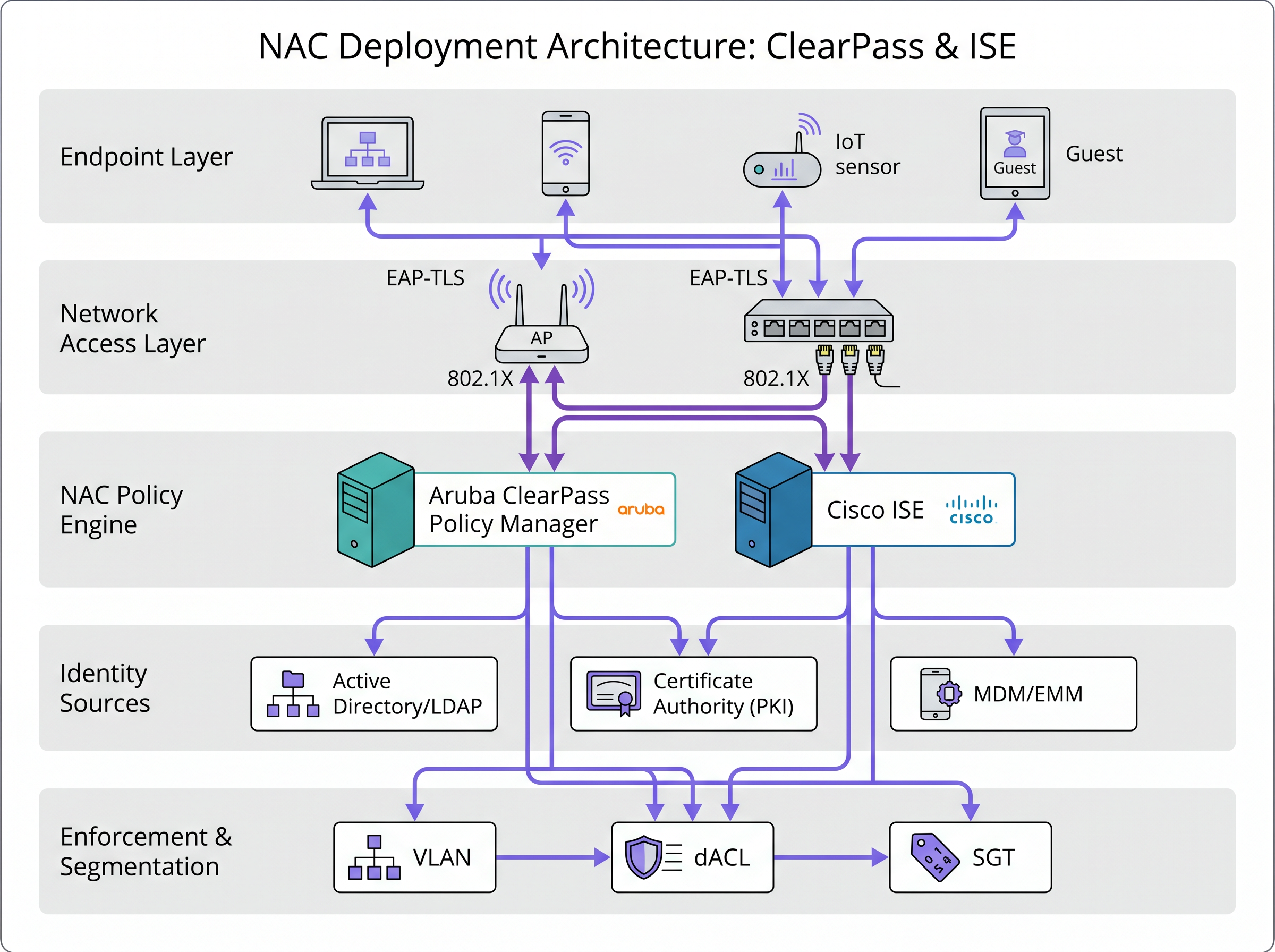
Policy Engine und Verwaltungsoberfläche
Die Richtlinienerstellung in ClearPass ist sehr visuell und serviceorientiert. Administratoren definieren einen 'Service' (z.B. 'Corporate 802.1X') und stapeln sequenziell Authentifizierungsmethoden, Autorisierungsquellen und Enforcement-Profile. Dieser Top-Down-, modulare Ansatz ist intuitiv und vereinfacht die Fehlerbehebung.
Cisco ISE verwendet eine regelbasierte Matrix, ähnlich der Konfiguration einer hochentwickelten Firewall. Richtlinien werden mithilfe komplexer, mehrbedingter Regeln erstellt, die Identität, Haltung und Kontext gleichzeitig bewerten. Obwohl dies immense Flexibilität und Leistung für komplexe Unternehmensszenarien bietet, erfordert es eine steilere Lernkurve und ein akribisches Konfigurationsmanagement, um unbeabsichtigte Folgen zu vermeiden.
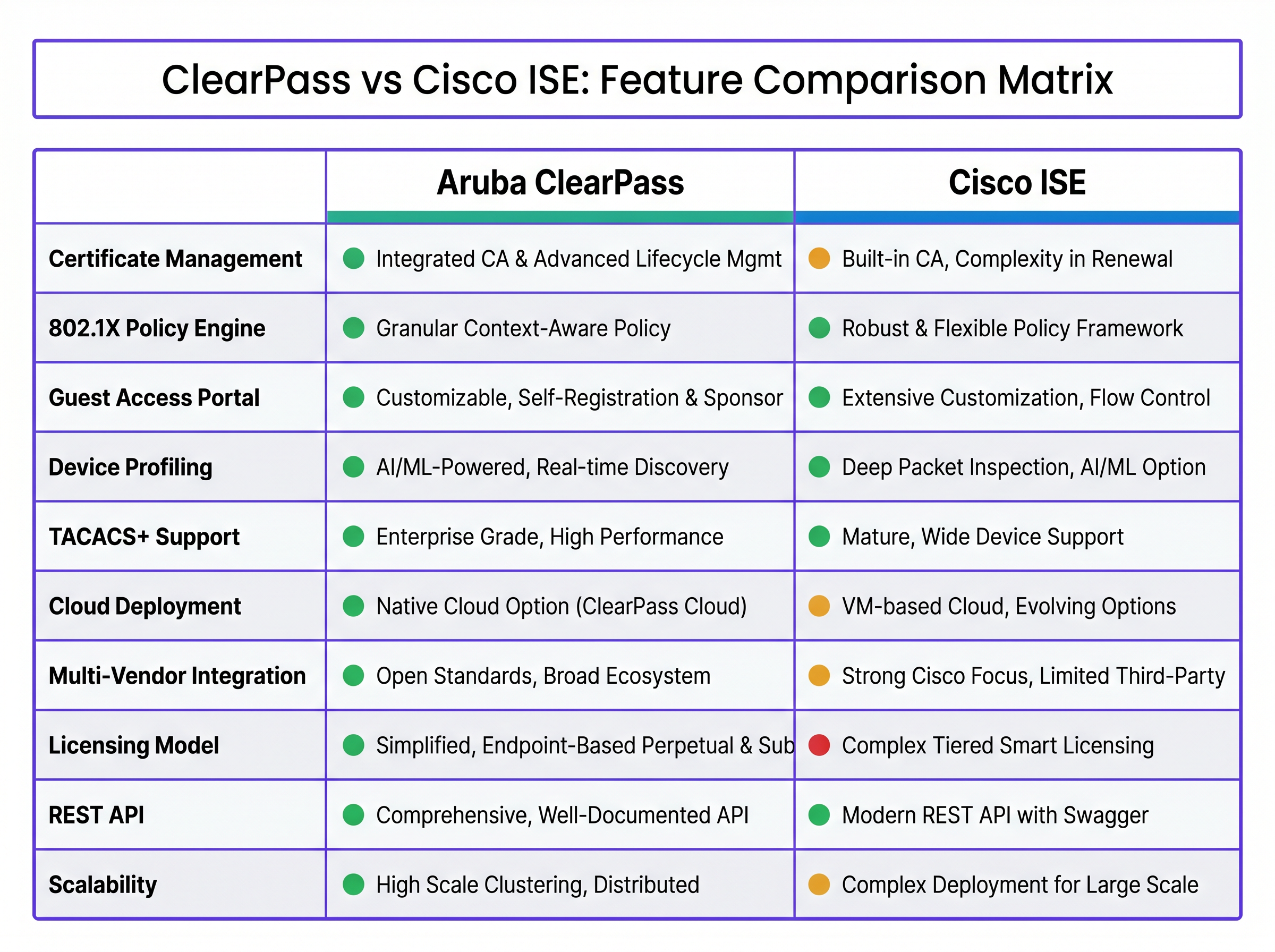
Geräteprofilierung und Sichtbarkeit
Eine genaue Geräteprofilierung ist entscheidend für moderne NAC, insbesondere angesichts der Verbreitung von IoT-Geräten. Beide Plattformen zeichnen sich hier aus, indem sie DHCP-, HTTP-, MAC OUI- und SNMP-Daten nutzen. ISE hat in Cisco-Umgebungen einen Vorteil durch den Device Sensor, der Deep Packet Inspection-Daten direkt von Cisco-Switches an den ISE-Knoten liefert. ClearPass begegnet dem mit ClearPass Device Insight, einer KI-gestützten, Cloud-basierten Lösung, die maschinelles Lernen nutzt, um obskure oder gefälschte Geräte zu identifizieren, die Standard-Profilierungssignaturen umgehen.
Implementierungsleitfaden
Die Bereitstellung einer NAC-Plattform ist ein risikoreiches Unterfangen. Eine Fehlkonfiguration kann legitime Benutzer aus dem Netzwerk aussperren und den Geschäftsbetrieb lahmlegen.
- Beginnen Sie mit Sichtbarkeit (Monitor-Modus): Implementieren Sie niemals die Durchsetzung am ersten Tag. Konfigurieren Sie die NAC so, dass Geräte profiliert und Authentifizierungsanfragen protokolliert werden, ohne den Datenverkehr zu blockieren. Dies liefert ein klares Bild dessen, was sich tatsächlich in Ihrem Netzwerk befindet, und hilft, Geräte zu identifizieren, die die 802.1X-Authentifizierung fehlschlagen werden.
- Zuerst Wireless durchsetzen: Wireless-Netzwerke sind im Allgemeinen einfacher zu sichern, da Geräte an die Authentifizierung gewöhnt sind (z.B. WPA3-Enterprise). Beginnen Sie mit Unternehmenslaptops, die von Active Directory oder einem MDM verwaltet werden, da diese die erforderlichen Zertifikate problemlos erhalten können.
- Das kabelgebundene Netzwerk angehen: Kabelgebundenes 802.1X ist aufgrund von älteren Druckern, nicht verwalteten IoT-Geräten und 'dummen' Switches notorisch schwierig. Verwenden Sie MAC Authentication Bypass (MAB) für Geräte, die 802.1X nicht unterstützen können, beschränken Sie jedoch deren Netzwerkzugriff streng mithilfe dynamischer VLAN-Zuweisung oder dACLs.
- Gastzugang implementieren: Für Gastgewerbe- und Einzelhandelsumgebungen ist der Gastzugang ein Hauptanliegen. ClearPass Guest bietet ein hochgradig anpassbares Portal mit Selbstregistrierung und Sponsor-Genehmigung, das sich nahtlos in Plattformen wie Guest WiFi für erweiterte Analysen integriert. ISE bietet ebenfalls robuste Gastfunktionen, erfordert jedoch möglicherweise mehr Aufwand, um ein stark gebrandetes Erlebnis zu erzielen.
Bewährte Praktiken
- Verzeichnis-Hygiene aufrechterhalten: Eine NAC ist nur so effektiv wie der Identitätsspeicher, den sie abfragt. Stellen Sie sicher, dass Ihr Active Directory oder LDAP sauber, genau und aktuell ist.
- Zertifikate nutzen: Vermeiden Sie nach Möglichkeit passwortbasierte Authentifizierung (PEAP-MSCHAPv2). Desetzen Sie EAP-TLS mit Zertifikaten ein, die von einer vertrauenswürdigen Zertifizierungsstelle (CA) ausgestellt wurden, für überlegene Sicherheit und eine nahtlose Benutzererfahrung.
- Planen Sie Hochverfügbarkeit: NAC ist eine kritische Infrastrukturkomponente. Stellen Sie redundante Knoten in einer verteilten Architektur bereit, um einen kontinuierlichen Netzwerkzugriff während Wartungsarbeiten oder Ausfällen zu gewährleisten.
Fehlerbehebung & Risikominderung
Häufige Fehlerursachen sind oft der Ablauf von Zertifikaten, eine falsche Richtlinienreihenfolge oder falsch konfigurierte Switch-Ports.
- Zertifikatsablauf: Implementieren Sie automatisierte Zertifikatserneuerungsprozesse (z. B. SCEP/EST), um plötzliche, weit verbreitete Authentifizierungsfehler zu verhindern.
- Richtlinienreihenfolge: Sowohl in ClearPass als auch in ISE werden Richtlinien von oben nach unten ausgewertet. Stellen Sie sicher, dass spezifischere Regeln über allgemeinen Catch-all-Regeln platziert werden, um unbeabsichtigten Zugriff zu verhindern.
- Rogue APs: Stellen Sie sicher, dass Ihr Wireless Intrusion Prevention System (WIPS) aktiv nach Imitationsangriffen sucht. Weitere Informationen zu detaillierten Strategien finden Sie in unserem Leitfaden zu Rogue AP Detection: Schutz von Venue WiFi vor Imitationsangriffen .
ROI & Geschäftlicher Nutzen
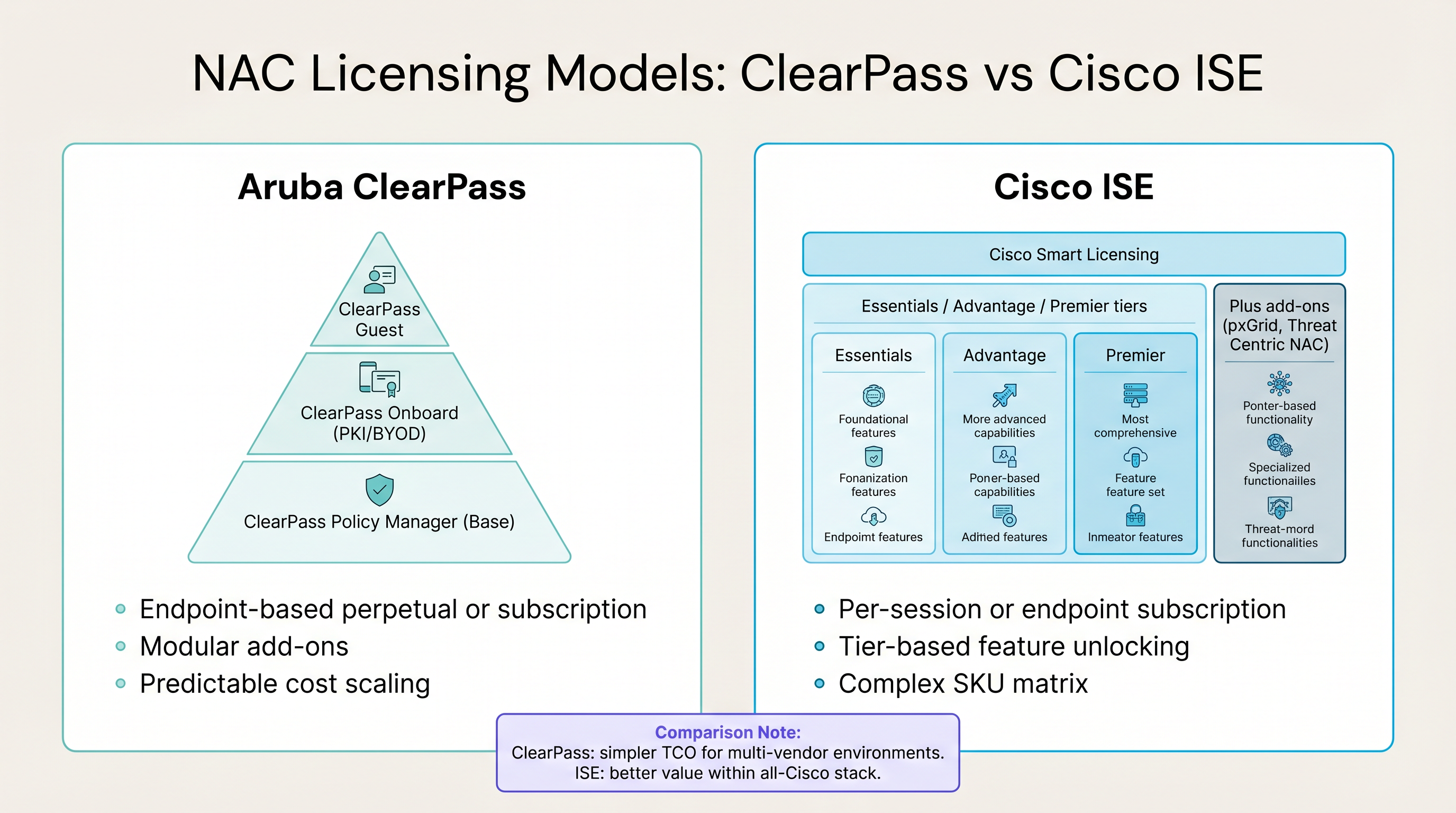
Die finanziellen Auswirkungen einer NAC-Bereitstellung gehen über die anfänglichen Software- und Hardwarekosten hinaus.
- Aruba ClearPass: Bietet ein vorhersehbares, Endpunkt-basiertes Lizenzierungsmodell (dauerhaft oder Abonnement) mit modularen Add-ons für Guest und Onboard. Diese Einfachheit führt oft zu niedrigeren Gesamtbetriebskosten (TCO) in Multi-Vendor-Umgebungen.
- Cisco ISE: Verwendet ein komplexes Smart Licensing-Modell mit Essentials-, Advantage- und Premier-Stufen. Obwohl potenziell teurer, liefert es einen außergewöhnlichen ROI, wenn Sie die erweiterten Funktionen einer einheitlichen Cisco-Sicherheitsarchitektur voll ausschöpfen.
Letztendlich mindert eine erfolgreiche NAC-Bereitstellung das Risiko kostspieliger Datenschutzverletzungen, gewährleistet die Einhaltung von Standards wie PCI DSS und GDPR und reduziert den Betriebsaufwand für die manuelle Netzwerkbereitstellung.
Schlüsseldefinitionen
802.1X
An IEEE standard for port-based network access control that provides an authentication mechanism to devices wishing to attach to a LAN or WLAN.
The foundational protocol for secure enterprise network access, preventing unauthorized devices from communicating on the network.
RADIUS (Remote Authentication Dial-In User Service)
A networking protocol that provides centralized Authentication, Authorization, and Accounting (AAA) management for users who connect and use a network service.
The primary protocol used by both ClearPass and ISE to communicate with network switches and access points.
TACACS+ (Terminal Access Controller Access-Control System Plus)
A Cisco-developed protocol that provides access control for routers, network access servers, and other networked computing devices via one or more centralized servers.
Used primarily for device administration (authenticating IT staff logging into switches and routers), separating authentication from authorization.
MAC Authentication Bypass (MAB)
A method of authenticating devices that do not support 802.1X (like printers or legacy IoT devices) by using their MAC address as the identity credential.
A necessary workaround for headless devices, though inherently less secure than 802.1X as MAC addresses can be spoofed.
EAP-TLS (Extensible Authentication Protocol-Transport Layer Security)
An EAP method that relies on client and server certificates for mutual authentication.
Considered the gold standard for wireless and wired security, providing robust protection against credential theft.
TrustSec
A Cisco security architecture that uses Security Group Tags (SGTs) to enforce access control policies based on endpoint identity and context, rather than IP addresses.
A key differentiator for Cisco ISE in homogeneous Cisco environments, enabling scalable micro-segmentation.
pxGrid (Platform Exchange Grid)
A Cisco protocol that enables security platforms to share context and automate threat responses across the network infrastructure.
Allows ISE to act as a central intelligence hub, sharing user and device context with firewalls and endpoint security tools.
Device Profiling
The process of identifying the type, operating system, and capabilities of a device connecting to the network using various data sources (DHCP, HTTP, SNMP).
Essential for applying appropriate security policies to IoT and unmanaged devices that cannot authenticate via 802.1X.
Ausgearbeitete Beispiele
A large university campus with a mix of Aruba wireless controllers and legacy Juniper access switches needs to implement role-based access control for students, faculty, and IoT devices (projectors, smart locks). They currently use Active Directory for identity.
Given the multi-vendor environment, Aruba ClearPass is the recommended solution. The deployment would begin in monitor mode to profile the diverse range of IoT devices. Faculty and student laptops would be onboarded using ClearPass Onboard to provision EAP-TLS certificates, ensuring secure, password-less authentication. The legacy Juniper switches would be configured to use RADIUS for 802.1X authentication, with MAC Authentication Bypass (MAB) configured for the IoT devices. ClearPass policies would dynamically assign VLANs based on the user's AD group (Student vs. Faculty) or the device profile (IoT).
A global retail chain is standardizing its entire network infrastructure on Cisco Meraki (APs, switches, and MX security appliances). They need to enforce strict micro-segmentation to isolate point-of-sale (POS) terminals from the guest WiFi network and corporate devices to maintain PCI DSS compliance.
Cisco ISE is the optimal choice for this homogeneous Cisco environment. The deployment would leverage Cisco TrustSec to assign Security Group Tags (SGTs) to different endpoints. POS terminals would receive a specific SGT upon authentication (via MAB or 802.1X). ISE would then push Security Group Access Control Lists (SGACLs) to the Meraki switches and MX appliances, explicitly denying traffic between the POS SGT and the Guest or Corporate SGTs, regardless of the underlying IP addressing or VLAN structure.
Übungsfragen
Q1. A hospital network requires strict isolation between medical devices (infusion pumps, patient monitors) and the guest WiFi network. The infrastructure consists of Aruba wireless access points and Cisco Catalyst switches. Which NAC platform is best suited for this environment and why?
Hinweis: Consider the multi-vendor nature of the network infrastructure.
Musterlösung anzeigen
Aruba ClearPass is the recommended platform. While Cisco ISE is powerful, its advanced segmentation features (TrustSec/SGTs) require end-to-end Cisco hardware to function optimally. ClearPass can effectively manage policies across both Aruba APs and Cisco switches using standard RADIUS attributes to dynamically assign VLANs or dACLs, ensuring the medical devices are securely isolated from guest traffic.
Q2. Your organization is migrating from a password-based PEAP-MSCHAPv2 wireless network to a certificate-based EAP-TLS deployment to improve security. You have a large BYOD (Bring Your Own Device) population. What is a critical feature you need from your NAC platform to support this transition?
Hinweis: Think about how certificates will be delivered to unmanaged personal devices.
Musterlösung anzeigen
You need a robust onboarding and certificate provisioning portal. In the Aruba ecosystem, this is ClearPass Onboard; in Cisco, it's the ISE BYOD portal. This feature allows users to self-provision their personal devices by connecting to an open provisioning network, authenticating with their corporate credentials, and automatically downloading and installing the required EAP-TLS certificate and network profile, minimizing helpdesk overhead.
Q3. During a phased NAC rollout, you configure a switch port for 802.1X enforcement. A user connects a legacy printer that does not support 802.1X. What mechanism should the NAC platform use to authenticate this device, and what is the primary security risk associated with it?
Hinweis: How do you identify a device that cannot provide a username or certificate?
Musterlösung anzeigen
The NAC platform should use MAC Authentication Bypass (MAB). The switch sends the printer's MAC address to the NAC server as the username and password. The primary security risk is MAC spoofing; an attacker can easily discover the printer's MAC address, clone it to their laptop, and gain unauthorized access to the network segment assigned to the printer. Therefore, MAB must be combined with strict profiling and network segmentation (e.g., placing printers in a highly restricted VLAN).
Weiterlesen in dieser Reihe
Die Zukunft der Wi-Fi-Sicherheit: KI-gesteuertes NAC und Bedrohungserkennung
Dieser maßgebliche Leitfaden beleuchtet die Entwicklung der Unternehmens-Wi-Fi-Sicherheit von veraltetem WPA2 zu KI-gesteuerter Netzwerkzugangskontrolle (NAC) und Bedrohungserkennung. Er wurde für IT-Führungskräfte entwickelt und bietet umsetzbare Bereitstellungsstrategien zur Sicherung von Umgebungen mit hoher Dichte wie Einzelhandel, Gastgewerbe und Stadien mithilfe der identitätsbasierten Netzwerke von Purple.
Verwaltung der IoT-Gerätesicherheit mit NAC und MPSK
Dieser technische Leitfaden beschreibt, wie Unternehmen ihre Headless-IoT-Geräte mithilfe der Multiple Pre-Shared Key (MPSK)-Architektur und Network Access Control (NAC) sichern können. Er bietet umsetzbare Implementierungsschritte zur Erreichung von Mikrosegmentierung, zur Eindämmung von Sicherheitsrisiken und zur Einhaltung von Vorschriften, ohne die Skalierbarkeit zu beeinträchtigen.
RadSec: Wie RADIUS über TLS die Sicherheit der WiFi-Authentifizierung verbessert
Diese maßgebliche technische Referenz erklärt, wie RadSec (RFC 6614) die Sicherheit der Unternehmens-WiFi-Authentifizierung verbessert, indem es den traditionellen RADIUS-Verkehr in TLS-Verschlüsselung einhüllt. Für IT-Manager und Netzwerkarchitekten konzipiert, behandelt sie Architektur, Bereitstellungsstrategien und praktische Schritte zur Minderung der Risiken von unverschlüsseltem UDP RADIUS-Verkehr in Unternehmens- und Gastnetzwerken.