
Aruba ClearPass vs Cisco ISE: Confronto tra piattaforme NAC
Questa guida di riferimento tecnico fornisce un confronto dettagliato e neutrale tra Aruba ClearPass e Cisco ISE. Fornisce ad architetti di rete e IT manager approfondimenti pratici su architettura, complessità di implementazione, licenze ed ecosistemi di integrazione per guidare decisioni informate sulla piattaforma NAC.
Ascolta questa guida
Visualizza trascrizione del podcast

Riepilogo Esecutivo
Per gli architetti di rete aziendali e i CTO che valutano le piattaforme Network Access Control (NAC), la scelta spesso si restringe a due forze dominanti: Aruba ClearPass e Cisco Identity Services Engine (ISE). Entrambe le piattaforme forniscono robuste capacità di autenticazione, autorizzazione e accounting (AAA), garantendo che ogni endpoint, dai laptop aziendali ai sensori IoT headless, sia profilato e segmentato in modo sicuro prima di ottenere l'accesso alla rete. Tuttavia, le loro filosofie architettoniche differiscono in modo significativo. Cisco ISE è profondamente integrato nell'ecosistema Cisco, sfruttando protocolli proprietari come pxGrid e TrustSec per fornire una micro-segmentazione senza precedenti in ambienti omogenei. Al contrario, Aruba ClearPass è progettato da zero come motore di policy indipendente dal fornitore, utilizzando standard aperti come RADIUS e REST APIs per integrarsi senza soluzione di continuità in reti multi-vendor. Questa guida fornisce un confronto pragmatico e approfondito di entrambe le piattaforme, esplorando le loro funzionalità, le complessità di implementazione e i modelli di licenza per aiutarvi ad allineare la vostra strategia NAC con le realtà operative e i requisiti di conformità della vostra organizzazione.
Approfondimento Tecnico
Architettura e Integrazione dell'Ecosistema
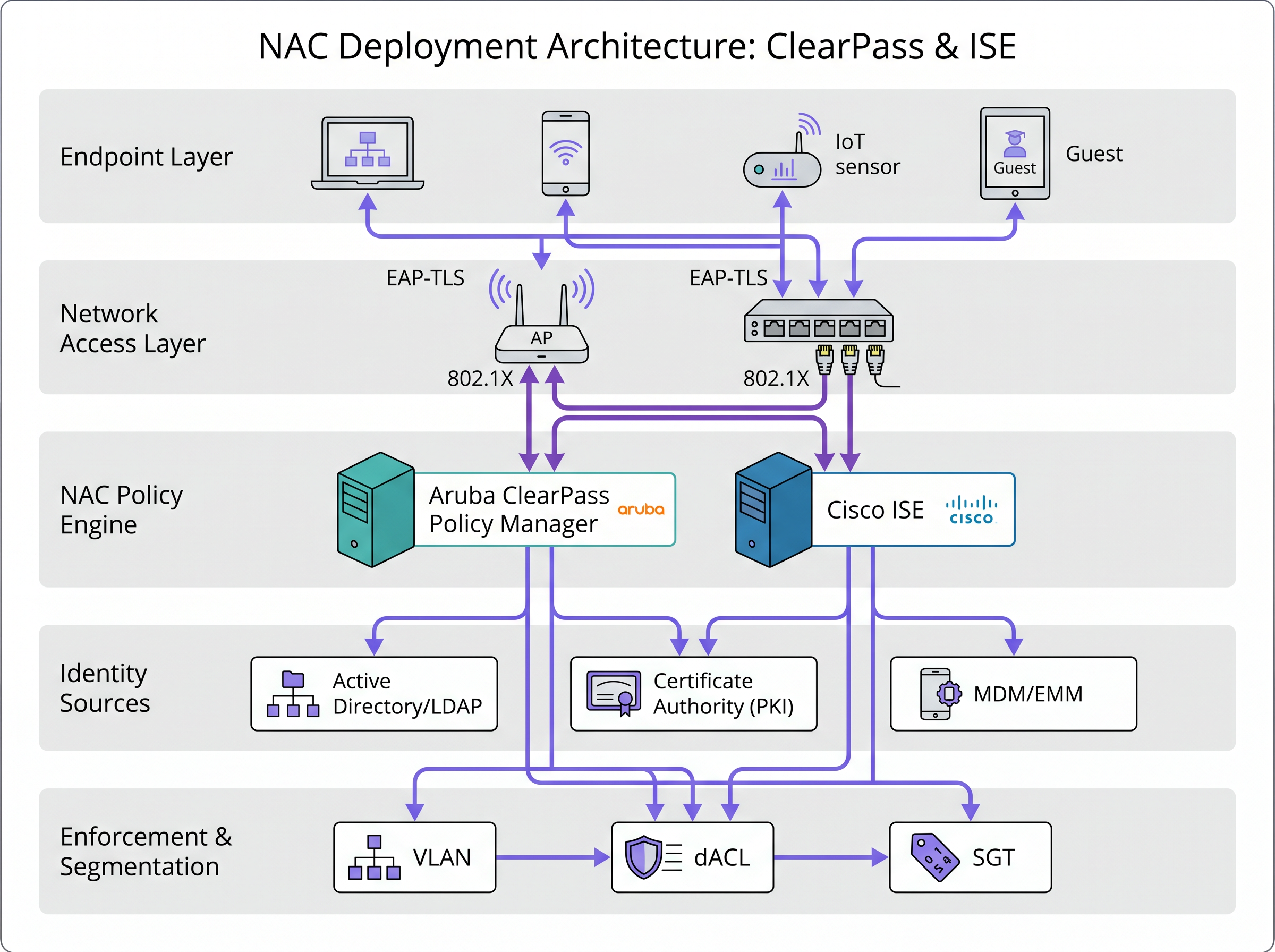
La divergenza fondamentale tra ClearPass e ISE risiede nel loro approccio all'integrazione dell'ecosistema. Cisco ISE prospera in un ambiente Cisco-centrico. Utilizza Security Group Tags (SGTs) all'interno del framework Cisco TrustSec per applicare un controllo degli accessi granulare e scalabile su switch Catalyst, access point Meraki e firewall Firepower senza fare affidamento esclusivamente su Access Control Lists (ACLs) tradizionali basate su IP. Il protocollo pxGrid (Platform Exchange Grid) migliora ulteriormente questo aspetto consentendo a ISE di condividere dati contestuali ricchi con soluzioni di sicurezza di terze parti, creando un ecosistema di risposta alle minacce coeso e automatizzato.
Aruba ClearPass, al contrario, abbraccia una filosofia di rete eterogenea. Agisce come un traduttore universale, applicando policy coerenti su hardware Aruba, Cisco, Juniper e Palo Alto utilizzando i protocolli standard RADIUS e TACACS+. La sua robusta REST API e l'ampio ecosistema di integrazione gli consentono di acquisire facilmente contesto da piattaforme Mobile Device Management (MDM), firewall e agenti di sicurezza degli endpoint. Per le sedi con implementazioni hardware miste, ClearPass spesso presenta una barriera all'ingresso inferiore per l'applicazione unificata delle policy.
Motore di Policy e Interfaccia di Gestione
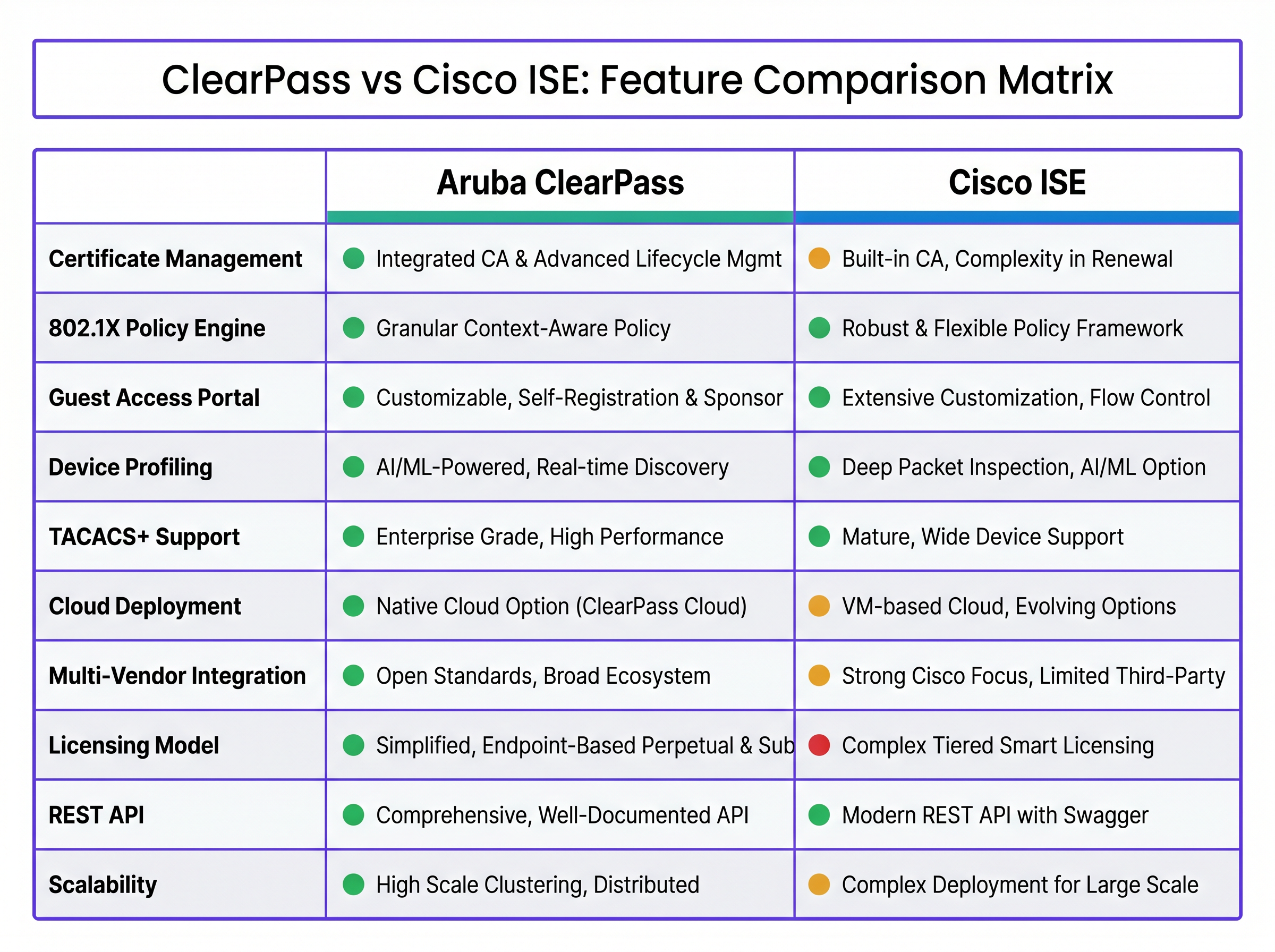
La creazione di policy in ClearPass è altamente visiva e orientata ai servizi. Gli amministratori definiscono un 'Servizio' (ad esempio, 'Corporate 802.1X') e impilano sequenzialmente metodi di autenticazione, sorgenti di autorizzazione e profili di enforcement. Questo approccio modulare e top-down è intuitivo e semplifica la risoluzione dei problemi.
Cisco ISE utilizza una matrice basata su regole, simile alla configurazione di un firewall sofisticato. Le policy sono costruite utilizzando regole complesse e multi-condizione che valutano identità, postura e contesto simultaneamente. Sebbene ciò offra immensa flessibilità e potenza per scenari aziendali complessi, richiede una curva di apprendimento più ripida e una gestione meticolosa della configurazione per evitare conseguenze indesiderate.
Profilazione e Visibilità dei Dispositivi
Una profilazione accurata dei dispositivi è fondamentale per il NAC moderno, specialmente con la proliferazione dei dispositivi IoT. Entrambe le piattaforme eccellono in questo, utilizzando dati DHCP, HTTP, MAC OUI e SNMP. ISE detiene un vantaggio negli ambienti Cisco tramite Device Sensor, che alimenta i dati di deep packet inspection direttamente dagli switch Cisco al nodo ISE. ClearPass risponde a questo con ClearPass Device Insight, una soluzione basata su AI e cloud che sfrutta il machine learning per identificare dispositivi oscuri o spoofed che eludono le firme di profilazione standard.
Guida all'Implementazione
L'implementazione di una piattaforma NAC è un'operazione ad alto rischio. Una configurazione errata può bloccare gli utenti legittimi fuori dalla rete, paralizzando le operazioni aziendali.
- Inizia con la Visibilità (Modalità Monitor): Non implementare mai l'enforcement il primo giorno. Configura il NAC per profilare i dispositivi e registrare le richieste di autenticazione senza bloccare il traffico. Questo fornisce un quadro chiaro di ciò che è effettivamente sulla tua rete e aiuta a identificare i dispositivi che falliranno l'autenticazione 802.1X.
- Applica prima al Wireless: Le reti wireless sono generalmente più facili da proteggere perché i dispositivi sono abituati all'autenticazione (ad esempio, WPA3-Enterprise). Inizia con i laptop aziendali gestiti da Active Directory o un MDM, poiché questi possono facilmente ricevere i certificati necessari.
- Affronta la Rete Cablata: Il 802.1X cablato è notoriamente difficile a causa di stampanti legacy, dispositivi IoT non gestiti e switch 'dumb'. Utilizza MAC Authentication Bypass (MAB) per i dispositivi che non supportano il 802.1X, ma limita rigorosamente il loro accesso alla rete utilizzando l'assegnazione dinamica di VLAN o dACLs.
- Implementa l'Accesso Ospiti: Per gli ambienti hospitality e retail, l'accesso ospiti è una preoccupazione primaria. ClearPass Guest offre un portale altamente personalizzabile con auto-registrazione e approvazione dello sponsor, integrandosi senza problemi con piattaforme come Guest WiFi per analisi avanzate. ISE fornisce anche robuste capacità per gli ospiti, ma potrebbe richiedere più sforzo per ottenere un'esperienza altamente brandizzata.
Best Practices
- Mantieni l'Igiene della Directory: Un NAC è efficace solo quanto lo store di identità che interroga. Assicurati che il tuo Active Directory o LDAP sia pulito, accurato e aggiornato.
- Sfrutta i Certificati: Evita l'autenticazione basata su password (PEAP-MSCHAPv2) ove possibile. Deutilizzare EAP-TLS con certificati emessi da una Certificate Authority (CA) fidata per una sicurezza superiore e un'esperienza utente senza interruzioni.
- Pianificare l'alta disponibilità: NAC è un componente critico dell'infrastruttura. Implementare nodi ridondanti in un'architettura distribuita per garantire un accesso continuo alla rete durante la manutenzione o i guasti.
Risoluzione dei problemi e mitigazione dei rischi
Le modalità di errore comuni spesso ruotano attorno alla scadenza dei certificati, all'ordine errato delle policy o alle porte dello switch configurate in modo errato.
- Scadenza dei certificati: Implementare processi automatizzati di rinnovo dei certificati (ad es. SCEP/EST) per prevenire improvvisi e diffusi errori di autenticazione.
- Ordine delle policy: Sia in ClearPass che in ISE, le policy vengono valutate dall'alto verso il basso. Assicurarsi che le regole più specifiche siano posizionate sopra le regole generali "catch-all" per prevenire accessi non intenzionali.
- AP non autorizzati: Assicurarsi che il sistema di prevenzione delle intrusioni wireless (WIPS) monitori attivamente gli attacchi di impersonificazione. Fare riferimento alla nostra guida su Rilevamento di AP non autorizzati: Proteggere il WiFi della sede dagli attacchi di impersonificazione per strategie dettagliate.
ROI e impatto sul business
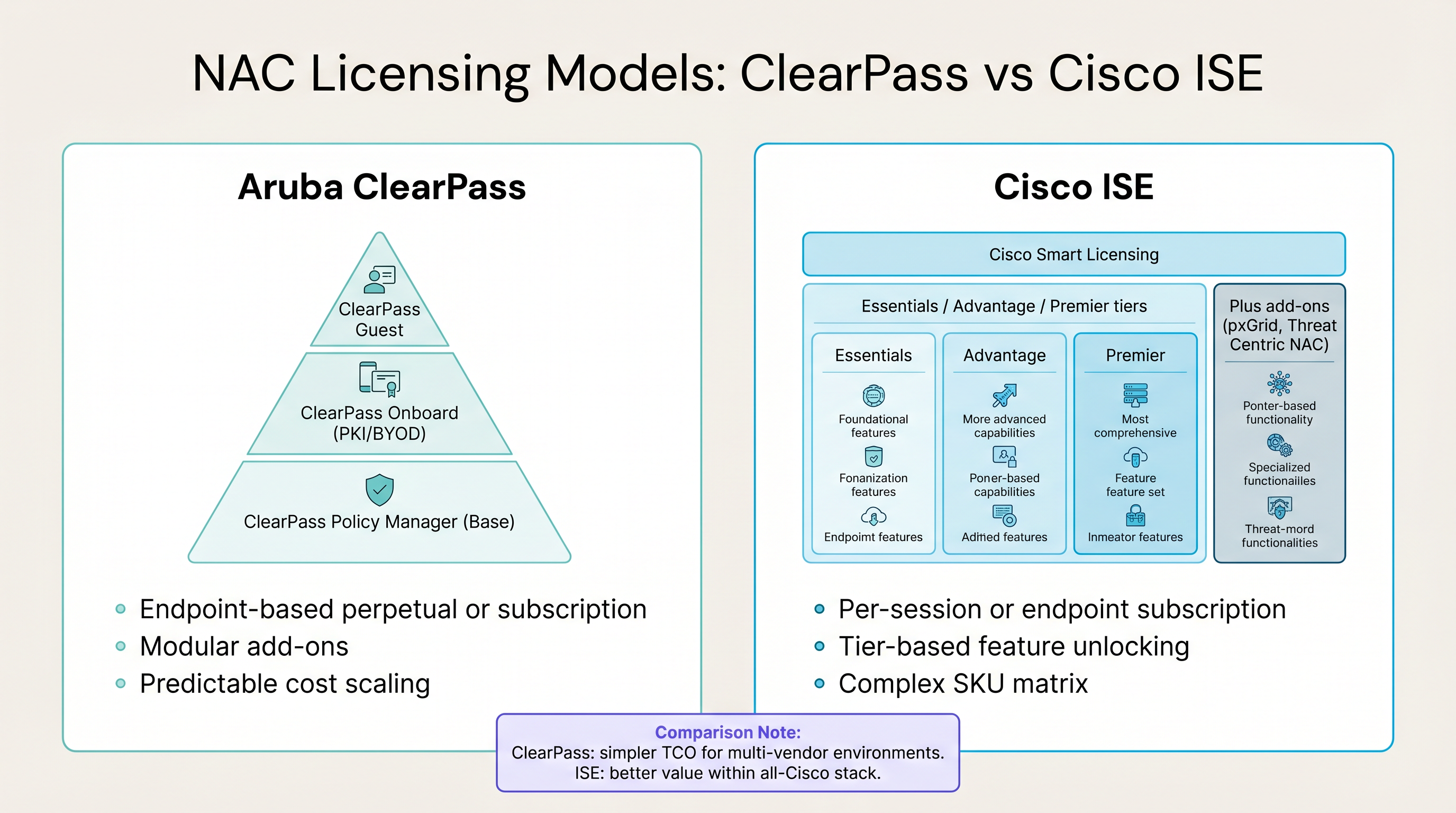
L'impatto finanziario di un'implementazione NAC si estende oltre i costi iniziali di software e hardware.
- Aruba ClearPass: Offre un modello di licenza prevedibile basato su endpoint (perpetuo o in abbonamento) con componenti aggiuntivi modulari per Guest e Onboard. Questa semplicità si traduce spesso in un costo totale di proprietà (TCO) inferiore in ambienti multi-vendor.
- Cisco ISE: Utilizza un complesso modello di Smart Licensing con livelli Essentials, Advantage e Premier. Sebbene potenzialmente più costoso, offre un ROI eccezionale se si sfruttano appieno le capacità avanzate di un'architettura di sicurezza Cisco unificata.
In definitiva, un'implementazione NAC di successo mitiga il rischio di costose violazioni dei dati, garantisce la conformità a standard come PCI DSS e GDPR e riduce il sovraccarico operativo del provisioning manuale della rete.
Definizioni chiave
802.1X
An IEEE standard for port-based network access control that provides an authentication mechanism to devices wishing to attach to a LAN or WLAN.
The foundational protocol for secure enterprise network access, preventing unauthorized devices from communicating on the network.
RADIUS (Remote Authentication Dial-In User Service)
A networking protocol that provides centralized Authentication, Authorization, and Accounting (AAA) management for users who connect and use a network service.
The primary protocol used by both ClearPass and ISE to communicate with network switches and access points.
TACACS+ (Terminal Access Controller Access-Control System Plus)
A Cisco-developed protocol that provides access control for routers, network access servers, and other networked computing devices via one or more centralized servers.
Used primarily for device administration (authenticating IT staff logging into switches and routers), separating authentication from authorization.
MAC Authentication Bypass (MAB)
A method of authenticating devices that do not support 802.1X (like printers or legacy IoT devices) by using their MAC address as the identity credential.
A necessary workaround for headless devices, though inherently less secure than 802.1X as MAC addresses can be spoofed.
EAP-TLS (Extensible Authentication Protocol-Transport Layer Security)
An EAP method that relies on client and server certificates for mutual authentication.
Considered the gold standard for wireless and wired security, providing robust protection against credential theft.
TrustSec
A Cisco security architecture that uses Security Group Tags (SGTs) to enforce access control policies based on endpoint identity and context, rather than IP addresses.
A key differentiator for Cisco ISE in homogeneous Cisco environments, enabling scalable micro-segmentation.
pxGrid (Platform Exchange Grid)
A Cisco protocol that enables security platforms to share context and automate threat responses across the network infrastructure.
Allows ISE to act as a central intelligence hub, sharing user and device context with firewalls and endpoint security tools.
Device Profiling
The process of identifying the type, operating system, and capabilities of a device connecting to the network using various data sources (DHCP, HTTP, SNMP).
Essential for applying appropriate security policies to IoT and unmanaged devices that cannot authenticate via 802.1X.
Esempi pratici
A large university campus with a mix of Aruba wireless controllers and legacy Juniper access switches needs to implement role-based access control for students, faculty, and IoT devices (projectors, smart locks). They currently use Active Directory for identity.
Given the multi-vendor environment, Aruba ClearPass is the recommended solution. The deployment would begin in monitor mode to profile the diverse range of IoT devices. Faculty and student laptops would be onboarded using ClearPass Onboard to provision EAP-TLS certificates, ensuring secure, password-less authentication. The legacy Juniper switches would be configured to use RADIUS for 802.1X authentication, with MAC Authentication Bypass (MAB) configured for the IoT devices. ClearPass policies would dynamically assign VLANs based on the user's AD group (Student vs. Faculty) or the device profile (IoT).
A global retail chain is standardizing its entire network infrastructure on Cisco Meraki (APs, switches, and MX security appliances). They need to enforce strict micro-segmentation to isolate point-of-sale (POS) terminals from the guest WiFi network and corporate devices to maintain PCI DSS compliance.
Cisco ISE is the optimal choice for this homogeneous Cisco environment. The deployment would leverage Cisco TrustSec to assign Security Group Tags (SGTs) to different endpoints. POS terminals would receive a specific SGT upon authentication (via MAB or 802.1X). ISE would then push Security Group Access Control Lists (SGACLs) to the Meraki switches and MX appliances, explicitly denying traffic between the POS SGT and the Guest or Corporate SGTs, regardless of the underlying IP addressing or VLAN structure.
Domande di esercitazione
Q1. A hospital network requires strict isolation between medical devices (infusion pumps, patient monitors) and the guest WiFi network. The infrastructure consists of Aruba wireless access points and Cisco Catalyst switches. Which NAC platform is best suited for this environment and why?
Suggerimento: Consider the multi-vendor nature of the network infrastructure.
Visualizza risposta modello
Aruba ClearPass is the recommended platform. While Cisco ISE is powerful, its advanced segmentation features (TrustSec/SGTs) require end-to-end Cisco hardware to function optimally. ClearPass can effectively manage policies across both Aruba APs and Cisco switches using standard RADIUS attributes to dynamically assign VLANs or dACLs, ensuring the medical devices are securely isolated from guest traffic.
Q2. Your organization is migrating from a password-based PEAP-MSCHAPv2 wireless network to a certificate-based EAP-TLS deployment to improve security. You have a large BYOD (Bring Your Own Device) population. What is a critical feature you need from your NAC platform to support this transition?
Suggerimento: Think about how certificates will be delivered to unmanaged personal devices.
Visualizza risposta modello
You need a robust onboarding and certificate provisioning portal. In the Aruba ecosystem, this is ClearPass Onboard; in Cisco, it's the ISE BYOD portal. This feature allows users to self-provision their personal devices by connecting to an open provisioning network, authenticating with their corporate credentials, and automatically downloading and installing the required EAP-TLS certificate and network profile, minimizing helpdesk overhead.
Q3. During a phased NAC rollout, you configure a switch port for 802.1X enforcement. A user connects a legacy printer that does not support 802.1X. What mechanism should the NAC platform use to authenticate this device, and what is the primary security risk associated with it?
Suggerimento: How do you identify a device that cannot provide a username or certificate?
Visualizza risposta modello
The NAC platform should use MAC Authentication Bypass (MAB). The switch sends the printer's MAC address to the NAC server as the username and password. The primary security risk is MAC spoofing; an attacker can easily discover the printer's MAC address, clone it to their laptop, and gain unauthorized access to the network segment assigned to the printer. Therefore, MAB must be combined with strict profiling and network segmentation (e.g., placing printers in a highly restricted VLAN).
Continua a leggere questa serie
Il Futuro della Sicurezza Wi-Fi: NAC basato su AI e Rilevamento delle Minacce
Questa guida autorevole esplora l'evoluzione della sicurezza Wi-Fi aziendale, dal WPA2 tradizionale al Network Access Control (NAC) basato su AI e al rilevamento delle minacce. Progettata per i leader IT, fornisce strategie di implementazione attuabili per la messa in sicurezza di ambienti ad alta densità come negozi al dettaglio, strutture ricettive e stadi, utilizzando le reti basate sull'identità di Purple.
Gestire la sicurezza dei dispositivi IoT con NAC e MPSK
Questa guida tecnica illustra come le aziende possano proteggere i dispositivi IoT headless utilizzando l'architettura Multiple Pre-Shared Key (MPSK) e il Network Access Control (NAC). Fornisce passaggi di implementazione pratici per ottenere la micro-segmentazione, contenere i raggi di esplosione della sicurezza e mantenere la conformità senza sacrificare la scalabilità.
RadSec: Come RADIUS su TLS migliora la sicurezza dell'autenticazione WiFi
Questo riferimento tecnico autorevole spiega come RadSec (RFC 6614) protegge l'autenticazione WiFi aziendale incapsulando il traffico RADIUS tradizionale nella crittografia TLS. Progettato per manager IT e architetti di rete, copre architettura, strategie di implementazione e passaggi pratici per mitigare i rischi del traffico RADIUS UDP non crittografato attraverso reti aziendali e guest.