

Hotel WiFi: Elite Guest Expectations and Chain-Wide Consistency
This technical reference guide details how global hotel brands design and deliver elite WiFi experiences that ensure chain-wide consistency and integrate with loyalty programmes. It covers capacity planning, PMS integration, centralised policy governance, and the technical mechanisms for bandwidth differentiation.
🎧 Listen to this Guide
View Transcript

Executive Summary
Delivering a consistently excellent guest WiFi experience across a global hotel brand is no longer a luxury—it is a baseline expectation. In an era where guests arrive with multiple devices and expect seamless connectivity for 4K streaming, remote working, and video conferencing, legacy network architectures simply cannot keep pace. For IT directors and network architects at major hospitality brands, the challenge is not merely providing internet access; it is designing a unified, cloud-managed network that delivers consistent performance from a flagship property in London to a resort in Dubai.
This technical reference guide explores the critical elements of enterprise hotel WiFi design, focusing on elite guest expectations, loyalty tier differentiation, and chain-wide consistency. We will examine the technical requirements for delivering high-bandwidth, secure, and resilient connectivity, alongside the operational imperatives of Property Management System (PMS) integration and centralised policy governance. By treating WiFi as a strategic service rather than a utility, hotel operators can enhance guest satisfaction, drive loyalty programme engagement, and gather valuable operational intelligence through analytics.
Technical Deep-Dive
The Shifting Baseline of Guest Expectations
The hospitality industry's definition of acceptable WiFi performance has evolved dramatically. A decade ago, providing 10 Mbps per room was often sufficient for basic web browsing and email. Today, the proliferation of bandwidth-intensive applications—coupled with guests carrying an average of three connected devices—demands a fundamental reassessment of capacity planning.
For standard connectivity, properties must now target a minimum of 25 Mbps per room. However, for luxury brands and premium loyalty tiers, expectations are significantly higher. Elite guests expect an experience comparable to, or better than, their home or corporate networks. Therefore, a design target of 50 Mbps to 100 Mbps per room is increasingly becoming the standard for luxury accommodations. It is crucial to understand that this metric is "per room," not per access point (AP) or per floor. Network capacity must be calculated from the edge inward, ensuring that the aggregate backhaul and core switching infrastructure can support peak concurrent usage without degradation.
Architecture for Consistency and Roaming
A high-capacity internet circuit is meaningless if the wireless distribution layer is flawed. Poor access point placement, suboptimal channel planning, and inefficient roaming protocols are the primary causes of guest complaints. In a modern hotel environment, seamless mobility is non-negotiable. Guests expect to maintain a video call or stream audio without interruption as they move from their suite to the lobby or the pool area.
To achieve this, the implementation of IEEE 802.11r (Fast BSS Transition) is essential. This standard allows a client device to authenticate with a new access point before breaking its connection with the current one, reducing roaming latency to milliseconds. Without 802.11r, devices must undergo a full re-authentication cycle during a handoff, resulting in noticeable connection drops and poor user experience. Furthermore, proper RF site surveys and predictive modelling must dictate AP density and placement, ensuring adequate signal coverage and minimising co-channel interference.
Security and Authentication Standards
Security in hospitality WiFi must balance robust protection with user convenience. WPA3 is the current standard for new deployments, offering enhanced cryptographic strength and protection against offline dictionary attacks. For authenticated networks, particularly those differentiating service based on loyalty tiers, WPA2-Enterprise or WPA3-Enterprise with IEEE 802.1X authentication is the gold standard.
The 802.1X framework provides a mechanism for port-based network access control. When a guest authenticates, the RADIUS server can dynamically assign VLANs and apply Quality of Service (QoS) policies based on the user's identity and loyalty status. This dynamic policy enforcement is the technical foundation for delivering differentiated bandwidth tiers, ensuring that premium guests receive priority network resources without manual intervention.
Implementation Guide
Loyalty Tier Differentiation and PMS Integration
The true value of a hospitality WiFi network is unlocked when it integrates seamlessly with the Property Management System (PMS). The PMS is the authoritative source of truth for guest identity, room assignment, and loyalty status. Without this integration, the network cannot intelligently differentiate service levels, reducing the WiFi experience to a generic, one-size-fits-all offering.
A best-practice implementation involves real-time API or webhook integration between the WiFi management platform and the PMS (such as Oracle OPERA, Mews, or Agilysys). The workflow should operate as follows:
- Pre-Provisioning: Upon check-in, the PMS transmits the guest's profile, including their loyalty tier, to the WiFi platform.
- Authentication: The guest connects to the network and authenticates via a branded captive portal or a seamless profile-based authentication method (e.g., Passpoint/OpenRoaming).
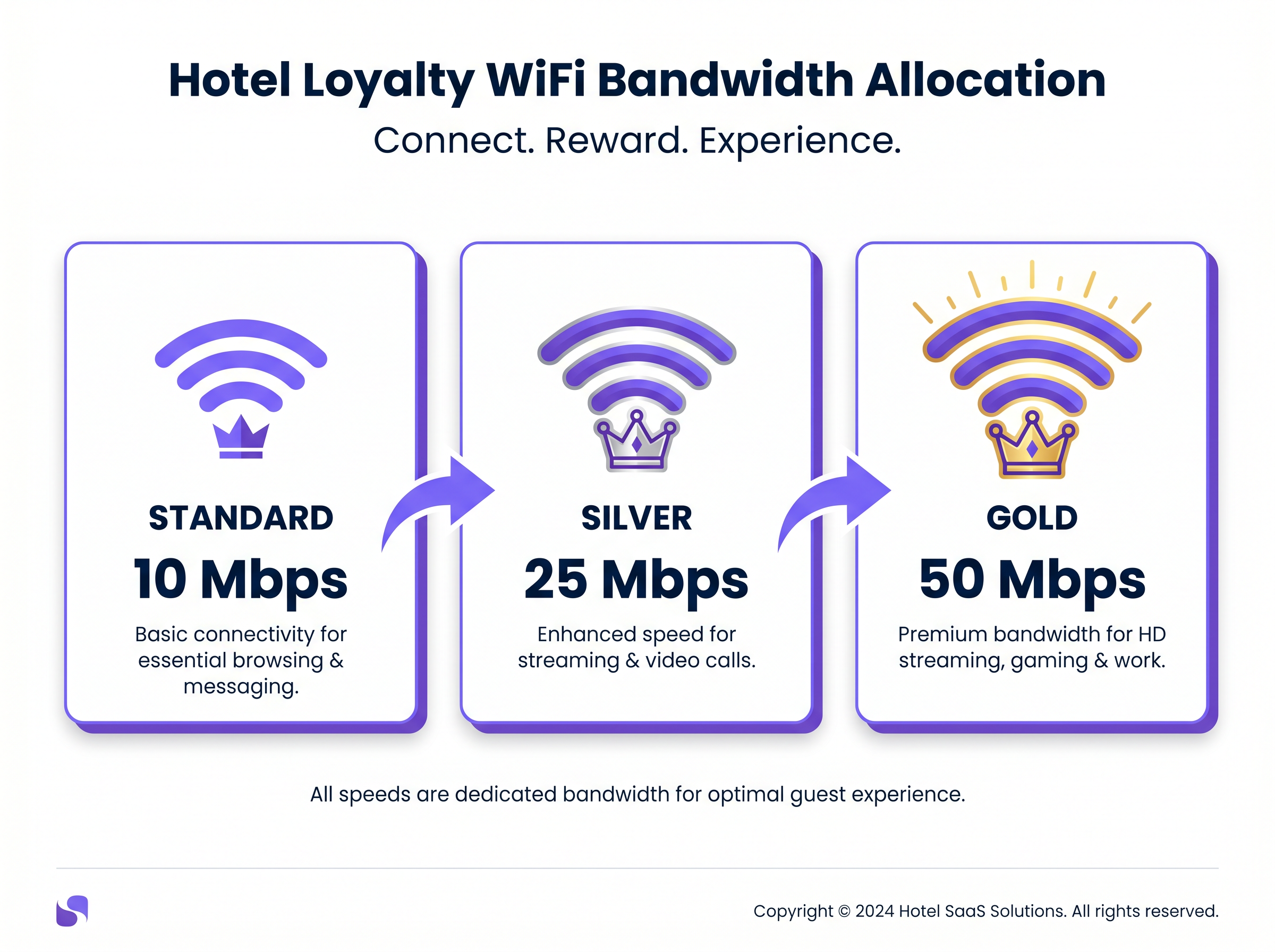
- Dynamic Policy Application: The network identifies the guest, queries the provisioned profile, and applies the appropriate VLAN and QoS policies. For example, a Gold member might be assigned to a premium VLAN with a 50 Mbps bandwidth ceiling, while a standard guest is assigned to a basic VLAN with a 25 Mbps ceiling.
- Session Termination: Upon check-out, the PMS signals the WiFi platform to terminate the session and purge temporary credentials, ensuring security and freeing up IP addresses.
Centralised Governance for Chain-Wide Consistency
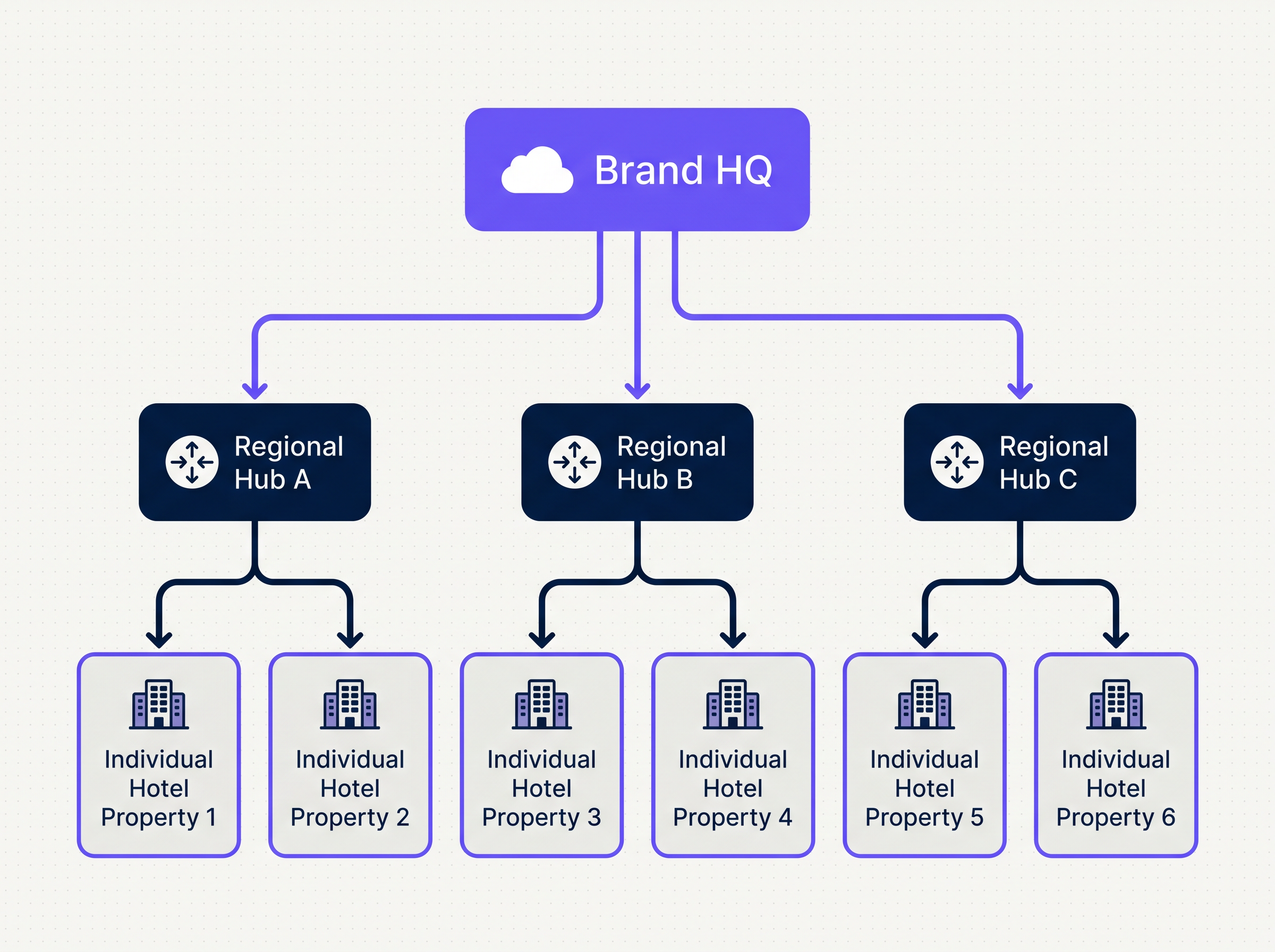
For global hotel brands operating hundreds of properties, maintaining consistency requires a centralised, cloud-managed network architecture. A hierarchical policy model is essential to balance brand standards with local operational requirements.
- Brand HQ (Global): Defines core policy templates, including SSIDs, security protocols, loyalty tier bandwidth allocations, and captive portal branding guidelines.
- Regional Hubs: Apply the global templates while incorporating regional variations, such as specific ISP configurations or compliance with local data sovereignty regulations (e.g., GDPR in Europe).
- Individual Properties: Inherit configurations from the regional hub. Local IT staff can manage day-to-day operations and monitor performance but cannot override core brand standards.
This "guardrails" approach ensures that a guest experiences the same high-quality connectivity and branded authentication flow whether they are staying at a Ritz Carlton in New York or a W Hotel in Singapore.
Best Practices
- Conduct Comprehensive RF Site Surveys: Never rely solely on legacy cabling plans or assumptions. Conduct predictive modelling and active site surveys to determine optimal AP placement, accounting for wall attenuation, floor layouts, and high-density areas like conference centres.
- Implement Seamless Authentication: Minimise friction at the captive portal. Utilise profile-based authentication or integration with the hotel's mobile app to automatically connect returning guests. Avoid lengthy forms that demand excessive personal information.
- Leverage Analytics for Operational Intelligence: Utilise the data generated by the WiFi network to understand guest behaviour. Platforms like Purple's WiFi Analytics provide insights into dwell times, zone usage, and foot traffic patterns, enabling data-driven decisions for staffing, marketing, and infrastructure investment.
- Adopt Cloud-Managed Infrastructure: Deploy access points and switches that can be centrally managed and monitored via a cloud controller. This provides a unified dashboard for troubleshooting, firmware updates, and policy enforcement across the entire estate.
- Ensure Network Resilience: Design the network to survive WAN outages. Access points must be capable of operating in autonomous mode, enforcing last-known-good policies even if connectivity to the cloud controller is temporarily lost.
Troubleshooting & Risk Mitigation
Common Failure Modes
- Over-Segmented VLAN Architecture: Creating too many VLANs (e.g., separate VLANs for every loyalty tier, IoT devices, POS systems, and back-of-house operations) introduces unnecessary complexity and can overwhelm the routing capabilities of edge switches. Consolidate into functional groups: Guest Standard, Guest Premium, Management, IoT, and PCI-scoped.
- Captive Portal Latency: A captive portal that takes excessive time to load or redirect frustrates guests immediately. Ensure the portal is hosted on a high-availability Content Delivery Network (CDN) and optimized for mobile devices.
- Inadequate DHCP Scopes: High-turnover environments like lobbies and conference centres can quickly exhaust IP address pools. Implement aggressive DHCP lease times (e.g., 30 minutes to 1 hour) for public areas to ensure IP availability.
Risk Mitigation Strategies
- IoT Segmentation: The proliferation of smart TVs, voice assistants, and connected thermostats in hotel rooms introduces significant security risks. These devices must be isolated on a dedicated IoT VLAN with strict egress filtering and no lateral movement capabilities. They must never share a network segment with guest devices.
- Compliance and Data Privacy: When capturing guest data via the captive portal, strict adherence to regulations like GDPR is mandatory. Only collect necessary information, clearly state the intended use, provide accessible opt-out mechanisms, and automate data retention policies. A platform with built-in consent management significantly reduces compliance risk.
ROI & Business Impact
Investing in enterprise-grade hospitality WiFi yields measurable returns across multiple operational domains.
Firstly, it directly impacts guest satisfaction and brand loyalty. In the modern hospitality landscape, poor WiFi is a primary driver of negative reviews. Conversely, a seamless, high-speed connection—particularly one that recognises and rewards loyalty status—enhances the overall guest experience and encourages repeat bookings.
Secondly, a robust WiFi infrastructure enables the deployment of advanced operational technologies. From mobile keyless entry and staff communication devices to location-based services and asset tracking, the wireless network is the foundational layer for digital transformation within the property.
Finally, the implementation of a comprehensive Guest WiFi platform transforms the network from a cost centre into a strategic asset. By capturing first-party data and integrating with marketing systems, hotels can drive targeted campaigns, promote on-property amenities, and increase ancillary revenue. The analytics derived from network usage provide actionable intelligence for optimising venue layouts and improving operational efficiency, ultimately contributing to a stronger bottom line.
Key Terms & Definitions
IEEE 802.11r (Fast BSS Transition)
A wireless networking standard that permits continuous connectivity aboard wireless devices in motion, with fast and secure handoffs from one access point to another.
Critical for preventing dropped VoIP calls or video streams when a guest walks through a hotel.
IEEE 802.1X
An IEEE Standard for port-based Network Access Control (PNAC), providing an authentication mechanism to devices wishing to attach to a LAN or WLAN.
Used in enterprise hospitality to securely authenticate guests and dynamically assign them to specific VLANs based on their loyalty tier.
Property Management System (PMS)
A comprehensive software application used to coordinate the operational functions of a hotel, including reservations, guest details, room assignments, and billing.
Integration with the PMS is essential for automating WiFi access and enforcing loyalty-based bandwidth tiers.
Quality of Service (QoS)
The description or measurement of the overall performance of a service, particularly the performance seen by the users of the network, allowing prioritization of specific traffic types or users.
Applied to ensure that premium loyalty guests receive their allocated bandwidth even during peak network congestion.
Captive Portal
A web page that the user of a public-access network is obliged to view and interact with before access is granted.
The primary interface for guest onboarding, data capture, and terms of service acceptance in hospitality environments.
VLAN (Virtual Local Area Network)
A custom network created from one or more existing LANs, enabling groups of devices from multiple networks to be combined into one logical network.
Used to securely segment guest traffic, IoT devices, and back-of-house operations on the same physical infrastructure.
Passpoint (Hotspot 2.0)
An industry-wide solution that streamlines network access, allowing users to automatically and securely connect to WiFi networks without needing to manually authenticate.
Provides a cellular-like roaming experience for guests, eliminating the need for repetitive captive portal logins.
WPA3-Enterprise
The latest generation of Wi-Fi security, providing robust authentication and cryptographic strength for enterprise networks.
The required security standard for new hotel deployments to ensure guest data privacy and protect against advanced wireless attacks.
Case Studies
A global luxury hotel brand with 150 properties needs to implement a tiered WiFi service where Gold loyalty members receive 50 Mbps dedicated bandwidth, while standard guests receive 25 Mbps. Currently, properties use disparate captive portals and local RADIUS servers. How should this be architected?
- Deploy a centralised, cloud-managed WiFi platform with a hierarchical policy engine.
- Establish an API integration between the central WiFi platform and the global Property Management System (PMS).
- Configure the PMS to transmit guest loyalty tier data to the WiFi platform upon check-in.
- Implement 802.1X authentication or a dynamic captive portal that queries the guest profile.
- Define global QoS policies: assign Gold members to a 'Premium' VLAN with a 50 Mbps bandwidth cap, and standard guests to a 'Basic' VLAN with a 25 Mbps cap.
- Push these policy templates from the Brand HQ level to all regional hubs and individual properties.
A newly acquired 300-room property is experiencing frequent guest complaints about WiFi dropouts when walking from their rooms to the conference centre, despite speed tests showing adequate bandwidth. What is the likely technical cause and remediation?
The likely cause is inefficient roaming due to a lack of Fast BSS Transition (IEEE 802.11r) and potentially poor RF overlap. Remediation:
- Verify that 802.11r is enabled on the WLAN configuration to allow seamless handoffs between access points.
- Conduct an active RF site survey to identify coverage gaps or excessive co-channel interference between the rooms and the conference centre.
- Adjust AP transmit power levels to encourage client devices to roam to stronger signals rather than 'sticking' to distant APs.
Scenario Analysis
Q1. You are deploying a new WiFi network for a 400-room resort. The business requirement is to offer a 'freemium' model where basic access is free, but high-speed access requires payment OR a specific loyalty tier. What is the most efficient architectural approach to enforce this?
💡 Hint:Consider how the network applies policies to individual users dynamically rather than relying on multiple SSIDs.
Show Recommended Approach
Implement a single SSID with dynamic VLAN assignment via 802.1X or a robust captive portal integrated with the PMS and payment gateway. When a user authenticates, the system checks their profile. If they are a premium loyalty member or have paid for an upgrade, the RADIUS server assigns them to a premium VLAN with a high QoS profile. If not, they remain on the default VLAN with a restricted QoS profile. This avoids SSID pollution and centralises policy management.
Q2. A regional IT manager reports that the DHCP pools for the lobby and conference centre subnets are constantly exhausted, preventing new guests from connecting, even though physical occupancy is below capacity. What is the immediate remediation?
💡 Hint:Think about the behavior of modern smartphones and how long network addresses are reserved.
Show Recommended Approach
Reduce the DHCP lease time for the public area subnets. Modern devices often randomize MAC addresses and connect briefly while passing through, consuming an IP address. By reducing the lease time from a standard 24 hours to 30-60 minutes, the DHCP server will reclaim and recycle IP addresses from transient devices much faster, ensuring availability for active users.
Q3. The marketing team wants to capture guest email addresses via the captive portal for a new promotional campaign. However, the legal team is concerned about GDPR compliance. How should the captive portal be designed to satisfy both requirements?
💡 Hint:Focus on the principles of consent and data minimization.
Show Recommended Approach
The captive portal must be designed with explicit, unbundled consent mechanisms. The request for the email address should be accompanied by a clear statement of purpose (e.g., 'to send promotional offers'). The consent checkbox must not be pre-ticked, and agreeing to marketing communications cannot be a condition for accessing the WiFi. Furthermore, the backend system must support automated data retention policies and provide an easy mechanism for users to request data deletion.
Key Takeaways
- ✓Elite hotel guests expect WiFi performance comparable to corporate networks, necessitating design targets of 50-100 Mbps per room.
- ✓Seamless roaming is non-negotiable; IEEE 802.11r must be implemented to prevent connection drops as guests move through the property.
- ✓PMS integration is the critical enabler for delivering differentiated bandwidth based on loyalty tiers.
- ✓Dynamic VLAN assignment and QoS policies via 802.1X allow automated enforcement of premium service levels.
- ✓Chain-wide consistency requires a cloud-managed architecture with a hierarchical policy model (Brand HQ > Regional > Property).
- ✓IoT devices in guest rooms must be strictly segmented onto dedicated VLANs to mitigate security risks.
- ✓Enterprise-grade WiFi transforms the network from a cost centre into a strategic asset for data capture and operational intelligence.




