

Hotel WiFi: Erwartungen von Elite-Gästen und konzernweite Konsistenz
Dieser technische Leitfaden beschreibt, wie globale Hotelmarken erstklassige WiFi-Erlebnisse konzipieren und bereitstellen, die konzernweite Konsistenz gewährleisten und sich in Treueprogramme integrieren lassen. Er behandelt Kapazitätsplanung, PMS-Integration, zentralisierte Richtlinienverwaltung und die technischen Mechanismen zur Bandbreitendifferenzierung.
🎧 Diesen Leitfaden anhören
Transkript anzeigen
Zusammenfassung für die Geschäftsleitung
Ein durchweg exzellentes Gäste-WiFi-Erlebnis über eine globale Hotelmarke hinweg zu bieten, ist kein Luxus mehr – es ist eine grundlegende Erwartung. In einer Ära, in der Gäste mit mehreren Geräten anreisen und nahtlose Konnektivität für 4K-Streaming, Remote-Arbeit und Videokonferenzen erwarten, können ältere Netzwerkarchitekturen einfach nicht mithalten. Für IT-Direktoren und Netzwerkarchitekten großer Hotelmarken besteht die Herausforderung nicht nur darin, Internetzugang bereitzustellen; es geht darum, ein einheitliches, cloud-verwaltetes Netzwerk zu entwerfen, das eine konsistente Leistung von einem Flaggschiff-Hotel in London bis zu einem Resort in Dubai liefert.
Dieser technische Leitfaden untersucht die entscheidenden Elemente des Enterprise-Hotel-WiFi-Designs, wobei der Schwerpunkt auf den Erwartungen von Elite-Gästen, der Differenzierung von Treuestufen und der konzernweiten Konsistenz liegt. Wir werden die technischen Anforderungen für die Bereitstellung einer hochbandbreitigen, sicheren und widerstandsfähigen Konnektivität sowie die operativen Notwendigkeiten der Property Management System (PMS)-Integration und der zentralisierten Richtlinienverwaltung untersuchen. Indem Hotelbetreiber WiFi als strategischen Dienst und nicht als Versorgungsleistung behandeln, können sie die Gästezufriedenheit steigern, die Beteiligung an Treueprogrammen fördern und durch Analysen wertvolle Betriebsdaten sammeln.
Technischer Einblick
Die sich wandelnde Basis der Gästeerwartungen
Die Definition der akzeptablen WiFi-Leistung in der Hotellerie hat sich dramatisch entwickelt. Vor einem Jahrzehnt waren 10 Mbit/s pro Zimmer oft ausreichend für grundlegendes Web-Browsing und E-Mail. Heute erfordert die Verbreitung bandbreitenintensiver Anwendungen – gepaart mit Gästen, die durchschnittlich drei verbundene Geräte mit sich führen – eine grundlegende Neubewertung der Kapazitätsplanung.
Für Standardkonnektivität müssen Hotels nun mindestens 25 Mbit/s pro Zimmer anstreben. Für Luxusmarken und Premium-Treuestufen sind die Erwartungen jedoch deutlich höher. Elite-Gäste erwarten ein Erlebnis, das mit ihren Heim- oder Unternehmensnetzwerken vergleichbar oder besser ist. Daher wird ein Designziel von 50 Mbit/s bis 100 Mbit/s pro Zimmer zunehmend zum Standard für Luxusunterkünfte. Es ist entscheidend zu verstehen, dass diese Metrik „pro Zimmer“ und nicht pro Access Point (AP) oder pro Etage gilt. Die Netzwerkkapazität muss von außen nach innen berechnet werden, um sicherzustellen, dass die aggregierte Backhaul- und Core-Switching-Infrastruktur die gleichzeitige Spitzennutzung ohne Leistungseinbußen unterstützen kann.
Architektur für Konsistenz und Roaming
Eine Internetverbindung mit hoher Kapazität ist bedeutungslos, wenn die drahtlose Verteilungsschicht fehlerhaft ist. Schlechte Platzierung der Access Points, suboptimale Kanalplanung und ineffiziente Roaming-Protokolle sind die Hauptursachen für Gästebeschwerden. In einer modernen Hotelumgebung ist nahtlose Mobilität nicht verhandelbar. Gäste erwarten, einen Videoanruf aufrechtzuerhalten oder Audio zu streamen, ohne Unterbrechung, wenn sie sich von ihrer Suite in die Lobby oder den Poolbereich bewegen.
Um dies zu erreichen, ist die Implementierung von IEEE 802.11r (Fast BSS Transition) unerlässlich. Dieser Standard ermöglicht es einem Client-Gerät, sich bei einem neuen Access Point zu authentifizieren, bevor es die Verbindung zum aktuellen trennt, wodurch die Roaming-Latenz auf Millisekunden reduziert wird. Ohne 802.11r müssen Geräte während eines Handoffs einen vollständigen Re-Authentifizierungszyklus durchlaufen, was zu spürbaren Verbindungsabbrüchen und einer schlechten Benutzererfahrung führt. Darüber hinaus müssen ordnungsgemäße HF-Standortuntersuchungen und prädiktive Modellierungen die AP-Dichte und -Platzierung bestimmen, um eine ausreichende Signalabdeckung zu gewährleisten und Gleichkanalinterferenzen zu minimieren.
Sicherheits- und Authentifizierungsstandards
Sicherheit im Hospitality WiFi muss robusten Schutz mit Benutzerfreundlichkeit in Einklang bringen. WPA3 ist der aktuelle Standard für neue Implementierungen und bietet verbesserte kryptografische Stärke und Schutz vor Offline-Wörterbuchangriffen. Für authentifizierte Netzwerke, insbesondere solche, die Dienste basierend auf Treuestufen differenzieren, ist WPA2-Enterprise oder WPA3-Enterprise mit IEEE 802.1X-Authentifizierung der Goldstandard.
Das 802.1X-Framework bietet einen Mechanismus zur portbasierten Netzwerkzugriffskontrolle. Wenn sich ein Gast authentifiziert, kann der RADIUS-Server dynamisch VLANs zuweisen und Quality of Service (QoS)-Richtlinien basierend auf der Identität und dem Treuestatus des Benutzers anwenden. Diese dynamische Richtliniendurchsetzung ist die technische Grundlage für die Bereitstellung differenzierter Bandbreitenstufen, die sicherstellt, dass Premium-Gäste priorisierte Netzwerkressourcen ohne manuelles Eingreifen erhalten.
Implementierungsleitfaden
Differenzierung von Treuestufen und PMS-Integration
Der wahre Wert eines Hospitality WiFi-Netzwerks entfaltet sich, wenn es nahtlos in das Property Management System (PMS) integriert wird. Das PMS ist die maßgebliche Quelle der Wahrheit für Gästeidentität, Zimmerzuweisung und Treuestatus. Ohne diese Integration kann das Netzwerk die Servicelevel nicht intelligent differenzieren, wodurch das WiFi-Erlebnis zu einem generischen, einheitlichen Angebot reduziert wird.
Eine Best-Practice-Implementierung umfasst die Echtzeit-API- oder Webhook-Integration zwischen der WiFi-Managementplattform und dem PMS (wie Oracle OPERA, Mews oder Agilysys). Der Workflow sollte wie folgt ablaufen:
- Vorab-Bereitstellung: Beim Check-in übermittelt das PMS das Profil des Gastes, einschließlich seiner Treuestufe, an die WiFi-Plattform.
- Authentifizierung: Der Gast verbindet sich mit dem Netzwerk und authentifiziert sich über ein gebrandetes Captive Portal oder eine nahtlose profilbasierte Authentifizierungsmethode (z. B. Passpoint/OpenRoaming).
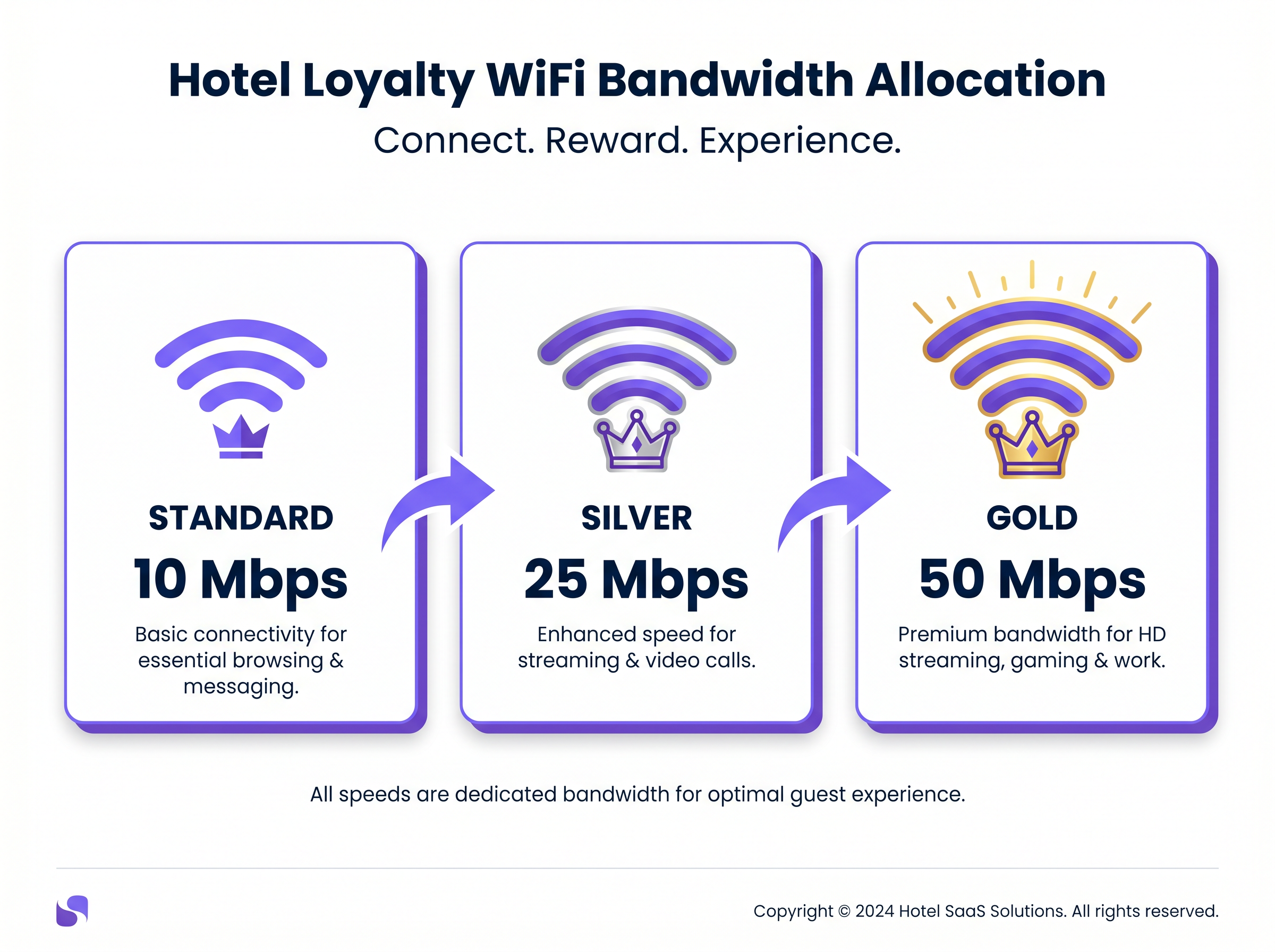
- Dynamische Richtlinienanwendung: Das Netzwerk identifiziert den Gast, fragt die bereitgestellten Profil und wendet die entsprechenden VLAN- und QoS-Richtlinien an. Zum Beispiel könnte einem Gold-Mitglied ein Premium-VLAN mit einer Bandbreitenobergrenze von 50 Mbit/s zugewiesen werden, während einem Standardgast ein Basis-VLAN mit einer Obergrenze von 25 Mbit/s zugewiesen wird.
- Sitzungsbeendigung: Beim Check-out signalisiert das PMS der WiFi-Plattform, die Sitzung zu beenden und temporäre Anmeldeinformationen zu löschen, um die Sicherheit zu gewährleisten und IP-Adressen freizugeben.
Zentralisierte Governance für kettenweite Konsistenz
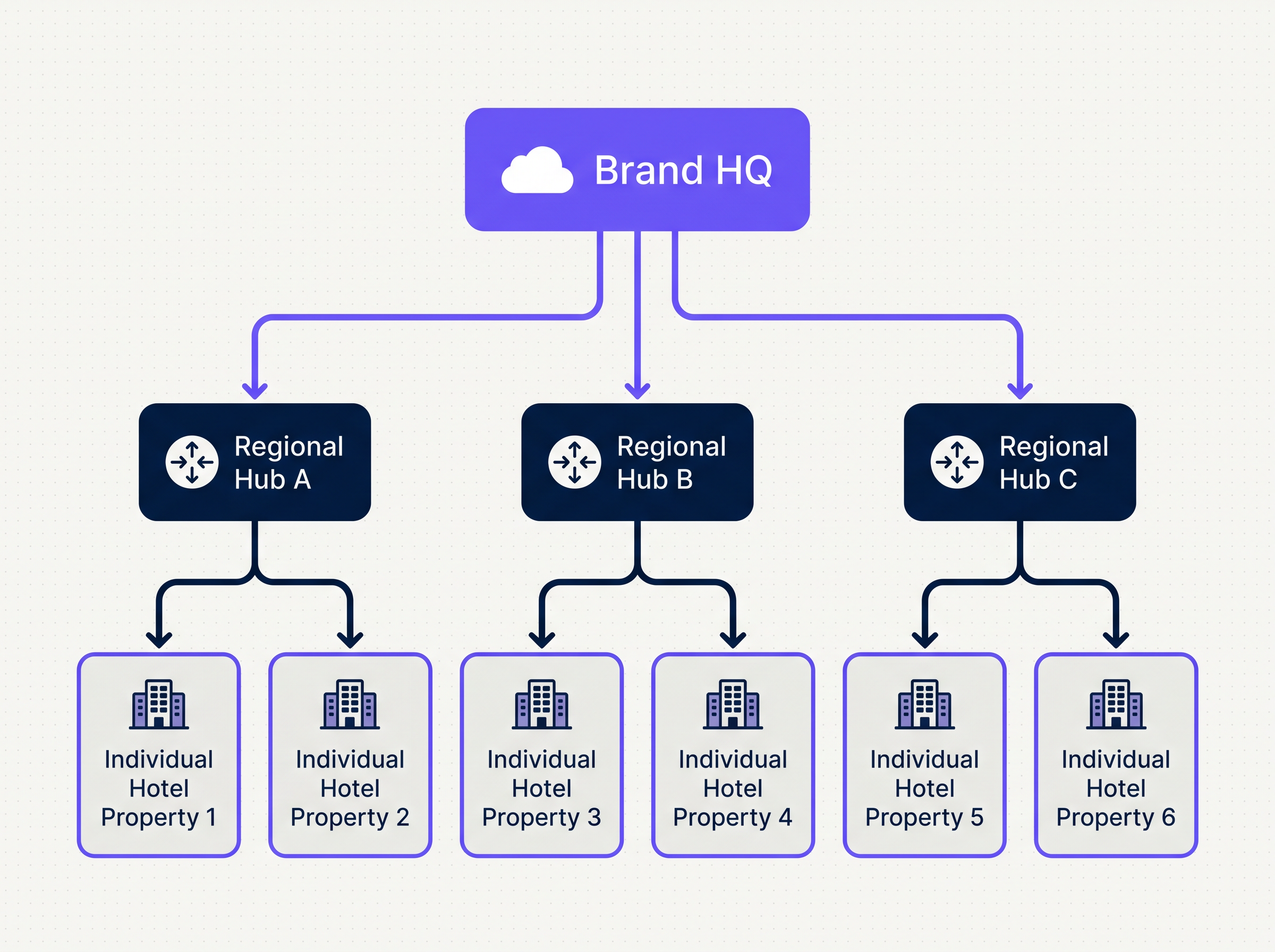
Für globale Hotelmarken, die Hunderte von Objekten betreiben, erfordert die Aufrechterhaltung der Konsistenz eine zentralisierte, cloud-verwaltete Netzwerkarchitektur. Ein hierarchisches Richtlinienmodell ist unerlässlich, um Markenstandards mit lokalen betrieblichen Anforderungen in Einklang zu bringen.
- Marken-HQ (Global): Definiert Kernrichtlinienvorlagen, einschließlich SSIDs, Sicherheitsprotokolle, Bandbreitenzuweisungen für Loyalitätsstufen und Captive Portal Branding-Richtlinien.
- Regionale Hubs: Wenden die globalen Vorlagen an und integrieren dabei regionale Variationen, wie spezifische ISP-Konfigurationen oder die Einhaltung lokaler Datenschutzbestimmungen (z.B. GDPR in Europa).
- Einzelne Objekte: Erben Konfigurationen vom regionalen Hub. Lokales IT-Personal kann den täglichen Betrieb verwalten und die Leistung überwachen, aber keine Kernmarkenstandards außer Kraft setzen.
Dieser „Leitplanken“-Ansatz stellt sicher, dass ein Gast die gleiche hochwertige Konnektivität und den gleichen Marken-Authentifizierungsfluss erlebt, egal ob er in einem Ritz Carlton in New York oder einem W Hotel in Singapur übernachtet.
Best Practices
- Umfassende RF-Standortbegehungen durchführen: Verlassen Sie sich niemals ausschließlich auf alte Verkabelungspläne oder Annahmen. Führen Sie prädiktive Modellierungen und aktive Standortbegehungen durch, um die optimale AP-Platzierung zu bestimmen, unter Berücksichtigung von Wanddämpfung, Grundrissen und Bereichen mit hoher Dichte wie Konferenzzentren.
- Nahtlose Authentifizierung implementieren: Minimieren Sie die Reibung am Captive Portal. Nutzen Sie profilbasierte Authentifizierung oder die Integration mit der mobilen App des Hotels, um wiederkehrende Gäste automatisch zu verbinden. Vermeiden Sie lange Formulare, die übermäßige persönliche Informationen erfordern.
- Analysen für operative Intelligenz nutzen: Verwenden Sie die vom WiFi-Netzwerk generierten Daten, um das Gästeverhalten zu verstehen. Plattformen wie Purple's WiFi Analytics bieten Einblicke in Verweildauern, Zonennutzung und Fußgängerverkehrsmuster und ermöglichen datengesteuerte Entscheidungen für Personal, Marketing und Infrastrukturinvestitionen.
- Cloud-verwaltete Infrastruktur einführen: Stellen Sie Access Points und Switches bereit, die zentral über einen Cloud-Controller verwaltet und überwacht werden können. Dies bietet ein einheitliches Dashboard für Fehlerbehebung, Firmware-Updates und Richtliniendurchsetzung im gesamten Bestand.
- Netzwerkresilienz gewährleisten: Entwerfen Sie das Netzwerk so, dass es WAN-Ausfälle übersteht. Access Points müssen in der Lage sein, im autonomen Modus zu arbeiten und die zuletzt bekannten guten Richtlinien durchzusetzen, selbst wenn die Verbindung zum Cloud-Controller vorübergehend unterbrochen ist.
Fehlerbehebung & Risikominderung
Häufige Fehlerursachen
- Übersegmentierte VLAN-Architektur: Das Erstellen von zu vielen VLANs (z.B. separate VLANs für jede Loyalitätsstufe, IoT devices, POS systems und Back-of-House-Operationen) führt zu unnötiger Komplexität und kann die Routing-Fähigkeiten von Edge-Switches überfordern. Konsolidieren Sie in funktionale Gruppen: Guest Standard, Guest Premium, Management, IoT und PCI-scoped.
- Captive Portal Latenz: Ein Captive Portal, das übermäßig lange zum Laden oder Weiterleiten benötigt, frustriert Gäste sofort. Stellen Sie sicher, dass das Portal auf einem hochverfügbaren Content Delivery Network (CDN) gehostet und für mobile Geräte optimiert ist.
- Unzureichende DHCP-Scopes: Umgebungen mit hohem Durchsatz wie Lobbys und Konferenzzentren können IP-Adresspools schnell erschöpfen. Implementieren Sie aggressive DHCP-Lease-Zeiten (z.B. 30 Minuten bis 1 Stunde) für öffentliche Bereiche, um die IP-Verfügbarkeit zu gewährleisten.
Strategien zur Risikominderung
- IoT Segmentation: Die Verbreitung von Smart TVs, Sprachassistenten und vernetzten Thermostaten in Hotelzimmern birgt erhebliche Sicherheitsrisiken. Diese Geräte müssen auf einem dedizierten IoT VLAN mit strenger Egress-Filterung und ohne laterale Bewegungsmöglichkeiten isoliert werden. Sie dürfen niemals ein Netzwerksegment mit Gastgeräten teilen.
- Compliance und Datenschutz: Bei der Erfassung von Gastdaten über das Captive Portal ist die strikte Einhaltung von Vorschriften wie GDPR zwingend erforderlich. Sammeln Sie nur notwendige Informationen, geben Sie den Verwendungszweck klar an, stellen Sie zugängliche Opt-out-Mechanismen bereit und automatisieren Sie Datenaufbewahrungsrichtlinien. Eine Plattform mit integriertem Einwilligungsmanagement reduziert das Compliance-Risiko erheblich.
ROI & Geschäftsauswirkungen
Die Investition in ein Enterprise-Grade Hospitality WiFi führt zu messbaren Erträgen in mehreren operativen Bereichen.
Erstens wirkt sie sich direkt auf die Gästezufriedenheit und Markenloyalität aus. In der modernen Hotellandschaft ist schlechtes WiFi ein Hauptgrund für negative Bewertungen. Umgekehrt verbessert eine nahtlose, schnelle Verbindung – insbesondere eine, die den Loyalitätsstatus erkennt und belohnt – das gesamte Gästeerlebnis und fördert wiederholte Buchungen.
Zweitens ermöglicht eine robuste WiFi-Infrastruktur den Einsatz fortschrittlicher Betriebstechnologien. Von mobilem schlüssellosem Zugang und Kommunikationsgeräten für Mitarbeiter bis hin zu standortbasierten Diensten und Asset-Tracking ist das drahtlose Netzwerk die grundlegende Schicht für die digitale Transformation innerhalb des Objekts.
Schließlich verwandelt die Implementierung einer umfassenden Guest WiFi Plattform das Netzwerk von einem Kostenfaktor in einen strategischen Vermögenswert. Durch die Erfassung von First-Party-Daten und die Integration mit Marketingsystemen können Hotels gezielte Kampagnen durchführen, Annehmlichkeiten vor Ort bewerben und zusätzliche Einnahmen steigern. Die aus der Netzwerknutzung abgeleiteten Analysen liefern umsetzbare Informationen zur Optimierung von Veranstaltungsortlayouts und zur Verbesserung der Betriebseffizienz, was letztendlich zu einem stärkeren Geschäftsergebnis beiträgt.
Schlüsselbegriffe & Definitionen
IEEE 802.11r (Fast BSS Transition)
A wireless networking standard that permits continuous connectivity aboard wireless devices in motion, with fast and secure handoffs from one access point to another.
Critical for preventing dropped VoIP calls or video streams when a guest walks through a hotel.
IEEE 802.1X
An IEEE Standard for port-based Network Access Control (PNAC), providing an authentication mechanism to devices wishing to attach to a LAN or WLAN.
Used in enterprise hospitality to securely authenticate guests and dynamically assign them to specific VLANs based on their loyalty tier.
Property Management System (PMS)
A comprehensive software application used to coordinate the operational functions of a hotel, including reservations, guest details, room assignments, and billing.
Integration with the PMS is essential for automating WiFi access and enforcing loyalty-based bandwidth tiers.
Quality of Service (QoS)
The description or measurement of the overall performance of a service, particularly the performance seen by the users of the network, allowing prioritization of specific traffic types or users.
Applied to ensure that premium loyalty guests receive their allocated bandwidth even during peak network congestion.
Captive Portal
A web page that the user of a public-access network is obliged to view and interact with before access is granted.
The primary interface for guest onboarding, data capture, and terms of service acceptance in hospitality environments.
VLAN (Virtual Local Area Network)
A custom network created from one or more existing LANs, enabling groups of devices from multiple networks to be combined into one logical network.
Used to securely segment guest traffic, IoT devices, and back-of-house operations on the same physical infrastructure.
Passpoint (Hotspot 2.0)
An industry-wide solution that streamlines network access, allowing users to automatically and securely connect to WiFi networks without needing to manually authenticate.
Provides a cellular-like roaming experience for guests, eliminating the need for repetitive captive portal logins.
WPA3-Enterprise
The latest generation of Wi-Fi security, providing robust authentication and cryptographic strength for enterprise networks.
The required security standard for new hotel deployments to ensure guest data privacy and protect against advanced wireless attacks.
Fallstudien
A global luxury hotel brand with 150 properties needs to implement a tiered WiFi service where Gold loyalty members receive 50 Mbps dedicated bandwidth, while standard guests receive 25 Mbps. Currently, properties use disparate captive portals and local RADIUS servers. How should this be architected?
- Deploy a centralised, cloud-managed WiFi platform with a hierarchical policy engine.
- Establish an API integration between the central WiFi platform and the global Property Management System (PMS).
- Configure the PMS to transmit guest loyalty tier data to the WiFi platform upon check-in.
- Implement 802.1X authentication or a dynamic captive portal that queries the guest profile.
- Define global QoS policies: assign Gold members to a 'Premium' VLAN with a 50 Mbps bandwidth cap, and standard guests to a 'Basic' VLAN with a 25 Mbps cap.
- Push these policy templates from the Brand HQ level to all regional hubs and individual properties.
A newly acquired 300-room property is experiencing frequent guest complaints about WiFi dropouts when walking from their rooms to the conference centre, despite speed tests showing adequate bandwidth. What is the likely technical cause and remediation?
The likely cause is inefficient roaming due to a lack of Fast BSS Transition (IEEE 802.11r) and potentially poor RF overlap. Remediation:
- Verify that 802.11r is enabled on the WLAN configuration to allow seamless handoffs between access points.
- Conduct an active RF site survey to identify coverage gaps or excessive co-channel interference between the rooms and the conference centre.
- Adjust AP transmit power levels to encourage client devices to roam to stronger signals rather than 'sticking' to distant APs.
Szenarioanalyse
Q1. You are deploying a new WiFi network for a 400-room resort. The business requirement is to offer a 'freemium' model where basic access is free, but high-speed access requires payment OR a specific loyalty tier. What is the most efficient architectural approach to enforce this?
💡 Hinweis:Consider how the network applies policies to individual users dynamically rather than relying on multiple SSIDs.
Empfohlenen Ansatz anzeigen
Implement a single SSID with dynamic VLAN assignment via 802.1X or a robust captive portal integrated with the PMS and payment gateway. When a user authenticates, the system checks their profile. If they are a premium loyalty member or have paid for an upgrade, the RADIUS server assigns them to a premium VLAN with a high QoS profile. If not, they remain on the default VLAN with a restricted QoS profile. This avoids SSID pollution and centralises policy management.
Q2. A regional IT manager reports that the DHCP pools for the lobby and conference centre subnets are constantly exhausted, preventing new guests from connecting, even though physical occupancy is below capacity. What is the immediate remediation?
💡 Hinweis:Think about the behavior of modern smartphones and how long network addresses are reserved.
Empfohlenen Ansatz anzeigen
Reduce the DHCP lease time for the public area subnets. Modern devices often randomize MAC addresses and connect briefly while passing through, consuming an IP address. By reducing the lease time from a standard 24 hours to 30-60 minutes, the DHCP server will reclaim and recycle IP addresses from transient devices much faster, ensuring availability for active users.
Q3. The marketing team wants to capture guest email addresses via the captive portal for a new promotional campaign. However, the legal team is concerned about GDPR compliance. How should the captive portal be designed to satisfy both requirements?
💡 Hinweis:Focus on the principles of consent and data minimization.
Empfohlenen Ansatz anzeigen
The captive portal must be designed with explicit, unbundled consent mechanisms. The request for the email address should be accompanied by a clear statement of purpose (e.g., 'to send promotional offers'). The consent checkbox must not be pre-ticked, and agreeing to marketing communications cannot be a condition for accessing the WiFi. Furthermore, the backend system must support automated data retention policies and provide an easy mechanism for users to request data deletion.
Wichtigste Erkenntnisse
- ✓Elite hotel guests expect WiFi performance comparable to corporate networks, necessitating design targets of 50-100 Mbps per room.
- ✓Seamless roaming is non-negotiable; IEEE 802.11r must be implemented to prevent connection drops as guests move through the property.
- ✓PMS integration is the critical enabler for delivering differentiated bandwidth based on loyalty tiers.
- ✓Dynamic VLAN assignment and QoS policies via 802.1X allow automated enforcement of premium service levels.
- ✓Chain-wide consistency requires a cloud-managed architecture with a hierarchical policy model (Brand HQ > Regional > Property).
- ✓IoT devices in guest rooms must be strictly segmented onto dedicated VLANs to mitigate security risks.
- ✓Enterprise-grade WiFi transforms the network from a cost centre into a strategic asset for data capture and operational intelligence.




