

Wi-Fi 7 (802.11be) समझाया गया: एंटरप्राइज़ WiFi के लिए क्या बदलता है
यह मार्गदर्शिका IT प्रबंधकों, नेटवर्क आर्किटेक्ट्स और CTOs के लिए Wi-Fi 7 (IEEE 802.11be) पर एक निश्चित तकनीकी संदर्भ प्रदान करती है जो 2026-2027 में बुनियादी ढांचे के नवीनीकरण की योजना बना रहे हैं। इसमें चार मुख्य वास्तुशिल्प प्रगति शामिल हैं — Multi-Link Operation (MLO), 320 MHz चैनल, 4K-QAM मॉड्यूलेशन, और Multi-RU — Wi-Fi 6E के साथ स्पष्ट तुलना, आतिथ्य और खुदरा से वास्तविक दुनिया की तैनाती के परिदृश्य, और आवश्यक हार्डवेयर और स्विचिंग अपग्रेड का एक स्पष्ट मूल्यांकन। Purple हार्डवेयर-अज्ञेयवादी है और किसी भी Wi-Fi 7 परिनियोजन का समर्थन करता है, जिससे यह मार्गदर्शिका उन टीमों के लिए एक स्वाभाविक प्रवेश बिंदु बन जाती है जो AP नवीनीकरण के साथ अपने guest WiFi और एनालिटिक्स स्टैक का मूल्यांकन कर रही हैं।
🎧 इस गाइड को सुनें
ट्रांसक्रिप्ट देखें

कार्यकारी सारांश
Wi-Fi 7 (IEEE 802.11be) कोई वृद्धिशील अपग्रेड नहीं है। यह Wi-Fi 6 में OFDMA की शुरुआत के बाद से वायरलेस मीडियम एक्सेस आर्किटेक्चर का पहला मौलिक रीडिज़ाइन है। चार मुख्य परिवर्तन — Multi-Link Operation (MLO), 320 MHz चैनल चौड़ाई, 4K-QAM मॉड्यूलेशन, और Multi-Resource Unit (Multi-RU) आवंटन — मिलकर 46 Gbps की अधिकतम सैद्धांतिक थ्रूपुट प्रदान करते हैं, जो Wi-Fi 6E के लगभग पाँच गुना है। एंटरप्राइज़ ऑपरेटरों के लिए अधिक महत्वपूर्ण बात यह है कि वे नियतात्मक, कम-विलंबता कनेक्टिविटी प्रदान करते हैं जो उच्च-घनत्व वाले वातावरण में वायरलेस प्रदर्शन को वायर्ड Ethernet के बराबर बनाता है।
2026-2027 AP नवीनीकरण की योजना बना रही नेटवर्क टीमों के लिए, मुख्य निर्णय द्विआधारी है: Wi-Fi 6E में एक संक्रमणकालीन कदम के रूप में निवेश करें, या सीधे Wi-Fi 7 को रोकें और तैनात करें। साक्ष्य बाद वाले के पक्ष में दृढ़ता से हैं। Wi-Fi 6E ने 6 GHz स्पेक्ट्रम पेश किया लेकिन 802.11ax की सिंगल-लिंक वास्तुकला को बरकरार रखा। Wi-Fi 7 का MLO उस वास्तुशिल्प सीमा को अप्रचलित कर देता है। मौजूदा Wi-Fi 6E हार्डवेयर को फ़र्मवेयर के माध्यम से Wi-Fi 7 में अपग्रेड नहीं किया जा सकता है — नए APs की आवश्यकता है। बजट योजना में उच्च PoE पावर बजट (802.3bt/PoE++) और किनारे पर 10 Gigabit Ethernet अपलिंक को भी ध्यान में रखना चाहिए। Purple का प्लेटफ़ॉर्म पूरी तरह से हार्डवेयर-अज्ञेयवादी है और किसी भी Wi-Fi 7 परिनियोजन के साथ एकीकृत होता है, यह सुनिश्चित करते हुए कि आपकी Guest WiFi और WiFi Analytics क्षमताएं आपके नए बुनियादी ढांचे के साथ बढ़ती हैं।
तकनीकी गहन-विश्लेषण
Wi-Fi 7 के चार स्तंभ
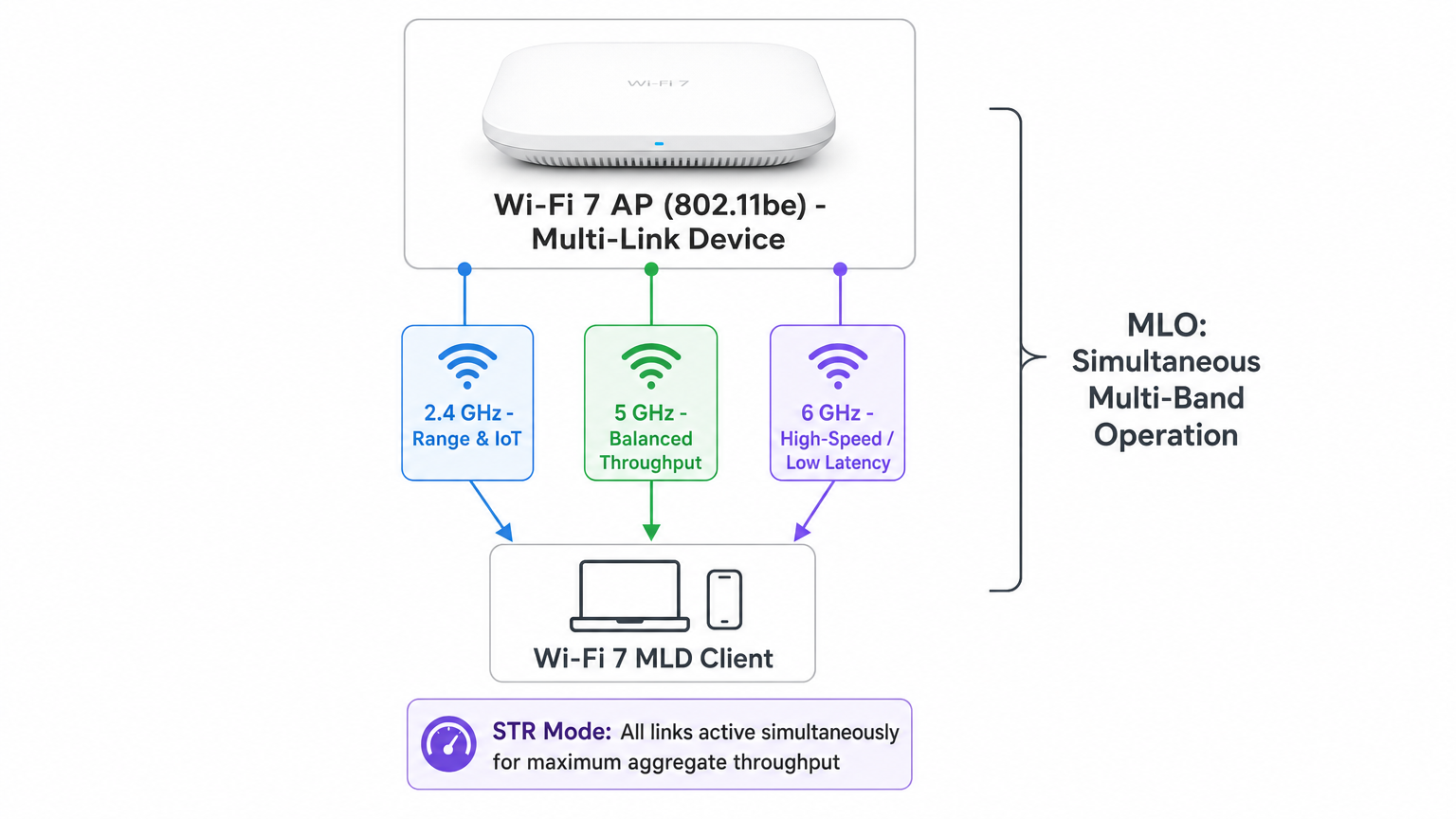
Multi-Link Operation (MLO) 802.11be में परिभाषित वास्तुशिल्प परिवर्तन है। पिछली हर Wi-Fi पीढ़ी में, एक क्लाइंट डिवाइस किसी भी समय एक ही बैंड से एक ही एसोसिएशन बनाए रखता था। बैंड स्टीयरिंग और रोमिंग प्रतिक्रियाशील, क्लाइंट-संचालित प्रक्रियाएं थीं जिन्होंने विलंबता और कनेक्शन ड्रॉप्स पेश किए। MLO इस मॉडल को मौलिक रूप से बदलता है। एक Wi-Fi 7 Multi-Link Device (MLD) — एक्सेस पॉइंट और क्लाइंट दोनों — 2.4 GHz, 5 GHz, और 6 GHz बैंड में एक साथ एसोसिएशन स्थापित कर सकता है। नेटवर्क स्टैक इन्हें एक एकल तार्किक लिंक के रूप में मानता है, जिससे बिना किसी क्लाइंट-दृश्यमान व्यवधान के बैंड में वास्तविक समय ट्रैफिक स्टीयरिंग, लोड संतुलन और फ़ेलओवर सक्षम होता है।
MLO कई मोड में संचालित होता है। STR (Simultaneous Transmit and Receive) सबसे सक्षम और सबसे व्यापक रूप से लागू किया गया मोड है, जो सिंक्रनाइज़ेशन बाधाओं के बिना कई बैंड में समवर्ती Tx और Rx संचालन की अनुमति देता है। STR मोड का उपयोग करके एक Cisco लैब परीक्षण में, Wi-Fi 7 ने समान परिस्थितियों में Wi-Fi 6 के लिए 506 Mbps की तुलना में 747 Mbps का कुल थ्रूपुट प्रदान किया — 47 प्रतिशत का सुधार। eMLSR (Enhanced Multi-Link Single Radio) एक एकल रेडियो का उपयोग करता है जो लिंक के बीच तेजी से स्विच करता है, उन क्लाइंट डिवाइसों के लिए एक लागत प्रभावी मार्ग प्रदान करता है जो पूर्ण STR हार्डवेयर का समर्थन नहीं कर सकते। MLSR (Multi-Link Single Radio) अनिवार्य आधारभूत है जिसका सभी MLDs को समर्थन करना चाहिए।
320 MHz चैनल चौड़ाई Wi-Fi 6E (160 MHz) में उपलब्ध अधिकतम चैनल चौड़ाई का दोगुना प्रतिनिधित्व करती है। ये व्यापक चैनल केवल 6 GHz बैंड में उपलब्ध हैं, जहाँ पर्याप्त सन्निहित स्पेक्ट्रम मौजूद है। 5 GHz बैंड में, नियामक बाधाएं और मौजूदा परिनियोजन व्यावहारिक चैनल चौड़ाई को 80 या 160 MHz तक सीमित करते हैं। यूके और यूरोपीय संघ में 6 GHz बैंड 500 MHz स्पेक्ट्रम प्रदान करता है, जिससे दो गैर-अतिव्यापी 320 MHz चैनल सक्षम होते हैं। घने शहरी वातावरण में एंटरप्राइज़ परिनियोजन के लिए, 320 MHz पर चैनल नियोजन के लिए सह-चैनल हस्तक्षेप से बचने के लिए सावधानीपूर्वक RF सर्वेक्षण कार्य की आवश्यकता होती है, लेकिन कम-हस्तक्षेप वाले वातावरण में थ्रूपुट लाभ पर्याप्त हैं।
4K-QAM (4096-QAM) Wi-Fi 6 और 6E में उपयोग किए गए 1024-QAM से मॉड्यूलेशन घनत्व को अपग्रेड करता है। QAM मॉड्यूलेशन वाहक सिग्नल के आयाम और चरण को बदलकर डेटा को एन्कोड करता है; उच्च QAM ऑर्डर प्रत्येक प्रतीक में अधिक बिट्स पैक करते हैं। 1024-QAM (प्रति प्रतीक 10 बिट्स) से 4096-QAM (प्रति प्रतीक 12 बिट्स) में जाने से आदर्श सिग्नल स्थितियों में चरम डेटा दर में 20 प्रतिशत की वृद्धि होती है। व्यावहारिक चेतावनी यह है कि 4K-QAM के लिए एक मजबूत, स्वच्छ सिग्नल की आवश्यकता होती है — यह अच्छे SNR के साथ छोटी से मध्यम सीमा पर सबसे प्रभावी होता है। शोरगुल वाले या भीड़भाड़ वाले RF वातावरण में, एक्सेस पॉइंट स्वचालित रूप से निचले QAM ऑर्डर पर वापस आ जाएगा।
Multi-RU (Multiple Resource Units) घने एंटरप्राइज़ परिनियोजन में सबसे लगातार समस्याओं में से एक को संबोधित करता है: आंशिक चैनल हस्तक्षेप। Wi-Fi 6 में, OFDMA ने चैनल को व्यक्तिगत क्लाइंट को सौंपे गए निश्चित Resource Units (RUs) में विभाजित किया। यदि चैनल का एक हिस्सा हस्तक्षेप से अवरुद्ध हो गया था, तो पूरा प्रभावित RU अनुपयोगी था। Wi-Fi 7 का Multi-RU एक ही ट्रांसमिशन अवसर (TXOP) के भीतर एक ही क्लाइंट को कई गैर-सन्निहित RUs असाइन करने की अनुमति देता है, और Preamble Puncturing पेश करता है, जो AP को हस्तक्षेपित उप-चैनलों को अनुपलब्ध के रूप में गतिशील रूप से चिह्नित करने और उनके चारों ओर ट्रैफ़िक को रूट करने की अनुमति देता है। यह विशेष रूप से retail और hospitality वातावरण में मूल्यवान है जहाँ 5 GHz बैंड अक्सर पड़ोसी नेटवर्क द्वारा भीड़भाड़ वाला होता है।
Wi-Fi 7 बनाम Wi-Fi 6E: वास्तुशिल्प मामला
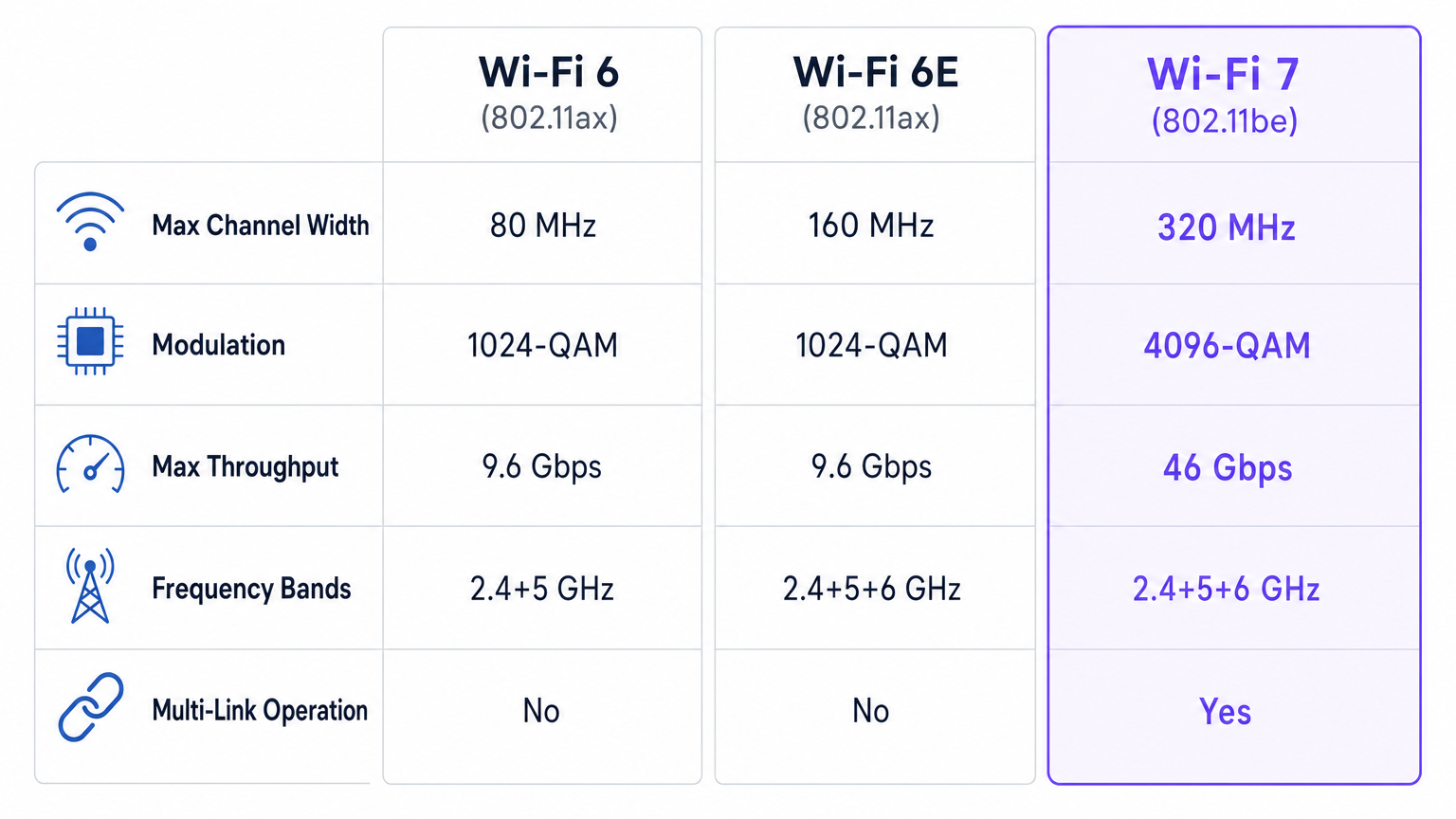
Wi-Fi 6E को तैनात करना है या Wi-Fi 7 का इंतजार करना है, यह सवाल उद्योग 2023 से बहस कर रहा है। 2026-2027 में नवीनीकरण की योजना बना रहे अधिकांश एंटरप्राइज़ ऑपरेटरों के लिए, इसका उत्तर स्पष्ट है: 6E को छोड़ दें। Wi-Fi 6E ने 6 GHz बैंड जोड़ा लेकिन सिंगल-लिंक 802.11ax वास्तुकला को बरकरार रखा। इसने अधिक स्पेक्ट्रम की पेशकश की लेकिन उस स्पेक्ट्रम को कैसे प्रबंधित किया जाता है, इसमें कोई सुधार नहीं हुआ। Wi-Fi 7 का MLO, इसके विपरीत, मौलिक संबंध को बदलता हैक्लाइंट और नेटवर्क के बीच। Wi-Fi 6E द्वारा पेश किया गया 6 GHz स्पेक्ट्रम अभी भी Wi-Fi 7 द्वारा पूरी तरह से उपयोग किया जाता है — लेकिन अब यह एकमात्र विकल्प के बजाय तीन एक साथ लिंक में से एक के रूप में है।
| विशेषता | Wi-Fi 6 (802.11ax) | Wi-Fi 6E (802.11ax) | Wi-Fi 7 (802.11be) |
|---|---|---|---|
| अधिकतम चैनल चौड़ाई | 80 MHz | 160 MHz | 320 MHz |
| मॉड्यूलेशन | 1024-QAM | 1024-QAM | 4096-QAM |
| अधिकतम थ्रूपुट | 9.6 Gbps | 9.6 Gbps | 46 Gbps |
| फ़्रीक्वेंसी बैंड | 2.4 + 5 GHz | 2.4 + 5 + 6 GHz | 2.4 + 5 + 6 GHz |
| मल्टी-लिंक ऑपरेशन | नहीं | नहीं | हाँ |
| प्रीएम्बल पंक्चरिंग | नहीं | नहीं | हाँ |
| मल्टी-RU | नहीं | नहीं | हाँ |
| स्थानिक स्ट्रीम | 8 तक | 8 तक | 16 तक |
स्वास्थ्य सेवा वातावरण के लिए जहाँ नेटवर्क विश्वसनीयता सुरक्षा-महत्वपूर्ण है, या परिवहन हब के लिए जहाँ हजारों समवर्ती सत्रों को प्रबंधित किया जाना चाहिए, केवल MLO के विश्वसनीयता लाभ ही 6E पर Wi-Fi 7 निवेश को उचित ठहराते हैं।
कार्यान्वयन मार्गदर्शिका
चरण 1: अवसंरचना तत्परता मूल्यांकन
एक भी Wi-Fi 7 AP खरीदने से पहले, एक पूर्ण अवसंरचना ऑडिट करें। सबसे आम परिनियोजन विफलता वायरलेस परत नहीं है — यह इसके नीचे की वायर्ड अवसंरचना है। तीन बैंड और 320 MHz चैनलों पर MLO के साथ काम करने वाले Wi-Fi 7 APs कुल थ्रूपुट उत्पन्न कर सकते हैं जो मध्यम लोड के तहत 1 Gigabit अपलिंक को संतृप्त कर देगा। उच्च-घनत्व वाले क्षेत्रों में प्रति AP न्यूनतम अनुशंसित अपलिंक 10 Gigabit Ethernet (10GbE) है। सत्यापित करें कि आपके एज स्विच 10GbE पोर्ट का समर्थन करते हैं और आपकी कोर स्विचिंग फैब्रिक कुल लोड को संभाल सकती है।
PoE बजट दूसरी महत्वपूर्ण बाधा है। ट्राई-बैंड रेडियो और MLO क्षमता वाले Wi-Fi 7 APs को आमतौर पर प्रति AP 30–60 वाट की आवश्यकता होती है, जबकि एक विशिष्ट Wi-Fi 6 AP के लिए 15–25 वाट की आवश्यकता होती है। इसके लिए IEEE 802.3bt (PoE++) स्विच की आवश्यकता होती है, जो प्रति पोर्ट 90 वाट तक प्रदान करते हैं। अपनी मौजूदा PoE अवसंरचना का ऑडिट करें और जहाँ आवश्यक हो, स्विच अपग्रेड के लिए बजट निर्धारित करें।
चरण 2: RF सर्वेक्षण और चैनल योजना
किसी भी भौतिक स्थापना से पहले अपने चुने हुए विक्रेता के नियोजन उपकरणों का उपयोग करके एक पूर्वानुमानित RF सर्वेक्षण करें। Wi-Fi 7 के लिए, सर्वेक्षण में तीनों बैंडों को एक साथ ध्यान में रखना चाहिए, जिसमें 6 GHz प्रसार विशेषताओं पर विशेष ध्यान दिया जाना चाहिए। उच्च मुक्त-स्थान पथ हानि के कारण 6 GHz बैंड की सीमा 5 GHz से कम होती है, जिसका अर्थ है कि बड़े खुले स्थानों में AP घनत्व बढ़ाने की आवश्यकता हो सकती है। 320 MHz चैनल परिनियोजन के लिए, अपने नियामक डोमेन में उपलब्ध गैर-अतिव्यापी चैनलों की पहचान करें और सह-चैनल हस्तक्षेप शमन के लिए योजना बनाएं।
होटलों जैसे आतिथ्य वातावरण में, Wi-Fi 6 के लिए प्रति दो से तीन अतिथि कमरों में एक AP की मानक सिफारिश की जाती है। MLO के साथ Wi-Fi 7 के लिए, वही घनत्व उपयुक्त है, लेकिन गलियारों और सामान्य क्षेत्रों में 6 GHz उपयोग को अधिकतम करने के लिए चैनल योजना पर फिर से विचार किया जाना चाहिए जहाँ डिवाइस घनत्व सबसे अधिक है।
चरण 3: सुरक्षा वास्तुकला
Wi-Fi 7 न्यूनतम सुरक्षा मानक के रूप में WPA3 को अनिवार्य करता है। एंटरप्राइज़ परिनियोजन के लिए, EAP-TLS प्रमाणपत्रों या PEAP-MSCHAPv2 का उपयोग करके IEEE 802.1X प्रमाणीकरण के साथ WPA3-Enterprise लागू करें। नेटवर्क विभाजन महत्वपूर्ण है: अतिथि ट्रैफ़िक, कॉर्पोरेट उपकरणों और IoT एंडपॉइंट्स को अलग-अलग VLANs में उनके बीच उचित फ़ायरवॉल नीतियों के साथ अलग करें।
अतिथि WiFi परिनियोजन के लिए — होटल, खुदरा, सम्मेलन केंद्र, सार्वजनिक क्षेत्र के स्थान — एक अनुपालनशील Captive Portal समाधान आवश्यक है। Purple का Guest WiFi प्लेटफ़ॉर्म GDPR-अनुरूप डेटा कैप्चर, मार्केटिंग सहमति प्रबंधन और PCI DSS-संरेखित नेटवर्क विभाजन को आउट-ऑफ़-द-बॉक्स संभालता है, जो किसी भी Wi-Fi 7 AP विक्रेता के साथ एकीकृत होता है। यह नेटवर्क टीम से अनुपालन बोझ को हटाता है और सुनिश्चित करता है कि आपके नए उच्च-प्रदर्शन नेटवर्क के माध्यम से कैप्चर किया गया डेटा Purple के WiFi Analytics प्लेटफ़ॉर्म के माध्यम से कार्रवाई योग्य है।
चरण 4: चरणबद्ध रोलआउट
एक ही चरण में पूर्ण-कैंपस Wi-Fi 7 परिनियोजन का प्रयास न करें। उच्च-घनत्व या मिशन-महत्वपूर्ण क्षेत्रों से शुरू करें जहाँ ROI सबसे तत्काल है: सम्मेलन कक्ष, लॉबी, ट्रेडिंग फ़्लोर, स्टेडियम कॉनकोर्स, या खुदरा चेकआउट। प्रदर्शन को मान्य करें, चैनल योजनाओं को परिष्कृत करें, और विस्तार करने से पहले परिचालन परिचितता बनाएं। एक चरणबद्ध दृष्टिकोण क्लाइंट डिवाइस इकोसिस्टम को परिपक्व होने की भी अनुमति देता है — Wi-Fi 7 क्लाइंट अपनाने में तेजी आ रही है, जिसमें अधिकांश प्रमुख स्मार्टफोन और लैपटॉप 2024 से Wi-Fi 7 चिपसेट के साथ शिपिंग कर रहे हैं।
सर्वोत्तम अभ्यास
एंटरप्राइज़ Wi-Fi 7 परिनियोजन जो अपने प्रदर्शन के वादों को पूरा करते हैं, उनमें कई सामान्य विशेषताएं होती हैं। सबसे पहले, वे वायर्ड अवसंरचना को एक प्राथमिक चिंता के रूप में मानते हैं, न कि बाद के विचार के रूप में। वायरलेस परत केवल उतनी ही अच्छी तरह से प्रदर्शन कर सकती है जितनी उसके नीचे की स्विचिंग और अपलिंक अवसंरचना। दूसरा, वे परिनियोजित नेटवर्क पर सुरक्षा को रेट्रोफिट करने के बजाय, पहले दिन से WPA3 और IEEE 802.1X को लागू करते हैं। तीसरा, वे ट्रैफ़िक को आक्रामक रूप से विभाजित करते हैं — अतिथि, कॉर्पोरेट और IoT ट्रैफ़िक को कभी भी एक ही VLAN या SSID साझा नहीं करना चाहिए।
IoT-भारी वातावरण के लिए, Wi-Fi 7 का MLO एक प्राकृतिक विभाजन तंत्र प्रदान करता है: IoT उपकरणों को रेंज और बिजली दक्षता के लिए 2.4 GHz बैंड पर पिन किया जा सकता है, जबकि कॉर्पोरेट डिवाइस MLO के माध्यम से 5 GHz और 6 GHz बैंड का लाभ उठाते हैं। यह Purple के Internet of Things Architecture guide में वर्णित वास्तुशिल्प पैटर्न से सीधे संबंधित है, जहाँ नेटवर्क विभाजन और बैंड प्रबंधन को महत्वपूर्ण डिज़ाइन सिद्धांतों के रूप में पहचाना जाता है।
इनडोर पोजिशनिंग सिस्टम तैनात करने वाले स्थानों के लिए, Wi-Fi 7 की बेहतर टाइमिंग और रेंजिंग क्षमताएं — व्यापक चैनल चौड़ाई और अधिक सटीक OFDMA शेड्यूलिंग द्वारा सक्षम — Wi-Fi-आधारित स्थान सेवाओं की सटीकता में सुधार करती हैं। यह विशेष रूप से प्रासंगिक है बड़े खुदरा वातावरण और परिवहन केंद्रों के लिए जहाँ वेफ़ाइंडिंग और एसेट ट्रैकिंग परिचालन प्राथमिकताएँ हैं।
समस्या निवारण और जोखिम न्यूनीकरण
Wi-Fi 7 डिप्लॉयमेंट में सबसे आम विफलता मोड अनुमानित और परिहार्य हैं। बैकहॉल बॉटलनेक खराब प्रदर्शन का प्रमुख कारण हैं: एक AP जो 2+ Gbps कुल वायरलेस थ्रूपुट प्रदान करता है और 1 Gbps अपलिंक के माध्यम से जुड़ा होता है, लोड के तहत तुरंत सीमित हो जाएगा। डिप्लॉयमेंट से पहले अपलिंक क्षमता सत्यापित करें। PoE बजट की कमी दूसरी सबसे आम समस्या है — अपर्याप्त PoE बजट वाला स्विच AP पावर को कम कर देगा, जिससे रेडियो कम पावर पर काम करेंगे या पूरी तरह से अक्षम हो जाएंगे। डिप्लॉयमेंट से पहले एक स्विच पर सभी APs में कुल PoE खपत की गणना हमेशा करें।
क्लाइंट संगतता एक सूक्ष्म जोखिम है। MLO के लिए AP और क्लाइंट दोनों का Wi-Fi 7 MLD-सक्षम होना आवश्यक है। लेगेसी क्लाइंट सामान्य रूप से जुड़ेंगे लेकिन MLO से लाभान्वित नहीं होंगे। मिश्रित-क्लाइंट वातावरण में, सुनिश्चित करें कि आपके AP विक्रेता का कार्यान्वयन Wi-Fi 7 क्लाइंट प्रदर्शन को कम किए बिना लेगेसी क्लाइंट एसोसिएशन को सुचारू रूप से संभालता है। प्रीएम्बल पंक्चरिंग कुछ लेगेसी क्लाइंट के साथ इंटरऑपरेबिलिटी समस्याएँ पैदा कर सकती है — उत्पादन रोलआउट से पहले लैब वातावरण में अच्छी तरह से परीक्षण करें।
नियामक अनुपालन के लिए, सत्यापित करें कि आपका 6 GHz डिप्लॉयमेंट स्थानीय नियामक आवश्यकताओं का अनुपालन करता है। यूके में, Ofcom ने लो पावर इंडोर (LPI) नियमों के तहत इनडोर उपयोग के लिए 6 GHz बैंड को मंजूरी दे दी है। आउटडोर 6 GHz डिप्लॉयमेंट के लिए ऑटोमेटेड फ़्रीक्वेंसी कोऑर्डिनेशन (AFC) के साथ स्टैंडर्ड पावर ऑपरेशन की आवश्यकता होती है, जो परिचालन जटिलता को बढ़ाता है। AFC एकीकरण मार्गदर्शन के लिए अपने AP विक्रेता के दस्तावेज़ों से परामर्श करें।
ROI और व्यावसायिक प्रभाव
Wi-Fi 7 के लिए व्यावसायिक मामला उन वातावरणों में सबसे मजबूत है जहाँ नेटवर्क प्रदर्शन सीधे राजस्व या परिचालन दक्षता को प्रभावित करता है। हॉस्पिटैलिटी में, 2024 के एक अध्ययन में पाया गया कि अतिथि WiFi गुणवत्ता होटल समीक्षा स्कोर में तीसरा सबसे अधिक उद्धृत कारक है, जो कमरे की स्वच्छता और स्टाफ सेवा के बाद आता है। एक Wi-Fi 7 डिप्लॉयमेंट जो घने होटल वातावरण में सामान्य बफरिंग और ड्रॉप हुए कनेक्शन को समाप्त करता है, उसका अतिथि संतुष्टि स्कोर और दोहराई जाने वाली बुकिंग दरों पर सीधा, मापने योग्य प्रभाव पड़ता है।
रिटेल में, ROI गणना पॉइंट-ऑफ़-सेल विश्वसनीयता और ग्राहक ठहरने के समय पर केंद्रित है। Wi-Fi 7 का MLO यह सुनिश्चित करता है कि भुगतान टर्मिनल चरम व्यापारिक अवधियों के दौरान भी एक विश्वसनीय कनेक्शन बनाए रखें जब RF वातावरण सबसे अधिक भीड़भाड़ वाला हो। Purple के WiFi Analytics प्लेटफॉर्म का उपयोग करने वाले खुदरा विक्रेताओं के लिए, बेहतर कनेक्शन विश्वसनीयता का मतलब अधिक पूर्ण सत्र डेटा, उच्च Captive Portal पूर्णता दर और अधिक सटीक फ़ुटफॉल एनालिटिक्स भी है।
स्टेडियम और सम्मेलन केंद्र संचालकों के लिए, 320 MHz चैनलों और मल्टी-RU से क्षमता लाभ परिवर्तनकारी हैं। 40,000 समवर्ती कनेक्टेड डिवाइस वाला 50,000 सीटों वाला स्टेडियम मौजूदा सबसे अधिक मांग वाले RF वातावरणों में से एक है। Wi-Fi 7 की स्पेक्ट्रम को गतिशील रूप से प्रबंधित करने, एक साथ कई बैंडों में ट्रैफ़िक को रूट करने और हस्तक्षेप को पंक्चर करने की क्षमता इसे पहला वायरलेस मानक बनाती है जो अव्यावहारिक AP घनत्व की आवश्यकता के बिना उस पैमाने पर विश्वसनीय कनेक्टिविटी प्रदान करने में वास्तव में सक्षम है।
Wi-Fi 7 के लिए लागत मॉडल को पूर्ण इंफ्रास्ट्रक्चर स्टैक को ध्यान में रखना चाहिए: APs, PoE++ स्विच, 10GbE केबलिंग और अपलिंक, और प्रबंधन प्लेटफॉर्म लाइसेंसिंग। अधिकांश एंटरप्राइज़ ऑपरेटरों के लिए, Wi-Fi 7 रीफ्रेश की कुल लागत एक समान Wi-Fi 6 डिप्लॉयमेंट की तुलना में 30-50 प्रतिशत अधिक है। हालांकि, जब इसे 5-7 साल के हार्डवेयर जीवनचक्र पर अमूर्त किया जाता है, और जब कम समस्या निवारण, कम समर्थन कॉल और बेहतर एप्लिकेशन प्रदर्शन से परिचालन बचत को ध्यान में रखा जाता है, तो Wi-Fi 6E की तुलना में Wi-Fi 7 के लिए TCO मामला आकर्षक है।
यह जानने के लिए कि Purple का प्लेटफॉर्म विभिन्न विक्रेताओं के एंटरप्राइज़ Wi-Fi डिप्लॉयमेंट के साथ कैसे एकीकृत होता है, Purple vs Cloud4Wi तुलना गाइड देखें। कनेक्टेड वाहन इंफ्रास्ट्रक्चर के लिए Wi-Fi 7 पर विचार कर रहे ऑटोमोटिव और फ्लीट वातावरण के लिए, Wi-Fi in Auto: The Complete 2026 Enterprise Guide एक क्षेत्र-विशिष्ट डिप्लॉयमेंट फ्रेमवर्क प्रदान करता है।
मुख्य शब्द और परिभाषाएं
Multi-Link Operation (MLO)
An 802.11be capability that allows a Wi-Fi 7 Multi-Link Device (MLD) to establish and maintain simultaneous associations across multiple frequency bands (2.4 GHz, 5 GHz, 6 GHz). The network stack presents these as a single logical link, enabling real-time traffic steering, load balancing, and seamless failover across bands.
MLO is the defining architectural change in Wi-Fi 7. IT teams encounter this when evaluating whether Wi-Fi 7 APs and client devices are 'MLD-capable' — both ends of the link must support MLO for the feature to activate. Legacy clients will associate normally but will not benefit from MLO.
STR (Simultaneous Transmit and Receive)
The most capable MLO operating mode, in which a Multi-Link Device can transmit and receive data on multiple bands concurrently without synchronisation constraints. STR requires dedicated radio hardware for each active link and is the mode implemented by most enterprise AP vendors.
When evaluating Wi-Fi 7 AP specifications, network architects should confirm that the AP supports STR mode rather than only eMLSR. STR delivers the full MLO throughput and latency benefits; eMLSR is a cost-reduced alternative that switches between links rather than operating them simultaneously.
4K-QAM (4096-QAM)
A modulation scheme that encodes 12 bits per symbol by varying the amplitude and phase of the carrier signal across 4,096 distinct states. This represents a 20 percent increase in spectral efficiency over the 1024-QAM (10 bits per symbol) used in Wi-Fi 6 and 6E, but requires a high signal-to-noise ratio to operate reliably.
IT teams will encounter 4K-QAM in AP specification sheets as a headline throughput figure. The practical caveat is that 4K-QAM only activates at close range with strong SNR — at the cell edge, the AP falls back to lower QAM orders. Design AP placement to ensure adequate SNR for 4K-QAM in high-priority zones.
Multi-RU (Multiple Resource Units)
An 802.11be feature that allows a single client device to be assigned multiple non-contiguous Resource Units (RUs) within a single OFDMA transmission opportunity. This enables more efficient spectrum utilisation and, combined with Preamble Puncturing, allows the AP to route traffic around interfered sub-channels.
Multi-RU is particularly valuable in high-density environments where partial channel interference is common. Network teams in retail and hospitality environments will see the most benefit from Multi-RU, as it directly addresses the spectrum fragmentation caused by neighbouring networks and legacy devices.
Preamble Puncturing
A Wi-Fi 7 mechanism that allows an access point to mark specific 20 MHz sub-channels within a wider channel as unavailable due to interference, and transmit data across the remaining sub-channels. This prevents the entire wide channel from being abandoned when only a portion is affected by interference.
Preamble Puncturing is a key enabler of 320 MHz channel deployments in environments where the full channel width cannot always be used cleanly. IT teams should verify that their AP vendor's implementation handles Preamble Puncturing gracefully with legacy clients, as some older devices may not decode punctured preambles correctly.
MLD (Multi-Link Device)
A Wi-Fi 7 device — either an access point or a client — that supports Multi-Link Operation. An AP MLD manages multiple affiliated APs (one per band), while a non-AP MLD (client) manages multiple affiliated stations. Both ends of a link must be MLD-capable for MLO to activate.
When procuring Wi-Fi 7 APs and evaluating client device compatibility, the MLD designation is the key indicator of MLO support. Not all Wi-Fi 7 certified devices are MLD-capable — verify this explicitly in vendor specifications, particularly for IoT devices and low-cost client hardware.
IEEE 802.3bt (PoE++)
The IEEE standard for Power over Ethernet that delivers up to 90 watts per port (Type 4), compared to 30 watts for 802.3at (PoE+). Wi-Fi 7 APs with tri-band radios and MLO capability typically require 30–60 watts, making 802.3bt switches a prerequisite for full-performance Wi-Fi 7 deployments.
PoE budget is the most commonly overlooked infrastructure constraint in Wi-Fi 7 planning. IT teams must audit existing switch PoE capabilities before AP procurement. Deploying a Wi-Fi 7 AP on a switch that cannot supply sufficient power will result in radios operating at reduced power or being disabled entirely.
WPA3-Enterprise
The Wi-Fi Alliance's enterprise security certification for WPA3, requiring IEEE 802.1X authentication with EAP (Extensible Authentication Protocol) and, in its 192-bit mode, AES-256-GCMP encryption. WPA3 is mandatory for Wi-Fi 7 certification and provides significantly stronger protection against offline dictionary attacks than WPA2.
IT teams must ensure their RADIUS infrastructure and client supplicant configurations are updated to support WPA3-Enterprise before deploying Wi-Fi 7. In environments with legacy devices that only support WPA2, a transition mode SSID may be required, but this should be treated as a temporary measure with a defined sunset date.
AFC (Automated Frequency Coordination)
A regulatory mechanism required for Standard Power operation in the 6 GHz band, in which an AP queries a cloud-based AFC database to determine which channels and power levels are available at its specific location without causing interference to incumbent fixed and satellite services.
AFC is relevant for enterprise operators deploying Wi-Fi 7 APs outdoors or in locations where Standard Power operation is required for coverage. Indoor Low Power Indoor (LPI) deployments do not require AFC in most regulatory domains, including the UK. IT teams planning outdoor 6 GHz deployments must ensure their AP vendor supports AFC and that the AFC service is configured correctly.
केस स्टडीज
A 350-room full-service hotel is running Wi-Fi 6 deployed in 2021. The network team is seeing increasing guest complaints about buffering during peak evening hours (7–10 PM) when occupancy exceeds 80 percent. The CTO wants to know whether to upgrade to Wi-Fi 6E now or wait for Wi-Fi 7, and what the full infrastructure scope of a Wi-Fi 7 deployment would look like.
The recommendation is to skip Wi-Fi 6E entirely and plan a Wi-Fi 7 deployment for Q3 2026. The evening peak complaints are a classic symptom of spectrum congestion in the 5 GHz band — the 2.4 GHz band is saturated by IoT devices, and the 5 GHz band is being contested by hundreds of concurrent client sessions. Wi-Fi 6E would add 6 GHz capacity but would not address the fundamental single-link architecture that forces clients to compete for a single band. Wi-Fi 7's MLO would allow each client device to simultaneously use 5 GHz and 6 GHz, effectively doubling available throughput per client during peak periods.
Infrastructure scope: The hotel has 350 rooms across 8 floors, plus lobby, restaurant, meeting rooms, and pool area — approximately 180 APs total. Current switches are 1 GbE PoE (802.3at). Required upgrades: (1) Replace all edge switches with 802.3bt PoE++ switches supporting 10GbE uplinks — budget approximately £800–£1,200 per switch, 18 switches required. (2) Deploy Wi-Fi 7 APs at existing mounting locations — budget approximately £400–£700 per AP depending on vendor. (3) Verify fibre uplinks from IDF to MDF are 10GbE capable. (4) Deploy Purple's Guest WiFi platform for GDPR-compliant captive portal and analytics, replacing the existing legacy splash page. Total estimated infrastructure investment: £180,000–£280,000, with a projected 5-year TCO saving of £40,000–£60,000 versus a Wi-Fi 6E deployment that would require replacement again in 3–4 years.
A national retail chain with 120 stores is planning a network refresh. Each store has approximately 15–20 APs, a mix of payment terminals, staff tablets, digital signage, and customer guest WiFi. The IT director wants to understand whether Wi-Fi 7 is justified for retail, or whether the investment is better directed at improving the wired backbone.
Wi-Fi 7 is justified for this retail deployment, but the business case must be built on operational reliability rather than raw throughput. The critical use case is payment terminal reliability. Under PCI DSS, payment card data must be transmitted over a network that meets specific security and availability requirements. In a busy retail environment during peak trading (Black Friday, Christmas), the 5 GHz band can become severely congested, causing intermittent payment terminal failures. Wi-Fi 7's MLO and Preamble Puncturing directly address this: payment terminals can be assigned dedicated 6 GHz links via MLO, isolated from the congested 5 GHz band used by customer devices.
Deployment recommendation: Deploy Wi-Fi 7 APs in a phased rollout starting with the 20 highest-volume stores. Configure three SSIDs per store: (1) Corporate/POS — WPA3-Enterprise, 802.1X, VLAN-isolated, 6 GHz preferred via MLO band steering. (2) Staff devices — WPA3-Personal, 5 GHz. (3) Guest WiFi — Purple captive portal, GDPR-compliant, 2.4/5 GHz, analytics-enabled. Use Purple's WiFi Analytics platform to measure customer dwell time, footfall patterns, and return visit rates across the rollout stores versus control stores. This creates a measurable ROI dataset to justify the remaining 100-store rollout. Per-store infrastructure cost estimate: £8,000–£15,000 including APs and switch upgrades.
परिदृश्य विश्लेषण
Q1. Your organisation operates a 15,000-seat conference centre. During major events, the network team reports that 5 GHz throughput collapses when attendance exceeds 8,000. You have been asked to evaluate whether Wi-Fi 7 would resolve this and to outline the key infrastructure changes required. What is your recommendation and what are the three most critical infrastructure prerequisites?
💡 संकेत:Consider how MLO and Multi-RU specifically address high-density spectrum congestion, and what the wired infrastructure must support to avoid backhaul bottlenecks.
अनुशंसित दृष्टिकोण दिखाएं
Wi-Fi 7 is the correct solution for this scenario. The 5 GHz collapse at 8,000+ attendees is a classic high-density spectrum congestion problem that Wi-Fi 6E would only partially address (by adding 6 GHz capacity) but Wi-Fi 7 solves architecturally through MLO and Multi-RU. MLO allows each client to simultaneously use 5 GHz and 6 GHz, effectively doubling available spectrum per client. Multi-RU and Preamble Puncturing allow the AP to route traffic around interfered sub-channels, maintaining throughput even when the RF environment is heavily contested.
The three critical infrastructure prerequisites are: (1) 10 Gigabit Ethernet uplinks from every AP to the edge switch — at 15,000 seats with high device density, 1 GbE uplinks will be saturated. (2) IEEE 802.3bt (PoE++) switches — Wi-Fi 7 tri-band APs require 30–60W per AP, exceeding the 30W limit of 802.3at switches. (3) A revised 6 GHz channel plan — the conference centre must map available 6 GHz spectrum, plan non-overlapping 320 MHz channels, and verify that 6 GHz propagation characteristics provide adequate coverage at the planned AP density.
Q2. A retail IT director asks: 'We have 200 stores on Wi-Fi 6. Our payment terminals are reliable and our guest WiFi works. Should we upgrade to Wi-Fi 7 now, or wait until Wi-Fi 6 hardware reaches end-of-support?' What is your recommendation and how do you frame the business case?
💡 संकेत:Consider the hardware lifecycle, the skip-6E argument, and how to frame a phased pilot with measurable ROI rather than a full-fleet commitment.
अनुशंसित दृष्टिकोण दिखाएं
The recommendation is to plan a phased Wi-Fi 7 pilot now, targeting the 20 highest-volume stores, rather than waiting for Wi-Fi 6 end-of-support. The rationale is twofold. First, Wi-Fi 6 hardware deployed in 2020–2022 will reach end-of-support around 2027–2028, at which point the only upgrade path is Wi-Fi 7 (Wi-Fi 6E is a dead-end transition). Starting a pilot now builds operational expertise and creates a measurable ROI dataset before the forced upgrade. Second, Wi-Fi 7's MLO provides a genuine operational benefit for retail: POS terminals can be assigned dedicated 6 GHz links via MLO, isolated from the congested 5 GHz band used by customer devices, improving payment terminal reliability during peak trading.
The business case should be framed around three measurable outcomes from the pilot stores: (1) Payment terminal uptime during peak trading hours (target: 99.9% vs current baseline). (2) Customer dwell time and return visit rate, measured via Purple's WiFi Analytics platform. (3) IT support ticket volume for network-related issues. If the pilot stores show improvement across these metrics, the board-level case for the remaining 180-store rollout is data-driven rather than speculative.
Q3. A network architect is designing a Wi-Fi 7 deployment for a 500-bed NHS hospital. The deployment must support clinical applications (electronic patient records, medical imaging), staff devices, and patient guest WiFi. What are the three most important security and compliance considerations, and how does Wi-Fi 7 specifically address them?
💡 संकेत:Consider WPA3 requirements, network segmentation for clinical vs guest traffic, IoT medical device management, and the specific compliance frameworks relevant to NHS environments.
अनुशंसित दृष्टिकोण दिखाएं
The three most important security and compliance considerations are: (1) Network segmentation and traffic isolation. Clinical applications (EPR, PACS/DICOM imaging) must be completely isolated from patient guest WiFi and staff personal devices. Wi-Fi 7's MLO enables band-level traffic segmentation: clinical devices can be assigned dedicated 6 GHz links with WPA3-Enterprise and 802.1X authentication, while patient guest WiFi operates on separate 2.4/5 GHz SSIDs with a GDPR-compliant captive portal. VLANs and firewall policies enforce the segmentation at the wired layer. (2) Medical IoT device management. NHS hospitals have large populations of legacy medical IoT devices (infusion pumps, monitoring equipment) that may only support WPA2 or even WPA. Wi-Fi 7 APs must support a transition mode SSID for these devices, with strict VLAN isolation and NAC policies to prevent lateral movement. MLO's ability to pin IoT traffic to the 2.4 GHz band while clinical applications use 6 GHz provides a natural architectural separation. (3) Compliance with NHS DSPT (Data Security and Protection Toolkit) and GDPR. Patient guest WiFi must capture only the minimum necessary personal data, with explicit consent, and must be stored in compliance with GDPR data residency requirements. A platform like Purple's Guest WiFi handles consent management and data minimisation out of the box, reducing the compliance burden on the network team.




