
Medindo o ROI de Negócios de Guest WiFi e Location Analytics
Esta referência técnica mostra às equipes de TI e de locais como medir o ROI do guest WiFi com uma cadeia defensável que vai desde a integridade da rede e dados consentidos até resultados operacionais ou comerciais validados. Ela separa evidências mensuráveis de suposições, mapeia o Purple Connect, Capture e Engage para a camada de medição correta e apresenta cenários de planejamento para hotéis, redes de varejo e locais de eventos.
Video overview
Ouça este guia
Ver transcrição do podcast
Parte da nossa série principal: Guia de WiFi Analytics →
Resumo Executivo
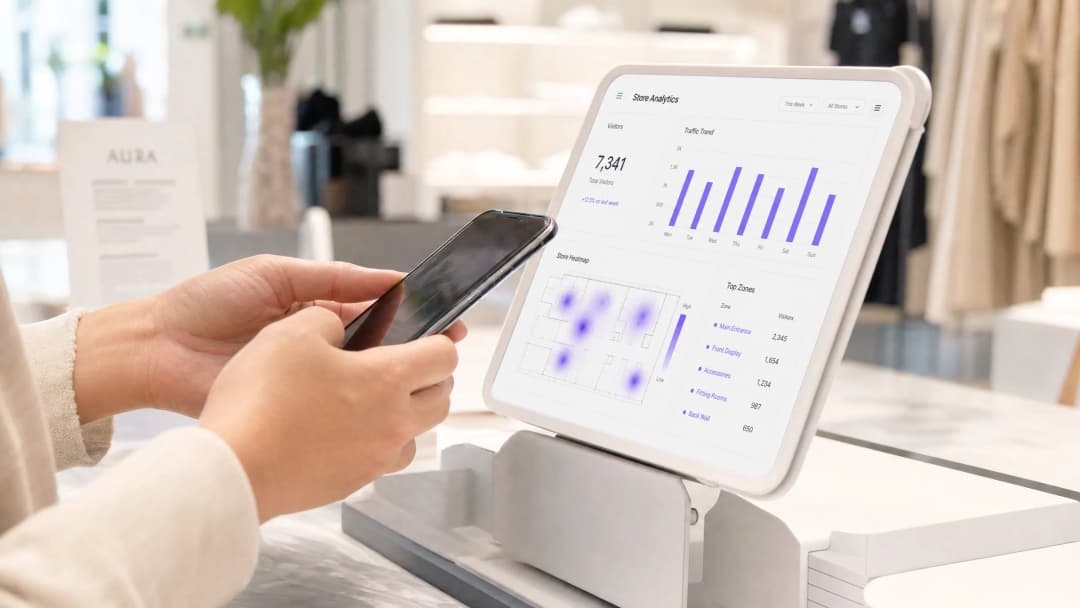
A maioria das empresas vê o WiFi de visitantes como uma despesa operacional pura - uma comodidade esperada, um item no orçamento de TI e uma fonte de chamados de suporte. No entanto, essa abordagem ignora uma mudança fundamental nas capacidades de rede. As infraestruturas modernas de WiFi são redes de sensores de alta resolução que capturam grandes volumes de dados primários (first-party data) e análises espaciais.
O Purple está implantado em mais de 80.000 locais ativos, processando aproximadamente 440 milhões de logins e capturando 29 bilhões de pontos de dados em 2024. A plataforma opera como uma sobreposição em nuvem sobre o hardware existente da Cisco Meraki, HPE Aruba, Ruckus, Juniper Mist, Ubiquiti UniFi, Cambium, Extreme Networks e Fortinet. Este guia demonstra como medir o ROI desse investimento. Indo além dos modelos teóricos, ele fornece uma estrutura concreta para calcular o valor por meio do aumento do tempo de permanência, crescimento da base de dados do CRM, eficiências operacionais e receita direta de acesso em camadas. Quer você gerencie um grupo hoteleiro, uma rede de varejo ou locais públicos, os princípios de medição permanecem os mesmos.
Aprofundamento Técnico: Os Mecanismos de Medição
Para medir o ROI, você deve primeiro entender como os dados são gerados. Esse processo conta com dois métodos distintos de coleta de dados: Presence Analytics e Engagement Analytics. Confundir esses dois termos corre o risco de construir um modelo de medição falho.
Presence Analytics
O Presence Analytics captura a atividade antes mesmo de o usuário se conectar. Quando um dispositivo móvel com um módulo WiFi ativo entra em um local, ele transmite solicitações de busca (probe requests). O dispositivo está consultando a rede para ver se redes conhecidas estão por perto. Cada ponto de acesso (Access Point) ao alcance intercepta essas solicitações de busca. Elas contêm o endereço MAC do dispositivo (um identificador de hardware exclusivo) e a intensidade do sinal, expressa como RSSI (Received Signal Strength Indicator).
Ao triangular os valores de RSSI em vários pontos de acesso, a plataforma de análise estima a localização física do dispositivo. Isso forma a base para o rastreamento de fluxo de pessoas (footfall tracking) e cálculo do tempo de permanência. Esse processo é anônimo, não requer interação do usuário e ocorre em todas as suas instalações - quer você capture esses dados ativamente ou não.
Desde 2020, toda implantação profissional de análise enfrenta um desafio: desde o iOS 14 e Android 10, os dispositivos móveis usam endereços MAC aleatórios para solicitações de busca. Em vez de transmitir um identificador estático, o dispositivo alterna por endereços temporários. Se a sua plataforma de análise não corrigir isso, a contagem de visitantes será imprecisa. O Purple usa modelos de correção estatística calibrados em relação a dados de câmeras do mundo real para garantir uma precisão de ±3-7% (dados da plataforma Purple). Se você está avaliando uma plataforma que não consegue explicar sua metodologia para corrigir a aleatorização de MAC, isso é um sinal de alerta.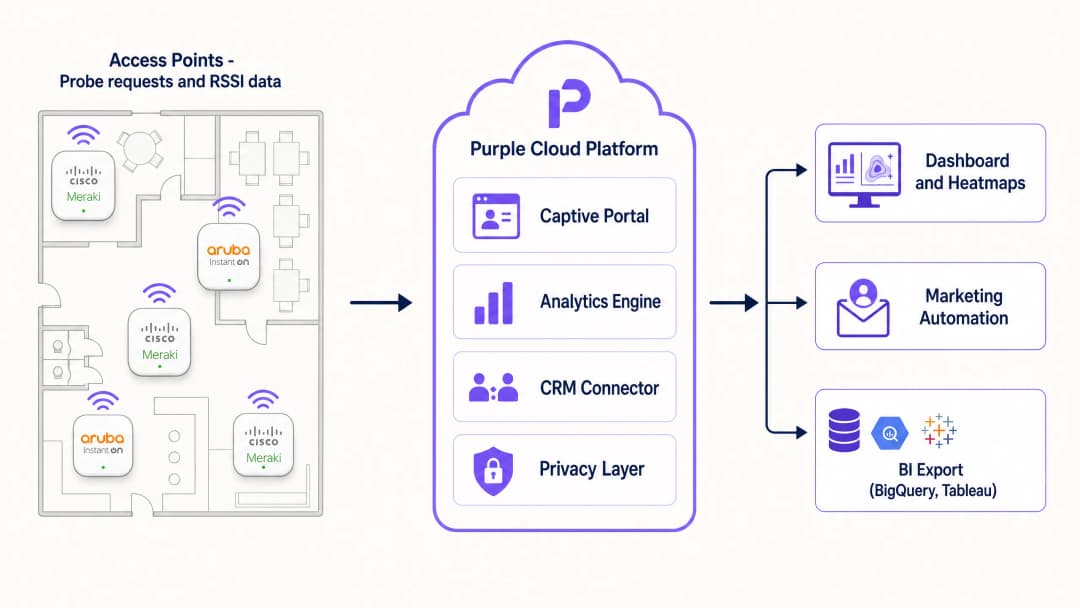
Engagement Analytics
O Engagement Analytics começa quando um usuário se conecta à rede WiFi de visitantes por meio de um Captive Portal. O Captive Portal serve como gateway de autenticação e o sistema principal para capturar dados primários (first-party data). Assim que um usuário se autentica - seja via Microsoft Entra ID, Google Workspace, logins de redes sociais ou um formulário de e-mail - o dispositivo anônimo é transformado em um perfil de visitante identificado.
Esse perfil identificado é o principal motor do ROI de marketing. Ele vincula a presença física a uma identidade digital. Você pode rastrear a frequência de visitas de coortes específicas, medir a taxa de conversão de campanhas de marketing e integrar esses dados diretamente ao seu CRM. Usando exatamente esses dados, a Harrods alcançou um ROI de 57 vezes (57x) por meio de marketing direcionado para clientes adquiridos via WiFi de visitantes.
Seis Métricas-Chave para a Tomada de Decisão
As plataformas de análise de WiFi podem exibir dezenas de métricas. No entanto, estas seis métricas são as mais críticas para o cálculo de ROI e tomada de decisão:
| Métrica | O que Ela Mede | Uso Principal |
|---|---|---|
| Fluxo de Pessoas (Footfall) | Visitantes únicos em uma zona definida durante um período específico | Dados de localização de referência, comparações |
| Tempo de Permanência (Dwell time) | Média e distribuição do tempo gasto por zona e visita | Otimização de layout, escala de funcionários, correlação de conversão |
| Taxa de Retorno de Visita | Proporção de visitantes que retornam dentro de N dias | Sinais de fidelidade, atribuição de marketing |
| Transições de Zona | Fluxos de visitantes da zona de origem para a de destino | Análise de jornada, testes de layout |
| Visitantes Novos vs. Recorrentes | Proporção de aquisição em relação à retenção | Atribuição de canais de marketing |
| Taxa de Captura | Proporção de dispositivos detectados que se autenticam | Eficácia do portal, indicador de qualidade dos dados |
A taxa de captura merece atenção especial. Ela preenche a lacuna entre os dados de presença anônima e os dados de engajamento identificados. Os benchmarks do setor mostram que a taxa de captura normalmente varia entre 15% e 40%, dependendo do design do portal e dos incentivos oferecidos. Uma taxa abaixo de 15% indica que o fluxo do portal precisa de otimização.
Guia de Implementação: Alinhando para o ROI
Para construir um sistema que entregue um ROI mensurável, decisões arquitetônicas específicas são necessárias. Uma rede projetada exclusivamente para cobertura não entregará análises espaciais precisas.
Densidade e Posicionamento dos Access Points
A análise de localização baseia-se em triangulação. Para determinar uma localização com precisão, um dispositivo deve ser detectado por pelo menos três Access Points simultaneamente. Em ambientes típicos de varejo ou hotelaria, isso requer um Access Point a cada 150 a 200 metros quadrados. Crucialmente, os Access Points devem ser posicionados nos limites das zonas, e não apenas no centro de uma sala. Se você colocar os Access Points apenas no centro, o sistema não poderá determinar com precisão quando os visitantes cruzam um limite. Esse é o motivo mais comum para falhas em implantações de análise de dados.
Para um espaço de varejo de 3.000 metros quadrados, planeje de 15 a 20 Access Points para garantir a sobreposição de cobertura nos limites dos departamentos. Compare isso com uma instalação focada apenas em cobertura, que poderia utilizar apenas oito Access Points para manter a força do sinal, sem considerar a precisão da triangulação.
Configuração do Captive Portal
O Captive Portal é o seu mecanismo de conversão. Mantenha o processo de login em no máximo três etapas. Solicite apenas dados essenciais durante a primeira visita. Se o seu objetivo principal for o crescimento do CRM, torne o endereço de e-mail um campo obrigatório e utilize o Purple Verify para validá-lo no momento da captura. Isso evita que dados inválidos entrem em seu banco de dados. Para hotelaria, recomendamos oferecer banda larga premium como um benefício exclusivo para membros do programa de fidelidade. Isso impulsiona as inscrições e cria uma fonte de receita direta a partir do seu investimento em WiFi.
Para estabelecimentos que desejam receber visitantes recorrentes sem fricção, recomendamos a implementação do Passpoint (Hotspot 2.0). O Passpoint permite que dispositivos certificados se conectem automaticamente em visitas subsequentes sem apresentar o portal novamente, enquanto ainda captura os dados de sessão necessários para a análise. Isso é altamente eficaz em aeroportos e hotéis com altas taxas de visitantes recorrentes.
Integração de Dados
Dados ociosos em um portal não geram ROI. Integre a plataforma de análise de WiFi com os seus sistemas operacionais existentes usando APIs REST padrão ou webhooks. Essa etapa de integração costuma ser o maior obstáculo, pois exige o alinhamento entre as equipes de TI, marketing e operações, que raramente compartilham a mesma infraestrutura de dados. Priorize esta tarefa logo no início do projeto.
Para varejo, a integração com sistemas de Ponto de Venda (PDV) oferece o maior valor. Ao correlacionar o tempo de permanência em zonas específicas com os dados de transações, você pode identificar áreas de alto fluxo e baixa conversão - zonas onde os visitantes permanecem, mas não compram. Em hotelaria, a integração com o Sistema de Gestão de Propriedade (PMS) permite vincular os dados de sessão de WiFi diretamente às reservas de quartos e aos gastos com alimentos e bebidas.
Tem dúvidas sobre a sua configuração específica?
A nossa equipa trabalha com operadores de espaços, gestores de TI e engenheiros de rede em 80.000 locais. Agende uma chamada de 20 minutos e mostraremos como outros profissionais na sua situação o resolveram.
Melhores Práticas
Implementar Banda Larga em Camadas
A largura de banda em níveis é a forma mais direta de monetizar o WiFi de convidados. Ofereça um nível gratuito com velocidade limitada para navegação básica e um nível premium de alta velocidade pago (ou incentivado por fidelidade). Essa abordagem compensa os custos de rede e impulsiona as inscrições em programas de fidelidade. A AGS Airports implementou esse modelo em níveis, alcançando um ROI de 842% (dados de clientes Purple). O modelo funciona porque transforma um centro de custo em um gerador de receita sem prejudicar a experiência do usuário para aqueles que optam por não pagar.
Segmente a Rede
Não misture o tráfego de convidados com as redes corporativas internas. Use VLANs para segregar os dispositivos dos convidados dos seus sistemas internos. Em ambientes de varejo que processam pagamentos com cartão, esse é um requisito fundamental de segurança sob o PCI-DSS. A Purple fornece uma infraestrutura RADIUS para gerenciar centralmente essas políticas em toda a sua propriedade, oferecendo suporte a IEEE 802.1X para controle de acesso à rede baseado em porta e WPA3-Enterprise para os padrões de criptografia mais fortes disponíveis.
Para obter mais detalhes sobre a arquitetura de segurança de WiFi corporativo, consulte o guia Enterprise WiFi Security: A Comprehensive Guide for 2026.
Priorize a Privacidade e a Conformidade
A privacidade não é opcional. Se você opera no Reino Unido ou na UE, deve cumprir o UK GDPR e o GDPR. Na Califórnia, o CCPA se aplica. Seu Captive Portal deve comunicar claramente quais dados são coletados, por quanto tempo são armazenados e como os visitantes podem exercer seus direitos. Obtenha consentimento explícito (opt-in) para comunicações de marketing. O Presence Analytics - que é anônimo - baseia-se no interesse legítimo, apoiado por uma Avaliação de Impacto sobre a Proteção de Dados (DPIA) concluída e sinalização física altamente visível.
A Purple possui certificação ISO 27001, conformidade com GDPR, conformidade com CCPA e certificação Cyber Essentials. A plataforma é fornecida com modelos de DPIA e modelos de sinalização, para que você não precise criar uma infraestrutura de conformidade do zero. Para informações detalhadas sobre a arquitetura de conformidade, consulte o guia WiFi GDPR Compliance: How to Securely Collect Guest Data via Captive Portals.
Solução de Problemas e Mitigação de Riscos
Dados de Localização Imprecisos
Se os seus mapas de calor mostrarem visitantes em locais impossíveis, ou se as contagens no nível da zona não estiverem alinhadas com as observações físicas, o problema geralmente é o posicionamento do Access Point ou a configuração da potência de transmissão. Certifique-se de que as posições dos Access Points em suas plantas baixas correspondam exatamente aos locais físicos. Verifique se a potência de transmissão não está definida como muito alta - Access Points excessivamente potentes criam células de cobertura grandes e sobrepostas, o que degrada a precisão da triangulação. Reduza a potência de transmissão e aumente a densidade de Access Points para melhorar a resolução espacial.
Baixa Conversão do Captive Portal
Se um alto número de dispositivos for detectado, mas menos de 15% se autenticarem, você deve revisar o fluxo do portal. Causas comuns incluem: excesso de campos obrigatórios, falha no carregamento do portal no navegador padrão do dispositivo, falta de incentivos claros para a conexão ou um portal que não é otimizado para dispositivos móveis. Teste o portal em dispositivos iOS e Android antes do lançamento. Remova quaisquer campos que não sejam essenciais. Se você estiver oferecendo uma proposta de valor clara - como WiFi gratuito, descontos ou pontos de fidelidade - destaque isso de forma proeminente na splash page.
Falhas de Integração
Se os dados não estiverem fluindo para o seu sistema CRM ou PDV, primeiro verifique as credenciais de API e as configurações de webhook. Certifique-se de que os campos de dados mapeados na plataforma de WiFi estejam alinhados com os campos correspondentes no sistema de destino. Verifique os logs de API em busca de limites de taxa ou erros de autenticação. A maioria das falhas de integração decorre de problemas de configuração, e não de erros de plataforma. Certifique-se de que sua equipe de TI documente o mapeamento de campos antes do go-live.
Contagem Excessiva devido à Randomização de MAC
Se a contagem de visitantes de WiFi for significativamente maior do que os dados dos seus contadores de fluxo de pessoas ou sistemas de câmera, sua plataforma não está corrigindo a randomização de MAC. Este é um problema conhecido em plataformas que não atualizaram suas metodologias de análise desde 2020. Pergunte ao seu fornecedor sobre a metodologia de correção e os dados de validação dele. A correção da Purple mantém a variação dentro de ±3-7% em comparação com os dados das câmeras físicas (dados da plataforma Purple).
Retorno sobre o Investimento (ROI) e Valor de Negócio
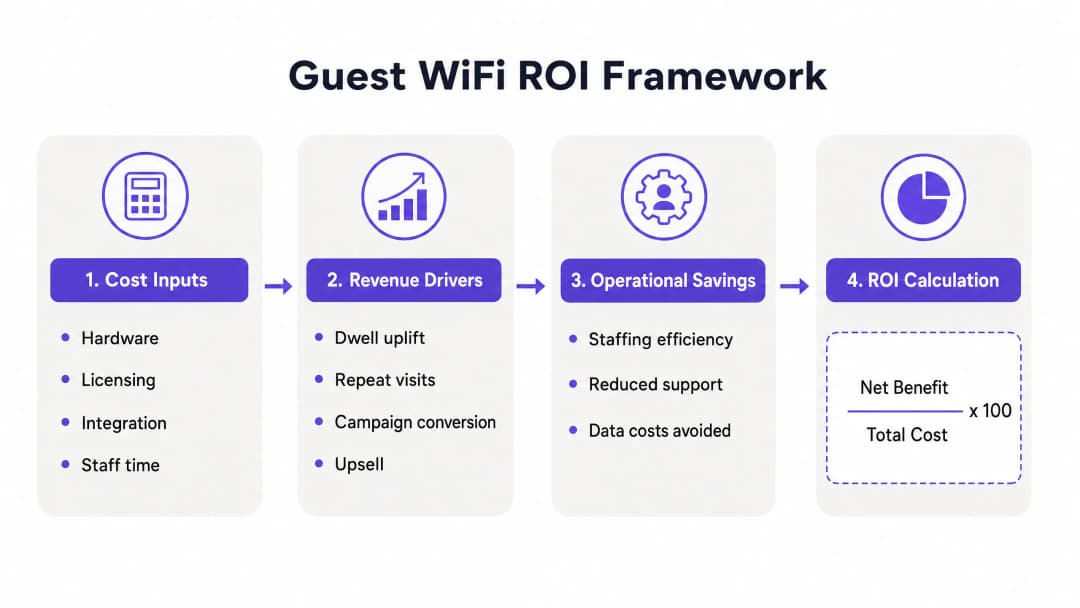
Medir o ROI do WiFi para visitantes exige uma abordagem estruturada. Você deve quantificar os custos e compará-los com os benefícios mensuráveis em quatro categorias.
Fatores de Custo
O Custo Total de Propriedade (TCO) inclui: hardware (pontos de acesso, switches, cabeamento); licenciamento de software (a sobreposição em nuvem da Purple, disponível nos planos Connect, Capture e Engage); serviços de implantação; e despesas contínuas de equipe para administração e relatórios. Para um hotel de 200 quartos com implantação em cinco locais, o TCO real de três anos abrangerá atualizações de hardware, licenciamento e esforço de integração.
Geradores de Receita
Dados do setor mostram que 62% das empresas relatam um aumento no tempo de permanência do cliente quando o WiFi gratuito é oferecido (BT Business WiFi Survey, 2025). No varejo, um maior tempo de permanência correlaciona-se diretamente com um ticket médio maior. Um aumento de 10% no tempo de permanência em um departamento específico, combinado com uma alta de 2% nas vendas para essa categoria, fornece um sinal claro e causal de ROI.O crescimento da base de dados do CRM é o segundo principal impulsionador de receita. Calcule o valor de um novo assinante de e-mail com base na sua taxa de conversão média de campanha e no valor médio do pedido. Se suas campanhas de e-mail convertem a 3% com um valor médio de pedido de £80, cada novo assinante tem um valor de campanha esperado de £2.40. Um local que adquire 500 novos assinantes mensalmente gera £1.200 em receita de campanha mensal esperada apenas a partir deste canal.
Para locais que utilizam largura de banda em camadas, a receita direta de assinaturas premium oferece um retorno mensurável imediato. A AGS Airports alcançou um ROI de 842% usando seu modelo em camadas (dados de clientes da Purple).
Economia Operacional
Os dados de fluxo de visitantes mapeados em relação às escalas de funcionários evitam o excesso de pessoal durante períodos de pouco movimento. Um local que experimenta uma queda consistente de 30% no fluxo de visitantes nas manhãs de terça-feira pode reduzir os níveis de pessoal para essa janela de tempo, gerando economia direta de custos. Em saúde e transporte, os dados de fluxo de visitantes também auxiliam na gestão de filas e no planejamento de capacidade, minimizando gargalos sem aumentar o número de funcionários.
Cálculo de ROI
A fórmula padrão de ROI se aplica: ROI (%) = ((Benefício Líquido - Custo Total) / Custo Total) x 100. O benefício líquido é a soma da receita incremental de tempo de permanência, receita de campanha de CRM, receita de acesso em camadas e economia operacional. O custo total inclui hardware, licenciamento, implantação e administração contínua.
Para a maioria das implantações em hotelaria e varejo, os clientes da Purple veem um ROI mensurável em seis meses. Os primeiros 90 dias são dedicados ao estabelecimento de dados de referência. Nos 90 dias subsequentes, o valor operacional e de marketing começa a se materializar totalmente.
-
-
Leituras Recomendadas
- Guest WiFi - A plataforma principal da Purple para conectividade de visitantes
- WiFi Analytics - Plataforma de analytics e marketing
- Design of a Survey: A Practical Guide for Venues - Como usar o Captive Portal para feedback estruturado
- What Is Wireless Display: Protocols and Best Practices 2026 - Referência para tecnologias sem fio complementares
Definições principais
ROI de guest WiFi
Benefício líquido atribuível mais a redução de custos verificada, menos o custo do programa, expresso em relação ao custo do programa.
Use quando o setor financeiro perguntar se deve estender, alterar ou interromper o programa.
Guest WiFi
Um serviço de acesso de visitantes que pode fornecer uma conexão personalizada e registrar métricas definidas de uso e desempenho.
Defina a linha de base do serviço antes de adicionar captura de dados ou campanhas.
Captive Portal
A página de acesso personalizada usada para apresentar um fluxo de conexão de Guest WiFi.
Use para definir o consentimento, os campos de dados e a experiência do visitante.
Dados primários
Dados de contato ou demográficos coletados diretamente de um visitante por meio de um fluxo aprovado.
Importante ao enriquecer um CRM e construir um público com permissão concedida.
Registro de e-mail verificado
Um registro de contato verificado para reduzir endereços de e-mail inválidos antes do uso no CRM.
É o denominador correto para um público alcançável por e-mail.
IEEE 802.1X
Um padrão de controle de acesso à rede baseado em porta que utiliza EAP e EAPOL para autenticação mútua.
Relevante ao discutir o controle de acesso para funcionários ou redes de dispositivos gerenciados.
WPA3
Um programa de segurança WiFi que utiliza protocolos de segurança atuais e exige Protected Management Frames.
Revise quando sua equipe de rede avaliar a segurança de acesso e a compatibilidade do cliente.
Protected Management Frames
Proteções de segurança para frames de ação de gerenciamento de WiFi, exigidas em redes WPA3.
Importantes ao analisar os efeitos de política de uma implantação WPA3.
PCI-DSS
Um conjunto de requisitos técnicos e operacionais destinados a proteger os dados de contas de pagamento.
Revise quando a arquitetura de Guest WiFi puder afetar o ambiente de dados do portador do cartão.
Análise de localização
Análise do comportamento do visitante, taxa de retorno ou atividade de zona a partir do conjunto de dados aprovado.
Use para testar mudanças operacionais no layout, equipe, sinalização ou horários.
Exemplos práticos
Um hotel de 200 quartos precisa reduzir as reclamações de conectividade e validar os sinais de reserva pós-estadia.
Exporte oito semanas comparáveis de sucesso de conexão, incidentes de cobertura, contatos com o suporte, captura consentida, registros de e-mail verificados e resultados do sistema de reservas. Execute uma alteração em período definido no fluxo de acesso ou na comunicação pós-estadia. Meça a taxa de reclamações de conectividade, a taxa de correspondência do CRM e as respostas confirmadas pelo sistema de reservas. Adicione apenas o esforço de suporte evitado aprovado e a contribuição de reserva confirmada ao numerador do ROI.
Uma rede de varejo precisa testar se uma oferta consentida gera um resultado de resgate incremental.
Selecione lojas de teste e controle correspondentes com as mesmas datas de oferta, briefing de equipe e disponibilidade de produtos. Capture contatos verificados apenas após uma escolha consciente. Vincule a exposição aprovada da oferta aos registros de fidelidade ou de ponto de venda. Compare a alteração no resgate entre as lojas de teste e controle, mantendo o volume bruto de conexões fora do cálculo de receita.
Um estádio precisa testar se uma alteração na posição de serviço do saguão melhora a experiência dos participantes.
Escolha faixas de eventos comparáveis, defina as zonas e use o mesmo método de observação. Combine os sinais de zona de Guest WiFi com observações de filas, registros do suporte e dados de concessão mantidos pelo local. Registre a alteração operacional e o período de teste. Relate a métrica acordada de fila ou serviço e qualquer resultado de concessão validado de forma independente, em vez de tratar o mapa de calor como prova financeira.
Continue a ler esta série
Privacy by Design: Anonimização de Dados WiFi para Conformidade com a GDPR
Este guia autoritativo detalha a arquitetura técnica e as estratégias de implementação para anonimizar dados de WiFi para garantir a conformidade com a GDPR. Ele fornece aos líderes de TI e arquitetos de rede frameworks práticos para equilibrar análises robustas de locais com requisitos estritos de privacidade de dados.
Heatmapping vs Presence Analytics: Diferenças Técnicas
Este guia técnico de autoridade detalha as diferenças arquitetônicas e operacionais críticas entre WiFi heatmapping e presence analytics para operadores de locais corporativos. Ele fornece aos líderes de TI, arquitetos de rede e diretores de operações estruturas de implantação práticas, cenários de implementação do mundo real e as melhores práticas independentes de fornecedor para extrair o ROI máximo de sua infraestrutura sem fio existente.
Como calcular o tempo de permanência usando análises de localização WiFi
Este guia fornece uma referência técnica abrangente para calcular o tempo de permanência de wifi usando análises de localização WiFi, cobrindo toda a arquitetura, desde a captura de probe requests 802.11 até a análise de zonas cercadas geograficamente (geofenced) por meio de trilateração baseada em RSSI. Ele foi projetado para gerentes de TI, arquitetos de rede e diretores de operações de estabelecimentos que precisam implantar inteligência de localização precisa e escalável em ambientes de varejo, hospitalidade, saúde e setor público. Os leitores obterão orientações práticas de implementação, estudos de caso do mundo real e uma estrutura clara para traduzir dados espaciais brutos em resultados de negócios mensuráveis.
Tem dúvidas sobre a sua configuração específica?
A nossa equipa trabalha com operadores de espaços, gestores de TI e engenheiros de rede em 80.000 locais. Agende uma chamada de 20 minutos e mostraremos como outros profissionais na sua situação o resolveram.