
Mesurer le ROI commercial du WiFi invité et de la Location Analytics
Cette référence technique montre aux équipes informatiques et de gestion de site comment mesurer le ROI du WiFi invité grâce à une chaîne de preuves justifiable, de l'état du réseau et des données consenties jusqu'aux résultats opérationnels ou commerciaux validés. Elle sépare les preuves mesurables des hypothèses, associe Purple Connect, Capture et Engage au bon niveau de mesure, et propose des scénarios de planification pour les hôtels, les parcs de commerces et les sites événementiels.
Video overview
Écouter ce guide
Voir la transcription du podcast
Fait partie de notre série principale : Guide de la WiFi Analytics →
Résumé analytique
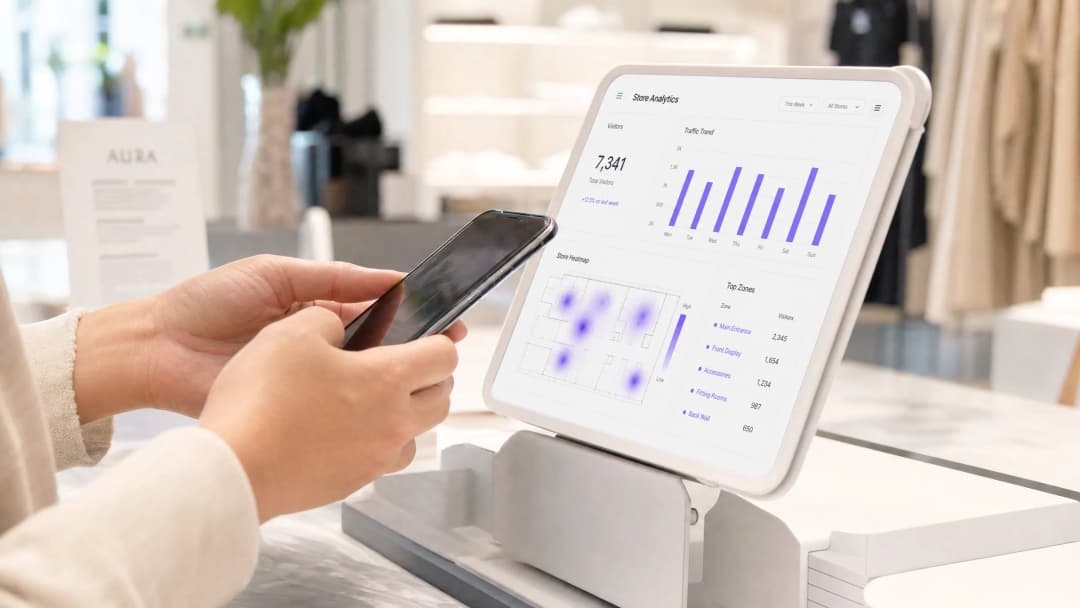
La plupart des entreprises considèrent le WiFi invité comme une simple dépense opérationnelle - un service attendu, une ligne budgétaire informatique et une source de tickets d'assistance. Cependant, cette approche occulte une évolution fondamentale des capacités réseau. Les infrastructures WiFi modernes sont des réseaux de capteurs à haute résolution qui capturent d'importantes quantités de données de première partie et d'analyses spatiales.
Purple est déployé sur plus de 80 000 sites actifs, traitant environ 440 millions de connexions et capturant 29 milliards de points de données en 2024. La plateforme fonctionne comme une surcouche cloud sur le matériel existant de Cisco Meraki, HPE Aruba, Ruckus, Juniper Mist, Ubiquiti UniFi, Cambium, Extreme Networks et Fortinet. Ce guide montre comment mesurer le ROI de cet investissement. En dépassant les modèles théoriques, il fournit un cadre concret pour calculer la valeur générée par l'augmentation des temps de visite, la croissance de la base de données CRM, l'efficacité opérationnelle et les revenus directs issus de l'accès payant par paliers. Que vous gériez un groupe hôtelier, un parc de points de vente ou des lieux publics, les principes de mesure restent les mêmes.
Analyse technique approfondie : les mécanismes de mesure
Pour mesurer le ROI, vous devez d'abord comprendre comment les données sont générées. Ce processus repose sur deux méthodes distinctes de collecte de données : l'analyse de présence (Presence Analytics) et l'analyse d'engagement (Engagement Analytics). Confondre ces deux termes risque de fausser votre modèle de mesure.
Analyse de présence
L'analyse de présence capture l'activité avant même qu'un utilisateur ne se connecte. Lorsqu'un appareil mobile doté d'un module WiFi actif pénètre dans un établissement, il transmet des requêtes de sonde (probe requests). L'appareil interroge le réseau pour vérifier si des réseaux connus se trouvent à proximité. Chaque point d'accès à portée intercepte ces requêtes. Elles contiennent l'adresse MAC de l'appareil (un identifiant matériel unique) et la puissance du signal, exprimée en RSSI (Received Signal Strength Indicator).
En triangulant les valeurs RSSI sur plusieurs points d'accès, la plateforme d'analyse estime l'emplacement physique de l'appareil. Cela constitue la base du suivi de la fréquentation et du calcul du temps de visite. Ce processus est anonyme, ne nécessite aucune interaction de la part de l'utilisateur et se déroule dans vos établissements - que vous capturiez activement ces données ou non.
Depuis 2020, tout déploiement d'analyse professionnelle est confronté à un défi : depuis iOS 14 et Android 10, les appareils mobiles utilisent des adresses MAC aléatoires pour les requêtes de sonde. Au lieu de transmettre un identifiant statique, l'appareil alterne entre des adresses temporaires. Si votre plateforme d'analyse ne corrige pas ce phénomène, votre décompte des visiteurs sera inexact. Purple utilise des modèles de correction statistique calibrés par rapport à des données réelles de caméras pour garantir une précision de ±3-7 % (données de la plateforme Purple). Si vous évaluez une plateforme qui ne peut pas expliquer sa méthodologie pour corriger l'anonymisation des adresses MAC, c'est un signal d'alarme.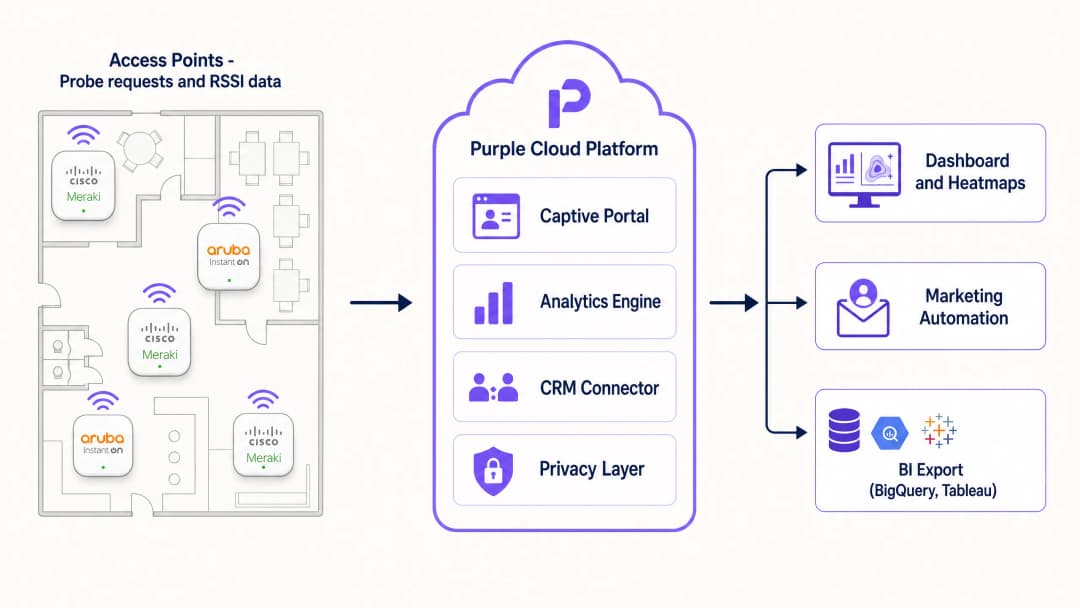
Analyses d'engagement
Les analyses d'engagement commencent lorsqu'un utilisateur se connecte au réseau WiFi invité via un Captive Portal. Le Captive Portal sert de passerelle d'authentification et de système principal pour capturer les données de première partie. Une fois qu'un utilisateur s'authentifie - que ce soit via Microsoft Entra ID, Google Workspace, des connexions via les réseaux sociaux ou un formulaire d'e-mail - l'appareil anonyme est transformé en un profil de visiteur identifié.
Ce profil identifié est le principal moteur du ROI marketing. Il relie la présence physique à une identité numérique. Vous pouvez suivre la fréquence de visite de cohortes spécifiques, mesurer le taux de conversion des campagnes marketing et intégrer ces données directement dans votre CRM. En utilisant précisément ces données, Harrods a obtenu un ROI multiplié par 57 (57x) grâce à un marketing ciblé auprès des clients acquis via le WiFi invité.
Six indicateurs clés pour la prise de décision
Les plateformes d'analyse WiFi peuvent afficher des dizaines d'indicateurs. Cependant, ces six indicateurs sont les plus critiques pour le calcul du ROI et la prise de décision :
| Indicateur | Ce qu'il mesure | Utilisation principale |
|---|---|---|
| Fréquentation | Visiteurs uniques dans une zone définie sur une période spécifique | Données de localisation de référence, comparaisons |
| Temps de séjour | Moyenne et répartition du temps passé par zone et par visite | Optimisation de l'agencement, planification du personnel, corrélation des conversions |
| Taux de retour | Proportion de visiteurs revenant dans un délai de N jours | Signaux de fidélité, attribution marketing |
| Transitions de zone | Flux de visiteurs de la zone de départ à la zone de destination | Analyse du parcours, tests d'agencement |
| Nouveaux vs. Visiteurs récurrents | Ratio d'acquisition par rapport à la rétention | Attribution des canaux marketing |
| Taux de capture | Proportion d'appareils détectés qui s'authentifient | Efficacité du portail, indicateur de qualité des données |
Le taux de capture mérite une attention particulière. Il comble le fossé entre les données de présence anonymes et les données d'engagement identifiées. Les références du secteur montrent que le taux de capture varie généralement entre 15 % et 40 %, selon la conception du portail et les incitations proposées. Un taux inférieur à 15 % indique que le flux du portail nécessite une optimisation.
Guide de mise en œuvre : S'aligner pour le ROI
Pour concevoir un système qui génère un ROI mesurable, des décisions architecturales spécifiques sont requises. Un réseau conçu uniquement pour la couverture ne fournira pas d'analyses spatiales précises.
Densité et positionnement des points d'accès
L'analyse de localisation repose sur la triangulation. Pour déterminer une position avec précision, un appareil doit être détecté par au moins trois points d'accès simultanément. Dans les environnements typiques du commerce de détail ou de l'hôtellerie, cela nécessite un point d'accès pour 150 à 200 mètres carrés. De plus, les points d'accès doivent être placés aux limites des zones, et pas seulement au centre d'une pièce. Si vous placez uniquement les points d'accès au centre, le système ne pourra pas déterminer avec précision quand les clients franchissent une limite. C'est la raison la plus courante de l'échec des déploiements analytiques.
Pour un espace de vente de 3 000 mètres carrés, prévoyez 15 à 20 points d'accès afin de garantir une couverture chevauchante aux limites des rayons. Comparez cela à une installation uniquement axée sur la couverture, qui n'utiliserait que huit points d'accès pour la puissance du signal, sans se soucier de la précision de la triangulation.
Configuration du Captive Portal
Le Captive Portal est votre moteur de conversion. Limitez le processus de connexion à un maximum de trois étapes. Ne demandez que les données essentielles lors de la première visite. Si votre objectif principal est la croissance du CRM, faites de l'adresse e-mail un champ obligatoire et utilisez Purple Verify pour la valider au moment de la saisie. Cela empêche les données invalides d'entrer dans votre base de données. Pour l'hôtellerie, nous recommandons de proposer une bande passante premium comme avantage exclusif pour les membres du programme de fidélité. Cela stimule les inscriptions et crée une source de revenus directs à partir de votre investissement WiFi.
Pour les établissements qui souhaitent accueillir sans friction les visiteurs récurrents, nous recommandons d'implémenter Passpoint (Hotspot 2.0). Passpoint permet aux appareils certifiés de se connecter automatiquement lors des visites suivantes sans présenter à nouveau le portail, tout en capturant les données de session requises pour les analyses. Cette solution est très efficace dans les aéroports et les hôtels affichant un taux élevé de visiteurs récurrents.
Intégration des données
Des données inactives dans un portail ne génèrent aucun retour sur investissement. Intégrez la plateforme d'analyse WiFi à vos systèmes opérationnels existants à l'aide d'API REST standard ou de webhooks. Cette étape d'intégration est souvent le plus grand obstacle, car elle nécessite un alignement entre les équipes informatiques, marketing et opérationnelles qui partagent rarement la même infrastructure de données. Priorisez cette tâche dès le début du projet.
Pour le commerce de détail, l'intégration avec les systèmes de point de vente (POS) offre la plus grande valeur. En corrélant les temps de séjour dans des zones spécifiques avec les données de transaction, vous pouvez identifier les zones à forte fréquentation et faible conversion - des zones où les visiteurs s'attardent mais n'achètent pas. Dans l'hôtellerie, l'intégration avec le Property Management System (PMS) vous permet de lier directement les données de session WiFi aux réservations de chambres et aux dépenses de restauration.
Vous avez des questions sur votre configuration spécifique ?
Notre équipe collabore avec des exploitants de sites, des responsables informatiques et des ingénieurs réseau au sein de 80 000 sites. Réservez un appel de 20 minutes et nous vous montrerons comment d'autres professionnels comme vous ont résolu ce problème.
Bonnes pratiques
Mettre en œuvre une bande passante hiérarchisée
La bande passante par paliers est le moyen le plus direct de monétiser le WiFi invités. Proposez un palier gratuit à vitesse limitée pour la navigation de base, et un palier premium payant (ou réservé aux membres du programme de fidélité) à haut débit. Cette approche compense les coûts du réseau et stimule les inscriptions aux programmes de fidélité. AGS Airports a mis en œuvre ce modèle par paliers, atteignant un ROI de 842 % (données clients Purple). Ce modèle fonctionne car il transforme un centre de coûts en générateur de revenus sans dégrader l'expérience utilisateur de ceux qui choisissent de ne pas payer.
Segmenter le Réseau
Ne mélangez pas le trafic des invités avec les réseaux d'entreprise internes. Utilisez des VLAN pour séparer les appareils des invités de vos systèmes internes. Dans les environnements de vente au détail qui traitent des paiements par carte, il s'agit d'une exigence de sécurité fondamentale en vertu de la norme PCI-DSS. Purple fournit une infrastructure RADIUS pour gérer de manière centralisée ces politiques sur l'ensemble de votre parc, prenant en charge la norme IEEE 802.1X pour le contrôle d'accès réseau basé sur les ports et WPA3-Enterprise pour les normes de chiffrement les plus strictes disponibles.
Pour plus de détails sur l'architecture de sécurité WiFi d'entreprise, reportez-vous au guide Enterprise WiFi Security: A Comprehensive Guide for 2026.
Donner la Priorité à la Confidentialité et à la Conformité
La confidentialité n'est pas facultative. Si vous opérez au Royaume-Uni ou dans l'UE, vous devez vous conformer au UK GDPR et au GDPR. En Californie, la CCPA s'applique. Votre Captive Portal doit communiquer clairement quelles données sont collectées, combien de temps elles sont stockées et comment les visiteurs peuvent exercer leurs droits. Obtenez un consentement explicite (opt-in) pour les communications marketing. Presence Analytics - qui est anonyme - repose sur l'intérêt légitime, soutenu par une analyse d'impact relative à la protection des données (AIPD) complétée et une signalisation physique très visible.
Purple est certifié ISO 27001, conforme au GDPR, conforme à la CCPA et certifié Cyber Essentials. La plateforme est fournie avec des modèles d'AIPD et des modèles de signalisation, de sorte que vous n'avez pas à concevoir d'infrastructure de conformité à partir de zéro. Pour des informations détaillées sur l'architecture de conformité, reportez-vous au guide WiFi GDPR Compliance: How to Securely Collect Guest Data via Captive Portals.
Dépannage et Atténuation des Risques
Données de Localisation Inexactes
Si vos cartes de chaleur indiquent des visiteurs dans des endroits impossibles, ou si les comptages au niveau des zones ne correspondent pas aux observations physiques, le problème provient généralement de l'emplacement des points d'accès ou de la configuration de la puissance de transmission. Assurez-vous que l'emplacement des points d'accès sur vos plans d'étage correspond exactement aux emplacements physiques. Vérifiez que la puissance de transmission n'est pas réglée trop haut - des points d'accès trop puissants créent de grandes cellules de couverture qui se chevauchent, ce qui dégrade la précision de la triangulation. Réduisez la puissance de transmission et augmentez la densité de points d'accès pour améliorer la résolution spatiale.
Faible Taux de Conversion du Captive Portal
Si un nombre élevé d'appareils est détecté mais que moins de 15 % s'authentifient, vous devriez revoir le parcours du portail. Les causes courantes incluent : un trop grand nombre de champs obligatoires, un portail qui ne charge pas dans le navigateur par défaut de l'appareil, un manque d'incitations claires à la connexion ou un portail non optimisé pour les mobiles. Testez le portail sur les appareils iOS et Android avant le déploiement. Supprimez tous les champs non essentiels. Si vous proposez une proposition de valeur claire - telle que du WiFi gratuit, des réductions ou des points de fidélité - mettez-la en évidence de manière visible sur la splash page.
Échecs d'Intégration
Si les données ne remontent pas dans votre système CRM ou POS, vérifiez d'abord les identifiants API et les configurations des webhooks. Assurez-vous que les champs de données mappés dans la plateforme WiFi correspondent aux champs du système cible. Consultez les journaux API pour détecter d'éventuels dépassements de limites de requêtes ou des erreurs d'authentification. La plupart des échecs d'intégration proviennent de problèmes de configuration plutôt que d'erreurs de plateforme. Veillez à ce que votre équipe informatique documente le mappage des champs avant la mise en service.
Surcomptage dû à la Randomisation MAC
Si le nombre de visiteurs WiFi est nettement supérieur aux données de vos compteurs de passage ou systèmes de caméras, votre plateforme ne corrige pas la randomisation MAC. Il s'agit d'un problème connu avec les plateformes qui n'ont pas mis à jour leurs méthodologies d'analyse depuis 2020. Demandez à votre fournisseur sa méthodologie de correction et ses données de validation. La correction de Purple maintient l'écart dans une fourchette de ±3 à 7 % par rapport aux données physiques des caméras (données de la plateforme Purple).
ROI et Valeur Commerciale
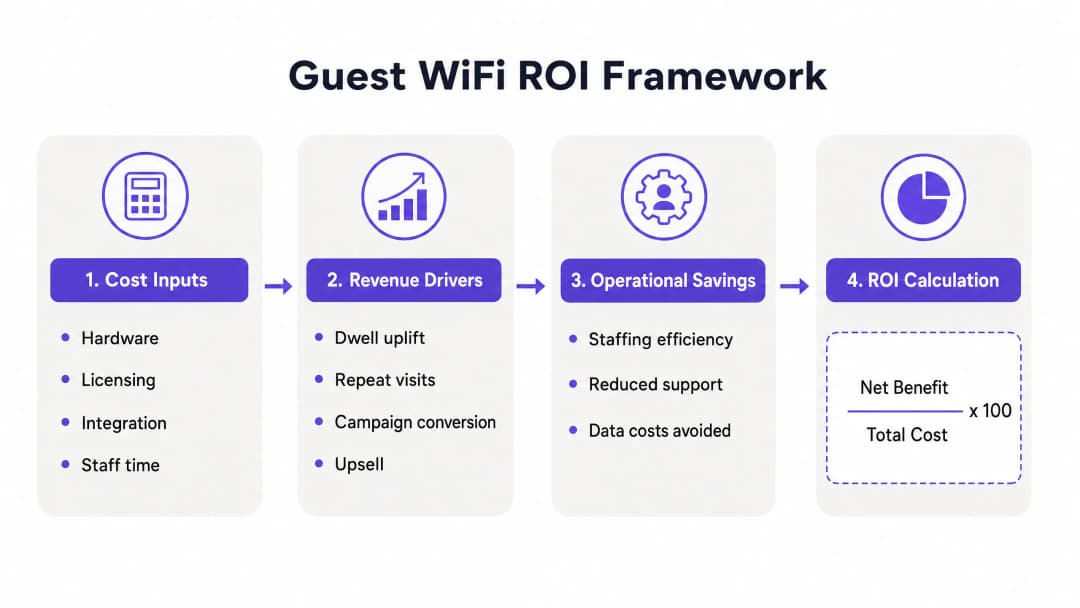
La mesure du ROI du WiFi invités nécessite une approche structurée. Vous devez quantifier les coûts et les comparer aux avantages mesurables à travers quatre catégories.
Facteurs de Coût
Le coût total de possession (TCO) comprend : le matériel (bornes d'accès, commutateurs, câblage) ; les licences logicielles (la surcouche cloud Purple, disponible dans les niveaux Connect, Capture et Engage) ; les services de déploiement ; et les frais de personnel permanents pour l'administration et les rapports. Pour un hôtel de 200 chambres réparti sur cinq sites, le TCO réel sur trois ans englobera les mises à niveau matérielles, les licences et l'effort d'intégration.
Leviers de Croissance du Chiffre d'Affaires
Les données du secteur montrent que 62 % des entreprises signalent une augmentation du temps de visite des clients lorsque du WiFi gratuit est fourni (BT Business WiFi Survey, 2025). Dans le secteur du commerce de détail, un temps de visite plus long est directement corrélé à un panier moyen plus élevé. Une augmentation de 10 % du temps de visite dans un département spécifique, associée à une hausse de 2 % des ventes pour cette catégorie, fournit un signal de ROI clair et causal.La croissance de la base de données CRM est le deuxième levier majeur de revenus. Calculez la valeur d'un nouvel abonné à la newsletter en fonction de votre taux de conversion moyen des campagnes et de la valeur moyenne des commandes. Si vos campagnes d'e-mailing convertissent à 3 % avec un panier moyen de 80 £, chaque nouvel abonné a une valeur de campagne attendue de 2,40 £. Un établissement acquérant 500 nouveaux abonnés par mois génère 1 200 £ de revenus de campagne mensuels attendus grâce à ce seul canal.
Pour les établissements utilisant une bande passante échelonnée, les revenus directs issus des abonnements premium offrent un retour immédiatement mesurable. AGS Airports a obtenu un ROI de 842 % en utilisant leur modèle échelonné (données clients Purple).
Économies Opérationnelles
Les données de fréquentation associées aux plannings du personnel évitent le sureffectif pendant les périodes creuses. Un établissement constatant une baisse constante de 30 % de la fréquentation le mardi matin peut réduire les effectifs sur ce créneau, générant des économies directes. Dans les secteurs de la santé et des transports, les données sur les flux de visiteurs facilitent également la gestion des files d'attente et la planification des capacités, minimisant les goulets d'étranglement sans augmenter les effectifs.
Calcul du ROI
La formule standard du ROI s'applique : ROI (%) = ((Bénéfice Net - Coût Total) / Coût Total) x 100. Le bénéfice net est la somme des revenus incrémentiels liés au temps de visite, des revenus des campagnes CRM, des revenus d'accès échelonnés et des économies opérationnelles. Le coût total inclut le matériel, les licences, le déploiement et l'administration continue.
Pour la plupart des déploiements dans l'hôtellerie, la restauration et le commerce de détail, les clients Purple constatent un ROI mesurable sous six mois. Les 90 premiers jours sont consacrés à l'établissement des données de référence. Au cours des 90 jours suivants, la valeur opérationnelle et marketing commence à se concrétiser pleinement.
-
-
Lectures Complémentaires
- Guest WiFi - La plateforme centrale de Purple pour la connectivité des invités
- WiFi Analytics - Plateforme d'analyses et de marketing
- Conception d'une enquête : guide pratique pour les établissements - Comment utiliser le Captive Portal pour obtenir des retours structurés
- Qu'est-ce que l'affichage sans fil : protocoles et bonnes pratiques 2026 - Référence pour les technologies sans fil complémentaires
Définitions clés
ROI du WiFi invité
Bénéfice net attribuable plus évitement des coûts vérifié, moins le coût du programme, exprimé par rapport au coût du programme.
À utiliser lorsque la finance demande s'il faut prolonger, modifier ou arrêter le programme.
WiFi invité
Un service d'accès visiteur qui peut fournir une connexion personnalisée et enregistrer des métriques d'utilisation et de performance définies.
Définissez la base de référence du service avant d'ajouter la capture de données ou des campagnes.
Captive Portal
La page d'accès personnalisée utilisée pour présenter un flux de connexion WiFi invité.
Utilisez-le pour définir le consentement, les champs de données et l'expérience visiteur.
Données de première partie
Données de contact ou démographiques collectées directement auprès d'un visiteur via un flux approuvé.
Elles sont cruciales lors de l'enrichissement d'un CRM et de la constitution d'une audience qualifiée.
Enregistrement d'e-mail vérifié
Un enregistrement de contact vérifié pour réduire les adresses e-mail invalides avant utilisation dans le CRM.
Il s'agit du dénominateur correct pour une audience e-mail joignable.
IEEE 802.1X
Une norme de contrôle d'accès réseau basée sur les ports utilisant EAP et EAPOL pour l'authentification mutuelle.
Il est pertinent lorsque vous discutez du contrôle d'accès pour le personnel ou les réseaux de terminaux gérés.
WPA3
Un programme de sécurité WiFi qui utilise les protocoles de sécurité actuels et requiert des Protected Management Frames.
Examinez-le lorsque votre équipe réseau évalue la sécurité d'accès et la compatibilité des clients.
Protected Management Frames
Protections de sécurité pour les trames d'action de gestion WiFi, requises dans les réseaux WPA3.
Elles importent lors de l'évaluation des effets de politique d'un déploiement WPA3.
PCI-DSS
Un ensemble d'exigences techniques et opérationnelles destinées à protéger les données de comptes de paiement.
Examinez-le lorsque l'architecture du WiFi invité pourrait affecter l'environnement des données de titulaires de carte.
Location analytics
Analyse du comportement des visiteurs, du taux de retour ou de l'activité des zones à partir du jeu de données approuvé.
Utilisez-la pour tester des changements opérationnels de configuration, de personnel, de signalisation ou de timing.
Exemples concrets
Un hôtel de 200 chambres doit réduire les plaintes liées à la connectivité et valider les signaux de réservation post-séjour.
Exportez huit semaines comparables de réussite de connexion, d'incidents de couverture, de contacts avec le centre de support, de captures consenties, d'enregistrements d'e-mails vérifiés et de résultats du système de réservation. Appliquez une modification sur une période définie au flux d'accès ou à la communication post-séjour. Mesurez le taux de plaintes de connectivité, le taux de correspondance CRM et les réponses confirmées par le système de réservation. Ajoutez uniquement les coûts de support évités approuvés et la contribution aux réservations confirmées au numérateur du ROI.
Un parc de commerces doit tester si une offre consentie génère un résultat de conversion incrémentiel.
Sélectionnez des magasins de test et de contrôle comparables avec les mêmes dates d'offre, le même briefing du personnel et la même disponibilité des produits. Capturez des contacts vérifiés uniquement après un choix conscient. Associez l'exposition approuvée de l'offre aux dossiers de fidélité ou de point de vente. Comparez l'évolution des conversions entre les magasins de test et de contrôle, en excluant le volume brut de connexions du calcul du chiffre d'affaires.
Un stade doit tester si une modification de l'emplacement d'un service dans les allées améliore l'expérience des participants.
Choisissez des catégories d'événements comparables, définissez les zones et utilisez la même méthode d'observation. Combinez les signaux de zone du WiFi invité avec les observations de files d'attente, les rapports du centre de support et les données de concession détenues par le site. Enregistrez le changement opérationnel et la période de test. Signalez l'indicateur de file d'attente ou de service convenu ainsi que tout résultat de concession validé de manière indépendante, plutôt que de traiter la heatmap comme une preuve financière.
Continuer la lecture de cette série
Privacy by Design : Anonymiser les données WiFi pour la conformité GDPR
Ce guide d'autorité détaille l'architecture technique et les stratégies de mise en œuvre pour anonymiser les données WiFi afin de garantir la conformité GDPR. Il fournit aux responsables informatiques et aux architectes réseau des cadres d'action pour concilier des analyses de fréquentation précises et des exigences strictes en matière de confidentialité des données.
Heatmapping vs Presence Analytics : Différences techniques
Ce guide technique de référence détaille les différences architecturales et opérationnelles critiques entre le WiFi heatmapping et le presence analytics pour les exploitants de sites d'entreprise. Il fournit aux responsables informatiques, architectes réseau et directeurs des opérations des cadres de déploiement exploitables, des scénarios d'implémentation réels et des meilleures pratiques neutres vis-à-vis des fournisseurs afin de maximiser le retour sur investissement de leur infrastructure sans fil existante.
Comment calculer la durée de séjour à l'aide de l'analyse de localisation WiFi
Ce guide fournit une référence technique complète pour calculer la durée de séjour WiFi à l'aide de l'analyse de localisation WiFi, couvrant l'ensemble de l'architecture, de la capture des requêtes de sonde 802.11 à l'analyse des zones géofencées, en passant par la trilatération basée sur le RSSI. Il est conçu pour les responsables informatiques, les architectes réseau et les directeurs d'exploitation de sites qui doivent déployer une intelligence de localisation précise et évolutive dans les secteurs du commerce de détail, de l'hôtellerie, de la santé et du secteur public. Les lecteurs y trouveront des conseils de mise en œuvre concrets, des études de cas réels et un cadre clair pour traduire les données spatiales brutes en résultats commerciaux mesurables.
Vous avez des questions sur votre configuration spécifique ?
Notre équipe collabore avec des exploitants de sites, des responsables informatiques et des ingénieurs réseau au sein de 80 000 sites. Réservez un appel de 20 minutes et nous vous montrerons comment d'autres professionnels comme vous ont résolu ce problème.