
How to leverage SMS marketing software to increase return visits

This guide explains how venue operators can leverage SMS marketing software to drive measurable return visits by capturing verified first-party phone data through Guest WiFi. It covers technical deployment, data segmentation architecture, compliance standards, and the direct business impact of moving from broadcast messaging to automated triggers.

📖 5 min read📝 1,029 words🔧 2 worked examples3 practice questions📚 8 key definitions

Listen to this guide

View podcast transcript
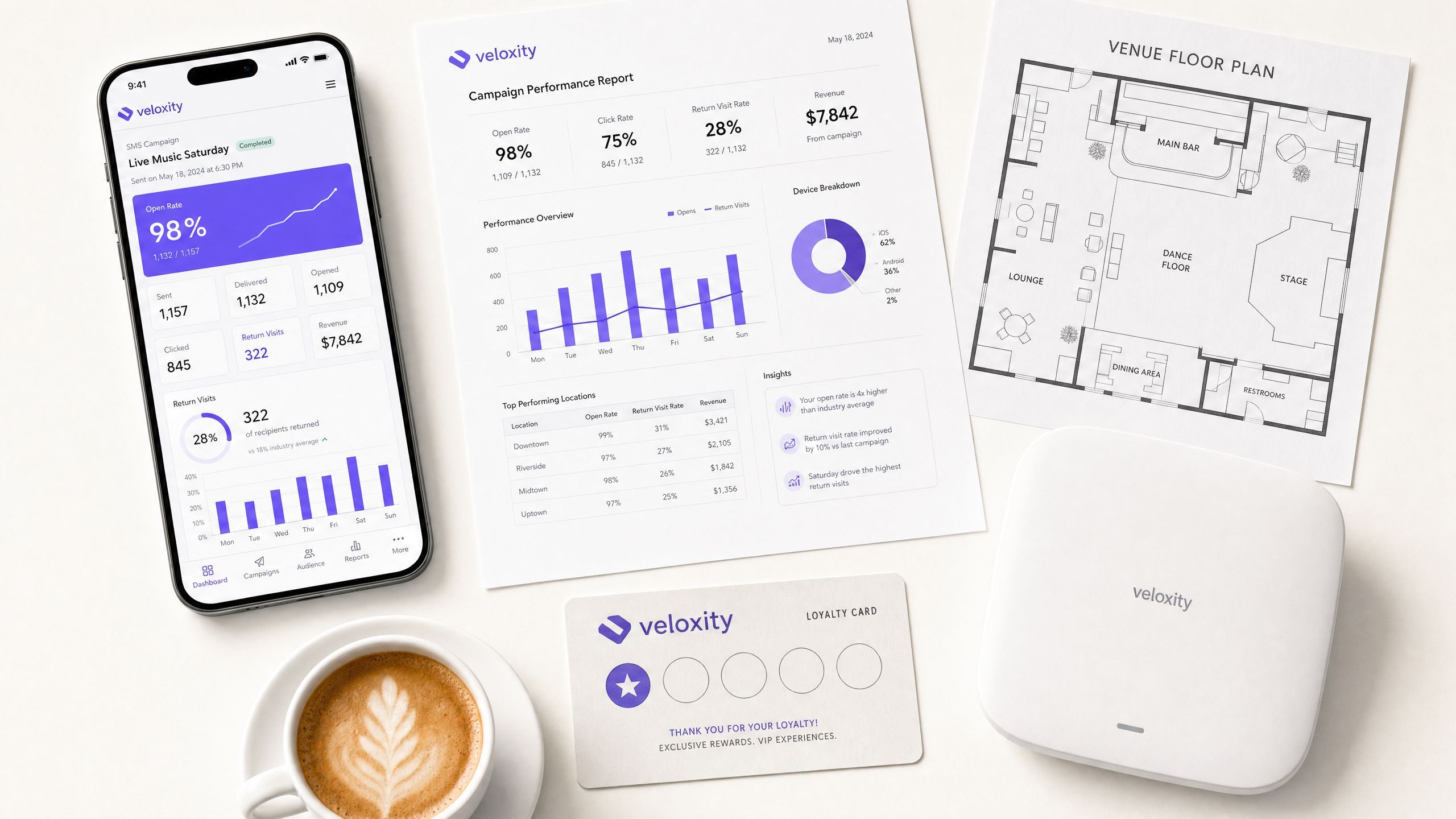
Speak in British English with a confident, authoritative, and conversational tone - like a senior consultant briefing a client. Measured pace, clear diction, professional but not stiff. Natural pauses for emphasis. Approximately 10 minutes total. Welcome to the Purple technical briefing series. Today we are talking about SMS marketing software - specifically, how venue operators can use it to drive measurable increases in return visits. Whether you run a hotel chain, a retail portfolio, a stadium, or a conference centre, the principles here apply directly to your operation. [pause] Let me start with the problem. Physical venues have a data gap. Thousands of guests walk through your doors every week, and most of them leave as strangers. You know they visited. You might know roughly when. But you have no verified, direct way to reach them afterwards. That is a significant commercial gap. SMS marketing software closes it - but only when you have the right data infrastructure underneath it. And that infrastructure starts at the WiFi login. [pause] Section one: why SMS outperforms every other re-engagement channel. The numbers are not subtle. SMS carries a 98% open rate. Email sits at around 20 to 28%. That is not a marginal difference - it is a structural one. When you send an SMS to a verified phone number, it gets read. Ninety percent of messages are read within three minutes of delivery. Click-through rates for well-segmented SMS campaigns run between 18 and 35%, depending on campaign type and timing. Conversion rates for programmes with solid segmentation land at 21 to 30%. Compare that to email's 10 to 15% and you understand why SMS deserves its own budget line, not just a footnote in your email strategy. ROI figures reinforce this. Industry data puts average SMS marketing returns at between 21 and 41 pounds for every pound spent. In well-optimised, behaviour-triggered programmes, that figure climbs higher. These are not theoretical projections. They are what venues running Purple Engage across our 80,000-plus live venues are seeing in practice. [pause] The critical word in all of this is "verified." This is where Guest WiFi becomes the foundation of your entire SMS strategy. When a visitor connects to your Guest WiFi through a captive portal - the branded login screen they see before they get internet access - you have a structured, consent-driven moment to capture their phone number. Not a guessed number from a third-party list. Not a purchased contact. A number they typed in themselves, verified by a one-time passcode, with explicit marketing consent recorded at the point of capture. Purple Engage captures that data across more than 80,000 live venues. In 2024 alone, we processed 440 million logins. Every one of those logins is a potential first-party data point - a verified identity attached to a real visit, a real location, and a real timestamp. That data architecture is what makes meaningful segmentation possible. And segmentation is what separates a 3% click-through rate from a 26% one. [pause] Section two: the technical architecture. The data flow has five stages. Stage one: the venue access point - whether that is Cisco Meraki, HPE Aruba, Ruckus, Juniper Mist, or Ubiquiti UniFi - routes unauthenticated devices to the captive portal. Stage two: the captive portal presents a branded login screen with a clear, GDPR-compliant consent checkbox. The visitor enters their phone number, receives a one-time passcode, and confirms. Stage three: Purple Engage stores that verified number alongside the visit metadata - venue, timestamp, dwell time, visit frequency. Stage four: the automated campaign engine applies your segmentation rules and triggers the appropriate SMS at the configured time. Stage five: the message lands on a verified device, with a tracked link that closes the attribution loop back to your analytics dashboard. Purple operates as a hardware-agnostic cloud overlay. You do not need to replace your existing network infrastructure. The platform sits on top of Cisco Meraki, HPE Aruba, Ruckus, Juniper Mist, Ubiquiti UniFi, Cambium, Extreme, and Fortinet hardware. The captive portal and campaign engine are delivered as a cloud service with 99.999% uptime. The compliance layer sits across all five stages. GDPR and PECR - the Privacy and Electronic Communications Regulations - require explicit, specific, freely given consent for SMS marketing. That consent must be separate from the WiFi access itself. You cannot make SMS opt-in a condition of connecting. Purple's captive portal handles this correctly by design. The opt-in checkbox is clearly labelled, separate from the connect button, and the consent record is timestamped and stored. Purple is ISO 27001 certified, GDPR and CCPA compliant, and B Corp certified. [pause] Section three: the four audience segments that drive return visits. Segment one: new visitors. First-time guests who connected to your WiFi in the last seven days. A welcome SMS with a small incentive for a return visit - say, 15% off - sent within 24 to 48 hours of their first visit, captures them while the experience is still fresh. Purple data shows a 28% second-visit rate from this segment when the follow-up is sent within that window. Segment two: lapsed visitors. People who visited your venue 30 or more days ago and have not returned. A targeted re-engagement SMS - something like "We have not seen you in a while. Here is 20% off your next visit" - sent at the right time, to the right person, consistently outperforms broadcast campaigns. The re-engagement rate for this segment runs at around 45% when the message is personalised to visit history. Segment three: frequent visitors. Your highest-value guests. These people visit regularly and respond well to loyalty messaging - early access, double points, exclusive offers. The goal here is not re-engagement; it is frequency amplification. Venues using this segment correctly see visit frequency increase by a factor of three compared to non-targeted guests. Segment four: event attendees. If someone attended a conference, a match, or a concert at your venue, they are a warm prospect for the next one. An SMS sent within 48 hours of their visit, referencing the specific event, with a link to the next event or an exclusive pre-sale, converts at rates significantly above standard promotional messages. [pause] Section four: two real-world implementation scenarios. Scenario one: a 250-room hotel. The property runs Purple Engage on an HPE Aruba network. Guests authenticate via SMS OTP at login. Over 12 months, the hotel builds a verified database of 18,000 unique guest phone numbers. They run three automated campaigns: a post-checkout follow-up with a return booking offer, a lapsed guest re-engagement at 60 days, and a seasonal promotion to guests who visited the same period last year. The result: a 31% increase in direct bookings from repeat guests, reducing OTA commission costs by an estimated 140,000 pounds annually. The SMS list became a direct revenue channel. Scenario two: a 12-site retail chain. Each site runs Purple on Cisco Meraki hardware. Shoppers who connect to Guest WiFi and opt in to SMS receive a post-visit message with a personalised offer based on dwell time in specific zones tracked via WiFi Analytics. Lapsed shoppers who have not visited in 30 days receive a re-engagement SMS with a time-limited discount. Across the estate, the chain sees a 19% uplift in repeat visit frequency and a 23% increase in average transaction value among SMS subscribers. [pause] Section five: implementation pitfalls and how to avoid them. The first mistake is treating SMS as a broadcast channel. Sending the same message to your entire contact list is the fastest way to drive up opt-outs and drive down return on investment. The ROI on SMS sits between 21 and 71 pounds for every pound spent - but that range assumes segmentation. A broadcast to an unsegmented list sits at the bottom of that range. A triggered, behavioural message to a well-defined segment sits at the top. The second mistake is poor timing. SMS messages sent within five minutes of a user action - a visit, a purchase, an event check-in - achieve click-through rates of up to 36%. Scheduled broadcasts to a full list achieve around 9%. The difference is context. Build your campaign triggers around visit events, not calendar slots. The third mistake is skipping the attribution step. If you are not tracking which SMS messages drove which return visits, you cannot optimise. Every link in your SMS should carry UTM parameters. Every return visit should be matched back to the originating campaign in your analytics dashboard. The fourth mistake is underinvesting in the consent capture moment. The captive portal is not just a login screen. It is the data acquisition layer for your entire SMS programme. A poorly designed portal with buried consent options produces a small, low-quality list. A well-designed portal with a clear value exchange produces a large, high-intent list. Venues typically see 15 to 25% of WiFi users opt in to SMS. A venue with 500 daily connections can build a list of 20,000 to 30,000 verified numbers within six months. [pause] Section six: rapid-fire questions. How quickly should you send the first SMS after a visit? Within 24 hours for new visitors. Within 48 hours for event attendees. For lapsed visitor re-engagement, timing is less critical than personalisation. What is the right message length? Under 160 characters for standard SMS. If you need more, use a link to a landing page. Long messages fragment across multiple SMS units and increase cost. Do you need a short code? For high-volume venue programmes, a dedicated short code or a verified sender ID gives you better deliverability and brand recognition. Long numbers work for low-volume testing but do not scale. What frequency is safe? No more than four to six promotional SMS messages per month per contact. Sixty-one per cent of SMS unsubscribes are caused by over-frequency. Set your frequency caps in the campaign engine before you launch, not after you have seen a spike in opt-outs. Can SMS campaigns work without a loyalty programme? Yes. The WiFi login is the opt-in mechanism. You do not need a loyalty app. Does SMS replace email? No. They work best together. Email for longer-form content and pre-arrival communications, SMS for time-sensitive triggers. Adding SMS to an email programme produces roughly 56% higher ROI than email alone, according to industry benchmarks. [pause] Summary and next steps. SMS marketing software is the highest-ROI re-engagement channel available to physical venues - but only when built on verified, consent-compliant first-party data. Purple Engage captures that data at the WiFi login, automates the campaign triggers, and integrates with your existing CRM stack. The five actions to take this quarter: first, audit your current captive portal - is it capturing phone numbers with explicit marketing consent? Second, segment your existing contact list into the four groups - new, lapsed, frequent, and event. Third, set up at least one automated trigger - the 24-hour new visitor welcome message. It is the highest return on investment campaign in the toolkit and takes under an hour to configure in Purple Engage. Fourth, implement UTM tracking on every SMS link. Fifth, set your frequency caps before you launch. The full technical guide is available at purple.ai, including architecture diagrams, worked examples for hospitality, retail, and stadium environments, and the compliance checklist. Thanks for listening.

header_image.png

Executive Summary

For IT managers and venue operations directors, the value of a physical venue is directly tied to the frequency of return visits. Yet, most venues fail to capitalise on the data generated during those visits. When a guest connects to Guest WiFi , they leave a digital footprint. An effective SMS marketing software strategy converts that footprint into a verified contact and an automated re-engagement loop.

SMS marketing is not about sending generic discount codes to purchased lists. It is a precision tool. SMS delivers a 98% open rate, compared to 20% for email. More importantly, when deployed using behavioural triggers - such as a message sent 24 hours after a first visit - click-through rates routinely exceed 25%. This guide explains the technical architecture required to capture first-party data securely, segment audiences based on visit behaviour, and automate SMS campaigns that drive measurable return visits across Hospitality , Retail , and stadium environments.

Listen to the companion podcast briefing:

Technical Deep-Dive

The foundation of any high-converting SMS marketing strategy is the data acquisition layer. Without verified, first-party phone numbers and explicit consent, an SMS campaign is non-compliant and ineffective. Purple Engage provides the infrastructure to capture this data securely.

The Data Acquisition Architecture

The process begins at the venue access point. When a device attempts to connect to the network, the controller - whether Cisco Meraki, HPE Aruba, Ruckus, Juniper Mist, or Ubiquiti UniFi - routes the unauthenticated traffic to a captive portal. This portal serves as the primary data capture interface.

To ensure data validity, the portal must enforce One-Time Passcode (OTP) verification. The visitor enters their phone number, the system sends an SMS containing a secure token, and the visitor inputs that token to gain network access. This mechanism eliminates fake numbers and ensures the device is currently active and in the visitor's possession.
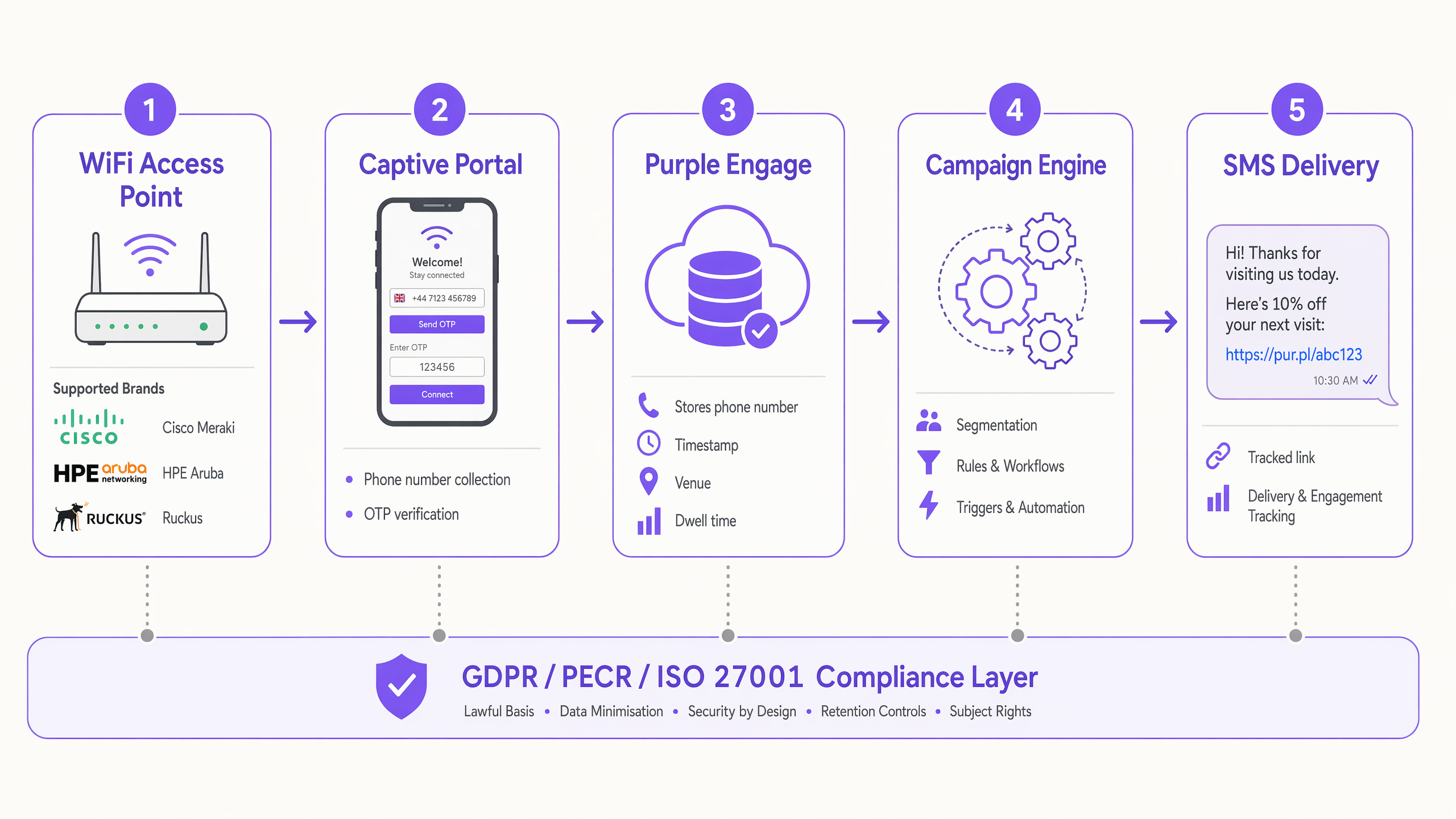
sms_data_flow_architecture.png

Capturing a phone number is only half the requirement. You must also capture legal consent. Under GDPR and PECR in the UK and EU, consent for marketing communications must be explicit, informed, and freely given. It cannot be bundled with the general terms of service or made a mandatory condition for accessing the WiFi.

Purple's captive portal handles this by presenting a clear, unticked checkbox specifically for marketing communications. When a visitor opts in, Purple records the timestamp, the specific consent language presented, and the device MAC address. This creates a secure, auditable trail that satisfies compliance requirements. Purple is ISO 27001 certified, GDPR compliant, and CCPA compliant.

Implementation Guide

Deploying SMS marketing software effectively requires moving beyond batch-and-blast broadcasts. The highest returns come from automated, behavioural triggers.

Segmentation Strategy

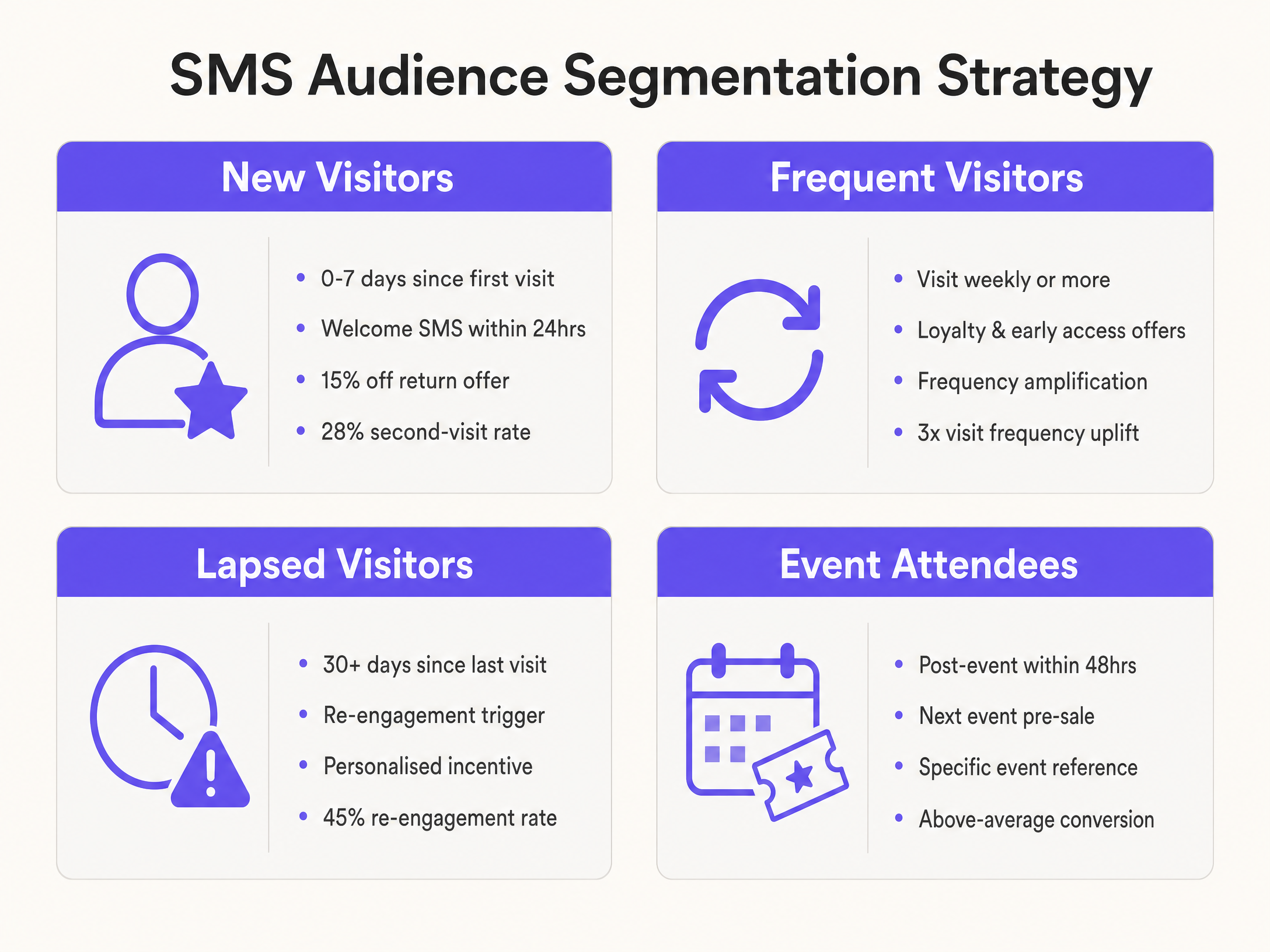
A successful implementation segments the audience based on their actual physical behaviour at the venue, captured via WiFi Analytics .
segmentation_strategy.png

  1. New Visitors: Trigger an automated welcome SMS 24 to 48 hours after a first visit. Include a modest incentive for a return visit. Purple data shows a 28% second-visit rate from this segment.
  2. Lapsed Visitors: Identify guests who have not visited in 30 days or more. Trigger a re-engagement SMS. The re-engagement rate for this segment runs at around 45% when the message is personalised.
  3. Frequent Visitors: Target your most loyal guests with early access to sales or exclusive event invitations. This drives frequency amplification, often tripling visit rates compared to non-targeted guests.
  4. Event Attendees: For stadiums or conference centres, trigger a post-event SMS within 48 hours. Reference the specific event and offer pre-sale access for the next fixture.

Vendor-Neutral Deployment Steps

  1. Audit Existing Infrastructure: Confirm your current wireless controllers support external captive portal redirection (e.g., RADIUS authentication).
  2. Configure the Captive Portal: Design a clean login flow. Prioritise SMS OTP authentication over social login to guarantee mobile number capture.
  3. Establish Frequency Caps: Configure your SMS marketing software to enforce strict limits. Do not exceed two to three promotional messages per month per contact.
  4. Implement UTM Tracking: Append UTM parameters to every link included in an SMS. This allows your analytics platform to attribute return visits and revenue directly to the campaign.

Best Practices

To maximise the effectiveness of your SMS marketing software, adhere to these industry standards:

  • Prioritise Timing: Send messages when they are most likely to be acted upon. Midday sends (11:00 to 14:00) generally outperform morning or evening sends. Triggered messages sent within hours of a visit outperform scheduled broadcasts.
  • Keep it Concise: SMS stands for Short Message Service. Keep copy under 160 characters. If you need to convey more information, use a clear call-to-action linking to a mobile-optimised landing page.
  • Identify the Sender: Use a custom Sender ID (where supported) so the message appears from your brand name, not an unknown number.
  • Integrate Channels: SMS does not replace email; it complements it. Use email for newsletters and detailed updates. Use SMS for time-sensitive offers and urgent alerts.

Troubleshooting & Risk Mitigation

  • High Unsubscribe Rates: If opt-outs exceed 3% per campaign, your frequency is too high or your content is irrelevant. Reduce send volume and refine your segmentation.
  • Low Delivery Rates: This usually indicates poor list quality. Ensure SMS OTP verification is mandatory at the Captive Portal stage to prevent fake numbers from entering the database.
  • Lack of Attribution: If you cannot prove ROI, securing budget becomes difficult. Ensure all links are tracked and your SMS marketing software integrates with your broader CRM and analytics stack.

ROI & Business Impact

The business case for SMS marketing software is compelling. Industry benchmarks indicate an average ROI of £21 to £41 for every £1 spent.

To measure success accurately, track the following metrics:

  • List Growth Rate: The percentage of WiFi users who opt in to SMS marketing. A healthy rate is 15% to 25%.
  • Return Visit Uplift: The increase in visit frequency among SMS subscribers compared to non-subscribers.
  • Attributed Revenue: Revenue generated from links clicked within SMS campaigns.

By capturing first-party data at the point of WiFi login and applying intelligent, automated segmentation, venue operators can transform their physical spaces into powerful engines for customer retention and revenue growth.

Key Definitions

Captive Portal

The branded login screen presented to a user before they are granted access to a public WiFi network.

This is the primary interface for capturing verified phone numbers and explicit marketing consent.

First-Party Data

Information collected directly from your audience or customers, rather than purchased from a third party.

First-party data captured via Guest WiFi is highly accurate and forms the foundation of compliant SMS marketing.

One-Time Passcode (OTP)

A secure, automatically generated numeric code sent via SMS to verify a user's phone number.

OTP prevents users from entering fake phone numbers during the WiFi login process, ensuring database quality.

Segmentation

The process of dividing a broad target audience into smaller, more defined groups based on shared characteristics or behaviours.

In SMS marketing, segmenting by visit frequency (e.g. lapsed vs. frequent) drastically improves click-through rates.

UTM Parameters

Short text codes added to URLs to track the performance of campaigns across traffic sources.

Adding UTMs to SMS links allows venue operators to attribute specific return visits and revenue to their SMS marketing software.

Opt-In

The explicit, documented action of a user agreeing to receive marketing communications.

A compliant opt-in is legally required under GDPR and PECR before sending promotional SMS messages.

Sender ID

The name or number that appears on the recipient's phone to identify who sent the SMS.

Using a branded alphanumeric Sender ID increases trust and open rates compared to an unknown number.

Hardware-Agnostic

Software designed to function seamlessly across different types of hardware or operating systems.

Purple is a hardware-agnostic cloud overlay, meaning it works with Cisco Meraki, HPE Aruba, Ruckus, and others without requiring network replacement.

Worked Examples

A 250-room hotel needs to increase direct bookings and reduce reliance on Online Travel Agencies (OTAs). They currently offer free Guest WiFi but do not capture verified contact data.

The hotel deploys Purple Engage over their existing HPE Aruba network. They configure the captive portal to require SMS OTP authentication, capturing verified phone numbers and explicit marketing consent. They segment the data to trigger a post-checkout SMS 24 hours after departure, offering a 15% discount on the next direct booking. They also configure a 60-day lapsed guest trigger. Over 12 months, they build a database of 18,000 verified numbers and see a 31% increase in direct bookings from repeat guests.

Examiner's Commentary: This approach works because it replaces anonymous usage with verified first-party data. The automated triggers ensure timely, relevant communication without requiring manual intervention from the marketing team. The reliance on SMS OTP guarantees list quality, preventing bounce rates that plague purchased lists.

A 12-site retail chain wants to drive footfall during quiet mid-week periods. They have a loyalty app, but adoption is low.

The retailer implements Purple on their Cisco Meraki hardware. They use the captive portal to capture phone numbers, bypassing the friction of an app download. Using WiFi Analytics, they identify shoppers who frequently visit on weekends. They trigger an automated SMS campaign on Tuesday mornings, offering a time-limited discount valid only on Wednesdays and Thursdays. They append UTM parameters to the link to track conversions.

Examiner's Commentary: This strategy succeeds by using the WiFi login as a low-friction acquisition channel, rather than forcing an app download. By segmenting based on actual physical behaviour (weekend visits) and sending a targeted, time-sensitive offer, they address the specific business problem (mid-week footfall) with measurable attribution.

Practice Questions

Q1. A venue operator notices their SMS marketing campaigns have an unsubscribe rate of 4.5% per send. What is the most likely cause and how should they address it?

Hint: Consider the relationship between message frequency, relevance, and audience fatigue.

View model answer

The most likely cause is over-frequency or sending irrelevant broadcast messages. The operator should immediately reduce send volume to a maximum of two to three messages per month. They must also move away from full-list broadcasts and implement behavioural segmentation (e.g., targeting only lapsed or new visitors) to ensure the content is highly relevant to the recipient.

Q2. You are deploying a new captive portal across a 50-site retail estate. The marketing director wants to make SMS opt-in mandatory to access the WiFi to quickly build the database. How do you advise them?

Hint: Review the compliance requirements for consent under GDPR and PECR.

View model answer

You must advise the marketing director that making SMS opt-in mandatory for WiFi access violates GDPR and PECR compliance. Consent must be freely given, specific, and informed. It cannot be bundled with the provision of a service. The portal must feature a clear, unticked checkbox for marketing consent, separate from the main terms and conditions.

Q3. A stadium wants to drive merchandise sales immediately after a match. They plan to send an SMS to all 40,000 attendees at the final whistle. What technical and strategic risks does this present?

Hint: Consider network congestion and the principles of effective timing and segmentation.

View model answer

Sending 40,000 messages simultaneously at the final whistle risks severe network congestion, as attendees are likely already overwhelming local mobile masts. Strategically, a generic broadcast lacks personalisation. A better approach is to delay the send until 24 hours post-match, segmenting the audience based on whether they connected to WiFi near the merchandise stands, and offering a targeted discount.