
Cdp customer data platform: a comprehensive guide for businesses
A comprehensive technical reference guide detailing the architecture, deployment, and business impact of Customer Data Platforms (CDPs) in physical venue environments. It explains how IT and operations teams can integrate Guest WiFi, resolve identities, and activate first-party data securely.
Listen to this guide
View podcast transcript
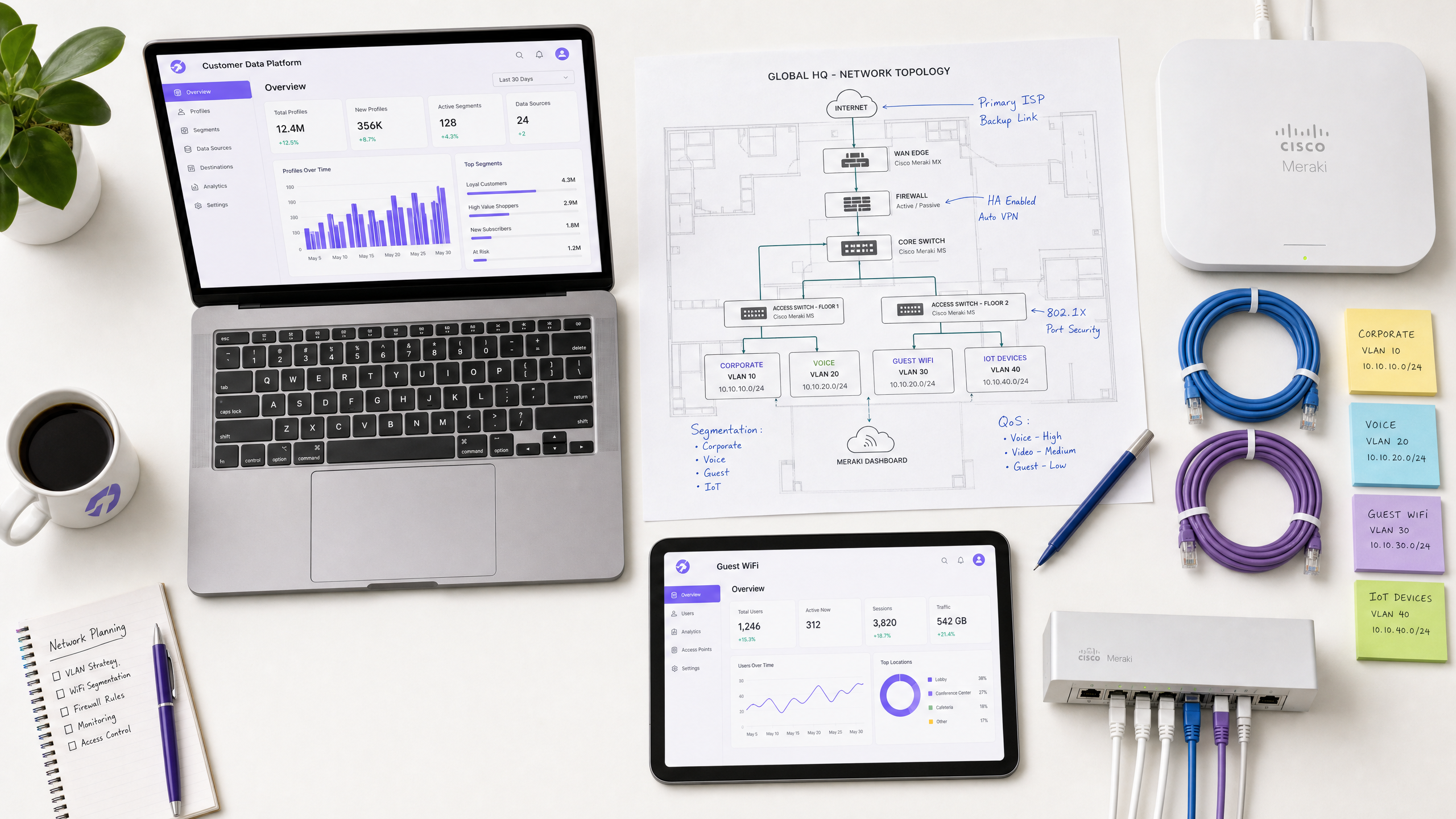
Executive Summary
Customer data is fragmented across property management systems, point-of-sale terminals, loyalty programmes, and marketing platforms. A Customer Data Platform (CDP) solves this structural problem by ingesting data from every touchpoint, resolving identities, and building a persistent, unified profile for each venue user.
For IT managers and venue operators, deploying a CDP is not just a marketing initiative; it is a fundamental shift in data architecture. It replaces siloed batch exports with real-time data flows. Crucially, it elevates Guest WiFi from a network cost centre to a primary source of verified, first-party data. By capturing explicit consent at the captive portal, venues build a defensible data asset that complies with GDPR and CCPA.
This guide details the six-layer CDP architecture, integration strategies for physical venues, and the exact steps to implement a unified data strategy using identity-based networks.
Technical Deep-Dive: The Six-Layer Architecture
A well-architected CDP operates across six logical layers, moving raw signals to activated campaigns in milliseconds.
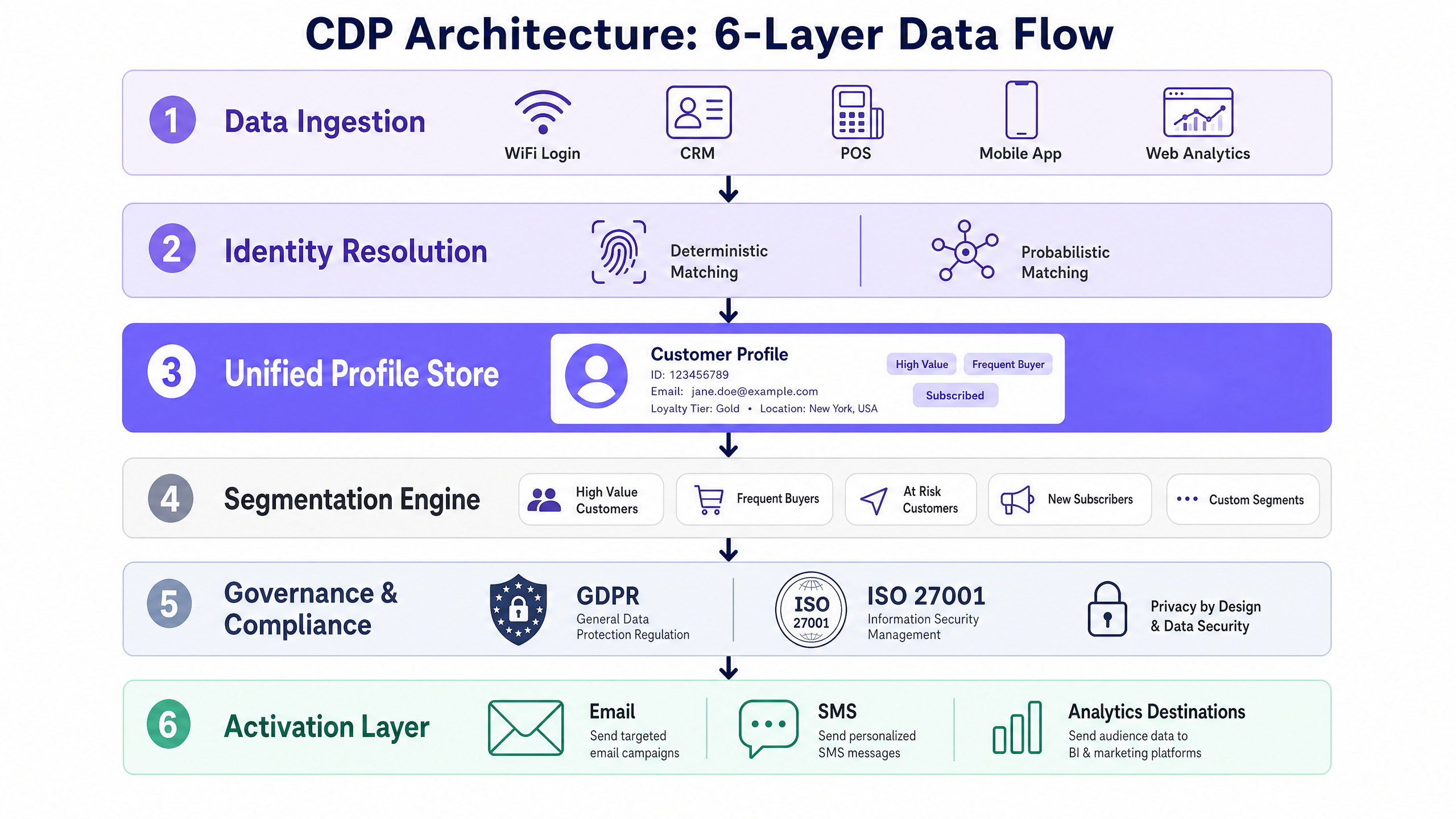
1. Data Ingestion Layer
The ingestion layer connects every customer touchpoint. It handles batch imports, near real-time streaming, and API-based connectors. In a physical venue, this includes the CRM, the point-of-sale system, the mobile app, and critically, the Guest WiFi login. When a guest authenticates via a captive portal, the network captures a verified email address, a device MAC address, a timestamp, and a physical location.
2. Identity Resolution
Raw data arrives with different identifiers. A hotel guest might use an email address for WiFi, a loyalty number for booking, and a device ID on the mobile app. Identity resolution stitches these fragments into a single persistent profile using two methods:
- Deterministic matching: Uses exact, unique identifiers (e.g., email address, phone number).
- Probabilistic matching: Uses behavioural patterns, fuzzy logic, and IP/device associations to link anonymous sessions to known profiles.
3. Unified Profile Store
The unified profile store is the system of record. It merges and deduplicates data to create a single customer view. This layer must support schema-on-read and scale independently of compute resources to handle large data volumes efficiently.
4. Segmentation Engine
The segmentation engine allows teams to query the unified profile store and build audience cohorts based on behaviour, attributes, and predictive scores. Advanced platforms use machine learning to identify high-value segments automatically.
5. Governance and Compliance
This layer enforces data privacy. It manages GDPR consent tracking, right-to-be-forgotten requests, and role-based access controls. Data must be encrypted at rest and in transit (TLS). The CDP acts as the central ledger for consent, ensuring that downstream systems only receive data they are legally permitted to process.
6. Activation Layer
The activation layer pushes unified profiles and segments to downstream execution tools - email platforms, SMS gateways, and advertising networks. The outcome of these activations flows back into the ingestion layer, creating a closed-loop system that continuously refines the profile.
Implementation Guide: From WiFi Login to Unified Profile
Guest WiFi is one of the highest-quality first-party data sources available. Unlike third-party cookies, which are obsolete, or probabilistic advertising data, which lacks consent, WiFi login data is collected directly from a verified individual at a known location.
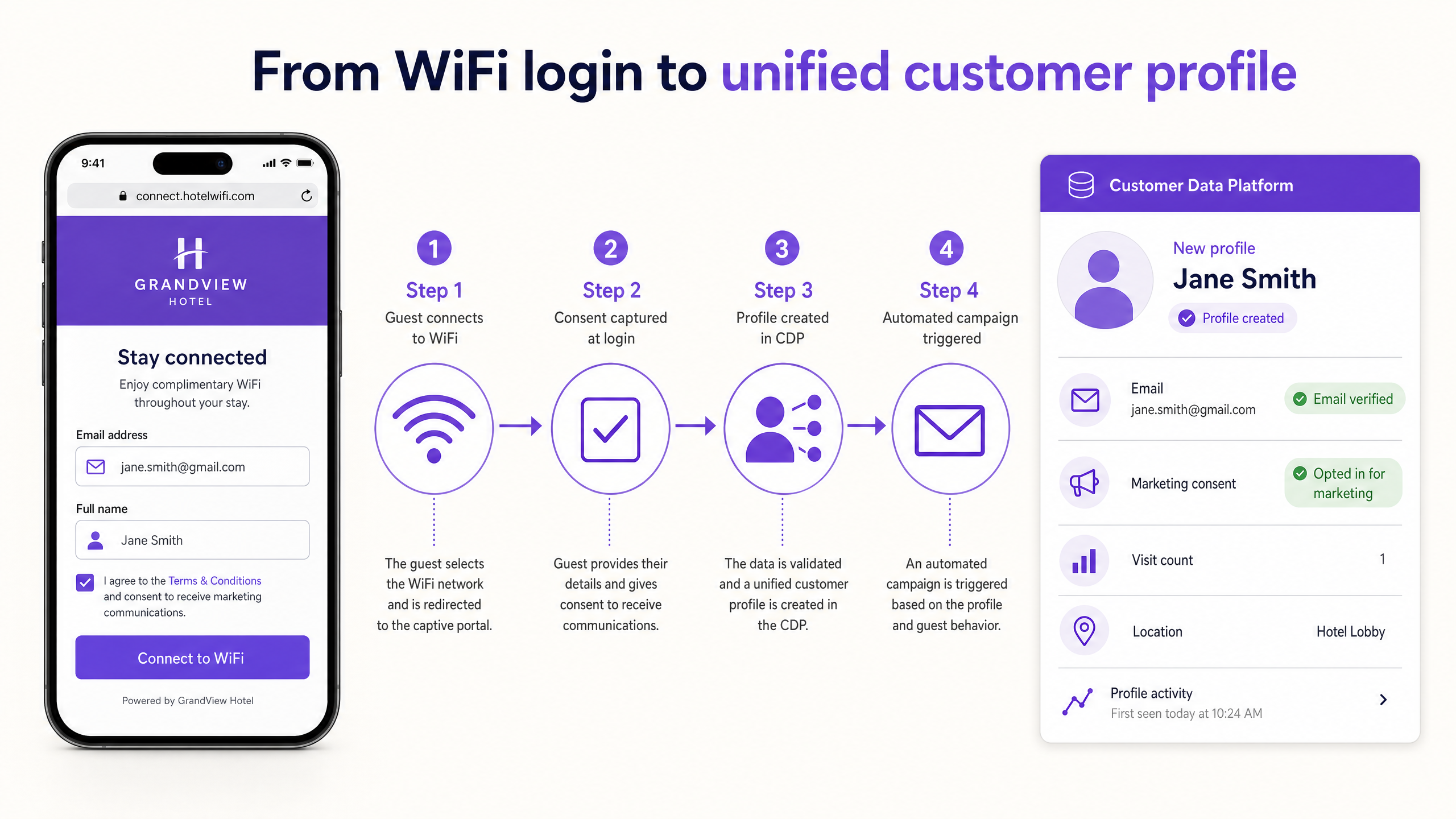
Step 1: Network Configuration
Deploy hardware-agnostic access points (e.g., Cisco Meraki, HPE Aruba, Ruckus, Juniper Mist) configured with a secure Captive Portal. Isolate guest traffic on a dedicated VLAN.
Step 2: Consent Architecture
Configure the Captive Portal to capture explicit, conscious-choice opt-ins. The user must actively check a box to receive marketing communications. Record the timestamp, the specific terms agreed to, and the IP address. This data is passed securely to the CDP via API.
Step 3: Identity Graph Mapping
Before activating the integration, map your identity graph. Define which identifier serves as the primary key (typically the email address). Configure conflict resolution rules - for example, if the CRM lists the user as "Jonathan" but the WiFi login captures "Jon", determine which system overrides the other based on recency or data quality scores.
Step 4: WiFi Analytics Integration
Integrate the CDP with your analytics engine. Purple Engage captures verified guest email and phone data at login and automates marketing campaigns. By linking presence analytics (dwell time, return visits) with the unified profile, you can trigger real-time actions.
Listen to our full technical briefing on CDP deployment here:
Best Practices for Venue Operators
- Audit Data Sources Before Vendor Selection: Map every system generating data in your Hospitality or Retail environment. You cannot unify data if you do not know where it lives.
- Prioritise First-Party Data: Shift reliance away from third-party aggregators. Use your physical footprint to capture verified first-party data through Guest WiFi and mobile apps.
- Design for Consent: Treat GDPR and CCPA compliance as a feature, not a burden. Build a robust consent architecture that can process deletion requests across all connected systems within 30 days.
- Define Activation Use Cases: Do not deploy a CDP solely as a data lake. Define three specific activation use cases (e.g., welcome campaigns, churn prevention, loyalty upsell) and build the architecture to support them.
Troubleshooting & Risk Mitigation
Risk: Duplicate Profiles Failure Mode: Disconnected systems use different primary keys, resulting in fragmented profiles for the same individual. Mitigation: Implement strict deterministic matching rules. Use a central identity resolution engine that cascades updates to all connected systems.
Risk: Stale Data in Activation Channels Failure Mode: The CDP relies on daily batch exports rather than real-time APIs, meaning guests receive irrelevant offers based on outdated context. Mitigation: Ensure the activation layer uses real-time event streaming or webhooks to trigger downstream actions instantly.
Risk: Compliance Breaches Failure Mode: A user opts out via an email link, but the CDP does not propagate the opt-out to the SMS gateway. Mitigation: Establish the CDP as the absolute system of record for consent. Configure bi-directional syncs with all execution platforms.
ROI & Business Impact
Deploying a CDP transforms IT infrastructure into a revenue engine. By unifying data, venues can execute highly targeted campaigns that drive measurable business outcomes.
For example, integrating tools for SMS marketing with a CDP allows a stadium to text a food-and-beverage offer to a fan precisely when presence analytics detect them near a concession stand.
Purple's network processes 440 million logins annually, collecting 29 billion data points. Venues leveraging this scale see immediate returns through increased loyalty programme sign-ups, higher repeat visit rates, and improved marketing attribution accuracy.
Key Definitions
Customer Data Platform (CDP)
Packaged software that creates a persistent, unified customer database accessible to other systems for real-time activation.
IT teams deploy CDPs to eliminate data silos and provide marketing with a single source of truth.
Identity Resolution
The process of stitching together fragmented customer records from multiple systems into a single unified profile.
Critical for preventing duplicate communications and accurately calculating customer lifetime value.
Deterministic Matching
Linking data records using exact, unique identifiers such as an email address or phone number.
The most accurate form of identity resolution, relying on verified first-party data.
Probabilistic Matching
Linking data records using statistical models, behavioural patterns, and fuzzy logic when exact identifiers are missing.
Used to associate anonymous browsing sessions or device IDs with known profiles.
First-Party Data
Information collected directly from customers with their explicit consent, such as via a Guest WiFi login.
Highly valuable and defensible data that venues own, unaffected by third-party cookie deprecation.
Captive Portal
A web page that users must view and interact with before accessing a public WiFi network.
The primary interface for capturing user data and marketing consent in physical venues.
Activation
The process of pushing unified profiles and audience segments to downstream marketing tools for campaign execution.
The final step in the CDP data flow that drives measurable business ROI.
Conscious-Choice Opt-In
A mechanism requiring the user to actively select or confirm their consent to receive communications.
A mandatory requirement for GDPR compliance, ensuring data is collected legally.
Worked Examples
A 400-room hotel currently operates siloed systems: a property management system (PMS) for bookings, a separate point-of-sale (POS) in the restaurant, and basic Guest WiFi. They want to trigger a personalised email offer for a spa discount when a high-value returning guest logs onto the WiFi. How should the IT team architect this?
- Deploy a CDP to act as the central hub.
- Configure the Guest WiFi captive portal to capture email and marketing consent.
- Integrate the PMS and POS via API to feed historical spend data into the CDP.
- Set up an identity resolution rule using email address as the primary key to link the WiFi session to the PMS profile.
- Create a segment in the CDP: 'Guests with lifetime spend > £1000 AND current status = connected to WiFi'.
- Configure a real-time webhook in the activation layer to push the segment data to the email marketing platform instantly.
A large retail chain uses Cisco Meraki hardware. They want to understand cross-store shopping behaviour but find that shoppers use different email addresses or log in via social media at different locations. How can they build a unified profile?
- Standardise the captive portal across all locations using Purple Engage.
- Implement device MAC address tracking alongside the authentication method.
- Configure the CDP's identity resolution engine to use probabilistic matching. When the same MAC address authenticates with ' john.doe@email.com ' at Store A and via a Google login at Store B, the CDP merges the records into a single unified profile.
- Ensure the privacy policy explicitly covers cross-location tracking and device association.
Practice Questions
Q1. A stadium IT director needs to select a new WiFi authentication method. The marketing team wants maximum data capture, but the legal team is concerned about GDPR. Which approach balances these requirements?
Hint: Consider the difference between passive tracking and active consent.
View model answer
Deploy a captive portal with conscious-choice opt-ins. This captures verified first-party data (satisfying marketing) while explicitly recording the user's consent timestamp and IP address (satisfying legal). The data is then fed securely into the CDP.
Q2. During a CDP deployment, the integration between the POS system and the CDP is configured as a nightly batch export. What is the primary business risk of this architectural decision?
Hint: Think about the timing of automated campaigns.
View model answer
Nightly batch exports prevent real-time activation. If a customer makes a high-value purchase at 10:00 AM, the CDP will not know until the next day. Any real-time triggers (e.g. an immediate SMS thank-you offer while they are still in the venue) will fail. The integration should use real-time APIs or webhooks.
Q3. A venue operator finds that their CDP reports 50,000 unique profiles, but their CRM only shows 30,000 active customers. What is the most likely cause of this discrepancy?
Hint: Review the layers of the CDP architecture.
View model answer
A failure in the Identity Resolution layer. The CDP is likely creating separate profiles for the same individual (e.g. one profile based on their WiFi MAC address, and another based on their CRM email address) because the deterministic matching rules have not been configured correctly to stitch them together.