
How to leverage best SMS marketing platforms to increase return visits
This technical guide details how to integrate enterprise SMS marketing platforms with Guest WiFi infrastructure to drive measurable return visits. It covers deployment architecture, compliance requirements, platform evaluation criteria, and practical implementation scenarios for venue operators.
Listen to this guide
View podcast transcript
Executive Summary
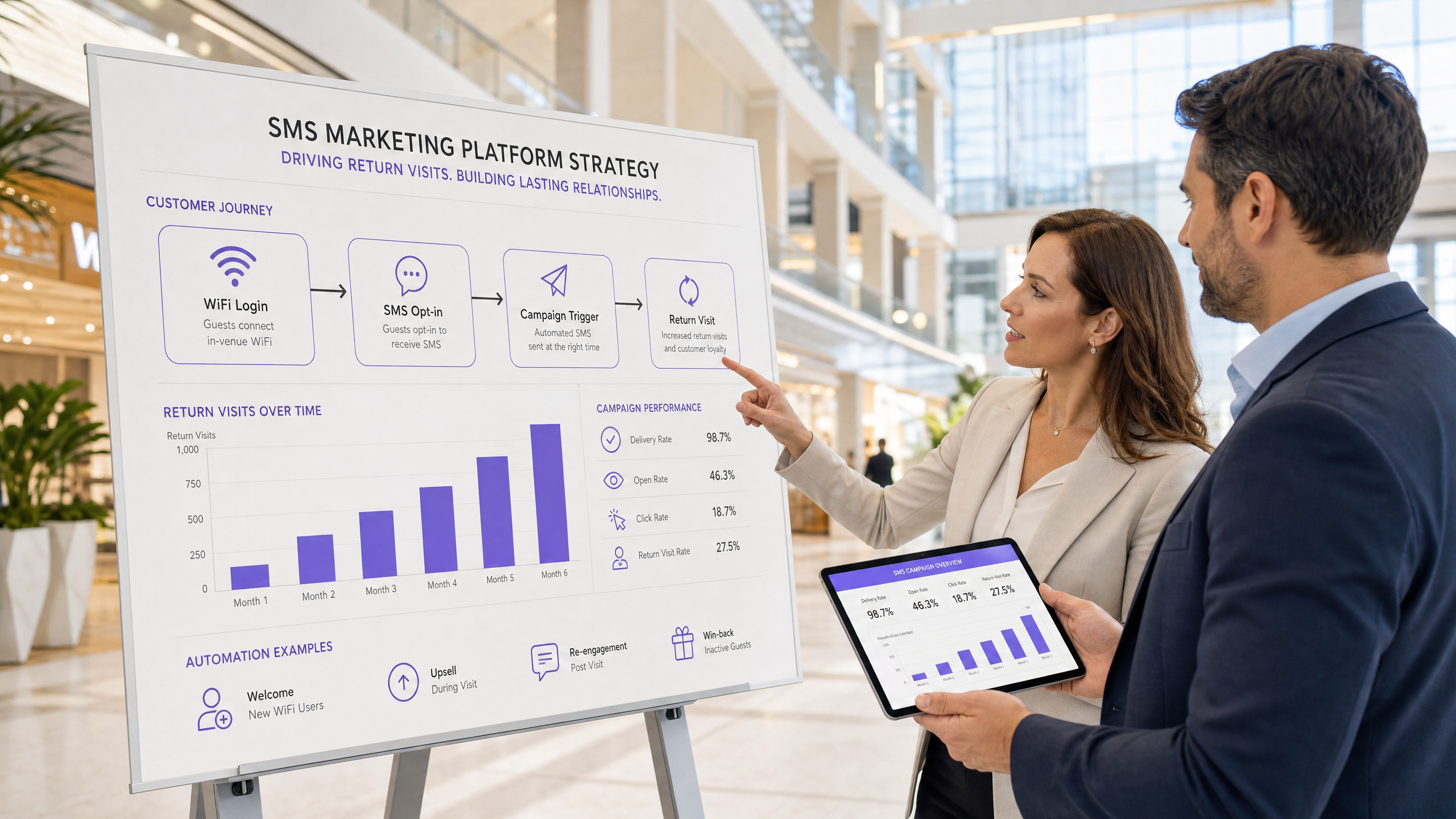
Return visits are the primary driver of lifetime value in physical venues. Yet most operators rely on email campaigns with 20% open rates to re-engage visitors. SMS marketing, when integrated with your existing Guest WiFi infrastructure, delivers 98% open rates and immediate engagement. This guide explains how to connect Purple Engage with the best SMS marketing platforms to automate re-engagement campaigns based on verified first-party data. You will learn how to capture explicit consent at login, route data to your chosen SMS platform via API, trigger campaigns based on physical presence, and measure the resulting return visits through WiFi reconnection events.
Technical Deep-Dive
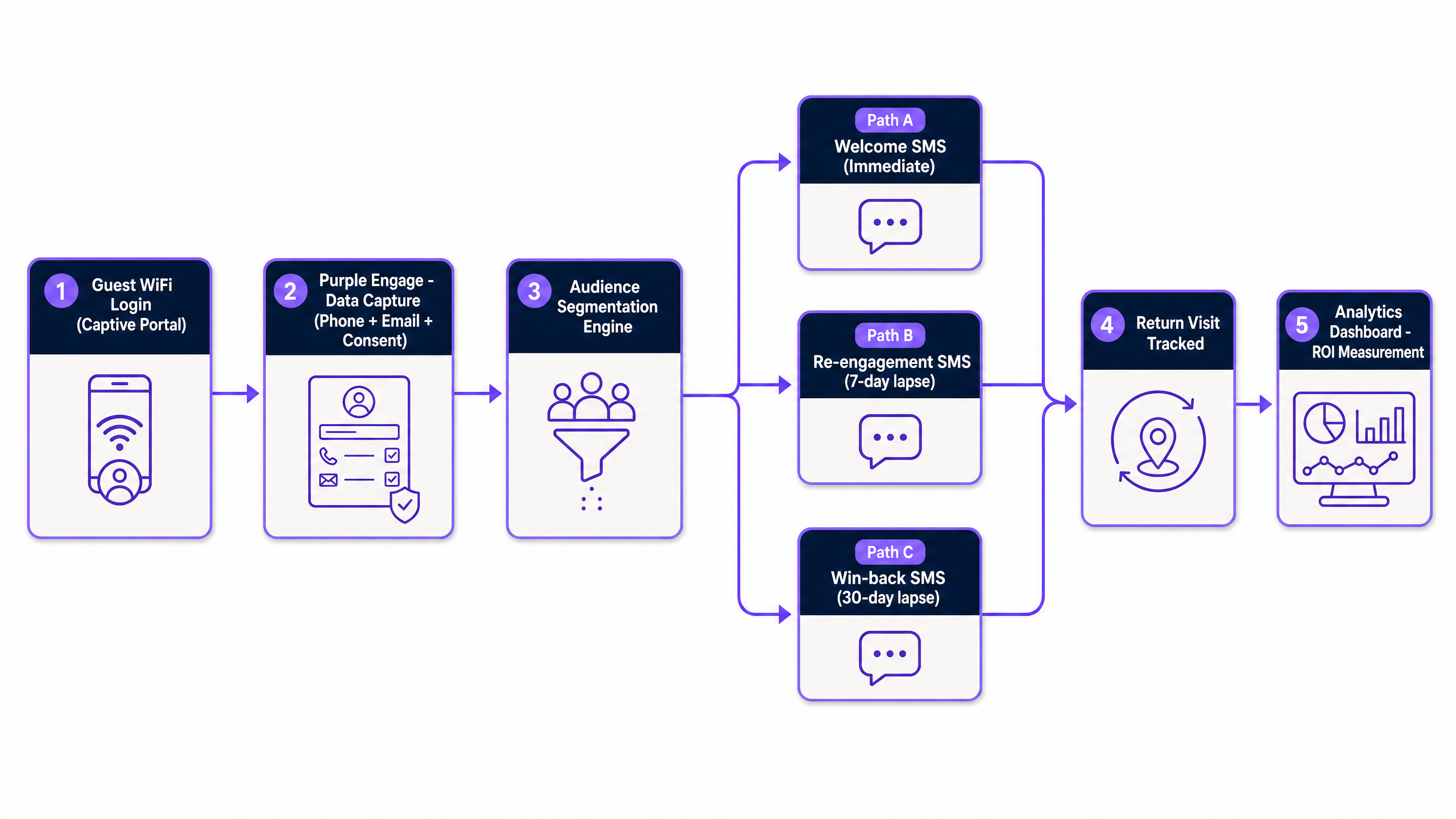
The foundation of an effective SMS programme is the data capture mechanism. When a guest connects to your Guest WiFi network, they are presented with a captive portal. Purple acts as a cloud overlay on your existing hardware - whether that is Cisco Meraki, HPE Aruba, Ruckus, Juniper Mist, Ubiquiti UniFi, Cambium, Extreme, or Fortinet. The authentication flow requires the guest to provide a verified phone number alongside explicit, conscious-choice consent to receive marketing communications.
Once authenticated, Purple records the device MAC address, the verified phone number, and the timestamp of the visit. This data forms the baseline for your audience segmentation. Purple Engage pushes this data to your chosen SMS platform via webhook or direct API integration. When the guest leaves the venue, the segmentation engine monitors the elapsed time. If the guest does not return within a defined period, the SMS platform triggers a targeted message.
The attribution loop closes when the guest returns. The device automatically reconnects to the network, and Purple logs the return visit. Because this event is tied to the original guest profile, you can directly attribute the physical return to the specific SMS campaign sent days or weeks prior.
Implementation Guide
Deploying an SMS automation pipeline requires coordination between your network infrastructure, identity provider, and marketing stack. Follow this vendor-neutral deployment sequence.
- Configure the Captive Portal: Update your login flow to mandate phone number verification. Implement a conscious-choice opt-in checkbox for SMS marketing. Ensure the consent language explicitly names your organisation and the purpose of the communication, in line with GDPR or TCPA requirements.
- Establish the API Connection: Connect Purple Engage to your SMS platform. Use secure webhooks to transmit new guest profiles and consent records in real time. Ensure your SMS platform can handle the expected throughput during peak venue hours.
- Define Audience Segments: Create dynamic segments based on visit frequency and recency. Start with three core segments: new visitors, lapsed visitors (e.g., no visit in 14 days), and churned visitors (e.g., no visit in 60 days).
- Build Automation Workflows: Configure triggers in your SMS platform. A new visitor segment triggers a welcome message two hours after their initial connection. A lapsed visitor segment triggers a re-engagement offer on a Tuesday afternoon. A churned visitor segment triggers a high-value win-back incentive.
- Implement Suppression Logic: Configure bidirectional sync for opt-outs. If a guest replies "STOP" to an SMS, the platform must immediately update the suppression list and push that status back to your CRM or data store via API.
Best Practices
Successful SMS programmes respect the immediacy of the channel. Apply these industry-standard practices to protect your brand and maintain high engagement rates.
- Frequency Capping: Limit promotional SMS to a maximum of two messages per month per guest. Over-messaging is the primary cause of opt-outs.
- Timing Constraints: Schedule messages for optimal engagement windows. Send promotional offers between 10:00 and 12:00 or 17:00 and 19:00 local time. Avoid sending messages on Monday mornings or Friday evenings.
- Clear Value Exchange: Every message must offer tangible value. A generic "We miss you" message performs poorly. A message stating "Show this text for 15% off your next visit" provides a clear incentive to return.
- Link Tracking: Use unique, trackable short links in your messages. This provides an intermediate engagement metric between the message delivery and the physical return visit.
- Cross-Channel Coordination: Coordinate your SMS campaigns with your email strategy. Do not send an SMS and an email to the same guest on the same day. Use WiFi Analytics to determine which channel a specific guest prefers.
Troubleshooting & Risk Mitigation
The most significant risks in SMS marketing relate to compliance and data latency. Address these proactively.
Risk: Compliance Breaches Failure to record explicit consent or process opt-outs immediately can result in severe regulatory fines. Mitigation: Use Purple's consent management tools to store the exact wording, timestamp, and IP address of every opt-in. Ensure your SMS platform processes "STOP" commands natively and syncs the suppression list in real time.
Risk: High Opt-Out Rates If your opt-out rate exceeds 2% per campaign, your messaging is either too frequent or lacks value. Mitigation: Review your segmentation logic. Ensure you are not sending generic offers to highly specific audiences. Implement strict frequency caps at the platform level.
Risk: Attribution Failures If your system cannot link an SMS send to a return visit, you cannot prove ROI. Mitigation: Verify that MAC address randomisation is accounted for in your analytics setup. Encourage guests to install a venue app or use a loyalty integration to provide secondary identification markers beyond the MAC address.
ROI & Business Impact
The business impact of an integrated SMS strategy is measured in incremental footfall and revenue. By moving from batch-and-blast email to triggered SMS based on physical presence, venues typically see a significant increase in return visit rates.
Consider a retail venue that captures 10,000 new verified phone numbers per month. If a targeted 30-day win-back SMS campaign achieves a 15% conversion rate, that generates 1,500 incremental visits. If the average spend per visit is £40, the campaign delivers £60,000 in monthly revenue. The cost of sending 10,000 SMS messages is negligible compared to the return.
To measure success accurately, establish a control group. Exclude 10% of your opted-in guests from the SMS campaigns. Compare the organic return rate of the control group against the return rate of the active segment. The difference is your incremental lift, directly attributable to the SMS programme.
Key Definitions
Captive Portal
A web page that a user must view and interact with before access is granted to a public WiFi network.
This is the primary data capture point where venues collect verified phone numbers and explicit marketing consent.
Conscious-choice Opt-in
An active, affirmative action taken by a user to consent to communications, such as ticking an unticked box.
Required for GDPR and TCPA compliance. Pre-ticked boxes do not constitute valid consent.
First-party Data
Information collected directly from your audience or customers, rather than purchased or inferred from third parties.
WiFi analytics provides highly accurate first-party data based on actual physical presence.
MAC Address
A unique identifier assigned to a network interface controller for use as a network address in communications.
Used by WiFi systems to identify returning devices, though modern OS randomisation requires careful handling.
Webhook
A method of augmenting or altering the behaviour of a web page or web application with custom callbacks.
Essential for real-time data sync between Purple Engage and SMS platforms, particularly for opt-out management.
A2P 10DLC
Application-to-Person 10-Digit Long Code. A standard used in the US for sending commercial SMS from a local phone number.
Required for US venues sending high volumes of SMS to ensure high deliverability and carrier compliance.
Suppression List
A database of contacts who have opted out of receiving communications.
Must be maintained accurately and applied automatically by your SMS platform to prevent compliance breaches.
Attribution Loop
The process of connecting a marketing action (sending an SMS) to a desired business outcome (a return visit).
WiFi reconnection events close the loop, proving the ROI of the SMS campaign.
Worked Examples
A mid-scale hotel group with 12 properties wants to increase direct bookings from previous guests. They currently use email but see low engagement. How should they deploy SMS?
The group deploys Purple Engage across their existing HPE Aruba infrastructure. They update the captive portal to require phone number verification and include a conscious-choice SMS opt-in. They connect Purple to Twilio via API. They configure a 7-day post-checkout segment. If a guest has not booked a return stay within 7 days, Twilio triggers an SMS offering a 15% discount on their next direct booking. Return visits are tracked when the guest's device reconnects to the WiFi during their next stay.
A retail shopping centre operator needs to increase footfall on Tuesdays and Wednesdays. They have 60 tenants and capture 5,000 WiFi logins daily.
The operator uses Purple's WiFi analytics to identify a segment of guests who visit frequently on weekends but rarely mid-week. They export this segment to Sinch. On Monday afternoon, Sinch sends an SMS to this segment featuring a 'Midweek Exclusive' offer valid only on Tuesdays and Wednesdays at participating anchor tenants. The operator tracks the success by monitoring the reconnection rate of that specific segment on the target days.
Practice Questions
Q1. A stadium operator with Cisco Meraki hardware wants to launch an SMS campaign to attendees who attended a match but have not purchased tickets for the upcoming season. They have 40,000 phone numbers collected via WiFi over the last year, but the opt-in checkbox was pre-ticked. How should they proceed?
Hint: Consider the compliance requirements for consent under GDPR and TCPA.
View model answer
They cannot use the existing database for SMS marketing. Pre-ticked boxes do not constitute valid, conscious-choice consent under GDPR or TCPA. Sending messages to this list risks severe regulatory fines. The operator must update the captive portal to require explicit, active opt-in (an unticked box) moving forward, and build a new, compliant database before launching the campaign.
Q2. Your venue is experiencing a 4% opt-out rate on a weekly 'Thursday Special' SMS campaign sent to all 20,000 opted-in guests. What two immediate technical or strategic changes should you implement?
Hint: Focus on frequency and segmentation.
View model answer
- Reduce frequency: Change the campaign from weekly to fortnightly or monthly to prevent list fatigue. 2. Improve segmentation: Stop sending the offer to the entire database. Use WiFi analytics to segment the list and send the offer only to guests who have previously visited on a Thursday, or guests who have not visited in the last 30 days. Generic blasts drive opt-outs; targeted relevance retains subscribers.
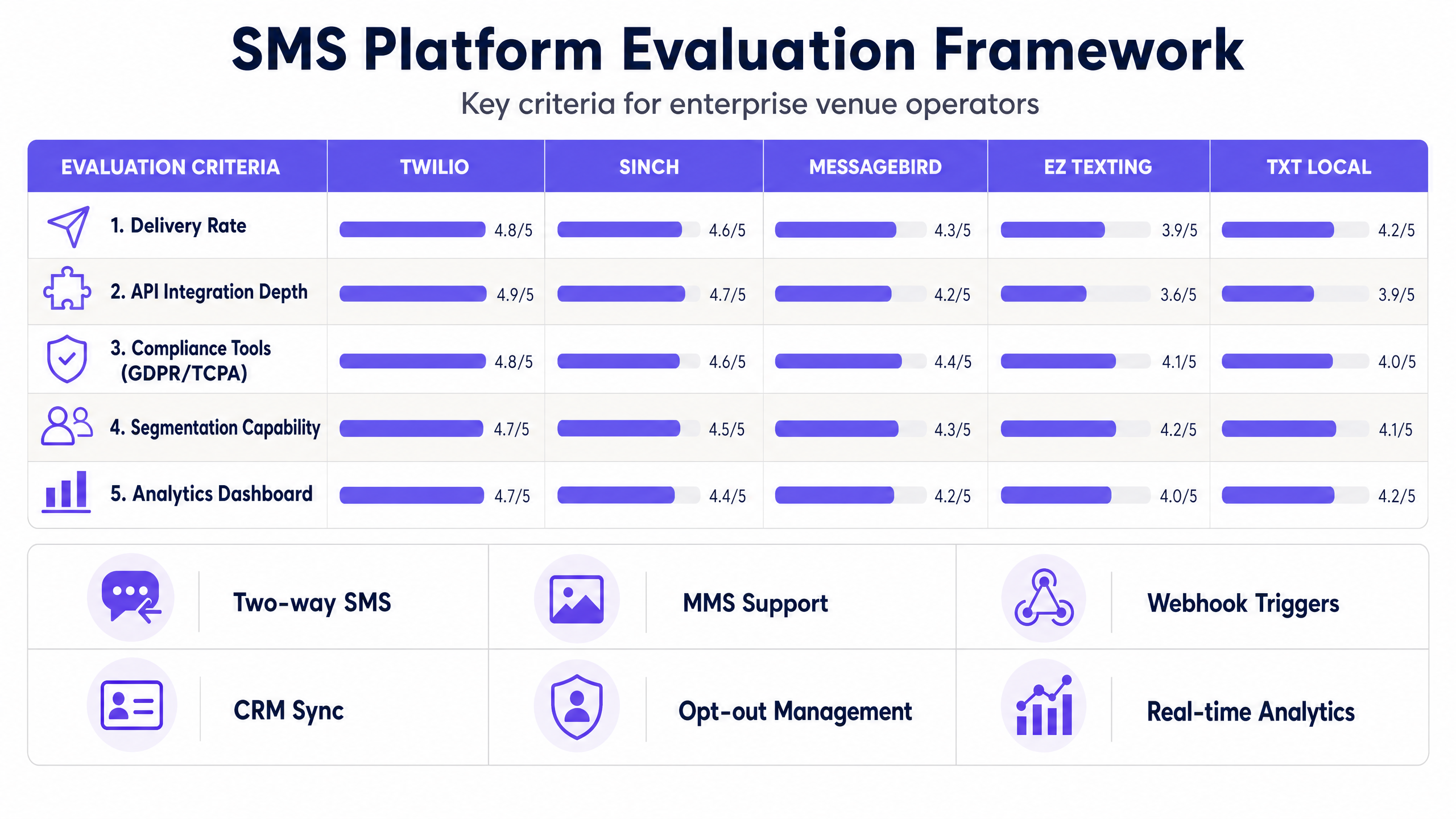
Q3. You are evaluating Twilio and a smaller, lower-cost SMS provider. The smaller provider requires manual CSV uploads for audience lists and handles opt-outs via a daily batch process. Twilio offers real-time API sync and webhook opt-out management. Which do you choose and why?
Hint: Consider the operational overhead and compliance risks of manual data handling.
View model answer
Select Twilio. The lower cost of the smaller provider is a false economy. Manual CSV uploads prevent automated, real-time campaigns (like sending a welcome message 2 hours after a visit). More critically, batch-processing opt-outs creates a compliance risk; if a guest texts STOP and is accidentally included in a CSV upload the next day, you breach regulations. Real-time API integration is mandatory for enterprise deployments.