
How to leverage the best SMS marketing platform to increase return visits
This guide provides technical decision-makers with actionable strategies for selecting and deploying an SMS marketing platform. It explains how to integrate WiFi login data, ensure GDPR compliance, and automate campaigns to drive measurable return visits across physical venues.
Listen to this guide
View podcast transcript
Executive Summary
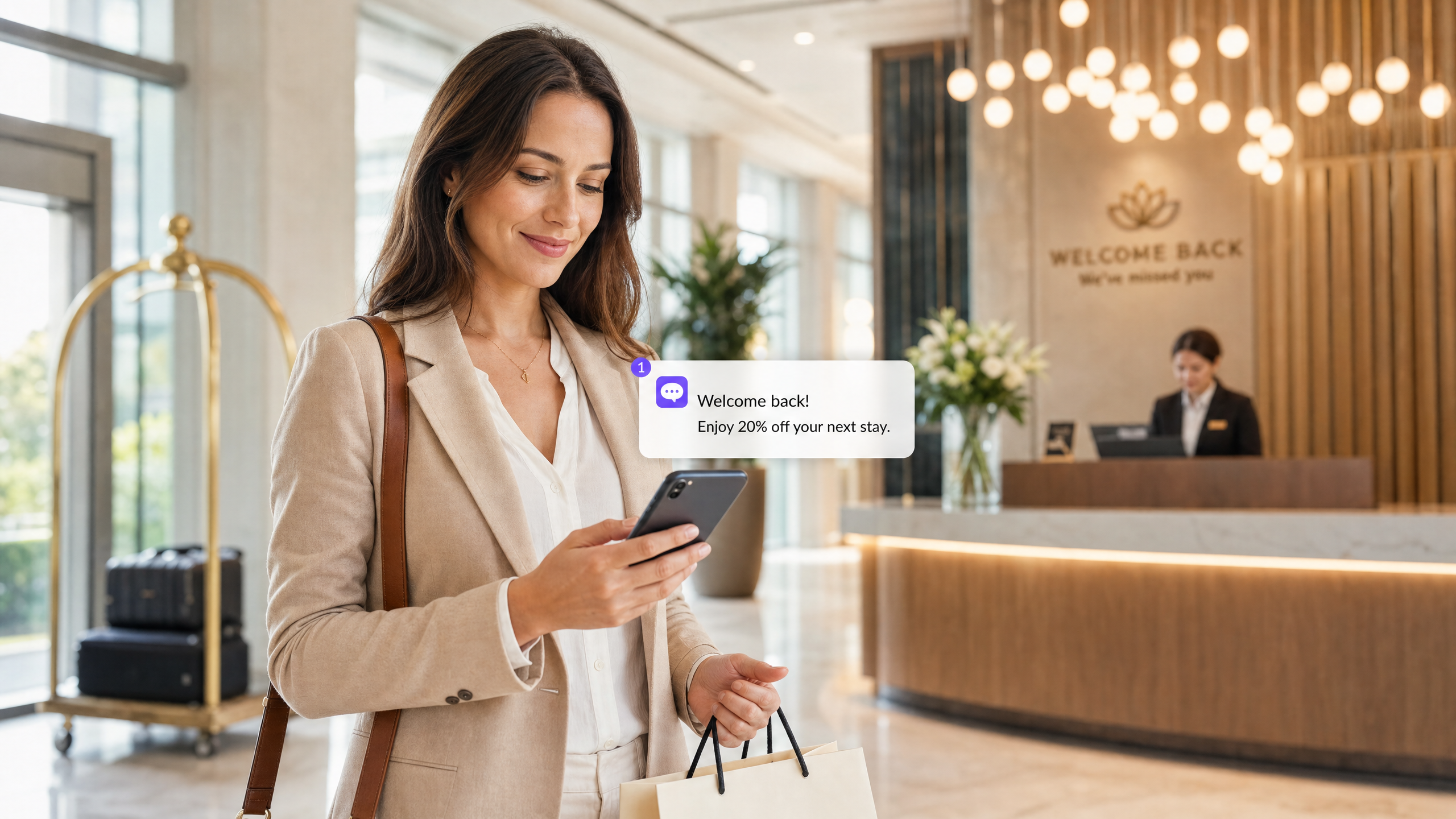
SMS marketing consistently delivers a 98% open rate, vastly outperforming email. Yet, many venue operators fail to capture verified phone numbers, relying instead on unverified web forms that lead to high bounce rates and compliance risks. The most effective method to build a clean, first-party database is through your Guest WiFi login flow. By requiring a mobile number and verifying it with a one-time passcode, you capture accurate data, secure explicit GDPR consent, and record timestamped visit data simultaneously.
This guide outlines how to select the best SMS marketing platform and integrate it with your WiFi infrastructure. We cover the technical architecture required to pipe verified numbers into your marketing stack, the automated segmentation rules that drive return visits, and the attribution models necessary to prove ROI. Whether you operate a 200-room hotel or a 40-site retail chain, deploying an integrated SMS and WiFi strategy will replace fragmented marketing efforts with a reliable, automated footfall engine.
Technical Deep-Dive
The Data Capture Architecture
The foundation of any SMS marketing strategy is the data capture mechanism. If you cannot verify the phone number at the point of entry, your downstream campaigns will fail. The optimal architecture uses your existing access points - such as Cisco Meraki, HPE Aruba, or Juniper Mist - configured with a cloud overlay like Purple.
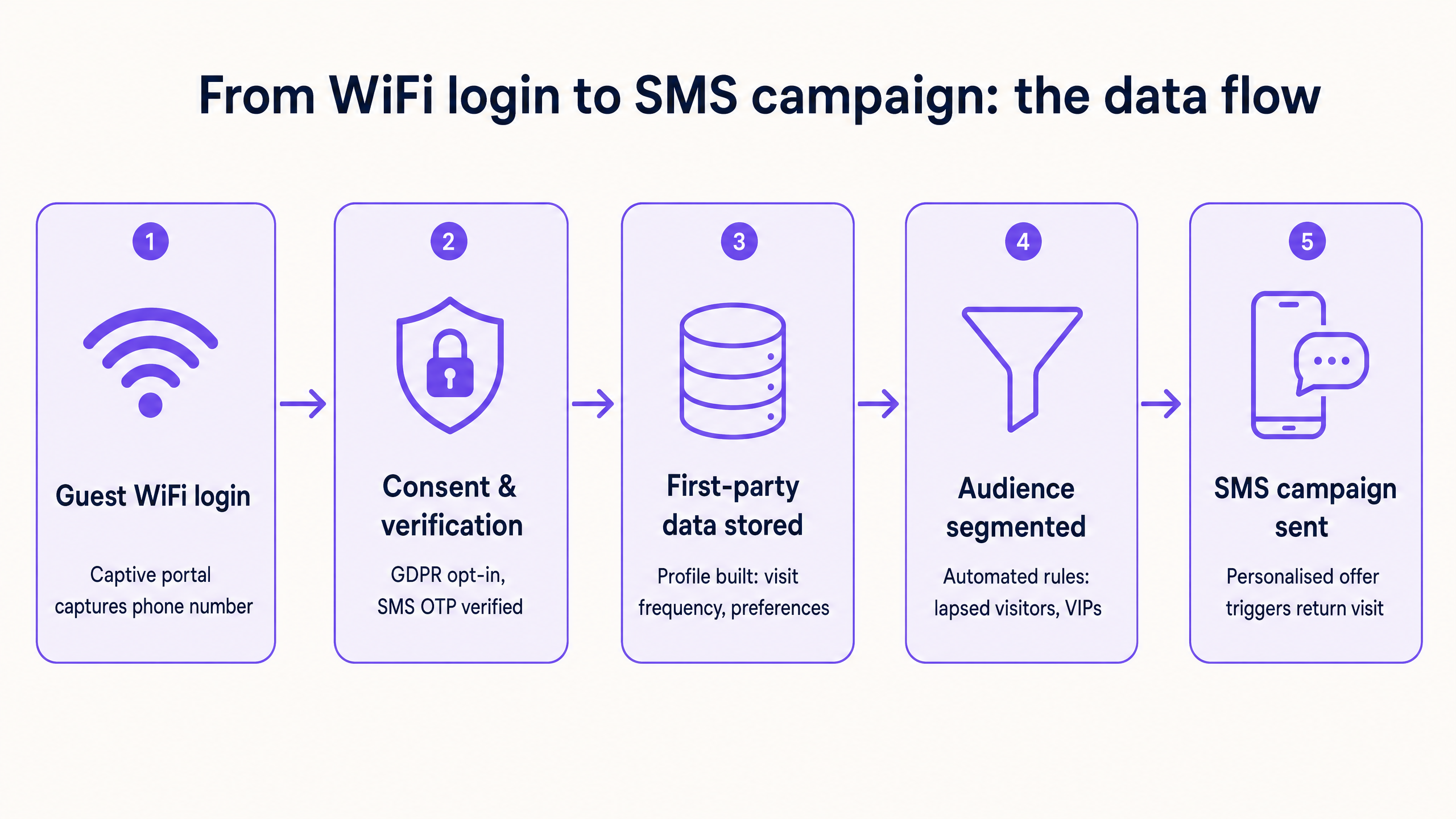
When a visitor connects to the Guest WiFi SSID, the network controller redirects them to a captive portal. This portal acts as the identity provider. The visitor inputs their mobile number, and the system sends an SMS one-time passcode (OTP) via a secure gateway. The visitor enters the OTP to gain network access. This handshake confirms the number is valid and active.
Simultaneously, the captive portal presents clear opt-in language for marketing communications. Because the visitor actively completes the OTP challenge, the consent record is explicit, timestamped, and tied to a verified identity. This satisfies the strict consent requirements of GDPR and PECR.
Platform Integration and Data Piping
Once you capture verified data, you must route it to your SMS marketing platform. The best platforms - such as Attentive or Klaviyo - offer robust REST APIs and webhook support.
Your WiFi analytics layer should act as the primary data source. When a visitor logs in, the WiFi platform generates a webhook payload containing the verified number, consent status, and visit metadata (e.g., location ID, MAC address, timestamp). The SMS platform ingests this payload and updates the visitor's profile.
This integration must be bidirectional if you use a separate CRM. If a visitor opts out via an SMS reply (e.g., texting "STOP"), the SMS platform must push an update back to the CRM or WiFi platform to suppress future sends across all channels.
Implementation Guide
Deploying an integrated SMS and WiFi marketing solution requires careful coordination between IT and marketing teams. Follow these steps to ensure a secure, compliant rollout.
Step 1: Audit and Prepare Your Infrastructure
Before selecting an SMS platform, confirm your WiFi hardware supports external captive portals via RADIUS authentication. Purple is hardware-agnostic and integrates natively with Cisco Meraki, HPE Aruba, Ruckus, Juniper Mist, Ubiquiti UniFi, Cambium, Extreme, and Fortinet. You do not need to replace access points; you only need to configure the controller to point to the Purple cloud overlay.
Step 2: Configure the Captive Portal
Design your captive portal to prioritise mobile number capture. Keep the UI clean and the opt-in language unambiguous. Do not pre-tick the marketing consent box; conscious-choice opt-ins are mandatory for compliance. Ensure the OTP delivery is fast - delays longer than five seconds will cause visitors to abandon the login.
Step 3: Select and Connect the SMS Platform
Evaluate SMS platforms based on their ability to ingest real-time behavioural data.
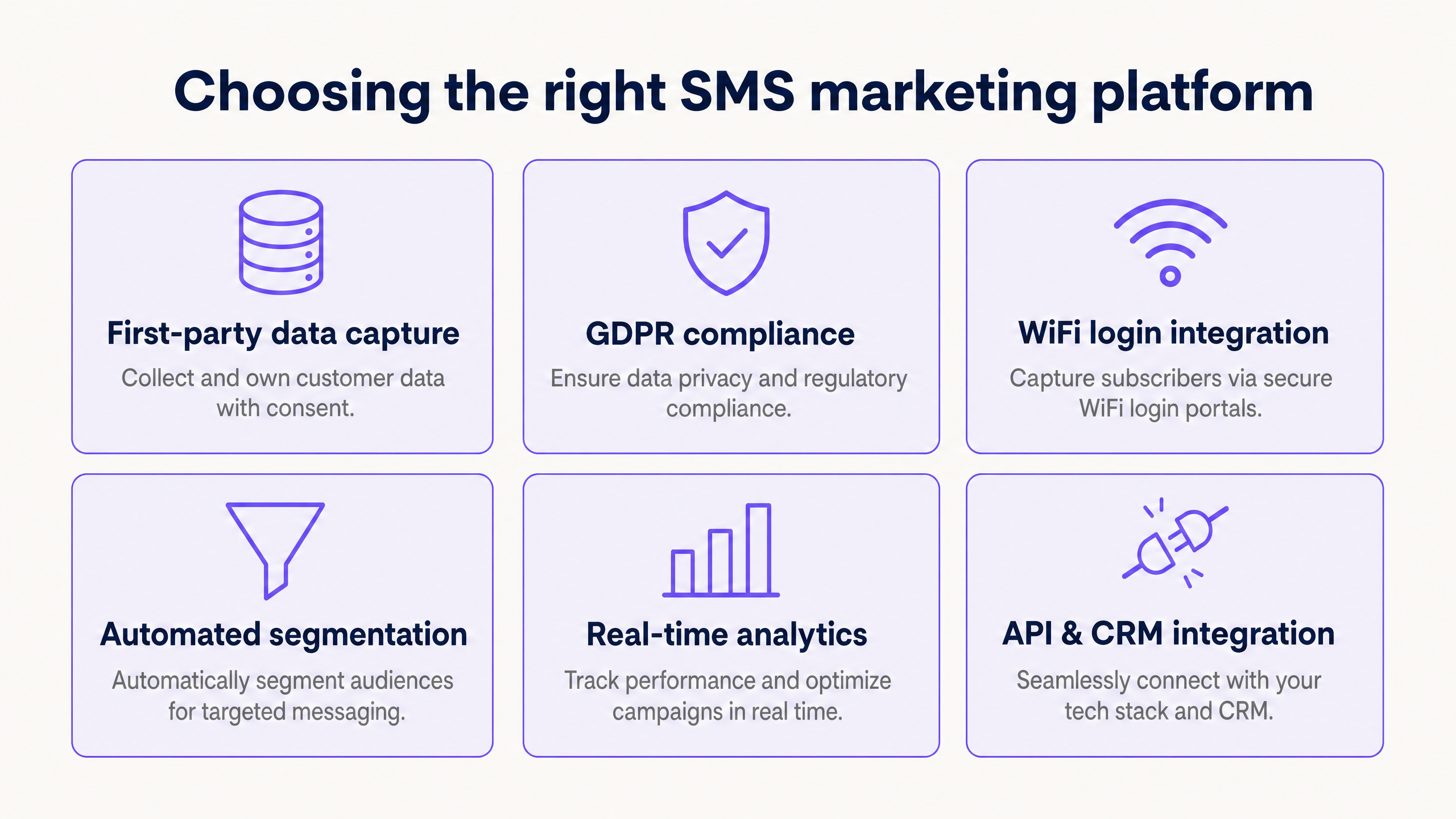
Once selected, configure the API connection between Purple and the SMS platform. Map the data fields carefully: ensure the location ID from the WiFi system maps to a segmentable field in the SMS platform, allowing you to trigger location-specific campaigns.
Step 4: Build Automated Segments
Do not rely on manual batch-and-blast campaigns. Configure automated rules based on visit recency and frequency. Create three core segments:
- First-time visitors: Trigger a welcome SMS 24 hours after their first visit.
- Lapsed visitors: Trigger a re-engagement offer 30 or 60 days after their last recorded visit.
- VIPs: Identify visitors with high frequency and trigger exclusive rewards.
Best Practices
Prioritise Send-Time Optimisation
SMS messages interrupt the recipient. You must time your sends to match the visitor's context. For hospitality venues, sending a lapsed-guest offer at 11:00 AM on a Tuesday performs better than a Friday evening send. For retail environments, sending a promotion at 4:00 PM on a Friday captures shoppers planning their weekend. Test different send windows and monitor the redemption rates.
Implement Multi-Step Flows
A single SMS rarely changes behaviour. Design automated flows that escalate the offer. For example, a lapsed retail shopper might receive a "We miss you" message at 30 days. If they do not return, a second message at 45 days offers a 10% discount. If they still do not return, a final message at 60 days offers a 20% discount. This approach protects margin while maximising return visits.
Measure Attribution via WiFi Logins
The most significant advantage of integrating SMS with WiFi is closed-loop attribution. When you send an SMS campaign, you track how many recipients subsequently log in to the Guest WiFi at your venue. This provides a definitive return visit rate, allowing you to calculate exact ROI rather than relying on inferred footfall or promo code redemptions.
Troubleshooting & Risk Mitigation
High Opt-Out Rates
If your opt-out rate exceeds 1.5%, you are likely sending messages too frequently or the offers lack value. Audit your automation rules to ensure visitors do not fall into multiple overlapping segments. Cap the frequency to a maximum of two marketing messages per month per visitor.
Low Return Visit Attribution
If your SMS platform reports high engagement but your WiFi system shows low return visits, investigate the login friction. If returning visitors must manually reconnect to the WiFi every time, you will lose the attribution data. Ensure your WiFi network is configured to automatically authenticate returning devices using their MAC address.
ROI & Business Impact
An integrated SMS and WiFi marketing strategy transforms a passive cost centre (guest internet) into an active revenue driver.
Consider a retail chain capturing 5,000 verified numbers per month across its portfolio. By implementing a 30-day lapsed-visitor automation, the chain can consistently re-engage 15% of those visitors. If the average transaction value is £40, that single automated flow generates £30,000 in monthly attributable revenue.
The upfront cost of the SMS platform and the Purple Connect license is rapidly offset by the measurable increase in footfall. Furthermore, the verified first-party database you build becomes a durable asset, insulating your marketing efforts from changes in third-party cookie policies or social media algorithms.
Listen to the Briefing
For a deeper discussion on implementation strategies and real-world case studies, listen to the companion podcast episode below.
Key Definitions
First-Party Data
Information a company collects directly from its customers with their consent, such as phone numbers captured via a WiFi captive portal.
Crucial for building independent marketing databases as third-party tracking becomes less reliable.
Captive Portal
A web page that a user must view and interact with before accessing a public WiFi network.
The primary interface for capturing visitor data, presenting terms of service, and securing GDPR consent.
OTP (One-Time Passcode)
A unique string of characters sent via SMS to verify the user possesses the mobile device they claim to own.
Essential for preventing fake data entry and ensuring the marketing database is clean.
Webhook
A method for one application to provide real-time data to another application when a specific event occurs.
Used to instantly push a visitor's verified phone number from the WiFi platform to the SMS marketing platform.
Cloud Overlay
A software layer that sits on top of existing network hardware, adding new capabilities without requiring physical equipment changes.
Allows venues to deploy Purple's analytics and marketing tools across disparate hardware vendors like Cisco Meraki and HPE Aruba.
Hardware-Agnostic
Software designed to function consistently across different manufacturers' equipment.
Ensures a multi-site operator can standardise their WiFi marketing strategy even if different locations use different access points.
MAC Address
A unique identifier assigned to a network interface controller for communications at the data link layer of a network segment.
Used by WiFi systems to recognise returning devices automatically, enabling accurate footfall attribution.
PECR (Privacy and Electronic Communications Regulations)
UK regulations that sit alongside GDPR and give people specific privacy rights in relation to electronic communications.
Dictates the strict rules around sending marketing text messages and the necessity of explicit opt-in.
Worked Examples
A 200-room hotel wants to increase direct bookings and reduce OTA commissions. They currently collect email addresses via a manual form at check-in, but the bounce rate is 18%. How should they deploy an SMS strategy?
- Deploy Purple Engage as a cloud overlay on the hotel's existing HPE Aruba access points.
- Configure the captive portal to require a mobile number and OTP verification for Guest WiFi access.
- Integrate Purple with an SMS platform via API.
- Build an automated segment for guests who have not logged into the WiFi in 45 days.
- Trigger an SMS offering a complimentary breakfast or room upgrade for direct bookings.
A stadium operator needs to drive merchandise and food sales during match days. They have Cisco Meraki hardware but no marketing integration. How can SMS drive immediate revenue?
- Overlay Purple on the Cisco Meraki network.
- Capture verified phone numbers and marketing consent at the WiFi login portal.
- Segment attendees based on the specific access point they connect to (e.g., East Stand vs. West Stand).
- Trigger real-time SMS offers for food and beverage outlets located in the attendee's specific zone, sent 15 minutes before half-time.
Practice Questions
Q1. Your retail client wants to start SMS marketing but has a database of 10,000 numbers collected via paper forms over three years. They want to upload this CSV to Klaviyo and send a broadcast offer. What is your recommendation?
Hint: Consider the verification status and compliance risks associated with legacy, unverified data.
View model answer
Advise against the broadcast. Unverified legacy data carries a high risk of bounce rates and GDPR violations. Recommend implementing a WiFi Captive Portal to start capturing verified numbers via OTP. For the legacy list, use a number validation API to scrub invalid numbers before attempting any re-engagement, and ensure explicit consent records exist for every remaining number.
Q2. A venue operator is evaluating two SMS platforms. Platform A requires manual CSV uploads weekly. Platform B supports webhooks and REST APIs. The operator prefers Platform A because it is cheaper. How do you justify the cost of Platform B?
Hint: Focus on the operational overhead of manual uploads and the inability to trigger automated, timely campaigns.
View model answer
Platform B is necessary because manual CSV uploads prevent automated, real-time triggers. The highest ROI in SMS marketing comes from timely, automated flows (e.g., a lapsed visitor campaign). Manual uploads introduce data lag, increase administrative overhead, and make accurate closed-loop attribution impossible. The increased revenue from automated triggers will offset the higher platform cost.
Q3. A hotel has deployed an SMS campaign offering 20% off direct bookings. The SMS platform shows a 15% click-through rate on the link, but the hotel claims they cannot see an increase in return visits. How do you resolve the attribution gap?
Hint: Look at the connection between the SMS campaign and the physical venue network.
View model answer
Implement closed-loop attribution by connecting the SMS campaign data to the WiFi analytics platform. Track how many devices associated with the SMS recipient list subsequently authenticate on the Guest WiFi. This measures actual physical footfall rather than just digital engagement, providing definitive proof of return visits.