
How to leverage SMS real estate marketing to increase return visits
This technical reference guide details how venue operators can transform existing guest WiFi infrastructure into a compliant, high-performing SMS marketing engine. It covers the technical architecture for capturing verified phone numbers via captive portals, GDPR/CCPA compliance requirements, and integration strategies with SMS platforms to drive measurable return visits.
Listen to this guide
View podcast transcript
Executive Summary
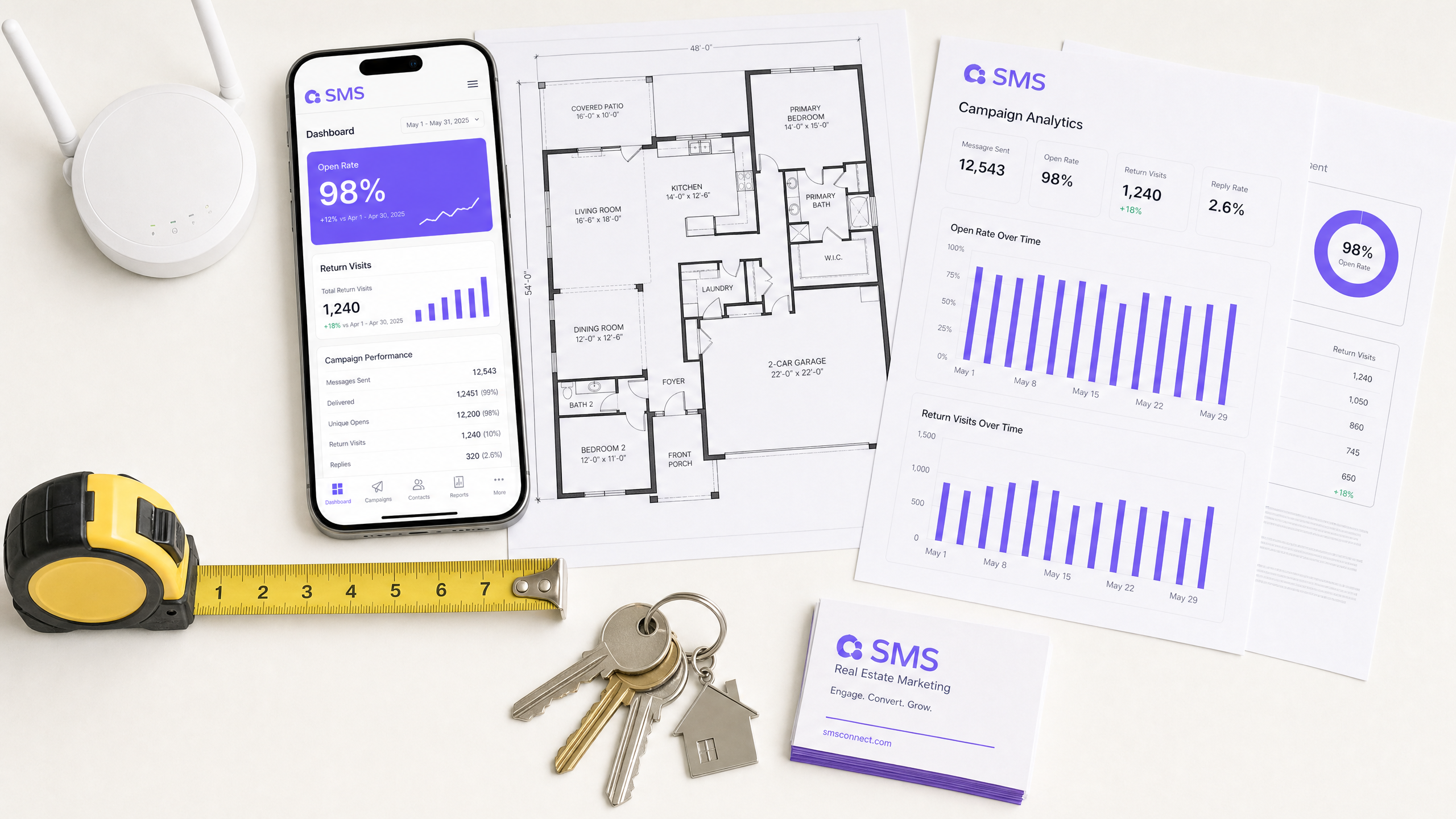
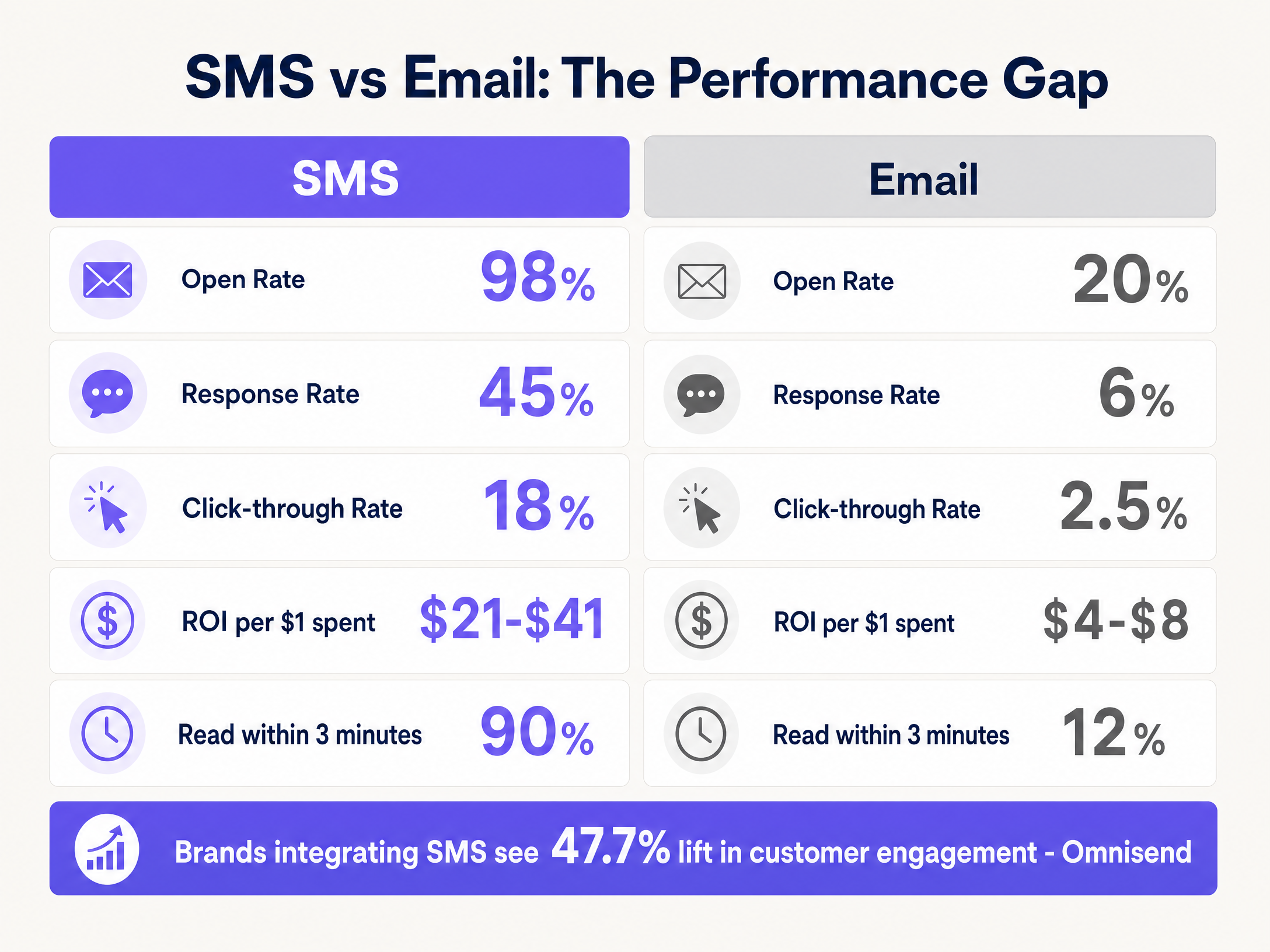
Venue operators sit on a goldmine of unactivated data. Every day, visitors connect to your WiFi network. While most venues capture email addresses, few successfully build a verified, consented database of mobile phone numbers. This represents a significant missed opportunity. SMS marketing delivers a 98% open rate and a 45% response rate, vastly outperforming email.
This guide details how to use your existing guest WiFi infrastructure to capture phone numbers compliantly, and how to integrate that data with an SMS marketing platform to drive measurable return visits. We cover the technical architecture of the Purple Engage platform, the mechanics of consent under GDPR and CCPA, and real-world implementation case studies from the hospitality and retail sectors. For IT managers and marketing directors looking to increase revenue from existing footfall, this is the technical playbook.
Listen to the Briefing
Technical Deep-Dive: The Data Capture Engine
The foundation of any successful SMS marketing programme is a clean, verified, and consented list of phone numbers. Purchasing third-party lists is ineffective and often non-compliant. The most reliable method for a physical venue to build a first-party database is through the Guest WiFi login process.
The Captive Portal Architecture
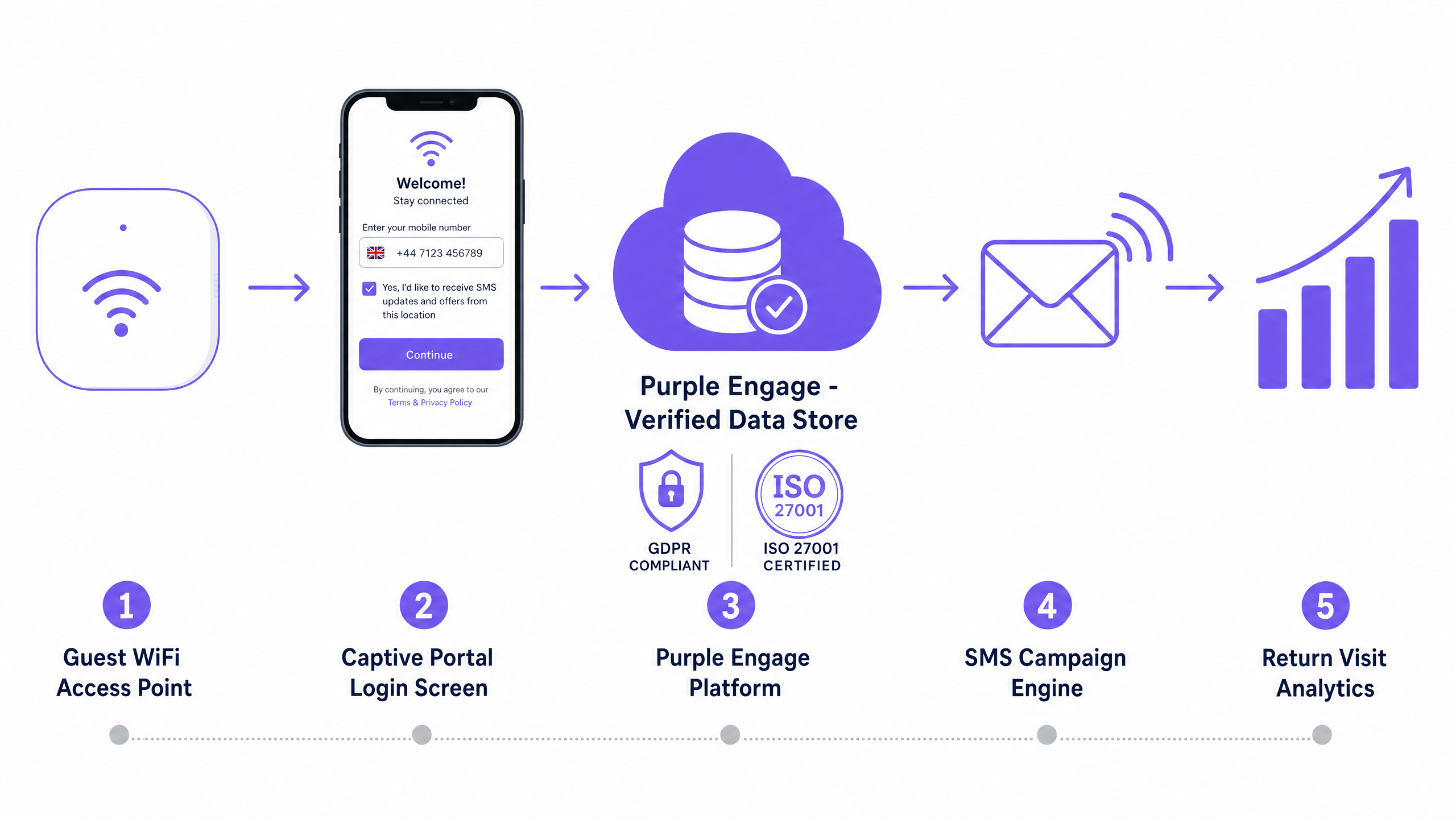
When a visitor connects to your network, they are intercepted by a captive portal before gaining internet access. Purple provides a hardware-agnostic cloud overlay that integrates with Cisco Meraki, HPE Aruba, Ruckus, Juniper Mist, Ubiquiti UniFi, Cambium, Extreme, and Fortinet. You do not need to replace your existing access points.
The captive portal presents a login screen where visitors authenticate. This is the critical data capture point. Instead of just asking for an email address, you configure the portal to require a mobile phone number.
The Mechanics of Compliance
Under GDPR in the UK and Europe, and CCPA in California, you cannot simply collect a phone number and start sending promotional texts. You need explicit, freely given consent for marketing communications.
The consent checkbox must be separate from the WiFi access terms. Tying marketing consent to WiFi access is not valid consent. The Information Commissioner's Office has been explicit on this point. Purple presents a separate, clearly worded opt-in at the login screen. That consent event is timestamped, stored, and linked to the visitor's profile in the Purple Engage platform. Purple is ISO 27001 certified, ensuring the data handling meets enterprise security standards.
Integration via Purple Engage
Purple Engage is the top-tier plan in Purple's guest WiFi stack. It provides automated journey triggers and CRM integration via over 400 connectors. This allows you to push verified, consented phone numbers directly into your SMS platform of choice - whether that is Attentive, Klaviyo, Twilio, or a bespoke SMS gateway.
The phone numbers arrive pre-verified and pre-consented. You are not starting from zero; you are starting from a warm list built from real visitors to your real venues.
Implementation Guide
Deploying an SMS real estate marketing strategy requires coordination between IT and marketing teams. Follow these steps to ensure a successful rollout.
Step 1: Configure the Captive Portal
Update your captive portal design to include a mobile phone number field. Ensure the SMS marketing opt-in checkbox is unchecked by default to comply with GDPR. Clearly state the value proposition for opting in, such as exclusive venue offers or priority booking access.
Step 2: Establish the API Connection
Use Purple Engage to configure the API connection between your WiFi platform and your SMS gateway. Map the data fields correctly: phone number, consent timestamp, venue location, and visit frequency.
Step 3: Define the Segmentation Strategy
Do not send batch-and-blast messages. Use the WiFi Analytics data to segment your audience based on presence analytics. Create segments for first-time visitors, frequent visitors, and lapsed visitors (e.g., no visit in 60 days).
Step 4: Set Frequency Caps
Configure your SMS platform to limit message frequency. We recommend a maximum of two to four messages per month per subscriber. Exceeding this limit significantly increases opt-out rates and damages your sender reputation.
Best Practices
To maximise the return on your SMS campaigns, adhere to these industry-standard best practices.
The Performance Gap
When evaluating channels, the data clearly supports SMS for time-sensitive or high-value communications.
Measure Return Visits, Not Just Clicks
The ultimate goal of SMS real estate marketing is to drive footfall back to your physical locations. While click-through rates are useful leading indicators, you must measure actual return visits.
Purple's analytics dashboard allows you to cross-reference WiFi reconnection data with SMS campaign sends. If a visitor receives an SMS on Tuesday and reconnects to your WiFi network on Thursday, that is a measurable return visit attributable to the campaign.
Maintain Data Hygiene
Phone numbers change. Run a monthly validation pass on your SMS list to remove bounced numbers. Purple Engage flags inactive profiles automatically, which helps keep your list clean without manual effort.
Troubleshooting & Risk Mitigation
Even with a solid architecture, campaigns can fail. Here are common failure modes and how to avoid them.
High Opt-Out Rates
If your opt-out rate spikes above 2% per campaign, you are either messaging too frequently or your offers lack value. Review your frequency caps and ensure every message includes a clear, compelling reason for the visitor to return.
Low Opt-In Rates at the Portal
If visitors are not ticking the SMS consent box, your value proposition is weak. "Sign up for our newsletter" is not compelling. Test variations like "Get 15% off your next drink" or "Receive priority access to event tickets."
Integration Failures
If data is not syncing from Purple to your SMS platform, check the API logs. The most common issue is a mismatch in phone number formatting. Ensure your captive portal forces international formatting (e.g., +44) before submission.
ROI & Business Impact
SMS marketing delivers substantial ROI when executed correctly. Businesses report between $21 and $41 returned for every $1 spent on SMS.
For venue operators, the business impact is measured in increased return visit frequency and reduced reliance on third-party booking platforms or online travel agencies (OTAs). By driving direct engagement through SMS, you retain the full margin on the resulting transactions.
Key Definitions
Captive Portal
The branded web page that intercepts users before they are granted access to a public WiFi network, used for authentication and data capture.
This is the primary interface where venue operators collect mobile phone numbers and marketing consent from visitors.
Presence Analytics
Data derived from WiFi network connections that indicates when a device is physically present at a location, how long it stays, and how often it returns.
Used to segment SMS campaigns based on real-world visitor behaviour rather than just online interactions.
Hardware-Agnostic
Software that operates independently of the underlying hardware manufacturer.
Purple's cloud overlay works across major vendors like Cisco Meraki and Aruba, meaning IT teams do not need to replace existing access points.
Explicit Consent
A clear, unambiguous, and freely given affirmative action by a user agreeing to receive marketing communications.
Required under GDPR and CCPA; cannot be bundled with general terms of service for WiFi access.
First-Party Data
Information collected directly by a company from its own audience or customers.
Phone numbers collected via guest WiFi are highly valuable first-party data, unlike purchased third-party lists.
API Connector
An interface that allows two software systems to communicate and share data automatically.
Purple Engage uses API connectors to push captured phone numbers directly into SMS platforms like Klaviyo or Twilio.
Frequency Cap
A limit placed on the number of marketing messages sent to an individual user within a specific timeframe.
Essential in SMS marketing to prevent list fatigue and high opt-out rates.
Return Visit Rate
The percentage of unique visitors who connect to the venue's WiFi network on more than one distinct day.
The primary success metric for SMS real estate marketing campaigns, proving the campaign drove physical footfall.
Worked Examples
A mid-scale hotel group with 12 properties needs to reduce reliance on OTA bookings and drive direct return visits from previous guests.
The group deploys Purple Engage across all sites. At WiFi login, guests enter their mobile number and tick the SMS marketing opt-in. Within 30 days, the group collects 8,000 verified, consented mobile numbers. They run a re-engagement campaign targeting guests who stayed more than 60 days ago. The campaign segments the list by property, visit frequency, and average spend. The message reads: "Hi Sarah, it's been a while since your last stay at [Property Name]. Book direct this weekend and get 15% off." The campaign achieves a 34% click-through rate and drives a 22% uplift in direct bookings over four weeks.
A fashion retailer with 40 stores wants to increase footfall during new collection launches without relying solely on email, which is seeing declining open rates.
The retailer uses Purple to capture shopper phone numbers at WiFi login. Their CRM team segments the list by store location and purchase history, synced from the retailer's existing CRM via Purple's connector library. When a new collection drops, they send a geo-targeted SMS to shoppers within five miles of each store. The message includes a unique discount code trackable back to the SMS campaign. The retailer sees a 19% redemption rate on the codes, and return visit frequency increases by 28% among SMS subscribers compared to non-subscribers over a six-month period.
Practice Questions
Q1. A retail venue wants to start sending SMS offers to all 10,000 phone numbers they have collected over the past year through their guest WiFi. They currently require users to accept a single 'Terms and Conditions' checkbox to access the internet. Should they proceed with the campaign?
Hint: Consider the requirements for valid marketing consent under GDPR.
View model answer
No, they should not proceed. Bundling marketing consent into the general Terms and Conditions for WiFi access does not constitute valid, explicit consent under GDPR or CCPA. They must implement a separate, optional opt-in checkbox for SMS marketing. They cannot retroactively assume consent for the existing 10,000 numbers and must build a new, compliant list.
Q2. Your marketing director wants to measure the ROI of an SMS campaign sent to previous hotel guests. They suggest looking at the click-through rate on the link provided in the text message. What is a more accurate way to measure the physical impact of the campaign?
Hint: Think about the data your WiFi infrastructure collects when a guest arrives on-site.
View model answer
While click-through rate is a useful leading indicator, it does not prove physical footfall. The most accurate way to measure physical ROI is to cross-reference the SMS campaign send list with WiFi network reconnection data. If a guest receives the SMS and subsequently connects their device to the venue's WiFi network within the campaign window, that constitutes a measurable, attributed return visit.
Q3. A stadium operations team has successfully built a list of 5,000 opted-in phone numbers. They want to send three promotional messages a week to this list to maximise revenue during the off-season. What is the primary risk of this approach?
Hint: Consider the impact of high message frequency on subscriber retention.
View model answer
The primary risk is a massive spike in opt-outs (unsubscribes). Over-messaging is the leading cause of SMS list churn. Sending three messages a week (12 per month) far exceeds the recommended frequency cap of 2 - 4 messages per month. This approach will rapidly deplete their hard-won database and could damage their sender reputation with the SMS gateway.