
How to leverage SMS marketing tools to increase return visits

This technical guide details how to build an automated data capture pipeline using Guest WiFi to drive SMS marketing campaigns. It covers deployment architecture, compliance frameworks, and proven strategies for increasing return visits across hospitality, retail, and event venues.

📖 4 min read📝 857 words🔧 2 worked examples3 practice questions📚 8 key definitions

Listen to this guide

View podcast transcript
Speak in British English with a confident, authoritative, conversational tone - like a senior consultant briefing a client in a boardroom. Measured pace, clear diction, calm authority. Not a lecture. Not a sales pitch. Just a smart professional sharing what works: Welcome to the Purple technical briefing series. Today we are talking about SMS marketing tools - specifically how venue operators can use their existing guest WiFi infrastructure to build a high-performing SMS channel that drives measurable return visits. [short pause] Let me set the scene. You are running a hotel, a retail chain, a stadium, or a conference centre. You have guest WiFi already deployed. Guests connect every day. And right now, most of those connections are just connectivity. The guest gets online, you get nothing back. No data, no contact, no way to bring them back next week or next month. That is the problem we are solving today. [medium pause] Section one. Why SMS outperforms every other re-engagement channel. Here is the headline number. SMS delivers a 98% open rate. Email sits at around 21%. Paid social is worse. Display advertising is worse still. When you send an SMS, it gets read - typically within three minutes of delivery, according to Sakari's 2025 SMS Marketing Statistics report. The ROI data is equally compelling. Conservative industry estimates put SMS returns at between 21 and 41 dollars in revenue for every dollar spent. Some peak seasonal campaigns report up to 71 dollars per dollar. For context, email marketing - already a strong channel - returns between 10 and 36 dollars per dollar. SMS consistently beats it. Click-through rates on SMS campaigns average around 26%, compared to roughly 3% for email. Response rates hit 45%, versus 6% for email. These are not marginal differences. They are structural advantages of a channel where the message lands directly in the notification tray of a device people check over 150 times a day. Now, here is the critical question for venue operators. Where do you get the phone numbers? And how do you get them compliantly? This is where your guest WiFi infrastructure becomes a genuine competitive asset. [medium pause] Section two. The technical architecture - from WiFi login to SMS campaign. The flow has five stages. Stage one is the physical layer. Your access points - whether that is Cisco Meraki, HPE Aruba, Ruckus, Juniper Mist, or Ubiquiti UniFi - are already deployed. They handle the radio frequency layer. Purple sits as a cloud overlay on top of that hardware, which means you do not need to rip and replace anything. Hardware-agnostic deployment is the starting point. Stage two is the captive portal. When a guest connects to your Guest WiFi network, they hit a branded splash page. This is where data capture happens. The portal presents a phone number field alongside a standalone SMS marketing opt-in checkbox. That checkbox is separate from the WiFi terms and conditions. That separation is not a user experience nicety - it is a legal requirement under GDPR Article 7 and TCPA prior express written consent rules. The consent must be granular, specific, and documented with a timestamp. Purple's Engage plan handles this automatically. The portal captures the phone number, records the consent event with a timestamp, and writes the record directly to the guest profile in the platform. Stage three is the data layer. Purple Engage builds a unified guest profile from every WiFi login. That profile includes the phone number, the consent status, the visit timestamp, the venue location, and the visit frequency. Over time, you accumulate behavioural signals - first-time visitor, repeat visitor, lapsed visitor - that drive segmentation. Stage four is the campaign engine. Purple Engage connects to your SMS gateway via API. You define automated journeys: a welcome message on first connection, a re-engagement message after 30 days of absence, a promotional message tied to a specific venue event. The platform handles delivery, tracks open rates and click-throughs, and feeds performance data back into the analytics dashboard. Stage five is SMS delivery itself. The message hits the guest's handset within seconds of the trigger firing. The guest sees a personalised offer, clicks through, and books a return visit. That is the full loop. [medium pause] Let me give you a concrete architecture example. A 200-room hotel running Cisco Meraki access points deploys Purple Engage as a cloud overlay. The captive portal is branded to the hotel. Guests log in with their mobile number and tick the SMS opt-in box. Purple writes the consent record to the guest profile. After check-out, an automated journey triggers a message 48 hours later with a loyalty offer. Guests who have not returned within 60 days receive a re-engagement message with a discounted rate. The hotel's CRM receives all profile data via one of Purple's 400-plus connector integrations. WiFi login to verified phone number to automated SMS campaign to return visit. [medium pause] Section three. Implementation - the four configuration stages. Stage one is network setup. Confirm your access points are on the supported hardware list - Cisco Meraki, HPE Aruba, Ruckus, Juniper Mist, Ubiquiti UniFi, Cambium, Extreme, or Fortinet. Purple deploys as a cloud overlay, so the configuration change is at the SSID level. You create a dedicated Guest WiFi SSID and point it at Purple's captive portal URL. This takes under an hour on most enterprise hardware. Stage two is portal design. Build your branded splash page in Purple's portal editor. The phone number field and SMS opt-in checkbox are standard components. The consent language must be plain English - something like: I agree to receive promotional SMS messages from this venue. Message frequency varies. Reply STOP to unsubscribe. That language satisfies both GDPR and TCPA requirements. Stage three is consent architecture. This is where most operators make mistakes. The SMS opt-in must be a standalone checkbox. It cannot be pre-ticked. It cannot be bundled with the WiFi terms. Purple's portal builder enforces this by default, but you should verify it before going live. Your legal team should sign off on the consent copy. Stage four is campaign automation. In Purple Engage, you build automated journeys using visit behaviour as triggers. Define your segments - first-time visitors, repeat visitors, lapsed visitors. Set your message cadence. A typical starting configuration is a welcome message on first connection, a follow-up offer at seven days, and a re-engagement message at 30 days. Keep message frequency to two or three per month maximum. Higher frequency drives unsubscribe rates up sharply. [medium pause] Section four. Real-world results - two case studies. Case study one: rail travel. Avanti West Coast deployed Purple Engage across their train network. By surfacing upsell offers through the WiFi journey - including SMS-triggered promotions - they achieved 3,744 purchases and a 463% return on investment. The key was timing: messages were triggered by presence on the network, not by a generic broadcast schedule. Case study two: retail. McDonald's used Purple to collect over 2.5 million unique visitor records. That data foundation enabled targeted SMS and email campaigns that drove measurable improvements in visit frequency and average spend. The data quality was high because it was captured at the point of physical presence - not from a third-party list. Both cases share the same pattern: verified first-party data captured at the moment of physical engagement, then activated through automated campaigns. The WiFi login is the data collection event. Everything else follows from it. [medium pause] Section five. Pitfalls and how to avoid them. Pitfall one: bundled consent. If your SMS opt-in is embedded in the WiFi terms, your consent is invalid under GDPR. Regulators have fined organisations for exactly this. Use a standalone checkbox. Pitfall two: no suppression list. Every SMS campaign must honour opt-outs instantly. If a guest replies STOP and receives another message, you are in breach of TCPA. Purple Engage manages suppression lists automatically, but if you are using a separate SMS gateway, ensure the suppression sync is real-time. Pitfall three: over-messaging. The fastest way to destroy an SMS list is to send too many messages. Two to three per month is the industry standard. More than that and unsubscribe rates climb sharply. Pitfall four: ignoring delivery rates. Monitor your delivery rate - anything below 95% signals a list quality problem. Purple's analytics dashboard surfaces delivery metrics in real time. Pitfall five: no attribution model. If you cannot connect an SMS send to a return visit, you cannot prove ROI. Purple's WiFi Analytics platform tracks return visit rates for SMS recipients versus non-recipients. Set this up before your first campaign, not after. [medium pause] Now, rapid-fire questions. Do I need a separate SMS platform, or does Purple handle it end to end? Purple Engage handles data capture, segmentation, journey automation, and analytics. For SMS delivery, it connects to your chosen SMS gateway via API. Most operators use an existing gateway - Twilio, MessageBird, or similar. Purple is the intelligence layer; the gateway is the delivery layer. How long does it take to build an SMS list from scratch? At a venue with 500 daily WiFi logins and a 30% opt-in rate, you build a list of 150 new contacts per day. Within 90 days, you have 13,500 opted-in contacts. That is a meaningful campaign audience built entirely from first-party data. What is a realistic return visit lift from SMS campaigns? Industry data shows SMS recipients visit three times more frequently than non-recipients. Purple's own data across 80,000-plus live venues shows that venues running automated re-engagement campaigns see measurable return visit increases within the first 60 days of activation. [medium pause] Summary and next steps. The core argument is straightforward. Guest WiFi is already deployed. It generates verified phone numbers at the point of physical presence. Those numbers, captured with proper consent, feed an SMS channel that outperforms every other re-engagement channel by open rate, click-through rate, and ROI. The implementation path is four stages: network setup, portal design, consent architecture, and campaign automation. The compliance requirements are clear: standalone opt-in, plain language consent, instant opt-out processing, timestamped records. If you are running Purple Engage, you have the infrastructure to do this today. If you are on the Connect or Capture plan, upgrading to Engage unlocks the full automation and SMS integration capability. The next step is to audit your current captive portal. Does it capture phone numbers? Does it have a standalone SMS opt-in? If not, that is the first thing to fix. Everything else - the campaigns, the journeys, the ROI - follows from having the data. Thank you for listening to the Purple technical briefing series. For more on Guest WiFi analytics and SMS marketing implementation, visit purple.ai.

header_image.png

Executive Summary

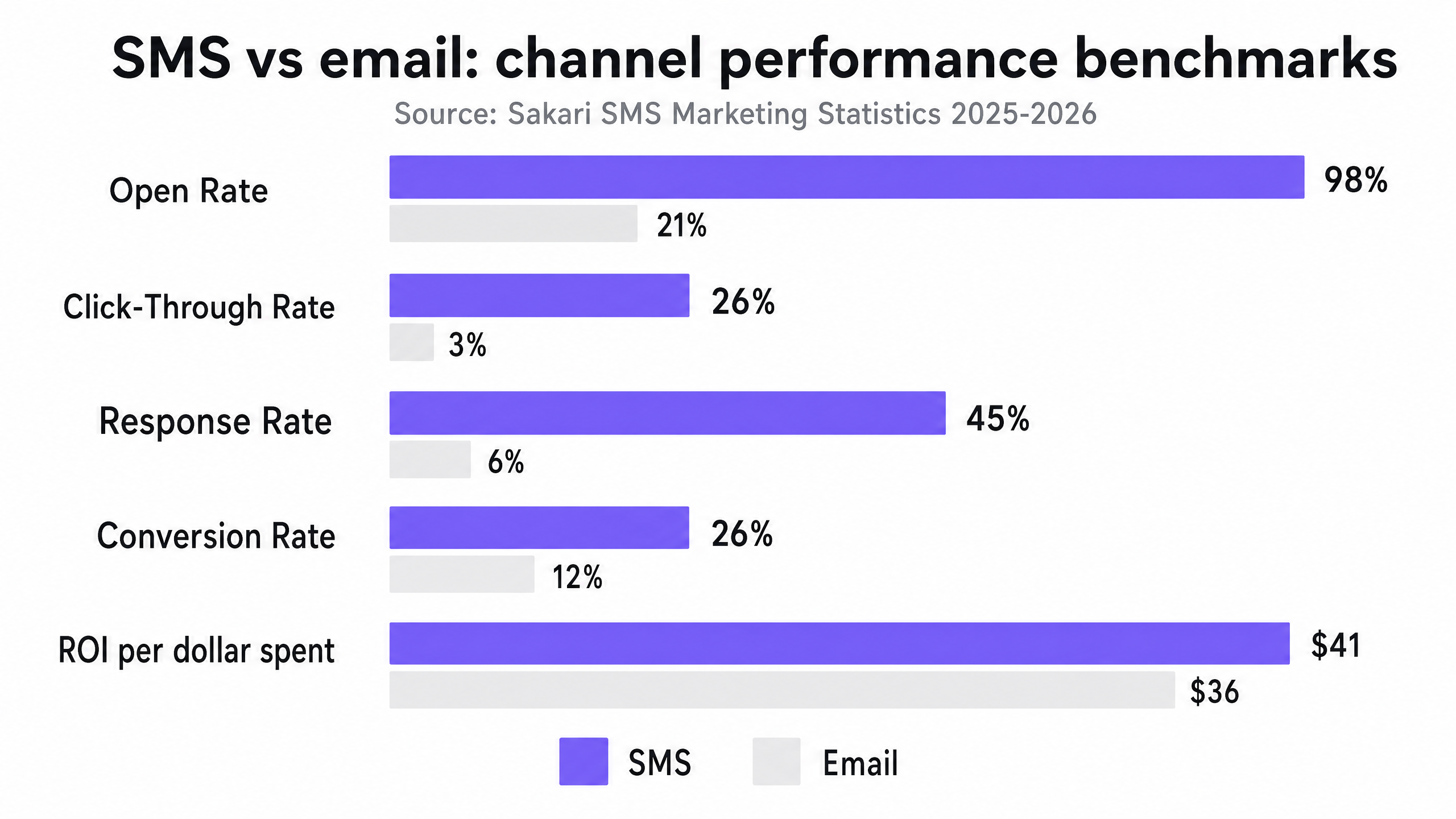
SMS marketing consistently outperforms other re-engagement channels, delivering a 98% open rate compared to email's 21%. For venue operators, the challenge is not whether to use SMS, but how to capture verified phone numbers compliantly at scale. Your existing Guest WiFi infrastructure solves this. By deploying a cloud overlay on your current access points, you can capture mobile numbers during the initial login, secure explicit consent, and trigger automated SMS campaigns based on physical visit behaviour. This guide details the technical architecture, implementation steps, and compliance requirements to turn Guest WiFi into a revenue-generating SMS channel.

Technical Deep-Dive

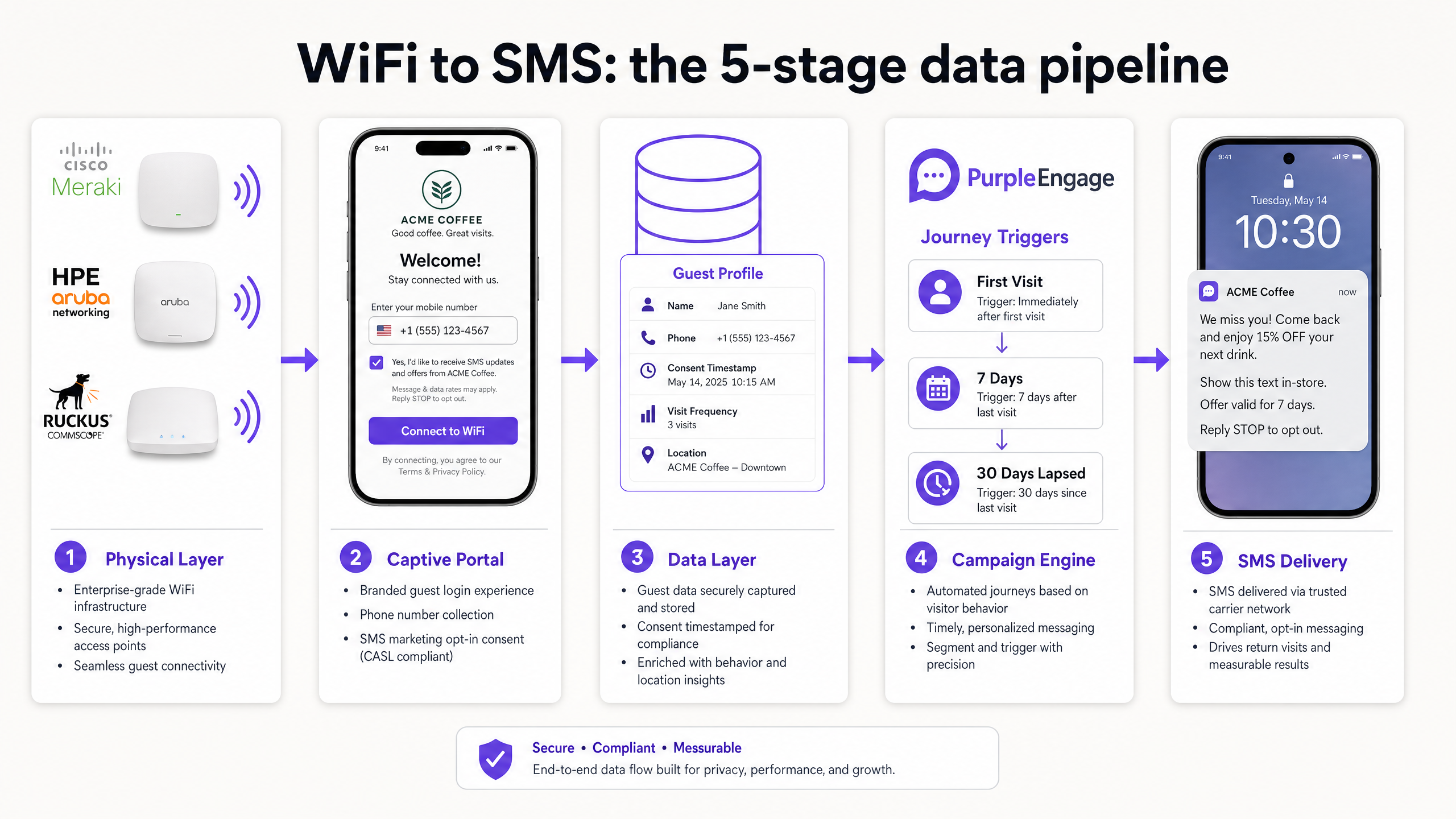
The data pipeline from physical venue entry to SMS delivery involves four distinct layers.

Physical Layer: The foundation is your existing enterprise hardware. Purple operates as a hardware-agnostic cloud overlay compatible with Cisco Meraki, HPE Aruba, Ruckus, Juniper Mist, Ubiquiti UniFi, Cambium, Extreme Networks, and Fortinet. You do not need to replace access points. The integration happens at the controller or gateway level, directing unauthenticated traffic to the Purple platform.

Captive Portal Layer: When a guest connects, they are redirected to a branded splash page. This is the critical data capture point. The portal presents a phone number input field alongside a standalone SMS marketing opt-in checkbox. This separation is mandatory for GDPR and TCPA compliance. Purple captures the number, records the consent event with a timestamp, and passes it to the data layer.

Data Layer: The Purple platform builds a unified guest profile. This profile aggregates the verified phone number, the consent timestamp, and physical visit data including location, dwell time, and visit frequency. This first-party data is stored securely and can be exported to external systems via WiFi Analytics integrations.

Campaign Layer: The Purple Engage engine connects to your SMS gateway via API. You define automated journeys using physical visit behaviour as triggers. When a trigger condition is met - such as 30 days since the last visit - the platform pushes the message payload to the gateway for delivery.
architecture_overview.png

Implementation Guide

Deploying an SMS marketing pipeline via Guest WiFi requires precise configuration across network, portal, and campaign systems.

1. Network Configuration

Create a dedicated Guest WiFi SSID on your wireless controller. Configure the RADIUS authentication to point to Purple's servers. Set the walled garden entries to allow traffic to the captive portal domain and any required identity providers (such as Microsoft Entra ID, Okta, or Google Workspace) before authentication.

Use the Purple portal editor to build your splash page. Add the SMS authentication method. You must configure the SMS opt-in as a standalone, unticked checkbox. Do not bundle this with the general WiFi terms and conditions. The consent language must clearly state the purpose, expected frequency, and the method to opt out.

3. Integration and Automation

Connect your SMS gateway to Purple Engage. Define your visitor segments based on the data captured. Create automated journeys for key scenarios:

  • Welcome: Triggered immediately after the first login.
  • Loyalty: Triggered after a specific number of visits.
  • Re-engagement: Triggered when a guest has not returned within a defined period (e.g., 30, 60, or 90 days).

Best Practices

To maximise the impact of your SMS campaigns, follow these proven strategies.

Timing is everything: Trigger messages based on physical presence or absence. A message sent 48 hours after a visit is highly relevant. A generic broadcast sent on a random Tuesday is not.

Keep frequency low: Send a maximum of two to three messages per month. Over-messaging is the primary cause of unsubscribes.

Personalise the payload: Use the data captured at login to personalise the message. Include the venue name and reference their recent visit.

Measure the lift: Use Purple's analytics to track return visit rates for SMS recipients versus a control group. This proves the ROI of the channel.
channel_comparison_chart.png

Troubleshooting & Risk Mitigation

Invalid Consent: If your SMS opt-in is embedded within the general WiFi terms, your entire database is non-compliant. Regulators have issued significant fines for bundled consent. Ensure the opt-in is a separate, explicit action.

Delivery Failures: Monitor your SMS delivery rates. A rate below 95% indicates poor list quality or gateway configuration issues. Purple's dashboard surfaces these metrics in real time.

Suppression List Sync: If a guest replies "STOP", they must be removed from the active list immediately. Purple Engage handles this automatically, but if you use an external CRM, ensure the suppression sync is bidirectional and real-time.

ROI & Business Impact

SMS marketing requires investment in both the platform and the per-message delivery cost. However, the returns consistently justify the spend.

In the Hospitality sector, venues see average open rates of 98% and click-through rates of 26%. By capturing first-party data at the point of physical presence, you eliminate the need to purchase third-party lists or rely entirely on expensive paid social advertising.

A standard deployment in a 200-room hotel or a mid-sized Retail venue can build an opted-in database of 10,000 verified numbers within 90 days. When activated through automated re-engagement campaigns, this audience drives measurable increases in visit frequency and overall venue revenue.

Key Definitions

Captive Portal

A customised login page that requires users to authenticate or accept terms before gaining access to a public or enterprise WiFi network.

This is the primary data capture mechanism for venue operators.

First-Party Data

Information a company collects directly from its customers and owns entirely.

Capturing phone numbers via Guest WiFi builds a first-party database, reducing reliance on third-party advertising.

Hardware-Agnostic

Software that is compatible with various types of hardware platforms without requiring modifications.

Purple integrates with Cisco Meraki, HPE Aruba, and others, meaning IT teams do not need to replace access points.

Cloud Overlay

A software layer deployed over existing physical network infrastructure to provide additional services.

This deployment model allows rapid rollout of data capture capabilities across multiple venues.

Granular Consent

The practice of asking users to opt-in to specific types of communication separately, rather than bundling them together.

Essential for GDPR compliance when collecting phone numbers for marketing.

TCPA

Telephone Consumer Protection Act. US legislation regulating telemarketing calls, auto-dialled calls, prerecorded calls, and text messages.

Requires prior express written consent for promotional SMS messages.

Automated Journey

A sequence of marketing messages triggered automatically by specific user actions or data points.

Used in Purple Engage to send re-engagement texts based on visit frequency.

Suppression List

A database of contacts who have opted out of receiving communications.

Crucial for compliance; if a guest replies STOP, they must be added to this list immediately.

Worked Examples

A national rail operator wants to increase retail spend at station concourses. They have Cisco Meraki access points deployed across 50 stations but currently offer open, unauthenticated WiFi. How do they deploy an SMS marketing pipeline to drive retail footfall?

  1. Deploy Purple as a cloud overlay on the existing Cisco Meraki infrastructure. No hardware changes required.
  2. Configure the captive portal to require SMS authentication for WiFi access.
  3. Add a clear, standalone SMS marketing opt-in tick box on the splash page.
  4. Build an automated journey in Purple Engage: when a passenger connects at a specific station, trigger an SMS 15 minutes later with a time-limited discount code for a coffee shop on that specific concourse.
Examiner's Commentary: This approach uses physical presence as the trigger. The 15-minute delay ensures the passenger is on the concourse and has time to act on the offer. By capturing the data compliantly via the WiFi login, the operator builds a highly targeted, location-aware marketing database.

A restaurant chain with 120 locations uses HPE Aruba hardware. They want to re-engage customers who have not visited in 60 days. They currently rely on email marketing but see low open rates.

  1. Integrate Purple Engage with the HPE Aruba controllers.
  2. Update the captive portal to capture phone numbers and marketing consent.
  3. Create a 'Lapsed Visitor' segment in Purple Engage for users with a 'last seen' timestamp older than 60 days.
  4. Configure an automated SMS journey targeting this segment with a specific 'We miss you' offer, such as a complimentary appetiser with their next main course.
Examiner's Commentary: This shifts the re-engagement strategy from a low-performing channel (email) to a high-performing channel (SMS). The automation ensures the message is sent at exactly the right time in the customer lifecycle, without requiring manual list exports or campaign management.

Practice Questions

Q1. You are deploying a new captive portal for a stadium. The marketing team wants to pre-tick the SMS opt-in box to maximise the database size. How do you advise them?

Hint: Consider the requirements of GDPR Article 7.

View model answer

Advise the marketing team that pre-ticked boxes are strictly prohibited under GDPR and do not constitute valid consent. The opt-in must be a deliberate, affirmative action by the user. Explain that while a pre-ticked box might artificially inflate the database size in the short term, it creates significant legal risk and will likely result in high unsubscribe rates and poor campaign performance. Recommend clear, compelling opt-in copy instead.

Q2. A hotel chain wants to send an SMS offer to guests who are currently on the property. They plan to trigger the message immediately upon login. What is the potential flaw in this approach?

Hint: Consider the guest experience at the exact moment of connection.

View model answer

Triggering an SMS immediately upon login interrupts the guest while they are actively trying to get online, often while standing at the check-in desk. This can be perceived as intrusive. A better approach is to delay the trigger by 30 to 60 minutes, allowing the guest to settle into their room or visit the bar before receiving the promotional message.

Q3. Your venue has Cisco Meraki access points. You want to deploy Purple Engage for SMS data capture. Do you need to install new hardware controllers?

Hint: Review the deployment architecture for Purple.

View model answer

No new hardware is required. Purple operates as a cloud overlay and is fully hardware-agnostic. The integration is configured at the SSID level on the existing Cisco Meraki dashboard, pointing the authentication traffic to the Purple captive portal.