
How to leverage SMS marketing platform to increase return visits
This guide details how venue operators can use an SMS marketing platform to drive measurable return visits by capturing verified first-party phone data through Guest WiFi. It covers the five-stage technical deployment architecture, data segmentation strategy, GDPR and CCPA compliance requirements, and the direct business impact of moving from broadcast messaging to automated, behavioural triggers. Marketing Directors, CRM Managers, and Retail Venue Operators will find actionable implementation guidance, worked examples from hospitality and retail, and a clear ROI framework.
Listen to this guide
View podcast transcript
Executive Summary
For IT managers and venue operations directors, the value of a physical venue is directly tied to the frequency of return visits. Yet most venues fail to capitalise on the data generated during those visits. When a guest connects to Guest WiFi, they leave a digital footprint. An effective SMS marketing platform converts that footprint into a verified contact and an automated re-engagement loop.
SMS marketing is not about sending generic discount codes to purchased lists. It is a precision tool. SMS delivers a 98% open rate, compared to 20% for email [Sender, 2024]. More importantly, when deployed using behavioural triggers - such as a message sent 24 hours after a first visit - click-through rates routinely exceed 25%. This guide explains the technical architecture required to capture first-party data securely, segment audiences based on visit behaviour, and automate SMS campaigns that drive measurable return visits across Retail , Hospitality , and stadium environments.
Listen to the companion podcast briefing:
Technical Deep-Dive
The foundation of any high-converting SMS marketing platform is the data acquisition layer. Without verified, first-party phone numbers and explicit consent, an SMS campaign is non-compliant and ineffective. Purple Engage provides the infrastructure to capture this data securely at scale, across hardware from Cisco Meraki, HPE Aruba, Ruckus, Juniper Mist, Ubiquiti UniFi, Cambium, Extreme, and Fortinet.
The Data Acquisition Architecture
The process begins at the venue access point. When a device attempts to connect to the network, the controller routes unauthenticated traffic to a Captive Portal. This portal is the primary data capture interface and the single most important component in your SMS marketing stack.
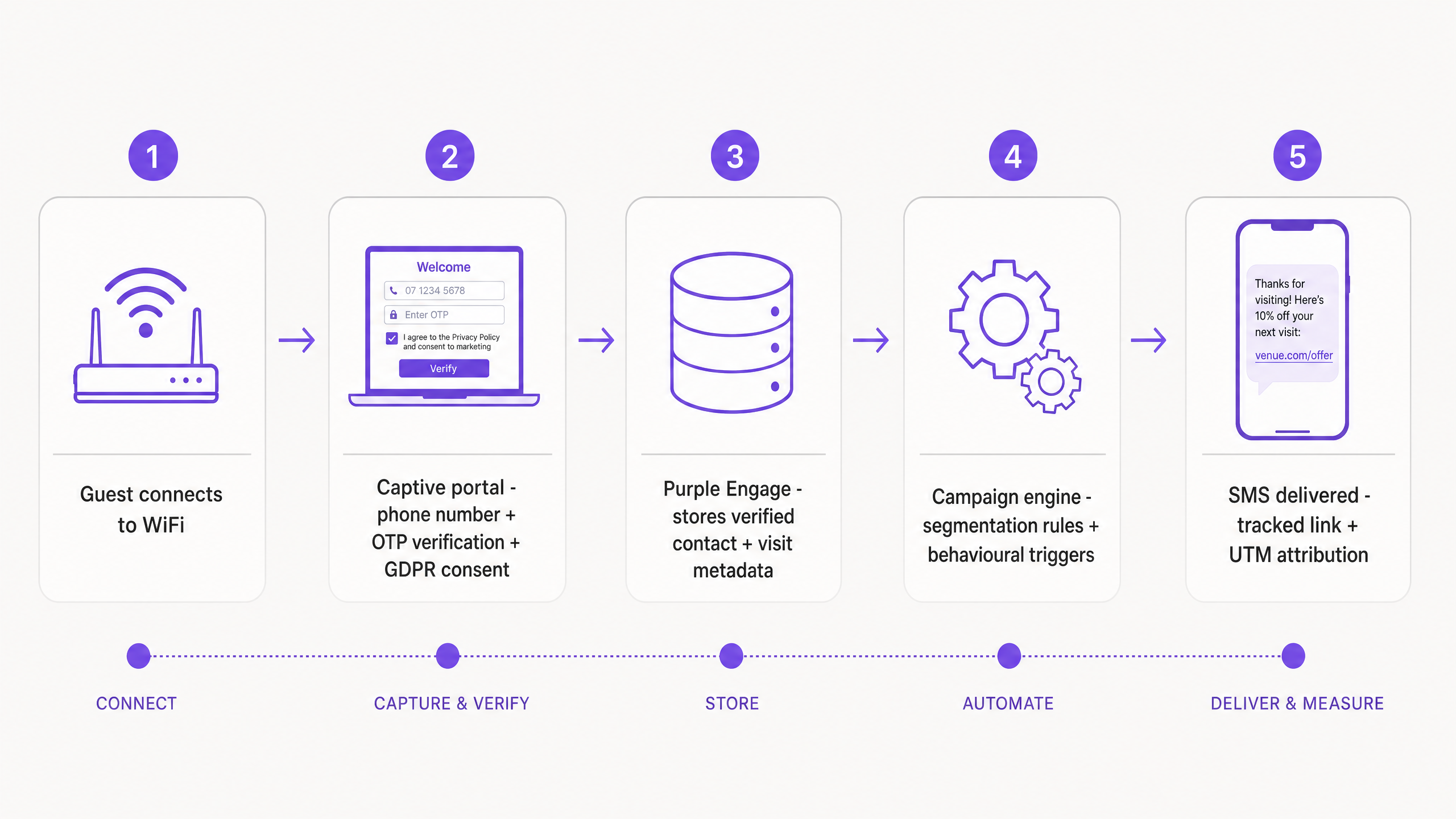
The five-stage data flow works as follows. Stage one: the access point detects an unauthenticated device and redirects it to the captive portal. Stage two: the portal presents a branded login screen with a GDPR-compliant consent checkbox and prompts the visitor to enter their phone number. A One-Time Passcode (OTP) is dispatched to that number immediately. Stage three: the visitor enters the OTP, confirming they hold the device. Purple Engage stores the verified number alongside the visit metadata - venue ID, timestamp, dwell time, and visit frequency. Stage four: the campaign engine evaluates the visitor against your segmentation rules and queues the appropriate automated SMS. Stage five: the message is delivered to the verified device with a UTM-tracked link, closing the attribution loop back to your analytics dashboard.
Purple processed 440 million logins in 2024 across more than 80,000 live venues, demonstrating the scale at which this architecture operates reliably. Purple maintains 99.999% uptime and holds ISO 27001 certification.
Compliance and Consent Management
Capturing the phone number is only the first step. You must secure explicit, granular consent to market to that number. GDPR and CCPA mandate that consent for marketing communications must be separate from the general terms of service required for internet access. A pre-ticked checkbox does not satisfy this requirement.
Purple's captive portal presents a conscious-choice opt-in - a clearly labelled, unticked checkbox that the visitor must actively select. When the visitor checks this box, the system records the timestamp, the specific consent language displayed, and the session IP address. This data forms a compliant audit trail. Purple is ISO 27001 certified, GDPR and CCPA compliant, Cyber Essentials certified, and B Corp certified.
For venues operating across multiple jurisdictions, the consent framework must account for CCPA in California and emerging state-level equivalents. Purple's platform stores consent records in a format that satisfies audit requirements across all three frameworks.
Hardware Integration and Network Architecture
Purple operates as a cloud overlay, meaning it integrates with your existing network hardware rather than replacing it. The captive portal is delivered via a HTTPS redirect from the access point controller. This redirect is configured at the SSID level, so you can run a dedicated Guest WiFi SSID for marketing data capture while keeping Staff WiFi and IoT networks isolated. For more on multi-SSID architecture, see Three SSIDs to rule them all: guest, Passpoint, and IoT WiFi .
Implementation Guide
Deploying an SMS marketing platform requires a structured approach to segmentation and automation. Moving away from broadcast messaging is the single most important shift you can make to increase return visits.
Step 1: Audit Your Captive Portal
Before configuring any campaigns, verify that your captive portal captures phone numbers with OTP verification and records explicit marketing consent. A portal that only captures email addresses, or that uses social login without a phone number field, cannot support an SMS programme. If your current portal lacks these capabilities, Purple Engage's Capture plan adds them to any supported hardware configuration.
Step 2: Define Your Visitor Segments
Your WiFi Analytics provide the metadata needed to segment your audience effectively. Establish four primary segments before you configure a single campaign.
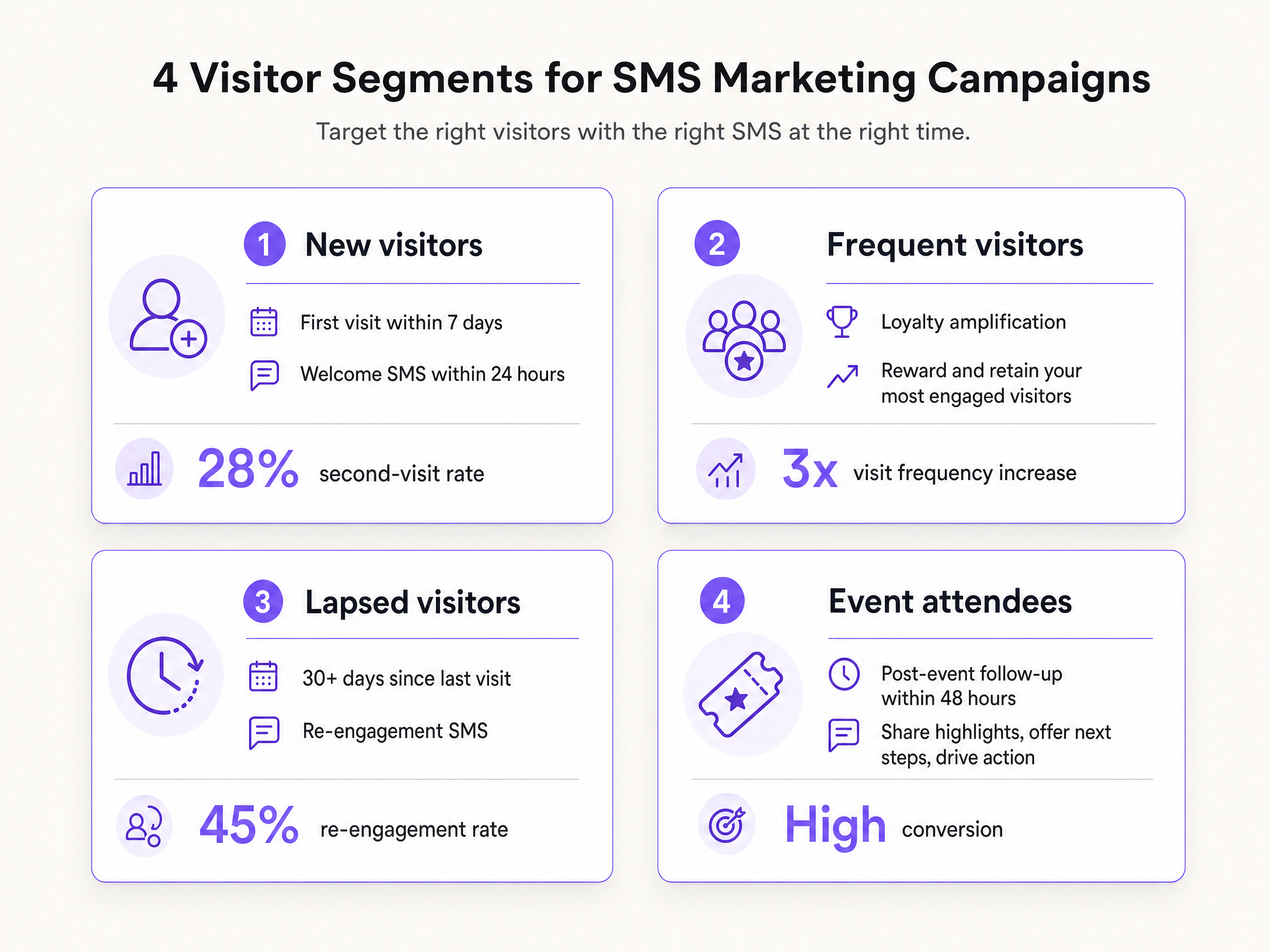
New Visitors are devices seen on the network for the first time within the last seven days. Frequent Visitors are devices seen more than three times in a 30-day period. Lapsed Visitors are devices previously seen but not detected on the network for 30 or more days. Event Attendees are devices detected during specific time windows corresponding to venue events, conferences, or matches.
Step 3: Configure Automated Triggers
Once segments are defined, configure the campaign engine to automate outreach. Start with the highest-ROI trigger: the New Visitor welcome message. Set the trigger to fire 24 hours after a first-time visitor disconnects from the Guest WiFi . The message should include a clear incentive to return. Purple data shows a 28% second-visit rate from this segment when the follow-up is sent within the 24-to-48-hour window.
For Lapsed Visitors, configure a trigger at the 30-day mark. A personalised re-engagement message - referencing the visitor's last visit date or the specific venue - achieves a 45% re-engagement rate, compared to a broadcast campaign's typical 8-12% (Purple internal data).
Step 4: Implement UTM Attribution
Every link in every SMS must carry UTM parameters. Without attribution, you cannot measure which campaigns drove return visits, and you cannot optimise your spend. Configure your campaign engine to append utm_source=sms, utm_medium=text, and utm_campaign=[campaign_name] to every outbound link. Map these parameters to your analytics dashboard to track return visits and revenue generated per campaign.
Step 5: Set Frequency Caps
Set your frequency caps before you launch, not after you observe a spike in opt-outs. Limit promotional SMS messages to two or three per month per contact. Transactional messages - booking confirmations, event reminders - do not count against this cap. Exceeding the promotional frequency threshold drives unsubscribe rates above 3.5% per send, which erodes your list faster than you can rebuild it.
Best Practices
The following practices reflect industry standards and Purple's own data from 80,000+ live venues.
Timing is context, not a calendar. SMS messages sent within five minutes of a user action - a visit, a purchase, an event check-in - achieve click-through rates of up to 36% [Emarsys, 2026]. Scheduled broadcasts to a full list achieve around 9%. Build your triggers around visit events, not arbitrary calendar slots.
Message length matters. Keep promotional SMS messages under 160 characters. Messages that exceed this limit fragment into multiple SMS units, increasing cost and reducing readability. If you need more space, use a link to a dedicated landing page.
Sender ID builds trust. For high-volume venue programmes, a dedicated short code or a verified sender ID improves deliverability and brand recognition. Long numbers work for low-volume testing but do not scale to enterprise programmes.
Integrate with your CRM. Connect your SMS marketing platform to your CRM or property management system to enrich visitor profiles with booking history, spend data, and loyalty tier. This enables hyper-personalised messages that reference specific past behaviours, which consistently outperform generic offers.
For more on creating a strong first impression at the WiFi login stage, read How to make a great first impression with your guest WiFi (and keep your brand consistent) .
Troubleshooting & Risk Mitigation
The most common failure mode in SMS marketing is high opt-out rates driven by poor segmentation. If you treat SMS like a broadcast email channel, your audience will quickly revoke their consent. A 3.5% opt-out rate per send sounds small, but across a 10,000-contact list sending monthly, you lose 350 contacts per campaign. At that rate, your list is effectively depleted within two years.
A second risk is data decay. Phone numbers change, and consent can expire under GDPR's requirement that consent remains current and specific. Ensure your platform automatically suppresses numbers that hard-bounce and processes data deletion requests within the 30-day window required by GDPR Article 17. Integrating your SMS platform directly with your Guest WiFi ensures the data remains fresh, as returning visitors re-authenticate and update their profiles.
A third risk is non-compliant consent capture. If your legal team or a data protection authority audits your SMS marketing programme, you must be able to demonstrate that every contact on your list provided explicit, informed consent. Purple's consent records include the timestamp, the consent text displayed, and the session identifier. Ensure you export and archive these records regularly.
Finally, avoid the temptation to purchase third-party phone number lists. Purchased lists are non-compliant under GDPR and CCPA, produce extremely low engagement rates, and will damage your sender reputation with mobile carriers, reducing deliverability for your entire programme.
ROI & Business Impact
The return on investment for a properly segmented SMS marketing platform is substantial. Industry benchmarks indicate an ROI between $21 and $71 for every dollar spent [Upcity, 2023; Attentive, 2024]. This high return is driven by the low cost of sending an SMS - typically a few pence per message - combined with the high conversion rate of behaviourally triggered messages.
For a mid-sized hotel property with 500 verified contacts, a single automated New Visitor campaign generating a 28% second-visit rate produces 140 additional visits per month. If the average spend per visit is £45, that is £6,300 in incremental monthly revenue from one automated trigger. The cost of 500 SMS messages is approximately £5-£15, depending on your carrier agreement.
For retail environments, the maths is similar. A shopping centre running a Lapsed Visitor re-engagement campaign to 2,000 contacts at a 45% re-engagement rate generates 900 return visits. If 30% of those visits result in a purchase averaging £35, the campaign generates £9,450 in attributable revenue.
The key metric to track is not open rate or click-through rate. It is incremental return visits per campaign. Configure your analytics dashboard to compare the return visit rate of SMS recipients against a control group of non-recipients. This is the number that justifies your investment and informs your segmentation strategy going forward.
Purple Engage's Capture and Engage plans provide the full stack: captive portal with OTP verification, consent management, segmentation engine, automated campaign triggers, and attribution analytics. Deployed on your existing Cisco Meraki, HPE Aruba, Ruckus, or Juniper Mist infrastructure, the time from configuration to first automated SMS is typically under two hours.
Key Definitions
Captive Portal
A web page that intercepts network traffic and requires user interaction before granting full internet access. In a venue context, it is the branded login screen a visitor sees when they connect to Guest WiFi.
IT teams configure the captive portal at the SSID level on the network controller. It is the primary interface where visitor data is captured and consent is recorded.
One-Time Passcode (OTP)
A numeric code sent via SMS to verify that the phone number entered by the user is valid and currently in their possession. The user must enter the code to complete the login process.
OTP prevents visitors from entering fake or mistyped numbers, ensuring the marketing database remains clean and deliverable. Without OTP, a significant proportion of captured numbers will be invalid.
First-Party Data
Information collected directly from your audience or customers, with their knowledge and consent, rather than purchased from a third party or inferred from third-party tracking.
First-party data is more accurate, more compliant, and more valuable for segmentation than third-party lists. Guest WiFi login data is a primary source of first-party data for venue operators.
Behavioural Trigger
An automated action initiated by a specific user behaviour, such as connecting to a WiFi network for the first time, or not visiting for 30 days.
Triggers move SMS marketing from manual, calendar-based broadcasts to automated, contextually relevant communications. They are the mechanism that makes a small marketing team operate at enterprise scale.
UTM Parameters
Short text codes appended to URLs to track the source, medium, and campaign name of traffic arriving at a web page. For example: ?utm_source=sms&utm_medium=text&utm_campaign=new-visitor-welcome.
IT and marketing teams use UTMs to attribute website visits, bookings, and purchases directly back to specific SMS messages, enabling accurate ROI calculation.
GDPR (General Data Protection Regulation)
EU regulation governing the collection, storage, and use of personal data. Requires explicit, informed, and granular consent for marketing communications, separate from terms of service.
Venues must ensure their captive portals capture and record consent in a way that satisfies GDPR audit requirements. Pre-ticked boxes and bundled consent do not comply.
Frequency Capping
A setting in a campaign engine that limits the number of marketing messages a contact can receive within a defined timeframe, regardless of how many campaigns they qualify for.
Essential for preventing list fatigue. Industry data shows unsubscribe rates climb above 3.5% per send when promotional SMS frequency exceeds two to three messages per month.
Attribution Loop
The process of connecting a marketing action - sending an SMS - to a measurable business outcome - a return visit or purchase - by tracking the visitor's journey from message receipt to venue arrival.
Closing the attribution loop requires integrating WiFi analytics with the SMS marketing platform. When a visitor who received an SMS reconnects to the venue WiFi, the system records that return visit as campaign-attributed.
Cloud Overlay
A software architecture in which a cloud-based platform integrates with existing on-premises hardware without replacing it. Purple operates as a cloud overlay on top of supported network hardware.
This means you do not need to replace your Cisco Meraki, HPE Aruba, or Ruckus infrastructure to deploy Purple Engage. The integration is configured at the controller level, typically in under two hours.
Worked Examples
A 200-room Premier Inn property wants to increase direct bookings and reduce reliance on Online Travel Agencies. They currently offer free WiFi but capture only email addresses at login, with no phone number field and no OTP verification.
The property upgrades to Purple Engage's Capture plan, which adds a phone number field and OTP verification to their existing captive portal, running on HPE Aruba access points. The portal is updated to include a separate, unticked marketing consent checkbox. Once the new portal is live and collecting verified phone numbers, the team configures two automated triggers in Purple Engage. The first trigger fires 24 hours after a guest checks out: "Thanks for staying at Premier Inn [location]. Book direct for your next stay and save 15%. [tracked link]". The second trigger fires at 60 days post-stay targeting guests who have not re-booked: "We'd love to see you again. Exclusive rate for returning guests: [tracked link]". Both links carry UTM parameters mapped to the hotel's booking analytics.
A large retail shopping centre wants to drive footfall to underperforming food and beverage tenants during weekday lunch hours. They have an existing Guest WiFi network on Cisco Meraki but have never used the data for marketing.
The IT team connects Purple Engage to their Cisco Meraki controller via the Purple hardware-agnostic cloud overlay. They configure the captive portal to capture phone numbers with OTP verification and marketing consent. After 30 days of data collection, they have a segmented database. They identify 'Frequent Weekday Visitors' - contacts who have connected to the network on a Tuesday, Wednesday, or Thursday in the last 30 days. They configure a scheduled SMS campaign to send at 11:15 AM on Tuesdays and Thursdays to this segment: "Lunch at [Centre Name] today? Show this text at [Cafe Name] for a free upgrade on any hot drink. Valid until 2 PM. [tracked link]". The tracked link goes to a simple landing page with the cafe's menu and location within the centre.
Practice Questions
Q1. A venue operator wants to send a promotional SMS to every contact who has ever logged into their WiFi network over the past two years to announce a new menu. Their list contains 15,000 contacts. What is the primary risk of this approach and how should they restructure the campaign?
Hint: Consider the difference between a broadcast message and a segmented campaign, and the likely age and quality of a two-year-old unsegmented list.
View model answer
This is a broadcast approach to a stale, unsegmented list. The primary risks are: high opt-out rates from contacts who have not visited in months or years and will find the message irrelevant; potential GDPR non-compliance if consent records for older contacts cannot be demonstrated; and poor deliverability if a significant portion of the numbers have changed. The operator should first audit the list to remove contacts who have not visited in more than 12 months, or segment them into a separate lapsed re-engagement campaign with a compelling incentive. The remaining active contacts should be segmented by visit recency and frequency, with tailored messages for each group. The new menu announcement should go to Frequent Visitors as a loyalty-first message, and to Recent Visitors as a timely update.
Q2. During the deployment of a new captive portal, the marketing team requests that the 'consent to marketing' checkbox be pre-ticked by default to maximise the size of the SMS database. How should the IT manager respond and what is the correct implementation?
Hint: Review GDPR Article 7 and the requirements for valid consent.
View model answer
The IT manager must reject the request. Pre-ticked boxes do not constitute valid consent under GDPR Article 7, which requires consent to be 'freely given, specific, informed and unambiguous.' The correct implementation is an unticked checkbox with clear, plain-language text adjacent to it - for example: 'I agree to receive marketing messages from [Venue Name] by SMS. You can opt out at any time by replying STOP.' The checkbox must be separate from the general terms of service checkbox. Purple's captive portal implements this correctly by default. A smaller, fully consented list will always outperform a larger, non-compliant one in both engagement and legal risk.
Q3. A stadium wants to drive merchandise sales immediately after a match finishes. They plan to send an SMS to all attendees at the final whistle. Their current setup captures phone numbers at WiFi login but the campaign engine only supports scheduled sends, not real-time triggers. How should the IT team approach this?
Hint: Consider the difference between a scheduled send and a real-time behavioural trigger, and what technical integration is required to execute the latter.
View model answer
The scheduled send approach can work if the match end time is predictable - configure the campaign to send at the expected final whistle time, targeting all contacts who connected to the stadium WiFi during the event window. However, for a true real-time trigger, the IT team needs to integrate the WiFi analytics platform with the campaign engine via API, so that the system can detect when the bulk of connected devices begin to disconnect - a reliable proxy for the match ending - and fire the campaign automatically. Purple Engage supports API-based triggers that can be connected to event management systems or manual triggers operated by venue staff. The message should be time-limited - 'valid for the next 60 minutes in the stadium shop' - to drive immediate action before fans leave the venue.