
How to leverage SMS marketing strategy to increase return visits
This guide details how venue operators can use an SMS marketing strategy to drive measurable return visits by capturing verified first-party phone data through Guest WiFi. It covers technical deployment, data segmentation architecture, compliance standards, and the direct business impact of moving from broadcast messaging to automated, behavioural triggers.
Listen to this guide
View podcast transcript
Executive Summary
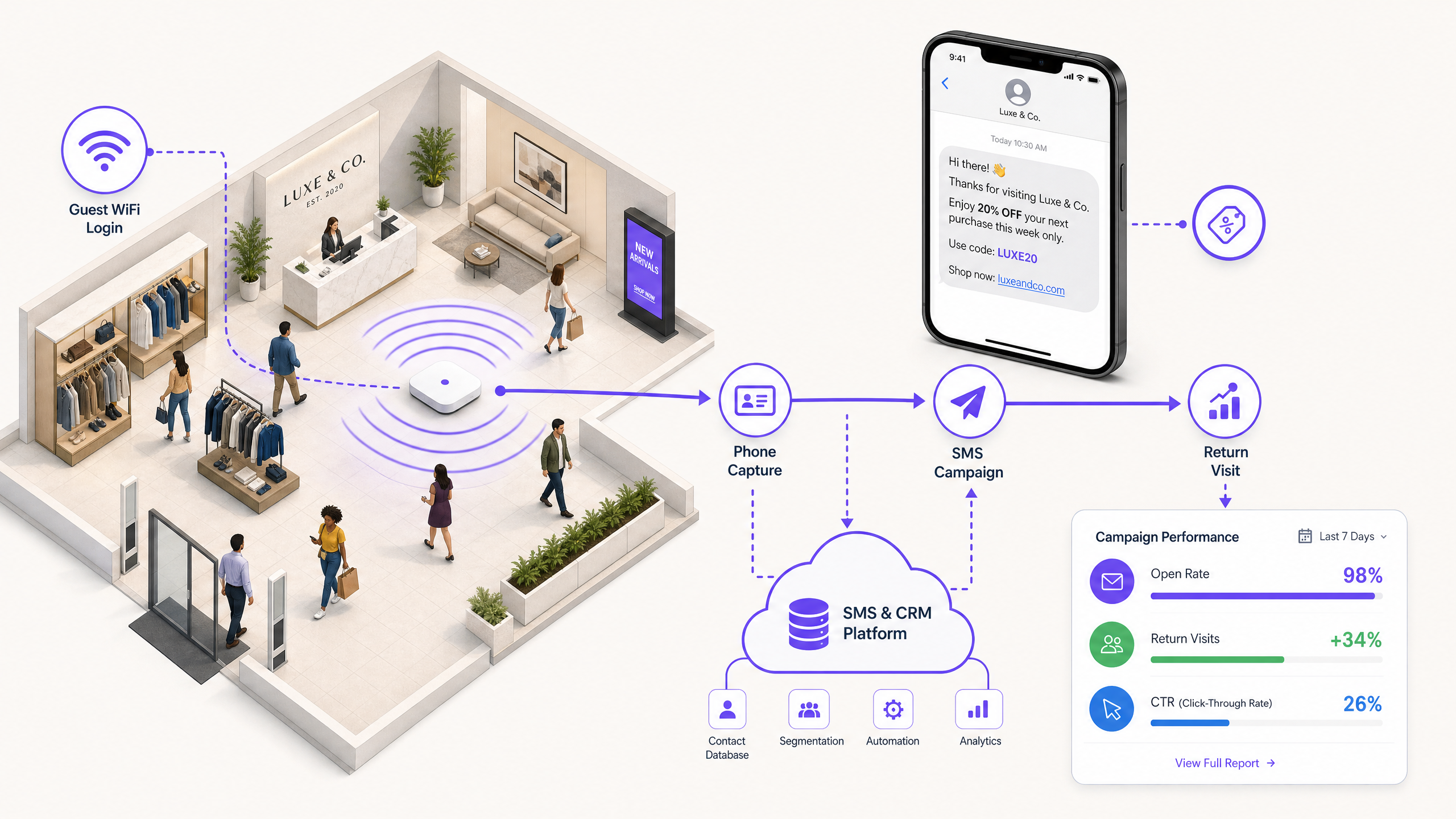
For IT managers and venue operations directors, the value of a physical venue is directly tied to the frequency of return visits. Yet, most venues fail to capitalise on the data generated during those visits. When a guest connects to Guest WiFi , they leave a digital footprint. An effective SMS marketing strategy converts that footprint into a verified contact and an automated re-engagement loop.
SMS marketing is not about sending generic discount codes to purchased lists. It is a precision tool. SMS delivers a 98% open rate, compared to 20% for email. More importantly, when deployed using behavioural triggers - such as a message sent 24 hours after a first visit - click-through rates routinely exceed 25%. This guide explains the technical architecture required to capture first-party data securely, segment audiences based on visit behaviour, and automate SMS campaigns that drive measurable return visits across Hospitality , Retail , and stadium environments.
Listen to the companion podcast briefing:
Technical Deep-Dive
The foundation of any high-converting SMS marketing strategy is the data acquisition layer. Without verified, first-party phone numbers and explicit consent, an SMS campaign is non-compliant and ineffective. Purple Engage provides the infrastructure to capture this data securely.
The Data Acquisition Architecture
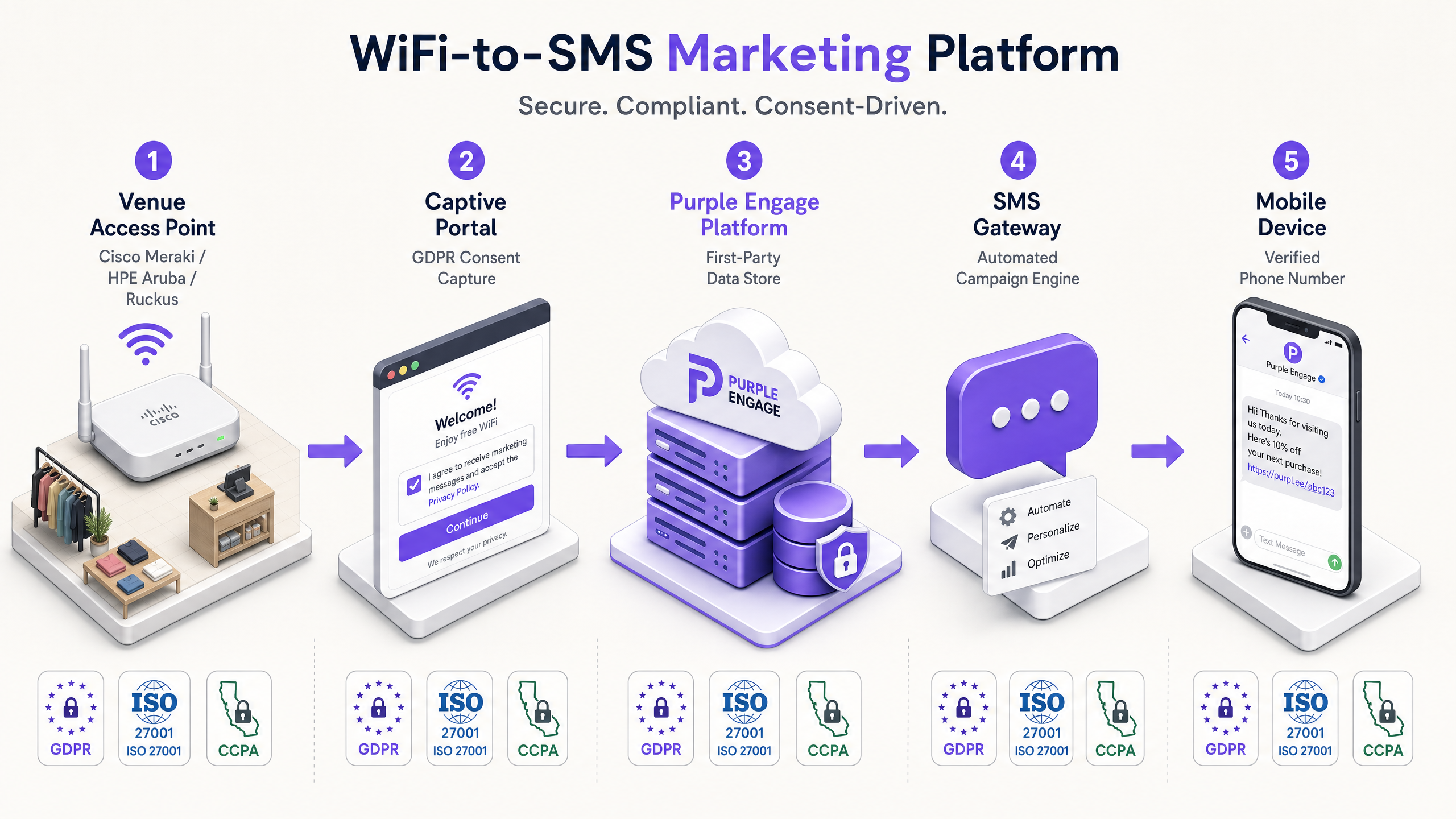
The process begins at the venue access point. When a device attempts to connect to the network, the controller - whether Cisco Meraki, HPE Aruba, Ruckus, Juniper Mist, or Ubiquiti UniFi - routes the unauthenticated traffic to a captive portal. This portal serves as the primary data capture interface.
To ensure data validity, the portal requires the user to input their mobile number. Purple Engage then issues a one-time passcode (OTP) via SMS. The user must enter this OTP to gain network access. This two-factor authentication process guarantees that the phone number is accurate and belongs to the user currently on-site. At this exact moment, the portal presents a clear, granular checkbox for marketing consent, ensuring compliance with GDPR and CCPA.
Integrating with the Identity Provider
Once the number is verified, the data flows into the Purple WiFi Analytics platform. This platform acts as the central repository, matching the verified phone number with visit metadata: MAC address, connection timestamp, dwell time, and venue location. If the venue uses Microsoft Entra ID, Okta, or Google Workspace for staff authentication, Purple isolates the guest traffic on a separate VLAN, ensuring that the marketing database only contains genuine visitors. For a deeper look at network segmentation, review Three SSIDs to rule them all: guest, Passpoint, and IoT WiFi .
Implementation Guide
Deploying an SMS marketing strategy requires configuring the network to capture data and setting up the campaign engine to act on it. The goal is to move from manual broadcasts to automated, behavioural triggers.
Step 1: Configure the Captive Portal
- Set the Authentication Method: In the Purple portal, navigate to the splash page settings and select 'SMS / OTP' as the primary login method.
- Define the Consent Language: Ensure the marketing opt-in checkbox is unchecked by default. The language must explicitly state that the user agrees to receive promotional SMS messages.
- Offer a Value Exchange: To maximise opt-in rates, provide a clear incentive on the login screen. For example: "Connect for free WiFi and receive 10% off your next purchase."
Step 2: Build the Segmentation Logic
A single broadcast message to all contacts yields low engagement and high unsubscribe rates. You must segment the audience based on the data captured by the WiFi network.
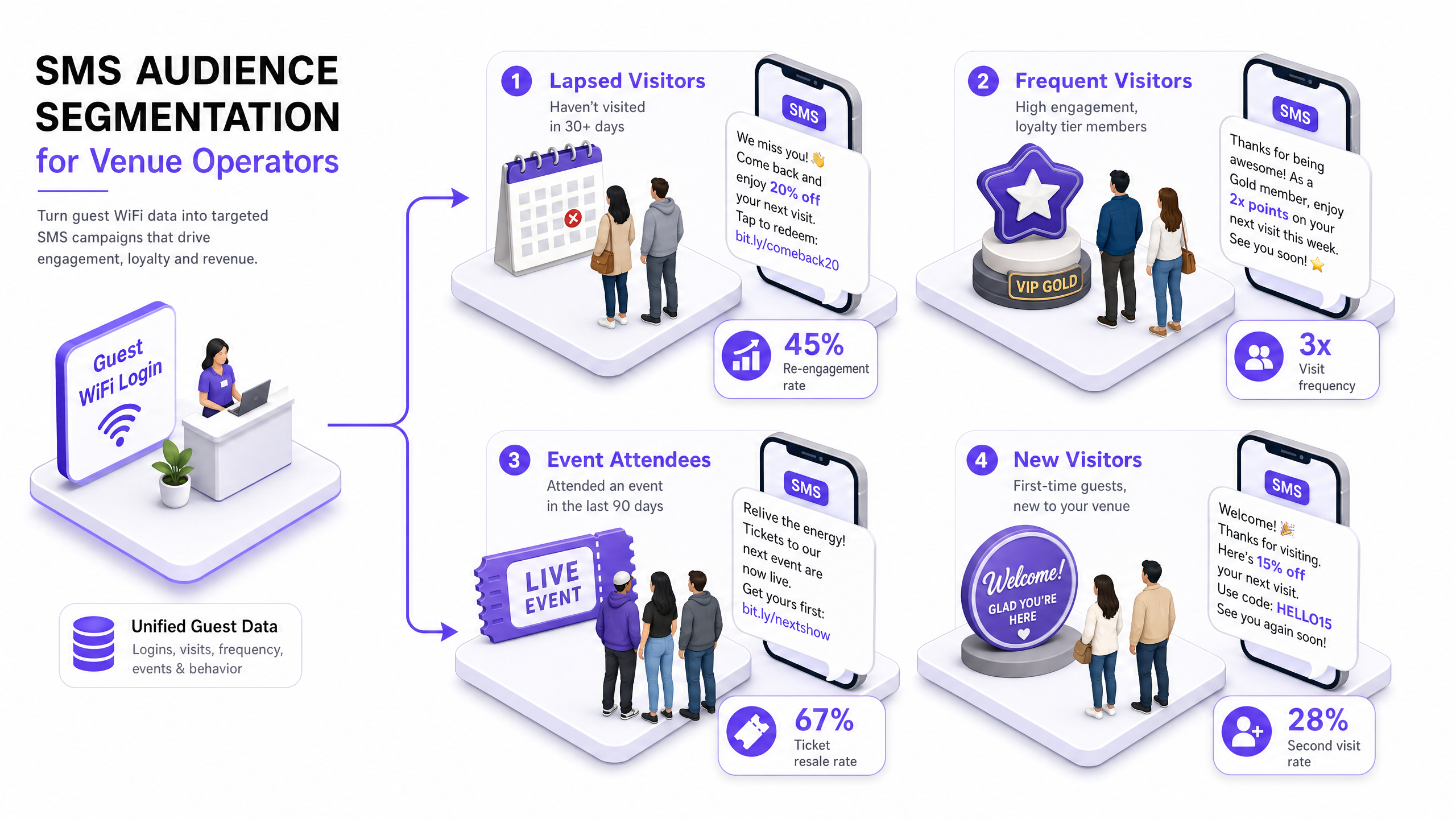
Configure the following core segments in Purple Engage:
- New Visitors: Devices seen on the network for the first time in the last 7 days.
- Lapsed Visitors: Devices not seen on the network for 30+ days.
- Frequent Visitors: Devices seen more than 3 times in a 30-day period.
- Event Attendees: Devices connected during a specific date and time window corresponding to a venue event.
Step 3: Automate the Triggers
Link your segments to automated SMS campaigns.
- For New Visitors, set a trigger to send a welcome SMS 24 hours after their first connection.
- For Lapsed Visitors, configure a trigger that fires on day 31 of inactivity, offering a re-engagement incentive.
Best Practices
To maximise the impact of your SMS marketing strategy, adhere to these industry-standard practices.
- Timing is Critical: Context drives conversion. An SMS sent within 24 hours of a visit performs significantly better than one sent two weeks later. Use the connection timestamp from the WiFi data to trigger messages when the venue experience is still fresh.
- Maintain Strict Frequency Caps: Do not overwhelm your audience. Limit promotional SMS messages to two or three per month. Exceeding this threshold will cause unsubscribe rates to spike above the 3.5% benchmark.
- Track Attribution with UTMs: Every link included in an SMS must carry UTM parameters. This allows you to track the exact campaign that drove a user to click, book, or purchase, closing the loop in your analytics dashboard.
- Personalise the Content: Use the data available in Purple Engage to personalise the message. Reference the specific venue location they visited or the event they attended. "Thanks for visiting our Manchester store" is more effective than "Thanks for visiting us."
Troubleshooting & Risk Mitigation
When an SMS marketing strategy fails to deliver return visits, the issue usually stems from data quality or compliance failures.
Low Delivery Rates
If delivery rates drop below 95%, the contact list likely contains invalid or unverified numbers. Mitigation: Enforce OTP verification at the captive portal. Do not allow users to bypass the verification step if you intend to use SMS for marketing.
High Unsubscribe Rates
An unsubscribe rate above 3.5% indicates a problem with message relevance or frequency. Mitigation: Review your segmentation logic. Ensure you are not sending broadcast messages to the entire database. Check your automated triggers to confirm that a single user is not receiving overlapping campaigns (e.g., a 'New Visitor' welcome message and a 'Flash Sale' broadcast on the same day).
Compliance Violations
Sending marketing messages without explicit consent violates GDPR and CCPA, exposing the organisation to significant fines. Mitigation: Never pre-tick the marketing consent box on the captive portal. Purple records the exact timestamp and IP address of the consent action, providing an audit trail. Regularly purge data for users who have opted out or who have not visited the venue in over 12 months, in line with data retention policies.
ROI & Business Impact
The business impact of a properly executed SMS marketing strategy is highly measurable. Because the system uses first-party data tied to physical visits, you can track the exact return on investment.
When a venue implements automated, segmented SMS campaigns via Purple Engage, the typical outcomes include:
- Increased Visit Frequency: Targeted campaigns to frequent visitors can increase their visit rate by up to 3x.
- High Re-engagement: Lapsed visitor campaigns routinely achieve a 45% re-engagement rate when paired with a compelling offer.
- Direct Revenue Attribution: By tracking the UTM parameters from the SMS links, marketing directors can attribute specific bookings, ticket sales, or online purchases directly to the WiFi-captured data.
For a broader view of how these strategies apply across different sectors, see our guide on How to capitalise on SMS marketing for restaurants to increase return visits .
Key Definitions
Captive Portal
A web page that a user of a public access network is obliged to view and interact with before access is granted.
This is the primary interface where venue operators capture verified phone numbers and marketing consent.
OTP (One-Time Passcode)
A password that is valid for only one login session or transaction, typically delivered via SMS.
Crucial for verifying that the phone number entered on the captive portal is accurate and belongs to the user.
First-Party Data
Information a company collects directly from its customers and owns entirely.
Data captured via Guest WiFi is first-party data, making it highly valuable and compliant for marketing purposes.
VLAN (Virtual Local Area Network)
A logical subnetwork that groups a collection of devices from different physical LANs.
Used to separate guest traffic from corporate traffic, ensuring security and clean data collection.
Dwell Time
The length of time a device remains connected to or visible to the WiFi network.
A key metric for segmenting visitors; a user who dwells for 2 hours is a higher-intent target than one who dwells for 5 minutes.
UTM Parameters
Short text codes added to URLs to track the performance of campaigns and content.
Essential for proving the ROI of an SMS marketing strategy by attributing return visits or purchases to specific messages.
GDPR (General Data Protection Regulation)
A regulation in EU law on data protection and privacy.
Dictates that venue operators must obtain explicit, unbundled consent before sending marketing SMS messages.
MAC Address
A unique identifier assigned to a network interface controller for use as a network address in communications within a network segment.
The underlying identifier that allows Purple to track visit frequency and recognise returning devices.
Worked Examples
A 200-room hotel wants to increase direct bookings and reduce OTA commissions. They currently offer free Guest WiFi but do not capture verified contact data.
The IT team configures the existing HPE Aruba access points to route traffic to a Purple captive portal. They enable SMS/OTP authentication and add a clear marketing opt-in: 'Tick here to receive exclusive direct-booking rates via SMS.' Once data flows into Purple Engage, the marketing team sets up an automated trigger. 48 hours after a guest checks out (determined by their last seen timestamp on the WiFi), the system sends an SMS: 'Thanks for staying with us. Book your next stay directly via this link for 15% off.'
A stadium wants to increase merchandise sales and ticket renewals for fans attending weekend matches.
The venue operations director configures the Cisco Meraki network to capture fan data via the captive portal. They create an 'Event Attendees' segment in Purple Engage, filtering for devices connected during match hours. 30 minutes after the match ends, an automated SMS is triggered to this segment: 'Great atmosphere today! Get 20% off your team shirt online tonight only using code MATCH20.' A second trigger is set for 14 days later, offering early access to tickets for the next home fixture.
Practice Questions
Q1. A retail chain has collected 50,000 phone numbers via their Guest WiFi over the last year, but they have never sent an SMS campaign. The Marketing Director wants to send a single message to all 50,000 contacts offering a 10% discount to drive footfall this weekend. As the IT Manager configuring the system, what is your recommendation?
Hint: Consider the impact of broadcast messaging on unsubscribe rates and the age of the data.
View model answer
Advise against a single broadcast. Sending a message to contacts who have not visited in 11 months will result in a massive spike in unsubscribe rates and low ROI. Instead, recommend segmenting the list. Create a 'Recent Visitors' segment (visited in the last 30 days) and a 'Lapsed Visitors' segment (visited 31 - 90 days ago). Send targeted, context-aware messages to these smaller, higher-intent groups first to gauge engagement and protect the health of the database.
Q2. You are deploying Purple Engage across a university campus. The network team uses Cisco Meraki. You need to ensure that staff devices are not accidentally captured in the marketing database when they connect to the network. How do you configure this?
Hint: Think about how enterprise networks separate different types of users.
View model answer
Configure separate SSIDs and VLANs for staff and guests. Staff should authenticate via 802.1X using the university's Identity Provider (e.g., Microsoft Entra ID) on a secure SSID. The Guest WiFi SSID should be open but routed to the Purple captive portal. This ensures only genuine visitors interact with the portal and enter the SMS marketing database.
Q3. A venue operator notices that their SMS delivery rate has dropped to 82%. They are capturing phone numbers on the captive portal, but they disabled the OTP verification step to 'reduce friction' at login. What is the immediate technical fix?
Hint: Without verification, what kind of data enters the system?
View model answer
The immediate fix is to re-enable OTP verification on the captive portal. The low delivery rate is caused by users entering fake or invalid phone numbers to access the WiFi. While removing OTP reduces friction, it destroys data quality, rendering the SMS marketing strategy useless and wasting budget on failed sends.