
How to leverage SMS marketing services to increase return visits
This guide details how to deploy SMS marketing services via guest WiFi infrastructure to capture verified mobile numbers and automate re-engagement. It covers deployment architecture, compliance frameworks, and proven strategies for increasing return visits across hospitality, retail, and event venues.
Listen to this guide
View podcast transcript
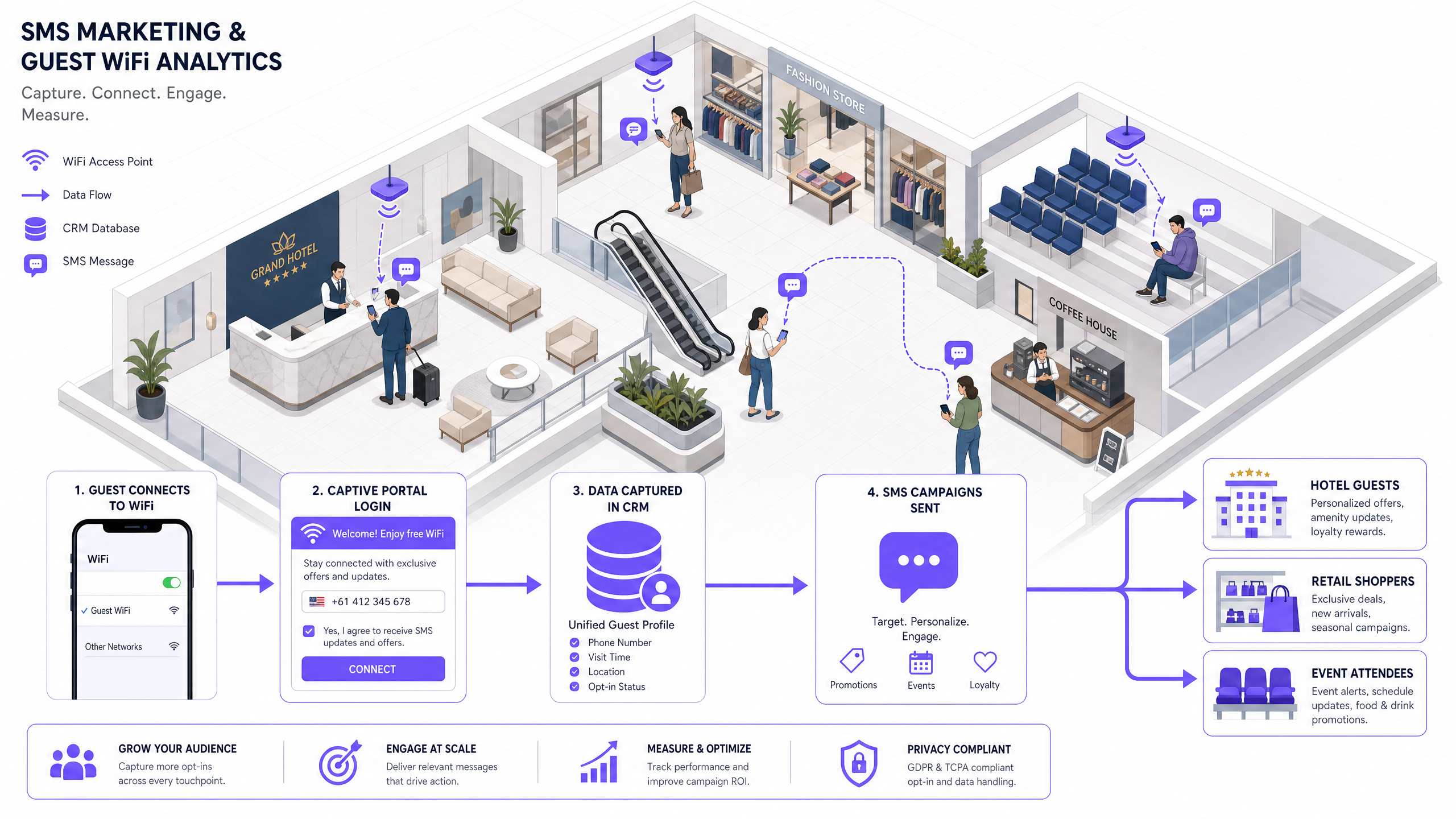
Executive Summary
SMS marketing consistently outperforms other re-engagement channels, delivering open rates of 98% and a return on investment (ROI) between $21 and $41 for every $1 spent. For venue operators, the primary challenge is not campaign execution, but compliant data capture. This technical guide explains how to use existing guest WiFi infrastructure to capture verified mobile numbers at the point of physical connection. By integrating captive portal login flows with the Purple Engage platform, IT and marketing teams can build an identity-grade, first-party data asset. This data enables automated, behaviour-triggered SMS campaigns that demonstrably increase return visits. We cover the deployment architecture, the compliance requirements for GDPR and TCPA, and the practical implementation steps required to launch an SMS marketing service within 30 days.
Technical Deep-Dive: WiFi as a Data Capture Engine
To execute SMS marketing services effectively, you need a scalable mechanism for capturing mobile numbers. Guest WiFi provides this mechanism by turning a necessary utility into a consent-driven data exchange.
The Data Capture Mechanism
When a visitor connects to the guest WiFi network, the wireless access point intercepts the traffic and redirects the device to a captive portal. This portal serves as the primary interface for data collection. Instead of relying on passive MAC address tracking, the portal requires the visitor to authenticate. By requiring a mobile number for access, the venue captures verified identity data.
Crucially, this process happens while the visitor is physically present in the venue, indicating high intent. The data captured is first-party data, owned entirely by the venue, avoiding reliance on third-party lists or cookies.
Architecture and Integration
Deploying SMS marketing services via guest WiFi requires a specific technical architecture. Purple operates as a cloud overlay, integrating with existing enterprise hardware.
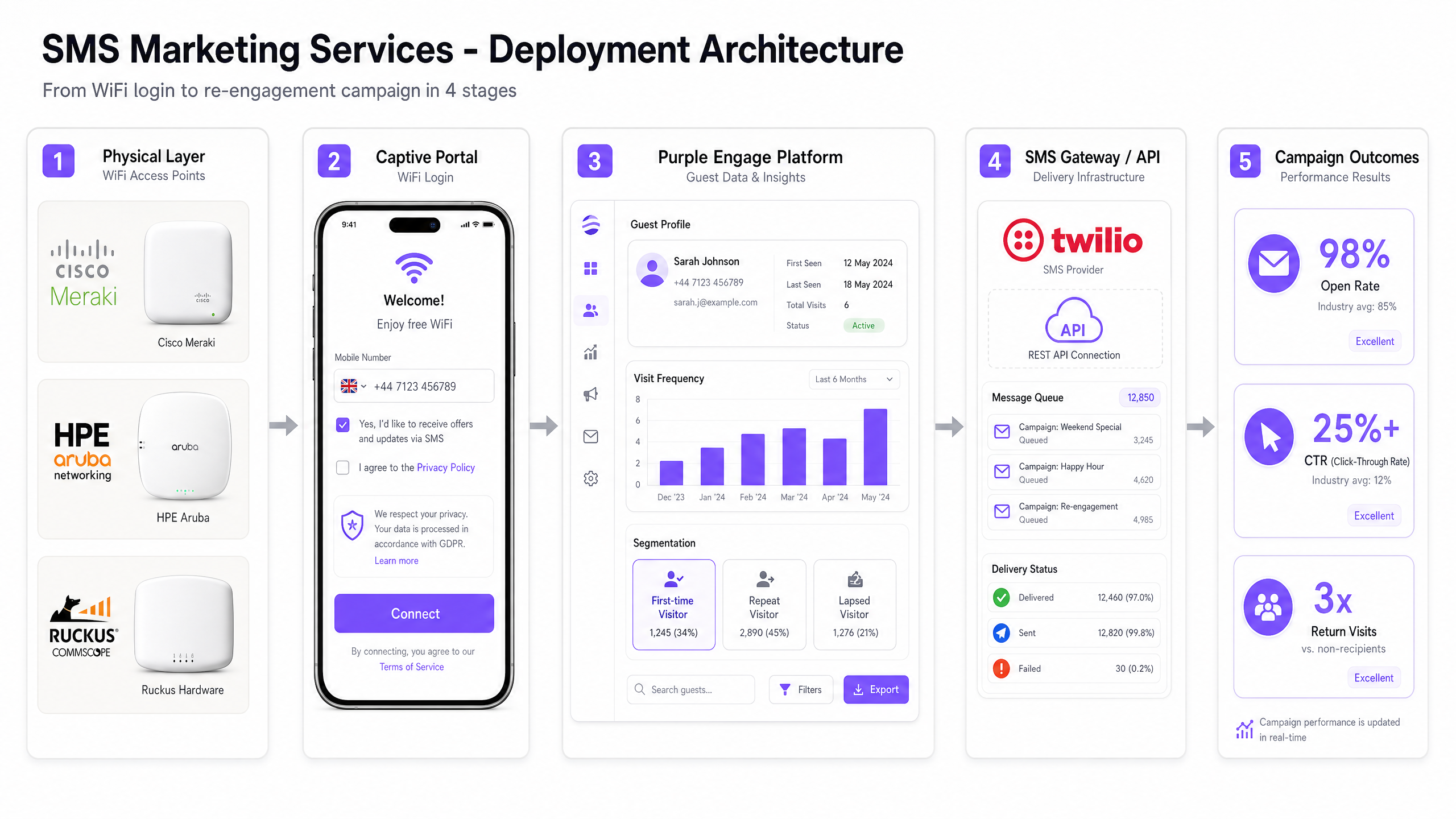
The architecture consists of four distinct layers:
- The Physical Layer: Enterprise access points from Cisco Meraki, HPE Aruba, Ruckus, Juniper Mist, or Ubiquiti UniFi handle the radio frequency connections. No hardware replacement is required.
- The Authentication Layer: The Purple cloud platform manages the captive portal, serving the splash page and processing the login request. This layer handles the immediate data validation.
- The Intelligence Layer: Purple Engage stores the captured data, building a unified guest profile. This profile aggregates visit frequency, dwell time, and location data alongside the verified mobile number and consent status.
- The Delivery Layer: Purple Engage connects via API to an SMS gateway (such as Twilio) to execute the automated campaigns based on the behavioural triggers defined in the intelligence layer.
The Importance of First-Party Data
Third-party data is increasingly unreliable and heavily regulated. Capturing first-party data through guest WiFi ensures accuracy. A visitor must provide a valid mobile number to receive an authentication code or complete the login process. This eliminates fake data entry and builds a clean, actionable database for the SMS marketing service.
Implementation Guide: Deploying the Service
Deploying an SMS marketing service using Purple Engage involves a structured configuration process. This process bridges the network infrastructure with the marketing automation platform.
Stage 1: Network Configuration
The initial step requires configuring the wireless network to route guest traffic to the Purple captive portal.
- Create a dedicated Service Set Identifier (SSID) for guest access (e.g., "Guest WiFi").
- Configure the SSID to use external RADIUS authentication, pointing to the Purple RADIUS servers.
- Set the walled garden or pre-authentication Access Control Lists (ACLs) to allow traffic to the Purple domain and necessary social login providers, ensuring the splash page loads correctly.
Stage 2: Portal Design and Data Fields
The captive portal must be designed to capture the required data without introducing excessive friction.
- Use the Purple portal builder to create a branded splash page.
- Add the mobile number field as a mandatory requirement for login.
- Add a standalone checkbox for SMS marketing opt-in. This is a critical compliance requirement (detailed in the Best Practices section).
Stage 3: Journey Automation
Once data capture is active, configure the automated campaigns within Purple Engage. These journeys trigger SMS messages based on specific visitor behaviours.
- The Welcome Journey: Trigger an SMS message 15 minutes after a first-time visitor connects. This message should offer immediate value, such as a discount code for an on-site purchase.
- The Re-engagement Journey: Trigger an SMS message if a visitor has not connected to the network for 30 days. This message aims to drive a return visit.
- The Loyalty Journey: Trigger an SMS message after a visitor completes their fifth visit, offering a reward for their continued patronage.
Best Practices: Compliance and Consent
The most significant risk in deploying SMS marketing services is regulatory non-compliance. You must adhere to the General Data Protection Regulation (GDPR) in the UK and Europe, and the Telephone Consumer Protection Act (TCPA) in the US.
Granular Consent Architecture
Consent cannot be assumed or bundled. You must design your captive portal to capture explicit, informed consent for SMS marketing.
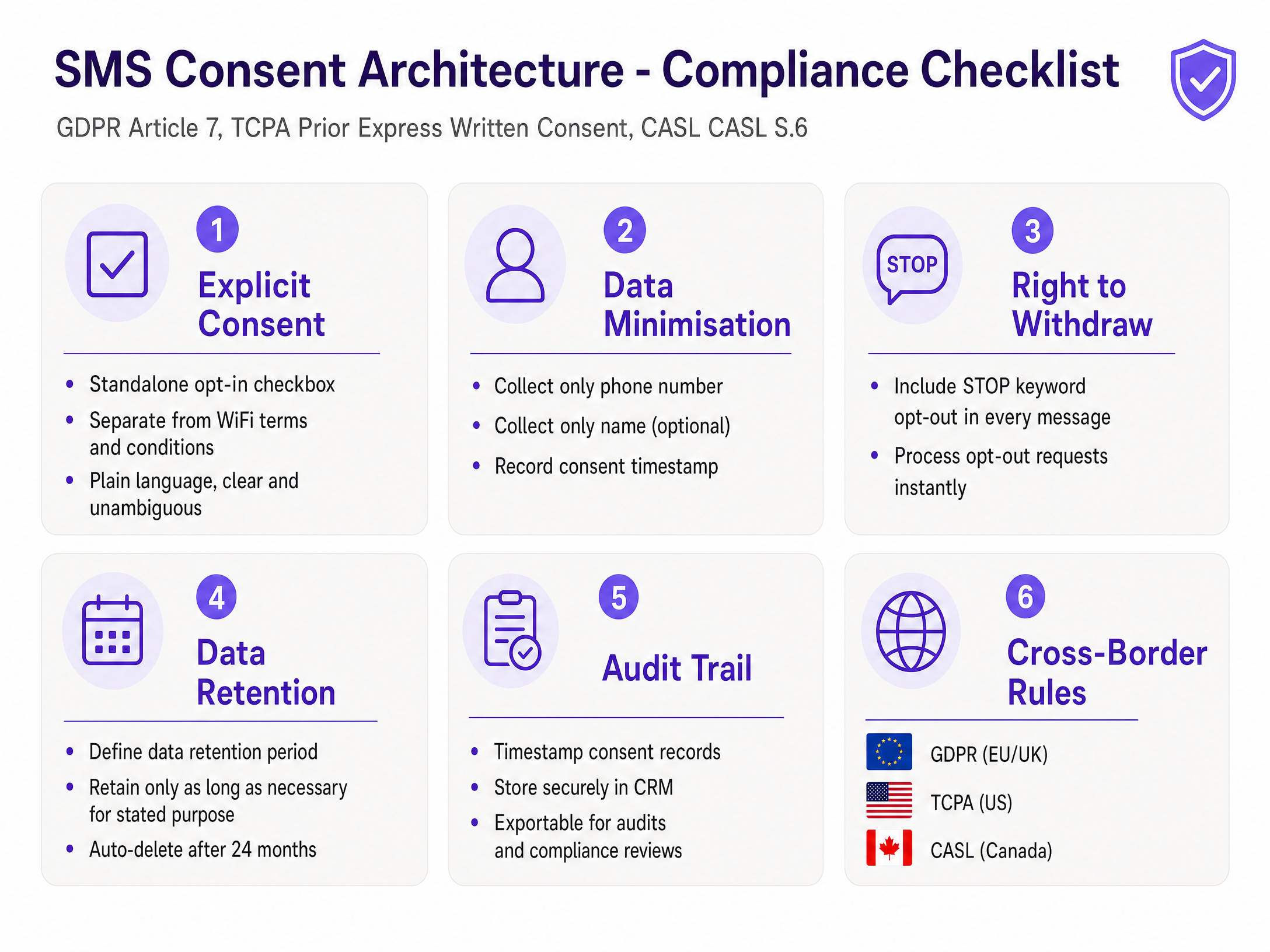
- Standalone Checkbox: The SMS opt-in must be a separate, unticked checkbox. You cannot bundle SMS consent with the general WiFi terms and conditions.
- Clear Language: The consent statement must clearly state what the visitor is opting into. Example: "I agree to receive promotional SMS messages from [Venue Name]. Message frequency varies. Reply STOP to unsubscribe."
- Timestamped Records: Purple Engage automatically records the exact timestamp, IP address, and MAC address associated with the consent event, providing an auditable trail.
Message Frequency and Suppression
Over-messaging is the primary cause of high unsubscribe rates. Limit SMS campaigns to two or three messages per month per visitor. Furthermore, you must honour opt-out requests instantly. If a visitor replies "STOP", the SMS gateway must immediately suppress that number, and the integration with Purple Engage must update the guest profile to prevent future sends.
Troubleshooting & Risk Mitigation
Even with a robust architecture, implementation issues can occur. Here are common failure modes and mitigation strategies.
Low Opt-in Rates
If visitors are connecting to the WiFi but not opting into the SMS marketing service, the value proposition is likely unclear.
- Mitigation: Offer an immediate incentive for opting in, clearly stated on the splash page (e.g., "Opt-in for 10% off your coffee today"). Ensure the opt-in checkbox is highly visible but not intrusive.
High Unsubscribe Rates
If visitors opt out shortly after receiving their first message, the content is either irrelevant or too frequent.
- Mitigation: Review the campaign triggers. Ensure messages are contextual to the venue and offer genuine value. Segment the audience more granularly; a generic broadcast message will perform worse than a targeted offer based on visit history.
Data Synchronisation Failures
If captured mobile numbers are not reaching the SMS gateway, the campaign cannot execute.
- Mitigation: Monitor the API connection between Purple Engage and the SMS provider. Check the Purple connector logs for authentication errors or rate-limiting issues. Ensure the mobile number format is standardised (e.g., E.164 format) during the captive portal capture phase.
ROI & Business Impact
To justify the investment in SMS marketing services, you must measure the direct impact on visitor behaviour and revenue.
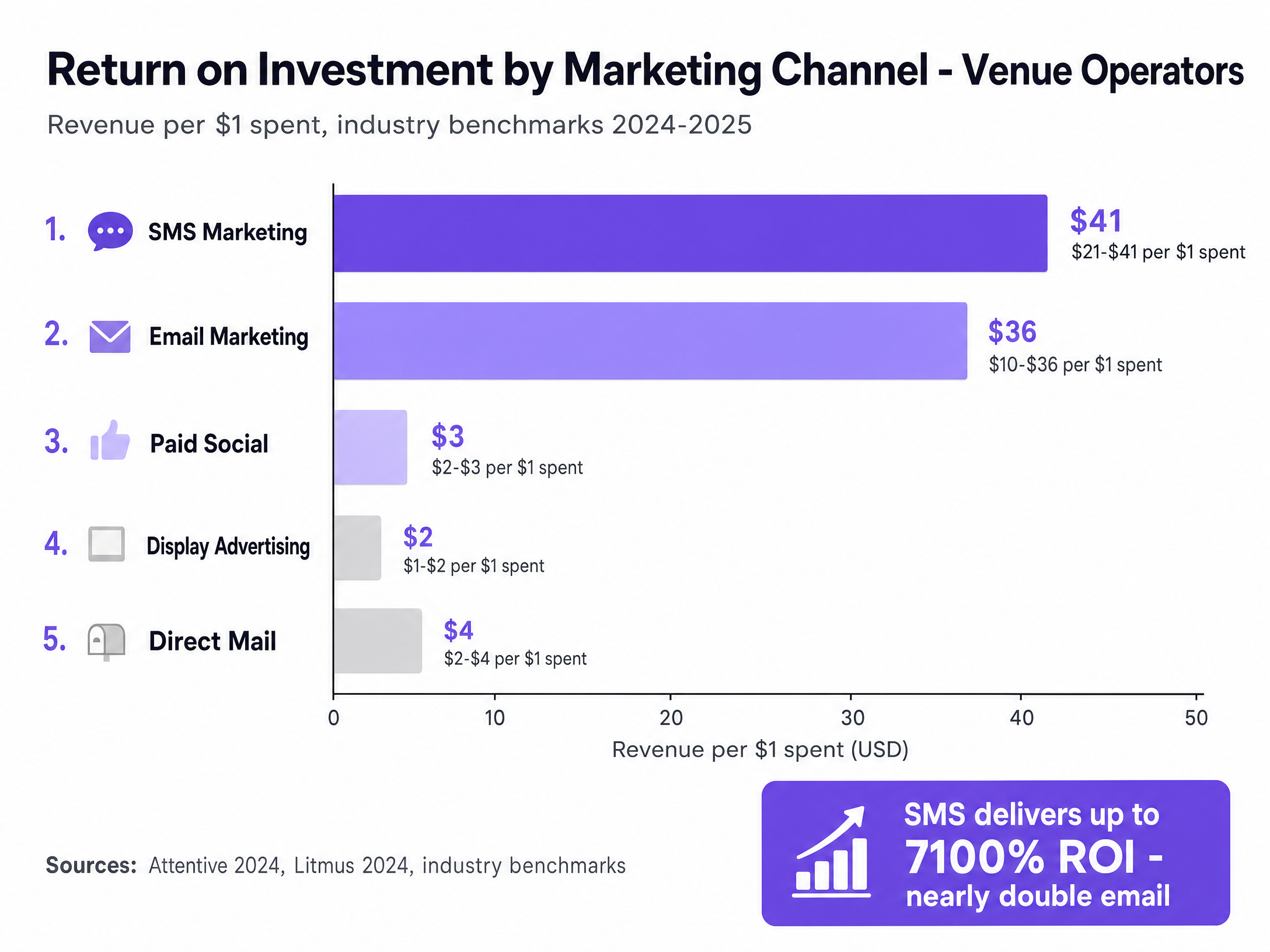
Measuring Return Visits
The primary metric for success is the return visit rate. Purple WiFi Analytics tracks device presence over time. By comparing the return visit frequency of visitors who opted into SMS against a control group of visitors who did not, you can isolate the impact of the SMS campaigns.
Industry data indicates that SMS recipients visit up to three times more frequently than non-recipients.
Cost-Benefit Analysis
Calculate the ROI by comparing the cost of the SMS sends against the revenue generated by the return visits.
- Determine the average spend per visit for your venue.
- Calculate the total number of return visits directly attributed to the SMS campaigns.
- Multiply the attributed return visits by the average spend to calculate total campaign revenue.
- Subtract the cost of the SMS gateway and the Purple Engage platform.
For example, if an automated re-engagement campaign costs $500 in SMS fees and generates 450 return visits at an average spend of $60, the revenue is $27,000, resulting in an ROI exceeding 5,000%. This data-driven approach moves SMS marketing from a speculative expense to a measurable revenue driver.
Key Definitions
Captive Portal
A web page that a user of a public access network is obliged to view and interact with before access is granted. It is the primary mechanism for data capture in a guest WiFi environment.
IT teams configure the network to redirect unauthenticated traffic to the captive portal, turning network access into a data collection opportunity.
First-Party Data
Information a company collects directly from its customers or visitors. In this context, it is the mobile number and visit history captured via the guest WiFi.
Marketing directors prioritise first-party data because it is accurate, owned by the venue, and not subject to the privacy restrictions impacting third-party cookies.
RADIUS (Remote Authentication Dial-In User Service)
A networking protocol that provides centralised authentication, authorisation, and accounting management for users who connect and use a network service.
Network architects configure the venue's access points to communicate with Purple's RADIUS servers to validate guest logins.
TCPA (Telephone Consumer Protection Act)
A US federal law that restricts telemarketing calls and the use of automated telephone equipment, requiring prior express written consent for promotional SMS messages.
Venue operators must ensure their captive portal consent language complies with TCPA to avoid significant legal penalties.
Automated Journey
A pre-configured sequence of marketing actions triggered by specific user behaviours or data points, rather than manual intervention.
CRM managers use automated journeys in Purple Engage to send SMS messages based on visit frequency (e.g., welcoming a new visitor or re-engaging a lapsed one).
SSID (Service Set Identifier)
The primary name associated with an 802.11 wireless local area network (WLAN).
IT managers deploy a specific guest SSID (e.g., 'Venue_Free_WiFi') to isolate public traffic from internal networks and route it through the captive portal.
Suppression List
A database of contacts who have opted out of receiving communications. Messages must not be sent to numbers on this list.
Marketing teams must ensure that when a visitor replies 'STOP' to an SMS, their number is instantly added to the suppression list to maintain compliance.
Return Visit Lift
The measurable increase in visit frequency among a specific cohort (e.g., SMS recipients) compared to a baseline or control group.
Venue operations directors use this metric to prove the ROI of the SMS marketing service, demonstrating that the campaigns actively drive footfall.
Worked Examples
A national retail chain with 50 locations wants to implement SMS marketing services to drive mid-week footfall. They currently offer free guest WiFi but do not require authentication. How should they architect the solution?
- Deploy Purple Engage across all 50 locations, integrating with their existing wireless access points via RADIUS.
- Reconfigure the guest WiFi SSID to route to a Purple captive portal.
- Design the portal to require a mobile number for access, including a clear, unticked checkbox for SMS marketing consent.
- Set up an automated journey in Purple Engage: If a visitor connects on a weekend but has not visited on a Tuesday or Wednesday in the past 30 days, trigger an SMS on Tuesday morning offering a mid-week discount.
A stadium operator captures 10,000 mobile numbers per match day via guest WiFi. They want to use SMS marketing to increase merchandise sales during the event. What is the optimal campaign setup?
- Ensure the captive portal explicitly states that SMS messages may be sent during the event.
- Create an automated journey in Purple Engage triggered by 'Network Presence'.
- Set a delay of 60 minutes after the initial connection.
- Send an SMS offering a time-limited discount at the merchandise store (e.g., 'Show this text for 15% off at the North Stand store until half-time').
Practice Questions
Q1. A hotel chain wants to launch an SMS campaign to promote a new restaurant. They plan to export the mobile numbers collected from their guest WiFi over the past two years and upload them to a new SMS gateway. What is the primary risk?
Hint: Consider the specific consent requirements for SMS marketing under GDPR and TCPA.
View model answer
The primary risk is regulatory non-compliance. If the historical data was collected without a specific, standalone opt-in for SMS marketing (e.g., if consent was bundled into the general WiFi terms), sending promotional messages to those numbers violates GDPR and TCPA. The hotel must verify that explicit SMS consent was recorded for every number before initiating the campaign.
Q2. You have configured the Purple captive portal to require a mobile number, but the opt-in rate for the SMS marketing service is below 5%. The WiFi connection rate remains high. How do you address this?
Hint: Review the user experience and the value proposition presented on the splash page.
View model answer
The low opt-in rate indicates a lack of incentive. To improve this, redesign the splash page to offer immediate value in exchange for consent. For example, add clear copy stating: 'Opt-in to SMS for a free drink voucher today.' Ensure the checkbox is visible but remains unticked to maintain compliance.
Q3. A venue operator wants to send a weekly SMS broadcast to their entire guest database promoting upcoming events. As the IT manager, why should you advise against this strategy?
Hint: Consider the impact of high-frequency, untargeted messaging on list health and subscriber retention.
View model answer
You should advise against this because frequent, untargeted broadcast messages lead to high unsubscribe rates and audience fatigue. SMS is an intimate channel. Instead, recommend using Purple Engage to build automated, segmented journeys based on visit behaviour - such as sending event details only to guests who have previously visited during similar events, and limiting frequency to two messages per month.