
How to leverage marketing SMS messages to increase return visits
This guide details how venue operators can use existing Guest WiFi infrastructure to capture verified phone numbers and deploy automated SMS marketing campaigns. It covers captive portal configuration, GDPR compliance, CRM integration, and the analytics required to measure return visit lift.
Listen to this guide
View podcast transcript
Executive Summary
Venue operators manage expensive physical infrastructure but often fail to monetise the digital layer. Guest WiFi provides a direct, low-friction mechanism to capture verified first-party data at the point of connection. By integrating captive portal data capture with automated SMS marketing campaigns, IT and marketing teams can build a compliant, high-engagement communication channel.
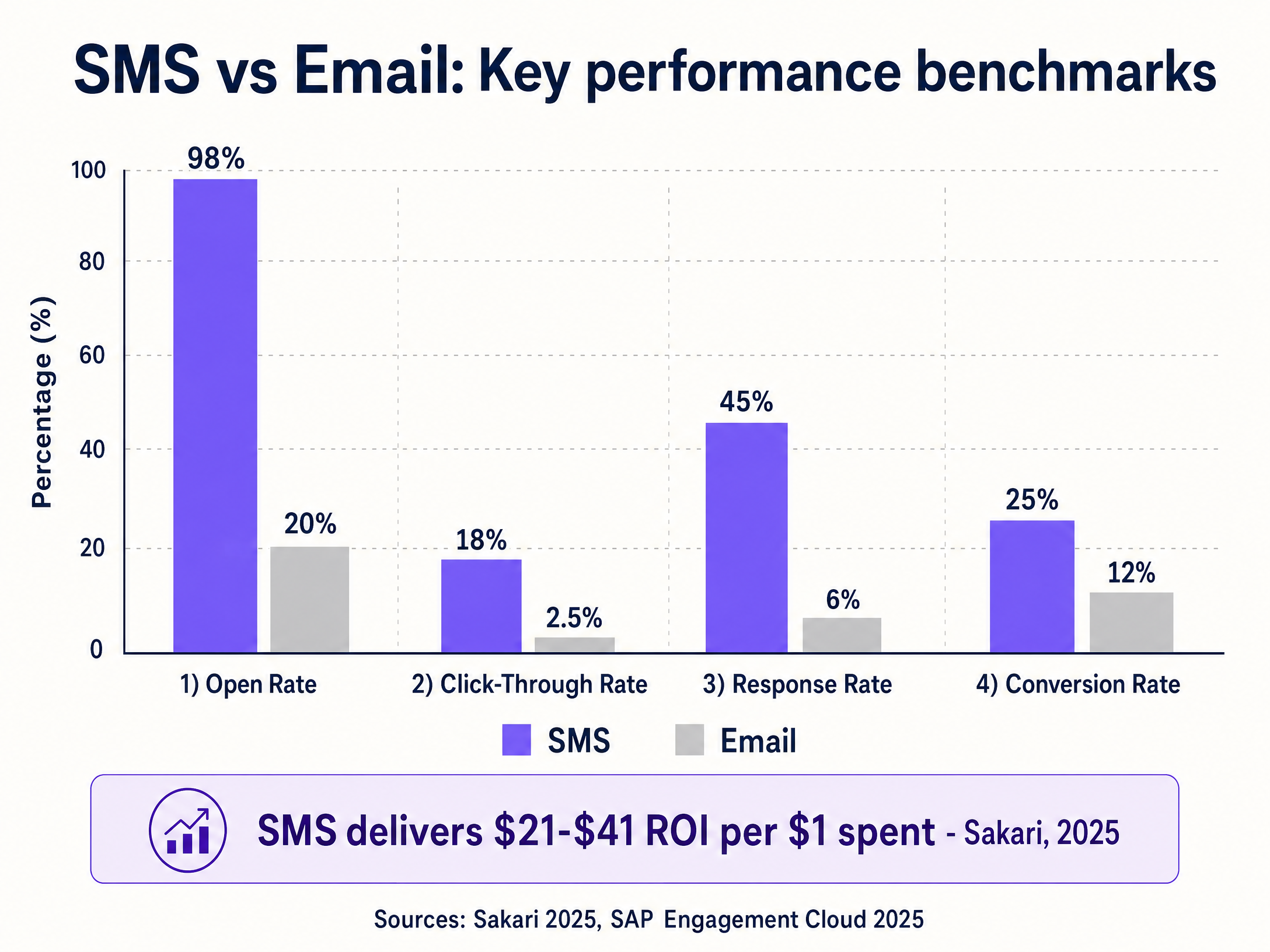
SMS marketing delivers a 98% open rate and average response rates of 45%, significantly outperforming email. When deployed correctly using a platform like Purple Engage, SMS campaigns drive measurable return visits across Retail , Hospitality , and Transport venues. This guide details the technical architecture, consent mechanisms, and deployment strategies required to implement SMS marketing securely and profitably, bridging the gap between network infrastructure and revenue generation.
Listen to the audio briefing: How to leverage marketing SMS messages to increase return visits
Technical Deep-Dive
The Data Capture Architecture
The foundation of any SMS marketing strategy is the captive portal. When a guest connects to your Guest WiFi network, the portal intercepts their traffic and presents a login screen. This is the critical moment for data capture.
The architecture relies on standard RADIUS authentication. When the user submits their details (name, email, phone number), the captive portal sends an Access-Request to the RADIUS server. Upon successful validation and policy checks, the server returns an Access-Accept message, granting internet access. Simultaneously, the captured demographic and contact data is securely transmitted via API to a central engagement hub, such as Purple Engage.
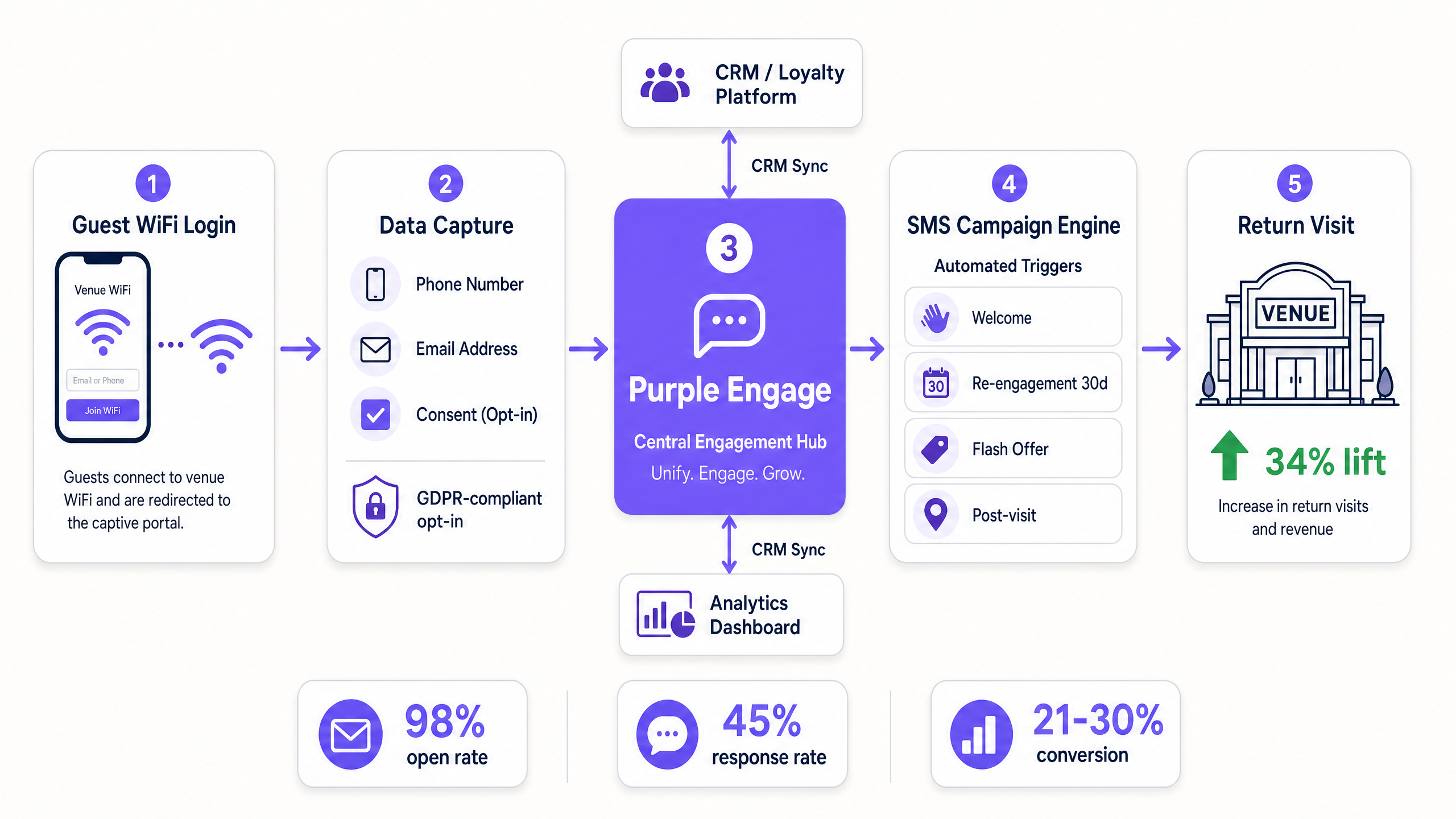
This cloud overlay approach is hardware-agnostic. Purple integrates seamlessly with Cisco Meraki, HPE Aruba, Ruckus, Juniper Mist, Ubiquiti UniFi, Cambium, Extreme, and Fortinet. You deploy the captive portal across your existing infrastructure without replacing access points or controllers.
Consent and Compliance Mechanisms
Capturing a phone number is useless if you cannot legally message it. The captive portal must be designed for strict compliance with the General Data Protection Regulation (GDPR) and the Privacy and Electronic Communications Regulations (PECR).
The opt-in mechanism for SMS marketing must be explicit, granular, and separate from the general terms and conditions required for WiFi access. Do not use pre-ticked boxes. The portal must record a time-stamped log of the consent event, including the exact language presented to the user and their IP address. Purple's infrastructure handles this logging automatically, providing an auditable trail that satisfies legal requirements.
Implementation Guide
Step 1: Configure the Captive Portal
Deploy a branded splash page that requests the user's mobile number. Keep the form simple to minimise friction. Include a clear, unticked checkbox stating: "I consent to receive marketing SMS messages regarding offers and events."
Step 2: Integrate CRM and Loyalty Systems
Do not let data sit in silos. Configure API connectors to sync the captured phone numbers and consent metadata from Purple Engage to your central CRM or loyalty platform. Purple supports over 400 integrations, including Microsoft Entra ID and Salesforce. This ensures your marketing team has immediate access to clean, verified data.
Step 3: Design Automated Campaign Triggers
Use WiFi Analytics to drive behaviour-based messaging. Set up automated triggers in Purple Engage based on presence data:
- Welcome Message: Triggered 15 minutes after the first connection.
- Re-engagement Nudge: Triggered if the guest has not connected to the network for 30 days.
- Post-Visit Survey: Triggered 24 hours after the guest disconnects from the network.
Step 4: Monitor and Segment
Avoid batch-and-blast messaging. Segment your audience based on visit frequency, dwell time, and location. A frequent shopper requires different messaging than a lapsed visitor. Use the analytics dashboard to track the return visit rate of the SMS cohort against a control group.
Best Practices
- Respect Frequency Limits: Send no more than two promotional SMS messages per month unless the user has opted into a specific, high-frequency alert programme. Over-messaging drives opt-out rates above 3.5%.
- Provide Immediate Value: Ensure the first message delivers tangible value, such as a discount code or free WiFi upgrade. This validates the user's decision to share their number.
- Include Clear Opt-Outs: Every SMS must include a simple opt-out mechanism (e.g., "Reply STOP to cancel"). Process opt-outs immediately to maintain compliance.
- Localise Content: For multi-site operators, use dynamic tags to insert the specific venue name into the message. A message from "The London Store" performs better than a generic corporate broadcast.
Troubleshooting & Risk Mitigation
Risk: High Opt-Out Rates If your unsubscribe rate exceeds 2% per campaign, you are either messaging too frequently or providing irrelevant content. Review your segmentation strategy. Ensure you are not sending generic offers to highly specific cohorts.
Risk: Low Opt-In Rates at the Portal If guests are connecting but not ticking the SMS consent box, review the portal design. Is the value exchange clear? Consider offering a tiered WiFi model: basic access requires an email, while high-speed access requires SMS consent. Read How to make a great first impression with your guest WiFi (and keep your brand consistent) for design guidance.
Risk: Integration Failures If phone numbers are not syncing to your CRM, verify the API credentials and field mapping. Ensure the CRM field accepts international dialling formats (E.164) and that the captive portal enforces this format during data entry.
ROI & Business Impact
The business case for SMS marketing via Guest WiFi is compelling. By converting anonymous footfall into known contacts, venues create an owned marketing channel that bypasses expensive third-party advertising networks.
With open rates of 98% and conversion rates frequently exceeding 20%, SMS delivers immediate impact. Avanti West Coast achieved a 463% ROI by promoting upsells through the WiFi journey. For a retail chain, a 30-day re-engagement SMS offering a 10% discount can drive a 15-25% lift in return visits among lapsed shoppers.
To measure success, track the Cost Per Acquisition (CPA) of a phone number via WiFi (which is effectively zero, as the infrastructure is a sunk cost) against the Customer Lifetime Value (CLV) of an SMS subscriber. Compare the return visit frequency of opted-in guests against anonymous guests. The data will consistently demonstrate that connected, engaged visitors return more often and spend more.
For further reading on network design to support these initiatives, see Three SSIDs to rule them all: guest, Passpoint, and IoT WiFi .
Key Definitions
Captive Portal
A web page that a user of a public access network is obliged to view and interact with before access is granted.
This is the primary data capture mechanism for venue operators, transforming anonymous network traffic into identifiable customer profiles.
First-Party Data
Information a company collects directly from its customers and owns entirely.
In a post-cookie digital landscape, capturing first-party data via Guest WiFi is critical for building sustainable marketing lists.
RADIUS
Remote Authentication Dial-In User Service; a networking protocol that provides centralised Authentication, Authorisation, and Accounting management.
RADIUS handles the backend validation when a guest submits their details on the captive portal, ensuring secure access control.
Opt-In
The process where a user takes an affirmative action to confirm their consent to receive marketing communications.
Under GDPR, an opt-in must be explicit and unbundled from other terms to be legally valid for SMS marketing.
Cloud Overlay
A software architecture that sits on top of existing hardware infrastructure to provide additional management or analytics capabilities.
Purple operates as a cloud overlay, meaning venues do not need to rip and replace their existing Cisco or Aruba access points to deploy SMS marketing.
Presence Analytics
The use of WiFi network data to determine the physical location, dwell time, and movement patterns of connected devices.
This data triggers automated SMS campaigns, such as sending a welcome message when a device is detected or a re-engagement message when a device has been absent.
PECR
Privacy and Electronic Communications Regulations; UK legislation governing electronic marketing, including SMS.
IT and marketing teams must ensure their captive portal data capture flows comply with PECR to avoid regulatory fines.
E.164 Format
The international standard format for phone numbers, ensuring global routing capability.
Captive portals must validate and format captured phone numbers to E.164 before syncing to CRMs to ensure SMS delivery success.
Worked Examples
A 350-room hotel group wants to increase direct bookings from previous guests to reduce OTA commission fees.
The hotel deploys Purple Engage across its 12 properties. They configure the captive portal to require a phone number and present a clear SMS opt-in. An automated trigger is set: 45 days after a guest disconnects from the network, they receive an SMS offering a 15% discount on their next direct booking. The campaign targets only guests who have not logged into the WiFi during that 45-day period.
A stadium operator needs to drive merchandise sales during half-time without overwhelming the concourse.
The operator segments their SMS database using Purple Engage, isolating fans currently connected to the stadium WiFi in the East Stand. At the 40-minute mark of the match, they trigger an SMS to this specific cohort offering a 20% discount on shirts ordered via the mobile app for post-match collection.
Practice Questions
Q1. A retail venue wants to start sending weekly promotional SMS messages to all users who have ever connected to their WiFi. What is the primary risk with this approach?
Hint: Consider both regulatory compliance and channel performance metrics.
View model answer
The primary risk is regulatory non-compliance if explicit SMS consent was not captured at the time of login. Even with consent, sending weekly broadcasts without segmentation leads to frequency fatigue, driving opt-out rates above the 3.5% threshold and burning through the database.
Q2. Your CRM is receiving phone numbers from the captive portal, but the SMS campaign engine is reporting a 40% delivery failure rate. What is the most likely technical cause?
Hint: Think about how data moves from user input to the messaging gateway.
View model answer
The captive portal is likely not enforcing strict E.164 formatting validation on the phone number input field. Users are entering local formats, spaces, or invalid characters, which the API syncs to the CRM, causing the SMS gateway to reject the malformed numbers.
Q3. You are managing a stadium deployment. The marketing director wants to send an SMS offer to fans as they leave the venue. How do you configure the trigger?
Hint: Rely on network presence data rather than time-of-day scheduling.
View model answer
Configure an automated trigger in Purple Engage based on a 'Disconnect' event. Set a delay of 30 to 60 minutes after the device drops off the network to ensure the fan has actually left the venue and isn't just experiencing a temporary dead zone in the concourse.