
How to leverage bulk SMS for marketing to increase return visits
This technical guide details how to build an automated data capture pipeline using Guest WiFi to drive GDPR-compliant bulk SMS campaigns. It covers the architecture required to capture verified phone numbers, segment audiences based on visit behaviour, and deploy targeted messaging that drives measurable return visits for physical venues.
Listen to this guide
View podcast transcript
Executive summary
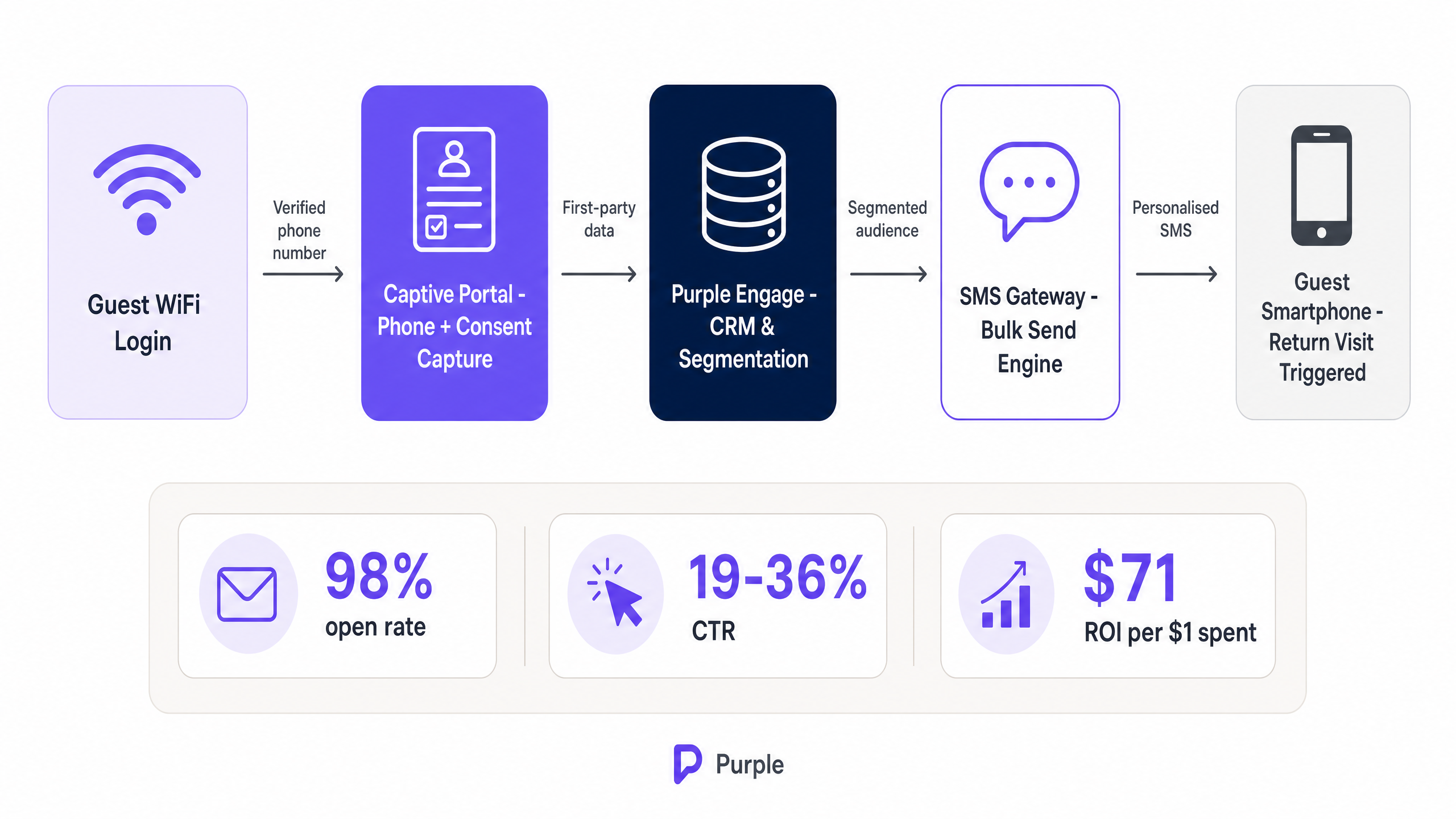
Getting a visitor through the door of your venue the first time is expensive. Getting them back is where profitability lies. Bulk SMS for marketing remains the highest-performing channel for physical venues, delivering a 98% open rate and average click-through rates between 19% and 36%. However, the traditional approach of buying lists or blasting unsegmented databases is dead.
Modern venue operators must build their SMS strategy on first-party data. By using the captive portal on your Guest WiFi network, you capture verified phone numbers and explicit marketing consent at the exact moment a guest connects. When you feed this data into a segmentation engine like Purple Engage, you transition from generic broadcast messaging to behaviour-triggered campaigns.
This guide breaks down the technical architecture required to implement this pipeline. We cover the data capture layer, the segmentation logic that drives a 34% uplift in return visits, and the strict compliance framework required by GDPR and PECR. Whether you operate a single hotel or a global retail chain, this is the blueprint for turning connectivity into measurable footfall.
Technical deep-dive: The data capture architecture
The foundation of any bulk SMS strategy is the quality of the phone numbers. Relying on staff to ask for numbers at the till or asking guests to fill out paper cards results in high error rates and poor compliance tracking. The most reliable capture mechanism in a physical venue is the network itself.
The captive portal layer
When a guest attempts to access the internet, the network controller intercepts the HTTP request and redirects the user to a captive portal. This portal serves as the authentication and data capture layer. To build an SMS marketing list, the portal must be configured to request the guest's mobile number and explicit marketing consent.
Purple operates as a cloud overlay on top of existing enterprise hardware. Whether you use Cisco Meraki, HPE Aruba, Ruckus, Juniper Mist, Ubiquiti UniFi, Cambium, Extreme, or Fortinet, the underlying architecture remains the same. The access point handles the radio frequency layer, while Purple handles the identity and policy layer via RADIUS.
Consent and compliance logging
Under GDPR Article 7, you must be able to demonstrate that consent was freely given, specific, informed, and unambiguous. The captive portal must present an unticked checkbox specifically for SMS marketing. You cannot bundle this consent with the general terms of service required to access the WiFi.
When a guest submits the form, Purple logs the mobile number, the timestamp, the IP address, the MAC address of the device, and the exact consent language displayed on the screen. This creates an immutable audit trail for every subscriber on your list.
Implementation guide: Segmentation and campaign deployment
Capturing the data is only the first step. Sending the same message to every captured number will quickly drive your opt-out rate above the 3.5% danger threshold. Effective bulk SMS requires behavioural segmentation driven by WiFi Analytics .
Behavioural triggers
Because the WiFi network sees the device MAC address every time the guest enters the venue, you have exact data on visit frequency, dwell time, and recency. This allows you to build campaigns triggered by specific behaviours rather than calendar dates.
Data from MessageFlow's 2026 benchmark report shows that messages sent within five minutes of a trigger event achieve click-through rates up to 36%, compared to 9% for scheduled broadcasts.
The four core segments
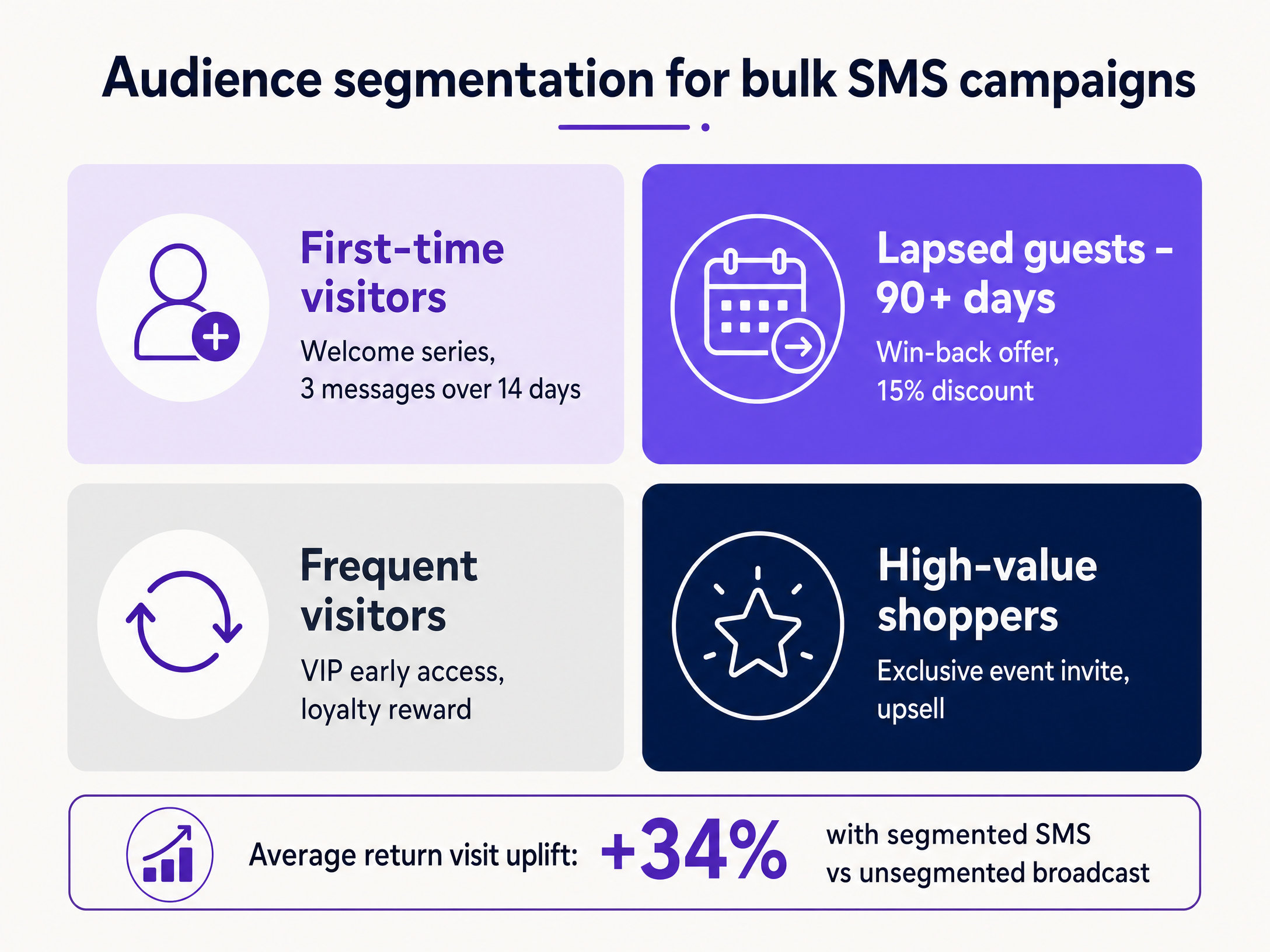
To maximise return visits, configure your CRM to automatically route guests into four primary segments:
- First-time visitors: Trigger a welcome message 48 hours after their first visit ends. Include a light incentive to return within 30 days.
- Lapsed guests: Trigger a high-value win-back offer when a guest crosses the 90-day threshold without a visit. Apply a strict deadline to create urgency.
- Frequent visitors: Exclude this group from discount campaigns. Instead, send early access invitations or loyalty rewards to recognise their status.
- High-value visitors: If you integrate point-of-sale data, identify top spenders and invite them to exclusive events.
Best practices for message delivery
When deploying the actual campaigns, adhere to these technical constraints to ensure deliverability and compliance.
Character limits and concatenation
A standard SMS message is limited to 160 characters. If you exceed this limit, the message is concatenated. This means it is split into multiple parts, transmitted separately, and reassembled on the recipient's handset. Concatenated messages cost two or more credits and have slightly lower deliverability rates. Keep your copy tight: include a personalised greeting, a clear offer, a short URL, and the mandatory opt-out instruction.
Real-time suppression
When a recipient replies "STOP", the SMS gateway must process that request instantly. The number must be added to a permanent suppression list that overrides any future campaign sends. A single message sent to a suppressed number constitutes a breach of the UK's Privacy and Electronic Communications Regulations (PECR). Ensure your API integration between the CRM and the SMS gateway handles opt-outs synchronously.
Troubleshooting and risk mitigation
Even with the correct architecture, SMS campaigns can fail if list hygiene is neglected.
Monitoring delivery rates
Your primary diagnostic metric is the delivery rate. A healthy list will maintain a delivery rate above 95%. If this number drops, it indicates that your list contains invalid numbers, disconnected lines, or numbers ported to networks outside your gateway's routing table. Run a list hygiene process every 90 days to purge numbers that have hard-bounced.
Managing frequency fatigue
Opt-out rates correlate directly with message frequency. If you send more than four messages per month to an individual, opt-outs will accelerate. Use frequency capping rules in your campaign manager to ensure no guest receives more than one message per week, regardless of how many segments they fall into.
ROI and business impact
The business case for integrating Guest WiFi with bulk SMS is compelling. By automating the data capture process, venues eliminate the manual effort and error rates associated with traditional list building.
Industry benchmarks show that SMS marketing generates $71 for every $1 spent. When you apply behavioural segmentation to these campaigns, Purple's data indicates an average return visit uplift of 34% compared to unsegmented broadcasts.
To measure this impact accurately, use UTM parameters on all links included in your SMS messages. Combine this click data with WiFi reconnection data. When a guest receives an SMS, clicks the link, and their device is subsequently seen on the venue's WiFi network within 30 days, you can confidently attribute that return visit to the campaign.
Key Definitions
Captive portal
A web page that intercepts a user's HTTP request when they connect to a public WiFi network, requiring authentication or data entry before granting internet access.
This is the primary mechanism for capturing verified phone numbers and marketing consent on physical premises.
First-party data
Information collected directly from your audience or customers, rather than purchased from a broker or aggregated by a third party.
First-party phone numbers collected via WiFi have significantly higher engagement rates and lower compliance risks than purchased lists.
Concatenated SMS
A long text message that exceeds the 160-character limit, which the network splits into multiple parts and reassembles on the recipient's phone.
IT teams must monitor character counts, as concatenation doubles the billing cost per recipient.
Suppression list
A permanent database of phone numbers that have opted out of marketing communications.
Maintaining an accurate suppression list is a strict legal requirement under GDPR and PECR to prevent messaging users who have withdrawn consent.
Delivery rate
The percentage of sent messages that successfully reach the recipient's handset, confirmed by a delivery receipt from the mobile network operator.
A delivery rate below 95% indicates poor list hygiene and requires immediate database cleaning.
Click-through rate (CTR)
The percentage of recipients who click on the URL included in the SMS message.
This is the primary engagement metric for SMS campaigns, typically ranging from 19% to 36%.
MAC address
A unique identifier assigned to a network interface controller, used to track a specific mobile device on the WiFi network.
The MAC address allows the network to recognise returning visitors automatically, enabling behavioural segmentation without requiring the guest to log in again.
RADIUS
Remote Authentication Dial-In User Service; a networking protocol that provides centralised authentication and authorisation management.
Purple uses RADIUS to communicate with the venue's access points, controlling who gets online and applying the necessary policies.
Worked Examples
A 200-room hotel wants to increase direct bookings from past guests. They currently send a monthly email newsletter but see low engagement. How should they implement an SMS strategy?
The hotel configures their Guest WiFi captive portal to require a mobile number and an opt-in checkbox. They set up a trigger in Purple Engage: 48 hours after a guest's device disconnects for the final time, an SMS fires thanking them for their stay and offering a 15% discount on their next direct booking. A second trigger fires at 11 months, prompting them to book for their anniversary.
A stadium operator with 80,000 seats wants to drive merchandise sales on match days. They have a database of 50,000 phone numbers but are worried about opt-outs if they message everyone.
The operator uses the WiFi network to identify which fans are actually inside the stadium on match day. They segment the audience and send an SMS only to fans currently connected to the network, offering a 10% discount at the club shop valid for the next two hours.
Practice Questions
Q1. Your marketing team wants to send a flash sale SMS to all 10,000 contacts in the database. The message is 185 characters long. What are the technical and financial implications?
Hint: Consider the standard character limit for SMS and the cost per message.
View model answer
The message exceeds the 160-character limit, resulting in a concatenated SMS. This means the campaign will consume 20,000 SMS credits instead of 10,000, doubling the cost. The team should edit the copy down to under 160 characters before sending.
Q2. A guest connects to the WiFi, provides their phone number, but leaves the marketing consent box unticked. Three days later, the CRM triggers a welcome SMS. What failure has occurred?
Hint: Review the requirements of GDPR Article 7 regarding valid consent.
View model answer
A severe compliance failure has occurred. The system has ignored the explicit lack of consent. The integration between the captive portal and the CRM must be configured to only sync phone numbers where the specific marketing consent boolean is true. Sending this message breaches PECR.
Q3. Your venue's SMS delivery rate has dropped from 97% to 88% over the last six months. What is the likely cause and how do you resolve it?
Hint: Think about what happens to phone numbers over time when a list is not maintained.
View model answer
The list has degraded due to poor hygiene. The 12% failure rate is likely caused by disconnected numbers or numbers that have changed networks. You must run a list hygiene pass, removing any number that has returned a hard bounce from the gateway to protect your sender reputation.