
How to Implement 802.1X Authentication with Cloud RADIUS
This technical reference guide provides a comprehensive framework for implementing 802.1X authentication with Cloud RADIUS across distributed enterprise estates. It details the architecture, EAP method selection, deployment sequencing, and risk mitigation strategies required to secure network access while eliminating the operational overhead of on-premises infrastructure.
Video overview
Listen to this guide
View podcast transcript
Part of our core series: Enterprise WiFi Security Guide →
Executive Summary
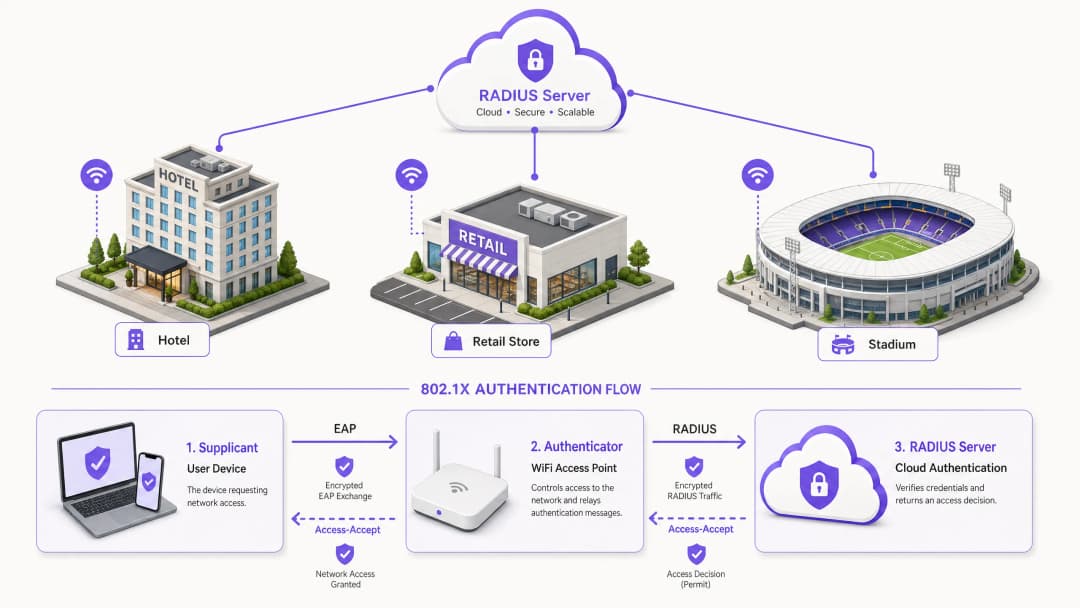
For IT decision-makers managing distributed network estates across hospitality, retail and the public sector, securing network access has shifted from an operational preference to a strict compliance mandate. Relying on Pre-Shared Keys (PSKs) introduces unacceptable risk, fails modern audit standards such as PCI DSS, and exposes the organisation to lateral movement in the event of credential compromise. Transitioning to IEEE 802.1X port-based network access control mitigates these risks effectively by authenticating devices before IP connectivity is granted.
Historically, deploying 802.1X across multi-site estates was hindered by the need for localised RADIUS infrastructure to manage latency and availability. The maturing of Cloud RADIUS architecture has fundamentally changed this picture. By centralising authentication decisions and integrating directly with cloud identity providers (such as Azure AD or Okta), organisations can enforce robust access policies uniformly across all locations without the capital expenditure and maintenance burden of on-premises servers. This guide outlines the technical architecture, deployment methodology and operational best practices for successfully implementing 802.1X authentication with Cloud RADIUS, ensuring both enterprise Guest WiFi and corporate networks remain secure and scalable.
Technical Deep-Dive
The foundation of modern enterprise wireless security is built on the IEEE 802.1X standard. Unlike application-layer authentication, 802.1X operates at Layer 2 of the OSI model. When a device (the supplicant) attempts to associate with an access point (the authenticator), the port remains in an unauthorised state, permitting only Extensible Authentication Protocol (EAP) traffic. This traffic is encapsulated in RADIUS packets and forwarded to the authentication server - the Cloud RADIUS instance. Only upon receipt of an Access-Accept message does the authenticator transition the port to an authorised state, granting network access.
Cloud RADIUS Architecture
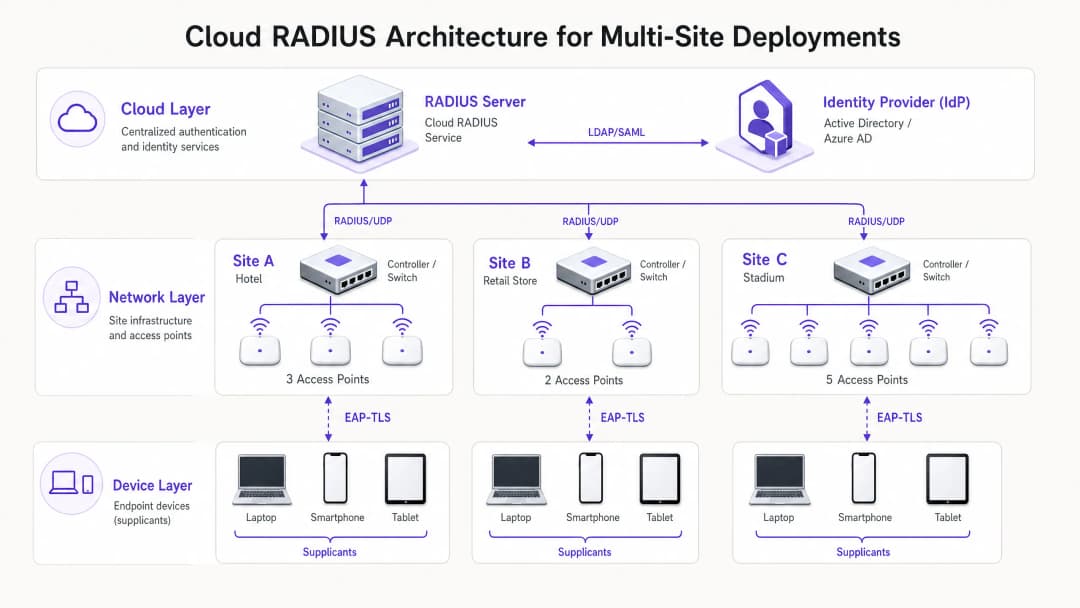
The architectural shift from on-premises to Cloud RADIUS removes the need for distributed FreeRADIUS or Microsoft NPS servers. In the cloud model, access points or wireless LAN controllers communicate directly over the internet with a globally distributed RADIUS service. To secure this transit, implementing RadSec (RADIUS over TLS) is essential, encrypting the authentication payload and protecting it from interception. The Cloud RADIUS service acts as the intermediary, validating credentials against a central Identity Provider (IdP) via LDAP, SAML or native API integrations. This enables dynamic policy enforcement, such as assigning VLANs based on Azure AD group membership, seamlessly integrating network access with the broader corporate identity management strategy.
EAP Method Selection
The choice of EAP method determines the security posture and operational complexity of the deployment.
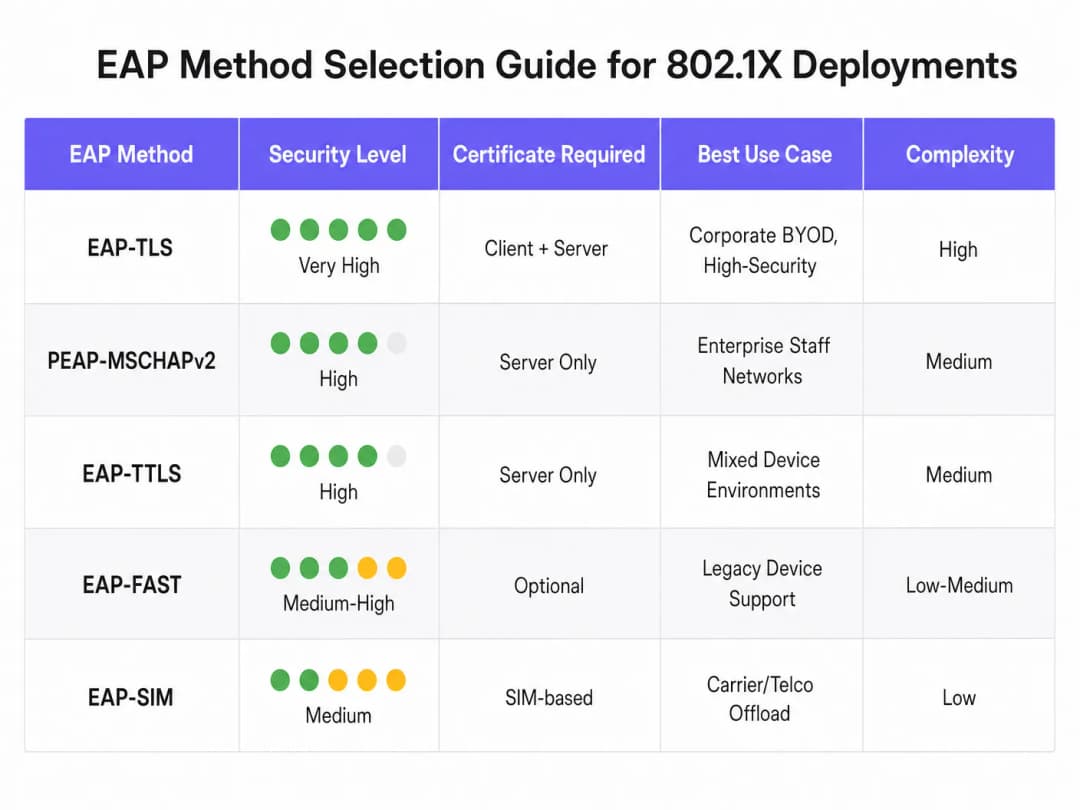
- EAP-TLS (Transport Layer Security): The most secure method, requiring both server and client certificates for mutual authentication. Because no passwords are exchanged, it eliminates the risk of credential theft. However, it requires a Public Key Infrastructure (PKI) and Mobile Device Management (MDM) to distribute client certificates. Strongly recommended for corporate devices.
- PEAP-MSCHAPv2 (Protected EAP): Widely deployed thanks to native support in Windows and its reliance on a server-side certificate only. It tunnels the credential exchange within a TLS session. While easier to deploy, it is vulnerable to credential harvesting attacks if client-side certificate validation is not strictly enforced.
- EAP-TTLS: Similar to PEAP but offering greater flexibility in the inner authentication protocol, making it suitable for environments with a diverse mix of client operating systems.
Got questions about your specific setup?
Our team works with venue operators, IT managers, and network engineers across 80,000 venues. Book a 20-minute call and we will show you how others like you solved it.
Implementation Guide
Deploying 802.1X with Cloud RADIUS requires a phased, systematic approach to minimise disruption to the existing business.
- Identity provider integration: Establish and validate the connection between the Cloud RADIUS service and the corporate IdP. Ensure directory synchronisation is accurate and that the necessary user attributes (such as group membership) are available for policy decisions.
- Certificate management: For PEAP deployments, obtain a server certificate from a trusted public Certificate Authority (CA). Crucially, configure clients via MDM or Group Policy to explicitly trust this CA and validate the server certificate name. For EAP-TLS, deploy internal CA infrastructure and begin issuing client certificates to managed devices.
- Network infrastructure configuration: Configure wireless controllers and access points to point at the Cloud RADIUS endpoints. Implement RadSec where the hardware vendor supports it. Define RADIUS shared secrets using strong cryptographically secure strings, ensuring the secret is unique per site or controller cluster.
- Policy definition: Build the authentication policies within the Cloud RADIUS platform. Define conditions based on user group, device type or location to dynamically assign VLANs or apply Access Control Lists (ACLs) upon successful authentication.
- Pilot and phased rollout: Select a representative subset of users and devices for the initial pilot. Monitor authentication logs closely to identify latency issues, certificate validation failures or incorrect VLAN assignments. Following a successful pilot, execute a phased rollout, prioritising high-risk locations such as executive offices or sites handling sensitive data.
Best Practices
- Enforce client-side certificate validation: The most common vulnerability in PEAP deployments is the failure to enforce server certificate validation on the client. If clients are permitted to blindly trust any presented certificate, they are wide open to rogue access point attacks.
- Implement MAC Authentication Bypass (MAB) with caution: For headless devices that cannot run an 802.1X supplicant (such as printers and IoT sensors), MAB can be used. However, MAC addresses are trivially spoofed. MAB devices must be isolated on heavily restricted VLANs, with strict firewall rules limiting their network access.
- Leverage 802.11r for roaming: In environments where devices move frequently between access points, the full 802.1X authentication process can introduce unacceptable latency that disrupts real-time applications such as voice. Implementing 802.11r (Fast BSS Transition) streamlines roaming by caching authentication keys.
- Integrate with analytics: For venues operating both a corporate 802.1X network and a public access network, integrating the authentication infrastructure with WiFi Analytics provides a comprehensive view of network utilisation and device behaviour across the estate.
Troubleshooting and Risk Mitigation
Authentication failures in an 802.1X environment can cause widespread connectivity outages. A robust troubleshooting process is essential.
- Certificate expiry: An expired server or client certificate will cause immediate authentication failure. Implement automated monitoring and alerting on certificate validity periods, ensuring renewals are handled well before expiry.
- Latency and timeouts: If the Cloud RADIUS service or IdP experiences high latency, the authenticator may time out and drop the connection. Configure appropriate timeout values on wireless controllers (typically 5-10 seconds) and deploy backup RADIUS servers to provide redundancy.
- RADIUS shared secret mismatch: A shared secret configured on the authenticator that does not match the one on the RADIUS server will cause packets to be silently discarded. Standardise secret management and avoid manual entry wherever possible.
ROI and Business Impact
Transitioning to 802.1X with Cloud RADIUS delivers measurable business value. By eliminating shared passwords, it dramatically reduces the attack surface, directly supporting compliance with PCI DSS (Requirements 1 and 8) and GDPR data protection mandates. Operationally, it enables centralised access control, allowing IT teams to instantly revoke a user's access across every location worldwide simply by disabling their account in the central directory. Furthermore, by decommissioning legacy on-premises RADIUS servers, organisations cut hardware maintenance costs, software licensing fees, and the administrative burden of patching and managing distributed infrastructure. For estate-wide deployments in sectors such as Retail and Hospitality, this centralised security posture is a key enabler of secure digital transformation.
Listen to our comprehensive briefing on the topic:
Key Definitions
Supplicant
The software client on an end-user device (laptop, smartphone) that negotiates network access using EAP.
IT teams must ensure the supplicant is correctly configured (often via MDM) to validate server certificates to prevent credential theft.
Authenticator
The network device (typically a WiFi access point or switch) that controls physical or logical access to the network based on the authentication status.
The authenticator acts as the middleman, relaying EAP messages between the supplicant and the RADIUS server.
Cloud RADIUS
A centralised, cloud-hosted authentication service that processes RADIUS requests from distributed network infrastructure without requiring on-premises servers.
Essential for multi-site organisations looking to implement enterprise-grade security without the hardware maintenance overhead.
EAP (Extensible Authentication Protocol)
The framework used to encapsulate authentication messages between the supplicant and the authentication server.
Choosing the right EAP method (e.g., PEAP vs. EAP-TLS) determines the security strength and deployment complexity of the wireless network.
RadSec
A protocol that transmits RADIUS data over a TLS tunnel, ensuring encryption of authentication traffic in transit.
Crucial when using Cloud RADIUS, as it protects sensitive credential exchanges from interception over the public internet.
Dynamic VLAN Assignment
The process where the RADIUS server instructs the authenticator to place a device onto a specific virtual network segment based on the user's identity or group membership.
Allows IT to broadcast a single SSID while securely segmenting traffic (e.g., putting HR staff and IT staff on different subnets).
Mutual Authentication
A security process where both the client verifies the server's identity, and the server verifies the client's identity (typically using certificates).
The defining characteristic of EAP-TLS, making it highly resistant to man-in-the-middle attacks.
MAC Authentication Bypass (MAB)
A fallback authentication method that uses a device's MAC address as its credential when it cannot support an 802.1X supplicant.
Used for legacy hardware like printers or IoT devices, but requires strict network segmentation due to the ease of MAC spoofing.
Worked Examples
A 200-room hotel operating a legacy PSK network for back-of-house operations (housekeeping tablets, point-of-sale terminals, manager laptops) needs to achieve PCI DSS compliance ahead of an upcoming audit. They lack on-site IT staff and cannot deploy local servers.
The hotel should deploy a Cloud RADIUS solution integrated directly with their central Azure AD tenant. For manager laptops (Windows/macOS), they should implement PEAP-MSCHAPv2, utilising an MDM profile to push the trusted server certificate and enforce validation. For point-of-sale terminals that may lack robust supplicants, they should utilise MAC Authentication Bypass (MAB) but strictly assign these devices to an isolated VLAN that only permits communication with the payment gateway. The deployment requires configuring the existing cloud-managed access points to point to the Cloud RADIUS IP addresses, securing the connection with RadSec.
A national retail chain is rolling out a new fleet of corporate-owned tablets for inventory management across 500 stores. They want to ensure that even if a tablet is stolen, it cannot be used to access the network, and they want to eliminate password-related helpdesk tickets.
The retailer must implement EAP-TLS. They will deploy an internal Certificate Authority (CA) and integrate it with their MDM platform. When a tablet is provisioned, the MDM pushes a unique client certificate to the device. The Cloud RADIUS service is configured to authenticate devices based solely on the presence of a valid client certificate. If a tablet is reported stolen, the IT team simply revokes that specific certificate in the CA. The Cloud RADIUS service, checking the Certificate Revocation List (CRL) or via OCSP, will immediately deny network access.
Practice Questions
Q1. Your organisation is migrating from a shared PSK to 802.1X using PEAP-MSCHAPv2. During the pilot phase, users report they can connect, but a security audit reveals that devices are silently accepting any server certificate presented to them. What is the immediate risk, and how must it be remediated?
Hint: Consider what happens if an attacker sets up an access point broadcasting your corporate SSID.
View model answer
The immediate risk is a Man-in-the-Middle (MitM) attack via a rogue access point. An attacker can broadcast the corporate SSID, present a self-signed certificate, and harvest user credentials as devices attempt to authenticate. To remediate this, the IT team must configure the supplicant profiles (via MDM or Group Policy) to explicitly validate the server certificate. This involves specifying the exact Trusted Root CA that issued the RADIUS server's certificate and strictly defining the expected server hostname.
Q2. A remote retail branch has lost its internet connection. The local access points are still powered on. Will staff devices currently connected to the 802.1X network remain connected, and will new devices be able to authenticate? Assume standard Cloud RADIUS architecture without local survivability nodes.
Hint: Think about the path an authentication request must take and the state of already authorised ports.
View model answer
Devices that are already authenticated and connected will typically remain connected until their session timeout expires or they disconnect, as the authenticator port is already in the authorised state. However, new devices attempting to connect, or devices attempting to re-authenticate, will fail. Because the internet connection is down, the access points cannot reach the Cloud RADIUS server to process the EAP exchange. This highlights the importance of resilient WAN links when relying on cloud-based authentication.
Q3. You need to secure network access for a fleet of legacy barcode scanners in a warehouse. These scanners do not support 802.1X supplicants and only support WPA2-Personal (PSK). You cannot upgrade the hardware. How do you integrate these devices into a secure network architecture alongside your 802.1X corporate devices?
Hint: You need an alternative to 802.1X that still provides access control, combined with network-level isolation.
View model answer
The recommended approach is to utilise MAC Authentication Bypass (MAB) for the barcode scanners. The access point will use the scanner's MAC address as the identity and send it to the RADIUS server. Because MAC addresses are easily spoofed, this provides weak authentication. Therefore, the RADIUS server must be configured to return a specific VLAN attribute upon successful MAB authentication. This VLAN must be heavily restricted via firewalls or ACLs, allowing the scanners to communicate only with the specific inventory servers they require, and blocking all other lateral network access.
Continue reading in this series
The Security Benefits of RADIUS as a Service for Hybrid Workforces
This technical reference guide explains how RADIUS as a Service secures network access for hybrid workforces across distributed venues. It covers the architecture, security benefits, and deployment steps for replacing on-premise RADIUS infrastructure with a cloud-managed authentication service. For IT managers and network architects at hotels, retail chains, stadiums, and public-sector organisations, this guide provides the evidence needed to evaluate and act on a cloud RADIUS migration this quarter.
Integrating RADIUS as a Service with Cloud Directories (Azure AD & Google Workspace)
This technical reference guide details how to integrate RADIUS as a Service with cloud directories - Microsoft Entra ID and Google Workspace - for enterprise WiFi authentication. It covers the architectural shift from on-premises NPS to cloud-native RADIUS, the deployment of certificate-based EAP-TLS authentication, and the operational best practices for securing wireless access across hospitality, retail, and public-sector environments. For IT managers and network architects already invested in cloud identity, this guide bridges the gap between directory management and physical network security.
What is Cloud RADIUS? A Comprehensive Guide to RADIUS as a Service
This comprehensive guide explores Cloud RADIUS (RADIUS as a Service), detailing its architecture, EAP methods, and implementation strategies. It provides IT leaders with actionable insights on migrating from on-premises servers to a scalable, secure, and compliant cloud-based authentication model.
Got questions about your specific setup?
Our team works with venue operators, IT managers, and network engineers across 80,000 venues. Book a 20-minute call and we will show you how others like you solved it.