
How to leverage SMS marketing campaigns to increase return visits
This guide details how venue operators can use guest WiFi captive portals to capture verified phone numbers and automate SMS marketing campaigns. It covers technical deployment, GDPR/TCPA compliance, segmentation strategies, and real-world case studies showing measurable return visit uplift.
Listen to this guide
View podcast transcript
Executive Summary
Guest WiFi is a ubiquitous utility in modern venues, but treating it purely as an IT cost centre misses its primary business value. When structured correctly, the authentication moment at the captive portal is a consent-based data engine. By requiring visitors to verify their phone numbers via SMS OTP to access the network, venues can build a verified, first-party database of physical visitors.
With SMS achieving a 98% open rate compared to email's 20% [1], the channel offers unmatched immediacy for driving return visits. This guide details how to use the Purple Engage plan to capture data compliantly, segment audiences based on visit frequency, and automate SMS campaigns that deliver measurable revenue uplift for retail, hospitality, and public-sector environments.
Technical Deep-Dive
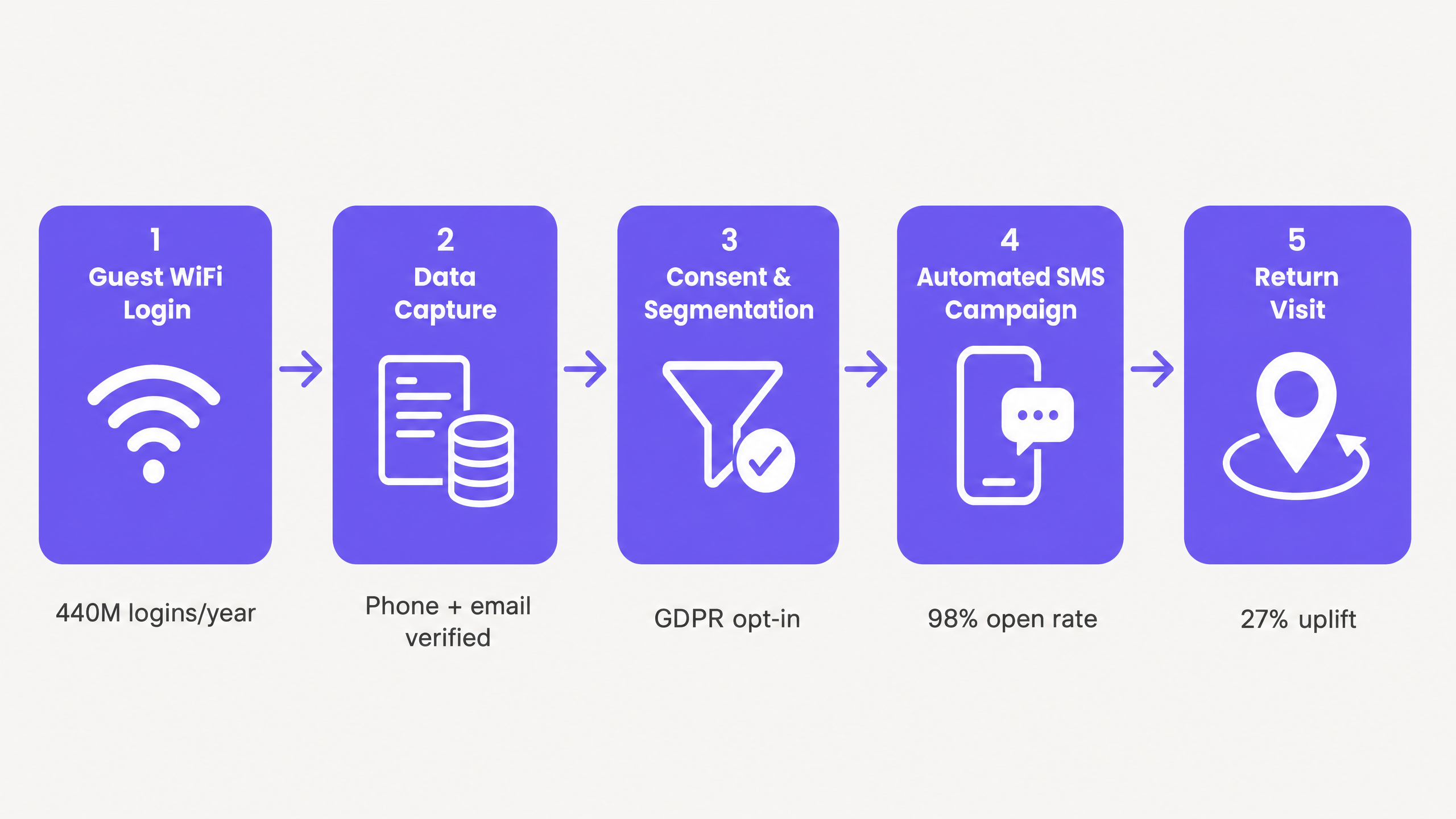
The architecture for an automated SMS marketing campaign requires three integrated layers: network access, data capture, and campaign automation.
The Network Overlay
Purple operates as a cloud overlay on your existing network hardware. It is hardware-agnostic, integrating natively with Cisco Meraki, HPE Aruba, Ruckus, Juniper Mist, Ubiquiti UniFi, Cambium, Extreme, and Fortinet. You do not need to replace access points or controllers. The integration is typically achieved via RADIUS authentication and a redirect to the Purple captive portal.
Data Capture and Verification
The captive portal is the critical conversion point. When a visitor selects the guest SSID, they are redirected to a branded login page. To access the internet, they must provide their mobile number (or authenticate via social login, which can capture the number).
To ensure data hygiene, Purple employs SMS OTP (One-Time Passcode) verification. The system sends a unique code to the provided number, which the user must enter to complete the login. This eliminates fake numbers and ensures your database only contains verified, active contacts.
Compliance and Consent Management
Capturing a phone number is not enough; you must secure explicit consent to send marketing messages. Under GDPR in the UK and EU, and the TCPA in the US, implied consent or pre-ticked boxes are invalid [2].
The captive portal must present a clear, unbundled opt-in checkbox for marketing communications. Purple handles this natively, storing the consent record, timestamp, and IP address against the visitor's profile. This provides an auditable trail if regulators request proof of consent. The system also manages opt-outs automatically; if a user replies "STOP" to an SMS, their profile is updated, and no further marketing messages are sent.
Implementation Guide
Deploying an SMS marketing programme requires moving from data collection to targeted activation. A single broadcast message to your entire database will result in high opt-out rates and diminished returns. Success relies on segmentation and automation.
Step 1: Define Your Audience Segments
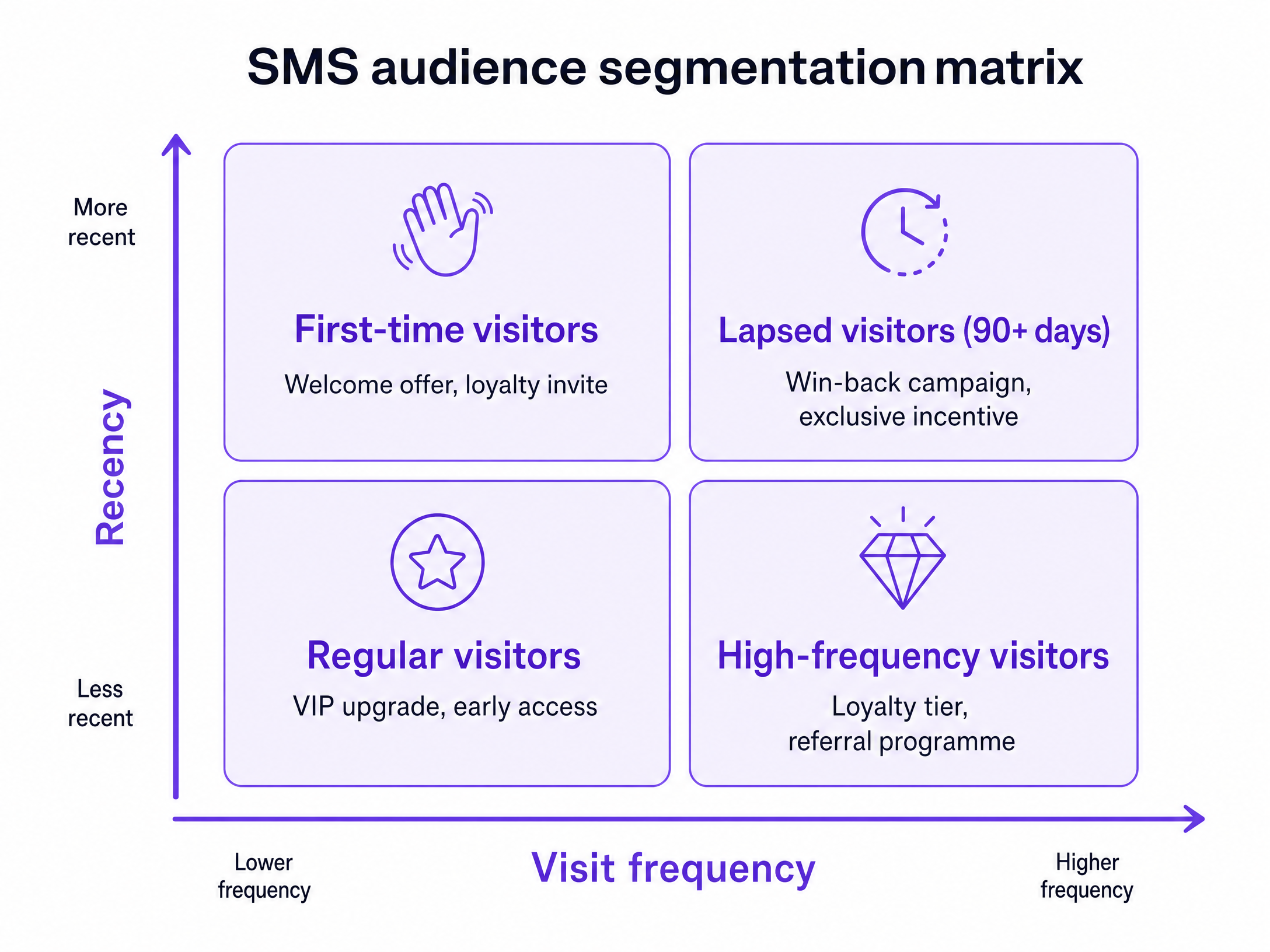
Purple's analytics engine tracks physical presence, allowing you to segment your audience based on recency and frequency. We recommend establishing four core segments:
- First-time visitors: Users who have logged in once. The goal is to convert them into repeat visitors.
- Regular visitors: Users who visit consistently (e.g., twice a month). The goal is to increase basket size or frequency.
- High-frequency visitors: Your most loyal customers. The goal is retention and advocacy.
- Lapsed visitors: Users who have not connected in a defined period (e.g., 90 days). The goal is re-engagement.
Step 2: Build Automated Workflows
Rather than manually sending campaigns, use Purple Engage to trigger messages based on visitor behaviour.
- The Welcome Campaign: Trigger an SMS 24 hours after a first-time visitor logs in. "Thanks for visiting [Venue Name]. Show this text on your next visit within 14 days for 15% off your order."
- The Win-Back Campaign: Trigger an SMS when a user's profile shows 90 days since their last login. "We've missed you at [Venue Name]. Enjoy a complimentary coffee on us this week when you drop by."
Step 3: Integrate with Your Existing Stack
Purple integrates with over 400 CRMs and marketing platforms. If you use tools like Salesforce, HubSpot, or specialised SMS gateways, you can push the verified phone numbers and visit data from Purple into your central system via API or native connectors, allowing for cross-channel orchestration.
Best Practices
- Control the Frequency: The high open rate of SMS makes over-communication punishing. Limit marketing texts to 2-4 per month maximum [3].
- Optimise Send Times: Timing dictates conversion. For venue operators, midday sends (11:00 AM - 2:00 PM) generally outperform morning or evening blasts. Never send marketing SMS after 8:00 PM to maintain compliance and respect user boundaries.
- Use Alphanumeric Sender IDs: Where supported (such as the UK), configure your sender ID to display your brand name (e.g., "PurpleWiFi") rather than a random long-code number. This increases trust and open rates.
- Track Every Link: Every URL included in an SMS must be shortened and UTM-tagged. This allows you to track click-through rates and attribute specific revenue or return visits to the campaign in your analytics dashboard.
Troubleshooting & Risk Mitigation
- Low Opt-In Rates: If less than 15% of users are opting into SMS marketing at the captive portal, the value exchange is unclear. Introduce a tangible incentive for opting in, such as immediate access to higher bandwidth or a discount code delivered via the first text.
- High Unsubscribe Rates: If your unsubscribe rate exceeds 3% per campaign, you are likely sending too frequently or your offers lack relevance [3]. Review your segmentation logic and ensure messages are targeted.
- Delivery Failures: If messages are failing to deliver, ensure you have implemented SMS OTP at the login stage to prevent users from submitting fake numbers. Also, verify that your SMS gateway is properly configured for the destination countries to avoid carrier filtering.
ROI & Business Impact
To justify the investment in guest WiFi and SMS marketing, you must measure the outcomes. The primary metrics are cost per acquisition (CPA) for a verified contact, and the uplift in return visits attributed to the campaigns.
Consider a retail chain that captures 10,000 verified phone numbers per month via their in-store WiFi. If 30% opt into marketing, they add 3,000 contacts to their database monthly. By deploying a lapsed-visitor win-back campaign via SMS (costing approximately £0.03 per message), they can drive a measurable percentage of those users back into the store.
Purple's analytics dashboard provides footfall data, allowing you to correlate the SMS send time with subsequent physical visits from those specific devices, proving the ROI of the campaign without relying on assumptions.
References
[1] MessageFlow. (2026). SMS Marketing Benchmarks 2026: CTR, Open Rates, and Conversion Data by Industry. Retrieved from https://messageflow.com/blog/sms-marketing-benchmarks/
[2] Information Commissioner's Office (ICO). (n.d.). Direct marketing and privacy and electronic communications. Retrieved from https://ico.org.uk/for-organisations/direct-marketing-and-privacy-and-electronic-communications/
[3] QuickConnect. (2026). 40 Essential SMS Marketing and Text Messaging Statistics. Retrieved from https://quickconnect.biz/blog/sms-marketing-and-text-messaging-statistics/
Key Definitions
Captive Portal
The branded web page that users must interact with before being granted access to a public WiFi network. It is the primary mechanism for enforcing terms of service and capturing user data.
IT teams deploy captive portals to secure the network, while marketing teams use them to collect verified phone numbers and opt-ins for SMS campaigns.
SMS OTP (One-Time Passcode)
A security mechanism where a unique, temporary code is sent to a user's mobile phone via SMS, which they must enter to verify their identity or device.
Crucial for data hygiene; it prevents users from entering fake phone numbers at the captive portal, ensuring the marketing database is accurate.
First-Party Data
Information a company collects directly from its customers or visitors, with their consent.
Guest WiFi is a primary source of first-party data for physical venues, reducing reliance on expensive third-party advertising networks.
PECR (Privacy and Electronic Communications Regulations)
UK legislation that sits alongside GDPR, specifically governing electronic marketing communications, including emails, calls, and SMS.
PECR mandates that venues must obtain explicit, opt-in consent before sending marketing text messages to individuals.
Sender ID
The name or number that appears at the top of a text message, identifying who sent it.
In supported regions, venues should use an alphanumeric Sender ID (e.g., 'PurpleWiFi') to increase brand recognition and open rates, rather than a generic long-code.
Dwell Time
The amount of time a visitor spends connected to the WiFi network or physically present within the venue.
A key behavioural metric captured by Purple Analytics, used to segment audiences (e.g., sending a specific offer to users who stay longer than two hours).
Hardware-Agnostic
Software that is designed to function across different types of hardware from various manufacturers without requiring modification.
Purple's cloud overlay is hardware-agnostic, meaning venues can deploy it over existing Cisco Meraki, Aruba, or Ruckus access points without buying new equipment.
Cloud Overlay
A software architecture where new services and management capabilities are delivered from the cloud, operating on top of existing physical infrastructure.
This allows IT teams to add advanced captive portal and analytics features without altering the underlying network routing or hardware controllers.
Worked Examples
A 120-location pub group wants to use guest WiFi to build a marketing database, but their current captive portal only asks for an email address, resulting in low engagement and high bounce rates on marketing emails. How should they transition to an SMS-led strategy?
- Update the Purple captive portal login flow to require a mobile phone number instead of an email address.
- Implement SMS OTP (One-Time Passcode) verification to ensure the numbers provided are active and accurate.
- Add a clear, unbundled opt-in checkbox stating: "Tick here to receive exclusive offers and updates via SMS from [Pub Group Name]."
- Create a segment in Purple Engage for 'Lapsed Customers' (no login for 45 days).
- Build an automated campaign that triggers an SMS to this segment on Thursday afternoons: "Kick off the weekend at [Pub Name]. Show this text for a free pint with any main meal before 7pm on Friday."
- Use UTM-tagged links if directing to a booking page, or track the redemption of the specific offer code at the POS.
A large shopping centre with 80,000 weekly visitors uses Cisco Meraki access points. They want to implement SMS marketing but are concerned about GDPR compliance and the IT overhead of managing opt-outs.
- Deploy Purple as a cloud overlay on the existing Cisco Meraki infrastructure; no hardware changes are required.
- Configure the captive portal to include a mandatory privacy policy link and an optional SMS marketing opt-in checkbox.
- Enable Purple's native consent management features. The system automatically logs the date, time, IP address, and consent status of every user.
- Integrate the SMS campaigns via a gateway that supports automated opt-outs. When a user replies 'STOP', the gateway updates the CRM, which syncs with Purple to ensure no further messages are sent.
Practice Questions
Q1. A retail venue wants to launch an SMS campaign targeting customers who haven't visited in 6 months. Their database contains 50,000 phone numbers collected via a legacy open WiFi network without OTP verification or explicit consent tickboxes. What is the recommended approach?
Hint: Consider the legal requirements of PECR/GDPR and the impact of sending messages to unverified numbers.
View model answer
Do not send the campaign to the legacy list. Sending marketing SMS without explicit, auditable opt-in consent violates GDPR and PECR, risking significant fines. Furthermore, without OTP verification, a large portion of the numbers may be fake or inactive, leading to high bounce rates and potential blacklisting by SMS gateways. The recommended approach is to implement Purple Engage with OTP verification and explicit consent tickboxes on the captive portal immediately, and build a new, compliant first-party database for future campaigns.
Q2. You are configuring an automated SMS campaign for a stadium to drive merchandise sales. The stadium hosts matches on Saturday afternoons. When should the promotional SMS be triggered?
Hint: Timing is critical for SMS engagement. Consider when the fan is most likely to be receptive and able to act on the offer.
View model answer
Trigger the SMS on Saturday morning, ideally between 11:00 AM and 1:00 PM, or shortly after the fan authenticates on the stadium WiFi upon arrival. Sending the message days in advance loses the immediacy of SMS. Sending it during the match interrupts the experience. A midday send on match day capitalises on the excitement and provides a timely incentive just as the fan is considering a purchase.
Q3. A hotel IT manager is hesitant to deploy a new captive portal for data capture, citing concerns about having to replace their recently installed HPE Aruba access points. How do you address this?
Hint: Focus on the architectural relationship between Purple and the underlying network hardware.
View model answer
Explain that Purple operates as a hardware-agnostic cloud overlay. It integrates natively with HPE Aruba (and other major vendors) without requiring any hardware replacement. The integration is achieved through configuration changes, typically pointing the Aruba controller to Purple's RADIUS servers for authentication and redirecting traffic to the Purple hosted captive portal. The existing infrastructure remains intact.
Continue reading in this series
How to leverage SMS marketing for restaurants to increase return visits
This technical guide explains how venue operators and IT teams can implement SMS marketing using existing guest WiFi infrastructure to drive return visits. It covers the data capture architecture, GDPR compliance requirements, and behavioural segmentation strategies that deliver measurable ROI for restaurants.
How to leverage SMS marketing solutions to increase return visits
This guide details how to architect and deploy SMS marketing solutions using the Purple Engage platform to drive return visits at hotels, retail venues, stadiums, and public-sector sites. It covers captive portal configuration, verified phone number capture via SMS OTP, GDPR-compliant consent architecture, and trigger-based campaign automation using existing wireless infrastructure from Cisco Meraki, HPE Aruba, and other supported vendors.
How to leverage SMS text marketing to increase return visits
This guide details how venue operators can use SMS text marketing to drive measurable return visits by capturing verified first-party phone data through Guest WiFi. It covers the full technical architecture from captive portal authentication to RADIUS integration, the compliance requirements under GDPR and TCPA, and the automated campaign triggers that deliver consistent ROI across hospitality, retail, and transport environments.