
How to leverage SMS campaigns for marketing to increase return visits
This guide explains how venue operators can build compliant SMS marketing campaigns using Guest WiFi data to drive measurable increases in return visits. It covers the technical architecture for capturing verified phone numbers, segmentation strategies, and the legal requirements under GDPR and PECR.
Listen to this guide
View podcast transcript
Executive summary
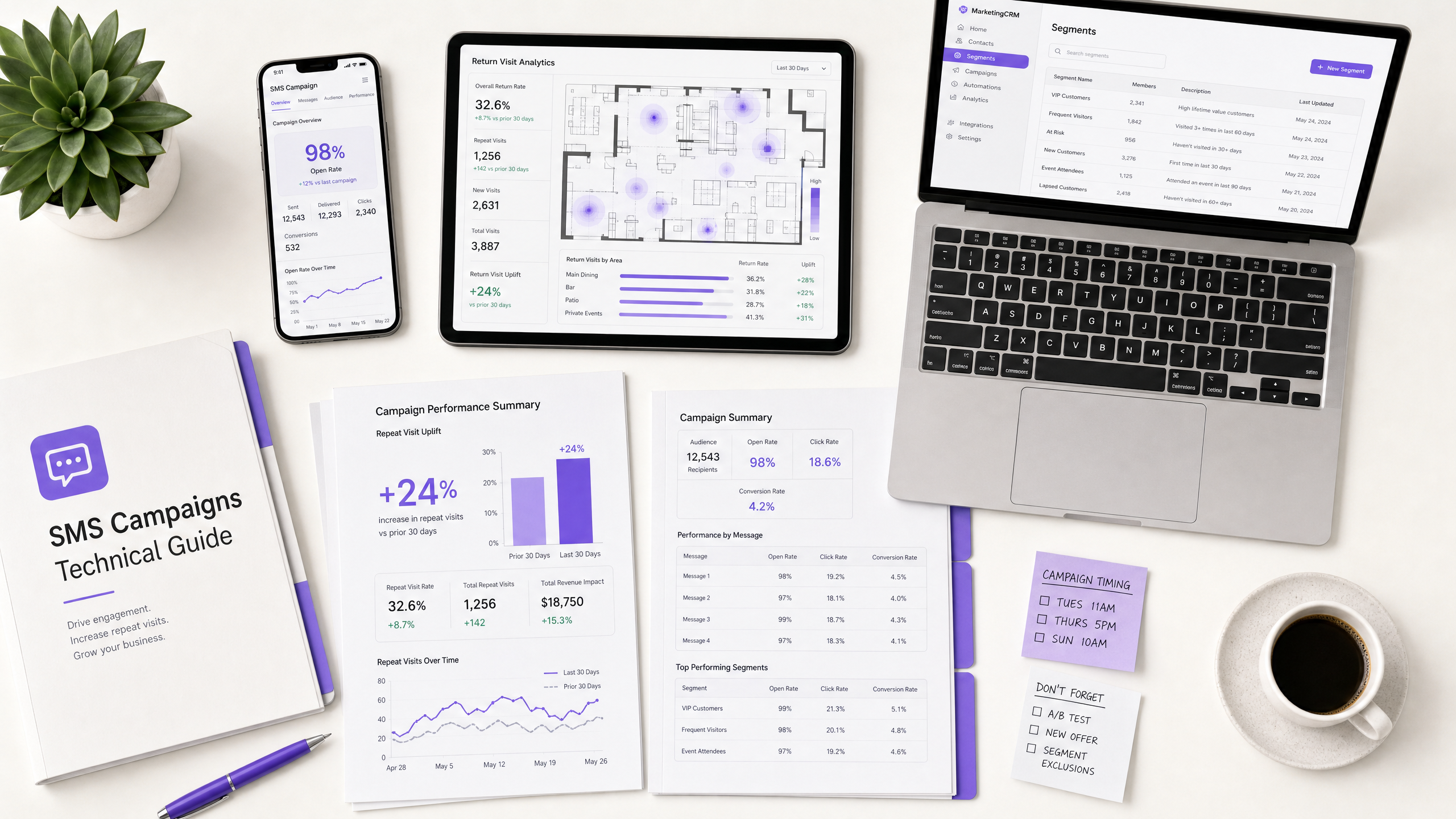
Physical venues face a persistent data gap. Millions of visitors walk through your doors annually, yet most leave without providing a reliable way to reach them again. SMS campaigns for marketing solve this problem by converting anonymous foot traffic into a verified, reachable audience.
This guide details how to build the data infrastructure required for effective SMS marketing. It explains how to capture verified phone numbers at the WiFi login, store consent records securely, and deploy automated campaigns that drive return visits. The technical approach focuses on using Purple Engage as a cloud overlay across your existing network hardware to create a compliant, high-ROI marketing channel.
Listen to the technical briefing podcast:
Technical deep-dive: the data capture architecture
The foundation of any SMS campaign is a verified, compliant contact list. Capturing this data requires a seamless integration between your network infrastructure and your marketing platform.
Purple operates as a hardware-agnostic cloud overlay. It integrates with enterprise network controllers including Cisco Meraki, HPE Aruba, Ruckus, Juniper Mist, Ubiquiti UniFi, Cambium, Extreme, and Fortinet. This architecture allows you to deploy Guest WiFi data capture across multiple sites without replacing your underlying access points or switches.
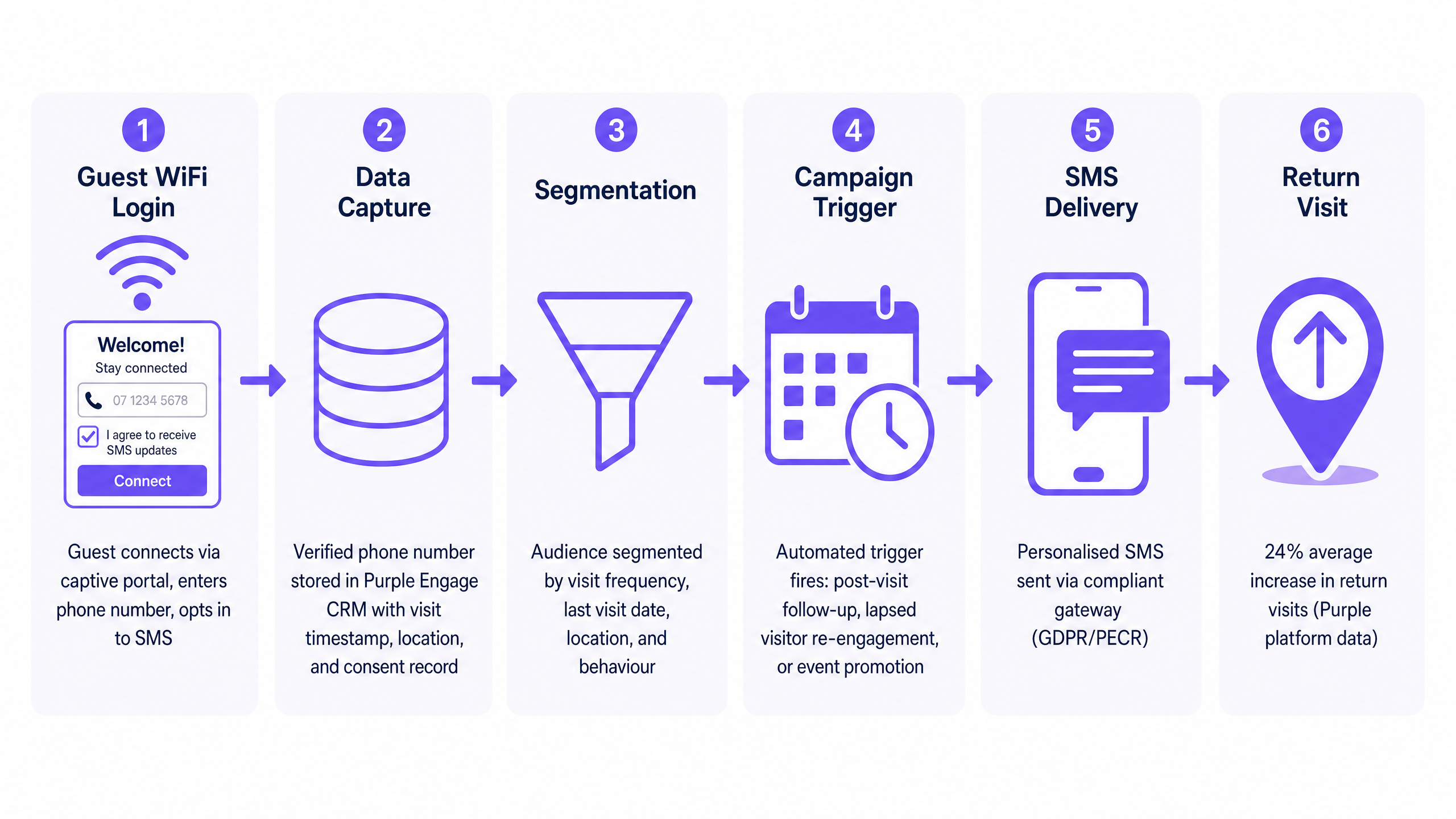
When a guest attempts to connect to the network, the hardware controller redirects them to a Purple-hosted captive portal. If the guest selects SMS authentication, the system prompts them for their mobile number. Purple's gateway then transmits a one-time passcode (OTP) to that number. The guest must enter this OTP to gain network access.
This OTP verification step serves two critical functions. First, it ensures the phone number is active and belongs to the user, eliminating the bounce rates associated with fake data. Second, it creates a definitive, timestamped consent record when the guest ticks the opt-in box. This record forms the legal basis for your subsequent SMS campaigns for marketing.
Implementation guide: deploying automated campaigns
Once you have established the data capture infrastructure, the next phase is deploying the campaigns. A generic broadcast SMS will underperform. The campaigns that drive return visits are triggered by specific guest behaviours.
1. Post-visit follow-ups
The most effective SMS campaign triggers 24 to 48 hours after a guest leaves your venue. Purple's WiFi Analytics tracks the device's MAC address to determine the duration of the visit and the departure time. The Engage platform then automatically sends a personalised SMS offering an incentive to return.
For example, a guest visits a restaurant within a Hospitality portfolio. The following day, they receive an SMS offering a complimentary dessert on their next visit within 30 days. Purple platform data shows this specific triggered campaign drives a 24% average increase in return visits.
2. Lapsed visitor re-engagement
You must identify guests who are at risk of churning. The analytics engine tracks individual visit frequencies. You can configure a rule in Purple Engage to trigger an SMS when a guest deviates from their usual pattern.
If a shopper typically visits a Retail location every fortnight but has not appeared for 45 days, the system fires a re-engagement SMS. This message might include a time-limited discount to prompt an immediate return.
3. Segmented event promotion
When promoting an event, use historical location data to target the right audience. A stadium operator can segment their database to isolate fans who attended specific fixtures last season. They can then send a targeted SMS campaign to drive ticket sales for similar upcoming events, avoiding the fatigue caused by irrelevant mass messaging.
Best practices for SMS marketing
To maximise the return on your SMS campaigns, you must adhere to specific operational standards.
Optimise send times. Do not send SMS messages outside of normal waking hours. Midday sends between 11:00 and 14:00 local time consistently generate the highest engagement rates.
Control frequency. The primary reason consumers unsubscribe from SMS lists is excessive messaging. Limit your campaigns to a maximum of four to six messages per month per contact.
Implement UTM tracking. You must append UTM parameters to every link in your SMS campaigns. This allows your analytics platform to attribute website traffic and subsequent conversions directly to the SMS channel, proving the ROI.
Design for mobile. Ensure any landing page linked from an SMS is fully responsive and loads quickly on mobile devices. A high click-through rate is useless if the destination page causes the user to abandon the session.
For further reading on network design to support these initiatives, review our guide on Three SSIDs to rule them all: guest, Passpoint, and IoT WiFi .
Troubleshooting and risk mitigation
The most significant risk in SMS marketing is regulatory non-compliance. In the UK and EU, SMS marketing is governed by the General Data Protection Regulation (GDPR) and the Privacy and Electronic Communications Regulations (PECR).
You must obtain explicit, freely given consent before sending marketing messages. You cannot make SMS opt-in a mandatory condition for accessing the Guest WiFi. The captive portal must present a clear, unticked checkbox for marketing consent, separate from the terms and conditions acceptance.
Purple's platform handles this compliance by design. The system stores a secure, timestamped record of every opt-in, providing a clear audit trail. Furthermore, every SMS sent through the Engage platform automatically includes a compliant opt-out mechanism, such as a "Reply STOP" instruction.
Another common failure mode is poor list hygiene. If you bypass the OTP verification step, your database will fill with invalid numbers. This increases your messaging costs and damages your sender reputation with the telecommunications carriers. Always enforce OTP verification at the point of capture.
If you are managing authentication across multiple sites, you may also find value in our comprehensive resource: Server RADIUS: a comprehensive guide for businesses .
ROI and business impact
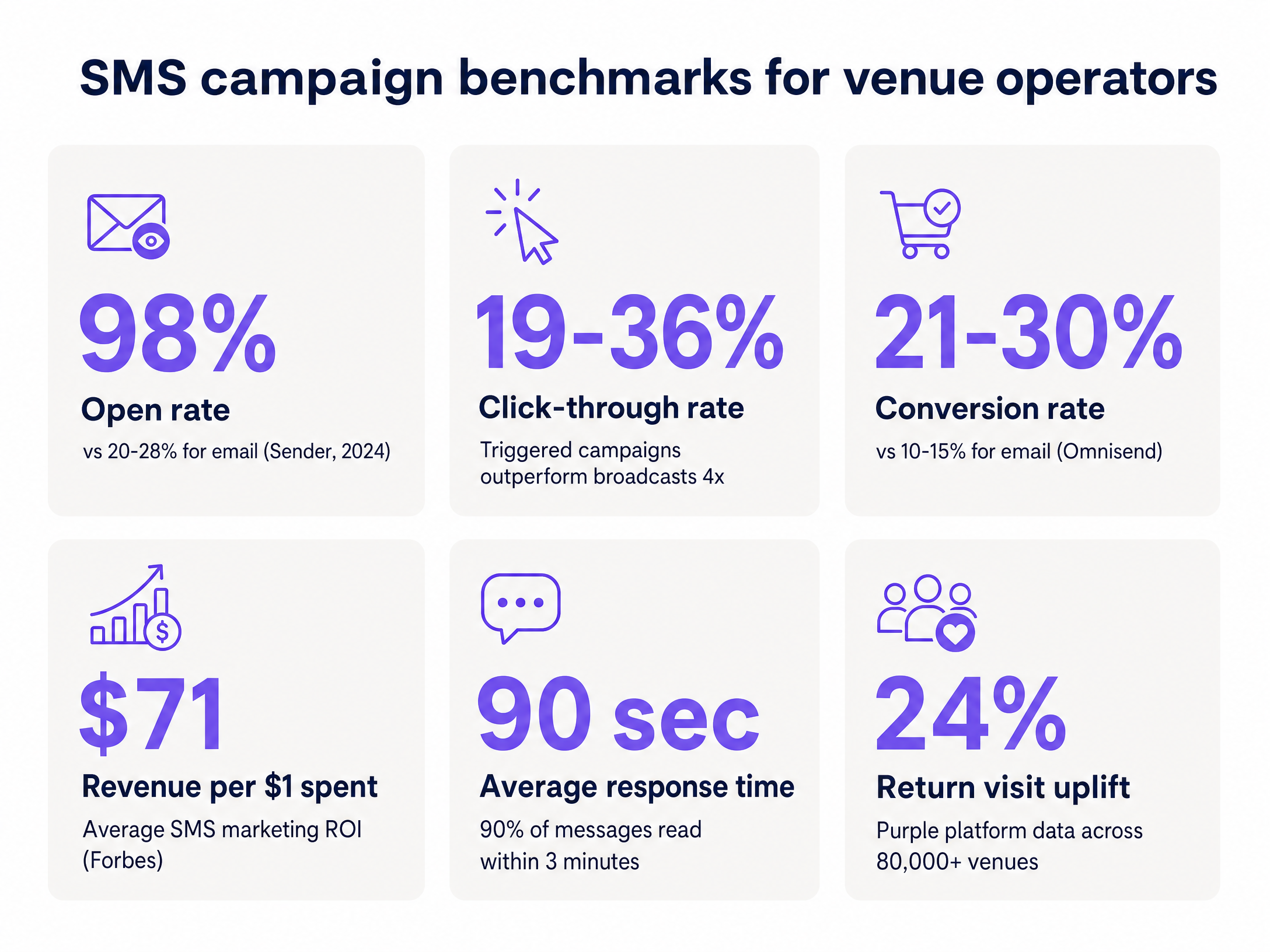
SMS campaigns for marketing represent one of the highest-ROI channels available to venue operators. Industry benchmarks indicate an average return of $71 for every $1 spent on SMS marketing.
This high return is driven by the exceptional engagement metrics. SMS achieves open rates of 98%, compared to 20 to 28% for email. Furthermore, 90% of text messages are read within three minutes of delivery. Click-through rates for triggered campaigns typically range from 19% to 36%.
When a venue deploys Purple Engage to automate these campaigns, the impact on return visits is measurable. By capturing verified first-party data at the WiFi login and triggering personalised SMS messages based on actual visit behaviour, venues consistently see a 24% uplift in return visits. This direct correlation between network infrastructure and marketing revenue transforms Guest WiFi from an IT cost centre into a commercial asset.
Key Definitions
Captive portal
A web page that a user must view and interact with before accessing a public WiFi network. It is the primary interface for data capture and authentication.
IT teams configure the captive portal to manage network access, while marketing teams use it to collect first-party data and secure marketing consent.
OTP (One-Time Passcode)
A unique, temporary numeric code sent via SMS to verify a user's phone number during the authentication process.
Essential for ensuring the accuracy of the CRM database and preventing users from submitting fake phone numbers to gain network access.
First-party data
Information a company collects directly from its customers or visitors, rather than purchasing it from external sources.
Capturing verified phone numbers via Guest WiFi provides high-quality first-party data, reducing reliance on third-party advertising platforms.
PECR
The Privacy and Electronic Communications Regulations. The UK legislation that sits alongside the GDPR and specifically governs electronic marketing, including SMS.
Venue operators must comply with PECR requirements, ensuring they have explicit consent before sending SMS campaigns for marketing.
Triggered campaign
An automated marketing message sent in response to a specific user action or behaviour, rather than on a fixed schedule.
Sending an SMS 24 hours after a guest leaves a venue is a triggered campaign, offering higher relevance and conversion rates than mass broadcasts.
Cloud overlay
A software platform that integrates with and manages existing hardware infrastructure from the cloud, without requiring physical equipment replacement.
Purple operates as a cloud overlay, allowing venues to deploy advanced WiFi analytics and marketing tools across diverse hardware environments like Cisco Meraki and HPE Aruba.
MAC address
A unique identifier assigned to a network interface controller. Used by WiFi analytics platforms to identify individual devices.
Allows the system to track visit frequency and dwell time, enabling behavioural segmentation for targeted SMS campaigns.
Hardware-agnostic
Software designed to function correctly across multiple different hardware platforms or vendors.
Purple's hardware-agnostic design means a retail chain can deploy a unified SMS marketing strategy even if different stores use different WiFi access points.
Worked Examples
A 250-room hotel needs to increase direct bookings from repeat guests to reduce OTA commission costs. They currently offer free WiFi but do not capture verified guest data.
The hotel deploys Purple Engage over their existing HPE Aruba network. They configure the captive portal to require SMS OTP authentication for Guest WiFi access, with a clear, optional checkbox for marketing consent. Over 12 months, they build a database of 18,000 verified phone numbers. They configure an automated campaign in Purple Engage to send an SMS 24 hours after checkout, offering a 15% discount on the guest's next direct booking. They also configure a lapsed-guest campaign triggering at 60 days.
A 12-site retail chain wants to drive foot traffic during quiet mid-week periods. They have a database of customer phone numbers but suffer from high unsubscribe rates when they send broadcast promotions.
The chain integrates their Cisco Meraki network with Purple Engage. Instead of broadcasting generic offers, they use WiFi Analytics to segment their audience based on previous visit behaviour. They identify shoppers who previously visited on Tuesdays or Wednesdays but have not returned in the last 30 days. They send a targeted SMS campaign on Tuesday morning offering a time-limited discount valid only for mid-week purchases.
Practice Questions
Q1. A venue operator wants to increase their SMS database quickly. They propose removing the OTP verification step from the captive portal to reduce friction during login. What is the primary risk of this approach?
Hint: Consider the impact on data quality and future campaign costs.
View model answer
Removing the OTP verification step will severely degrade the quality of the database. Guests will frequently enter fake or incorrect phone numbers to bypass the login screen quickly. This results in a high bounce rate for future SMS campaigns, wasting marketing spend and potentially damaging the venue's sender reputation with telecommunications carriers. The minor increase in login friction from OTP is necessary to ensure the captured data is verified and commercially useful.
Q2. A marketing director plans to send a promotional SMS to the entire database of 50,000 contacts captured via Guest WiFi over the past two years. The message will be sent at 08:00 on a Monday morning. Identify two critical flaws in this plan.
Hint: Evaluate the segmentation strategy and the chosen send time.
View model answer
The first flaw is the lack of segmentation. Sending a generic broadcast message to a two-year-old database will result in low relevance, poor conversion rates, and a high volume of unsubscribes. The campaign should be segmented based on recent visit behaviour. The second flaw is the timing. Sending an SMS at 08:00 on a Monday is intrusive and likely to annoy recipients. Industry best practice dictates sending messages during midday hours (11:00 to 14:00) when engagement rates are highest.
Q3. An IT manager is configuring the captive portal for a new stadium deployment. They set the marketing opt-in checkbox to be ticked by default, assuming fans will un-tick it if they do not want to receive SMS messages. Is this compliant?
Hint: Review the requirements for consent under GDPR and PECR.
View model answer
No, this is not compliant. Under GDPR and PECR, consent for marketing communications must be freely given, specific, informed, and unambiguous. This requires a positive opt-in action. Pre-ticked boxes do not constitute valid consent. The captive portal must present an unticked checkbox, requiring the user to actively select it to confirm their agreement to receive SMS campaigns for marketing.
Continue reading in this series
How to leverage SMS marketing for restaurants to increase return visits
This technical guide explains how venue operators and IT teams can implement SMS marketing using existing guest WiFi infrastructure to drive return visits. It covers the data capture architecture, GDPR compliance requirements, and behavioural segmentation strategies that deliver measurable ROI for restaurants.
How to leverage SMS marketing solutions to increase return visits
This guide details how to architect and deploy SMS marketing solutions using the Purple Engage platform to drive return visits at hotels, retail venues, stadiums, and public-sector sites. It covers captive portal configuration, verified phone number capture via SMS OTP, GDPR-compliant consent architecture, and trigger-based campaign automation using existing wireless infrastructure from Cisco Meraki, HPE Aruba, and other supported vendors.
How to leverage SMS text marketing to increase return visits
This guide details how venue operators can use SMS text marketing to drive measurable return visits by capturing verified first-party phone data through Guest WiFi. It covers the full technical architecture from captive portal authentication to RADIUS integration, the compliance requirements under GDPR and TCPA, and the automated campaign triggers that deliver consistent ROI across hospitality, retail, and transport environments.