
How to leverage marketing SMS examples to increase return visits
This guide explains how venue operators - in hospitality, retail, events, and public-sector environments - can use marketing SMS examples to drive measurable return visits by turning Guest WiFi data capture into an automated, GDPR-compliant SMS engagement engine. It covers the technical architecture from captive portal consent collection through to trigger-based automation and WiFi-matched attribution, with worked examples from hotel and retail deployments. Marketing directors and CRM managers will find specific message templates, compliance checklists, and ROI benchmarks they can act on immediately.
Listen to this guide
View podcast transcript
Executive summary
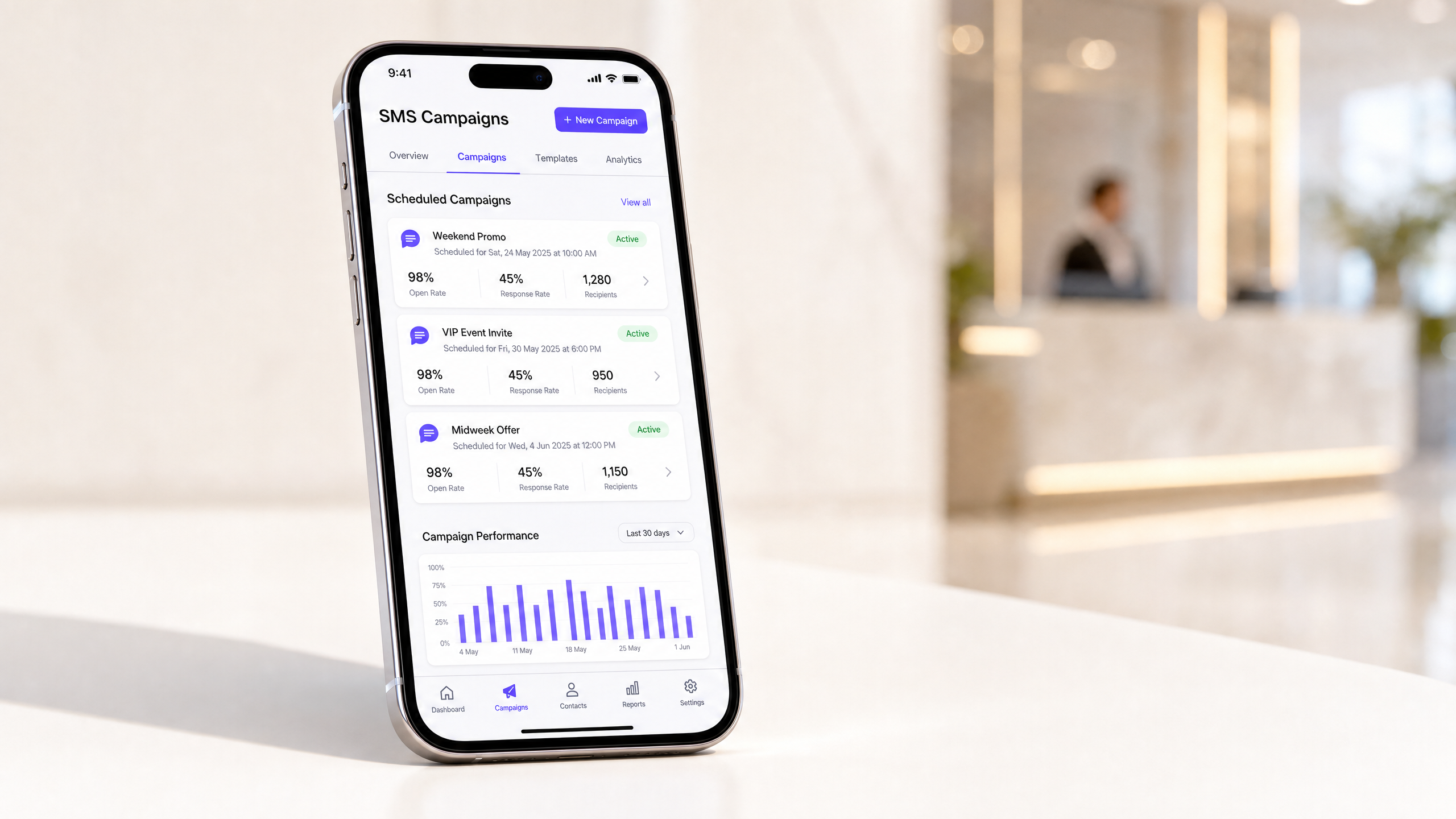
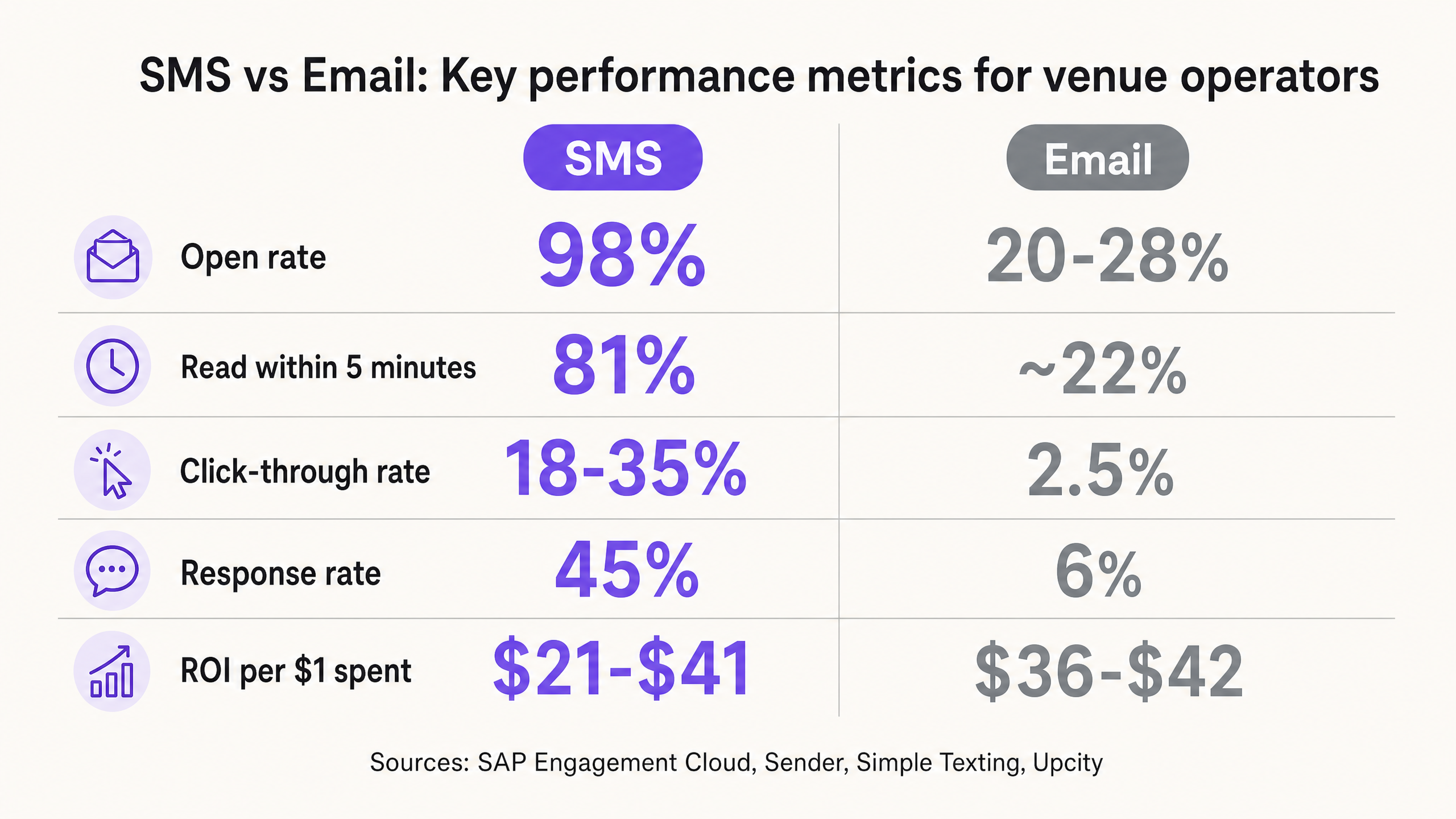
Venue operators spend significantly more acquiring a new visitor than retaining an existing one. Yet most venues have no reliable mechanism to contact a guest after they leave. SMS marketing solves that problem - but only when it is built on verified, consented first-party data. SMS messages achieve a 98% open rate and a 45% response rate, compared to 20-28% and 6% respectively for email (SAP Engagement Cloud, Simple Texting, 2025). The channel is not new. What is new is the infrastructure to build a compliant, opted-in SMS list at scale without a separate sign-up flow.
Your Guest WiFi captive portal is that infrastructure. Purple Engage captures verified phone numbers and explicit SMS consent at the point of login, across hardware from Cisco Meraki, HPE Aruba, Ruckus, Juniper Mist and others. A four-stage automated sequence - welcome, re-engagement nudge, urgency trigger, and win-back - then fires based on visitor behaviour, with return visits tracked by matching SMS recipients to subsequent WiFi logins. This guide walks through the full architecture, compliance requirements, worked examples from hospitality and retail, and the attribution model that closes the measurement loop.
Technical deep-dive
The data capture architecture
The foundation of any effective SMS marketing programme is a verified, consented contact list. For venue operators, the most scalable way to build that list is through the Guest WiFi captive portal - the login interface guests encounter when they connect to your SSID.
When a guest connects, the network controller (running on Cisco Meraki, HPE Aruba, Ruckus, Juniper Mist, Ubiquiti UniFi, Cambium, Extreme, or Fortinet hardware) redirects their HTTP traffic to a captive portal hosted by Purple. The portal prompts the guest for name, email address, and optionally a phone number. A separate, unticked checkbox - distinct from the WiFi terms of service acceptance - presents the SMS marketing opt-in. This is a conscious-choice opt-in: the guest actively selects it, which satisfies the GDPR requirement for freely given, specific, informed, and unambiguous consent.
Purple Engage records each consent event with a cryptographic timestamp, the exact consent language displayed, the venue identifier, and the device MAC address. This creates an auditable first-party data record that withstands regulatory scrutiny under GDPR, the UK PECR (Privacy and Electronic Communications Regulations), and the US TCPA (Telephone Consumer Protection Act).
Across Purple's network of 80,000+ live venues, phone number opt-in rates at the captive portal run between 35% and 55% of WiFi logins when the opt-in is presented with a clear benefit statement (Purple internal data, 2024). The phrasing matters: "Get exclusive offers by text" consistently outperforms a plain opt-in checkbox with no stated benefit.
Automation and trigger mechanisms
Once a phone number enters the system with valid consent, Purple Engage's automation engine takes over. The platform supports trigger-based SMS workflows that fire on visitor behaviour events rather than on a fixed calendar schedule. The distinction matters: behavioural triggers produce CTRs of 19-36%, while scheduled broadcast messages to a full list average around 9% (MessageFlow, 2026).
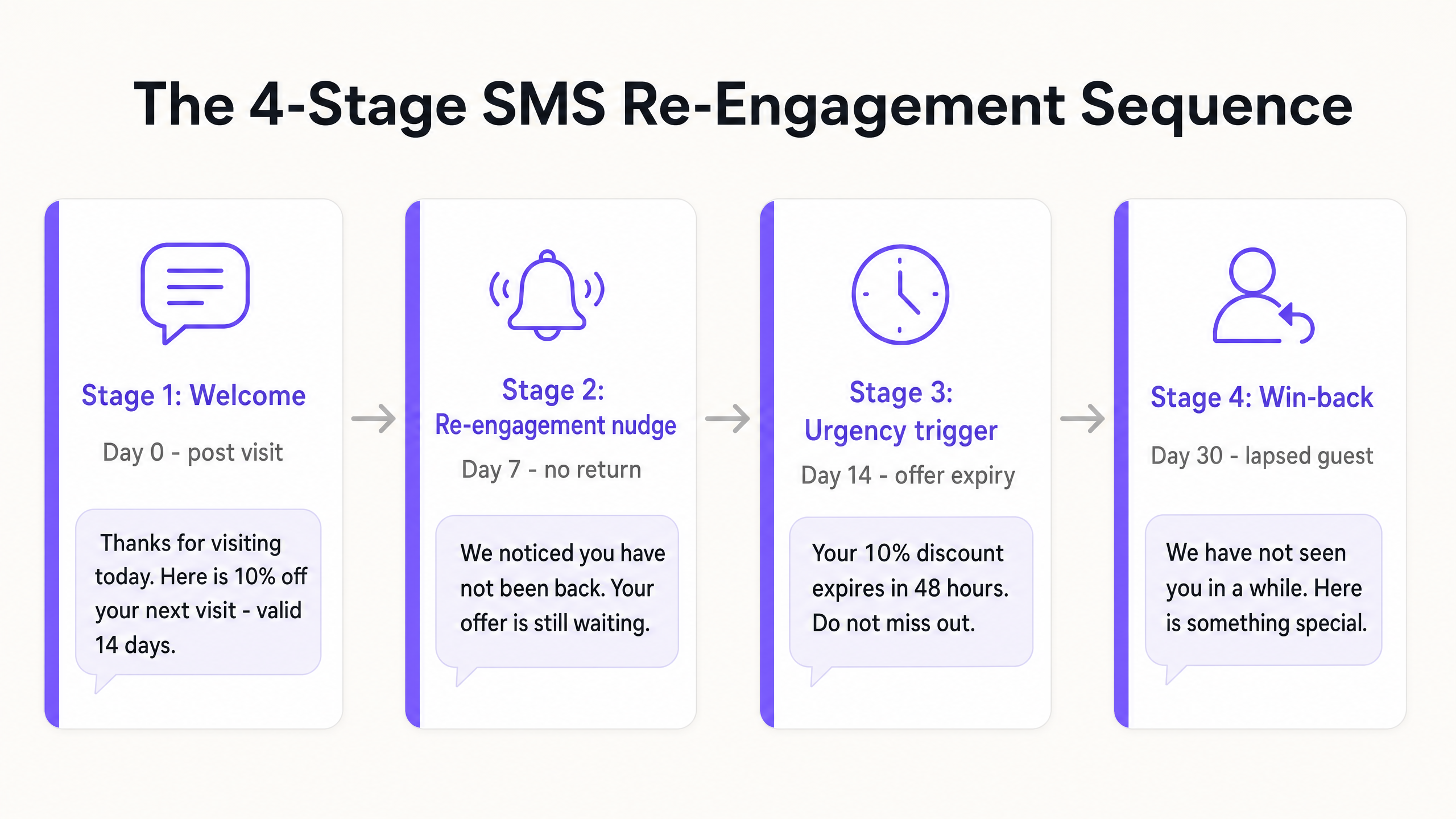
The four-stage re-engagement sequence is the most widely deployed pattern across Purple's venue network:
| Stage | Trigger | Message objective | Example copy |
|---|---|---|---|
| 1 - Welcome | Day 0, post-visit | Set expectation, deliver immediate value | "Thanks for visiting [Venue] today. Here is 10% off your next visit - valid 14 days. Reply STOP to opt out." |
| 2 - Re-engagement nudge | Day 7, no return | Reference previous visit, renew incentive | "We noticed you have not been back to [Venue]. Your offer is still waiting. [Link] Reply STOP to opt out." |
| 3 - Urgency trigger | Day 14, offer expiry | Create deadline, drive immediate action | "Your 10% discount at [Venue] expires in 48 hours. Use it before it goes. [Link] Reply STOP to opt out." |
| 4 - Win-back | Day 30, lapsed visitor | Different tone, higher-value offer | "We have not seen you in a while at [Venue]. Here is something special to bring you back. [Link] Reply STOP to opt out." |
Each message is personalised at the venue level by default. Purple Engage supports further personalisation using visit-time data (day of week, time of day, dwell duration) and demographic data captured at login. A guest who visited on a Saturday afternoon and spent 90 minutes on-site is a different audience segment from a weekday lunch visitor, and the message copy should reflect that.
Attribution architecture
The attribution model is what separates a well-run SMS programme from one that cannot prove its value. Most operators send messages but cannot confirm whether they drove physical return visits because they track clicks, not footfall.
Purple's WiFi Analytics platform closes this loop by matching the phone number of an SMS recipient against subsequent WiFi login events at the same venue. When a guest who received a Stage 2 nudge message on day seven connects to the venue WiFi on day nine, that connection is logged as an attributed return visit for that campaign. The attribution window is configurable - typically 14 to 30 days per message.
This produces a clean return visit rate metric per campaign, per message stage, and per audience segment. It also enables cohort analysis: comparing the return visit rate of SMS subscribers against non-subscribers over the same period gives you the incremental lift attributable to the SMS programme.
Implementation guide
Step 1: Audit your current captive portal
Before activating SMS capture, confirm that your captive portal includes a separate, unticked SMS marketing opt-in checkbox with clear benefit language. If your current portal bundles SMS consent with the WiFi terms of service, this is a GDPR compliance risk. Purple Engage portals are pre-configured with compliant consent architecture; if you are running a custom portal on Cisco Meraki or HPE Aruba, review the consent flow against the PECR checklist in Step 4.
Step 2: Configure the phone number capture field
Add an optional phone number field to your captive portal form. Mark it as optional - mandatory phone number collection reduces overall WiFi login completion rates. The opt-in checkbox should appear immediately below the phone number field with the text: "Tick here to receive exclusive offers and updates from [Venue Name] by SMS. You can opt out at any time by replying STOP."
For multi-site operators, configure venue-level sender names so that guests receive messages identified as coming from the specific location they visited, not a generic brand name.
Step 3: Build the four-stage automation sequence
In Purple Engage, navigate to Campaigns and create a new automated SMS workflow. Set the entry trigger to "First WiFi login at venue." Configure the four stages with the timing and copy outlined in the Technical Deep-Dive section. Set the suppression rule to exclude any contact who has already returned to the venue - there is no value in sending a re-engagement message to someone who came back the next day.
For hospitality operators, align Stage 1 timing with the check-out window rather than the login event. A guest who checks in on Monday and checks out on Wednesday should receive their welcome SMS on Wednesday, not Monday.
Step 4: Implement the GDPR and PECR compliance checklist
Before sending any messages, confirm the following:
- Consent is recorded with a timestamp and the exact consent language shown
- Every outbound SMS includes your sender name and a STOP opt-out instruction
- Opt-out requests are processed within 24 hours (best practice) or five working days (PECR minimum)
- Consent records are stored for a minimum of three years and are exportable for regulatory audit
- Your SMS platform suppresses opted-out numbers at the point of send, not retrospectively
For US operators, TCPA requires that the opt-in language explicitly references automated marketing messages. Add the phrase "including automated marketing messages" to your consent checkbox text.
Step 5: Set up attribution tracking
In Purple's analytics dashboard, create a campaign attribution report that matches SMS send events to return WiFi login events within your chosen attribution window. Set a baseline period of 30 days before campaign launch to establish the natural return visit rate for your venue. This baseline is your control group benchmark.
For retail operators running multiple concurrent promotions, use UTM parameters in SMS links to separate SMS-driven web traffic from other channels in your analytics platform.
Best practices
Frequency and timing
The ceiling for venue re-engagement SMS is two to three messages per 30-day period. 53% of SMS unsubscribes are caused by over-messaging (SAP Engagement Cloud, 2025). For most venue types, the four-stage sequence described above stays within this ceiling because each stage only fires if the guest has not returned - a returning guest exits the sequence automatically.
Timing within the day matters. Messages sent between 10:00 and 12:00, or between 17:00 and 19:00, consistently outperform messages sent outside these windows for venue re-engagement (MessageFlow, 2026). Avoid sending after 21:00 - this is both a best practice and a PECR requirement.
Personalisation depth
Three levels of personalisation are available in Purple Engage, and each level produces measurably better results than the one below it:
- Venue-level: The message references the specific venue the guest visited. This is the minimum viable personalisation for any multi-site operator.
- Visit-time personalisation: The message references the day or time of the visit. "Saturday afternoons just got better at [Venue]" outperforms a generic offer for Saturday visitors.
- Behavioural personalisation: The message references dwell time, visit frequency, or demographic data captured at login. Frequent visitors respond better to loyalty-framed messages; infrequent visitors respond better to discovery-framed messages.
Omnichannel sequencing
SMS performs best when layered with email rather than used as a standalone channel. Brands that integrate SMS into omnichannel strategies see a 47.7% lift in customer engagement compared to single-channel approaches (Omnisend, 2025). The recommended sequence for venue re-engagement is: SMS on day one post-visit (short, high-impact), followed by a more detailed email on day three (richer content, longer offer description). The SMS captures attention; the email delivers context.
For transport operators and healthcare venues, where the relationship with the visitor is more transactional, SMS is most effective for time-sensitive notifications (gate changes, appointment reminders) rather than promotional re-engagement. Adjust the sequence accordingly.
Troubleshooting and risk mitigation
High opt-out rates
If your opt-out rate exceeds 3.5% per send, the most likely cause is frequency. Audit your automation rules to confirm that the suppression logic is working correctly - a guest who returned to the venue should not continue receiving re-engagement messages. The second most common cause is irrelevant messaging: a generic offer sent to a highly specific audience segment. Review your personalisation depth and segment your audience more granularly before the next send.
Low opt-in rates at the portal
If phone number opt-in rates fall below 25% of WiFi logins, review the benefit statement on your opt-in checkbox. A/B test two variants: one that emphasises discounts ("Get 10% off your next visit") and one that emphasises information ("Be the first to hear about new events and offers"). The winning variant varies by venue type - discount framing works better in retail; information framing works better in hospitality and events.
Attribution gaps
If your return visit attribution report shows unexpectedly low match rates, check whether guests are connecting to the same SSID on return visits. Guests who connect to a different SSID (for example, a staff network or a different venue in a multi-site estate) will not match against the original login event. Ensure your attribution query is scoped to the correct venue identifier, not the SSID.
Delivery failures
SMS delivery rates should exceed 95% for a well-maintained list. If delivery rates fall below this, the most common causes are: stale phone numbers (guests who changed their number), invalid number formats (missing country code), or carrier filtering (triggered by high-frequency sends from a shared short code). For volumes above 100,000 messages per month, a dedicated short code or a verified sender ID eliminates carrier filtering risk.
ROI and business impact
Measuring success
The primary KPI for a venue SMS re-engagement programme is the attributed return visit rate - the percentage of SMS recipients who return to the venue within the attribution window. A well-configured four-stage sequence targeting a warm audience (guests who opted in within the last 90 days) should produce an attributed return visit rate of 20-35% (Purple internal data, 2024).
Secondary KPIs include:
| KPI | Benchmark | Measurement method |
|---|---|---|
| SMS opt-in rate at portal | 35-55% of logins | Purple Engage portal analytics |
| Message delivery rate | >95% | SMS platform delivery reports |
| Click-through rate (CTR) | 18-35% | UTM-tagged links in SMS |
| Opt-out rate per send | <3.5% | SMS platform opt-out reports |
| Attributed return visit rate | 20-35% | WiFi login matching in Purple Analytics |
| Cost per re-engaged visitor | <£2 | Total SMS cost / attributed returns |
Cost-benefit analysis
SMS messages cost approximately £0.03-£0.07 per send in the UK, depending on volume and provider. A venue sending 1,000 messages per month across the four-stage sequence at an average of 2.5 messages per contact spends roughly £75-£175 per month on message costs. If the attributed return visit rate is 25% and the average visitor spend is £30, that represents £7,500 in attributed revenue against a £175 cost - a return of approximately 43x on message spend alone, before accounting for platform costs.
SMS delivers $21-$41 ROI for every $1 spent at the industry level (Upcity, 2023). Venue operators with high average transaction values - hotels, premium retail, stadium concessions - consistently sit at the upper end of this range.
Case study: Premier Inn-style hotel chain
A 150-room hotel property was capturing guest email addresses through Guest WiFi but not phone numbers. They updated their Captive Portal to include an optional phone number field with a clear SMS opt-in. Within 90 days, they built an opted-in SMS list of 4,200 verified guests. A three-message sequence - welcome on check-out day, re-engagement at 21 days, seasonal offer at 60 days - produced a return booking rate 31% higher among SMS subscribers than non-subscribers over the same period. Cost per re-engaged guest was under £2.
Case study: Multi-site fashion retailer
A fashion retailer with 40 stores was using email for post-visit follow-up but seeing open rates below 18%. They layered SMS on top of their existing email flows: a short SMS on the day after a visit, followed by a more detailed email three days later. The combined sequence produced a 47% lift in return visits within 30 days, consistent with the 47.7% omnichannel engagement uplift reported by Omnisend (2025). The SMS layer added approximately £0.05 per contact per month to their marketing cost.
For related implementation guidance, see also: Comment exploiter le marketing par SMS pour les restaurants afin d'augmenter les visites de retour and Wie Sie SMS-Marketing für Restaurants nutzen, um die Zahl der wiederkehrenden Besuche zu steigern .
Key Definitions
Captive Portal
A web page presented to a guest when they connect to a WiFi network, before they are granted internet access. Used to capture identity data, present terms of service, and collect marketing consent. In Purple's architecture, the Captive Portal is the primary data capture interface for first-party phone numbers and SMS opt-ins.
IT teams encounter Captive Portals when configuring Guest WiFi SSIDs on Cisco Meraki, HPE Aruba, Ruckus, or other hardware. The portal URL is typically configured in the SSID settings as a redirect for unauthenticated clients.
Conscious-choice opt-in
A GDPR-compliant consent mechanism where the guest actively selects a checkbox to receive marketing communications. The checkbox must be unticked by default, separate from any other consent (such as WiFi terms of service), and accompanied by clear language describing what the guest is consenting to.
Required for all SMS marketing consent under GDPR Article 7 and UK PECR Regulation 22. Purple Engage portals implement this by default. Custom portals must be audited to confirm compliance.
First-party data
Data collected directly from a visitor by the venue operator, with the visitor's knowledge and consent. Includes name, email address, phone number, and visit behaviour data captured through Guest WiFi login. Contrasted with third-party data (purchased lists) and second-party data (shared from a partner).
First-party data is the foundation of compliant SMS marketing. It is the only data type that satisfies GDPR consent requirements for direct marketing and that survives third-party cookie deprecation.
PECR (Privacy and Electronic Communications Regulations)
UK regulations that govern electronic marketing communications, including SMS. Require prior consent for marketing messages, a clear sender identification in every message, and an opt-out mechanism that must be honoured within five working days. Enforced by the Information Commissioner's Office (ICO).
UK venue operators must comply with PECR in addition to GDPR. The key PECR requirement for SMS is that the opt-out instruction ('Reply STOP to unsubscribe') must appear in every marketing message.
TCPA (Telephone Consumer Protection Act)
US federal law that requires prior express written consent before sending automated marketing messages to a mobile number. Violations carry statutory damages of $500-$1,500 per message. The opt-in checkbox at a WiFi captive portal satisfies TCPA consent requirements if the consent language explicitly references automated marketing messages.
US venue operators must include the phrase 'including automated marketing messages' in their SMS opt-in consent language. Purple Engage portals for US deployments include TCPA-compliant consent text by default.
Trigger-based automation
An SMS workflow that fires based on a specific visitor behaviour event rather than on a fixed calendar schedule. Examples include: first WiFi login at a venue (triggers welcome message), seven days without a return visit (triggers re-engagement nudge), 14 days without a return visit (triggers urgency message). Trigger-based messages consistently outperform scheduled broadcasts in click-through rate.
Configured in Purple Engage under Campaigns > Automated Workflows. The entry trigger is typically a WiFi login event; suppression rules prevent messages from firing if the guest has already returned.
Attribution window
The time period after an SMS send event within which a return visit is counted as attributed to that message. Typically set to 14-30 days for venue re-engagement campaigns. A return visit that occurs after the attribution window closes is not counted as campaign-attributed, even if the SMS influenced the decision.
Configured in Purple's analytics attribution report. Shorter windows (14 days) are more conservative and defensible to finance teams. Longer windows (30 days) capture more return visits but may overstate attribution for venues with naturally high return rates.
Short code
A five or six-digit phone number used to send high-volume SMS messages. Comes in two variants: shared short codes (used by multiple senders, lower cost) and dedicated short codes (exclusive to one sender, higher cost but no carrier filtering risk). Dedicated short codes are recommended for volumes above 100,000 messages per month.
Most venue operators start with a long code (standard 11-digit number) or a shared short code. Dedicated short codes become cost-effective at high volume and are required for two-way SMS conversations at scale.
Omnichannel engagement
A marketing approach that coordinates messages across multiple channels (SMS, email, push notification, in-app) to create a consistent visitor experience. Brands that integrate SMS into omnichannel strategies see a 47.7% lift in customer engagement compared to single-channel approaches (Omnisend, 2025).
For venue operators, the most effective omnichannel sequence is SMS on day one post-visit (high-impact, short) followed by email on day three (richer content, longer offer). Purple Engage supports both channels from the same visitor profile.
Worked Examples
A 200-room hotel group with 12 properties across the UK has Guest WiFi on HPE Aruba hardware. They capture email addresses at login but have never collected phone numbers. The marketing director wants to run SMS re-engagement campaigns to increase repeat bookings. What is the minimum viable implementation to get from zero to a live SMS programme within 60 days?
Start with a portal audit across all 12 properties to confirm that the current consent flow is GDPR-compliant. If email consent is bundled with WiFi terms of service acceptance, fix this first - it affects SMS consent validity too. Next, update each captive portal to add an optional phone number field with a separate SMS opt-in checkbox. The consent language should read: 'Tick here to receive exclusive offers and updates from [Hotel Name] by SMS. You can opt out at any time by replying STOP.' Configure venue-level sender names so guests receive messages from the specific hotel they stayed at, not a generic group brand. In Purple Engage, build a three-stage automation sequence: Stage 1 fires on check-out day with a 10% discount on the next direct booking; Stage 2 fires at day 21 if no return booking is detected, referencing the specific property; Stage 3 fires at day 60 with a seasonal offer. Set suppression rules to exclude guests who have already rebooked. Connect the attribution report to match SMS recipients against return WiFi logins at any property in the group. Expect to have an opted-in list of 500-800 guests per property within the first 60 days, based on a 40% opt-in rate against typical hotel WiFi login volumes.
A retail chain with 60 stores is running SMS campaigns using a third-party platform, but the marketing team cannot attribute return store visits to specific campaigns. They know their SMS open rates are high but cannot prove ROI to the CFO. How do they close the attribution loop?
The attribution gap is a data matching problem. The retail chain needs to connect two data sources: the SMS send log (phone number, send timestamp, campaign ID) and the in-store visit log (phone number, visit timestamp, store ID). If the stores have Guest WiFi on Purple, the visit log is the WiFi login event. The matching logic is: for each SMS recipient, check whether a WiFi login event occurred at any store within the attribution window (typically 14 - 30 days) after the SMS send date. If yes, record that as an attributed return visit. In Purple's analytics platform, this is a built-in report - navigate to Campaigns, select the SMS campaign, and view the Return Visit Attribution tab. If the chain is using a third-party SMS platform, export the send log as a CSV (phone number, send date, campaign ID) and import it into Purple's attribution API. The API matches against WiFi login events and returns an attributed visit count per campaign. For stores without WiFi, an alternative attribution method is to include a unique discount code in each SMS message and track code redemptions at the point of sale. This is less precise than WiFi matching but provides a lower-bound attribution figure that is defensible to a CFO.
Practice Questions
Q1. A stadium operator with 50,000 capacity runs 30 events per year. They have Guest WiFi on Ruckus hardware and capture email addresses at login, but have never run SMS campaigns. Their marketing director wants to use SMS to increase merchandise sales at return events. What three decisions must they make before building the automation sequence, and what are the key constraints on each?
Hint: Think about consent architecture, audience segmentation (fan vs. attendee), and the attribution model for a venue where return visits are event-driven rather than spontaneous.
View model answer
The three decisions are: First, consent architecture - the stadium must add a separate SMS opt-in to the Captive Portal with GDPR-compliant consent language. Because events attract different audiences (season ticket holders vs. one-time attendees), the opt-in rate will vary significantly. Season ticket holders are a higher-value segment and should be offered a loyalty-framed opt-in ('Get early access to merchandise drops'). Second, segmentation strategy - the stadium should segment by event type (sport vs. concert vs. conference) because the re-engagement offer must be relevant to the specific event the fan attended. A rugby fan should not receive a concert merchandise offer. Purple Engage supports event-level segmentation using the venue identifier and login timestamp. Third, attribution model - unlike a hotel or retail store, a stadium's return visits are event-driven. The attribution window must align with the event calendar, not a fixed 14 - 30 day window. The correct approach is to send the win-back message 7 - 10 days before the next relevant event at the venue, rather than on a fixed post-visit schedule. Attribution is then measured by matching SMS recipients to WiFi logins at the next event.
Q2. A CRM manager at a 40-store fashion retailer receives a report showing that their SMS opt-out rate has risen from 1.2% to 4.8% per send over the past three months. The send volume has not changed. What are the three most likely causes, and how would you diagnose each one?
Hint: Opt-out rate increases without volume changes point to content or targeting problems, not frequency problems. Consider what changed in the content, the audience composition, or the suppression logic.
View model answer
The three most likely causes are: First, audience composition drift - if the opted-in list has grown to include contacts who opted in more than 90 days ago without returning, the audience is now colder and less engaged. Diagnose by segmenting the opt-out report by contact age (days since opt-in). If opt-outs are concentrated in the 90+ day cohort, suppress this segment from broadcast campaigns and move them to a lower-frequency win-back sequence. Second, suppression logic failure - if the automation sequence is not correctly suppressing contacts who have already returned to the store, returning customers are receiving re-engagement messages that are irrelevant to them. Diagnose by cross-referencing opt-out phone numbers against WiFi login events in the same period. If a significant proportion of opt-outs had a return visit in the 14 days before opting out, the suppression rule is broken. Third, message relevance decline - if the offer or copy has not changed in three months, audience fatigue sets in. Diagnose by comparing CTR on the current message against CTR three months ago. A declining CTR with a rising opt-out rate confirms relevance fatigue. Fix by refreshing the offer and testing a new copy variant.
Q3. A conference centre operator wants to use SMS to drive return bookings from corporate event organisers who used the venue in the past 12 months. Their legal team has flagged that corporate phone numbers (direct lines and mobile numbers provided on booking forms) may not meet GDPR consent requirements for SMS marketing. How do you resolve this, and what is the compliant path to building an SMS list for this audience?
Hint: B2B SMS marketing has different consent requirements from B2C under PECR. Consider the distinction between soft opt-in (existing customer relationship) and explicit opt-in, and how Guest WiFi data capture differs from booking form data.
View model answer
The legal team is correct to flag this. Phone numbers collected on booking forms are typically provided for operational purposes (venue coordination, logistics) and do not carry implied consent for marketing messages. Using them for SMS marketing without explicit consent would breach PECR Regulation 22. There are two compliant paths. First, the soft opt-in route: under PECR, you can send marketing messages to existing customers without explicit consent if the messages relate to similar products or services to those previously purchased, and the customer was given a clear opportunity to opt out at the time of data collection. A conference booking confirmation email that includes an opt-out link for future marketing, and that is followed by SMS messages about conference venue availability, may qualify. This should be reviewed by a GDPR-qualified legal adviser before deployment. Second, the Guest WiFi route: when event organisers and their delegates attend the venue, they connect to Guest WiFi. The captive portal presents a compliant SMS opt-in. This builds a consented list from actual venue visitors, including the decision-makers who attended the event. This is the cleaner compliance path and produces a higher-quality list because it captures people who have physically experienced the venue. For the conference centre, the recommended approach is to use the Guest WiFi opt-in for new list building while seeking legal advice on whether the soft opt-in route is viable for the existing booking form database.