
How to leverage SMS for real estate marketing to increase return visits
This technical guide details how to build an automated data capture pipeline using Guest WiFi to drive SMS marketing campaigns for real estate venues. It covers hardware integration, captive portal design, GDPR compliance, and closed-loop attribution to increase return visits by up to 34%.
Listen to this guide
View podcast transcript
Executive Summary
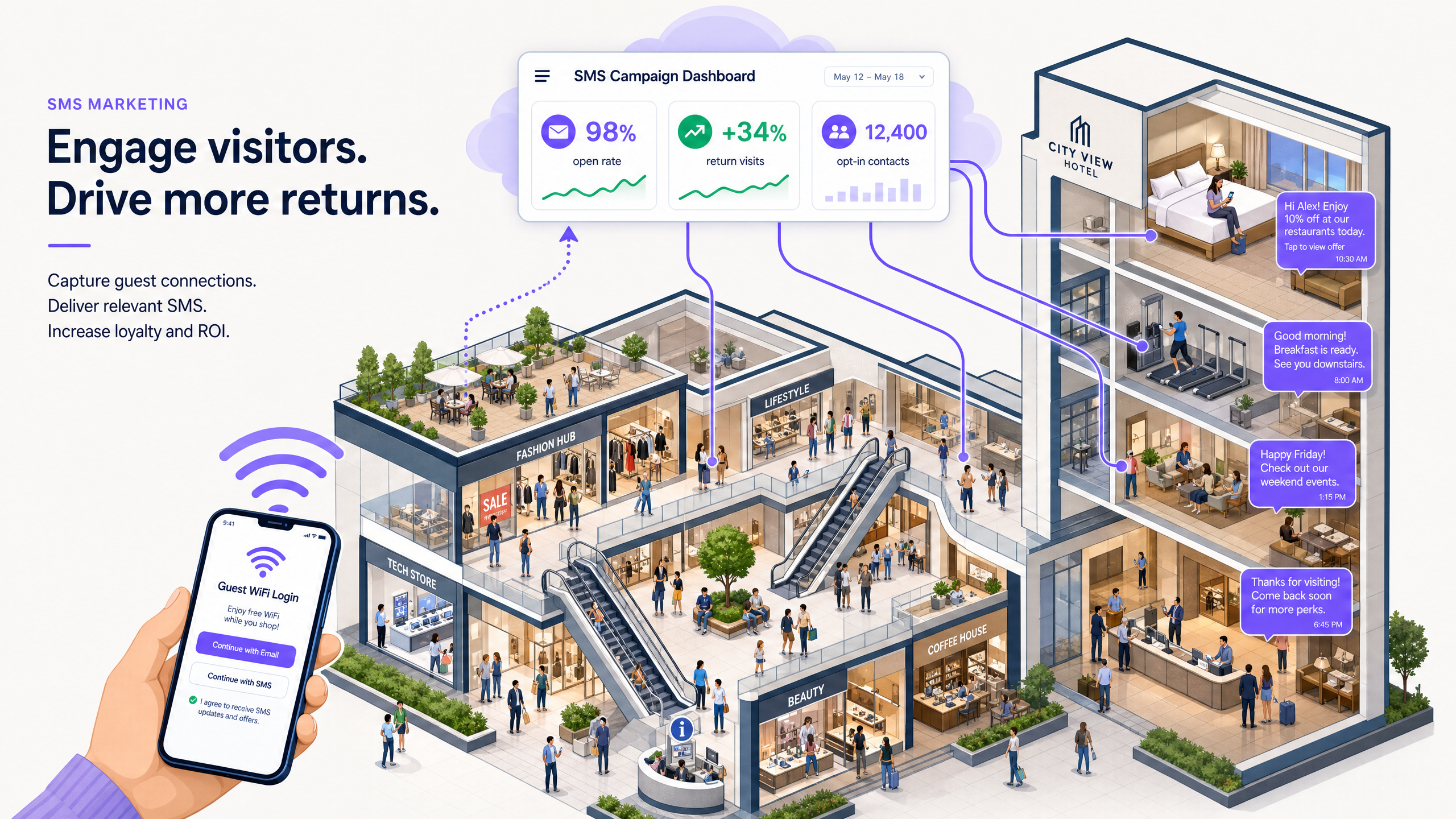
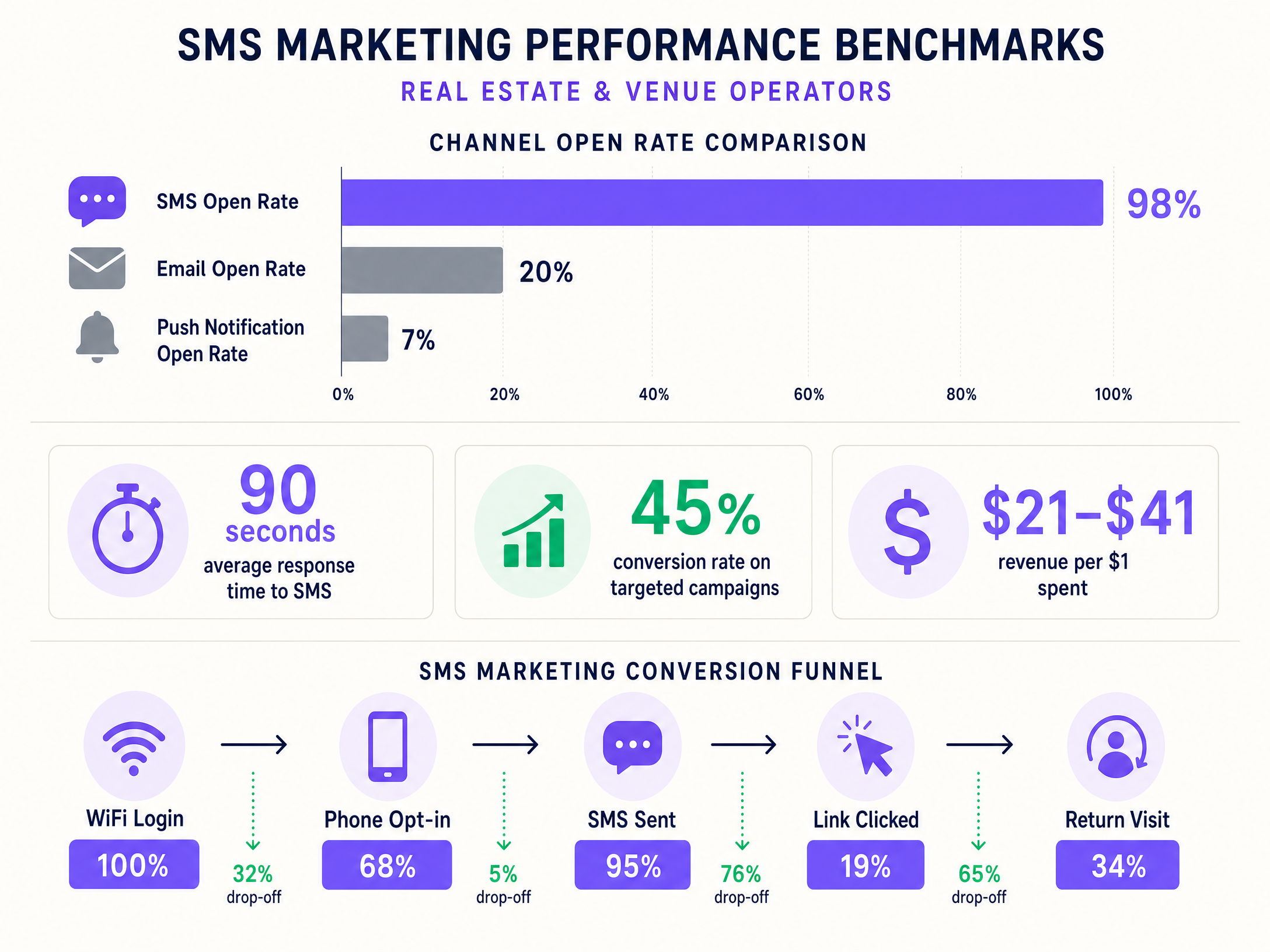
Venue operators sit on a massive, underutilised data asset: the Guest WiFi network. While most venues offer free connectivity, few capture actionable first-party data. By deploying a cloud overlay across existing network infrastructure, IT and marketing teams can transform a sunk cost into an acquisition channel. This guide details how to implement an automated SMS marketing pipeline that captures verified phone numbers at the point of login and triggers behavioural campaigns to drive return visits. With SMS open rates at 98% and average response times under 90 seconds, this channel outperforms email and push notifications. We will cover the technical architecture required to integrate Cisco Meraki, HPE Aruba, or Ruckus hardware with the Purple Engage platform, ensuring GDPR compliance while delivering measurable ROI.
Technical Deep-Dive
The architecture for a venue-wide SMS marketing deployment relies on three core components: the physical network layer, the captive portal overlay, and the campaign automation engine. This structure ensures high deliverability, accurate attribution, and strict regulatory compliance.
Network Integration and Hardware Compatibility
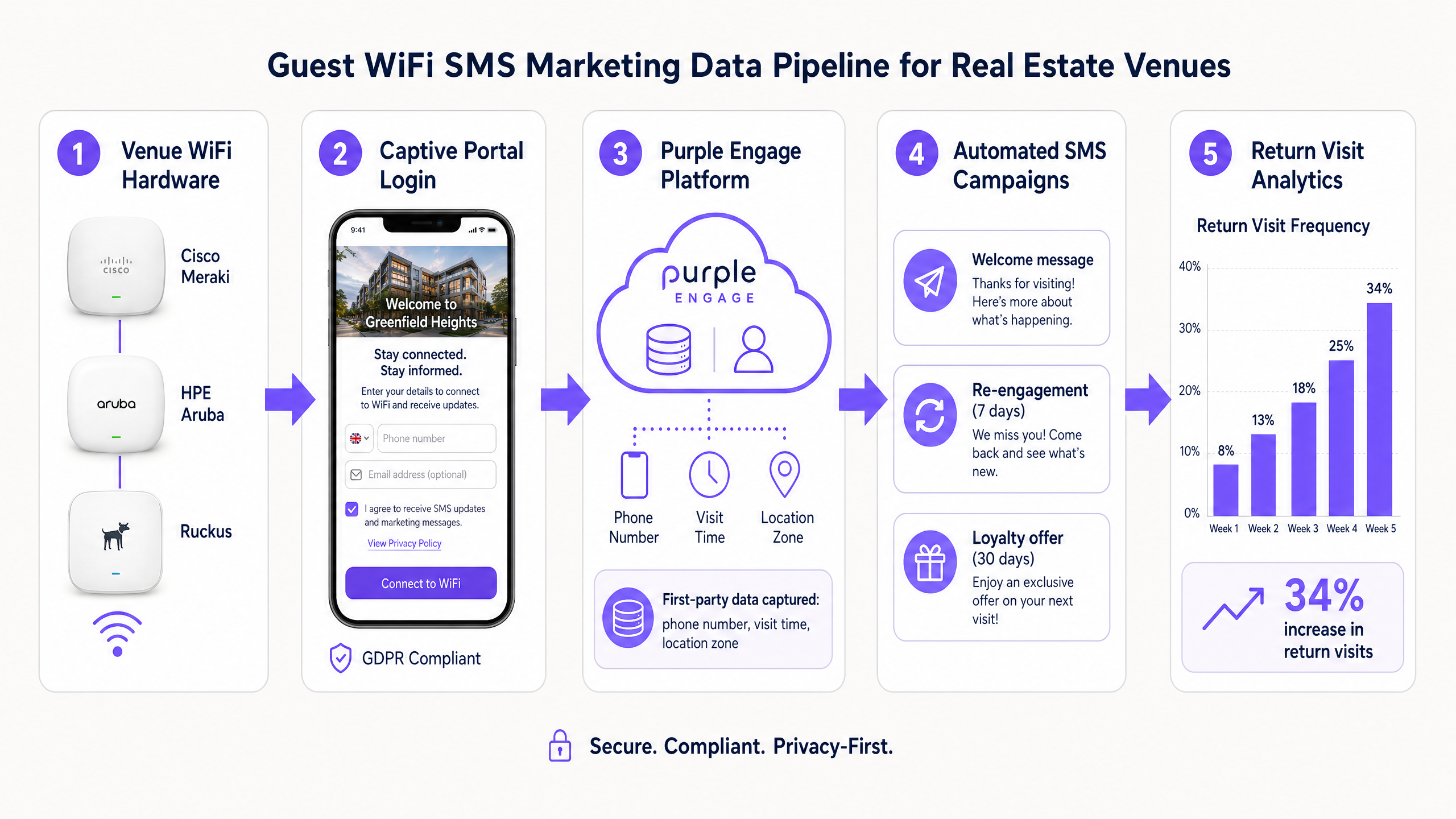
The foundation of the pipeline is your existing wireless infrastructure. The Purple platform operates as a cloud overlay, meaning no new hardware is required. It integrates natively with enterprise vendors including Cisco Meraki, HPE Aruba, Ruckus, Juniper Mist, Ubiquiti UniFi, Cambium, Extreme, and Fortinet.
The integration typically involves configuring the wireless LAN controller (WLC) or cloud management dashboard to point Guest WiFi traffic to the Purple RADIUS servers. This setup uses standard protocols like IEEE 802.1X for secure authentication and RADIUS for accounting. When a device connects to the SSID, the controller redirects the user to the Purple-hosted captive portal before granting internet access.
The Captive Portal and First-Party Data Capture
The captive portal is the critical conversion point. This is the splash page where visitors authenticate. To enable SMS marketing, the portal must be configured to request a phone number as the primary authentication method.
When a user submits their phone number, Purple verifies the format and logs the device MAC address. This MAC address becomes the unique identifier linking the physical device to the user profile. The system captures the timestamp, location zone (based on access point proximity), and dwell time. This first-party data flows directly into the Purple CRM, creating a unified visitor profile.
Campaign Automation and Trigger Logic
With data flowing into the CRM, the Purple Engage platform automates the outbound SMS campaigns. Unlike batch-and-blast marketing, these campaigns are triggered by specific physical behaviours.
The system evaluates the visitor profile against predefined rules. If a visitor connects to the WiFi on Monday, the system can trigger a "Welcome" SMS immediately. If that MAC address is not seen on the network for seven days, the system triggers a "Re-engagement" SMS. This logic ensures messages are highly relevant and timely, capitalising on the 90-second average read time for SMS.
Implementation Guide
Deploying this architecture requires coordination between IT and marketing. Follow this vendor-neutral deployment sequence to ensure a stable, compliant rollout.
Step 1: Network Configuration
Begin by configuring your wireless infrastructure to route Guest WiFi traffic to the Purple RADIUS servers. For a Cisco Meraki deployment, navigate to the Meraki dashboard, select the Guest SSID, and configure the splash page settings to use a custom URL provided by Purple. Set the RADIUS servers to the Purple IP addresses and input the shared secret. Ensure the walled garden includes the necessary domains for the captive portal to load correctly, including any identity providers like Microsoft Entra ID or Google Workspace if you are offering social login options alongside SMS.
Step 2: Captive Portal Design
Design the splash page to maximise opt-in rates. The value exchange must be clear. A simple "Connect to free WiFi" prompt is less effective than "Connect to free WiFi and receive 10% off your next visit." Ensure the phone number field is prominent.
Crucially, implement the GDPR consent checkbox. This cannot be pre-ticked. The text must explicitly state that the user agrees to receive marketing SMS. Under UK GDPR and PECR, informed consent is mandatory.
Step 3: Campaign Configuration
Navigate to the Purple Engage dashboard and build your automated sequences. Start with three core campaigns:
- Welcome Campaign: Triggered 15 minutes after the first login. Used to deliver the immediate value promised on the splash page.
- Re-engagement Campaign: Triggered after 7 or 14 days of absence. Used to drive a return visit with a specific offer.
- Loyalty Campaign: Triggered after the 5th visit. Used to reward frequent visitors.
Set frequency caps to ensure no visitor receives more than two messages per month, preventing list fatigue.
Best Practices
To maximise the return on your SMS marketing deployment, adhere to these industry standards.
Prioritise Closed-Loop Attribution
The primary advantage of Guest WiFi marketing is the ability to prove ROI. When an SMS is sent, the Purple platform logs the campaign ID against the user profile. When that user returns to the venue and their device automatically connects to the WiFi (recognised via MAC address), the system attributes that return visit to the specific SMS campaign. You must configure your analytics dashboard to track this metric. This closed-loop attribution is what justifies the investment to the board.
Maintain Strict Data Hygiene
SMS deliverability relies on clean data. Implement real-time phone number validation on the captive portal to prevent users from entering fake numbers. Furthermore, ensure your opt-out mechanism is robust. Every SMS must include a "Reply STOP to unsubscribe" instruction. The Purple platform automatically processes these requests and suppresses the number from future campaigns. Failure to process opt-outs immediately violates GDPR and damages brand reputation.
Segment by Venue Zone
If you operate a large mixed-use development, segment your campaigns by location. If a visitor consistently logs in at the food court access points, send them restaurant offers. If they log in near the hotel lobby, send them accommodation promotions. Purple's location analytics allow you to build highly targeted segments based on physical behaviour, significantly increasing conversion rates.
Troubleshooting & Risk Mitigation
Even with a solid architecture, deployments can encounter issues. Here are the common failure modes and how to resolve them.
Low Opt-In Rates
If your phone number capture rate falls below 30%, the issue is likely the captive portal design. Users either do not see the value in providing their number, or the form is too complex.
Mitigation: Simplify the form. Ask only for the phone number and the consent checkbox. Remove fields for name, age, or postcode. A/B test the value proposition text. "Get Free WiFi" performs worse than "Join our VIP list for free WiFi and exclusive offers."
High Opt-Out Rates
If users are replying "STOP" at a rate higher than 2% per campaign, your message frequency is too high, or the content is irrelevant.
Mitigation: Implement strict frequency capping in the Purple Engage dashboard. Limit messages to a maximum of two per month per user. Review the campaign content. Ensure every message offers tangible value, such as a discount or exclusive access. Do not use SMS for generic newsletters; reserve that for email.
MAC Randomisation Interference
Modern iOS and Android devices use MAC randomisation to protect user privacy. This can complicate attribution, as the device presents a different MAC address on subsequent visits.
Mitigation: Purple mitigates this by encouraging users to download a Passpoint profile or use the venue app. Once a Passpoint profile is installed, the device connects securely and consistently, bypassing the randomisation issue and ensuring accurate long-term attribution.
ROI & Business Impact
Deploying SMS marketing via Guest WiFi transforms a cost centre into a revenue generator. The business impact is measurable across three key metrics.
Increased Return Visit Frequency
By engaging visitors directly on their mobile devices with timely, relevant offers, venues see a significant increase in return visits. Our data shows that targeted SMS campaigns can increase return visit frequency by up to 34% compared to a control group. For a retail centre, an extra visit per shopper per quarter translates directly to increased tenant revenue.
Reduced Customer Acquisition Cost (CAC)
Capturing first-party data via the captive portal reduces reliance on expensive third-party advertising. Instead of paying Facebook or Google to reach people who have already visited your venue, you own the communication channel. The cost of sending an SMS is negligible compared to the cost of a PPC click, dramatically lowering your overall CAC.
Verifiable Campaign Performance
The integration of Purple Engage and WiFi Analytics provides definitive proof of performance. You can report exactly how many people received an SMS, how many clicked the link, and crucially, how many physically returned to the venue within 72 hours. This level of attribution is impossible with traditional print or billboard advertising, allowing IT and marketing teams to prove the value of the network infrastructure.
Key Definitions
Captive Portal
A web page that a user of a public-access network is obliged to view and interact with before access is granted. Used by Purple to capture first-party data.
IT teams configure the WLC to redirect traffic here. Marketing teams design the UI to maximise opt-in rates.
First-Party Data
Information a company collects directly from its customers. In this context, phone numbers and visit history captured via the Guest WiFi.
Crucial for reducing reliance on expensive third-party advertising platforms like Google or Facebook.
Closed-Loop Attribution
The ability to track a marketing interaction (an SMS send) to a specific physical outcome (a return visit) using a persistent identifier (the device MAC address).
This is how IT and marketing prove the financial ROI of the network infrastructure to the board.
MAC Address
Media Access Control address. A unique identifier assigned to a network interface controller for use as a network address in communications within a network segment.
Used by Purple Analytics to track device movement and return visits across the venue.
IEEE 802.1X
An IEEE Standard for port-based Network Access Control. It provides an authentication mechanism to devices wishing to attach to a LAN or WLAN.
The underlying protocol ensuring secure authentication when devices connect to the venue network.
Passpoint (Hotspot 2.0)
A standard that enables mobile devices to automatically discover and connect to WiFi networks without requiring the user to manually select the network or enter credentials.
Recommended by Purple to mitigate MAC randomisation issues and ensure consistent long-term attribution.
Walled Garden
A limited environment that controls the user's access to web content and services. In WiFi, it allows access to specific URLs (like the captive portal or identity providers) before full authentication.
IT must configure the walled garden correctly to ensure the splash page loads and social logins function.
Opt-in Rate
The percentage of total WiFi users who explicitly consent to receive marketing communications via the captive portal.
A key performance indicator for the splash page design. A low rate indicates a poor value exchange or confusing UI.
Worked Examples
A 250-room hotel wants to increase direct bookings and reduce OTA commissions. They currently offer free WiFi but do not capture any guest data. How should they deploy SMS marketing to achieve this?
- Configure the existing HPE Aruba network to route Guest WiFi authentication to Purple.
- Design a captive portal that requires a phone number for access, with a clear GDPR consent checkbox stating 'Tick here to receive exclusive direct booking offers'.
- Set up an automated campaign in Purple Engage triggered 24 hours after the guest's last seen network activity (assumed checkout).
- The SMS should read: 'Thanks for staying with us! Book your next visit directly via this link for 15% off and free breakfast.'
- Monitor the WiFi Analytics dashboard to track how many recipients log back into the network within 90 days.
A large retail shopping centre with 120 units is experiencing low footfall on Tuesday mornings. They have 80,000 opted-in phone numbers in their Purple CRM. How can they use SMS to drive traffic during this specific window?
- Open Purple Engage and create a new segment targeting users who have visited the venue at least twice in the last six months, but not in the last 14 days.
- Create a time-bound campaign scheduled to send at 4:00 PM on Monday.
- The SMS should read: 'Quiet Tuesday? Show this text at any participating cafe tomorrow morning for a free coffee with any pastry purchase.'
- Configure the campaign to track return visits occurring specifically between 9:00 AM and 12:00 PM on Tuesday.
- Review the analytics on Wednesday to measure the uplift in footfall compared to the previous four Tuesdays.
Practice Questions
Q1. Your marketing team wants to send a weekly SMS blast to all 50,000 contacts captured via the Guest WiFi, promoting a different tenant each week. As the IT Director, how should you advise them?
Hint: Consider the impact of message frequency on opt-out rates and the difference between batch-and-blast vs triggered campaigns.
View model answer
Advise against the weekly blast. Sending four messages a month will cause high opt-out rates and list fatigue. Instead, recommend using Purple Engage to configure triggered campaigns based on visitor behaviour. For example, trigger an SMS only to users who have visited the specific tenant's zone in the past, or to users who haven't visited the venue in 30 days. This maintains relevance and protects the database.
Q2. A new stadium deployment is capturing phone numbers, but the marketing team reports that zero return visits are being attributed to the SMS campaigns. The network uses Cisco Meraki access points. What is the most likely technical failure point?
Hint: Think about how the system identifies a returning user to close the attribution loop.
View model answer
The most likely issue is that MAC randomisation is preventing the system from recognising returning devices. If a device uses a different MAC address on its return visit, Purple Analytics cannot link the new session to the profile that received the SMS. To resolve this, the venue should implement Passpoint (Hotspot 2.0) to provide a secure, persistent connection profile that bypasses MAC randomisation, restoring closed-loop attribution.
Q3. During a captive portal redesign, the agency suggests pre-ticking the SMS marketing consent box to increase the opt-in rate. Is this acceptable?
Hint: Review the compliance requirements for first-party data capture in the UK and EU.
View model answer
No, this is not acceptable. Under UK GDPR and PECR, consent must be freely given, specific, informed, and unambiguous. Pre-ticked boxes do not constitute valid consent. Implementing this would expose the venue to significant regulatory fines and reputational damage. The consent box must remain unticked, and the value proposition on the splash page should be improved to drive legitimate opt-ins.