
Staff WiFi Terms and Conditions: Legal and Compliance Essentials
This guide covers the legal and technical essentials of drafting and enforcing staff WiFi terms and conditions for enterprise venues. It details what to include in an Acceptable Use Policy (AUP), how to meet GDPR and PCI DSS requirements, and how to deploy identity-based authentication and network segmentation to protect corporate assets. IT managers, HR teams, and operations directors at hotels, retail chains, stadiums, and public-sector organisations will find actionable guidance they can implement this quarter.
Video overview
Listen to this guide
View podcast transcript
Part of our core series: Enterprise WiFi Security Guide →
Executive summary
Securing staff network access requires more than technical controls. It demands a clear, enforceable Acceptable Use Policy (AUP) backed by identity-based authentication, network segmentation, and DNS-level content filtering. As venues scale across hospitality, retail, and public sectors, the risk surface expands proportionally. A single compromised employee device on a shared network can breach PCI DSS and GDPR requirements, triggering fines and operational disruption.
This guide gives IT managers, network architects, and venue operations directors a definitive framework for drafting and enforcing staff WiFi terms and conditions. We cover the legal essentials of employee monitoring transparency, the technical architecture required for compliance, and how Purple's Identity-Based Networks protect corporate assets from internal misuse. The core principle is straightforward: your staff WiFi policy must be specific, transparent, and technically enforced. A policy that exists only on paper is not a policy.
Technical deep-dive
Why shared passwords fail
The majority of staff WiFi networks in hospitality and retail still run on WPA2-Personal with a single shared password. That password is written on whiteboards, shared in Slack channels, and never changed when people leave. This is not a minor inconvenience. It is a structural security failure. When an employee departs, their access to the corporate network persists indefinitely. There is no audit trail, no per-user session key, and no way to isolate a compromised device without disrupting everyone.
The IEEE 802.1X standard, combined with WPA3-Enterprise encryption, resolves this. Each user authenticates with individual credentials tied to a central directory. Each session uses unique encryption keys, so a device on the same access point cannot intercept another user's traffic. Purple implements this through Identity-Based Networks, replacing shared passwords with certificate-based access managed through Microsoft Entra ID, Okta, or Google Workspace. When HR removes a staff member from the directory, Purple revokes their WiFi access within minutes via SCIM (System for Cross-domain Identity Management). No ticket to raise. No estate-wide password to rotate.
Network segmentation and PCI DSS compliance
Effective staff WiFi security begins with isolation. You must separate staff traffic from guest and payment networks to limit the scope of compliance audits and contain potential breaches. Deploying VLANs (Virtual Local Area Networks) is the standard approach, and it is a fundamental requirement of PCI DSS compliance.
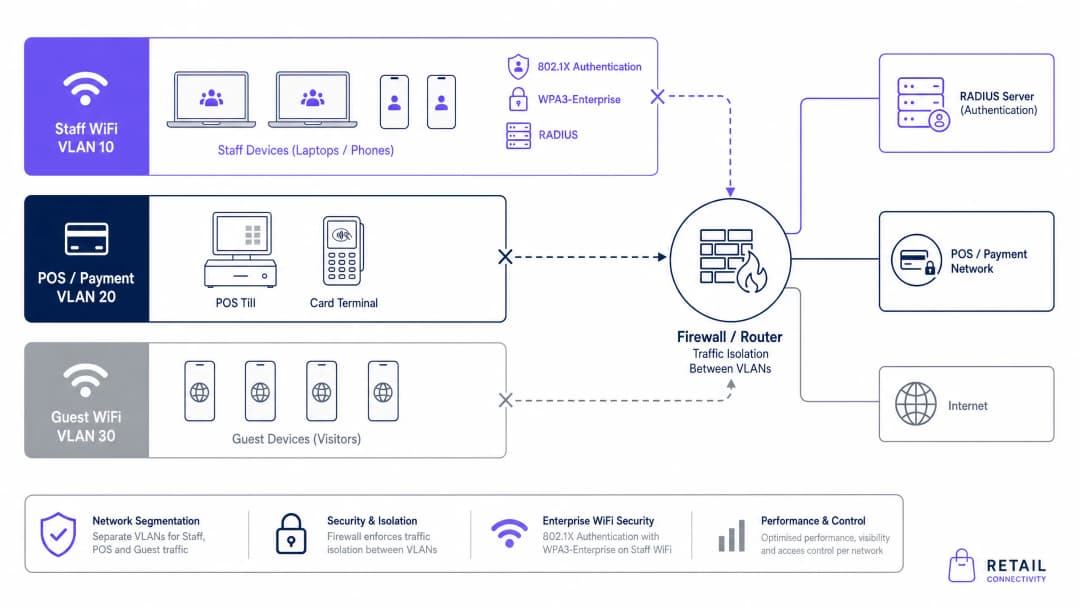
For a retail environment, you need at minimum three distinct VLANs: Guest WiFi, Staff WiFi, and Point of Sale (POS). This segmentation ensures that a compromised staff device cannot reach the cardholder data environment. PCI DSS v4.0 requires that network segmentation be validated annually as part of the compliance assessment. Purple integrates with all major enterprise wireless vendors - Cisco Meraki, HPE Aruba, Ruckus, Juniper Mist, Ubiquiti UniFi, Cambium, Extreme, and Fortinet - via standard RADIUS and VLAN tagging, so you do not need to replace existing hardware to achieve compliance.
GDPR and monitoring transparency
UK GDPR and the Data Protection Act 2018 impose strict requirements on employee monitoring. Monitoring is permitted, but only when it is lawful, proportionate, and transparent. The Information Commissioner's Office (ICO) is clear: simply having the technical capability to monitor staff does not give you the legal right to do so.
To establish a lawful basis, most organisations rely on legitimate interests. This requires documenting that the monitoring serves a specific security or operational purpose, that it is necessary to achieve that purpose, and that the privacy intrusion is proportionate. Consent is generally unsuitable in an employment context because the power imbalance between employer and employee means consent cannot be freely given.
The practical implication is that your staff WiFi terms and conditions must explicitly state what data is collected (connection times, device identifiers, bandwidth usage, DNS queries), why it is collected, who has access to it, and how long it is retained. This information must be in the AUP, the employee handbook, and the employment contract. Staff must acknowledge it. If you cannot demonstrate that employees were informed before monitoring began, you are exposed.
Got questions about your specific setup?
Our team works with venue operators, IT managers, and network engineers across 80,000 venues. Book a 20-minute call and we will show you how others like you solved it.
Implementation guide
Drafting the Acceptable Use Policy
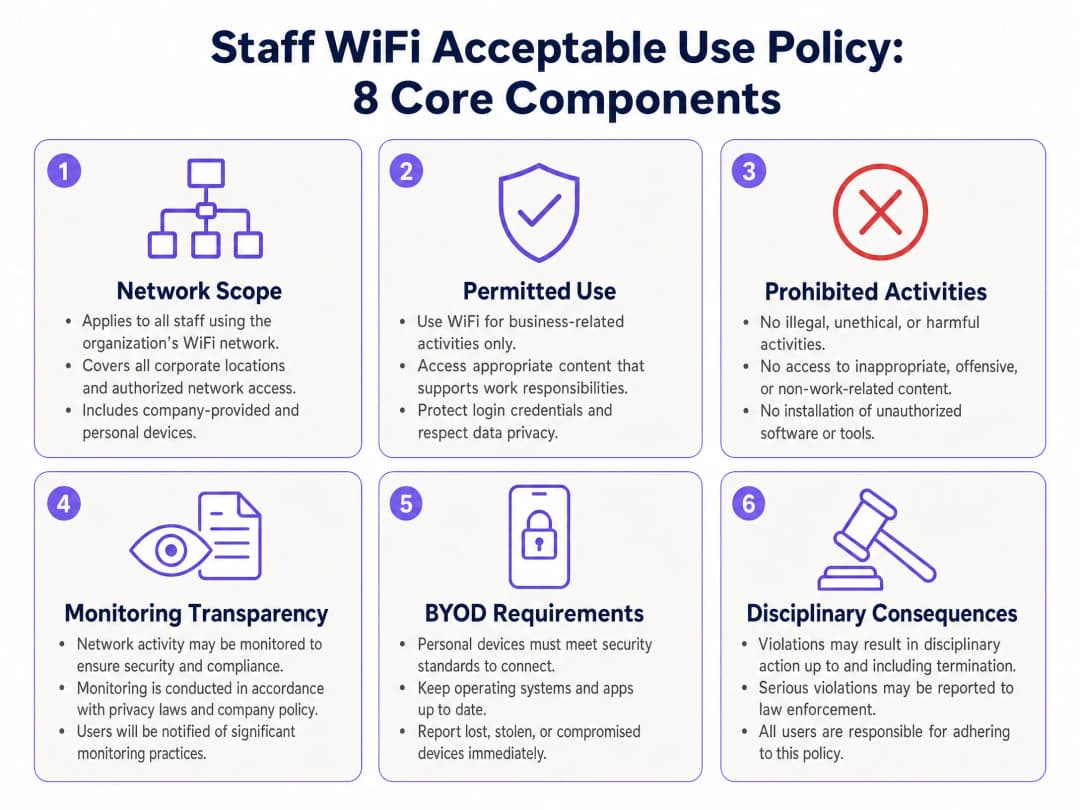
Your AUP is the legal foundation for network monitoring and disciplinary action. It must cover eight core areas.
1. Network scope. Specify that the policy applies to all employees, contractors, and authorised users connecting to the corporate network, regardless of whether they use a company-issued device or their own personal device (BYOD).
2. Permitted use. State clearly that the network is provided for business purposes. Incidental personal use may be tolerated, but it must not interfere with productivity or consume excessive bandwidth.
3. Prohibited activities. Explicitly forbid illegal activities, accessing inappropriate content, installing unauthorised software, attempting to bypass security controls, and using the network to access competitor systems.
4. Monitoring transparency. State that network activity may be monitored for security and performance management. Detail what data is collected and how it is used. This is your GDPR lawful basis statement.
5. BYOD requirements. If staff use personal devices, specify minimum security requirements: supported operating system, up-to-date security patches, and screen lock enabled. Require staff to report lost or stolen devices immediately.
6. Data handling obligations. Remind staff that they must not transmit sensitive customer or corporate data over unsecured connections, and that the corporate network does not substitute for data classification controls.
7. Disciplinary consequences. State the consequences of policy violations clearly, from verbal warnings through to termination and referral to law enforcement for serious breaches.
8. Policy review cycle. Commit to reviewing the AUP at least annually and communicating changes to all staff.
Deploying technical controls
Policy alone is insufficient. You must enforce it technically. The following sequence applies to most enterprise venues.
First, integrate your identity provider with Purple's cloud RADIUS. Connect Microsoft Entra ID, Okta, or Google Workspace to Purple's authentication infrastructure. This removes the need for on-premises RADIUS servers and provides multi-region failover with a 99.999% uptime SLA (Purple's own data).
Second, configure your access points to broadcast a dedicated staff SSID secured with WPA3-Enterprise. Assign staff devices to a dedicated VLAN based on their authenticated identity. Role-based VLAN assignment allows you to give managers, contractors, and general staff different levels of network access from the same infrastructure.
Third, enable SCIM synchronisation between your directory and Purple. This automates both onboarding and offboarding. When a new employee joins, their account in the directory automatically grants them WiFi access. When they leave, access is revoked within minutes.
Fourth, deploy Purple Shield for DNS-level content filtering. Shield blocks malicious domains and inappropriate content before they load, enforcing the prohibited activities clause of your AUP without requiring deep packet inspection. Shield strips ads and trackers at the DNS layer, reducing total data downloaded by 44% and cutting DNS queries by 62% (Purple's own data). During busy periods, you can throttle high-bandwidth streaming services to protect bandwidth for critical applications.
Best practices
Automate offboarding. Tie network access directly to your HR system. When an employee's status changes to inactive, their WiFi access must terminate instantly. Manual processes introduce gaps. IT teams using Purple typically see WiFi support tickets drop by 80% after automating access management (Purple's own data).
Conduct a Data Protection Impact Assessment (DPIA). Before implementing any new monitoring capability, complete a DPIA as required by UK GDPR for high-risk processing activities. Employee monitoring is classified as high-risk because it involves systematic tracking of individuals. Document the assessment and retain it for audit purposes.
Segment by role, not just by device type. Use role-based VLAN assignment to give contractors time-limited access that expires automatically. This is particularly relevant in hospitality environments where agency staff and seasonal workers are common.
Review policies annually. Regulations evolve. PCI DSS v4.0 introduced new requirements in 2024. UK GDPR guidance from the ICO is updated regularly. Schedule an annual policy review that involves IT, HR, and legal teams.
Train staff, not just managers. Do not bury the AUP in an onboarding manual. Run brief, practical training sessions that explain the risks of unsecured WiFi and the reasons behind the network policies. Staff who understand the why are far more likely to comply.
Troubleshooting and risk mitigation
| Failure Mode | Risk | Mitigation |
|---|---|---|
| Shared WPA2 password | Former employees retain access indefinitely | Migrate to 802.1X with identity provider integration |
| Staff and POS on the same subnet | PCI DSS scope violation, breach containment failure | Implement strict VLAN segmentation |
| No monitoring disclosure in AUP | GDPR violation, evidence inadmissible in disciplinary action | Update AUP and obtain signed acknowledgment |
| Manual offboarding process | Access persists after departure | Enable SCIM synchronisation with HR system |
| No content filtering | Malware ingress, bandwidth exhaustion, AUP enforcement gap | Deploy Purple Shield at DNS layer |
| BYOD without minimum security standards | Compromised personal devices on corporate network | Define and enforce BYOD requirements in AUP |
For a broader view of enterprise WiFi security architecture, see our Enterprise WiFi Security: A Complete Guide for 2026. If your primary concern is back-of-house retail networks, the Staff WiFi Policies for Retail: Securing Back-of-House Networks guide covers retail-specific deployment scenarios in detail.
ROI and business impact
Implementing a robust staff WiFi policy and secure architecture delivers measurable outcomes. Automating onboarding and offboarding through identity provider integration reduces IT support tickets related to WiFi access by up to 80% (Purple's own data from 80,000+ live venues). This efficiency allows IT teams to focus on strategic work rather than password resets.
Deploying Purple Shield reduces total data downloaded by 44% and improves page load times by 53% (Purple's own data). In a venue where staff rely on cloud-based applications, this directly improves productivity. In a retail environment, it protects POS performance during peak trading hours.
From a compliance perspective, the cost of a PCI DSS audit failure or a GDPR enforcement action far exceeds the cost of implementing proper controls. The ICO issued fines totalling over £7.5 million in 2023 for data protection violations. Network monitoring without transparency and proper segmentation without documentation are both audit failures waiting to happen.
Purple is ISO 27001, GDPR, CCPA, and Cyber Essentials certified, and operates across 80,000+ live venues with 350 million unique users. For venues in transport and healthcare environments where compliance requirements are particularly stringent, Purple's audit trail - logging every authentication event with user, device, time, and location - provides the documentation your auditors require.
For more on how to measure the effectiveness of your WiFi infrastructure, see WiFi Analytics.
Key Definitions
Acceptable Use Policy (AUP)
A documented set of rules defining the permitted and prohibited uses of an organisation's IT resources, including its WiFi network.
The legal foundation for employee monitoring and disciplinary action. Without a current, signed AUP, monitoring data may be inadmissible in disciplinary proceedings.
IEEE 802.1X
An IEEE standard for port-based network access control that requires individual user authentication before granting network access.
The authentication standard that replaces shared passwords with unique per-user credentials, enabling automated onboarding and offboarding.
WPA3-Enterprise
The latest WiFi security protocol for corporate networks, providing individualised encryption for each user session via 802.1X authentication.
Ensures that even on the same access point, users cannot intercept each other's traffic. Required for enterprise-grade staff WiFi security.
VLAN (Virtual Local Area Network)
A logical subnetwork that groups devices from different physical locations into an isolated broadcast domain.
Used to segment staff traffic from guest and payment networks, containing breaches and satisfying PCI DSS segmentation requirements.
RADIUS (Remote Authentication Dial-In User Service)
A networking protocol providing centralised Authentication, Authorisation, and Accounting (AAA) management for network access.
The engine behind 802.1X, verifying user credentials against a central directory and assigning VLAN membership based on identity.
SCIM (System for Cross-domain Identity Management)
An open standard that automates the exchange of user identity information between IT systems, such as an HR platform and a network access controller.
Allows Purple to instantly revoke WiFi access when an employee is removed from the corporate directory, closing the offboarding gap.
DNS Filtering
The process of blocking access to specific domains at the Domain Name System resolution layer, before a connection is established.
How Purple Shield enforces the AUP by preventing access to malicious or inappropriate content without requiring deep packet inspection.
PCI DSS (Payment Card Industry Data Security Standard)
An information security standard for organisations that process, store, or transmit cardholder data.
Requires strict network segmentation to ensure staff devices cannot access the payment environment. Validated annually as part of the compliance assessment.
DPIA (Data Protection Impact Assessment)
A process required by UK GDPR for processing activities likely to result in high risk to individuals' rights and freedoms.
Mandatory before implementing employee network monitoring. Documents the legitimate interest basis and proportionality of the monitoring.
BYOD (Bring Your Own Device)
A policy permitting employees to use personally owned devices to connect to the corporate network.
Requires specific AUP clauses defining minimum security requirements for personal devices connecting to the staff WiFi network.
Worked Examples
A 200-room hotel needs to secure its staff WiFi network. Currently, housekeepers, receptionists, and management all share a single WPA2 password. The IT manager is concerned about former employees retaining access and the risk of staff devices infecting the property management system.
The hotel migrates from a shared password model to 802.1X authentication. First, they integrate their existing Microsoft Entra ID directory with Purple's cloud RADIUS. Next, they configure their Cisco Meraki access points to broadcast a dedicated staff SSID secured with WPA3-Enterprise. Staff authenticate using their individual Microsoft credentials via the Purple app. The network is segmented, placing staff devices on VLAN 10, the property management system on VLAN 20, and guest WiFi on VLAN 30. SCIM synchronisation is enabled so that when HR disables an account, WiFi access is revoked within minutes. Purple Shield is deployed to filter malicious content and throttle high-bandwidth streaming during operational hours.
A retail chain with 50 locations wants to implement a staff WiFi Acceptable Use Policy but is concerned about GDPR compliance regarding employee monitoring across its UK stores. The current policy document is five years old and makes no reference to network monitoring.
The retailer updates its AUP to explicitly state that connection logs, bandwidth usage, and DNS query data are recorded for security and performance management. This updated policy is distributed to all employees, who must sign an acknowledgement. The retailer conducts a DPIA documenting the legitimate interest basis for monitoring. Technically, Purple logs authentication events (user, device, time, location) and Shield logs DNS-level activity, providing a comprehensive audit trail without inspecting encrypted traffic payloads. The retailer limits data retention to 90 days in line with the data minimisation principle.
Practice Questions
Q1. A regional manager requests that the new staff WiFi network use a single password that changes monthly to simplify access for visiting employees from other branches. How should the IT architect respond, and what alternative should they propose?
Hint: Consider the operational overhead of rotating passwords across a multi-site estate and the security gap that persists during each monthly cycle.
View model answer
The IT architect should reject the request. A shared password, even if rotated monthly, leaves the network exposed for up to 30 days after any departure. Distributing a new password monthly across a multi-site estate creates significant operational overhead and generates support tickets every rotation cycle. The correct alternative is 802.1X authentication integrated with the central directory. Visiting employees use their existing corporate credentials to connect automatically at any site. There is no password to distribute, no rotation cycle to manage, and no access gap when someone leaves. This delivers better security and a better user experience simultaneously.
Q2. During a PCI DSS audit, the assessor notes that staff devices and POS terminals are on the same network segment. What is the immediate risk, and what remediation steps are required?
Hint: Focus on the scope implications for the cardholder data environment and the timeline for remediation.
View model answer
The immediate risk is that the entire staff network falls within the PCI DSS cardholder data environment scope, significantly expanding the audit surface and the remediation cost. Any compromised staff device could potentially reach the POS terminals. Remediation requires implementing strict VLAN segmentation: a dedicated VLAN for staff devices, a separate VLAN for POS terminals, and firewall rules preventing lateral movement between them. This must be validated and documented before the audit can be closed. Going forward, role-based VLAN assignment through 802.1X ensures that devices are automatically placed on the correct segment based on authenticated identity.
Q3. An organisation wants to implement network monitoring to detect unusual bandwidth consumption that may indicate data exfiltration. Their employee handbook has not been updated in three years and contains no reference to network monitoring. What must happen before monitoring tools are activated?
Hint: Consider the sequence of legal requirements under UK GDPR before any monitoring begins.
View model answer
Before activating any monitoring tools, the organisation must complete three steps. First, update the Acceptable Use Policy and employee handbook to explicitly state that network activity is monitored, what data is collected, why it is collected, and how long it is retained. Second, conduct a DPIA documenting the legitimate interest basis for the monitoring and demonstrating that the privacy intrusion is proportionate to the security objective. Third, distribute the updated policy to all staff and obtain signed acknowledgment. Only after these steps are complete and documented is it lawful to activate monitoring. Monitoring without prior transparency is a UK GDPR violation regardless of the security justification.
Q4. A hotel's IT team is asked to allow agency housekeeping staff to connect to the staff WiFi during their shifts, but these workers are not in the corporate directory. How should access be provisioned and controlled?
Hint: Consider time-limited access, network isolation, and the offboarding challenge for temporary workers.
View model answer
Agency staff should be provisioned with time-limited guest credentials that expire automatically at the end of their engagement, rather than being added to the corporate directory. Purple supports contractor access management with automatic expiry, so access terminates without manual intervention. These credentials should grant access to a restricted VLAN with internet access only, isolated from internal systems. The AUP must cover contractors explicitly, and agency staff must acknowledge the policy before receiving credentials. This approach avoids the offboarding risk associated with temporary workers while maintaining a full audit trail.
Continue reading in this series
CIPA compliance: compliance checklist for venue operators
You will be able to decide whether CIPA binds your WiFi, then segment networks, route DNS through Purple Shield and close bypass routes. You will also know what evidence to keep for Form 486 or Form 479 certification. The checklist assigns every requirement an owner, so your next funding year certification has nothing missing.
WPA3 transition mode connection failures: a deployment checklist for Cisco Meraki, HPE Aruba and Ruckus
Use this checklist to diagnose why devices fail on a WPA3 SAE transition mode SSID and fix it on Cisco Meraki, HPE Aruba or Ruckus. You will match 802.11 status codes to causes, isolate PMF, 802.11r and 6GHz issues, and decide when to move to a WPA3-only SSID.
Best DNS filtering: a comprehensive guide for businesses
This technical reference guide explains how enterprise DNS filtering secures public networks by blocking malicious domains at the resolution layer - before a connection is ever established. It gives IT directors, network architects, and venue operations teams the deployment architecture, firewall configuration, and compliance context they need to protect Guest WiFi across hospitality, retail, and public-sector environments. Purple Shield blocks malware, botnets, and inappropriate content at the DNS level across 80,000+ live venues.
Got questions about your specific setup?
Our team works with venue operators, IT managers, and network engineers across 80,000 venues. Book a 20-minute call and we will show you how others like you solved it.