
Customer data platform: a comprehensive guide for businesses
This guide details how IT managers and venue operations directors can deploy a customer data platform (CDP) to convert guest WiFi infrastructure into a first-party data asset. It covers technical architecture, GDPR-compliant data capture, identity resolution, audience segmentation, and activation strategies with measurable ROI benchmarks from hospitality and retail deployments.
Listen to this guide
View podcast transcript
Executive summary
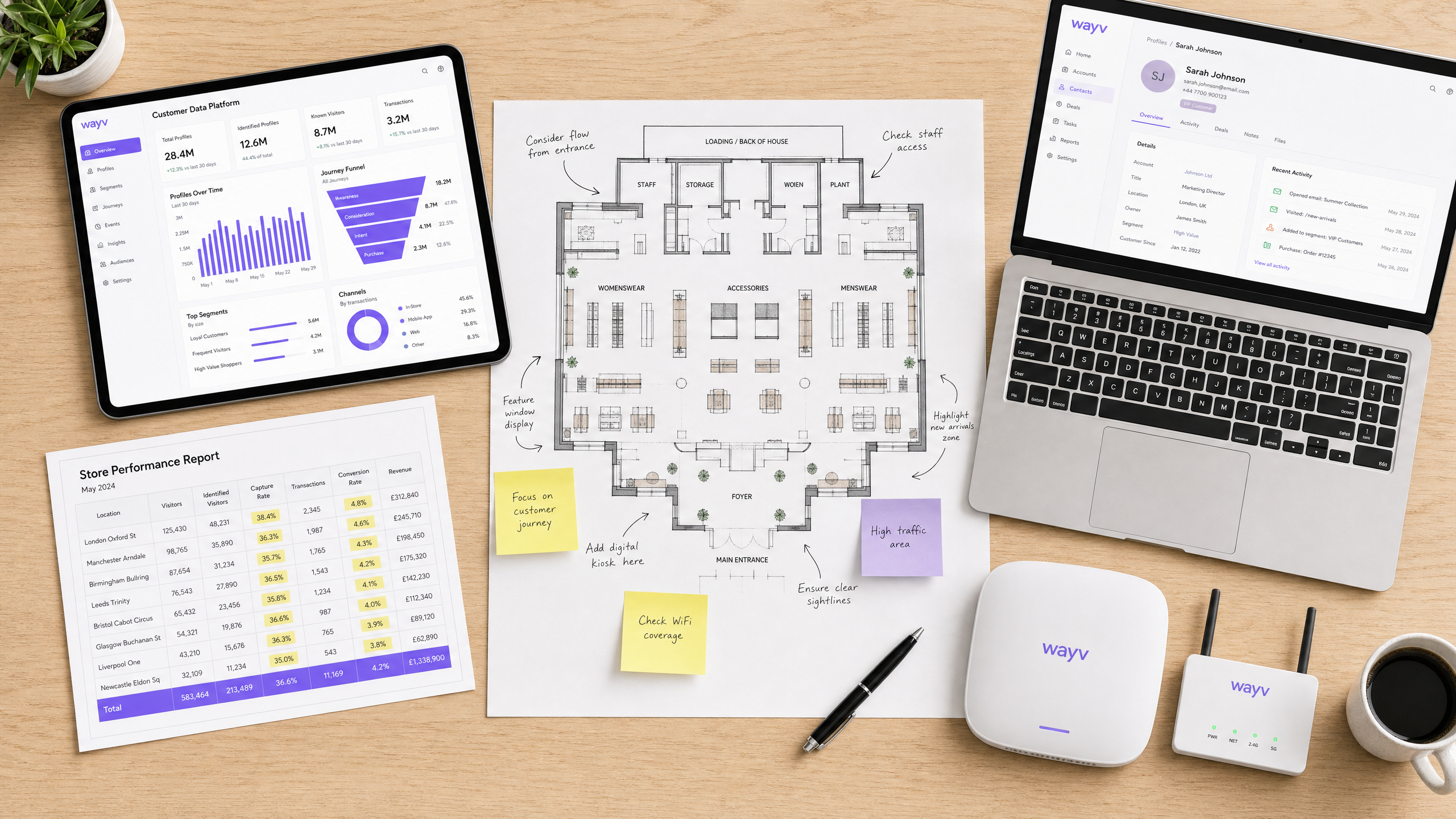
Your guest WiFi network already generates two types of data: anonymous presence data from device probe requests, and identified engagement data from captive portal authentications. A customer data platform (CDP) sits at the intersection of these two streams, resolving identities, building unified customer profiles, and activating those profiles across email, SMS, and paid media channels. For IT managers and venue operations directors, this means the network infrastructure you have already deployed can become the primary engine for first-party data capture. Purple Engage captures verified guest email and phone data at login and automates marketing campaigns, integrating with hardware from Cisco Meraki, HPE Aruba, Ruckus, Juniper Mist, Ubiquiti UniFi, Cambium, Extreme, and Fortinet without requiring a hardware replacement. Harrods achieved a 57x return on investment by marketing to customers acquired through their guest WiFi network (Purple, 2026). This guide provides the technical architecture, implementation steps, and compliance framework to replicate that outcome at your venue.
Technical deep-dive
What a CDP actually does
A customer data platform (CDP) is a centralised system that ingests data from multiple sources, resolves identities, and builds persistent unified customer profiles that marketing and operations teams can activate. The CDP Institute defines a CDP as "packaged software that creates a persistent, unified customer database that is accessible to other systems" (CDP Institute, 2024). In a physical venue, the primary ingestion point is the Guest WiFi network.
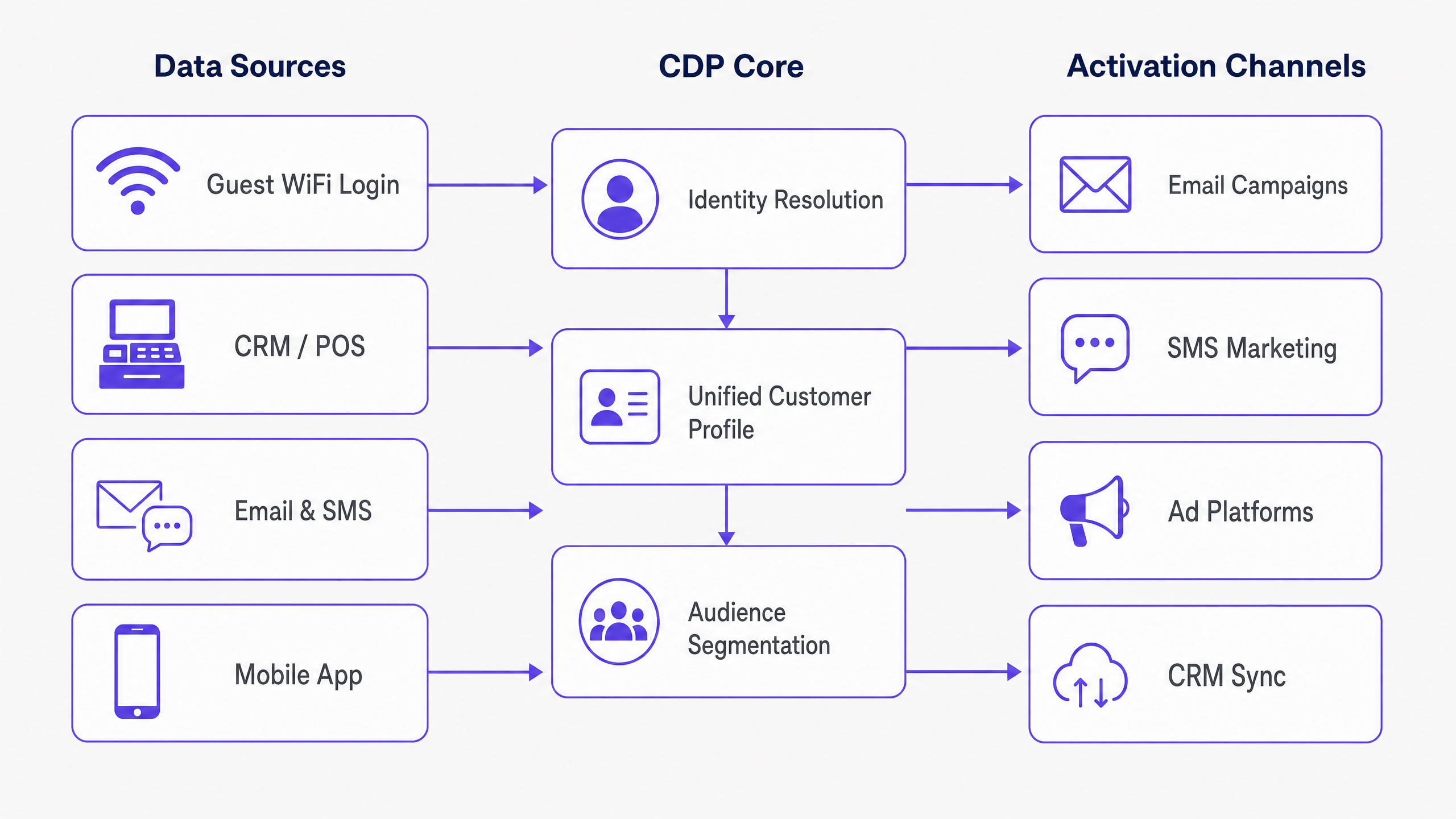
The architecture has five functional layers:
| Layer | Function | Venue context |
|---|---|---|
| Data ingestion | Pulls data from WiFi, CRM, POS, mobile app | Captive portal authentication events |
| Identity resolution | Links MAC address, email, CRM ID to one profile | Returning guest recognised across visits |
| Profile unification | Merges all attributes into a single record | Visit history, dwell time, spend data |
| Audience segmentation | Builds cohorts from profile attributes | "Visited 3x in 30 days, dwell > 20 min" |
| Activation | Syncs segments to email, SMS, ad platforms | Automated re-engagement campaign |
The data capture layer: guest WiFi as the ingestion point
When a device enters your venue with its WiFi radio active, it broadcasts probe requests - the device asking the network whether a known access point is nearby. Every access point in range picks up the probe request, recording the device MAC address and signal strength. This is the foundation of presence analytics: anonymous footfall counting and dwell time calculation.
The complication is MAC randomisation. Since iOS 14 and Android 10, mobile devices rotate through temporary MAC addresses for probe requests. Platforms that do not correct for this overstate visitor counts significantly. Purple applies statistical correction models calibrated against camera ground truth, maintaining accuracy within three to seven per cent (Purple, 2026).
Engagement data begins when the user connects through the captive portal. The captive portal is the authentication gateway and the primary mechanism for capturing first-party data. The user provides a verified email address or phone number. The CDP links this identifier to the device session and, via identity resolution, to any existing CRM record.
Identity resolution in practice
Identity resolution is the process of linking multiple identifiers - MAC address, email, CRM ID, loyalty number - to a single individual. When a shopper authenticates via WiFi at your Manchester store, then purchases through your mobile app two days later, the CDP recognises both interactions as the same person. It merges the records and updates the unified profile.
This cross-channel stitching is what separates a CDP from a simple email capture tool. The unified profile accumulates visit frequency, zone dwell times, purchase history, and campaign engagement data. Marketing teams can then build segments based on the full behavioural picture, not just the last interaction.
Audience segmentation and activation
Once profiles are unified, the CDP enables segmentation that goes beyond what a CRM or email platform can achieve alone. Segments are built using real-time behavioural filters: visit frequency, dwell time in specific zones, time since last visit, or spend threshold. These segments are then synced via REST APIs or webhooks to activation channels.
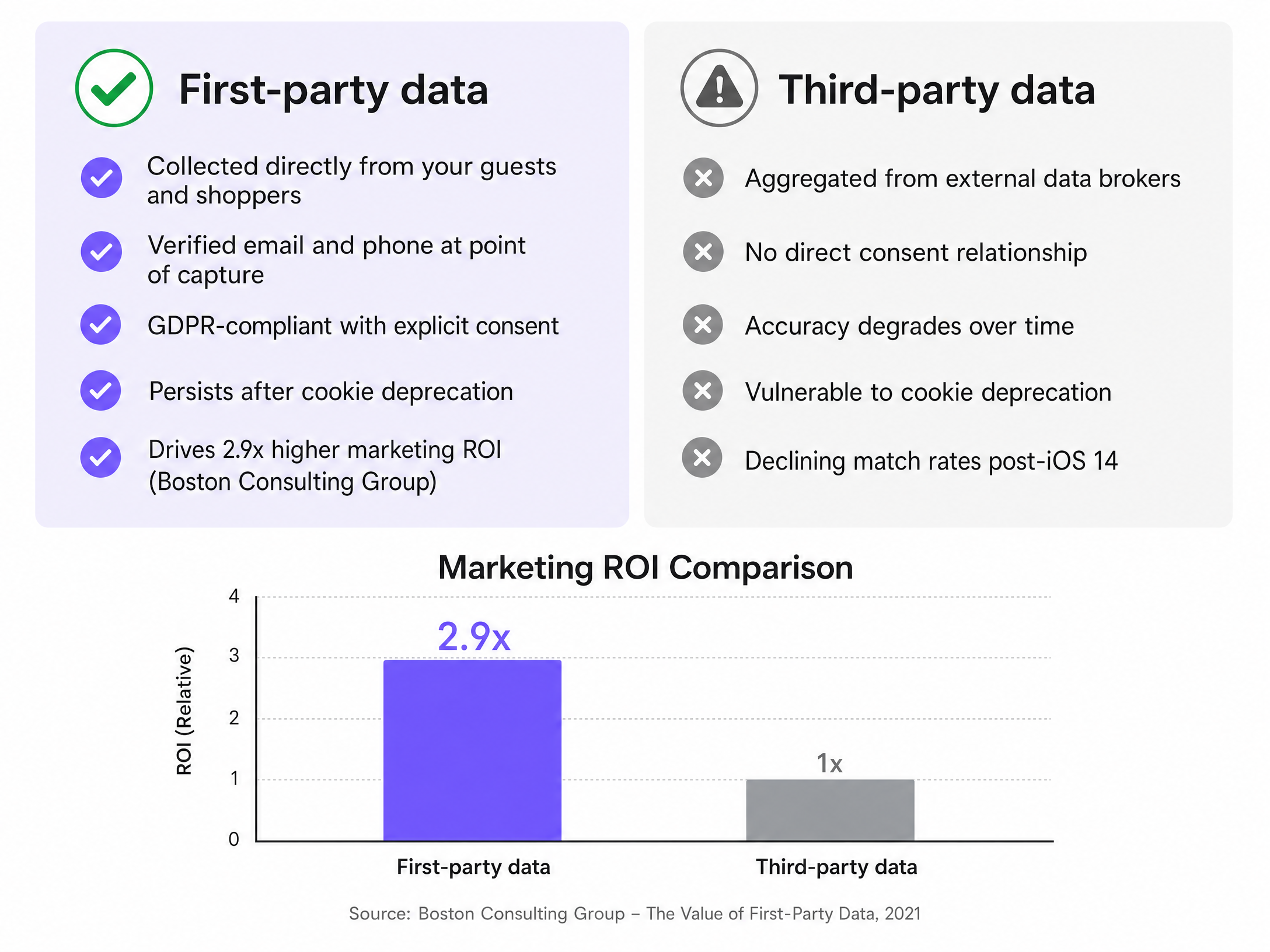
The highest-ROI activation use case is audience suppression: automatically excluding existing customers from paid acquisition campaigns. Boston Consulting Group found that brands using first-party data achieve up to 2.9x revenue uplift and 1.5x cost savings compared to those relying on third-party data (BCG, 2021). Industry benchmarks suggest 10-20% of acquisition budgets are wasted on already-converted customers; suppression eliminates this waste from week one.
For WiFi Analytics deployments, the activation layer also feeds operational workflows: staffing schedules aligned to footfall patterns, digital signage triggered by zone occupancy, and loyalty programme prompts sent at the moment a returning guest connects.
Implementation guide
Step 1: Audit your current data capture rate
Before deploying a CDP, establish your baseline. The capture rate - the percentage of detected devices that authenticate through the captive portal - is the key metric. Industry benchmarks put capture rate at between 15% and 40%, depending on portal design and the incentive offered (Purple, 2026). If you are below 15%, the portal flow needs attention before you invest in CDP infrastructure.
To measure capture rate: divide authenticated sessions by unique detected devices in the same time window. Most analytics platforms surface this directly. If yours does not, export both figures and calculate manually.
Step 2: Optimise the captive portal
The captive portal is the conversion engine of your CDP deployment. Three rules apply:
First, keep the login flow to three steps or fewer. Every additional field reduces conversion. Ask for a single identifier - an email address - on the first visit. Collect additional attributes progressively on subsequent visits.
Second, use Purple Verify to validate email addresses at the point of capture. An unvalidated database fills with typos and disposable addresses. Verify eliminates this at source, so your CDP is built on clean data from day one.
Third, make the value exchange explicit. Tell the user what they receive in return for their email address. Free WiFi access is the baseline. A loyalty programme discount, a digital receipt, or access to a premium bandwidth tier are stronger incentives. In hospitality environments, Premier Inn and Whitbread have used tiered bandwidth as a perk for loyalty members, driving sign-ups and providing a direct revenue line from the WiFi investment.
For more on portal design and brand consistency, see how to make a great first impression with your guest WiFi .
Step 3: Configure access point density for analytics
A network designed purely for connectivity will not provide the spatial resolution needed for zone-level analytics. To enrich CDP profiles with location data, you need overlapping coverage with access points positioned to create triangulation opportunities.
The rule of thumb is one access point per 150 to 200 square metres in open-plan environments. Place access points on zone boundaries, not just in the centre of rooms. This single configuration decision is the most common reason why analytics deployments underperform expectations.
Purple integrates with Cisco Meraki, HPE Aruba, Ruckus, Juniper Mist, Ubiquiti UniFi, Cambium, Extreme, and Fortinet. You do not need to replace existing hardware. You configure the access points to direct authentication traffic to the Purple cloud overlay, and the analytics engine processes the data from there.
Step 4: Establish API integrations
A CDP delivers value through activation, not storage. Configure the API layer to push segmented audiences into your CRM and marketing automation platform. Standard integration points include:
- CRM sync: Push unified profiles and segment membership to Salesforce, HubSpot, or your existing CRM via REST API.
- Email platform: Sync segments to Mailchimp, Klaviyo, or Braze for automated campaign triggers.
- Ad platforms: Activate first-party segments on Google Ads and Meta for suppression and lookalike targeting.
- Business intelligence: Push footfall and dwell time data to your BI platform via webhook for operational reporting.
The integration layer is where most deployments stall. It requires coordination between IT, marketing, and operations. Prioritise this work in the first 30 days of deployment, before the data volume makes retroactive integration complex.
Step 5: Define consent architecture
GDPR requires explicit, freely given consent for marketing communications. Your captive portal must present a clear opt-in checkbox, separate from the WiFi access terms, that specifies the marketing use of the email address. The CDP must store the consent record with a timestamp and make it available for audit.
Presence analytics - anonymous footfall and dwell time - runs under legitimate interest, not consent. You must complete a Data Protection Impact Assessment (DPIA) and display venue signage informing visitors that anonymous analytics are in operation. Purple provides DPIA templates and signage assets for both use cases.
For SMS marketing integration, see how to use SMS for marketing to increase return visits .
Best practices
Prioritise first-party data over third-party data
Third-party data accuracy degrades over time, and match rates have declined sharply since iOS 14 and the deprecation of third-party cookies. First-party data captured via WiFi authentication is verified at the point of capture, consented, and persistent. It is not subject to cookie deprecation. BCG's research shows first-party data-based campaigns deliver 2x or higher improvement in incremental revenue versus third-party audiences (BCG, 2021).
Implement tiered bandwidth as a loyalty mechanism
In retail and hospitality environments, tiered bandwidth converts a cost centre into a revenue line. Standard WiFi access is free. Premium bandwidth - higher speeds, no session timeout - is available to loyalty programme members or email subscribers. This creates a direct incentive for data capture and ties the WiFi investment to a measurable loyalty metric.
Align staffing to footfall data
The operational value of a CDP extends beyond marketing. Footfall and dwell time data from the WiFi analytics layer can feed directly into workforce management systems. A retail chain that aligns staffing schedules to peak footfall periods reduces both labour cost and queue times. This is a quantifiable operational saving that strengthens the business case for the CDP investment.
Run a three-SSID architecture
For venues managing guest, staff, and IoT devices on the same physical infrastructure, a three-SSID architecture isolates traffic and simplifies data governance. Guest WiFi captures first-party data through the captive portal. Staff WiFi uses 802.1X authentication with Microsoft Entra ID, Okta, or Google Workspace. IoT devices sit on a dedicated SSID with VLAN isolation. This architecture prevents cross-contamination of data streams and simplifies GDPR compliance. See three SSIDs to rule them all for the full deployment guide.
Troubleshooting and risk mitigation
Low capture rate
If your capture rate falls below 15%, the portal flow is the primary suspect. Audit the number of form fields, the clarity of the value exchange, and the page load speed. A portal that takes more than three seconds to load loses a significant proportion of users before they see the form. Simplify the flow, reduce fields to one, and retest.
Duplicate profiles in the CDP
Duplicate profiles occur when the same individual authenticates with different email addresses across visits. The CDP's identity resolution engine should merge these automatically using probabilistic matching on device fingerprint and behavioural patterns. If duplicates persist, review the matching logic configuration and ensure the MAC address is being passed correctly from the access point to the CDP.
Consent record gaps
If your CDP cannot produce a timestamped consent record for a given profile, you have a compliance gap. Audit the captive portal to confirm the consent checkbox is mandatory and that the consent event is being written to the CDP at the moment of authentication, not in a batch process. Batch processing creates a window where a user could receive a marketing communication before their consent record is confirmed.
MAC randomisation overcounting
If your footfall figures appear implausibly high, MAC randomisation is likely the cause. Ask your analytics vendor for their correction methodology and validation data. Purple applies statistical correction models calibrated against camera ground truth, maintaining accuracy within three to seven percent (Purple, 2026). A vendor that cannot explain their correction approach is producing unreliable data.
Integration failures between CDP and CRM
API integrations between the CDP and downstream systems are the most common operational failure point. Implement monitoring on the webhook or API endpoint to alert on failed pushes. Establish a retry policy for failed events. Audit the segment sync frequency - daily batch syncs are sufficient for most email campaigns, but real-time triggers (e.g., a welcome email on first connection) require event-driven webhooks.
ROI and business impact
Measuring success
The return on investment of a CDP deployment in a physical venue is measured across four dimensions:
| Metric | How to measure | Benchmark |
|---|---|---|
| Capture rate | Authenticated sessions / detected devices | 15-40% (Purple, 2026) |
| Email campaign ROI | Revenue from WiFi-acquired cohort / campaign cost | 57x (Harrods, Purple data) |
| Ad spend efficiency | Reduction in wasted acquisition spend | 10-20% saving (CDP Institute) |
| Operational savings | Labour cost reduction from footfall-aligned staffing | Venue-specific |
Case study: hospitality
A Premier Inn property deployed Purple Engage across its guest WiFi network. The captive portal captured verified email addresses from authenticating guests, with explicit marketing consent. The CDP resolved identities across repeat stays and synced segments to the email marketing platform. An automated campaign targeting guests who had not returned in 90 days achieved a measurable uplift in direct bookings, reducing OTA commission costs. The IT team configured the deployment on existing HPE Aruba hardware with no capital expenditure on access points.
Case study: retail
A national retail chain deployed WiFi Analytics across 50 locations. The CDP aggregated footfall and dwell time data from Cisco Meraki access points. The marketing team built a segment of shoppers who had visited twice in 30 days but had not made a purchase. An SMS campaign targeting this segment - using data from SMS marketing automation - drove a measurable increase in conversion rate. The operations team used the footfall data to align staffing schedules, reducing labour cost during low-footfall periods.
The cost-benefit calculation
For a venue processing 10,000 authenticated sessions per month, the CDP builds a first-party database of verified contacts at a rate that no paid media channel can match. The cost per acquired contact via WiFi is a fraction of the cost per lead from paid social or search. The long-term value of that database - activated through email, SMS, and ad suppression - compounds over time. Purple has processed 440 million logins in 2024 across 80,000+ live venues, with 29 billion data points collected (Purple, 2026). The platform is ISO 27001, GDPR, and CCPA compliant, and B Corp certified.
References
[1] Purple, "Measuring the Business ROI of Guest WiFi and Location Analytics", 2026. Available at: https://www.purple.ai/en-us/guides/measuring-the-business-roi-of-guest-wifi-and-location-analytics
[2] Boston Consulting Group, "The Value of Getting Personalization Right - or Wrong - Is Multiplying", 2021.
[3] CDP Institute, "CDP Use Cases", 2024. Available at: https://cdp.com/basics/cdp-use-cases/
[4] Hightouch, "What is a Customer Data Platform (CDP)?", 2025. Available at: https://hightouch.com/blog/what-is-a-customer-data-platform-cdp
Key Definitions
Customer data platform (CDP)
A centralised system that ingests data from multiple sources, resolves identities, and builds persistent unified customer profiles accessible to marketing and operations tools.
IT teams deploy CDPs to break down data silos between WiFi, CRM, POS, and mobile app systems, enabling data-driven marketing without manual data reconciliation.
Identity resolution
The process of linking multiple identifiers - MAC address, email, CRM ID, loyalty number - to a single individual across online and offline touchpoints.
Essential for creating accurate customer profiles. Without it, a guest who visits three times appears as three separate people in your database.
Captive portal
A web page that users must view and interact with before accessing a public WiFi network. It is the authentication gateway and the primary mechanism for capturing first-party data and marketing consent.
The design of the captive portal directly determines the capture rate. A poorly designed portal starves the CDP of data.
MAC randomisation
A privacy feature introduced in iOS 14 and Android 10 where mobile devices rotate through temporary MAC addresses when broadcasting probe requests, preventing persistent device tracking.
Analytics platforms that do not correct for MAC randomisation overstate visitor counts. Ask any vendor for their correction methodology and validation data.
First-party data
Data collected directly from customers with their explicit consent, through your own properties and interactions.
First-party data is the foundation of a CDP. It is verified, consented, and persistent after cookie deprecation. It drives 2.9x higher marketing ROI than third-party data (BCG, 2021).
Capture rate
The percentage of detected devices (presence data) that successfully authenticate through the captive portal (engagement data).
The key performance indicator for portal effectiveness. Industry benchmarks put capture rate at 15 - 40%. Below 15% indicates the portal flow needs simplification.
Cloud overlay
A software architecture that integrates with existing hardware infrastructure without requiring replacement. The cloud platform handles data processing, portal delivery, and API integrations.
Purple operates as a cloud overlay, meaning venues can deploy CDP capabilities on their existing Cisco Meraki, HPE Aruba, Ruckus, or other enterprise hardware.
Audience suppression
The practice of excluding existing customers or known contacts from paid acquisition campaigns on ad platforms such as Google Ads and Meta.
The highest-ROI CDP use case. Industry benchmarks suggest 10 - 20% of acquisition budgets are wasted on already-converted customers. Suppression eliminates this waste from week one.
Presence analytics
Anonymous footfall counting and dwell time calculation based on probe request data from mobile devices, before any user authentication.
Runs under legitimate interest (not consent) with a completed DPIA and venue signage. Provides operational data on visitor patterns without requiring user action.
Data Protection Impact Assessment (DPIA)
A GDPR-mandated process for identifying and mitigating privacy risks associated with data processing activities, required for high-risk processing such as location tracking.
Required before deploying presence analytics. Purple provides DPIA templates for venue operators.
Worked Examples
A 200-room Premier Inn property wants to increase direct bookings and reduce OTA commission costs. They have HPE Aruba access points installed throughout the building. How should the IT manager configure the CDP deployment to achieve this?
The IT manager configures the HPE Aruba controllers to route guest authentication traffic to the Purple cloud overlay. No hardware replacement is required. The captive portal is designed to capture a verified email address and explicit marketing consent in three steps: connect to WiFi, enter email, confirm consent. Purple Verify validates the email at the point of capture. The CDP resolves identities, linking returning guests to their previous stay records. The marketing team builds two audience segments: guests who booked via OTAs (identified from the PMS integration), and guests who have not returned in 90 days. An automated email campaign offers a 10% discount on the next direct booking. The segment is suppressed from paid acquisition campaigns on Meta and Google, eliminating wasted spend on already-known guests.
A national retail chain with 50 locations wants to measure the impact of a new in-store promotional campaign on footfall and dwell time in the promotional zones. They have Cisco Meraki access points installed. The marketing director wants to know whether the campaign is driving incremental visits or just longer dwell times from existing visitors.
The network architect audits the Cisco Meraki access point placement to confirm zone-boundary positioning in the promotional areas. Where access points are placed in the centre of rooms, they are repositioned to zone boundaries to enable triangulation. The Purple analytics engine processes probe requests, applying MAC randomisation correction to maintain visitor count accuracy within three to seven percent. The CDP correlates presence data with engagement data from the captive portal, separating new visitors (first authentication) from returning visitors (existing profile). The marketing director accesses the dashboard to view footfall uplift, median dwell time in the promotional zones, and the new-versus-returning split for the campaign period versus the baseline period.
Practice Questions
Q1. A retail venue reports a capture rate of 8%. The captive portal currently requires visitors to enter their first name, last name, email address, date of birth, and postcode before accessing WiFi. The venue manager argues that collecting more data upfront saves time later. How do you respond, and what specific changes do you recommend?
Hint: Consider the relationship between form length, friction, and conversion rate. Also consider progressive data collection.
View model answer
The venue manager's logic is understandable but counterproductive. A capture rate of 8% means 92% of detected devices never authenticate, so the CDP is being starved of data regardless of how comprehensive the form is. The fix is to reduce the portal to a single required field - email address - and collect additional attributes progressively on subsequent visits. A returning visitor who has already provided their email can be prompted for their postcode on their third visit, when the value exchange is established. This approach will increase the capture rate significantly and ultimately produce a richer database than the current approach, because more people will enter it.
Q2. The marketing team wants to run a retargeting campaign on Meta targeting shoppers who visited the venue in the last 30 days but did not make a purchase. They also want to run a separate acquisition campaign targeting new shoppers. How should the CDP be configured to support both campaigns without wasting budget?
Hint: Think about audience suppression and the distinction between known and unknown contacts.
View model answer
Build two segments in the CDP. Segment one: visitors with a recorded authentication in the last 30 days and no corresponding purchase event from the POS integration. Sync this segment to Meta for retargeting. Segment two: the full authenticated visitor database (all known contacts). Sync this as a suppression list to the acquisition campaign, so that known contacts are excluded from the new-shopper targeting. This ensures the acquisition budget reaches genuinely new audiences, while the retargeting budget is focused on the highest-probability converters.
Q3. A stadium IT director is planning a hardware refresh ahead of a major events season. They want the new network to support granular zone-level analytics for the concourses, hospitality suites, and pitch-side areas. The procurement team has specified Ruckus access points. What placement guidance should the IT director give to the installation team?
Hint: Consider the requirements for signal triangulation and the difference between coverage and density.
View model answer
The IT director should specify that access points are placed on zone boundaries, not in the centre of each area. Zone-level analytics require triangulation: the analytics engine estimates device location by comparing signal strength across multiple access points. This only works if the access points create overlapping coverage at the zone boundaries. The rule of thumb is one access point per 150 square metres in open-plan concourse areas. For enclosed hospitality suites, the density requirement is higher due to wall attenuation. The IT director should also confirm with the analytics vendor - in this case Purple, which integrates with Ruckus - that the MAC randomisation correction methodology is calibrated for the specific environment, as stadium environments with high device density require more robust correction models.
Q4. The data protection officer has flagged that the venue's presence analytics deployment may not be GDPR-compliant. The venue has been using footfall data for 12 months without a completed DPIA and without venue signage. What steps must the IT manager take to remediate this?
Hint: Consider the legal basis for presence analytics and the specific GDPR requirements for legitimate interest processing.
View model answer
Presence analytics runs under legitimate interest, not consent. To rely on legitimate interest under GDPR, the venue must complete a Legitimate Interest Assessment (LIA), which includes a DPIA for high-risk processing such as location tracking. The IT manager must: first, pause the presence analytics processing until the LIA and DPIA are complete; second, complete the DPIA using the templates provided by Purple; third, deploy venue signage at all entry points informing visitors that anonymous analytics are in operation, including the data controller's identity and the opt-out mechanism; fourth, document the LIA and DPIA in the data processing register; fifth, resume processing once the documentation is in place. The 12 months of historical data collected without this documentation represents a compliance gap that should be disclosed to the DPO for assessment.