
Customer data management platform: a comprehensive guide for businesses
This guide explains how venue operators can deploy a customer data management platform to unify fragmented visitor data. It covers technical architecture, integration strategies, and the critical role of Guest WiFi in building first-party data profiles.
Video overview
Listen to this guide
View podcast transcript
📚 Part of our core series: WiFi Marketing Guide →
Executive Summary
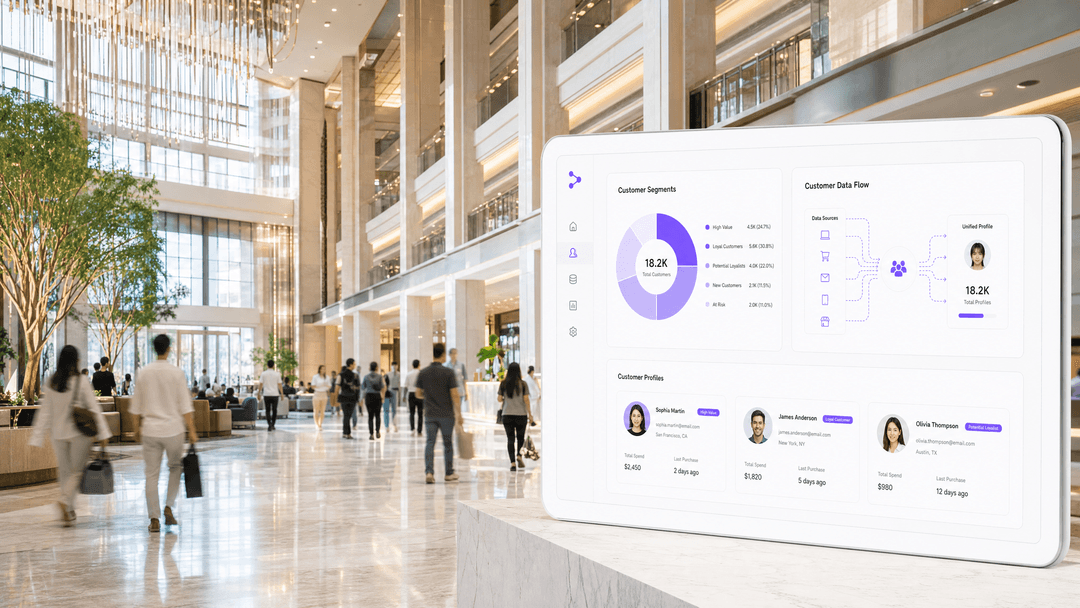
Venue operators face a structural data gap. You know the guests who booked in advance and the shoppers who scanned a loyalty card. You know almost nothing about the vast majority of visitors who walk through your doors. A customer data management platform closes this gap. It ingests data from every physical and digital touchpoint, resolves it into a single unified profile per individual, and makes that profile available for segmentation and activation.
For physical venues, the most scalable data collection point is the network itself. By using Guest WiFi as a data layer, you capture verified first-party data at the point of login. When integrated with a customer data management platform, this presence data transforms an anonymous footfall metric into a known, reachable audience. This guide details the architecture, implementation strategy, and compliance requirements for deploying a customer data management platform across enterprise venues.
Technical Deep-Dive
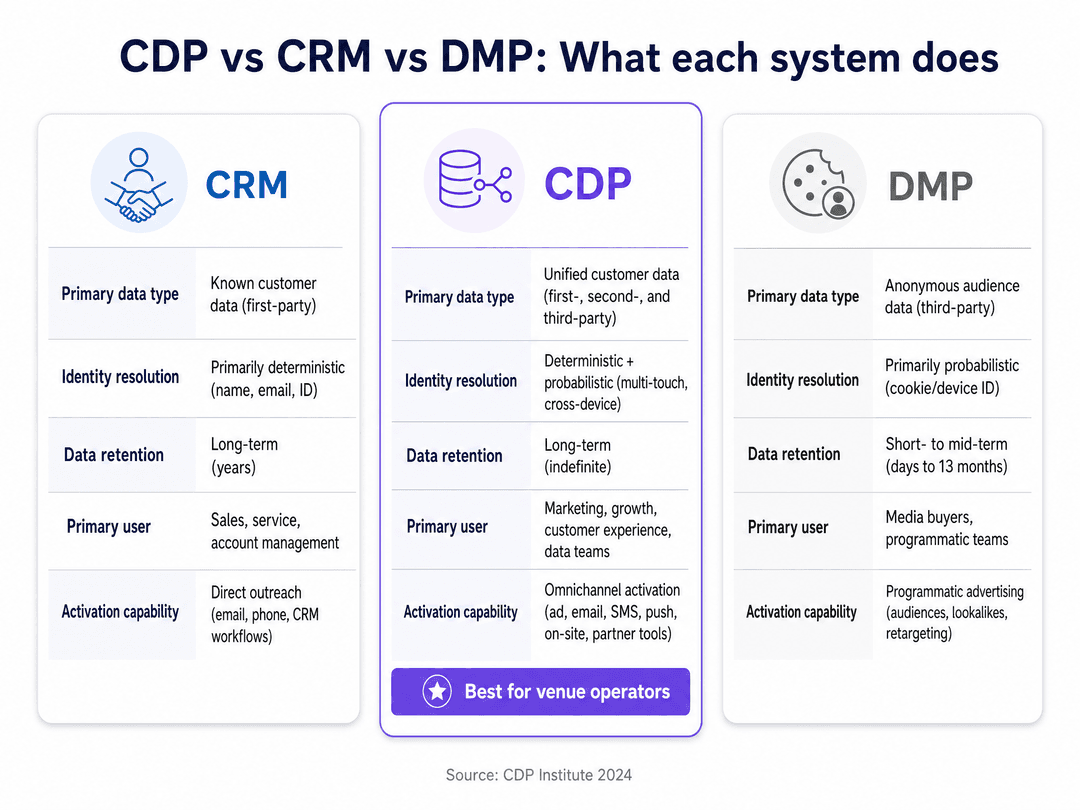
A customer data management platform differs from a CRM. A CRM manages your relationship with known customers and focuses on sales workflows. A customer data management platform ingests raw event data from across the organisation, including anonymous touchpoints, and builds a complete behavioural picture.
Core Architecture
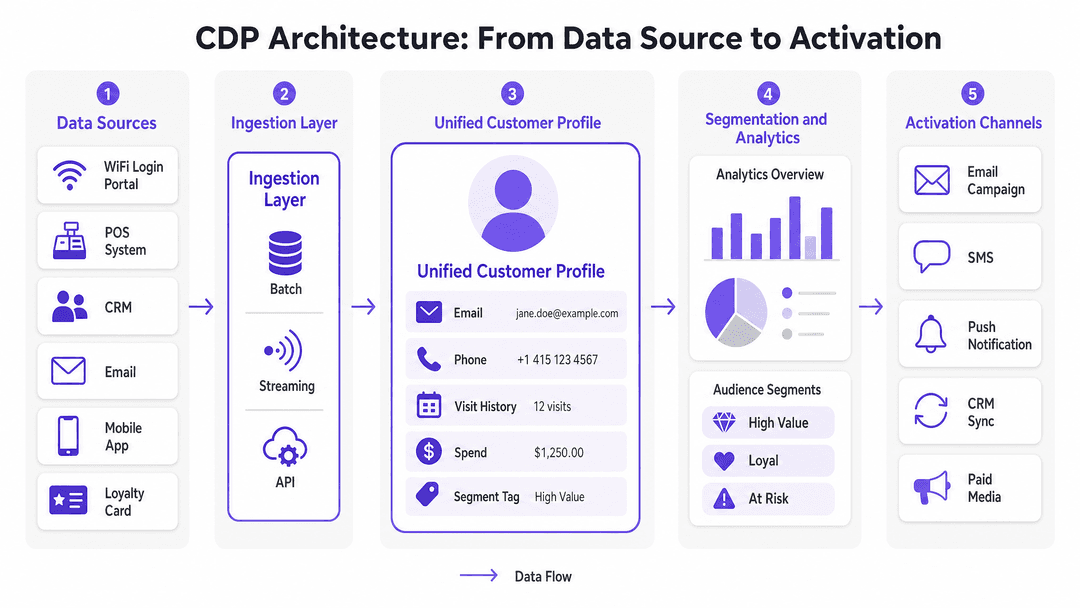
The architecture of a modern customer data management platform consists of six logical layers:
- Ingestion Layer: Collects data across touchpoints. This includes batch uploads from property management systems, streaming data from point-of-sale systems, and API feeds from the WiFi login portal.
- Storage Layer: Persists raw data in an immutable format before cleaning and structuring it into curated profiles.
- Processing Layer: Executes identity resolution. This is where the system matches a WiFi MAC address to an email address, and links that email to a loyalty programme ID.
- Cataloguing Layer: Manages metadata, access controls, and data governance.
- Analytics Layer: Enables audience segmentation and behavioural analysis.
- Activation Layer: Pushes audience segments to destination systems like email marketing platforms, SMS tools, and paid media networks.
The Role of Guest WiFi
In a venue context, Guest WiFi is the primary engine for identity resolution. When a visitor authenticates through a captive portal, you capture a verified email address or phone number. Purple's identity-based network authenticates 440 million logins annually across 80,000 venues. This scale provides the baseline first-party data required to populate a customer data management platform.
The integration requires a cloud overlay. Purple operates hardware-agnostic, integrating directly with Cisco Meraki, HPE Aruba, Ruckus, Juniper Mist, Ubiquiti UniFi, Cambium, Extreme, and Fortinet. This prevents the need for a hardware rip-and-replace when deploying a new data strategy.
Implementation Guide
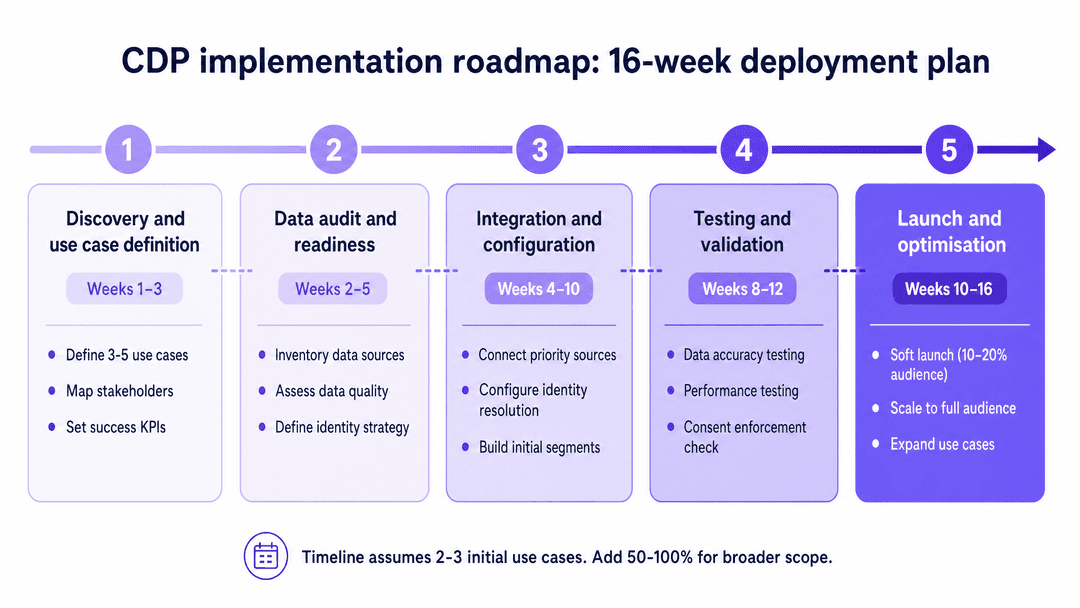
Deploying a customer data management platform requires strict scope control. Industry data indicates a high failure rate for projects that attempt to solve every data problem simultaneously. The fastest path to value is a phased approach targeting specific business outcomes.
Phase 1: Discovery and Use Case Definition
Define three to five specific use cases. Each must specify the business outcome, the required data, the activation channel, and the success metric. Do not proceed until these are locked.
Phase 2: Data Audit and Readiness
Document every system containing customer data. Assess completeness and consistency. If 30% of your legacy email addresses are invalid, clean the data before ingestion. A customer data management platform that unifies bad data produces bad profiles.
Phase 3: Integration and Configuration
Connect your highest-priority sources first. Configure your identity resolution rules. For example, determine whether email address or phone number serves as the primary key when merging profiles.
Phase 4: Launch and Optimisation
Execute a soft launch with 10% to 20% of your audience. Monitor profile match rates, data latency, and activation delivery before scaling to the full database.
Best Practices
Secure Conscious-Choice Opt-ins Under GDPR and CCPA, you must establish a clear consent basis for marketing. The captive portal provides a conscious-choice opt-in mechanism. The visitor actively consents to communications in exchange for network access.
Enforce Cross-Channel Opt-outs If a user unsubscribes from an email, that preference must propagate through the customer data management platform to all other activation channels, including SMS and paid media, within 24 hours.
Focus on Return Visit Rate When evaluating the success of your WiFi Analytics , track return visit rate as the primary KPI. Reaching known visitors with relevant campaigns consistently outperforms broadcasting to a generic list.
Troubleshooting & Risk Mitigation
Risk: Scope Creep Teams frequently expand requirements during the integration phase. Mitigation: Maintain a strict Phase 2 backlog. Refuse new data source integrations until the initial use cases are live and generating return on investment.
Risk: Identity Fragmentation The system fails to merge profiles, resulting in duplicate records for the same visitor. Mitigation: Implement deterministic matching rules based on hard identifiers (email, phone) before attempting probabilistic matching based on device or location behaviour.
Risk: Siloed Implementation Treating the deployment as a marketing-only project. Mitigation: Form a cross-functional team. IT must handle infrastructure and security. Legal must review data processing agreements. Marketing defines the use cases.
ROI & Business Impact
The business impact of a customer data management platform is measured in data activation efficiency. In the Hospitality sector, integrating property management data with WiFi presence data enables automated, highly targeted post-stay campaigns. This increases email open rates and drives direct bookings.
In Retail , matching dwell time analytics with point-of-sale data allows operators to segment shoppers into high-value regulars and lapsed visitors. Activating these segments through targeted offers improves return visit frequency. The return on investment justifies the deployment when the platform moves from passive data storage to active revenue generation.
Listen to our full executive briefing on customer data management platforms:
Key Definitions
Customer Data Platform (CDP)
A centralised software system that collects data from multiple sources, resolves it into unified customer profiles, and makes those profiles available to other systems for marketing and analytics.
IT teams deploy CDPs to eliminate data silos and provide marketing with a single source of truth for visitor behaviour.
Identity Resolution
The process of matching multiple identifiers (e.g., email, phone number, device MAC address) across different systems to a single individual.
This is the core technical function of a CDP, ensuring that a guest's WiFi login is correctly linked to their loyalty account.
First-Party Data
Information a company collects directly from its customers or visitors with their explicit consent.
With the deprecation of third-party cookies, venue operators must rely on first-party data captured via mechanisms like Guest WiFi portals.
Captive Portal
A web page that a user of a public access network is obliged to view and interact with before access is granted.
This is the primary interface for securing GDPR-compliant conscious-choice opt-ins and collecting verified contact details.
Deterministic Matching
Linking data records based on an exact match of a unique identifier, such as an email address or phone number.
IT architects prefer deterministic matching for its high accuracy when building unified profiles in a CDP.
Probabilistic Matching
Linking data records based on the statistical likelihood that they belong to the same person, using signals like IP address, location, and browsing behaviour.
Used when deterministic identifiers are unavailable, though it carries a higher risk of false positives.
Activation
The process of sending unified profiles and audience segments from the CDP to execution tools like email marketing platforms or ad networks.
A CDP is only valuable if the data is activated to drive business outcomes like increased return visits.
Conscious-Choice Opt-in
A consent mechanism where the user actively agrees to data processing and marketing communications, rather than relying on pre-ticked boxes.
Mandatory for GDPR compliance when capturing data through a venue's network infrastructure.
Worked Examples
A 200-room hotel needs to increase direct bookings from corporate guests who currently book through online travel agencies (OTAs). They have a property management system (PMS) and Purple Guest WiFi installed on Cisco Meraki hardware.
The hotel configures Purple to capture verified email addresses via the captive portal when guests log in. The customer data management platform ingests the WiFi login data and matches it against the PMS data. While the OTA masks the booking email, the WiFi login provides the guest's actual corporate email address. The platform unifies this profile, tags the guest as a corporate traveller based on their weekday stay pattern, and pushes this segment to the marketing automation tool. The hotel then triggers an automated campaign offering a free breakfast or room upgrade for their next stay if booked directly.
A large retail shopping centre wants to identify which shoppers visit the premium fashion wing but do not purchase, in order to send them targeted promotions.
The venue uses Purple's location analytics to track device presence in the premium fashion zone. This data flows into the customer data management platform via API. Simultaneously, the platform ingests transaction data from the retailers' point-of-sale systems. The platform cross-references the WiFi presence data against the transaction data. Shoppers who spent more than 30 minutes in the premium zone but have no corresponding transaction record are segmented into a 'High Intent, No Purchase' audience. This segment is activated via a targeted SMS campaign offering a 24-hour discount code for specific premium retailers.
Practice Questions
Q1. Your marketing director wants to integrate 12 different data sources into the new CDP before launch to ensure 'complete visibility'. As the IT lead, how do you respond?
Hint: Consider the primary cause of implementation failure and the recommended phased approach.
View model answer
Advise against a 'big bang' integration. Recommend defining 3 to 5 specific, high-impact use cases first, and integrating only the 2 or 3 data sources required to deliver them (e.g., Guest WiFi and PMS). Push the remaining sources to a Phase 2 backlog to prevent scope creep and accelerate time to value.
Q2. A hotel group uses Cisco Meraki access points and wants to start capturing first-party data for their new CDP. They assume they need to replace their network hardware to support identity-based authentication. What is the correct architectural approach?
Hint: Review how Purple integrates with existing network infrastructure.
View model answer
Explain that a hardware rip-and-replace is unnecessary. Deploy Purple as a cloud overlay on the existing Cisco Meraki infrastructure. The platform is hardware-agnostic and integrates directly with the existing controllers to provide the captive portal and route the captured first-party data to the CDP.
Q3. During the data audit phase, you discover that the legacy CRM contains 100,000 guest records, but 40% lack a valid email address, and 25% have no record of marketing consent. How should this data be handled during the CDP migration?
Hint: Consider the impact of bad data on unified profiles and GDPR compliance requirements.
View model answer
Do not ingest the corrupted data into the CDP. Quarantine the records lacking valid identifiers or consent. Use the Guest WiFi captive portal as a clean data collection engine to progressively rebuild the database with verified, conscious-choice opt-ins. A CDP that unifies bad data produces bad profiles.
Continue reading in this series
How to leverage SMS in marketing to increase return visits
This technical reference guide outlines how enterprise venues can integrate WiFi analytics with SMS marketing engines to drive repeat visits. It details the architecture required to capture real-time presence data, trigger automated SMS campaigns based on physical behaviour, and measure the direct impact on return rates. By aligning network infrastructure with marketing automation, IT and operations teams can establish a high-yield channel for customer retention.
First-party data marketing: a comprehensive guide for businesses
This guide explains how to build a robust first-party data marketing strategy using enterprise Guest WiFi networks. It covers the technical architecture for secure data capture via captive portals, GDPR-compliant consent workflows, CRM integration patterns, and automated campaign deployment. Venue operators across hospitality, retail, events, and public-sector environments will find actionable guidance for turning passive visitors into a high-quality, owned marketing audience.
How to Improve Customer Experience in Supermarkets Using WiFi
This technical reference guide details how enterprise WiFi infrastructure can be leveraged to measurably improve the customer experience in supermarkets. It provides actionable implementation strategies for IT leaders covering network architecture, real-time analytics, queue management, in-store navigation, and loyalty integration — with concrete deployment guidance, compliance considerations, and ROI frameworks for grocery retail environments.
Got questions about your specific setup?
Our team works with venue operators, IT managers, and network engineers across 80,000 venues. Book a 20-minute call and we will show you how others like you solved it.