
How to leverage SMS marketing best practices to increase return visits

This guide details how venue operators can use SMS marketing to drive measurable return visits by capturing verified first-party phone data via Guest WiFi. It covers technical architecture, compliance frameworks, segmentation strategies, and real-world deployment scenarios.

📖 4 min read📝 802 words🔧 2 worked examples3 practice questions📚 8 key definitions

Listen to this guide

View podcast transcript
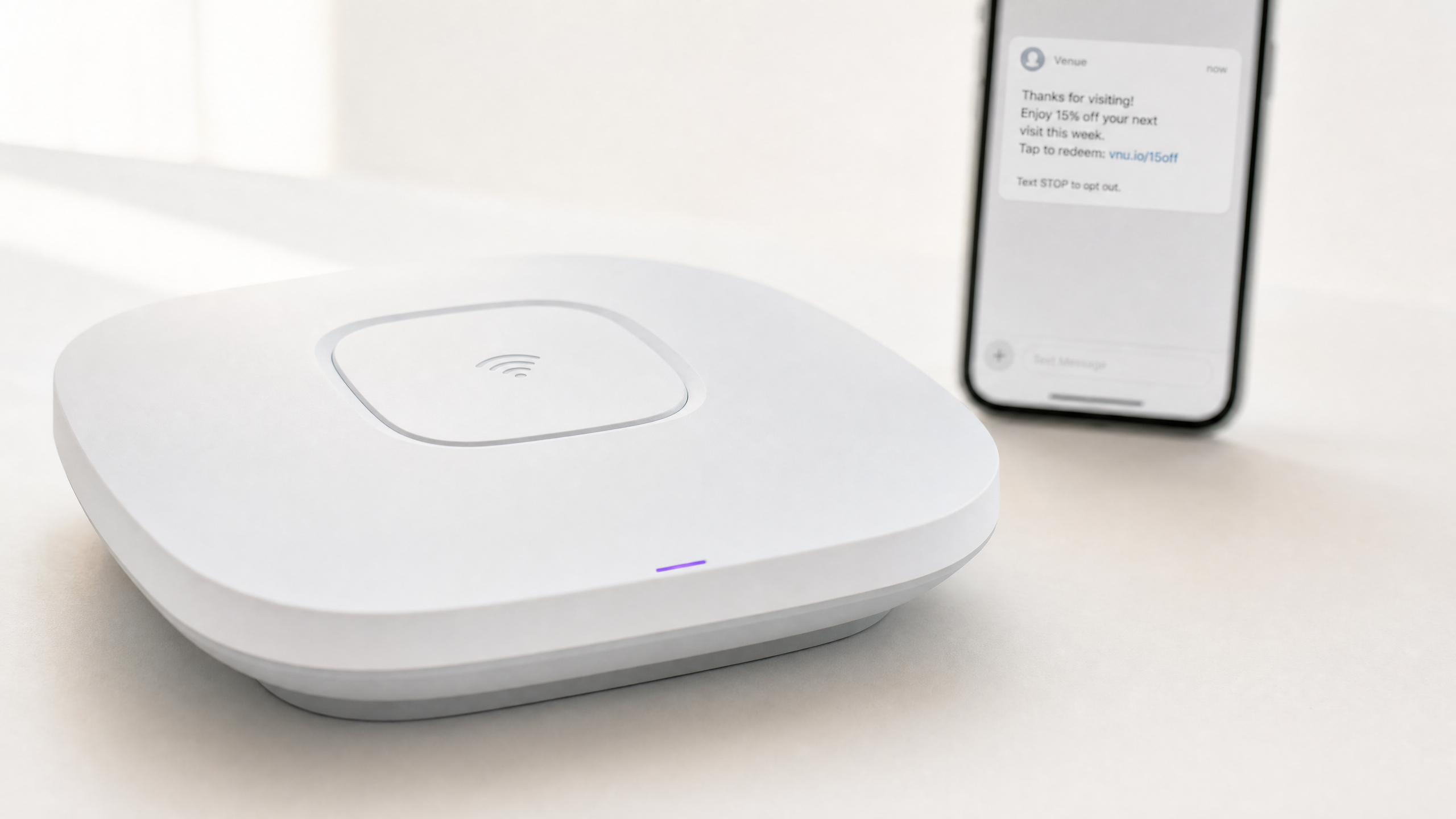
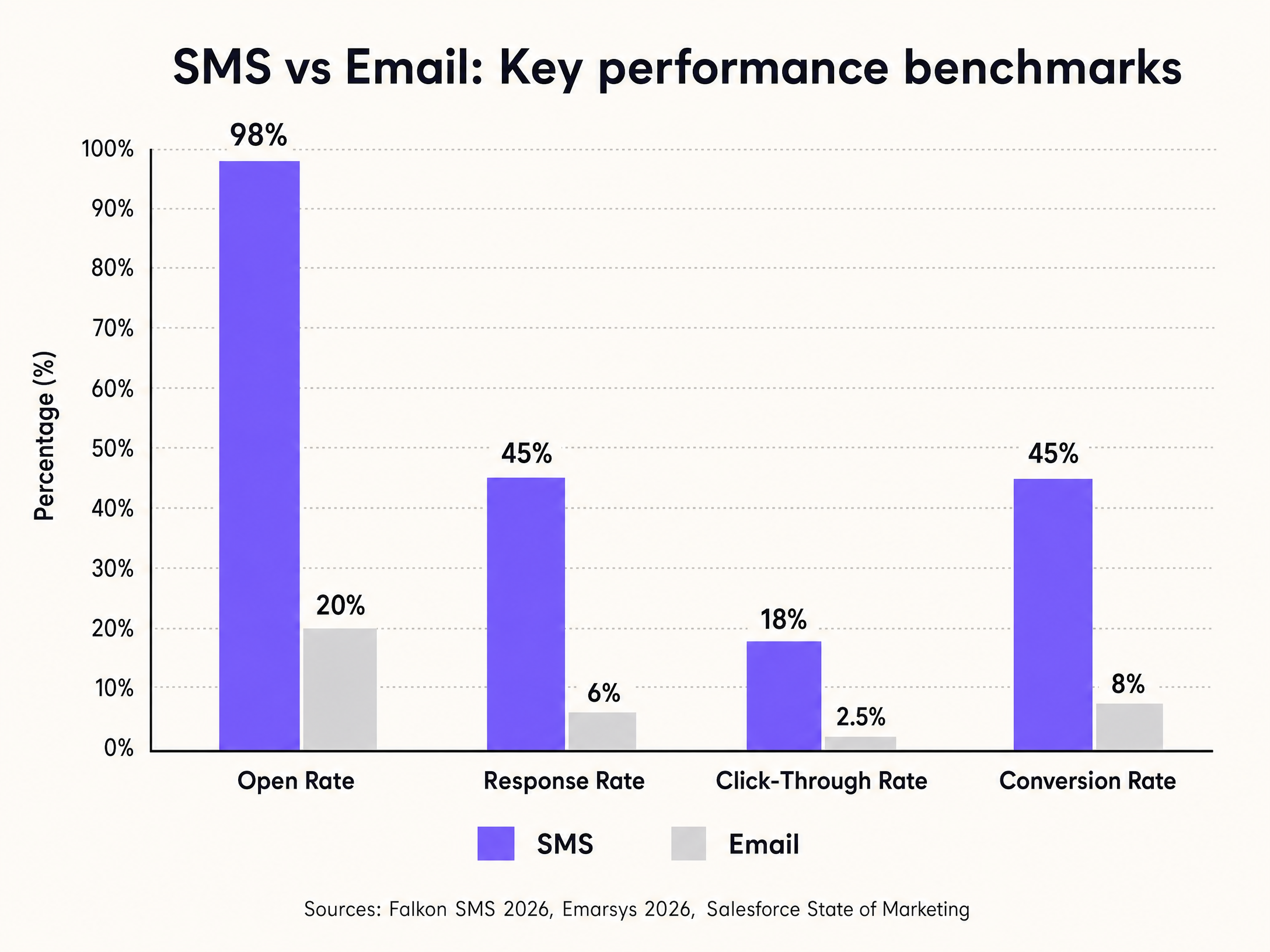
Welcome to the Purple technical briefing series. I'm going to walk you through something that, frankly, a lot of venue operators are leaving money on the table with: SMS marketing. Not the spray-and-pray bulk text approach from ten years ago. The structured, consent-first, data-driven kind that actually brings guests back through your doors. Let me set the scene. You run a hotel, a retail chain, a stadium, or a conference centre. Every day, hundreds or thousands of people connect to your Guest WiFi. They hand you their phone number at login. And then... nothing happens. That number sits in a database, unloved, uncontacted, doing precisely zero work for your business. That is the gap we're going to close today. So, why SMS? Here are the numbers. SMS messages have a 98% open rate, compared to around 20% for email. 90% of those messages are read within three minutes of delivery. The average response rate is 45%, versus 6% for email. And for every pound spent on SMS marketing, businesses typically see returns of between 21 and 71 pounds, depending on vertical and campaign quality. Those figures come from Falkon SMS, Emarsys, and the Salesforce State of Marketing report. SMS is not a replacement for email. It is a different channel entirely. Email is for long-form content, newsletters, detailed offers. SMS is for immediacy. A flash sale. A reminder that a guest's favourite table is available. A post-visit thank-you with a loyalty code. The channel works because it lands on a device the recipient checks dozens of times a day, and it bypasses the inbox clutter that kills email open rates. Now, let's get into the architecture. Because this is where most venues get it wrong. The foundation of any effective SMS programme is verified, consented first-party data. Not scraped numbers. Not purchased lists. Phone numbers that guests gave you directly, with explicit consent to receive marketing messages. The best mechanism for capturing that data at scale is your Guest WiFi captive portal. When a guest connects to your network, they land on a branded splash page. That page asks for their name, email, and mobile number. Critically, it includes a clearly labelled, unticked checkbox: 'I agree to receive SMS marketing messages from [venue name].' The guest ticks it. You capture a verified, consented number. Purple Engage stores that number, timestamps the consent, and makes it available for automated campaign triggers. This matters enormously from a compliance standpoint. Under GDPR in the UK and EU, you need a lawful basis for processing personal data. For marketing SMS, that basis is consent - and it must be freely given, specific, informed, and unambiguous. Under the UK's Privacy and Electronic Communications Regulations, known as PECR, you need prior consent before sending marketing texts. The ICO is not shy about enforcement. A pre-ticked box, or bundling SMS consent into your terms and conditions, does not meet the standard. In the US, the Telephone Consumer Protection Act, or TCPA, requires express written consent before sending automated marketing texts. The CTIA, the industry body, publishes additional best practice guidelines. Non-compliance carries fines of up to 1,500 dollars per message. That adds up fast at venue scale. The practical upshot: build your opt-in flow correctly from day one. Separate SMS consent from WiFi access consent. Make it a conscious choice. That produces a smaller but far more engaged list - and that is the list that converts. Let's talk segmentation. Because sending the same message to every number on your list is a waste of everyone's time. Purple's analytics layer captures behavioural data at WiFi login: visit frequency, dwell time, time of day, day of week, device type, and location within a multi-zone venue. That data lets you segment your SMS audience meaningfully. A guest who visits your hotel bar every Friday evening is a different audience from a conference delegate who visited once in March. The Friday regular gets an offer for your weekend cocktail menu. The conference delegate gets a re-engagement message about your meeting room packages. Segmented SMS campaigns achieve an 83% higher engagement rate than non-segmented ones, according to Falkon SMS data. That single change - moving from broadcast to segmented - is the highest-leverage improvement most venues can make. Timing matters too. Industry best practice, and TCPA regulation in the US, prohibits sending promotional texts before 8 AM or after 9 PM in the recipient's local time zone. But within that window, timing is strategic. Mid-morning, around 10 to 11 AM, works well for general announcements. Early afternoon, 2 to 3 PM, suits retail flash sales. Late afternoon, 4 to 6 PM, drives evening hospitality footfall. Test your specific audience and let the data tell you what works. Now, message construction. You have 160 characters per SMS segment. Use them well. Every message needs four things. First, identify yourself immediately - the recipient should know who is texting them before they read the second word. Second, state the offer or action clearly. No preamble. No 'we hope you're having a great day.' Third, include a single call to action with a link. Fourth, include opt-out instructions: 'Text STOP to unsubscribe.' That last one is not optional. It is legally required under PECR and TCPA, and it protects your sender reputation with mobile carriers. Here is an example of a well-constructed message. 'Premier Inn: Your exclusive 20% return visit discount expires Sunday. Book now: [link]. Text STOP to opt out.' That is 97 characters. Clear sender. Specific offer with urgency. Single action. Opt-out included. Done. Compare that to: 'Hi there! We at Premier Inn just wanted to reach out and let you know that we have some amazing offers available for your next stay with us. We really hope you'll come back and visit us soon!' That is 196 characters, split across two messages, with no offer, no link, no urgency, and no opt-out. It will be ignored. Let me walk through two real-world implementation scenarios. First, hospitality. A 150-room hotel deploys Purple Engage on its Cisco Meraki network. Guests connect to the Guest WiFi on arrival, complete the splash page, and tick the SMS consent checkbox. Purple captures the number and tags the guest with a 'hotel stay' segment. On checkout day, an automated message fires: 'Thanks for staying with us. Enjoy 15% off your next direct booking: [link]. Text STOP to opt out.' The hotel sees a 22% click-through rate on that message and a 9% direct booking conversion from the SMS cohort - guests who would otherwise have booked through an OTA at a 15 to 20% commission cost. The net revenue improvement more than covers the cost of the SMS programme. Second, retail. A fashion retailer with 40 stores across the UK uses Purple on HPE Aruba hardware. Shoppers who connect to in-store WiFi and opt in to SMS receive a post-visit message 24 hours later: 'You browsed our new autumn collection yesterday. It's selling fast. Shop now: [link]. Text STOP to opt out.' The retailer segments by store location and visit recency. Return visit rate for the SMS cohort is 31% higher than the control group over a 90-day period. Average basket value for SMS-attributed visits is 18% above the store average. Right, let's cover the pitfalls. Because there are a few ways to get this wrong. The first is frequency. 23% of consumers say they would stop supporting a brand that sends too many marketing messages, according to SAP Engagement Cloud research. For most venue types, one to two SMS messages per month per subscriber is the right cadence. More than that and you will see opt-out rates climb. Watch your unsubscribe rate as a leading indicator. If it exceeds 2%, reduce frequency or improve relevance. The second pitfall is poor data hygiene. Phone numbers go stale. People change numbers. Sending to dead numbers increases your bounce rate and damages your sender reputation with carriers. Scrub your list quarterly. Remove any number that has not engaged with three consecutive messages. The third is ignoring carrier registration requirements. In the US, the 10DLC system - that stands for 10-digit long code - requires businesses to register their brand and campaigns with The Campaign Registry before sending A2P, or application-to-person, messages at scale. Unregistered traffic gets filtered or blocked. In the UK, registering your Sender ID with the SMS SenderID Protection Registry reduces the risk of your brand name being spoofed in smishing attacks. Both are administrative steps that take days, not weeks, but they are easy to overlook. The fourth pitfall is treating SMS as a standalone channel. Brands that integrate SMS into their omnichannel strategy see a 47.7% lift in customer engagement, according to Omnisend. Your SMS programme should connect to your email flows, your loyalty programme, and your CRM. A guest who does not open your SMS should receive a follow-up email. A guest who clicks your SMS link but does not convert should enter a retargeting sequence. Purple Engage integrates with major CRM platforms to make those connections automatic. Let's do a quick rapid-fire on the questions I get asked most often. 'Can I use SMS for transactional messages without consent?' Yes, for genuinely transactional messages - booking confirmations, check-in reminders, order updates - you typically do not need marketing consent. But the moment a message includes a promotional element, you need explicit opt-in. 'What is the difference between a short code and a long code?' A short code is a five or six digit number used for high-volume sending. A long code is a standard ten-digit number. Short codes have higher throughput and better deliverability for mass campaigns. Long codes are better for two-way conversational messaging. Most venue operators start with a long code and move to a short code as volume grows. 'How do I measure ROI?' Track four metrics: opt-in rate from your WiFi login flow, click-through rate per campaign, conversion rate from click to visit or purchase, and revenue per SMS sent. Purple's analytics dashboard surfaces all four. A well-run programme should generate between 10 and 20 times its cost in attributed revenue within six months. 'What about double opt-in?' Double opt-in - where you send a confirmation text and the subscriber must reply YES to activate - produces a smaller but more engaged list. It also provides stronger evidence of consent in the event of a regulatory challenge. For venues operating in regulated sectors or handling sensitive data, double opt-in is worth the friction. To wrap up. The core principle is simple: your Guest WiFi is already capturing foot traffic. Purple Engage turns that foot traffic into a verified, consented SMS list. That list, managed with proper segmentation, timing, and message discipline, drives measurable return visits and incremental revenue. The three things to do this week: first, audit your current WiFi login flow and confirm that SMS consent is captured separately, explicitly, and in line with GDPR and PECR. Second, segment your existing contact list by visit recency and frequency, and build one targeted campaign for your highest-value segment. Third, set up automated post-visit messages to fire 24 to 48 hours after a guest's WiFi session ends. If you want to see how Purple Engage handles this end to end, the guide linked below walks through the full technical architecture and implementation steps. And if you want to talk through your specific venue setup, our team is at purple.ai. Thanks for listening. See you next time.

header_image.png

Executive Summary

SMS marketing represents a significant untapped revenue channel for physical venues. While most IT and marketing teams understand the value of email, SMS offers a 98% open rate and a 45% response rate [1]. The challenge is not the medium itself, but the data capture mechanism. This guide outlines how to use Guest WiFi infrastructure to capture verified, consented phone numbers and automate targeted SMS campaigns that increase return visits. We detail the technical deployment of Purple Engage across enterprise hardware, the compliance requirements for GDPR and TCPA, and the architectural decisions required to build a scalable SMS programme.

Technical Deep-Dive

The foundation of an effective SMS programme is the data capture layer. Relying on point-of-sale systems or loyalty app downloads introduces significant friction. Guest WiFi, however, is a high-demand utility that visitors actively seek out.

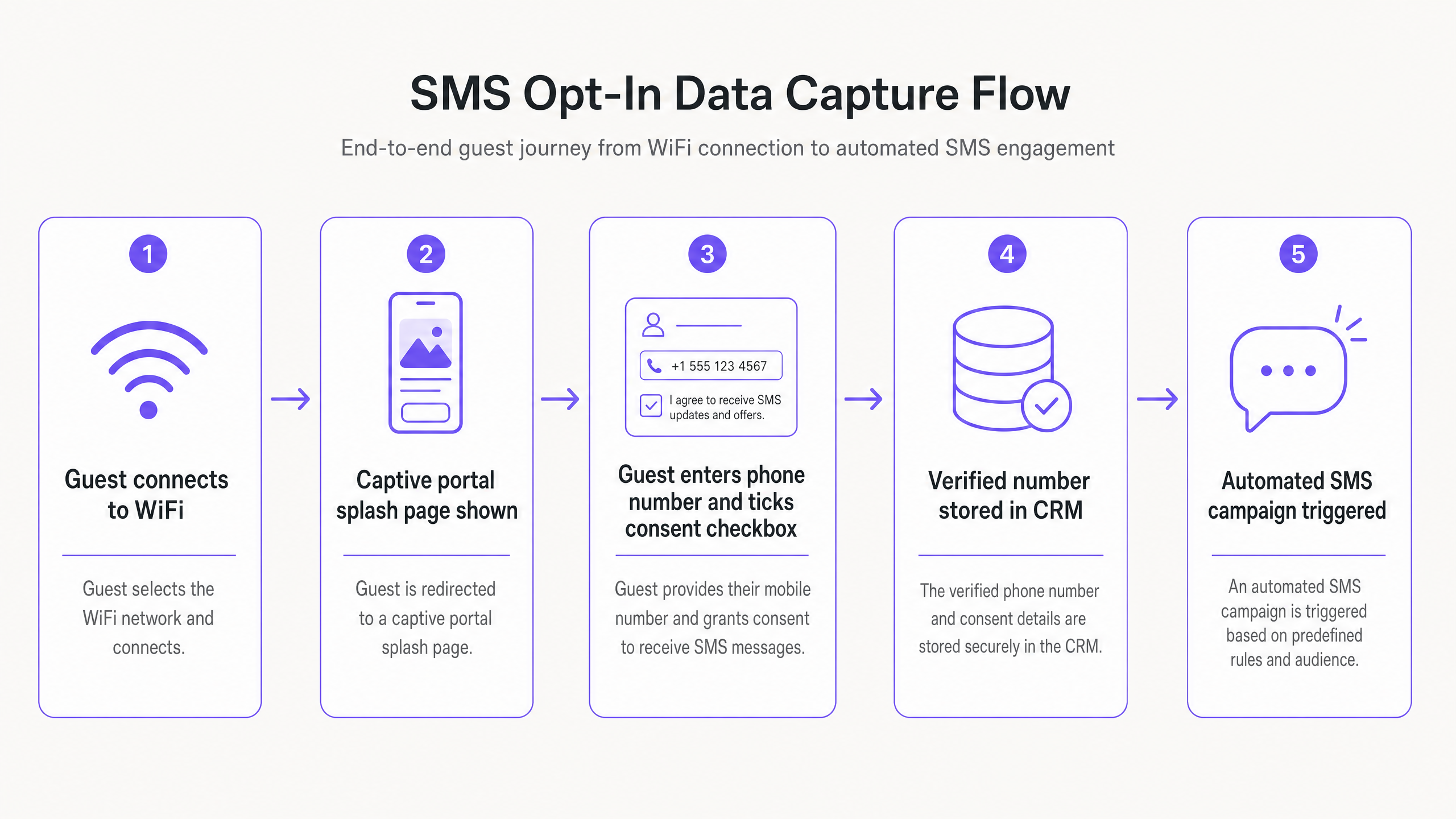
When a guest connects to the network (supported across Cisco Meraki, HPE Aruba, Ruckus, Juniper Mist, Ubiquiti UniFi, Cambium, Extreme, and Fortinet hardware), the controller redirects them to a captive portal hosted by Purple. This portal presents a form requesting a mobile number and explicit marketing consent.
sms_optin_flow_diagram.png

Once the guest submits the form, Purple authenticates the device MAC address via RADIUS and grants network access. Concurrently, Purple Engage stores the verified phone number, timestamps the consent, and enriches the profile with behavioural data (dwell time, visit frequency, location data). This first-party data is then available for automated campaign triggers via API or direct integration with identity providers like Microsoft Entra ID, Okta, and Google Workspace.

Compliance Architecture

Consent must be explicit. Under GDPR and PECR in the UK, and TCPA in the US, pre-ticked boxes or bundled terms and conditions are non-compliant. Purple Engage enforces a strict opt-in architecture. The consent checkbox is unticked by default, clearly labelled, and distinct from the network access terms.

Furthermore, the system automatically appends opt-out instructions (e.g., 'Text STOP to opt out') to every outbound message and processes opt-out requests immediately, updating the CRM record to prevent future sends.

Implementation Guide

Deploying an automated SMS programme requires coordination between IT and marketing. Follow these steps for a secure, compliant rollout.

  1. Configure the Captive Portal: Set up the Purple splash page to request a mobile number. Ensure the SMS marketing consent checkbox is visible, unticked, and clearly worded.
  2. Define the Audience Segments: Use Purple's analytics to create segments based on visit behaviour. For example, create a segment for 'First-time visitors who dwelled for over 60 minutes'.
  3. Establish the Triggers: Configure automated workflows in Purple Engage. A common trigger is '24 hours after a guest disconnects from the network'.
  4. Draft the Messages: Keep messages under 160 characters. Identify the brand immediately, state the offer clearly, include a single link, and append the mandatory opt-out instruction.
  5. Monitor and Iterate: Launch the campaign to a small test segment. Monitor the opt-out rate and click-through rate before scaling to the full database.

Best Practices

To maximise the effectiveness of your SMS marketing strategy, adhere to these proven industry practices.

  • Maintain strict data hygiene: Remove numbers that bounce or fail to engage over a 90-day period to protect your sender reputation.
  • Respect quiet hours: Do not send promotional messages before 08:00 or after 21:00 in the recipient's local time zone.
  • Segment ruthlessly: Broadcast messages yield poor results. Segment by visit recency, frequency, and location to ensure relevance.
  • Integrate channels: SMS should complement, not replace, email. Use SMS for urgent, high-value offers and email for detailed content.
sms_roi_comparison_chart.png

Troubleshooting & Risk Mitigation

  • High Opt-Out Rates: If your unsubscribe rate exceeds 2%, your messages are likely too frequent or irrelevant. Review your segmentation logic and reduce send frequency.
  • Carrier Filtering: Mobile carriers actively block unregistered application-to-person (A2P) traffic. In the US, ensure your brand and campaigns are registered via the 10DLC system. In the UK, register your Sender ID to prevent spoofing.
  • Low Conversion: If click-through rates are high but conversions are low, the landing page is likely the issue. Ensure the destination URL is mobile-optimised and the offer matches the SMS copy.

ROI & Business Impact

A well-structured SMS programme delivers measurable returns. Track the opt-in rate at the Captive Portal, the click-through rate of outbound messages, and the conversion rate of those clicks into return visits or direct revenue. Purple's analytics dashboard provides visibility into these metrics. Venues typically see a return of £21 to £71 for every £1 spent on SMS marketing [2], driven by the immediacy of the channel and the high intent of the verified audience.

Listen to the full technical briefing on SMS marketing architecture below:

References

[1] Falkon SMS, "SMS Marketing Statistics 2026: Open Rates, ROI & Engagement Data", 2026. [2] Upcity, "SMS Marketing Survey 2023", 2023.

Key Definitions

Captive Portal

A web page that a user of a public-access network is obliged to view and interact with before access is granted.

The primary mechanism for capturing first-party data and marketing consent on a Guest WiFi network.

First-Party Data

Information a company collects directly from its customers and owns entirely.

Crucial for building a compliant SMS database, as opposed to purchasing third-party lists which carry high regulatory risk.

10DLC (10-Digit Long Code)

A system in the US that requires businesses to register their brand and campaigns before sending A2P messages from standard local phone numbers.

Failure to register results in carrier filtering and blocked messages, directly impacting campaign ROI.

A2P (Application-to-Person) Messaging

The process of sending SMS messages from an application to a mobile user, typically used for marketing or alerts.

Carriers heavily regulate A2P traffic to prevent spam, requiring strict adherence to opt-in and opt-out protocols.

PECR (Privacy and Electronic Communications Regulations)

UK regulations that sit alongside GDPR, specifically governing electronic marketing, including SMS.

PECR dictates that organisations must have prior consent before sending marketing texts to individuals.

TCPA (Telephone Consumer Protection Act)

US federal law restricting telemarketing calls and the use of automated telephone equipment, including SMS.

Violations of the TCPA can result in fines of up to $1,500 per message, making strict opt-in compliance essential.

RADIUS (Remote Authentication Dial-In User Service)

A networking protocol that provides centralised Authentication, Authorization, and Accounting management for users who connect and use a network service.

Used by Purple to authenticate devices based on MAC address after the captive portal flow is completed.

Double Opt-In

A process where a user signs up and then must confirm their subscription via a follow-up message (e.g., replying YES).

Provides the strongest evidence of consent and results in a highly engaged list, though it introduces friction at signup.

Worked Examples

A 200-room hotel needs to reduce reliance on Online Travel Agencies (OTAs) and drive direct bookings from previous guests. They currently capture email addresses at check-in but see low open rates.

The hotel deploys Purple Engage on their existing WiFi network. They configure the captive portal to capture mobile numbers and SMS consent. They build an automated workflow that triggers a message to guests on the day of checkout: 'Thanks for staying with us. Enjoy 15% off your next direct booking: [link]. Text STOP to opt out.'

Examiner's Commentary: This approach works because it captures data at a moment of high utility (WiFi access) rather than high friction (the reception desk). The timing of the message leverages the recency of the stay, and the direct booking link bypasses the OTA commission structure. The 15% discount is funded by the saved commission.

A fashion retailer with 40 locations wants to increase footfall during quiet mid-week periods. They have a large database of phone numbers but no visibility into store-level visit patterns.

The retailer integrates their WiFi hardware with Purple to capture MAC addresses and associate them with verified phone numbers. They create a segment of shoppers who have visited a specific store on a weekend but not during the week. They send a targeted SMS on a Tuesday morning: 'Quiet Tuesday? Visit us in-store today for an exclusive mid-week offer: [link]. Text STOP to opt out.'

Examiner's Commentary: This scenario demonstrates the power of location-based segmentation. Broadcasting a generic offer to the entire database would annoy frequent mid-week shoppers and incur unnecessary costs. By targeting only weekend shoppers with a specific mid-week incentive, the retailer drives incremental footfall efficiently.

Practice Questions

Q1. A stadium operator wants to text all 50,000 attendees a merchandise discount code during the half-time break. They plan to use the phone numbers captured during ticket sales. What is the primary risk?

Hint: Consider the difference between transactional data collection and marketing consent.

View model answer

The primary risk is a compliance violation under GDPR/PECR or TCPA. Phone numbers collected for ticketing are transactional. Unless the attendees explicitly opted in to receive marketing SMS during the ticket purchase process, sending a promotional text is illegal. The operator should instead use the stadium Guest WiFi to capture explicit marketing consent from attendees on-site.

Q2. Your marketing team reports that the SMS unsubscribe rate has spiked to 4.5% following a recent campaign promoting a new menu at your restaurant chain. What is the most likely cause and immediate action required?

Hint: Review the 'Troubleshooting & Risk Mitigation' section regarding high opt-out rates.

View model answer

An unsubscribe rate above 2% indicates the messages are either too frequent or irrelevant to the audience. The immediate action is to pause the campaign, review the segmentation logic, and ensure the offer is targeted correctly (e.g., not sending a steak offer to known vegetarian diners). The team should also reduce the overall frequency of messages.

Q3. You are deploying Purple Engage across a university campus to communicate with students. The IT director insists that the SMS consent checkbox on the WiFi splash page must be pre-ticked to maximise the database size. How do you respond?

Hint: Refer to the 'Compliance Architecture' requirements for valid consent.

View model answer

You must advise the IT director that a pre-ticked checkbox is non-compliant with privacy regulations (GDPR/PECR/TCPA). Consent must be a conscious, unambiguous choice. While an unticked box will result in a smaller database, it ensures legal compliance and creates a more engaged audience, ultimately delivering better campaign ROI and protecting the university from significant fines.