
How to leverage the best SMS marketing service to increase return visits
This guide details how venue operators in hospitality, retail, events, and public-sector environments can deploy the best SMS marketing service to drive measurable return visits. It covers the technical architecture for capturing verified phone numbers via OTP at the Guest WiFi captive portal, segmentation strategies inside Purple Engage, and the legal requirements under GDPR and PECR. Marketing Directors, CRM Managers, and Venue Operators will find concrete implementation steps, two real-world case studies, and ROI benchmarks to justify investment.
Listen to this guide
View podcast transcript
Executive summary
Physical venues face a persistent data gap. Millions of visitors walk through your doors annually, yet most leave without providing a reliable way to reach them again. The best SMS marketing service closes that gap - but only when built on verified, consent-compliant first-party data captured at the point of WiFi login.
This guide details how to build the data infrastructure required for effective SMS marketing. It explains how to capture verified phone numbers at the Guest WiFi login using OTP authentication, store consent records securely in line with GDPR and PECR, and deploy automated campaigns that drive return visits. The technical approach uses Purple Engage as a hardware-agnostic cloud overlay across your existing network infrastructure - whether that is Cisco Meraki, HPE Aruba, Ruckus, Juniper Mist, Ubiquiti UniFi, Cambium, Extreme, or Fortinet.
SMS delivers an open rate of 98%, compared to 20-28% for email. Click-through rates reach 18-35%, versus 2.5-3.5% for email. ROI can reach $71 for every $1 spent. These are not marginal improvements. They represent a fundamentally different category of channel performance. The implementation steps in this guide are the difference between achieving those numbers and missing them.
Technical deep-dive
Why SMS outperforms other channels for physical venues
The performance gap between SMS and email is not a matter of degree - it is structural. Email inboxes are saturated. Promotional emails compete with hundreds of other messages. SMS arrives in a channel that most people reserve for personal communication, which is why 90% of text messages are read within three minutes of delivery (Source: Infobip, 2024).
For physical venues, this immediacy is commercially significant. A post-visit SMS sent 24 hours after a guest leaves can reach them while the experience is still fresh. A flash promotion sent at 11:00 on a quiet Tuesday can drive footfall within the hour. No other direct marketing channel delivers that combination of reach, speed, and personalisation at scale.
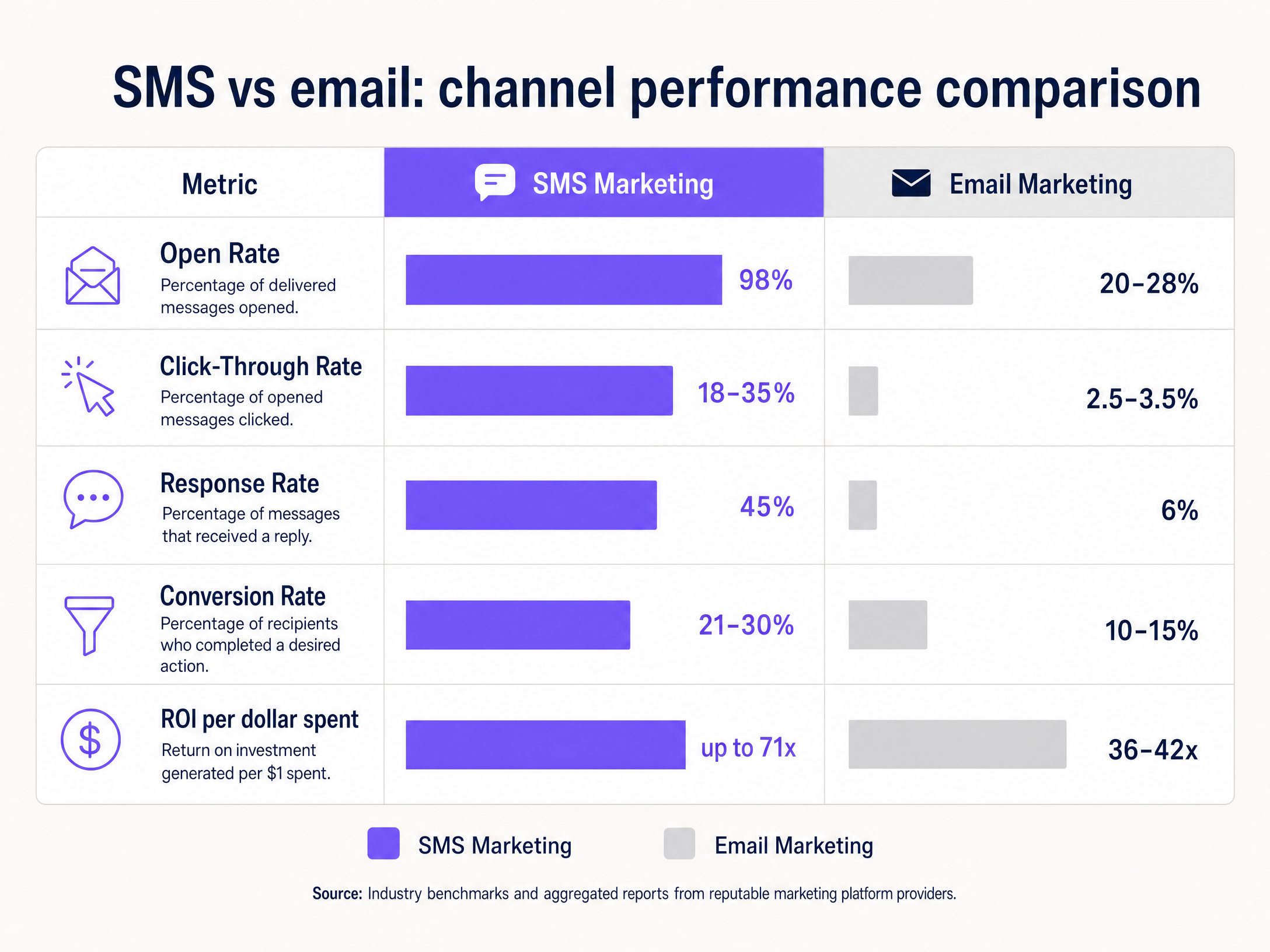
| Metric | SMS | |
|---|---|---|
| Open rate | 98% | 20-28% |
| Click-through rate | 18-35% | 2.5-3.5% |
| Response rate | ~45% | ~6% |
| Conversion rate | 21-30% | 10-15% |
| ROI per $1 spent | up to $71 | $36-42 |
Source: Infobip SMS Marketing Statistics 2024; Sakari SMS Marketing Statistics 2025-2026.
Data capture architecture
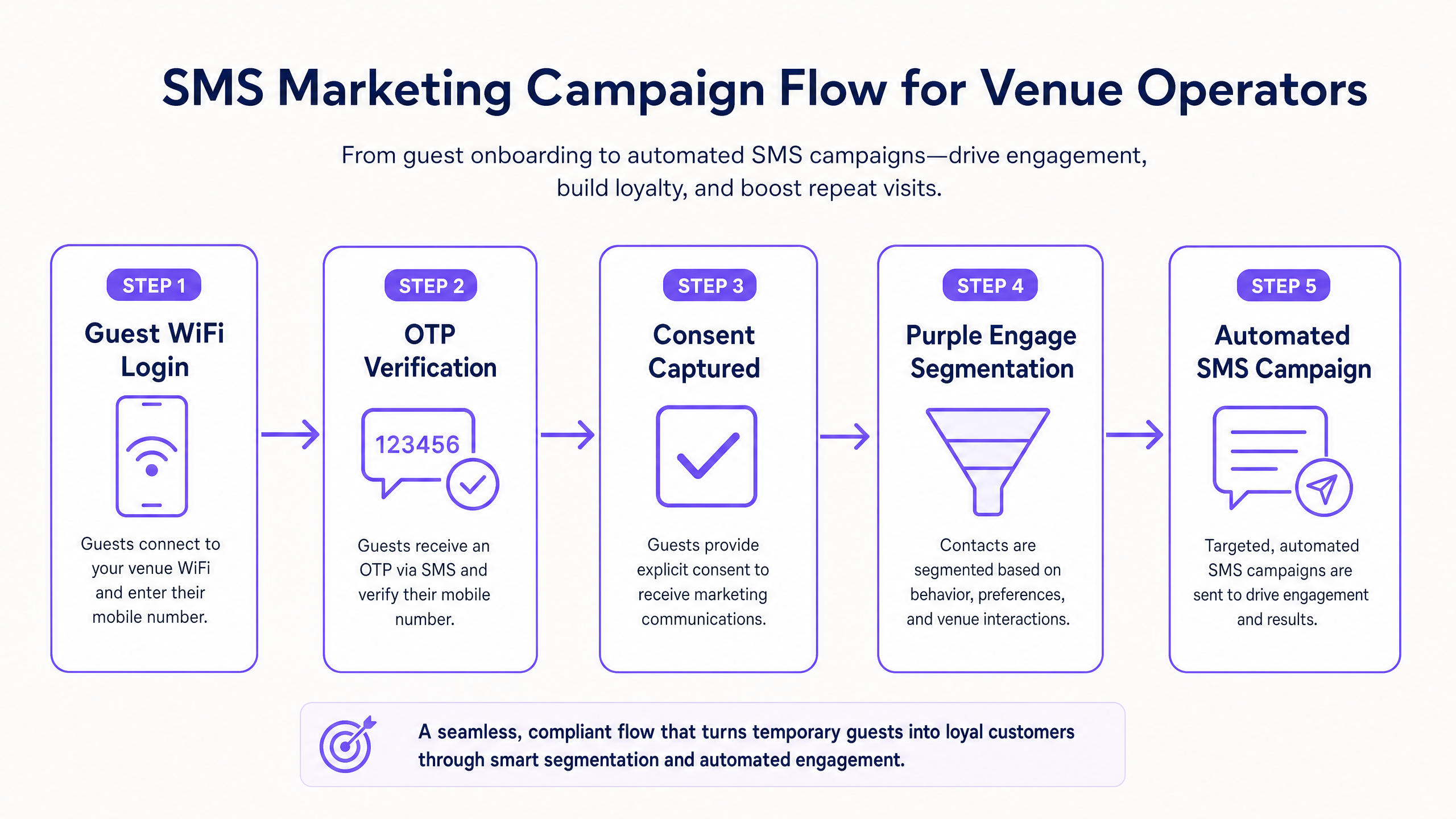
The foundation of any effective SMS marketing programme is verified first-party data. Purple captures this data at the Guest WiFi login using a captive portal. When a visitor selects SMS authentication, they enter their mobile number. Purple's gateway sends a one-time passcode (OTP) via SMS. The visitor must enter this code to gain internet access.
This OTP mechanism serves two functions simultaneously. First, it verifies that the number is real, active, and belongs to the person connecting. Second, it creates a documented interaction record tied to a specific device, location, and timestamp. That record is the foundation of every subsequent campaign.
Purple operates as a cloud overlay on your existing WiFi hardware. The platform integrates with Cisco Meraki, HPE Aruba, Ruckus, Juniper Mist, Ubiquiti UniFi, Cambium, Extreme, and Fortinet. You do not need to replace your network infrastructure. Purple sits on top and captures the visitor data at login, feeding it into the Engage marketing engine. For guidance on network architecture and SSID design, see Three SSIDs to rule them all: guest, Passpoint, and IoT WiFi .
Consent and compliance
Capturing a verified phone number is only the first step. To use that number for marketing, you must secure explicit consent. Under GDPR and PECR, consent for marketing communications must be freely given, specific, informed, and unambiguous. It cannot be a condition of accessing the WiFi service.
Purple's captive portal separates the terms of service acceptance from the marketing opt-in. The visitor must actively tick a clearly labelled box to receive SMS marketing. This box is unticked by default. Purple timestamps this consent record and stores it alongside the verified phone number and the device MAC address. This provides a complete audit trail for compliance with UK GDPR Article 6 and PECR Regulation 22.
For multi-tenant environments, Purple integrates with Microsoft Entra ID, Okta, and Google Workspace to manage staff access on a separate SSID, keeping the Guest WiFi focused on visitor data capture. See The Enterprise Guide to Setting Up Guest WiFi: Security, Segmentation, and Speed for full segmentation guidance.
Segmentation and campaign automation
Purple Engage uses WiFi Analytics to build dynamic audience segments based on actual visit behaviour. You can segment visitors by visit frequency, dwell time, specific zones visited, time since last visit, and visit history. This behavioural data is what separates an effective SMS programme from a generic broadcast.
The three campaign types that consistently drive return visits are:
Post-visit follow-up. Triggered 24 to 48 hours after a visitor disconnects from the network. The message references the recent visit and offers a time-bounded incentive to return. This campaign type drives a 24% average increase in return visits across Purple's 80,000+ live venues (Purple internal data, 2024).
Lapsed visitor re-engagement. Triggered when a visitor who previously connected regularly has not been seen for 30 to 60 days. The message acknowledges the absence and offers a specific reason to return. This campaign targets visitors at risk of churning before they are lost entirely.
Event and promotion-based campaigns. Targeted at visitors who previously attended similar events or visited specific zones. A hotel running a spa promotion segments by guests who previously used the spa. A stadium targets fans who attended last season. A retail chain pushes a flash sale to shoppers who visited a specific location in the last 90 days.
Implementation guide
Step 1: Configure the captive portal
Set up your Captive Portal to offer SMS OTP authentication. Ensure the marketing opt-in checkbox is clearly labelled, unchecked by default, and separate from the terms of service acceptance. Define the terms of your SMS programme in the consent language, including expected message frequency and data usage policies. For splash page and first-impression guidance, see How to make a great first impression with your guest WiFi (and keep your brand consistent) .
Step 2: Define your segmentation logic
Before launching any campaign, define the audience segments you will target. At minimum, configure three segments: all opted-in visitors (for event-based campaigns), visitors who have not connected in 30+ days (for re-engagement), and visitors who connected within the last 48 hours (for post-visit follow-up). Purple Engage allows you to define these segments once and apply them to automated campaign triggers.
Step 3: Build and schedule campaigns
Create your campaign messages. Keep them under 160 characters where possible to avoid multi-part SMS charges. Include a clear call to action and a trackable link with UTM parameters. Schedule post-visit follow-ups to send between 11:00 and 14:00 local time, when midday sends consistently outperform morning and evening deliveries.
Step 4: Connect your CRM
Purple Engage integrates with over 400 CRM and marketing connectors. Connect your existing CRM to synchronise the verified phone numbers and consent records. This allows you to use SMS data to enrich your broader customer profiles and coordinate SMS campaigns with email and other channels.
Step 5: Monitor and optimise
Track delivery rates, open rates, click-through rates, and unsubscribe rates for every campaign. A delivery rate below 95% indicates list quality issues. An unsubscribe rate above 3% indicates frequency or relevance problems. Review campaign performance monthly and adjust segmentation logic and message content accordingly.
Best practices
Control frequency. Send no more than four to six messages per month per contact. Excessive frequency is the primary cause of unsubscribes - 61% of opt-outs are caused by too many messages (Sakari, 2025).
Optimise send timing. Schedule messages between 11:00 and 14:00 local time. Avoid sending before 09:00 or after 20:00. Midday sends consistently outperform other time windows across Retail , Hospitality , Healthcare , and Transport verticals.
Track attribution. Append UTM parameters to every link in an SMS campaign. Without attribution, you cannot connect return visits and revenue to specific campaigns. Use dedicated landing pages or unique promo codes as an alternative attribution method.
Provide clear opt-outs. Every message must include a simple opt-out mechanism, such as replying STOP. Purple Engage handles these opt-outs automatically, updating the contact record to prevent future sends and maintaining your compliance audit trail.
Test message content. Run A/B tests on message copy, call-to-action wording, and offer types. Small changes in phrasing can produce significant differences in click-through and conversion rates.
Troubleshooting and risk mitigation
High unsubscribe rates. If your unsubscribe rate exceeds 3% per send, your content is likely irrelevant or your frequency is too high. Review your segmentation logic and ensure you are sending targeted offers rather than generic broadcasts. Reduce send frequency and monitor the impact.
Low delivery rates. If messages are failing to deliver, you may have an issue with unverified numbers or carrier filtering. Ensure OTP verification is mandatory at the Captive Portal. If carrier filtering is the issue, review your message content to ensure it does not contain spam triggers such as excessive capitalisation, misleading links, or aggressive promotional language.
Consent compliance failures. Failure to capture explicit consent or honour opt-out requests can result in significant fines under GDPR and PECR. Regularly audit your Captive Portal configuration to ensure the opt-in checkbox remains unchecked by default. Review your privacy policy annually and update consent language when your SMS programme changes.
List degradation. Phone numbers change. Run a list hygiene process quarterly to remove numbers that have generated consistent delivery failures. Purple Engage tracks delivery status per contact and can automatically suppress contacts with repeated failures.
ROI and business impact
The business case for the best SMS marketing service is built on superior engagement metrics combined with low cost per message. SMS is one of the lowest-cost direct marketing channels on a per-message basis, and its conversion rates are significantly higher than email.
For a venue with 500 daily connections and a 20% SMS opt-in rate, you can build a verified list of 20,000 to 30,000 numbers within six months. A single post-visit follow-up campaign to 10,000 contacts, achieving a 25% click-through rate and a 15% conversion rate, generates 375 return visits from a single send. At an average transaction value of £50, that is £18,750 in attributable revenue from one campaign.
The ROI compounds when you layer in lapsed visitor re-engagement. Preventing even a fraction of at-risk visitors from churning permanently has a significant lifetime value impact. Industry data from Sakari (2025) places conservative SMS ROI at $21 to $41 per $1 spent, with peak campaign performance reaching $71 per $1.
Purple's 80,000+ live venues and 440 million logins in 2024 provide the scale to benchmark these returns. The platform's ISO 27001 and GDPR certifications ensure that the data infrastructure underpinning your SMS programme meets enterprise security and compliance standards.
Key Definitions
First-party data
Information a venue collects directly from its visitors, rather than purchasing it from a third party or inferring it from browsing behaviour.
When Purple captures a verified phone number at the captive portal, that number is first-party data. It belongs to the venue, not to a platform intermediary. This distinction matters for GDPR compliance and for long-term data portability.
Captive portal
A web page that a user of a public access network must view and interact with before internet access is granted.
The captive portal is the primary interface where venue operators capture guest data and secure marketing consent. Purple's captive portal handles OTP verification, consent capture, and branding in a single flow.
OTP (one-time passcode)
A password valid for only one login session or transaction, typically delivered via SMS to the user's mobile number.
OTP is the mechanism that verifies phone numbers at the captive portal. Without OTP, a visitor can enter any number - real or fake - and gain access. With OTP, only the owner of the number can complete authentication.
GDPR (General Data Protection Regulation)
EU regulation governing the collection, storage, and use of personal data, including phone numbers and email addresses.
GDPR requires that consent for SMS marketing is freely given, specific, informed, and unambiguous. Venues must be able to demonstrate the legal basis for every contact in their SMS database.
PECR (Privacy and Electronic Communications Regulations)
UK regulations that govern the rules around sending marketing messages via electronic channels, including SMS and email.
PECR Regulation 22 specifically prohibits sending unsolicited marketing SMS messages without prior explicit consent. It also requires that every marketing message includes a simple opt-out mechanism.
Cloud overlay
A software architecture that sits on top of existing physical network hardware to provide additional functionality without requiring hardware replacement.
Purple operates as a cloud overlay. IT teams do not need to replace their Cisco Meraki or HPE Aruba hardware. Purple integrates at the authentication layer, captures data at login, and feeds it into the Engage marketing engine.
UTM parameters
Tags appended to a URL that allow analytics platforms to track the source, medium, and campaign name of a click.
Every link in an SMS campaign should carry UTM parameters. Without them, you cannot attribute return visits and revenue to specific campaigns in your analytics platform.
Click-through rate (CTR)
The percentage of SMS recipients who click on a link contained within the message.
SMS CTR ranges from 18% to 35% depending on industry and campaign type. This compares to 2.5-3.5% for email. CTR is the primary metric for evaluating message relevance and call-to-action effectiveness.
Lapsed visitor segment
A dynamic audience segment consisting of visitors who previously connected to the venue WiFi regularly but have not been seen for a defined period.
Purple Engage builds this segment automatically using WiFi Analytics visit frequency data. The lapsed visitor re-engagement campaign is one of the three highest-performing campaign types for driving return visits.
Worked Examples
A 250-room hotel wants to reduce OTA commission costs by increasing direct bookings from repeat guests. They have an HPE Aruba network and no existing guest data programme.
Deploy Purple as a cloud overlay on the existing HPE Aruba infrastructure. Configure the captive portal with SMS OTP authentication and a clearly labelled, unchecked marketing opt-in checkbox. Over 12 months, the hotel builds a verified database of 18,000 unique guest phone numbers. Configure Purple Engage to trigger three automated campaigns: a post-checkout follow-up SMS sent 24 hours after departure with a 15% direct booking discount valid for 30 days; a lapsed guest re-engagement SMS triggered at 60 days of absence; and a seasonal promotion targeting guests who visited during the same period the previous year. Apply UTM parameters to all campaign links to track direct booking attribution.
A 12-site retail chain wants to drive foot traffic during off-peak hours. They use Cisco Meraki hardware and have an existing email marketing programme but low engagement rates.
Deploy Purple on the existing Cisco Meraki hardware across all 12 sites. Configure SMS OTP authentication at each captive portal. Use Purple's WiFi Analytics to segment shoppers based on their typical visit times and dwell patterns. Identify a segment of shoppers who typically visit on weekends but have not visited in the last 14 days. On a quiet Tuesday afternoon, trigger a targeted SMS to this segment offering a time-limited discount valid only between 14:00 and 16:00 that day. Coordinate the SMS with an email send to the same segment, using email for the longer-form offer details and SMS for the time-sensitive reminder.
Practice Questions
Q1. You are deploying Guest WiFi across a 50-site retail portfolio. The marketing director wants to make SMS opt-in mandatory to connect to the WiFi to rapidly build the database. How do you respond, and what is the compliant alternative?
Hint: Consider the legal requirements for consent under GDPR and PECR, specifically the definition of freely given consent.
View model answer
You must advise the marketing director that making SMS opt-in mandatory for WiFi access violates GDPR and PECR. Consent must be freely given, which means it cannot be a condition of service. If a visitor must opt in to receive marketing messages in order to access the WiFi, that consent is not freely given and is therefore invalid. The compliant alternative is to keep the opt-in checkbox separate from the terms of service acceptance, leave it unchecked by default, and clearly label it so visitors understand what they are agreeing to. Purple's captive portal handles this compliance requirement automatically. You can still build the database quickly by optimising the opt-in copy to communicate the value of joining - for example, highlighting the types of offers subscribers receive.
Q2. Your venue has collected 10,000 phone numbers over the past year, but you did not use OTP verification at login. You want to launch an SMS campaign. What is the primary risk and how do you mitigate it?
Hint: Think about data quality, carrier filtering, and sender reputation.
View model answer
The primary risk is a high bounce rate and degraded carrier reputation. Without OTP verification, many of the numbers are likely fake, mistyped, or inactive. Sending bulk SMS to unverified numbers will result in carriers flagging your messages as spam, potentially blocking your sender ID entirely. This damage can take months to reverse. The mitigation strategy is two-fold. First, run a list hygiene process before any campaign send - use a phone number validation service to identify and remove invalid numbers. Second, implement OTP verification immediately at the Captive Portal to ensure all future data is verified. Do not attempt to send a large campaign to the unverified list. Start with a small test send to identify the scale of the problem before committing to a full campaign.
Q3. You want to send a promotional SMS to fans who attended a specific concert at your stadium six months ago. How do you identify this audience using Purple, and what campaign type would you use?
Hint: Consider how Purple tracks user presence and what data is stored per visit.
View model answer
You use Purple Engage to build a segment based on historical visit data. Purple stores a timestamped record for every device that connected to the Guest WiFi, including the date, time, and location. You filter the database for contacts whose devices connected to the stadium network during the specific date and time window of the concert. This gives you a verified audience of fans who were physically present at that event. You then configure an event-based campaign targeting this segment. The message can reference the specific concert to make it personally relevant, and offer an incentive tied to an upcoming event at the same venue. This is more effective than a generic broadcast because it references a shared experience, increasing the likelihood of engagement.
Q4. Your SMS unsubscribe rate has risen from 1.2% to 4.8% over the past three months. You have not changed your message content. What are the most likely causes and how do you diagnose them?
Hint: Think about frequency, relevance, and list composition changes.
View model answer
A rise in unsubscribe rate from 1.2% to 4.8% without a content change points to three likely causes. First, frequency may have increased - check whether the number of sends per contact per month has risen. The threshold is four to six messages per month; above this, unsubscribe rates climb sharply. Second, your list composition may have changed - if you have recently added a large batch of new contacts who opted in under different expectations, they may be less engaged than your established subscribers. Third, your segmentation may have degraded - if dynamic segments are no longer filtering correctly, you may be sending irrelevant messages to contacts who previously received targeted ones. Diagnose by segmenting the unsubscribe data by contact age, acquisition source, and campaign type to identify which group is driving the increase.