
How to leverage SMS marketing business to increase return visits
This guide details how venue operators can build an SMS marketing business strategy using enterprise Guest WiFi infrastructure to capture verified phone numbers, automate behaviour-triggered campaigns, and drive measurable return visits. It covers the full technical architecture from captive portal configuration and RADIUS authentication to GDPR-compliant consent flows and Purple Engage automation, with real-world scenarios from hospitality and retail environments.
Listen to this guide
View podcast transcript
Executive summary
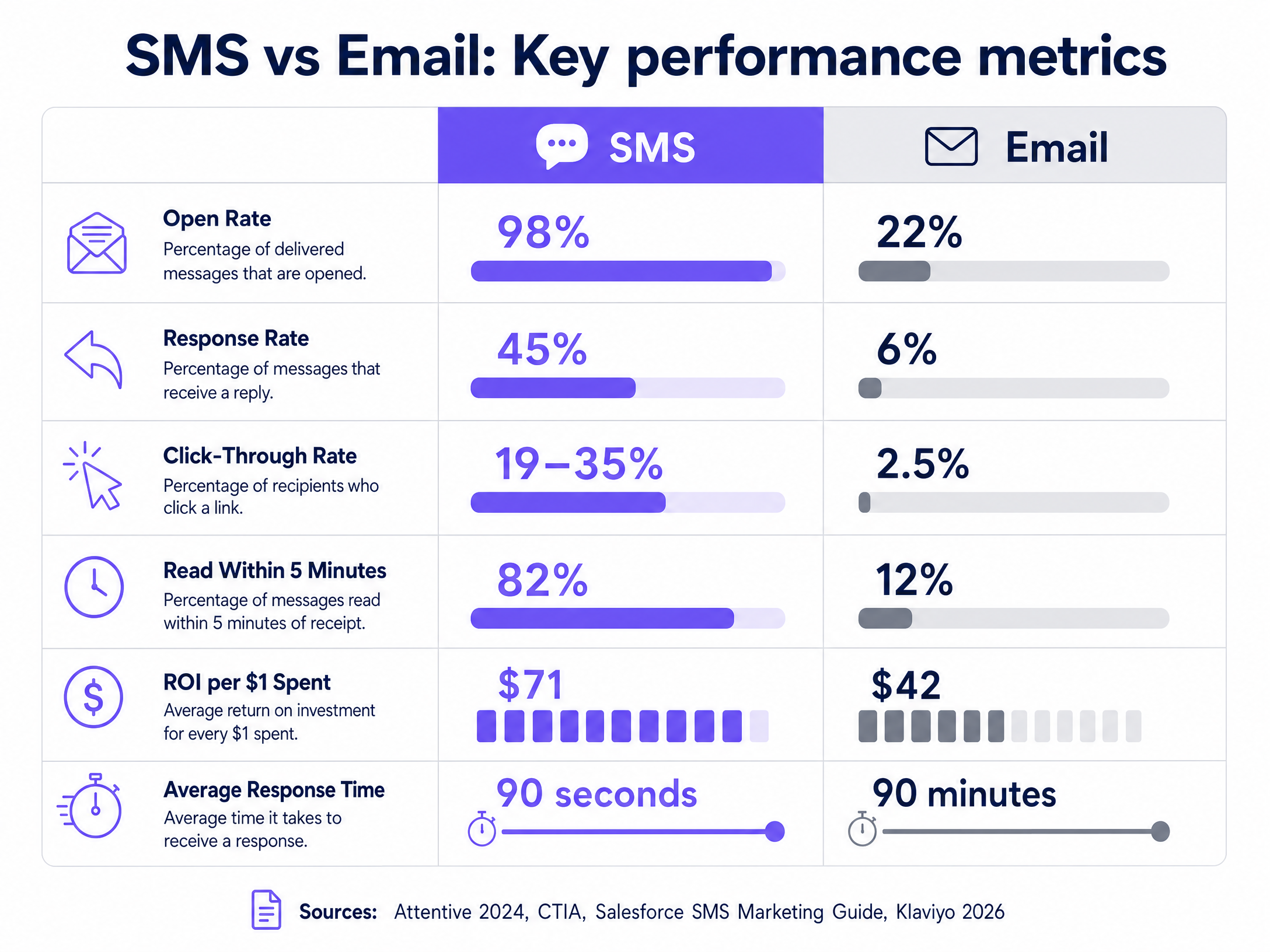
For enterprise venue operators, the shift from anonymous foot traffic to known, returning visitors requires an active data strategy. An SMS marketing business model built on Guest WiFi infrastructure provides a direct, high-engagement channel to drive those return visits. While email marketing averages a 22% open rate, SMS delivers a 98% open rate, with 82% of messages read within five minutes [CTIA; Salesforce SMS Marketing Guide].
This guide details the technical architecture required to capture verified phone numbers at the network edge, secure explicit consent under GDPR and TCPA, and automate targeted campaigns using Purple Engage. By integrating Cisco Meraki, HPE Aruba, or Ruckus hardware with Purple's cloud overlay, IT and marketing teams can deploy a compliant, automated system that turns a cost centre - Guest WiFi - into a measurable revenue driver. Purple operates across 80,000+ live venues and has processed 440 million logins in 2024, providing the data infrastructure to support this at scale.
Technical deep-dive
Deploying an effective SMS marketing business strategy requires a reliable mechanism for capturing phone numbers. The most effective approach in physical venues is integrating data capture directly into the Guest WiFi authentication flow. The WiFi Analytics platform then converts that raw data into actionable campaign intelligence.
The data capture architecture
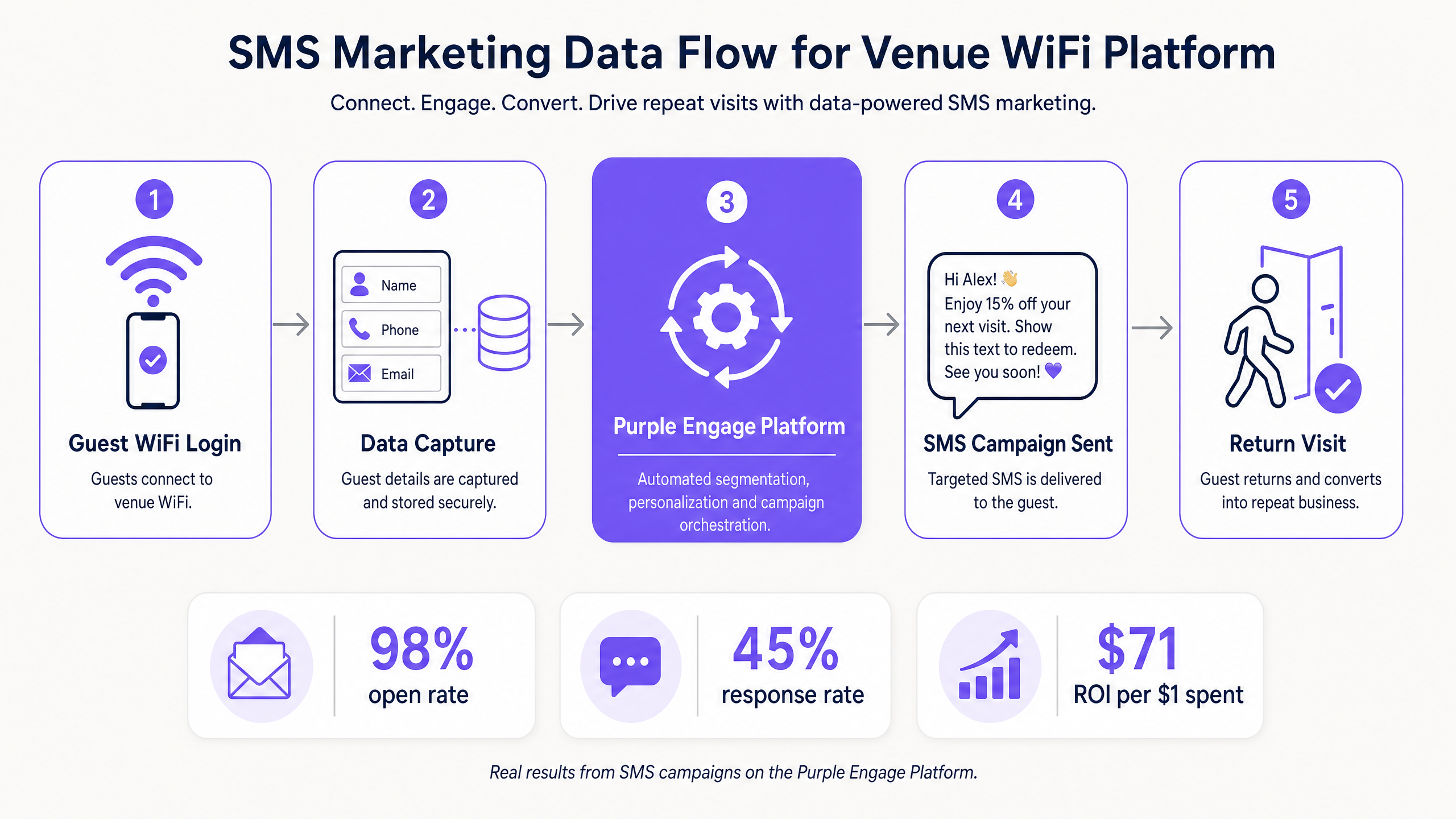
When a visitor connects to the venue network, the wireless access point (AP) intercepts the HTTP request and redirects the user to a captive portal hosted on the Purple cloud overlay. This portal acts as the gatekeeper, requiring authentication before granting internet access.
To build an SMS subscriber list, the portal must be configured to require a verified phone number. The authentication flow follows these technical steps:
Step 1 - Association. The client device associates with the Guest SSID broadcast by the AP.
Step 2 - Redirection. The network controller (Juniper Mist, Ubiquiti UniFi, or similar) intercepts the initial web request and redirects the client to the Purple splash page via RADIUS CoA (Change of Authorisation).
Step 3 - Data entry. The visitor enters their phone number and accepts the terms of service and marketing opt-in.
Step 4 - Verification. Purple sends a one-time password (OTP) via SMS to the provided number.
Step 5 - Authentication. The visitor enters the OTP. Upon success, Purple sends an Access-Accept message to the network controller, authorising the MAC address for network access.
Step 6 - Profile creation. The verified phone number, MAC address, and opt-in status are stored in the Purple Engage platform as a unified customer profile.
This verification step is critical. It prevents users from entering fake numbers to gain access, ensuring the integrity of your SMS marketing database. A list of 5,000 verified numbers delivers more revenue than a list of 50,000 unverified ones.
Compliance and consent standards
An SMS marketing business strategy must adhere to strict regulatory standards, primarily the Telephone Consumer Protection Act (TCPA) in the US and the General Data Protection Regulation (GDPR) in Europe.
Consent for SMS marketing must be explicit, unbundled, and auditable. The captive portal must present a clear, conscious-choice opt-in mechanism. Pre-ticked boxes are not compliant under GDPR Article 7. The consent record stored in Purple Engage includes the timestamp, the specific language presented to the user, and the IP address, providing a complete audit trail.
Furthermore, every SMS campaign must include a clear opt-out mechanism (e.g., "Reply STOP to cancel"). When a user opts out, the system must immediately update their profile to prevent further marketing messages, while still allowing them to access the Guest WiFi in the future.
Purple holds ISO 27001, GDPR, CCPA, and Cyber Essentials certifications, providing the compliance infrastructure that enterprise venues require.
| Requirement | GDPR (EU) | TCPA (US) |
|---|---|---|
| Opt-in type | Explicit, unbundled, no pre-ticked boxes | Prior express written consent |
| Opt-out mechanism | Mandatory in every message | Mandatory; must process within 10 business days |
| Data retention | Defined retention period required | No federal mandate; state laws vary |
| Audit trail | Timestamp, IP, consent language | Proof of consent must be retained |
| Re-opt-in after opt-out | Permitted after a reasonable period | 12-month restriction on re-solicitation |
Implementation guide
Implementing this architecture requires coordination between IT network administrators and marketing teams. Follow these steps to deploy the solution.
Step 1: Network configuration
Configure your enterprise hardware - Cisco Meraki, HPE Aruba, Ruckus, Juniper Mist, Ubiquiti UniFi, Cambium, Extreme, or Fortinet - to point to the Purple RADIUS servers. Set up a dedicated Guest SSID, isolated from the corporate network using VLAN tagging. Configure the Walled Garden to allow traffic to the Purple captive portal domains and the SMS gateway before authentication is complete.
For a detailed breakdown of RADIUS configuration, refer to the Server RADIUS: a comprehensive guide for businesses .
Step 2: Captive portal design
Design the splash page within the Purple portal. Configure the login method to require SMS verification. Ensure the legal terms and marketing opt-in checkboxes are clearly visible and unticked by default. The opt-in language must be specific: "I agree to receive promotional SMS messages from [Venue Name]. Message and data rates may apply. Reply STOP to cancel."
Step 3: CRM integration
While Purple Engage provides robust campaign orchestration, you may need to sync data with an external CRM. Configure the API webhooks to push new profiles and opt-in statuses to your central database in real-time. This ensures the CRM remains the single source of truth for customer data.
Step 4: Campaign automation
Set up automated triggers in Purple Engage based on venue behaviour. The most effective campaign for driving return visits is the "We Miss You" automated flow. Configure the system to trigger an SMS if a user has not authenticated on the network for a specified period - 30 days for a restaurant, 90 days for a retail store. The message should include a compelling offer to incentivise a return visit.
Automated flows account for just 7.6% of total sends but drive 45.2% of total SMS revenue [Klaviyo 2026 SMS Benchmarks]. The automation does the heavy lifting.
Best practices
To maximise the impact of your SMS marketing business strategy, adhere to these industry-standard recommendations.
Segment by behaviour
Do not send broadcast messages to your entire database. Use the location analytics gathered by the WiFi network to segment your audience. Send different messages to first-time visitors versus frequent loyalists. For example, a Retail venue might send a VIP discount to shoppers who visit more than four times a month, while a Hospitality venue sends a room upgrade offer to guests who have stayed three or more times.
Optimise send times
Timing dictates engagement. Schedule messages to arrive when the recipient is most likely to act on them. For a hospitality venue, sending a lunch offer at 11:30 AM yields a higher conversion rate than sending it at 3:00 PM. Attentive 2024 data shows 45% of SMS purchases occur in the evening, making evening send windows the highest-revenue time slot for promotional campaigns.
Maintain frequency discipline
SMS is an intimate channel. Overuse leads to high opt-out rates. SimpleTexting 2024 reports that 61% of SMS unsubscribes result from receiving messages too frequently. Limit promotional SMS messages to two to four times per month. Every message must provide tangible value to the recipient.
Register your A2P 10DLC campaigns
In the US, register your Application-to-Person 10-Digit Long Code (A2P 10DLC) campaigns with the mobile carriers. Unregistered campaigns are subject to filtering and throttling, which directly reduces delivery rates and undermines your SMS marketing business.
Troubleshooting & risk mitigation
Deploying an SMS marketing business architecture introduces specific risks that must be managed.
High drop-off rates at login
If visitors abandon the login process when asked for a phone number, the value exchange is insufficient. Ensure the Guest WiFi offers adequate bandwidth to justify the data request. Consider offering tiered access: basic speed for email login, premium speed for SMS verification. This provides a clear incentive for the user to hand over their phone number.
SMS delivery failures
If OTPs or marketing messages fail to deliver, verify your SMS gateway configuration. Confirm the gateway domain is whitelisted in the Walled Garden. In the US, ensure your A2P 10DLC campaign registration is active. Delivery failures at the OTP stage directly prevent new subscribers from joining your list.
MAC randomisation
Modern mobile operating systems use randomised MAC addresses to protect user privacy. This complicates return visit tracking, as a returning device may present a new MAC address. To mitigate this, encourage users to download a Passpoint profile after their initial login. Passpoint provides secure, seamless authentication using 802.1X and WPA3, and uses a consistent identifier, bypassing the MAC randomisation issue. Learn more about designing networks for different use cases in Three SSIDs to rule them all: guest, Passpoint, and IoT WiFi .
Data sovereignty and residency
For Healthcare or public-sector venues operating under strict data residency requirements, confirm that the Purple cloud overlay stores data in the appropriate geographic region. Purple's ISO 27001 certification and GDPR compliance framework support data residency configurations for EU and UK deployments.
ROI & business impact
An SMS marketing business strategy transforms Guest WiFi from an operational expense into a measurable revenue channel.
Success is measured by the return visit rate. By tracking the Passpoint identifier or correlating SMS campaign sends with subsequent network authentications, Purple Engage attributes a physical visit to a specific campaign. If a user receives a promotional text on Tuesday and their device authenticates on the network on Thursday, the platform records a confirmed conversion.
With an average ROI of $71 per $1 spent on SMS marketing [Attentive 2024], venue operators can quickly offset the cost of the network infrastructure. Stonegate Pubs, operating across hundreds of UK venues, implemented an automated SMS strategy through the Purple Engage platform that increased return visits by 15% within the first quarter, directly impacting food and beverage revenue.
For Transport hubs, the model adapts to passenger dwell time. Manchester Airports Group (MAG) captures passenger data at WiFi login across its terminals. Targeted SMS campaigns promoting retail and dining offers during layovers drive incremental spend from passengers who would otherwise remain in the departure lounge without engaging with commercial outlets.
| Metric | Benchmark | Source |
|---|---|---|
| SMS open rate | 98% | CTIA; Salesforce SMS Marketing Guide |
| Messages read within 5 minutes | 82% | eMarketer 2024 |
| SMS response rate | 45% | SimpleTexting 2024 |
| SMS click-through rate | 19-35% | Multiple 2024 benchmarks |
| Average ROI per $1 spent | $71 | Attentive 2024 |
| Revenue from automated flows | 45.2% of total SMS revenue | Klaviyo 2026 SMS Benchmarks |
| Consumers who purchased after SMS | 72% | Klaviyo and Recharge 2024 |
Key Definitions
Captive portal
A web page that intercepts a user's network connection request, requiring authentication or acceptance of terms before granting internet access. In the context of an SMS marketing business, this is the primary interface where venue operators capture guest data.
IT teams encounter this when configuring Guest WiFi. The portal design directly determines the quality and quantity of data captured for marketing.
RADIUS CoA (Change of Authorisation)
A protocol extension defined in RFC 5176 that allows a RADIUS server to dynamically modify the authorisation attributes of an active client session, including granting or revoking network access.
Used by the Purple cloud overlay to instruct the local hardware controller to grant network access once the SMS OTP is verified. Without CoA support, the controller cannot receive real-time access decisions.
Walled Garden
A network configuration that restricts a user's access to a limited set of web destinations before full authentication, while blocking all other internet traffic.
IT must configure the Walled Garden to allow access to the Purple portal domains and the SMS gateway so the OTP can be delivered before the user authenticates.
MAC randomisation
A privacy feature in modern mobile operating systems (iOS 14+, Android 10+) that generates a temporary, randomised MAC address for each network association, preventing long-term device tracking based on hardware identifiers.
This challenges traditional return visit tracking. Venues should use Passpoint profiles or identity-based authentication to maintain consistent visitor identification.
Passpoint (Hotspot 2.0)
An IEEE 802.11u-based protocol that enables secure, seamless roaming between WiFi networks using 802.1X authentication and WPA3 encryption, without requiring the user to manually select a network or enter credentials.
Provides a consistent identifier for tracking return visits, bypassing MAC randomisation. Passpoint profiles are installed on the device after initial authentication.
TCPA (Telephone Consumer Protection Act)
US legislation enacted in 1991 and updated by the FCC that restricts telemarketing and the use of automated SMS messages, requiring prior express written consent before sending marketing texts.
Failure to comply when building an SMS marketing business can result in statutory damages of $500 to $1,500 per unsolicited message. Consent records must be retained and auditable.
A2P 10DLC
Application-to-Person 10-Digit Long Code. A US carrier standard that requires businesses to register their SMS campaigns before sending messages at scale, to reduce spam and improve deliverability.
Venues must register their campaigns with US carriers. Unregistered campaigns are subject to filtering and throttling, which directly undermines the SMS marketing business strategy.
Identity-Based Network
A network architecture where access policies, bandwidth allocation, and data collection are tied to a verified user profile rather than an anonymous device or a shared pre-shared key (PSK).
The foundation of Purple's approach to Guest WiFi. Identity-based authentication enables personalised engagement, accurate return visit tracking, and GDPR-compliant data collection.
OTP (One-Time Password)
A temporary, single-use authentication code sent to a user's device to verify ownership of a phone number or email address.
In the SMS marketing data capture flow, the OTP confirms that the visitor owns the phone number they entered, ensuring database integrity and preventing fake submissions.
Worked Examples
A 200-room hotel with an existing HPE Aruba network wants to increase food and beverage revenue from guests. They currently offer open Guest WiFi with a simple click-through portal. How should they architect an SMS marketing business strategy to achieve this?
The hotel must replace the open network with an Identity-Based Network. First, IT configures the Aruba controller to redirect traffic to the Purple captive portal. The portal is updated to require SMS verification for access. When a guest logs in, they receive an OTP and are presented with a clear opt-in for marketing communications. Marketing configures Purple Engage to send an automated SMS at 5:00 PM to all guests currently authenticated on the network, offering a 15% discount at the hotel restaurant. The system tracks redemption by correlating the SMS send with a specific promo code at the point of sale. A secondary automated flow triggers a 'We Miss You' message to any guest who has not returned within 60 days, offering a loyalty rate on their next stay.
A large retail chain with Cisco Meraki hardware is experiencing a 30% drop-off rate on their captive portal since switching from email capture to SMS verification. How can they resolve this while maintaining their SMS marketing business goals?
The IT team must first audit the Walled Garden configuration on the Meraki dashboard. Confirm that the SMS gateway domain is whitelisted so the OTP can be delivered before authentication completes. If the Walled Garden is correctly configured, the issue is behavioural rather than technical. The marketing team should implement a tiered access model: shoppers can log in with an email address for 5 Mbps access, or verify via SMS for 50 Mbps premium access. This provides a clear, tangible incentive for the shopper to hand over their phone number. Additionally, the splash page copy should be reviewed to ensure the value proposition is explicit: 'Verify your number for fast WiFi and exclusive offers.'
Practice Questions
Q1. A stadium IT director wants to capture phone numbers from 50,000 fans during a two-hour pre-game window. They plan to use SMS OTP verification for all new visitors. What is the primary architectural risk of this approach, and how should they mitigate it?
Hint: Consider the limitations of external dependencies during high-density, concurrent authentication events, and the role of cellular network congestion.
View model answer
The primary risk is SMS gateway latency or failure during a mass concurrent authentication event. Requesting 50,000 OTPs simultaneously can overwhelm the SMS provider or saturate local cellular towers, causing OTPs to arrive after the portal session has timed out. The recommended mitigation is a multi-method approach: offer Passpoint seamless authentication for returning fans (who already have a profile), and use social login (Apple ID, Google) as the primary method for new visitors during peak events, as these rely on the more reliable internet backhaul rather than cellular delivery. Reserve SMS verification for lower-density periods such as post-event follow-up campaigns.
Q2. A retail venue operator notices that while their SMS opt-in rate is high, their return visit rate has not increased after three months of campaigns. The marketing team sends one broadcast message every Friday at 9:00 AM to the entire database. What should they change, and why?
Hint: Review the best practices regarding segmentation, timing, and the difference between broadcast and automated triggered campaigns.
View model answer
They must stop sending generic broadcast messages and implement behavioural segmentation. Configure Purple Engage to send automated, triggered messages based on each shopper's specific history - for example, a 'We Miss You' text sent 30 days after their last visit. Friday at 9:00 AM is a poor send time for retail; shoppers are typically commuting or at work. Test evening send windows, as Attentive 2024 data shows 45% of SMS purchases occur in the evening. Additionally, segment the list: send VIP offers to high-frequency visitors and re-engagement offers to lapsed ones. The goal is relevance, not reach.
Q3. An enterprise client requires that all marketing data collected via the Guest WiFi be stored exclusively in their centralised Salesforce instance, not retained in the Purple cloud beyond the session. How is this achieved technically, and what compliance consideration does it address?
Hint: Consider how systems communicate in real-time and which GDPR principle this configuration supports.
View model answer
The IT team must configure secure API webhooks within the Purple platform. When a guest authenticates and provides their phone number and opt-in consent, the webhook pushes the profile data payload directly to the Salesforce endpoint in real-time. Purple Engage can then be configured to operate in a mode where it reads campaign eligibility from the external CRM rather than its own database, ensuring the central Salesforce instance remains the single source of truth. This configuration supports the GDPR principle of storage limitation (Article 5(1)(e)), which requires that personal data is not retained for longer than necessary for the specified purpose.
Continue reading in this series
How to leverage SMS marketing for restaurants to increase return visits
This technical guide explains how venue operators and IT teams can implement SMS marketing using existing guest WiFi infrastructure to drive return visits. It covers the data capture architecture, GDPR compliance requirements, and behavioural segmentation strategies that deliver measurable ROI for restaurants.
How to leverage SMS marketing solutions to increase return visits
This guide details how to architect and deploy SMS marketing solutions using the Purple Engage platform to drive return visits at hotels, retail venues, stadiums, and public-sector sites. It covers captive portal configuration, verified phone number capture via SMS OTP, GDPR-compliant consent architecture, and trigger-based campaign automation using existing wireless infrastructure from Cisco Meraki, HPE Aruba, and other supported vendors.
How to leverage SMS text marketing to increase return visits
This guide details how venue operators can use SMS text marketing to drive measurable return visits by capturing verified first-party phone data through Guest WiFi. It covers the full technical architecture from captive portal authentication to RADIUS integration, the compliance requirements under GDPR and TCPA, and the automated campaign triggers that deliver consistent ROI across hospitality, retail, and transport environments.