Su red probablemente ya tenga los síntomas. Unos cuantos termostatos inteligentes llegaron con un instalador. Los controladores de puertas vinieron con otro. El departamento de instalaciones añadió sensores de fugas. Marketing quiere contadores de afluencia. Operaciones quiere etiquetas de activos. Los dispositivos de invitados, las tabletas del personal, las cámaras, los quioscos y los sistemas del edificio necesitan conectividad, pero no todos hablan el mismo idioma y, desde luego, no se comportan como ordenadores portátiles.
Ahí es donde muchos proyectos empresariales de IoT empiezan a tambalearse. Los equipos se centran en el dispositivo, en la radio o en el panel de control en la nube, y dejan el modelo de comunicación como una idea de último momento. Luego, la infraestructura crece. De repente, el problema no es añadir un sensor más. Es operar cientos o miles de dispositivos con diferentes patrones de tráfico, diferentes niveles de confianza y modos de fallo muy distintos.
La solución práctica empieza por comprender los protocolos para IoT. No como un ejercicio de glosario, sino como un modelo operativo. Una vez que sabe qué protocolo hace qué, dónde se sitúa en la pila y cómo afecta a la incorporación, el aislamiento y los costes de soporte, el caos se vuelve manejable.
Cómo domar el caos de los dispositivos conectados
En un hotel, un problema de pérdida de paquetes en una red de invitados puede parecer menor hasta que los controles de las habitaciones comparten el mismo tiempo de emisión y empiezan a perder actualizaciones. En el comercio minorista, un contador de colas que informa cada pocos segundos tiene necesidades muy diferentes a las de un reproductor de señalización digital que extrae contenido enriquecido. En un hospital o en una oficina grande, los sensores alimentados por batería pueden necesitar durar largos períodos, mientras que la infraestructura fija puede tolerar protocolos más pesados y planos de control más estrictos.
El error es tratar a todos los dispositivos conectados como si pertenecieran a un único diseño de red estándar.
Por qué la elección del protocolo se convierte en un problema operativo
Un protocolo no es solo una preferencia técnica. Define:
- Con qué frecuencia hablan los dispositivos y qué tan ruidosos son en la red
- Cuánta batería consumen para enviar datos útiles
- Qué tan fácil es incorporarlos sin credenciales compartidas
- Cómo escalan cuando varios sistemas necesitan la misma telemetría
- Qué tan limpiamente se integran con servicios en la nube, intermediarios, pasarelas y controles de identidad
Para los equipos que gestionan entornos mixtos, esto se convierte en un problema de soporte tanto como en un problema de arquitectura. Si ya se enfrenta a un número creciente de endpoints conectados, el análisis de Purple sobre cuántos dispositivos están conectados a internet es un recordatorio útil de que el crecimiento de los dispositivos no se está ralentizando. Más endpoints significan más diversidad de protocolos, no menos.
Regla práctica: Estandarice su modelo de incorporación y seguridad siempre que pueda, pero no fuerce a todos los tipos de dispositivos a utilizar el mismo protocolo de comunicación.
Cómo se ve un buen diseño
Un entorno de IoT viable suele presentar tres características.
En primer lugar, el protocolo se adapta a las limitaciones del dispositivo. Los sensores diminutos no deberían cargar con el peso de la comunicación de estilo web si solo necesitan publicar cambios de estado.
En segundo lugar, el protocolo se adapta al entorno. Los espacios interiores densos, los edificios de hormigón y los recintos multiinquilino castigan los diseños que parecían correctos en condiciones de laboratorio.
En tercer lugar, el protocolo es compatible con el modelo de seguridad que necesita. Si su equipo no puede asignar una identidad única, revocar el acceso de forma limpia y segmentar los dispositivos por función, el protocolo generará problemas en el futuro, incluso si la prueba piloto funciona.
Ese es el marco de referencia que debe tener en cuenta en cada decisión sobre protocolos.
Las cuatro capas de la comunicación IoT
Cuando los equipos escuchan nombres como MQTT, CoAP, Thread, LoRaWAN, TCP, UDP y WiFi en la misma reunión, la conversación suele volverse confusa porque estos protocolos no resuelven el mismo problema. La forma más clara de entenderlos es separarlos en capas.
Piense en la comunicación IoT como el envío de un paquete.
La analogía del paquete que realmente ayuda
- Capa de aplicación. Este es el artículo dentro del paquete. Es el significado de los datos. Una lectura de temperatura, una orden para abrir una puerta, una actualización del estado de un dispositivo.
- Capa de transporte. Así es como se maneja el paquete. ¿Desea una entrega confirmada o prefiere que se envíe rápidamente con menos costes indirectos?
- Capa de red. Esta es la dirección y la lógica de enrutamiento que lleva el paquete al destino correcto a través de las redes.
- Capa de enlace. Este es el vehículo de reparto y la ruta local. WiFi, Ethernet, Zigbee, Thread, IoT móvil y otros métodos de conectividad local residen aquí.
Ese modelo mental evita muchos debates sobre diseños incorrectos. Comparar MQTT con WiFi es como comparar el artículo de la caja con la furgoneta que lo transporta. Pertenecen a capas diferentes.
Por qué los equipos de la empresa necesitan esta visión por capas
Una vez que se ve la pila con claridad, la selección del protocolo se vuelve mucho menos emocional. Puede combinar y adaptar los elementos en función de las limitaciones en lugar de elegir un nombre conocido e intentar utilizarlo en todas partes.
Por ejemplo, un sensor de un edificio podría utilizar un protocolo de aplicación ligero, una opción de transporte adaptada a mensajes pequeños, una ruta de red basada en IP a través de una pasarela y una capa de enlace de bajo consumo dentro del edificio. Una cámara, por el contrario, podría estar conectada a una red cableada Ethernet o WiFi y utilizar un patrón de aplicación completamente diferente.
Un hito importante en este ámbito fue la normalización de MQTT como estándar OASIS y de CoAP tal como se define en el RFC 7252. Esto era crucial porque el mercado empresarial necesitaba formas comunes e interoperables de gestionar dispositivos limitados. El contexto de fondo es una adopción generalizada. TechAhead citó datos que muestran que los dispositivos IoT eran utilizados por el 29 % de las empresas de la UE en 2021, en el marco de la adopción empresarial y la normalización de protocolos, algo muy relevante para los equipos del Reino Unido que planifican la interoperabilidad y la seguridad en entornos digitales similares (EMQX sobre MQTT, CoAP y LwM2M).
Una pila sencilla para utilizar en las revisiones de diseño
| Capa | Pregunta clave | Ejemplos típicos |
|---|---|---|
| Aplicación | ¿Qué significan los datos y cómo se intercambian? | MQTT, CoAP, HTTP, LwM2M |
| Transporte | ¿Cómo se gestiona el envío? | TCP, UDP |
| Red | ¿Cómo se direccionamiento y se enruta el tráfico? | Redes basadas en IP |
| Enlace | ¿Cómo se conecta físicamente el dispositivo? | Ethernet, WiFi, Zigbee, Thread, LoRaWAN, NB-IoT |
Si una revisión de diseño se encalla, haz primero una pregunta: "¿De qué capa estamos hablando exactamente?". Eso suele resolver la confusión rápidamente.
Comparativa de los principales protocolos de aplicación y transporte
En la parte superior de la pila, la decisión fundamental suele girar en torno a cómo intercambian datos los dispositivos con las aplicaciones, los brókeres o las plataformas de gestión. Los equipos empresariales perciben este impacto de forma muy directa, ya que estos protocolos determinan el estilo de mensajería, el esfuerzo de integración y la cantidad de tráfico innecesario que acaba en la red.
El mercado se ha decantado por opciones más ligeras por una buena razón. Se prevé que el uso de protocolos diseñados específicamente para IoT, como MQTT y CoAP, aumente un 11 % en dos años, siendo la facilidad de uso y la fiabilidad los requisitos más importantes identificados por los desarrolladores, según IoT Analytics sobre protocolos IoT. Esto coincide con lo que la mayoría de los equipos empresariales ven en la práctica. Los dispositivos limitados no se benefician de soportar una gran sobrecarga de protocolo solo para decir "la temperatura sigue siendo normal".
Comparativa de protocolos de aplicación y transporte
| Protocolo | Modelo | Transporte subyacente | Sobrecarga (Overhead) | Ideal para |
|---|---|---|---|---|
| MQTT | Publicación y suscripción (Publish and subscribe) | Normalmente TCP | Baja | Telemetría, monitorización remota, distribución de datos de muchos a muchos |
| CoAP | Solicitud y respuesta (Request and response) | Normalmente UDP | Muy baja | Dispositivos limitados, mensajes pequeños, interacciones locales de baja latencia |
| HTTP(S) | Petición y respuesta | TCP | Alto | Integración web, APIs, flujos de trabajo compatibles con navegadores |
| LwM2M | Orientado a la gestión de dispositivos | Utilizado habitualmente con transportes ligeros | Bajo a moderado | Aprovisionamiento, gestión del ciclo de vida, configuración remota |
MQTT funciona cuando muchos sistemas necesitan los mismos datos
MQTT suele ser la opción predeterminada para el IoT empresarial porque es eficiente y operativamente limpio. Los dispositivos publican mensajes en temas. Los sistemas interesados se suscriben. Esto significa que un solo sensor puede alimentar la monitorización de las instalaciones, la analítica, las alertas y los flujos de trabajo de mantenimiento sin que cada consumidor tenga que sondear el dispositivo por separado.
Para los sectores de la hostelería y el comercio minorista, esto es fundamental. Un sensor de refrigeración, un sensor de ocupación o un medidor de potencia a menudo necesitan dar servicio a múltiples funciones de back-end a la vez. MQTT lo consigue de forma limpia.
CoAP se adapta a dispositivos muy pequeños y con recursos limitados
CoAP suele ser la mejor opción cuando el tamaño del dispositivo es minúsculo, el tráfico es sencillo y la mensajería ligera basada en UDP es aceptable. Resulta útil cuando la baja latencia y la sobrecarga mínima importan más que un modelo de mensajería más completo.
Dicho esto, a veces los equipos subestiman la sobrecarga de integración que rodea a CoAP. Puede resultar elegante en el lado del dispositivo y complejo en el lado de la empresa si las herramientas, los brokers, la pila de observabilidad y los controles de seguridad están diseñados en base a premisas diferentes.
Precaución de diseño: El protocolo más eficiente sobre el papel no es automáticamente la opción que menos problemas genera en producción.
HTTP sigue teniendo su espacio, pero no en todas partes
HTTP y HTTPS siguen siendo útiles porque todos los equipos de la nube, desarrolladores y plataformas de integración ya los conocen. Si el dispositivo necesita llamar a una API REST, cargar cargas útiles más grandes de forma ocasional o encajar en un flujo de trabajo de aplicación web existente, HTTP puede ser la respuesta adecuada.
El problema es el mal uso. Un sensor alimentado por batería que envía pequeñas actualizaciones de estado a través de un pesado patrón de petición-respuesta suele generar una sobrecarga evitable. Funciona, pero "funciona" y "funciona bien a escala" no son lo mismo.
LwM2M ayuda cuando la prioridad es la gestión
LwM2M merece atención cuando el mayor reto no es la telemetría, sino las operaciones de la flota. El aprovisionamiento, los ajustes remotos, el estado del software y la gestión del ciclo de vida se estructuran mejor con un protocolo diseñado para la gestión de dispositivos. En la práctica, muchas organizaciones utilizan un protocolo para la telemetría y otra capa de gestión para las funciones de control y ciclo de vida.
Una prueba empresarial para ir directo a la práctica
Pregúntese esto: ¿Necesita el dispositivo publicar pequeñas actualizaciones de forma repetida, responder a comandos directos o exponer una interfaz web fácil de usar?
- Telemetría frecuente a múltiples consumidores: MQTT suele encajar
- Muy poco espacio en disco e intercambios ligeros: CoAP suele ser la opción ideal
- Integración directa con API y compatibilidad con navegadores/nube: HTTP(S) encaja perfectamente
- Gestión de flotas y control estructurado de dispositivos: LwM2M merece una consideración
Si su entorno incluye vídeo, no confunda la mensajería general de IoT con los protocolos de streaming. Para los equipos que evalúan flujos de trabajo con cámaras, este manual sobre transmisiones RTSP resulta útil porque el transporte de vídeo tiene prioridades de diseño muy diferentes a las de la telemetría de sensores de bajo consumo.
Cómo navegar por los protocolos de capa de red y de enlace
Una vez elegido el protocolo de aplicación, la pregunta más difícil en el mundo real suele ser cómo se conecta el dispositivo a la red. Este desafío a menudo hace que los proyectos fracasen en edificios, fincas y espacios de uso mixto. La pila de protocolos puede parecer perfecta en la capa de aplicación y, aun así, tener un rendimiento inferior porque las opciones de enlace y red no eran las adecuadas para el entorno.
Los edificios densos necesitan una respuesta diferente a la de los sitios abiertos
Para entornos industriales y campus, las opciones de malla de bajo consumo como Zigbee y Thread se adaptan a los nodos alimentados por batería en espacios interiores densos, mientras que LoRaWAN y NB-IoT se adaptan mejor a la telemetría de varios kilómetros. El equilibrio se establece entre el ancho de banda, la latencia y la duración de la batería, y la respuesta correcta depende del caso de uso real en el Reino Unido, como el seguimiento de activos en interiores frente a la monitorización remota de propiedades, tal como se describe en esta guía de protocolos de comunicación IoT industrial.
Ese equilibrio importa más que la preferencia del proveedor.
Cómo agrupo las opciones de enlace en el diseño empresarial
Corto alcance y mayor rendimiento
WiFi y Ethernet pertenecen a esta categoría. Son la opción obvia para dispositivos con alimentación estable, cargas de datos más grandes o una integración de TI sencilla. Las cámaras, los quioscos, los reproductores multimedia y los dispositivos fijos suelen entrar en esta categoría.
El inconveniente es el consumo de energía y la saturación del espectro radioeléctrico. Si coloca demasiados dispositivos ruidosos de bajo valor en la misma infraestructura inalámbrica que el tráfico crítico, generará sus propias llamadas de soporte.
Malla de corto alcance y bajo consumo
Zigbee y Thread tienen más sentido cuando los dispositivos son pequeños, funcionan con baterías y están distribuidos por un edificio denso. Las salas inteligentes, los sensores de estanterías, los dispositivos de ocupación y la monitorización ambiental suelen ajustarse a este patrón.
La tecnología de malla puede ser excelente en interiores, pero solo cuando los equipos planifican la ubicación de las puertas de enlace, el comportamiento de roaming y las interferencias del entorno de radio circundante.
Largo alcance y red de área amplia de bajo consumo
LoRaWAN y NB-IoT son la mejor opción cuando el sitio es extenso, los datos son dispersos y la eficiencia de la batería importa más que el rendimiento. Los servicios públicos, las urbanizaciones, la monitorización de perímetros y la telemetría remota son ejemplos habituales.
El punto ciego del equipo de red
Muchos ingenieros de redes conocen bien la parte de IP pero no han dedicado mucho tiempo a las redes de dispositivos limitados o no tradicionales. Si su equipo necesita repasar los conceptos básicos de enrutamiento y conmutación antes de añadir la complejidad de IoT, una sólida preparación para el examen Cisco CCNA puede ayudar, ya que gran parte de la resolución de problemas de IoT sigue dependiendo de unos fundamentos de red sólidos.
Para los entornos de IoT basados en IP, la planificación de direcciones también importa más de lo que muchos equipos esperan. El crecimiento mixto de terminales, la segmentación y los largos ciclos de vida de los dispositivos son buenas razones para revisar la diferencia entre IPv6 e IPv4 antes de que el despliegue se vuelva demasiado grande.
En IoT, la elección de la radio rara vez consiste en obtener el "mejor alcance". Se trata de si la señal sobrevive al edificio real, a las interferencias reales y al modelo de soporte real.
Lo que suele funcionar y lo que no
- Funciona bien: WiFi para dispositivos con alimentación eléctrica y patrones de tráfico más complejos
- Funciona bien: Zigbee o Thread para entornos densos de baterías en interiores
- Funciona bien: LoRaWAN o NB-IoT para telemetría dispersa y de largo alcance
- Suele fallar: forzar un único estándar de conectividad para todas las clases de dispositivos
- Suele fallar: elegir basándose en mapas de cobertura de laboratorio en lugar de en las condiciones reales del sitio
Este último punto causa un dolor de cabeza interminable. Los materiales interiores, la densidad de inquilinos y el ruido de RF cambian la respuesta.
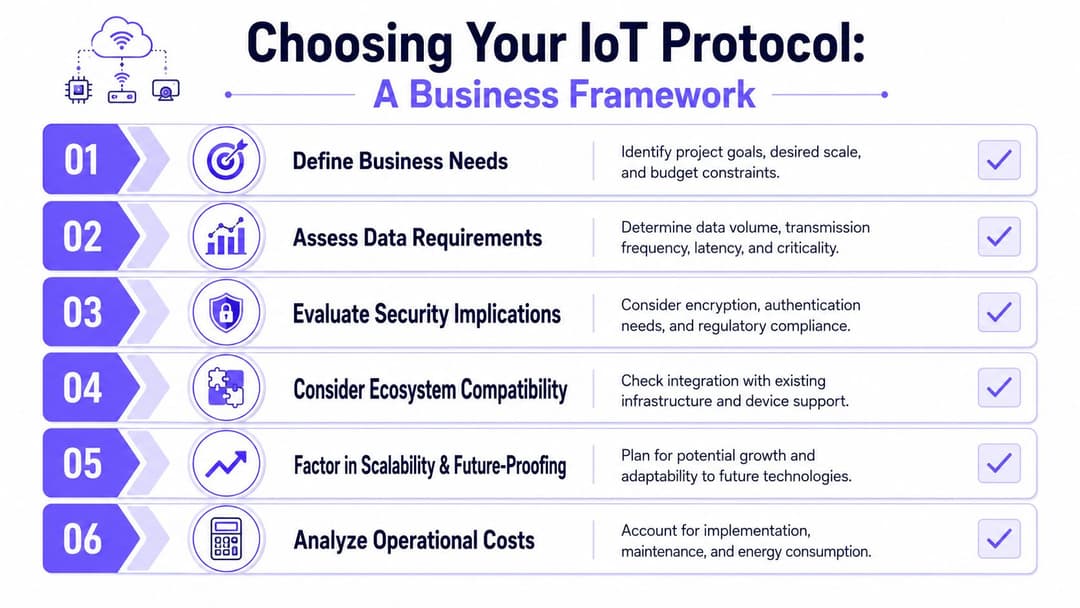
Cómo elegir el protocolo adecuado para su empresa
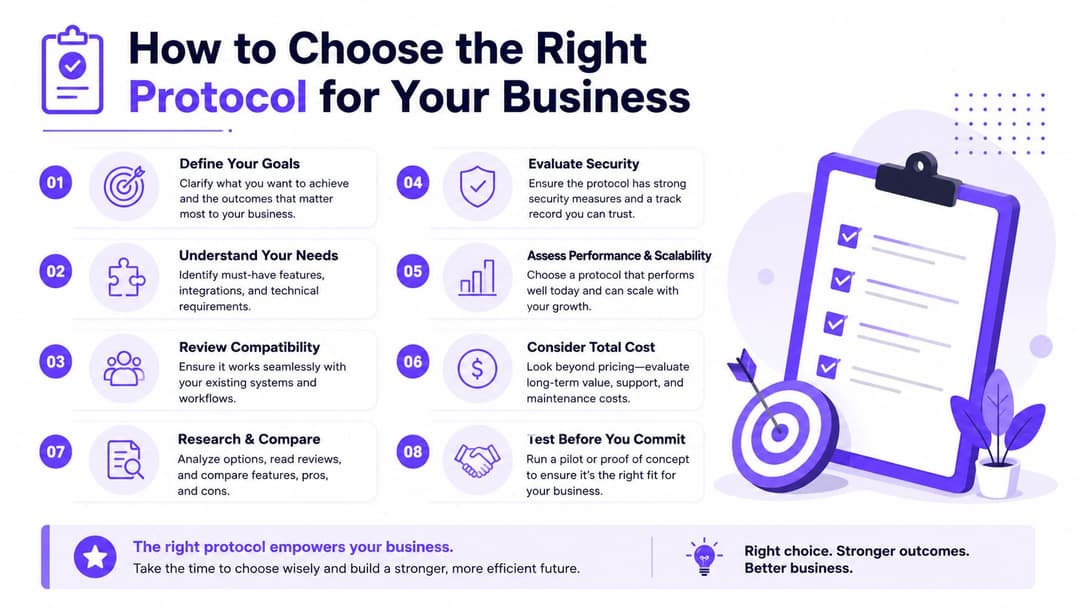
La mayoría de los compradores preguntan qué protocolo es el mejor. Esa es la pregunta equivocada. La pregunta útil es qué protocolo se adapta mejor al dispositivo, entorno, patrón de tráfico y modelo de seguridad que necesita operar.
En el Reino Unido, esto es especialmente importante porque la selección del protocolo a menudo viene determinada por las condiciones reales de la radio y no por el alcance teórico. Los datos de Ofcom muestran un uso intensivo de las bandas exentas de licencia, y los datos gubernamentales destacan las zonas sin cobertura móvil en interiores, lo que significa que la penetración en paredes, las interferencias y la fiabilidad de la red de transporte (backhaul) a menudo importan más que el titular de la hoja de especificaciones. Kore Wireless resume bien ese desafío en su análisis sobre las concesiones de los protocolos de IoT en el Reino Unido.
Comience con la realidad física
Un hotel de hormigón, un local comercial con estructura de acero y una zona de servicios públicos abierta no se comportan de la misma manera. Empiece por el espacio, no por la presentación del proveedor.
Pregunte:
- ¿Dónde se ubicará el dispositivo? Sala de máquinas, habitación, pasillo, aparcamiento, azotea, límite del campus.
- ¿Qué bloquea la señal? Hormigón, metal, ascensores, unidades de refrigeración, alta densidad de ocupación.
- ¿Quién es el propietario de la red de transporte (backhaul)? Su equipo, un proveedor gestionado, un tercero o un operador móvil.
Un protocolo que parece ideal en una sala de pruebas vacía puede fallar en un edificio real lleno de interferencias y movimiento.
Adapte el protocolo al comportamiento empresarial
Un enfoque de selección útil consiste en asociar cada caso de uso al conjunto mínimo de requisitos reales.
Termostatos de hotel y sensores ambientales
Estos dispositivos suelen enviar pequeñas actualizaciones, a menudo en intervalos fijos o ante cambios de estado. No necesitan una comunicación de estilo web, pero sí un funcionamiento estable y una gestión eficiente de la batería o de la energía. La mensajería ligera y una disciplina de puerta de enlace local suelen superar a los diseños complejos centrados en las API.
Beacons de retail y dispositivos de medición de afluencia
La densidad en interiores es fundamental en este caso. Lo que importa es la coexistencia, la duración de la batería y un funcionamiento predecible en condiciones de radiofrecuencia saturadas. Si los dispositivos están repartidos por una tienda o un centro comercial, las opciones de corto alcance y bajo consumo suelen tener más sentido que transferir todo al WiFi estándar.
Rastreadores de activos en hospitales o campus
La cobertura se convierte en el aspecto más difícil. Las zonas sin cobertura, los materiales de construcción y los patrones de movimiento importan más que lo que prometen los folletos explicativos. Los protocolos de telemetría de largo alcance pueden ser útiles para propiedades distribuidas, pero pueden no ser adecuados para una localización en interiores precisa o para actualizaciones frecuentes.
Una lista de verificación práctica para la toma de decisiones
- El presupuesto energético es lo primero: si el dispositivo funciona con batería, descarte pronto las opciones más pesadas o con excesivo intercambio de datos.
- El patrón de tráfico es lo siguiente: los cambios de estado pequeños y frecuentes favorecen la mensajería ligera.
- La tolerancia a la latencia importa: algunos sistemas de monitorización pueden tolerar retrasos. La seguridad y el control de accesos, por lo general, no.
- La carga de integración cuenta: un protocolo que su equipo de plataforma ya pueda proteger y observar puede valer más que una alternativa ligeramente más ligera.
- El modelo de soporte técnico decide la escala: si los equipos de campo no pueden sustituir, restablecer o volver a aprovisionar los dispositivos de forma limpia, sus costes operativos aumentarán rápidamente.
Regla de selección: Elija el protocolo que le ofrezca un rendimiento aceptable del dispositivo con la menor complejidad operativa. No el protocolo con la mejor ficha técnica.
Los diseños más robustos no suelen ser puros. Utilizan una familia de protocolos para telemetría restringida, otra para aplicaciones más complejas y un plano de gestión independiente para la identidad y las políticas.
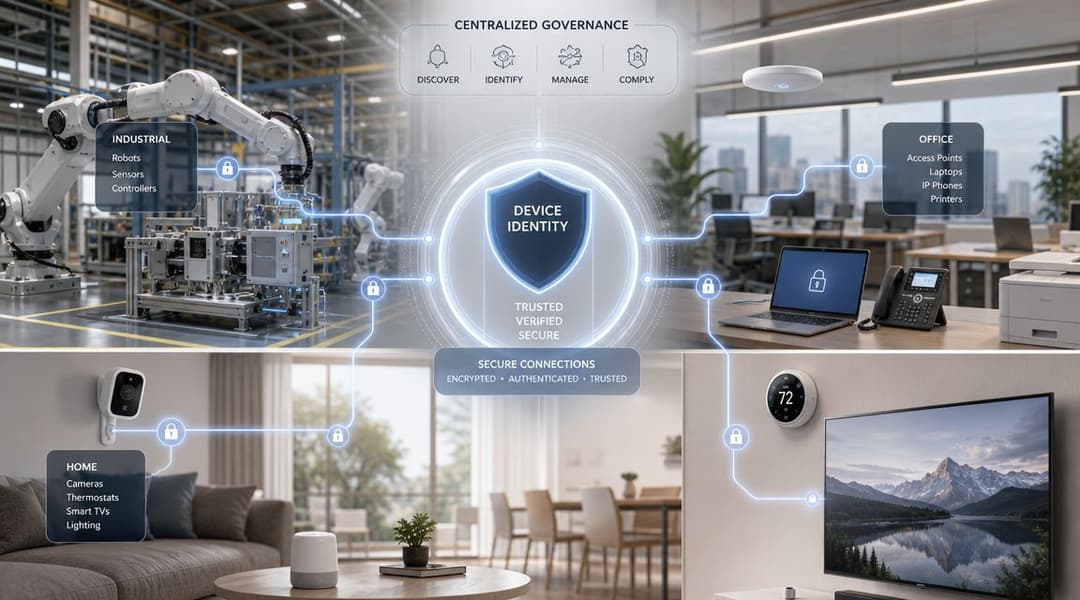
Unificación de la seguridad de IoT con la identidad del dispositivo
La mayoría de los debates sobre protocolos terminan demasiado pronto. Comparan el tamaño del mensaje, el uso de la batería y el alcance, y luego asumen que el problema de seguridad se puede solucionar más adelante. En entornos empresariales, eso es ir al revés. El desafío principal es demostrar que cada dispositivo es legítimo, asignarle el acceso correcto y revocar ese acceso de forma limpia cuando algo cambia.
Ahí es donde todavía fallan muchas implementaciones de IoT.
El cumplimiento normativo ha cambiado el rumbo de la conversación
El régimen PSTI del Reino Unido y las directrices del NCSC exigen credenciales únicas por dispositivo y prohíben las contraseñas predeterminadas. Eso lleva la planificación de protocolos más allá de una simple discusión entre MQTT y CoAP, y la dirige hacia una pregunta más difícil: ¿qué protocolos y plataformas facilitan la aplicación de la identidad del dispositivo, la gestión del ciclo de vida de los certificados y el acceso con privilegios mínimos? Ese aspecto de cumplimiento normativo a menudo se pasa por alto en los resúmenes generales de protocolos, pero es fundamental en el contexto del Reino Unido que se analiza en esta revisión de los requisitos de políticas y seguridad de IoT.
Las credenciales predeterminadas, las claves precompartidas comunes y la confianza en redes planas no escalan bien en espacios multiusuario. También complican enormemente la respuesta ante incidentes. Si un instalador conoce una clave común, o si un dispositivo controlado por un inquilino comparte un acceso amplio, la contención se vuelve más difícil de lo que debería ser.
Por qué la identidad importa más que la pureza del protocolo
Un diseño de IoT seguro requiere que cada dispositivo responda claramente a cuatro preguntas:
- ¿Quién es usted?
- ¿Cómo se realizó su incorporación?
- ¿A qué tiene permiso para acceder?
- ¿Cómo puedo revocar o rotar la confianza sin causar interrupciones?
Por eso, la autenticación basada en certificados suele ser más defendible que los secretos compartidos para los entornos empresariales críticos. Admite una identidad única por dispositivo, una revocación más limpia y una alineación mucho mejor con una política de confianza cero.
Para los equipos acostumbrados al control de acceso Wi-Fi tradicional, comprender qué es un servidor RADIUS resulta de ayuda, ya que el acceso basado en la identidad para los dispositivos sigue dependiendo de una autenticación disciplinada y de la aplicación de políticas, incluso cuando el extremo no es una persona con un ordenador portátil.
Las credenciales compartidas hacen que IoT parezca sencillo en el momento del despliegue y costoso durante el resto de su vida útil.
La pregunta sobre la plataforma que deben hacerse los equipos de TI
No se pregunte únicamente si un protocolo admite cifrado. Pregúntese si su plataforma puede vincular la identidad del dispositivo a la política, la lógica de directorio, la segmentación y los controles de ciclo de vida.
En entornos mixtos, esto puede implicar que los intermediarios, las pasarelas, las herramientas NAC, la PKI y los sistemas de incorporación de WiFi trabajen juntos. Una opción en esa capa de identidad más amplia es Purple, que admite el acceso sin contraseña, los flujos de incorporación basados en certificados y la integración con sistemas de identidad como Entra ID, Google Workspace y Okta para el personal y los entornos multiinquilino. El objetivo no es imponer un único protocolo. Es proporcionar a diversos dispositivos y usuarios un marco de confianza unificado.
Esto resulta especialmente crítico en sectores donde los fallos conllevan un elevado coste operativo. El sector sanitario es un claro ejemplo. Si desea una perspectiva sectorial más amplia, este artículo sobre IoT en el sector médico resulta de gran utilidad, ya que los entornos médicos demuestran exactamente por qué la identidad, la segmentación y el acceso controlado importan más que la mera conectividad.
Cómo crear una estrategia de IoT cohesionada
No existe una única respuesta correcta en cuanto a protocolos de IoT. Existe un conjunto de compensaciones, y una buena arquitectura consiste en adaptar esas compensaciones a cada tarea específica.
El patrón útil es sencillo. Utilice un modelo por capas para que su equipo sepa si está analizando el comportamiento de la aplicación, el transporte, el direccionamiento o la conectividad física. Elija mensajería ligera cuando los dispositivos tengan recursos limitados. Elija la tecnología de enlace adecuada para el edificio o entorno real, no para el laboratorio. Reserve los protocolos más complejos para los dispositivos que realmente los necesitan.
Cómo es un enfoque empresarial maduro
Una estrategia de IoT sólida suele incluir:
- Diferentes protocolos para diferentes clases de dispositivos, en lugar de imponer un único estándar
- Un modelo común de incorporación y políticas, para que las operaciones no se dispersen
- Segmentación por función y riesgo, no solo por costumbre de VLAN
- Seguridad basada primero en la identidad, para que cada dispositivo pueda ser autenticado, autorizado y revocado de forma limpia
Eso es lo que convierte una colección desordenada de sensores y terminales inteligentes en una plataforma gestionable.
El mayor cambio es de mentalidad. Deje de tratar IoT como una excepción de red. Trátelo como parte de su entorno de identidad y acceso. Cuando los equipos hacen eso, la selección de protocolos resulta más sencilla, la incorporación es más segura y el soporte a largo plazo se vuelve mucho más predecible.
Si está evaluando cómo se autentican los dispositivos conectados en entornos de invitados, personal e IoT, vale la pena considerar Purple como parte de la capa de identidad. Ofrece a los equipos de las empresas una forma de sustituir las contraseñas compartidas y el onboarding fragmentado por un acceso sin contraseña basado en políticas en recintos multiusuario y entornos de dispositivos mixtos.