
Migración de RADIUS (NPS) local a RADIUS como Servicio
Esta guía autorizada detalla la arquitectura técnica, la metodología de implementación y el impacto empresarial de la migración de Microsoft Network Policy Server (NPS) local a un modelo de RADIUS como Servicio nativo en la nube. Proporciona a los líderes de TI y arquitectos de red marcos prácticos para reducir la sobrecarga operativa, eliminar puntos únicos de fallo y asegurar la autenticación empresarial en ubicaciones distribuidas.
Escuchar esta guía
Ver transcripción del podcast
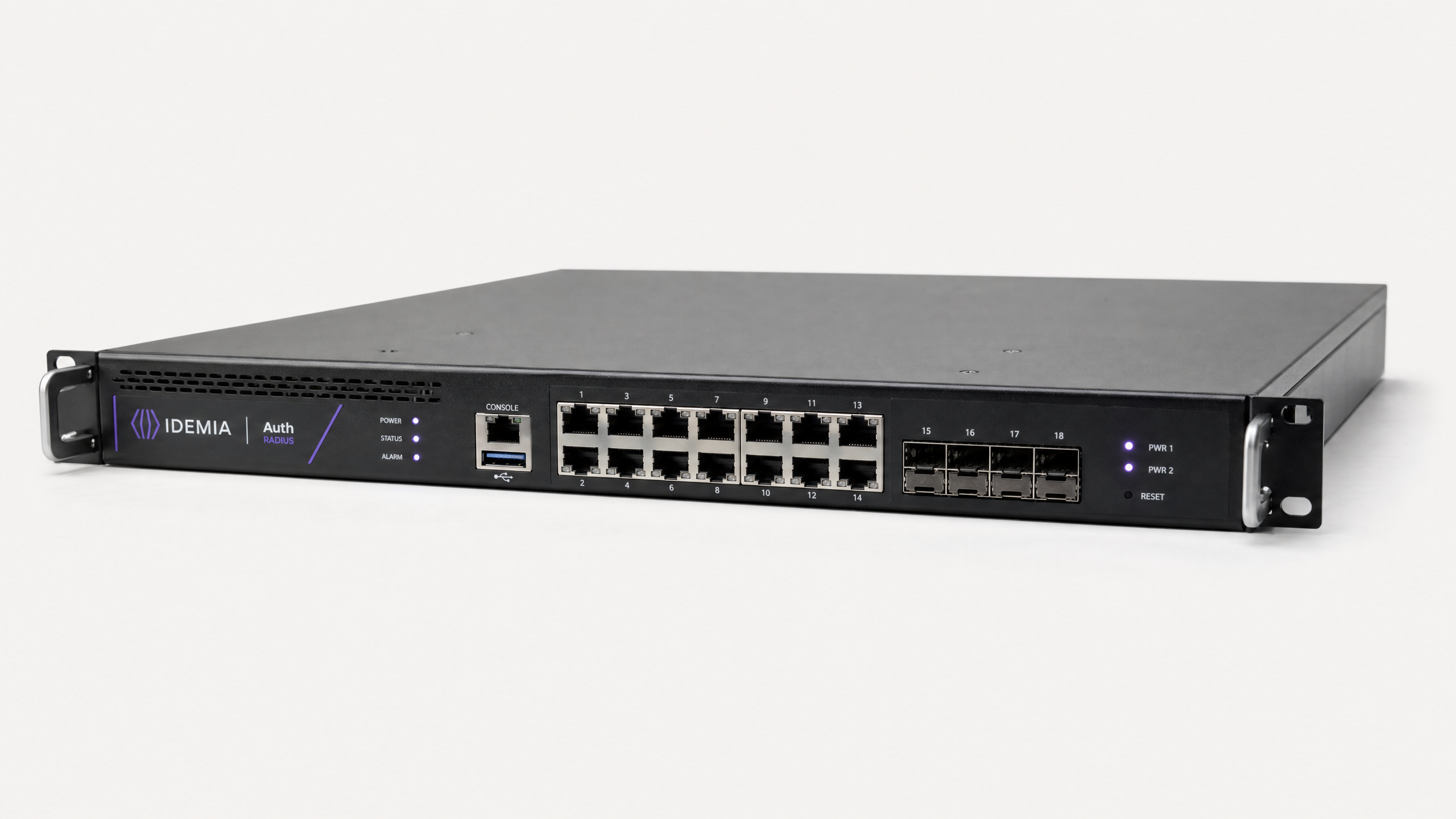
Resumen Ejecutivo
Durante casi dos décadas, Microsoft Network Policy Server (NPS) ha sido la implementación de RADIUS predeterminada para redes empresariales. Sin embargo, a medida que los operadores de recintos se expanden a ubicaciones distribuidas —desde cadenas minoristas hasta grupos hoteleros globales— la carga operativa de gestionar la infraestructura de autenticación local se ha convertido en una responsabilidad significativa.
La migración a RADIUS como Servicio traslada la autenticación de un componente de hardware gestionado a un servicio en la nube consumido. Esta transición arquitectónica elimina el punto único de fallo inherente a las implementaciones de NPS independientes, suprime los ciclos de renovación de hardware y proporciona la escalabilidad elástica necesaria para entornos de alta densidad como estadios y centros de conferencias. Para los gerentes de TI y arquitectos de red, esta guía ofrece una metodología estructurada y neutral en cuanto a proveedores para migrar la autenticación 802.1X a la nube sin afectar el tráfico de producción, garantizando el cumplimiento de PCI DSS y GDPR, y reduciendo el OpEx de la infraestructura de autenticación hasta en un 80%.
Análisis Técnico Detallado: Arquitectura y Estándares
Para entender la migración, primero debemos examinar el cambio arquitectónico en la forma en que se entrega el control de acceso basado en puertos IEEE 802.1X.
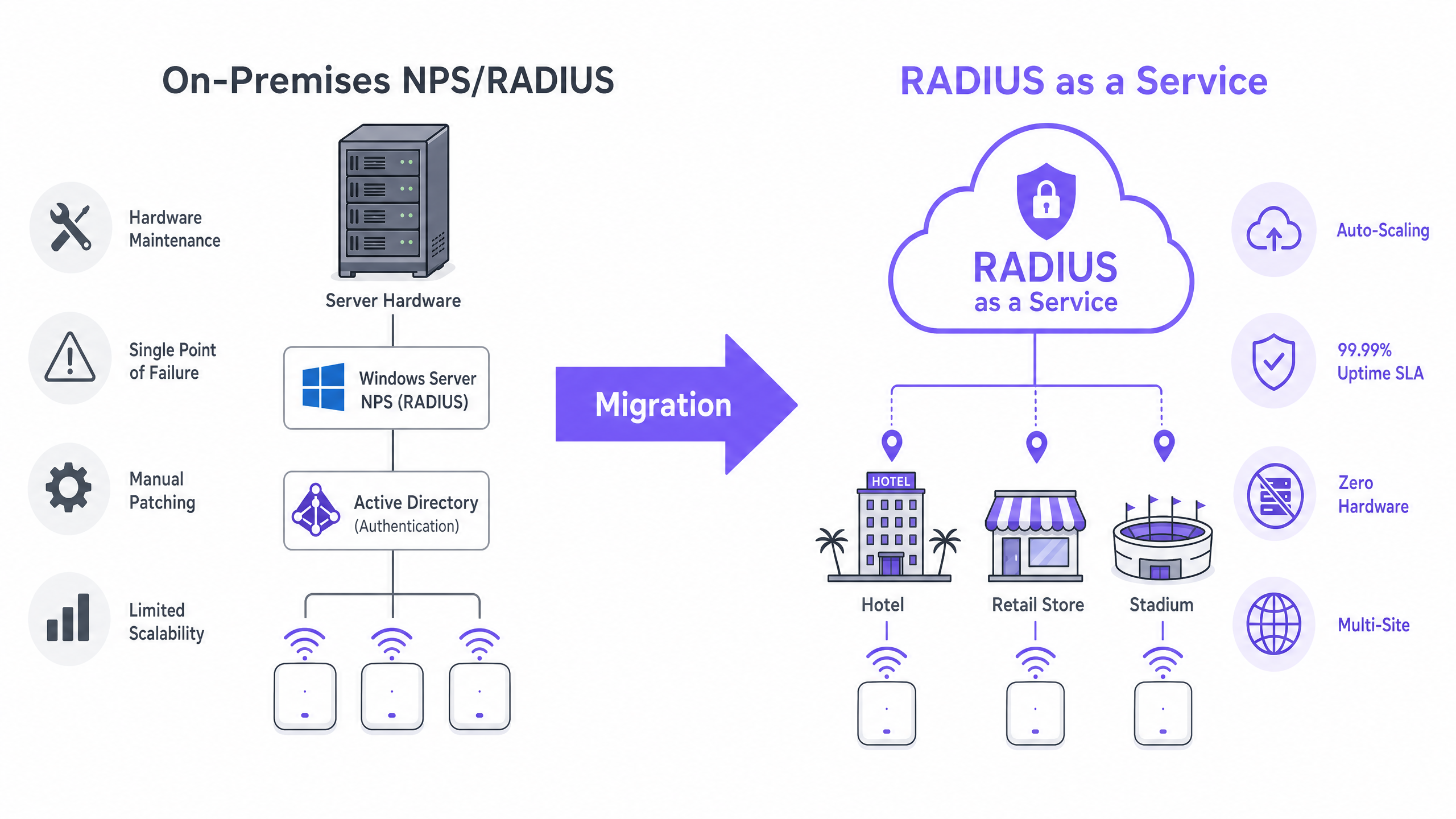
Las Limitaciones de NPS Local
En una implementación tradicional, los puntos de acceso actúan como Network Access Server (NAS), reenviando las solicitudes de autenticación a un servidor NPS local. El servidor NPS evalúa las políticas de solicitud de conexión, valida las credenciales contra un almacén de identidades (típicamente Active Directory a través de LDAP) y devuelve un mensaje de Access-Accept o Access-Reject.
Este modelo presenta tres limitaciones críticas para las redes modernas:
- Dependencia y Mantenimiento de Hardware: NPS requiere máquinas físicas o virtuales dedicadas, lo que exige parches continuos, planificación de capacidad y gestión del ciclo de vida.
- Complejidad de Alta Disponibilidad: Lograr la redundancia requiere implementar NPS en un par de conmutación por error, duplicando los costes de licencia sin proporcionar una verdadera redundancia geográfica.
- Cuellos de Botella de Rendimiento: Durante la concurrencia máxima —como la entrada a un estadio o las horas pico de comercio minorista— una única instancia de NPS puede convertirse en un cuello de botella, lo que lleva a tiempos de espera de autenticación y una experiencia de usuario degradada.
La Arquitectura RADIUS en la Nube
RADIUS como Servicio abstrae la capa de autenticación. Los proveedores de la nube operan clústeres de servidores RADIUS distribuidos y geo-redundantes. El NAS apunta a estos puntos finales en la nube, y las solicitudes se equilibran automáticamente.
Seguridad del Transporte: El Papel de RadSec Al mover RADIUS a la nube, el tráfico de autenticación atraviesa internet público. Mientras que el RADIUS tradicional utiliza un secreto compartido y hashing MD5, las implementaciones modernas deben implementar RadSec (RADIUS over TLS, RFC 6614). RadSec envuelve toda la conversación RADIUS en un túnel TLS (típicamente puerto TCP 2083), proporcionando cifrado de capa de transporte equivalente a HTTPS y autenticación mutua entre el NAS y el punto final RADIUS en la nube.
Integración de Identidades Cloud RADIUS no requiere migrar su directorio de usuarios. Los servicios suelen admitir conexiones LDAPS a Active Directory local o integraciones nativas de API con Azure Active Directory (Entra ID) a través de SAML o SCIM. Esto garantiza que sus procesos de gestión del ciclo de vida del usuario existentes permanezcan intactos.
Para recintos que utilizan plataformas de Guest WiFi , cloud RADIUS se integra directamente, proporcionando un plano de control unificado tanto para la autenticación corporativa 802.1X como para el acceso a la red de invitados, completo con WiFi Analytics avanzados.
Guía de Implementación: Una Metodología de 5 Fases
La ejecución de una migración sin tiempo de inactividad requiere un enfoque estructurado y por fases.
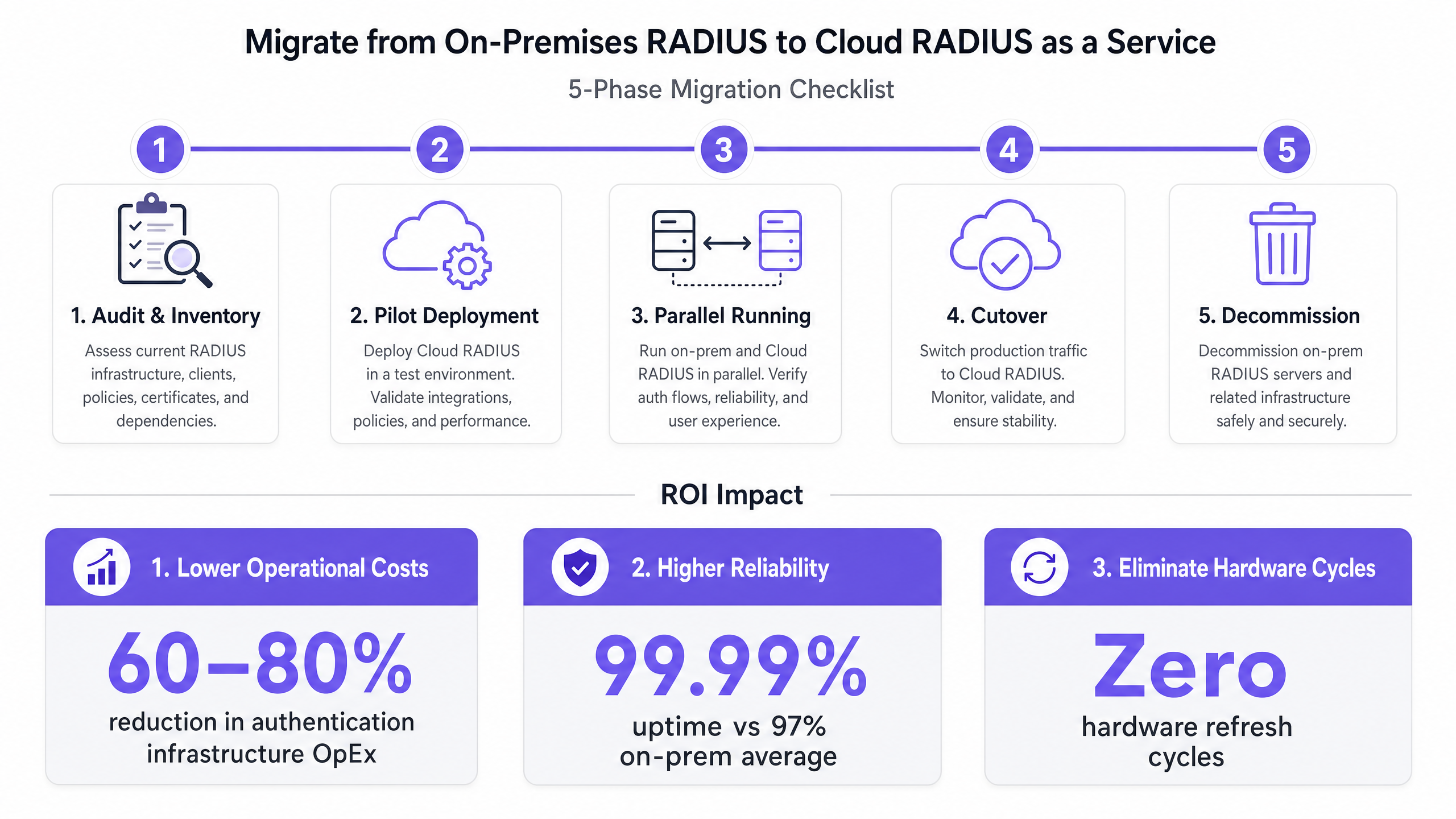
Fase 1: Auditoría e Inventario
Antes de realizar cualquier cambio, documente el estado actual:
- Clientes RADIUS: Identifique cada NAS (puntos de acceso, switches, concentradores VPN).
- Políticas: Documente las políticas de solicitud de conexión y de red de NPS existentes, incluidos los Atributos Específicos del Proveedor (VSAs) utilizados para la asignación de VLAN.
- Métodos EAP: Identifique qué métodos de Extensible Authentication Protocol están en uso (p. ej., EAP-TLS, PEAP-MSCHAPv2).
Fase 2: Despliegue Piloto
Aprovisione la instancia de cloud RADIUS y configure un SSID no productivo o un único sitio de prueba. Valide la integración del directorio de identidades (p. ej., sincronización de Entra ID) y asegúrese de que el método EAP funcione de extremo a extremo.
Fase 3: Ejecución en Paralelo (Mitigación de Riesgos)
Configure los dispositivos NAS de producción para usar tanto el servidor cloud RADIUS (Principal) como el servidor NPS heredado (Respaldo). Ejecute esta configuración durante un mínimo de dos semanas. Supervise las tasas de éxito de autenticación, las métricas de latencia y los flujos de datos de contabilidad para identificar cualquier discrepancia de política antes del cambio.
Fase 4: Transición
Durante una ventana de mantenimiento programada, elimine la configuración de respaldo de NPS heredada de los dispositivos NAS. Comprométase completamente con la infraestructura en la nube. Asegúrese de que su procedimiento de reversión esté documentado y probado.
Fase 5: Desmantelamiento
Después de 30 días de operación estable, desmantele de forma segura los servidores NPS heredados y recupere los recursos de cómputo.
Mejores Prácticas y Cumplimiento
Al diseñar su arquitectura cloud RADIUS, adhiérase a los siguientes estándares:
- Obligatoriedad de RadSec: Nunca envíe tráfico RADIUS a través de internet público utilizando UDP estándar 1812/1813 si RadSec (TCP 2083) es compatible con su hardware NAS.
- Cadenas de Confianza de Certificados: Asegúrese de que los dispositivos cliente confíen en el Certutoridad de Certificación (CA) que emitió el certificado del servidor RADIUS en la nube. Distribuya la CA raíz a los dispositivos gestionados a través de MDM o Directiva de grupo antes de la migración.
- Postura de Cumplimiento: Seleccione un proveedor de RADIUS en la nube que mantenga la certificación SOC 2 Tipo II y la acreditación ISO 27001. Esto simplifica significativamente sus evaluaciones anuales de PCI DSS, particularmente para entornos de Comercio minorista y Hostelería .
Para principios de diseño de red más amplios, consulte nuestras guías sobre Configuración de WiFi para empresas: Un manual de 2026 y Comprensión de RSSI y la intensidad de la señal para una planificación óptima de canales .
Solución de Problemas y Mitigación de Riesgos
| Modo de Fallo | Causa Raíz | Estrategia de Mitigación |
|---|---|---|
| Tiempos de Espera de Autenticación | Firewall bloqueando UDP saliente 1812/1813 o TCP 2083. | Verifique que las reglas del firewall perimetral permitan el tráfico saliente a los rangos IP específicos del proveedor de RADIUS en la nube. |
| Errores de Confianza del Certificado | Los dispositivos cliente carecen de la CA raíz en su almacén de confianza. | Implemente la CA raíz a través de MDM/GPO antes de la Fase 3 (Ejecución Paralela). |
| Fallo en la Asignación de VLAN | Atributos Específicos del Proveedor (VSAs) no mapeados correctamente en las políticas de la nube. | Replique los formatos de cadena VSA exactos de NPS al motor de políticas RADIUS en la nube durante la Fase 1. |
| Impacto por Interrupción de WAN | La pérdida de internet interrumpe el acceso a RADIUS en la nube. | Implemente enlaces WAN redundantes o un proxy RADIUS local que almacene en caché las credenciales de los dispositivos conocidos. |
ROI e Impacto Empresarial
La migración a RADIUS como Servicio ofrece resultados empresariales medibles:
- Reducción de Costes: Elimina la adquisición de hardware, las licencias de Windows Server y las horas de ingeniería dedicadas a parches y mantenimiento. La reducción típica de OpEx es del 60-80%.
- SLA de Fiabilidad: Los proveedores en la nube ofrecen SLAs de tiempo de actividad del 99,99% respaldados financieramente, en comparación con el 97-98% típico logrado por implementaciones de NPS en un solo sitio.
- Agilidad: Los nuevos sitios pueden ponerse en línea instantáneamente sin aprovisionar hardware de autenticación local, acelerando los plazos de implementación para centros de Transporte e instalaciones de Atención médica .
Escuche a nuestro equipo de consultoría senior discutir las implicaciones estratégicas en esta sesión informativa de 10 minutos:
Definiciones clave
RADIUS (Remote Authentication Dial-In User Service)
A networking protocol that provides centralized Authentication, Authorization, and Accounting (AAA) management for users who connect and use a network service.
The core protocol used by enterprise WiFi networks to validate user credentials before granting network access.
NPS (Network Policy Server)
Microsoft's implementation of a RADIUS server and proxy, bundled as a role in Windows Server.
The legacy on-premises infrastructure that organizations are actively migrating away from to reduce maintenance overhead.
NAS (Network Access Server)
The device that acts as the gateway to the network and passes authentication requests to the RADIUS server.
In a wireless context, the NAS is typically the WiFi Access Point or Wireless LAN Controller.
RadSec (RADIUS over TLS)
A protocol defined in RFC 6614 that transports RADIUS packets over a TCP connection encrypted with TLS.
Essential for cloud RADIUS deployments to ensure credential data is encrypted while traversing the public internet.
EAP (Extensible Authentication Protocol)
An authentication framework frequently used in wireless networks and point-to-point connections.
Determines how the client and server securely exchange credentials (e.g., certificates via EAP-TLS, or passwords via PEAP).
VSA (Vendor-Specific Attribute)
Custom attributes defined by hardware vendors within the RADIUS protocol to support proprietary features.
Crucial during migration; VSAs are often used to assign authenticated users to specific network VLANs dynamically.
LDAPS (Lightweight Directory Access Protocol over SSL)
A secure protocol for querying and modifying directory services like Active Directory.
Used by cloud RADIUS services to securely query on-premises identity stores without migrating the user directory to the cloud.
802.1X
An IEEE standard for port-based network access control (PNAC).
The underlying standard that uses RADIUS to ensure only authenticated devices can pass traffic onto the enterprise LAN or WLAN.
Ejemplos prácticos
A 200-property hotel group currently runs local NPS servers at each site for staff 802.1X authentication. They are migrating to Entra ID (Azure AD) and want to decommission the local servers. How should they approach the migration?
- Deploy a cloud RADIUS service that integrates natively with Entra ID via SAML/SCIM.
- Configure the cloud RADIUS policies to map Entra ID groups (e.g., 'Front Desk', 'Management') to specific VLAN VSAs.
- At a pilot property, configure the access points to use RadSec to connect to the cloud RADIUS endpoint.
- Push the cloud RADIUS server's Root CA to all staff devices via Microsoft Intune.
- Run parallel authentication at the pilot site, then execute a phased rollout across the remaining 199 properties.
A stadium with 50,000 capacity experiences authentication failures on their corporate SSID during major events because their on-premises NPS server cannot handle the throughput of thousands of devices roaming simultaneously.
- Audit the existing NPS policies and EAP methods.
- Provision a cloud RADIUS service capable of auto-scaling to handle high authentications per second (APS).
- Establish an LDAPS connection from the cloud RADIUS service to the stadium's on-premises Active Directory.
- Update the stadium's high-density wireless LAN controllers to point to the cloud RADIUS endpoints as the primary authentication servers.
Preguntas de práctica
Q1. Your organization is migrating to Cloud RADIUS. The security team mandates that no authentication traffic can be sent over the internet in cleartext or using deprecated hashing algorithms like MD5. What protocol must you configure on your wireless LAN controllers?
Sugerencia: Look for the protocol that wraps RADIUS in a TLS tunnel.
Ver respuesta modelo
You must configure RadSec (RADIUS over TLS). RadSec establishes a TLS tunnel over TCP port 2083 between the NAS and the cloud RADIUS server, providing transport-layer encryption and mutual authentication, satisfying the security team's requirements.
Q2. During Phase 3 (Parallel Running) of your migration, you notice that users are authenticating successfully against the cloud RADIUS server, but they are not being placed in the correct network segments. What is the most likely configuration gap?
Sugerencia: How does a RADIUS server tell an access point which network segment to use?
Ver respuesta modelo
The Vendor-Specific Attributes (VSAs) for dynamic VLAN assignment have not been configured correctly in the cloud RADIUS policies. You must ensure the exact VSA strings used in the legacy NPS server are replicated in the cloud environment so the NAS knows which VLAN to assign to the user.
Q3. A client device is repeatedly failing EAP-TLS authentication against the new cloud RADIUS service, but it works fine against the legacy NPS server. The device logs show an 'untrusted server' error. How do you resolve this?
Sugerencia: EAP-TLS requires the client to trust the server's identity.
Ver respuesta modelo
The client device does not have the Root Certificate Authority (CA) that issued the cloud RADIUS server's certificate in its trusted root store. You must deploy the Root CA to the client device using a Mobile Device Management (MDM) solution or Group Policy.