
How to leverage SMS marketing companies to increase return visits
This guide details the technical architecture for integrating Guest WiFi with SMS marketing companies to drive return visits. It provides venue operators and IT teams with actionable deployment strategies, API integration workflows, and GDPR compliance frameworks to automate behavioural messaging. Purple Engage captures verified guest phone data at login and automates segmented campaigns that achieve up to a 36% click-through rate.
Listen to this guide
View podcast transcript
Executive summary
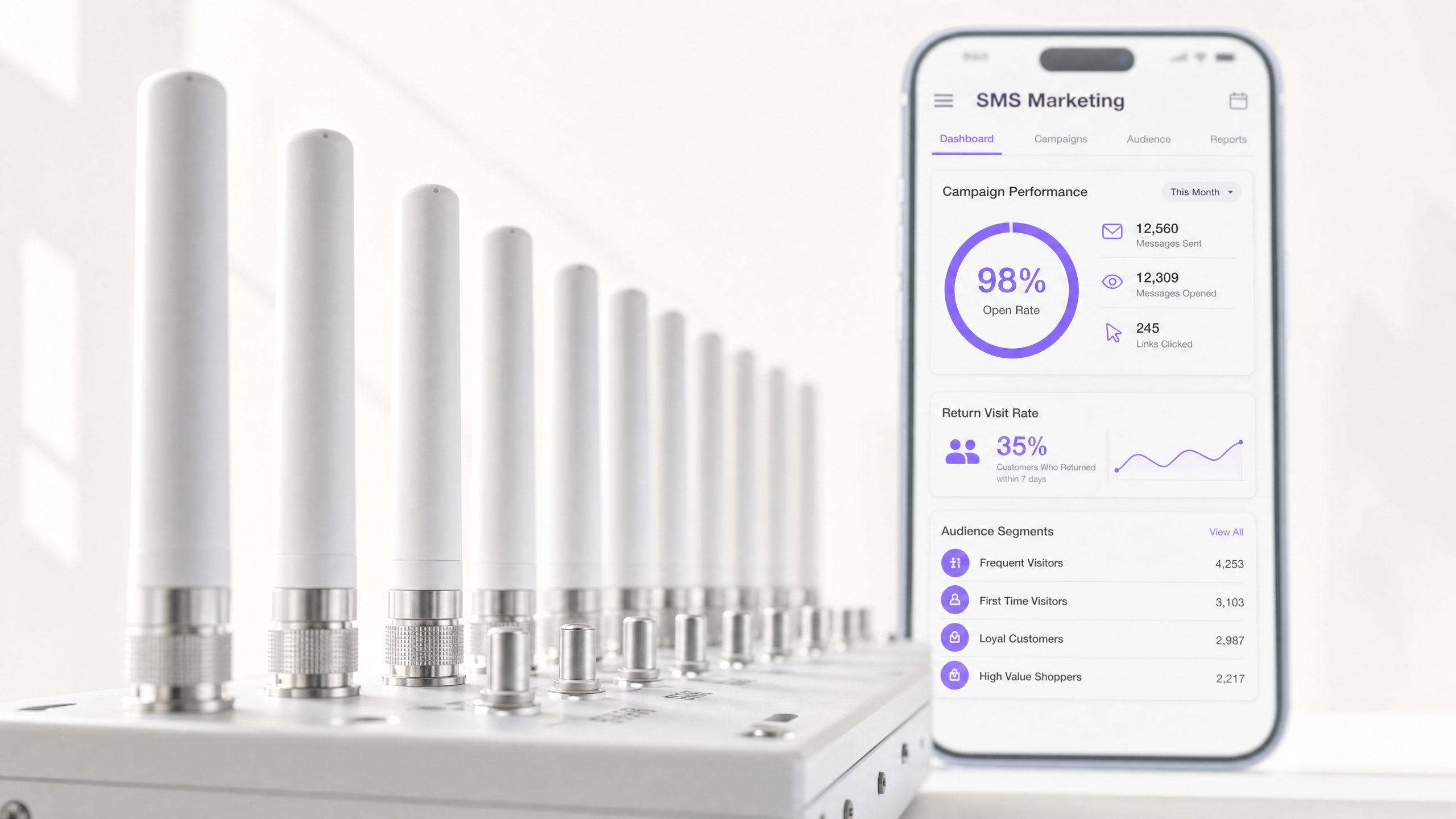
Guest WiFi is the most reliable engine for building a verified, first-party SMS database. While email marketing remains effective, SMS campaigns consistently deliver a 98% open rate and a 45% response rate. For venue operators across retail, hospitality, and public sectors, integrating network hardware with SMS marketing companies transforms passive internet access into an automated revenue channel.
This guide outlines the technical architecture required to capture compliant first-party data via captive portals and route it to platforms like Twilio, Klaviyo, or Attentive. By using behavioural data - such as dwell time and visit frequency - you can deploy segmented campaigns that achieve up to a 36% click-through rate. We detail the integration pathways, hardware configurations, and GDPR compliance standards necessary to deploy these systems securely and at scale.
Technical deep-dive
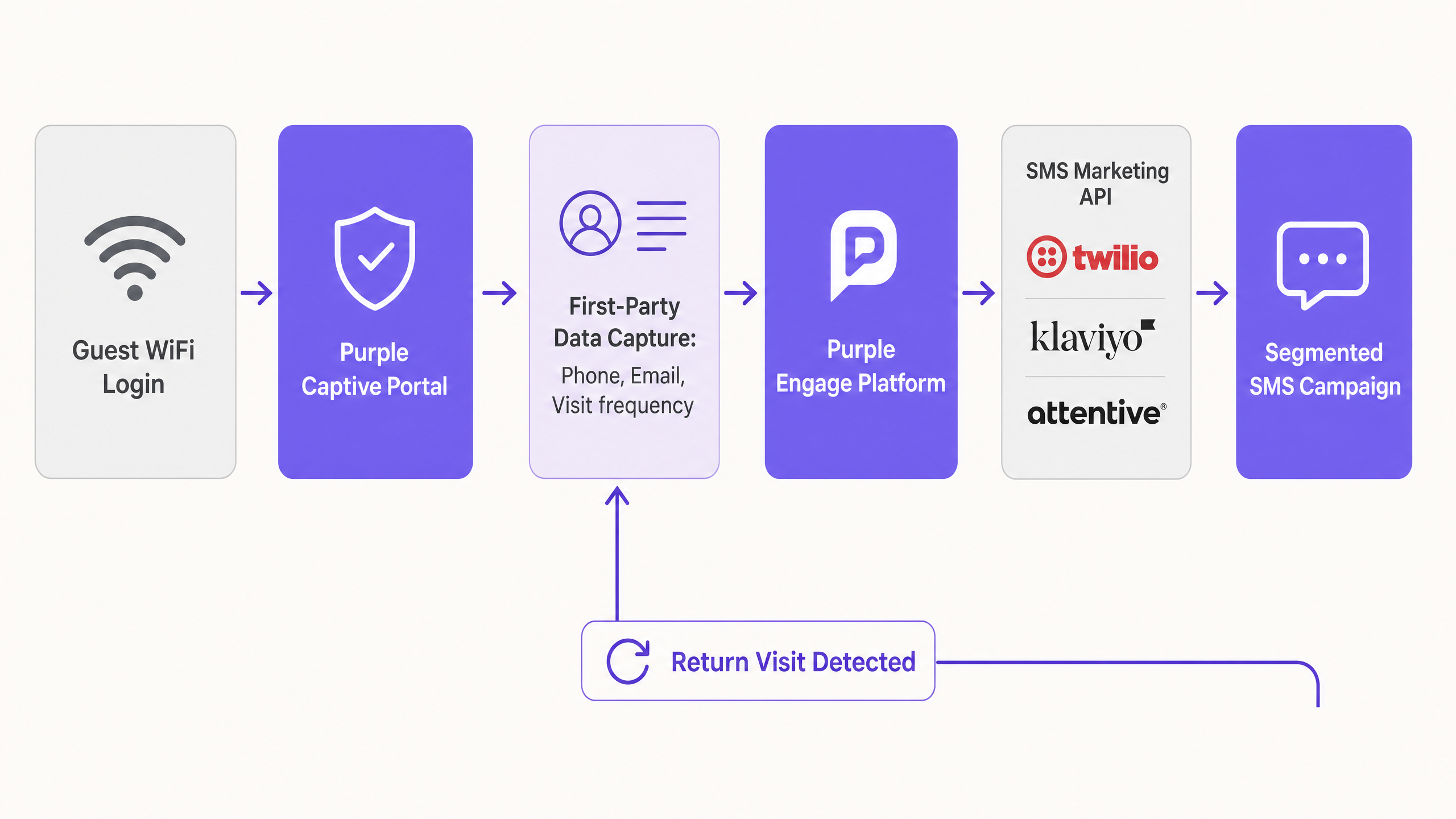
Integrating your physical network with an SMS marketing platform requires a clear data flow from the access point to the messaging API. The architecture relies on capturing identity at the edge and enriching it with presence analytics.
Data capture architecture
The process begins when a visitor connects to the Guest WiFi SSID. Enterprise hardware vendors - including Cisco Meraki, HPE Aruba, Ruckus, Juniper Mist, Ubiquiti UniFi, Cambium, Extreme, and Fortinet - redirect the user to the Purple captive portal via RADIUS authentication. Purple operates as a hardware-agnostic cloud overlay, meaning the same integration logic applies regardless of which vendor you run.
During authentication, the portal requests a phone number and explicit marketing consent. Purple uses the device MAC address as the primary key, linking it to the authenticated phone number to create a unified profile. When the device returns to the venue, the network detects the probe requests, allowing Purple to log the return visit, update dwell time, and track frequency without requiring the user to log in again. Across 80,000+ live venues, Purple has collected 29 billion data points using this method.
API and webhook integration
To activate this data, Purple integrates with SMS marketing companies via REST APIs and webhooks. When a visitor meets a predefined behavioural condition - such as a 60-day absence - Purple Engage fires a webhook payload containing the phone number, venue ID, and segment tag.
Platforms like Twilio or Klaviyo receive this payload and initiate the automated SMS flow. The payload must include the phone number formatted to the E.164 standard (e.g., +447911123456), which all major SMS APIs require for reliable delivery. This server-to-server communication ensures messages are triggered by real-world physical behaviour rather than arbitrary scheduling.
For Retail operators running Klaviyo, the integration uses Klaviyo's event API to create a custom event - for example, venue_visit_lapsed - which triggers the corresponding flow. For Hospitality operators using Twilio, the Purple webhook maps directly to a Twilio Messaging Service, which handles the carrier routing and delivery.
Presence analytics as a trigger engine
The network layer provides data points that no other channel can replicate. Purple tracks dwell time per visit, visit frequency over rolling 30, 60, and 90-day windows, and the time of day for each connection. These metrics feed directly into the segmentation engine within Purple Engage.
A shopper who visits a retail store every Saturday morning is a different audience segment from one who visited once six months ago. The SMS message for each should be different. The WiFi network is the only system that knows both of these facts with certainty, because it observes the physical presence of the device.
For more on how analytics data underpins these decisions, see our WiFi Analytics platform documentation.
Implementation guide
Deploying an SMS marketing integration requires coordination between the network infrastructure, the Purple Engage platform, and the SMS provider. The following steps apply to a standard enterprise deployment.
Step 1: Hardware and RADIUS configuration
Configure your wireless LAN controllers or cloud dashboard to point to the Purple RADIUS servers. For Cisco Meraki, this is done via the Meraki Dashboard under Wireless > Access Control > RADIUS servers. For HPE Aruba, configure the ClearPass Policy Manager to forward authentication requests to Purple. Ensure the walled garden allows traffic to the necessary authentication domains and the SMS gateway if you are using SMS-based OTP verification.
Step 2: Captive portal optimisation
Design the splash page to capture phone numbers alongside email addresses. To maintain a clean database, implement Purple's Verify add-on. This requires the user to input a one-time password sent via SMS before gaining internet access, ensuring your database only contains active, valid numbers. For guidance on creating a high-converting splash page, see our blog on how to make a great first impression with your guest WiFi .
Step 3: Segment definition in Purple Engage
Within Purple Engage, define your behavioural segments before configuring any outbound integrations. Do not rely on unsegmented broadcasts. Create specific triggers based on the data points collected by the network:
| Segment | Trigger Condition | Recommended SMS Action |
|---|---|---|
| First-time visitor | Visit Count = 1 | Welcome message with offer, sent 30 minutes post-visit |
| Frequent visitor | Visit Count = 5 in 30 days | Loyalty reward or early access offer |
| Lapsed visitor | Last seen > 60 days | Re-engagement offer with urgency |
| High-dwell visitor | Dwell time > 90 minutes | Upsell or cross-sell based on venue type |
Step 4: Webhook configuration
Configure the outbound webhooks in Purple to push the segmented audience data to your SMS marketing platform. Map the data fields correctly, ensuring phone numbers are formatted to E.164. Set up a retry policy for failed webhook deliveries - most SMS platforms accept a maximum of three retries within a 24-hour window before marking a contact as unreachable.
Step 5: Opt-out synchronisation
This step is non-negotiable for GDPR compliance. Configure a bidirectional sync between your SMS platform and Purple. When a user opts out via the SMS channel (by texting STOP), that status must propagate back to Purple within 24 hours to prevent re-triggering the webhook. Most SMS platforms expose an opt-out webhook or a suppression list API for this purpose.
Best practices
To maximise return on investment from your SMS campaigns, follow these industry-standard practices.
Behavioural segmentation
Generic SMS blasts yield lower engagement. Data from 2026 shows that behavioural trigger campaigns - those based on physical actions like visiting a venue - achieve a 36% click-through rate, compared to just 19% for unsegmented broadcasts. Use the location data from your WiFi Analytics to drive message timing and relevance.
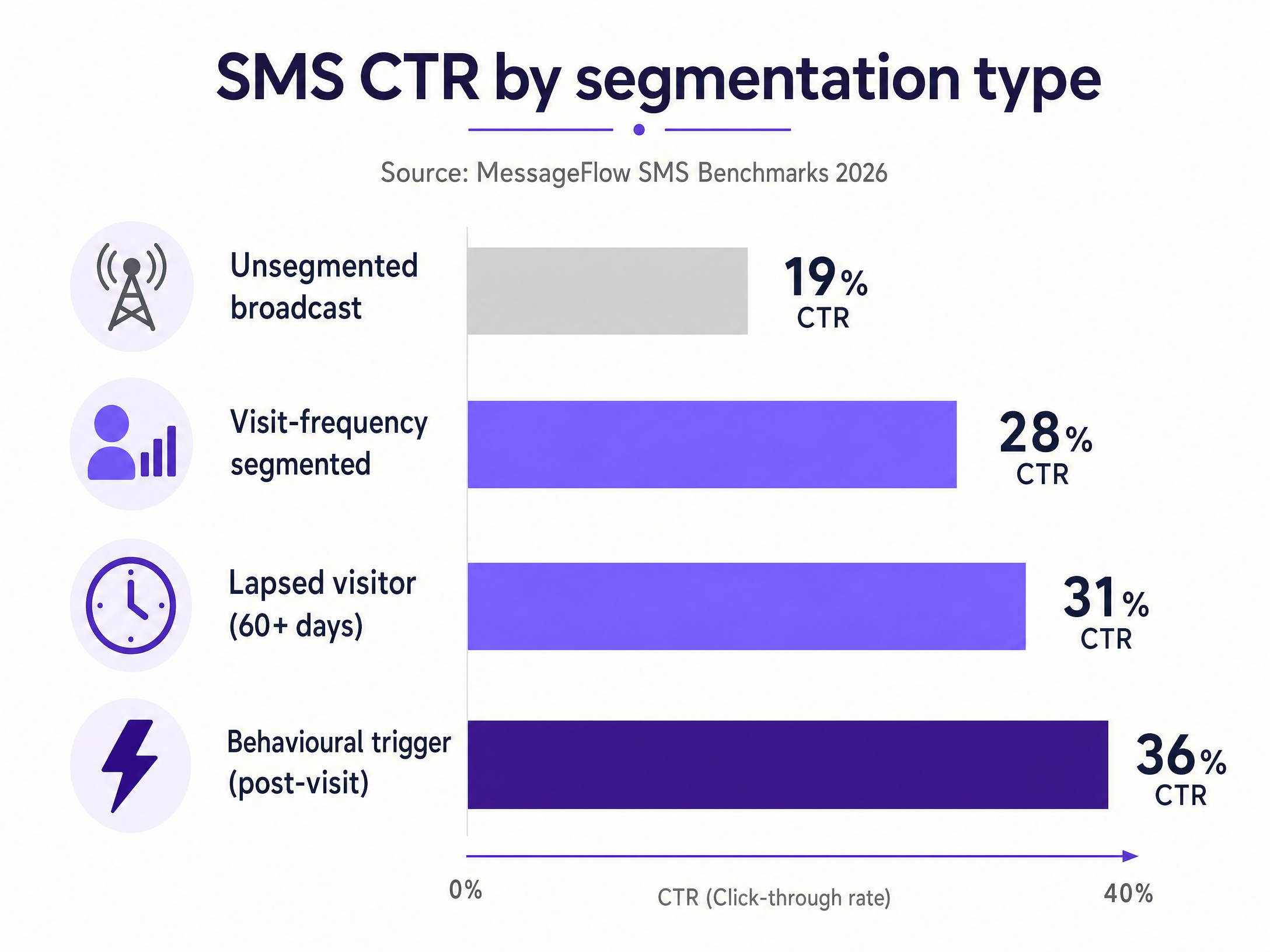
Segmented SMS campaigns achieve an 83% increase in engagement compared to non-segmented campaigns. The investment in setting up proper segmentation within Purple Engage pays back within the first campaign cycle.
Frequency limits
Over-messaging is the primary cause of opt-outs, with 53% of unsubscribes attributed to high frequency. Limit promotional SMS messages to a maximum of two per month per user. Ensure your SMS marketing platform is configured to respect these frequency caps globally, even if a user qualifies for multiple segments simultaneously.
Omnichannel alignment
Integrate your SMS strategy with your email marketing. Use email for long-form content and newsletters, and reserve SMS for urgent, time-sensitive alerts or in-venue promotions. Brands integrating SMS into omnichannel workflows see engagement increases of roughly 40 - 50%. SMS combined with email produces roughly 56% higher ROI than email alone. For more on unified data strategies, refer to our guide on the Customer data platform: a comprehensive guide for businesses .
Network architecture for multi-site deployments
For operators managing multiple venues - such as a retail chain or hotel group - deploy a centralised Purple tenant with per-venue segmentation. This allows you to run national campaigns while still triggering location-specific messages. For example, a guest who visits your Manchester location receives an SMS referencing that specific venue, not a generic brand message. For multi-site WiFi design considerations, see our guide on Three SSIDs to rule them all: guest, Passpoint, and IoT WiFi .
Troubleshooting & risk mitigation
Deploying SMS integrations introduces specific compliance and technical risks that must be managed proactively.
GDPR and consent compliance
Under GDPR, you cannot send marketing SMS messages without explicit, opt-in consent. Soft opt-ins are invalid for SMS. Your captive portal must present an unticked checkbox for marketing communications, separate from the terms of service acceptance.
The Purple platform logs the timestamp, IP address, and the exact text of the consent statement for every opt-in. This audit trail is your evidence in the event of a regulatory inquiry. If a user texts STOP to your campaign, the SMS provider must process the opt-out, and you must sync this status back to Purple to ensure compliance across all channels. Failure to do so can result in fines of up to 4% of global annual turnover under GDPR.
List hygiene and delivery failures
If your SMS delivery rate drops below 95%, you have list hygiene issues. This often occurs when users input fake numbers to access the Guest WiFi quickly. Implement SMS OTP verification at login to eliminate this risk. Regularly purge numbers that hard-bounce from your SMS platform to maintain a high sender reputation with the carriers.
Webhook reliability
Webhook failures are silent by default. Configure your SMS platform to log all incoming webhook events and set up alerting for failure rates above 2%. A common failure mode is a mismatch between the phone number format sent by Purple (E.164) and the format expected by the SMS platform. Validate this mapping during initial setup with a test payload before going live.
MAC address randomisation
Modern iOS and Android devices randomise MAC addresses per network connection to protect user privacy. This affects the accuracy of return visit detection. Purple mitigates this by using the authenticated phone number or email as the primary identifier after the first login, falling back to MAC address only for anonymous presence detection. Ensure your captive portal is configured to always prompt for authentication rather than allowing anonymous access.
ROI & business impact
SMS marketing requires a higher per-message spend than email, typically costing $0.02 to $0.04 per message. However, the return on investment justifies the cost when executed correctly.
Conservative estimates place SMS ROI between $21 and $41 for every $1 spent. Seasonal campaigns with strong urgency mechanics have reported returns of up to $71 per $1 spent. For a retail venue, triggering an automated discount to a lapsed shopper directly drives footfall. By using Purple to track the return visit, you close the attribution loop - measuring exactly how many users received the SMS and subsequently walked back into the venue.
| Metric | Unsegmented broadcast | Behavioural trigger |
|---|---|---|
| Click-through rate | 19% | 36% |
| Conversion rate | 10-15% | 21-30% |
| Estimated ROI per $1 spent | $21 | $41+ |
| Unsubscribe rate | 2-3.5% | 0-1.5% |
For Transport operators, such as rail or airport venues, the usecase is slightly different. Passengers connect to the WiFi during a journey or layover. A post-visit SMS promoting a lounge membership or a discount for the next booking converts at a high rate because the message is contextually relevant to a recent experience.
For Healthcare environments, SMS is used primarily for appointment reminders and wayfinding follow-ups rather than promotional campaigns. The same architecture applies, but the consent framework and message content must comply with sector-specific regulations alongside GDPR.
References: [1] Sakari, "SMS Marketing Statistics: Data-Backed Insights for 2025-2026" [2] Twilio, "How Klaviyo helps retail businesses build deep connections" [3] MessageFlow, "SMS Marketing Benchmarks 2026: CTR, Open Rates by Industry" [4] Digital Applied, "SMS Marketing Compliance: TCPA & GDPR Guide 2026"
Key Definitions
Captive portal
A web page that users must view and interact with before accessing a public WiFi network, used to capture authentication data and consent.
This is the primary data collection engine for venue operators to build their SMS marketing database. Purple's captive portal is the point at which phone numbers and explicit marketing consent are captured.
First-party data
Information a company collects directly from its customers with their consent, such as phone numbers and visit frequency.
First-party data is immune to third-party cookie depreciation and forms the foundation of compliant SMS marketing. Purple collects first-party data at the WiFi login point across 80,000+ venues.
Webhook
A method for one application to provide real-time information to another application using HTTP POST requests triggered by a specific event.
Webhooks are used to push behavioural triggers from Purple Engage to SMS platforms like Twilio the moment a guest meets a segment criteria, such as not visiting for 60 days.
RADIUS
Remote Authentication Dial-In User Service; a networking protocol that provides centralised authentication, authorisation, and accounting management for network access.
RADIUS connects the physical access points (e.g., Cisco Meraki, HPE Aruba) to the Purple platform to authenticate users and log session data used for segmentation.
E.164 standard
The international telephone numbering plan that ensures phone numbers are globally unique and formatted correctly, including the country code prefix (e.g., +447911123456).
SMS marketing APIs require phone numbers to be in E.164 format to ensure successful delivery across carriers. Misformatted numbers are a common cause of delivery failures.
MAC address
Media Access Control address; a unique identifier assigned to a network interface controller, used as a network address at the data link layer.
Purple uses the device MAC address to track return visits and dwell time without requiring the user to log into the captive portal again. MAC address randomisation in modern devices requires phone number as the primary identifier after first login.
Click-through rate (CTR)
The percentage of recipients who click on a link contained within an SMS message, calculated as clicks divided by delivered messages.
CTR is the most reliable metric for measuring SMS engagement, as SMS open rates cannot be tracked via pixels like email. Behavioural trigger campaigns achieve up to 36% CTR versus 19% for unsegmented broadcasts.
Opt-in consent
An explicit, affirmative action by a user agreeing to receive marketing communications, demonstrated by actively ticking an unticked checkbox or sending a keyword.
Under GDPR, venue operators must secure opt-in consent at the captive portal before transferring any phone number to an SMS marketing company. Pre-ticked boxes and implied consent are not valid.
Dwell time
The duration a device remains connected to a WiFi network within a venue, used as a proxy for how long a visitor spends on-site.
Dwell time is a key segmentation variable. A visitor who spends 90 minutes in a venue is a higher-value prospect than one who connects for five minutes. Purple tracks dwell time per session and aggregates it over time.
Worked Examples
A 200-room hotel wants to send a promotional SMS to guests who have not visited in six months. They use HPE Aruba access points and Twilio for SMS. How do they configure this?
- Configure the Aruba ClearPass Policy Manager to forward Guest WiFi authentication requests to Purple RADIUS servers.
- Set up the Purple captive portal to capture phone numbers and include an explicit, unticked checkbox for marketing consent.
- Enable Purple's Verify add-on to require SMS OTP authentication, ensuring only valid numbers enter the database.
- Create an audience segment in Purple Engage defined as 'Last seen > 180 days'.
- Configure a webhook integration in Purple to push this segment data to the Twilio Messaging Service API.
- Build an automated flow in Twilio that triggers the 'We miss you' SMS when a contact enters the segment.
- Configure a bidirectional opt-out sync so that STOP responses in Twilio suppress the contact in Purple.
A national retail chain with 50 locations needs to increase return visits from first-time shoppers. They use Cisco Meraki hardware and Klaviyo. How do they automate this?
- Integrate the Cisco Meraki dashboard with Purple via the Meraki API and configure RADIUS authentication.
- Enable Purple's Verify add-on to validate phone numbers via SMS OTP during the initial login.
- Create a segment in Purple Engage for 'Visit Count = 1 AND Last seen < 7 days'.
- Configure the Klaviyo integration within Purple to sync this segment via the Klaviyo Events API, firing a custom event named 'first_visit_completed'.
- Set up a flow in Klaviyo triggered by 'first_visit_completed' to send a 10% discount SMS 24 hours after the shopper leaves the venue.
- Set up a second flow triggered by 'return_visit_detected' to suppress the discount offer and send a loyalty acknowledgement instead.
Practice Questions
Q1. A stadium operator wants to text fans a merchandise discount when they connect to the WiFi at half-time. They have a database of 50,000 phone numbers collected over three years, but no record of explicit marketing consent. Can they send the SMS?
Hint: Consider the GDPR requirements for SMS marketing compared to email, and what constitutes valid consent.
View model answer
No. Under GDPR, SMS marketing requires explicit, opt-in consent. The operator cannot use the legacy database for marketing SMS without proof of consent. They must implement a new captive portal flow to collect compliant opt-ins moving forward. The legacy database can only be used for transactional messages (such as match day safety information) where a legitimate interest basis can be demonstrated, not for promotional campaigns.
Q2. Your retail venue is experiencing a 15% SMS delivery failure rate on campaigns triggered by the WiFi integration. What is the most likely cause, and how do you fix it?
Hint: Think about user behaviour at the point of data entry on free public networks, and what incentive users have to provide accurate information.
View model answer
The most likely cause is users entering fake phone numbers to bypass the captive portal quickly. To fix this, implement Purple's Verify add-on to require SMS OTP authentication. This forces users to provide a valid, active number to receive the OTP and complete the login. Additionally, purge existing invalid numbers from the SMS platform's contact list to restore sender reputation with the carriers.
Q3. You need to increase the click-through rate of your SMS campaigns. Currently, you send a single broadcast message to all authenticated WiFi users on the first of the month, achieving a 19% CTR. What architectural change should you make?
Hint: Leverage the physical presence data captured by the access points, and consider what data the WiFi network provides that no other system can.
View model answer
Move from scheduled broadcasts to behavioural triggers. Configure Purple Engage to track visit frequency and dwell time via MAC address probe requests. Set up webhooks to trigger SMS messages based on specific physical actions - such as a user not visiting for 60 days, or a user visiting for the fifth time. MessageFlow data from 2026 shows that behavioural trigger campaigns achieve a 36% CTR, nearly double the current 19%. The key change is that the WiFi network becomes the trigger engine, not a calendar.
Q4. A hotel group operates 30 properties across the UK and wants to run a national re-engagement campaign via SMS. Some properties use Cisco Meraki, others use Ruckus. How do you ensure consistent data capture and campaign triggering across both hardware types?
Hint: Consider Purple's hardware-agnostic architecture and how centralised tenant management works.
View model answer
Deploy Purple as a centralised cloud overlay tenant covering all 30 properties. Because Purple is hardware-agnostic, the same RADIUS integration and captive portal configuration applies to both Cisco Meraki and Ruckus access points. Configure each property as a separate venue within the Purple tenant, enabling per-property segmentation while maintaining a single national SMS marketing integration. This allows the hotel group to run a national campaign while still triggering location-specific messages referencing the specific property the guest visited.