
How to leverage SMS for marketing to increase return visits
This guide details how venue operators can use SMS for marketing to increase return visits by capturing verified first-party phone data through Guest WiFi and automating targeted campaigns via Purple Engage. It covers the full technical architecture from RADIUS-based captive portal authentication to GDPR-compliant consent flows, segmentation strategies, and trigger-based automation workflows. Marketing directors, CRM managers, and IT teams in hospitality, retail, and events will find actionable implementation steps and measurable ROI benchmarks throughout.
Listen to this guide
View podcast transcript
Executive summary
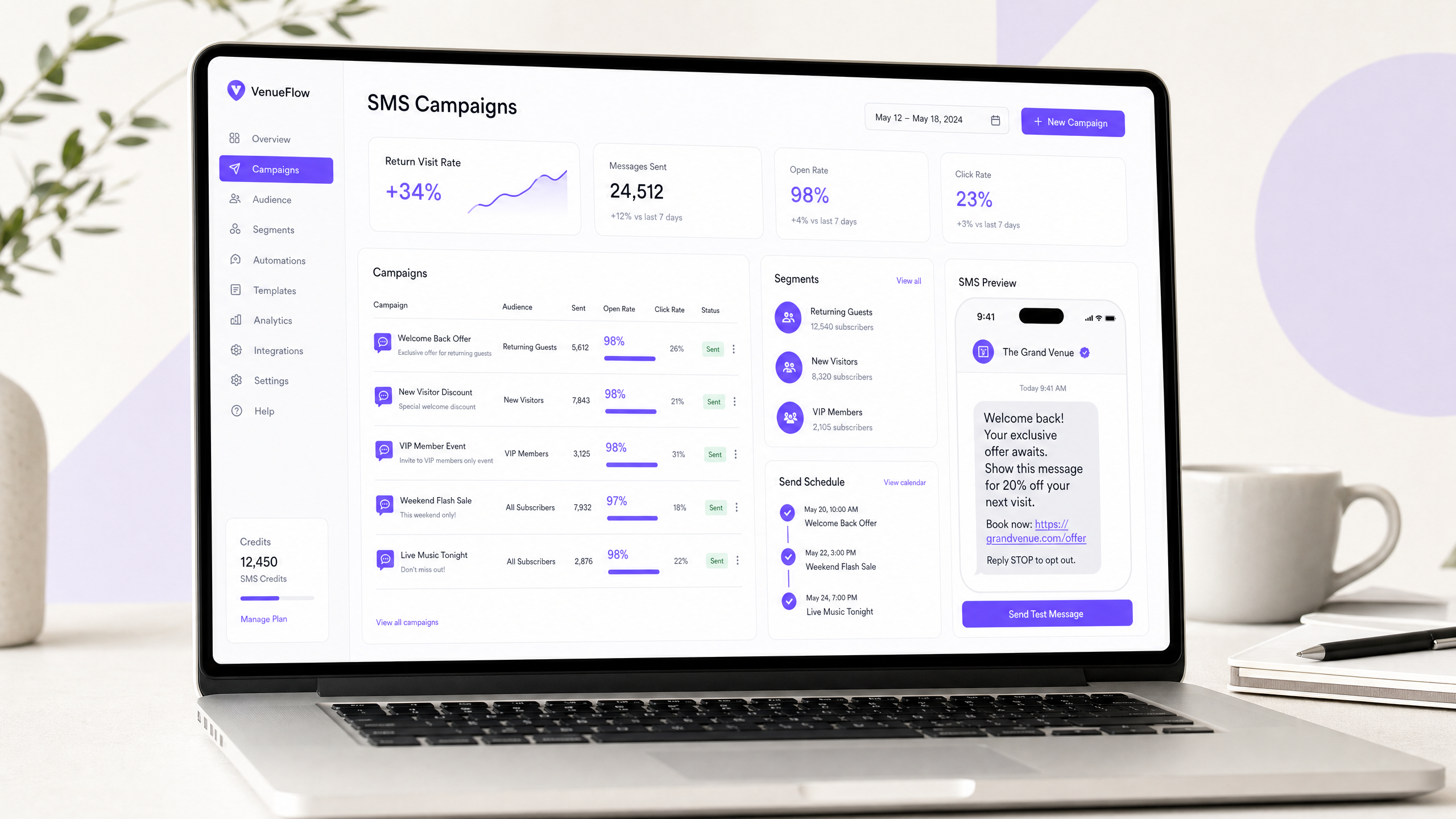
Venue operators face a persistent challenge: converting one-time visitors into loyal, returning guests. Traditional email marketing yields average open rates of around 20%, leaving a significant gap in audience engagement [1]. SMS for marketing closes that gap. SMS achieves a 98% open rate, with 81% of messages read within five minutes of delivery [1]. Average SMS marketing ROI sits between $21 and $71 for every $1 spent [2].
The critical enabler is your existing Guest WiFi infrastructure. Purple Engage captures verified guest phone numbers at the point of WiFi login through SMS authentication, secures explicit GDPR and TCPA-compliant consent, and automates segmented campaigns based on real presence data. This guide covers the full technical stack: RADIUS-based captive portal architecture, OTP verification, consent mechanics, segmentation logic, and trigger-based automation workflows. You will leave with a deployment plan you can act on this quarter.
Technical deep-dive: the data capture architecture
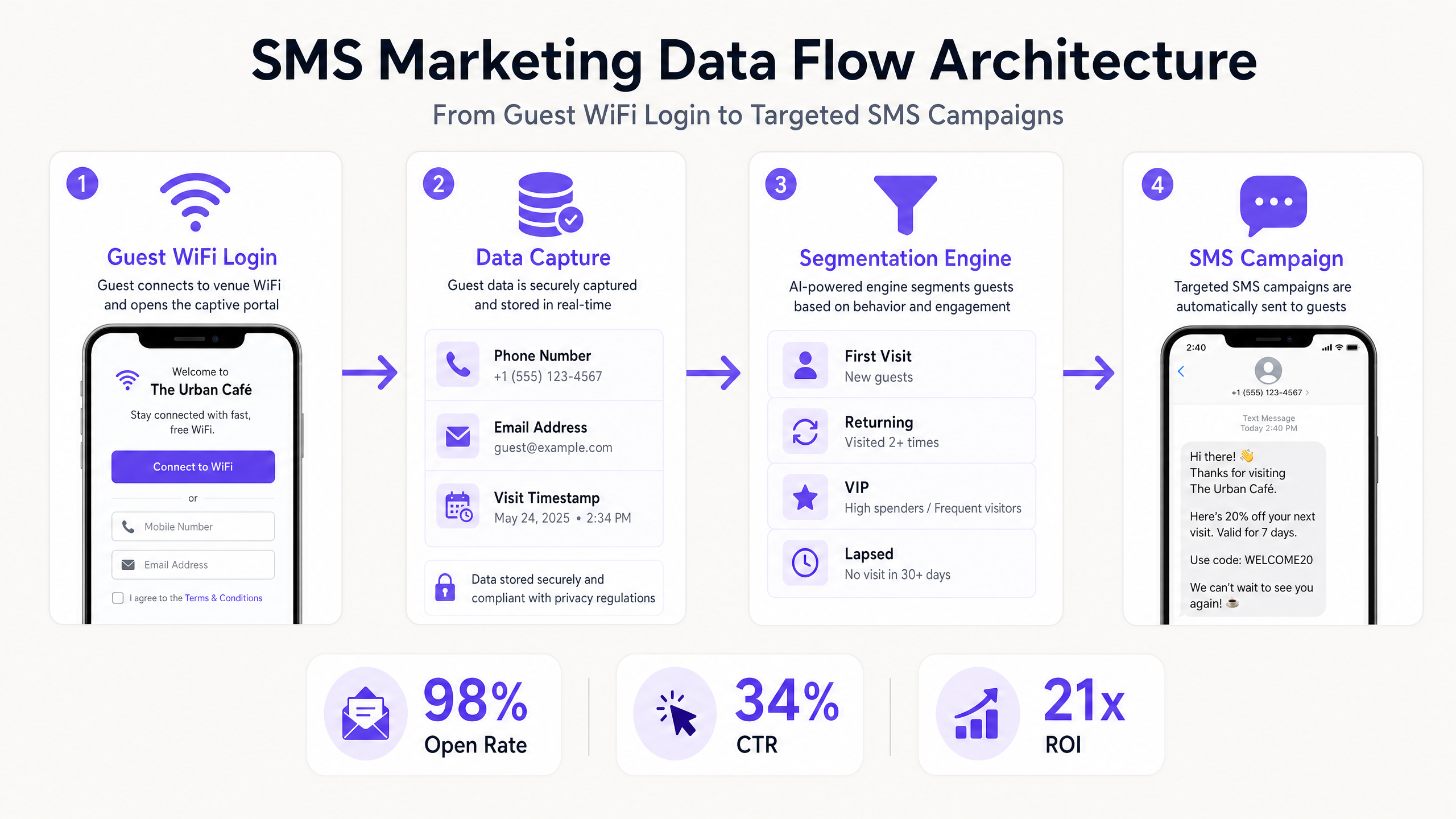
To leverage SMS for marketing to increase return visits, you must first capture verified phone numbers at scale. The most effective mechanism is the captive portal on your Guest WiFi network. When a visitor connects to the SSID, the wireless LAN controller (WLC) intercepts their HTTP traffic and redirects them to the Purple portal. This is the standard captive portal pattern, but the authentication method you choose determines the quality of your data.
Purple integrates with Cisco Meraki, HPE Aruba, Ruckus, Juniper Mist, Ubiquiti UniFi, Cambium, Extreme, and Fortinet as a cloud overlay. No hardware replacement is required. The integration uses RADIUS (Remote Authentication Dial-In User Service) to manage network access decisions. The flow operates as follows.
First, the user associates with the SSID and opens a browser. Second, the WLC intercepts the HTTP request and issues a redirect to the Purple captive portal. Third, the user selects SMS authentication and enters their mobile number. Fourth, Purple sends a one-time password (OTP) via SMS to the provided number. Fifth, the user enters the OTP on the portal. Sixth, Purple sends a RADIUS Access-Accept to the WLC, and internet access is granted. The phone number, along with a timestamp and venue identifier, is stored in Purple's first-party data platform.
The OTP step is the critical differentiator. Without it, users can enter any number to gain access, polluting your database with unverifiable data. With OTP enforcement, every number in your database is confirmed as active and belonging to the person on-site. This directly reduces SMS bounce rates and improves deliverability.
Consent architecture and compliance
Capturing the number is only one requirement. You must also secure explicit consent for marketing communications. This is governed by the TCPA in the United States and the UK GDPR and EU GDPR in Europe. Non-compliance carries substantial financial risk: TCPA violations can result in penalties of $500 to $1,500 per message sent without consent.
The Purple Captive Portal presents consent as a conscious-choice opt-in. The marketing consent checkbox must be unbundled from the general terms and conditions. The user must actively tick the box; pre-ticked checkboxes do not constitute valid consent under GDPR. The consent language must clearly state what the user is agreeing to, naming the organisation and the type of communication.
Purple stores consent records with a timestamp, IP address, and the exact consent text shown at the time of opt-in. This audit trail satisfies the accountability requirements under GDPR Article 5(2) and supports data subject access requests. Purple is ISO 27001 certified, GDPR compliant, CCPA compliant, and Cyber Essentials certified.
Implementation guide: segmentation and automation
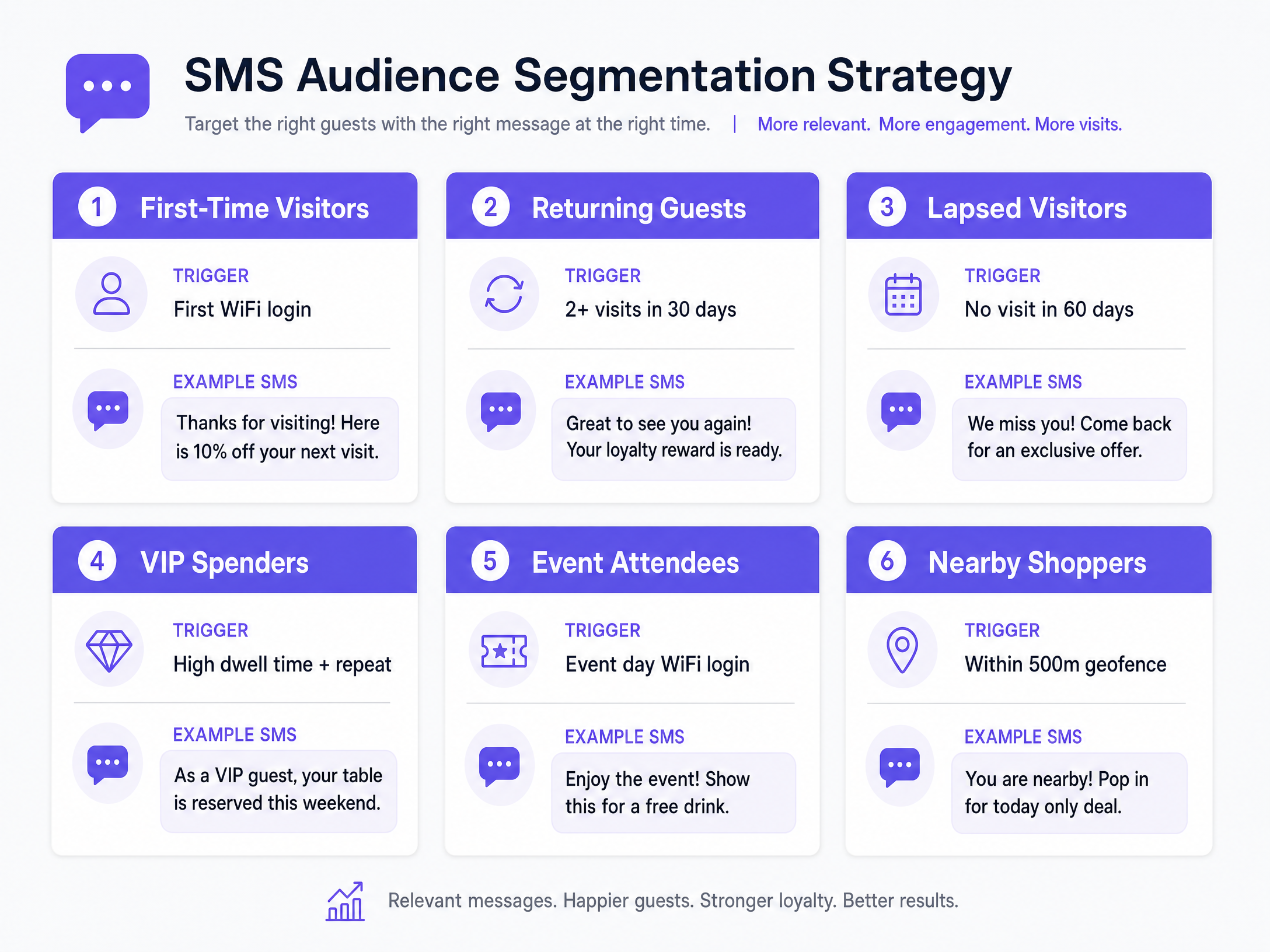
Once you have a compliant database, the next step is to segment it and build automated workflows. A broadcast message to your entire list is the least effective use of the channel. It drives higher opt-out rates and lower conversion. The goal is to send the right message to the right person at the right moment.
Purple Analytics provides the presence data necessary to trigger these flows. Because Purple tracks device presence across your access points, it knows when a device returns, how long it stays in a specific zone, and when it has not been seen for a defined period. This data feeds directly into the Purple Engage automation engine.
Core automation workflows
The following five workflows form the foundation of an SMS programme designed to increase return visits.
Post-visit thank you. Triggered 24 hours after a first-time visitor disconnects from the WiFi. The message includes a discount code valid for their next visit within 14 days. This workflow targets your highest-intent segment: people who have already visited once and are most likely to return if given a reason.
Lapsed visitor win-back. Triggered when a previously frequent visitor has not connected to the WiFi for 60 days. The message offers a compelling incentive to return. This is your most commercially valuable automation. Reactivating a lapsed guest costs significantly less than acquiring a new one.
Loyalty milestone reward. Triggered on a visitor's third, fifth, or tenth WiFi login. The message acknowledges their loyalty and delivers a reward. This reinforces the behaviour you want to encourage.
In-venue upsell. Triggered when a user connects to the WiFi in a specific zone and their dwell time exceeds 30 minutes. The message promotes a product or service available in that zone. For a hotel, this might be a spa promotion triggered by a guest connecting to the pool area WiFi.
Event-day engagement. Triggered when a user connects to the WiFi on a specific event date. The message delivers event-specific content, such as a show schedule or a food and drink offer. For stadium and conference venue operators, this workflow drives ancillary revenue during high-footfall periods.
For more on how Guest WiFi powers these workflows, see our platform overview. For industry-specific applications, see our guides for Retail , Hospitality , Healthcare , and Transport .
Technical configuration: trigger logic
Each automation workflow requires three configuration parameters: the trigger event, the audience filter, and the message content.
The trigger event is defined by a combination of presence signals. For the post-visit thank you, the trigger is first_visit = true AND session_end_timestamp > now - 24h. For the lapsed visitor win-back, the trigger is last_seen_timestamp < now - 60d AND visit_count >= 2. These queries run against Purple's data platform, which processes 29 billion data points collected across 80,000+ live venues.
The audience filter applies additional conditions. You can exclude users who have already redeemed a specific offer, users who have opted out of a specific campaign type, or users who are currently on-site.
Message content should follow the structure: personalisation token (first name where available), offer or value statement, call to action with a trackable URL, and opt-out instruction. Keep messages under 160 characters to avoid multi-part SMS charges and maintain high readability.
Best practices
The following practices reflect industry standards for SMS programmes operating at venue scale.
Frequency management. Limit promotional messages to two to four per month per user. If your unsubscribe rate exceeds 3.5%, reduce frequency or improve targeting [2]. Well-managed SMS programmes maintain unsubscribe rates of 0 to 1.5% per send.
Message timing. Send messages between 10 AM and 8 PM in the recipient's local time zone. Messages sent outside these hours generate higher opt-out rates and lower engagement.
Link tracking. Use shortened, UTM-tagged URLs in every message. This enables you to attribute website visits, bookings, and purchases directly to specific SMS campaigns. Industry benchmarks show SMS CTR of 19 to 36% [2], compared to email's 2 to 5%.
Opt-out compliance. Include opt-out instructions in every promotional message. A simple "Reply STOP to unsubscribe" satisfies both TCPA and GDPR requirements. Ensure your SMS gateway and CRM are integrated so that a STOP reply immediately updates the user's consent record across all systems.
A/B testing. Test message variants on 10% of your audience before sending to the full segment. Test one variable at a time: offer type, message length, or send time.
For related guidance on first impressions and portal design, see How to make a great first impression with your guest WiFi . For network architecture context, see Three SSIDs to rule them all: guest, Passpoint, and IoT WiFi .
Troubleshooting and risk mitigation
Low opt-in rates. If fewer than 15% of WiFi users are opting into SMS marketing, review the captive portal design. The value proposition for opting in must be prominent and specific. "Join our VIP list for exclusive weekly offers" outperforms "Tick here to receive marketing communications." Test different incentive structures: discounts, early access, and free items each appeal to different audiences.
High bounce rates. A bounce rate above 5% indicates invalid phone numbers in your database. Enforce OTP verification on all new sign-ups. For existing databases without OTP validation, run a list-cleaning pass using a number validation API before your next campaign.
Consent record gaps. If you cannot produce a consent record for a given contact, do not send to them. The risk of a GDPR or TCPA enforcement action outweighs the revenue from any individual campaign. Purple's consent management module maintains a complete audit trail for every contact.
Deliverability issues. If delivery rates fall below 95%, check for carrier filtering. Carriers filter messages that contain certain keywords, shortened URLs from unknown domains, or messages sent from unregistered sender IDs. Register your sender ID with the relevant carrier aggregator and use a reputable SMS gateway.
Automation loop errors. Test every trigger workflow in a staging environment before activating. A misconfigured trigger can result in a user receiving the same message repeatedly, which drives opt-outs and damages your sender reputation. Set a suppression window of at least 30 days on all automated workflows to prevent duplicate sends.
ROI and business impact
The financial case for SMS marketing via Guest WiFi is grounded in three advantages: data quality, channel performance, and attribution clarity.
Data quality is the starting point. Because every number in a Purple-captured database is OTP-verified and consent-confirmed, your effective reach is close to 100% of the database. A purchased or scraped list might have a 30 to 40% invalid number rate. Your first-party database has near-zero invalid numbers.
Channel performance is well-documented. SMS achieves a 98% open rate and CTR of 19 to 36% [2]. Conversion rates for well-segmented SMS programmes reach 21 to 30% [2]. For a venue with 5,000 opted-in contacts running a lapsed visitor win-back campaign, a 25% CTR and 15% conversion rate on a £20 average transaction value generates £3,750 in attributable revenue per campaign send.
Attribution clarity is the third advantage. Because Purple tracks WiFi logins, you can close the loop between SMS send and physical return visit. When a guest receives a win-back message and returns to the venue, their device reconnects to the WiFi. Purple records that reconnection and attributes it to the campaign. This is closed-loop attribution without requiring an app download or loyalty card scan.
For a 150-location retail chain running five automated workflows across an average database of 2,000 opted-in contacts per location, the programme reaches 300,000 contacts. At industry-standard conversion rates, this scale of programme generates measurable incremental revenue per quarter.
For further reading on related topics, see How to leverage SMS message marketing to increase return visits and So nutzen Sie SMS-Marketing zur Steigerung von Folgebesuchen .
References
[1] Emarsys. "20+ SMS Marketing Statistics to Know in 2026." https://emarsys.com/learn/blog/sms-marketing-statistics/
[2] MessageFlow. "SMS Marketing Benchmarks 2026: CTR, Open Rates by Industry." https://messageflow.com/blog/sms-marketing-benchmarks/
Key Definitions
Captive portal
A web page that intercepts a user's internet traffic when they connect to a public WiFi network, requiring them to authenticate or accept terms before access is granted.
The captive portal is the primary mechanism for capturing first-party data and securing marketing consent at the point of WiFi login. Purple deploys captive portals as a cloud overlay on Cisco Meraki, HPE Aruba, Ruckus, Juniper Mist, Ubiquiti UniFi, Cambium, Extreme, and Fortinet hardware.
Conscious-choice opt-in
An explicit, active confirmation by a user to receive marketing communications, presented as a separate, unticked checkbox distinct from the general terms of service.
Required under GDPR and TCPA. Pre-ticked boxes, bundled consent, and implied consent do not meet the legal standard. Purple's captive portal enforces this pattern by design.
First-party data
Information collected directly from your own visitors or customers, owned entirely by your organisation, with no intermediary involved in the collection.
Guest WiFi is one of the most efficient first-party data collection mechanisms available to physical venues. Purple has collected 29 billion data points across 80,000+ venues.
OTP (One-Time Password)
A temporary, single-use code sent to a user's device to verify that they own the contact detail they have provided.
Enforcing OTP verification during WiFi login ensures every phone number in your database is valid and belongs to the person on-site. This directly reduces SMS bounce rates.
RADIUS
Remote Authentication Dial-In User Service; a networking protocol that provides centralised authentication, authorisation, and accounting for network access.
Purple communicates with wireless LAN controllers via RADIUS to grant or deny internet access after a user completes the captive portal flow. This is the standard integration pattern across all supported hardware vendors.
TCPA
Telephone Consumer Protection Act; a US federal law that restricts telemarketing and requires express written consent before sending promotional SMS messages.
Violations carry penalties of $500 to $1,500 per message. Purple's consent management module captures and stores the consent records required to demonstrate TCPA compliance.
Triggered campaign
An automated marketing message sent in response to a specific user action or behavioural signal, rather than on a fixed schedule.
Triggered campaigns consistently outperform scheduled broadcasts in SMS marketing. Purple Engage supports triggers based on first visit, return visit, dwell time, zone entry, and time since last visit.
Closed-loop attribution
The ability to connect a marketing communication directly to a measurable outcome, such as a physical return visit, without relying on self-reported data.
Purple enables closed-loop attribution by tracking WiFi logins before and after an SMS send. When a guest returns to the venue and reconnects to the WiFi, Purple attributes that visit to the campaign that triggered the return.
Dwell time
The duration a visitor spends connected to a WiFi network within a venue or zone.
Dwell time is a key signal for in-venue upsell triggers. A user connected to the hotel bar WiFi for more than 30 minutes is a strong candidate for a food and beverage promotion.
Worked Examples
A 150-location retail chain offers free Guest WiFi but only captures email addresses via a simple form. Email open rates are 12% and return visit rates have plateaued. The CRM manager wants to add SMS to the mix without replacing the existing WiFi hardware (a mix of Cisco Meraki and HPE Aruba access points). How should they implement an SMS programme?
Step 1: Deploy Purple as a cloud overlay on the existing Cisco Meraki and HPE Aruba infrastructure. No hardware replacement is required. Purple integrates with both vendors via RADIUS. Step 2: Reconfigure the captive portal to require SMS authentication for WiFi access. The user enters their mobile number, receives an OTP, and enters it to gain internet access. This replaces the existing email-only form. Step 3: Add a clearly worded, unbundled marketing consent checkbox to the portal. The text should read: 'I agree to receive promotional SMS messages from [Brand Name]. I can unsubscribe at any time by replying STOP.' Step 4: Integrate the captured data with the existing CRM via Purple's API. Map the phone number and consent record to the existing customer profile where an email match exists. Step 5: Build three initial automation workflows in Purple Engage: a post-visit thank you (triggered 24 hours after first visit, offering 10% off next purchase), a lapsed visitor win-back (triggered after 60 days of inactivity, offering a free item with next purchase), and a loyalty milestone reward (triggered on fifth visit). Step 6: Set up UTM-tagged tracking links in every message and connect Purple's analytics to the CRM to track return visits attributable to each campaign.
A 12,000-capacity stadium wants to drive food and beverage revenue during matches. They have high WiFi adoption (around 60% of attendees connect per match) but no direct communication channel with fans during the event. The IT director is concerned about GDPR compliance and the marketing director wants to send offers in real time.
Step 1: Deploy a Purple captive portal on the stadium WiFi, which runs on Ruckus access points. Configure the portal with SMS authentication and a marketing consent opt-in. Step 2: Create a dedicated event-day audience segment in Purple Engage. This segment includes all users who connect to the WiFi on a match day and have opted in to marketing. Step 3: Configure zone-based triggers using Purple's presence analytics. Map the access points to specific zones: concourse, seating areas, hospitality suites. Step 4: Build an in-venue upsell workflow. Trigger condition: user has been connected to a concourse access point for more than 15 minutes and the match is in the first half. Message: 'Half-time rush? Pre-order your drinks now and skip the queue. Show this message at Bar 3 for 10% off. Offer expires at half-time.' Step 5: Build a post-event win-back workflow. Trigger condition: match day session ended and user has not returned within 30 days. Message: 'We miss you at the stadium. Book your next match ticket now and get a free programme.' Step 6: Register the stadium's sender ID with the carrier aggregator to ensure message delivery during high-traffic periods when carrier networks are under load.
Practice Questions
Q1. You are the IT director at a 50-site restaurant group. The marketing director wants to automatically send a text message to every customer 10 minutes after they log into the WiFi, asking them to leave a Google review. What is the primary risk with this approach, and what would you recommend instead?
Hint: Consider both the regulatory requirement for marketing consent and the user experience of receiving a message while still eating.
View model answer
The primary risk is a compliance violation. Logging into the WiFi does not constitute consent to receive marketing communications. You need an explicit, unbundled opt-in checkbox on the captive portal before you can send any promotional or operational marketing message. Sending without this consent violates GDPR in the UK and EU, and the TCPA in the US, with penalties of up to $1,500 per message under TCPA. The secondary risk is poor user experience: a message arriving 10 minutes after login interrupts the dining experience and will drive high opt-out rates. The recommended approach is to add a marketing consent checkbox to the captive portal, then trigger the review request message two hours after the user disconnects from the network. This catches them after the visit when they are more likely to reflect positively on the experience.
Q2. A hotel IT manager notices that their SMS database has a 15% bounce rate, meaning 15% of messages fail to deliver. They currently ask guests to type their phone number into a standard text field on the captive portal to access the WiFi. What is causing this and how do they fix it?
Hint: What is the difference between a user typing a number and a user proving they own that number?
View model answer
The cause is the absence of OTP verification. When users can type any number into a free-text field to gain WiFi access, a significant proportion will enter incorrect or fake numbers. This is not necessarily malicious; users often mistype numbers or enter a partner's number. The fix is to implement SMS authentication with OTP verification. The portal sends a one-time password to the number entered. The user must input that OTP to gain internet access. This step confirms the number is valid and belongs to the person on-site. Implementing OTP verification typically reduces bounce rates to below 2% and significantly improves campaign deliverability and ROI.
Q3. Your venue has 10,000 verified, consented phone numbers. The marketing team proposes sending a weekly promotional SMS to the entire list. You have data showing that 3,000 of these contacts visited in the last 30 days, 4,000 visited between 31 and 90 days ago, and 3,000 have not visited in over 90 days. How would you structure the SMS programme differently, and why?
Hint: Consider the different motivations and engagement levels of each segment, and how frequency should vary by segment.
View model answer
A weekly broadcast to all 10,000 contacts will quickly exhaust the channel. The 3,000 recent visitors are already engaged; they do not need a high-frequency push. The 4,000 lapsed-but-recent contacts need a reason to return. The 3,000 long-lapsed contacts need a compelling win-back offer. The recommended structure is three separate workflows. For recent visitors (visited in the last 30 days), send a loyalty milestone message on their third and fifth visit, and a monthly exclusive offer. This keeps frequency low and value high. For the 31 to 90 day segment, trigger a single win-back message at the 45-day mark with a time-limited offer. For the 90-plus day segment, trigger a single win-back message with a higher-value incentive, such as a free item or significant discount. If they do not respond within 14 days, suppress them from further sends to protect list health. This approach treats each segment according to their engagement level, reduces total send volume, and concentrates budget on the contacts most likely to convert.
Q4. A stadium with 50,000 capacity wants to send an in-venue SMS offer during half-time. They expect 30,000 fans to be connected to the WiFi. Their SMS gateway charges £0.04 per message. The marketing director wants to send to everyone. The IT director is concerned about carrier filtering. What technical steps should be taken before the first send?
Hint: Think about what happens when 30,000 messages are sent from the same sender ID within a five-minute window.
View model answer
Sending 30,000 messages in a short window from an unregistered sender ID will trigger carrier spam filters, resulting in a significant proportion of messages being blocked or delayed past the half-time window. The required steps are: first, register the stadium's sender ID or short code with the carrier aggregator used by the SMS gateway. This whitelists the sender and prevents filtering. Second, confirm the SMS gateway supports high-throughput sending at the required volume. A gateway capable of 1,000 messages per second will clear 30,000 messages in 30 seconds. Third, segment the audience before the event. Do not send to all 30,000 connected devices. Filter to only those who have opted into marketing communications. This reduces send volume and improves relevance. Fourth, schedule the send for the moment the half-time whistle blows, not during the second half when the opportunity has passed. Fifth, test the workflow at a smaller event before the main fixture to validate delivery rates and timing.