
How to leverage marketing SMS to increase return visits
This guide details how venue operators can use existing Guest WiFi infrastructure to capture verified mobile numbers and deploy automated SMS marketing campaigns. It covers the technical architecture of data capture, GDPR and TCPA compliance requirements, and provides concrete implementation frameworks for driving measurable return visits.
Listen to this guide
View podcast transcript
Executive Summary
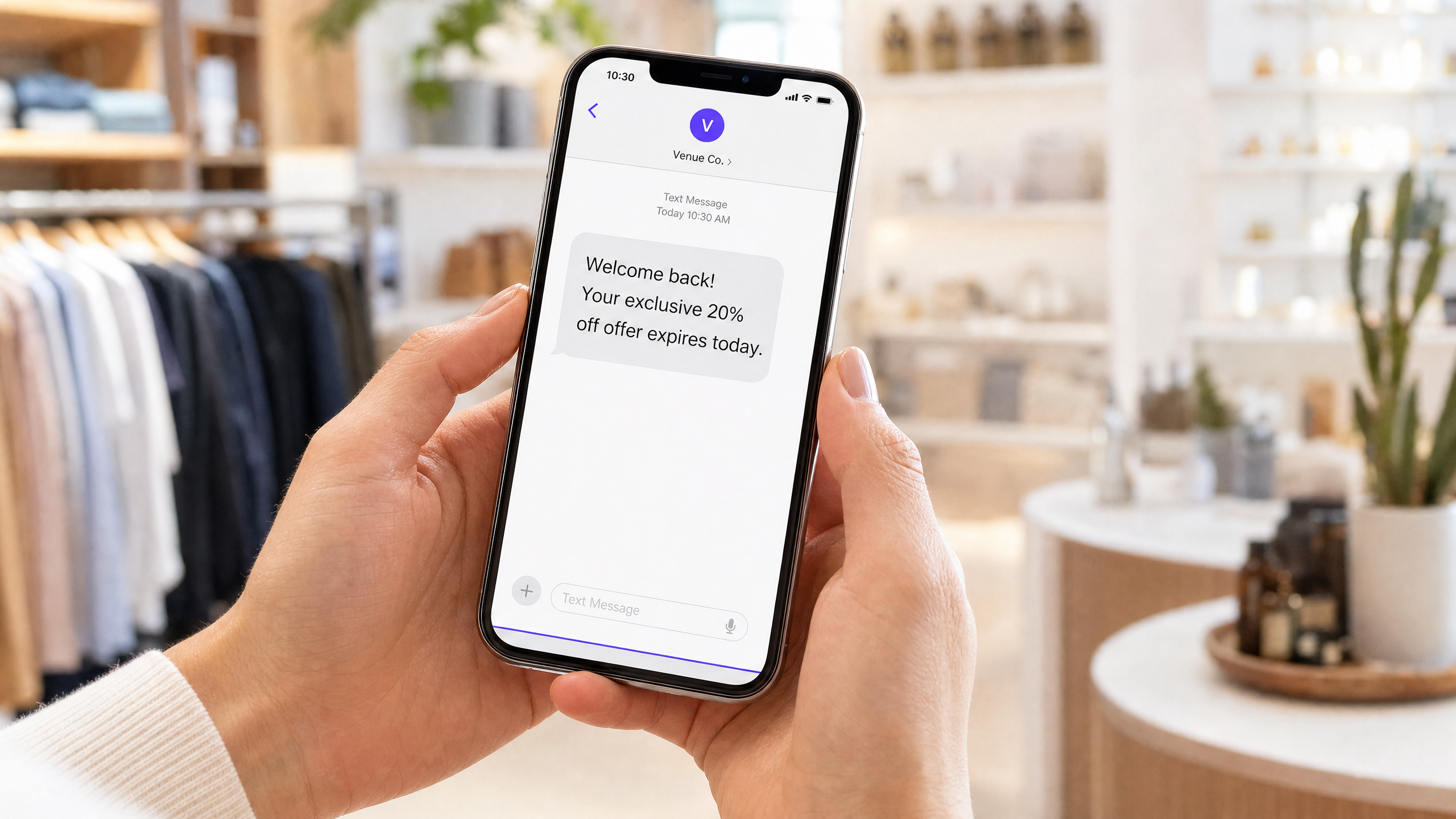
Venue operators sit on an untapped asset: verified mobile numbers captured through their existing Guest WiFi networks. While most IT and marketing teams understand the value of first-party data, few have implemented the technical architecture required to automate SMS marketing at scale. SMS delivers a 98% open rate, with 90% of messages read within three minutes [1]. This guide explains how to configure Purple Engage to capture explicit consent at login, segment visitor profiles based on network presence, and trigger automated SMS campaigns that demonstrably increase return visits.
We will examine the integration between access points (including Cisco Meraki, HPE Aruba, and Juniper Mist), the Purple captive portal, and the SMS delivery engine. We will also define the compliance frameworks required by GDPR and TCPA, ensuring your data capture strategy mitigates legal risk while maximising commercial return.
Technical Architecture and Data Capture
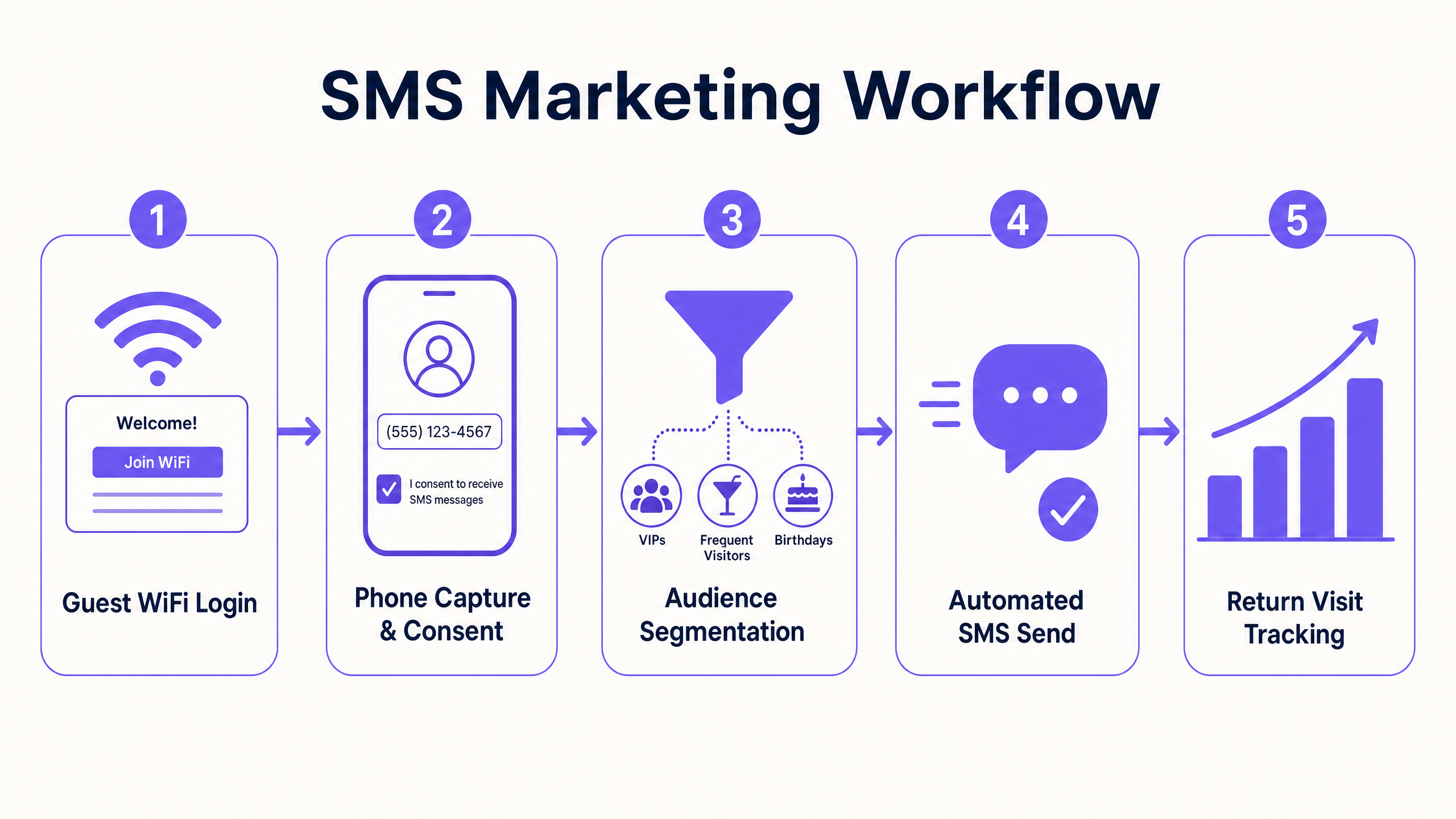
The foundation of effective SMS marketing is a robust, compliant data capture mechanism. The architecture relies on three distinct layers operating in sequence: network access, identity verification, and profile segmentation.
The Access Layer
The physical network layer handles the initial client connection. When a visitor's device associates with the Guest WiFi SSID, the wireless LAN controller intercepts the HTTP request and redirects the client to the Purple captive portal. This hardware-agnostic approach means the same logic applies whether you run Ruckus in a stadium or Ubiquiti UniFi in a retail chain.
The Identity Layer
The captive portal is where data capture occurs. To build an SMS marketing database, you must configure the portal to request a mobile number. This is typically achieved through a progressive profiling strategy or an explicit value exchange. For example, offering a faster connection tier or a digital voucher in return for SMS opt-in.
Crucially, this layer manages compliance. The login flow must present a conscious-choice opt-in mechanism. Pre-ticked boxes are invalid under GDPR. The user must actively select a checkbox confirming their agreement to receive marketing SMS messages. Purple records this transaction, timestamping the MAC address, the provided phone number, and the exact consent language displayed at the time of login.
The Segmentation Engine
Once authenticated, the visitor's device is tracked by the network infrastructure. Purple Engage aggregates these presence analytics - dwell time, visit frequency, and cross-venue movement - into a centralised visitor profile. This continuous data stream allows you to define dynamic audience segments. You can isolate first-time visitors, identify high-frequency loyalists, or flag guests who have not returned within a specific timeframe.
Implementation Guide
Deploying an automated SMS strategy requires precise configuration of triggers and templates. The goal is to move from batch-and-blast messaging to event-driven communication.
Step 1: Define the Trigger Event
Triggers dictate when an SMS is sent. They rely on the presence data captured by the WiFi network. The most effective triggers are temporal. For a hospitality venue, a post-stay trigger configured for 21 days after the last seen date targets guests in the re-booking window. For retail, a 60-day absence trigger identifies lapsed shoppers.
Step 2: Configure the Payload
The payload is the SMS content. It must be concise, personalised, and contain a clear call to action. Purple Engage allows you to inject dynamic variables into the message template, such as the visitor's first name and the specific venue they last visited.
Step 3: Establish Frequency Caps
To prevent list fatigue and elevated opt-out rates, you must implement global frequency caps. Configure the system to restrict SMS delivery to a maximum of two messages per user per month, regardless of how many triggers they qualify for.
Best Practices and Compliance
Operating an SMS marketing programme requires strict adherence to regulatory standards. The penalties for non-compliance are severe, with TCPA fines reaching $1,500 per message in the United States and GDPR penalties scaling to 4% of global turnover in Europe [2].
Consent Management
Consent must be freely given, specific, informed, and unambiguous. You cannot make Guest WiFi access conditional on marketing consent. The user must have a path to connect without opting in. The consent log maintained by Purple serves as your system of record in the event of an audit.
The Opt-Out Mechanism
Every SMS message must include a clear, functional opt-out mechanism. The industry standard is the "Reply STOP" command. Your SMS gateway must process these requests automatically and immediately update the user's profile in Purple Engage to suppress future sends.
Troubleshooting and Risk Mitigation
The primary failure mode in SMS marketing is list degradation caused by irrelevant messaging. If your opt-out rate exceeds 1% per campaign, your segmentation strategy is flawed.
To mitigate this risk, monitor campaign performance continuously. Analyse the correlation between message delivery and subsequent network presence. If an SMS campaign does not result in a measurable increase in return visits within 14 days, pause the trigger and refine the offer.
ROI and Business Impact
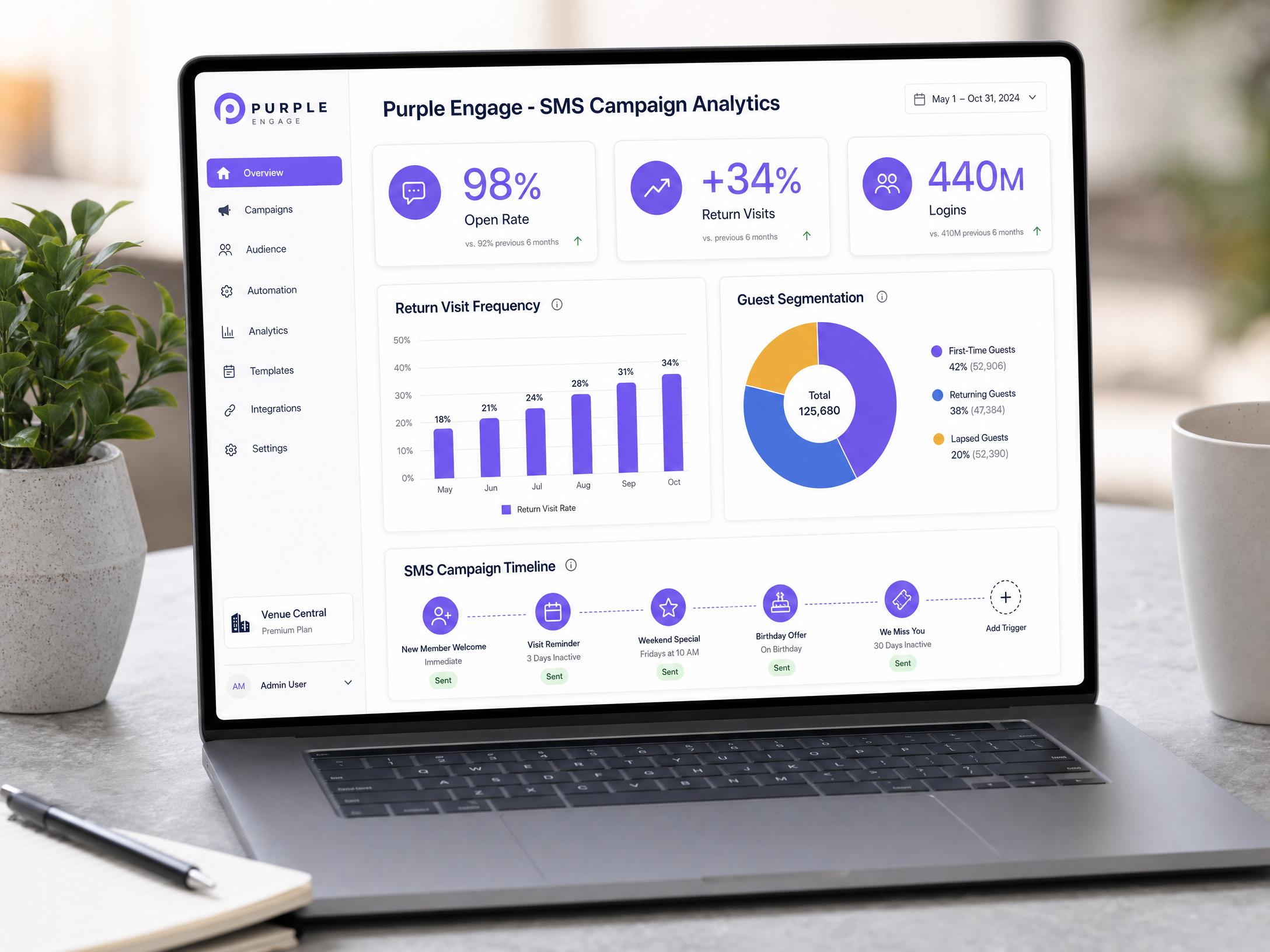
The commercial impact of automated SMS marketing is measured in recovered footfall and direct revenue. By leveraging existing Guest WiFi infrastructure, the acquisition cost of the phone number is effectively zero. The operational cost is limited to the SMS gateway fees.
When a lapsed visitor receives a targeted SMS and subsequently returns to the venue, the network logs their device. This closed-loop attribution model allows you to calculate the exact cost per return visit, providing definitive proof of ROI to the executive board.
References
[1] SMS Marketing Statistics 2026. Infobip. Available at: https://www.infobip.com/blog/sms-marketing-statistics [2] GDPR Compliance for SMS Marketing. Sakari. Available at: https://sakari.io/blog/gdpr-compliance-for-sms-marketing-the-complete-implementation-guide
Key Definitions
Captive Portal
The web page displayed to newly connected users before they are granted broader access to network resources.
This is the primary interface for capturing visitor data and securing explicit marketing consent.
Conscious-Choice Opt-In
A consent mechanism requiring the user to take an affirmative action, such as ticking an empty checkbox.
Required for GDPR and TCPA compliance; pre-ticked boxes do not constitute valid consent.
Dynamic Segmentation
The automated grouping of users based on real-time data inputs, such as their physical presence in a venue.
Allows IT and marketing teams to target visitors based on their actual behaviour rather than static lists.
Closed-Loop Attribution
The ability to track a marketing action (sending an SMS) to a physical outcome (the device reconnecting to the network).
Essential for proving the ROI of SMS campaigns to the business.
Frequency Cap
A system-level restriction on the number of messages a single user can receive within a defined timeframe.
Critical for preventing list fatigue and minimising opt-out rates.
Payload
The actual text content and dynamic variables contained within the SMS message.
Must be concise and include a clear call to action and opt-out mechanism.
Presence Analytics
Data derived from the wireless network regarding device location, dwell time, and visit frequency.
The fuel that powers the segmentation engine and triggers automated campaigns.
Hardware-Agnostic
Software that operates independently of the underlying physical infrastructure.
Purple's cloud overlay works across Cisco Meraki, Aruba, and others without requiring hardware replacement.
Worked Examples
A 120-location retail chain wants to reactivate shoppers who have not visited any store in the last 45 days. They currently capture email addresses at WiFi login but see open rates below 15%. How should they architect an SMS reactivation campaign?
- Update the Purple captive portal to include an optional mobile number field with a clear SMS marketing opt-in checkbox. Offer a 10% discount code for opting in.
- In Purple Engage, build a dynamic segment targeting users who have opted into SMS AND have a 'last seen' date greater than 45 days ago.
- Configure an automated SMS trigger to fire when a user enters this segment.
- Draft the message payload: 'Hi [First Name], we miss you at [Last Visited Venue]. Show this text for 15% off your next purchase. Reply STOP to opt out.'
- Monitor the WiFi analytics dashboard to track how many users in the segment reconnect to the network within 14 days of message delivery.
A stadium operator with 50,000 capacity wants to drive early arrivals to increase food and beverage revenue before kickoff. They have Aruba access points installed.
- Segment the Purple Engage database to identify fans who attended the previous three home fixtures.
- Schedule a batch SMS campaign to deploy 4 hours before the next kickoff.
- Payload: 'Beat the queues today! Get a pie and pint for £8 before 2pm at the South Stand concourse. Reply STOP to opt out.'
- Cross-reference the SMS delivery list with the WiFi connection logs between 12pm and 2pm to measure the early arrival conversion rate.
Practice Questions
Q1. A hotel operator wants to automatically send an SMS offering a late checkout for £20 to all guests at 8:00 AM on their day of departure. They plan to use the WiFi data to trigger this. What is the primary compliance risk with this approach?
Hint: Consider the difference between operational messages and marketing messages.
View model answer
The primary risk is that a late checkout offer is a marketing message (an upsell), not a purely operational service message. Therefore, it requires explicit marketing consent. The operator must ensure the SMS is only triggered for guests who actively ticked the marketing opt-in box on the captive portal, rather than sending it to all connected devices.
Q2. You have configured an automated SMS trigger for 'Lapsed Visitors' (not seen in 60 days). The campaign has run for three months. The open rate is assumed high, but the WiFi analytics show only a 0.5% return rate within 14 days of sending. What is the most likely technical or strategic failure?
Hint: Look at the payload and the segment definition.
View model answer
The most likely failure is a weak or irrelevant payload. If the message does not contain a compelling, time-limited offer or reason to return, the high open rate of SMS will not translate into physical footfall. The operator should A/B test a stronger incentive in the payload.
Q3. A retail venue is migrating from Cisco Meraki to Juniper Mist access points. How will this hardware change affect their existing Purple Engage SMS campaign triggers?
Hint: Consider where the logic and data reside in the architecture.
View model answer
It will have no effect. Purple is a hardware-agnostic cloud overlay. As long as the new Juniper Mist controllers are configured to point to the Purple RADIUS servers and captive portal, the identity capture, segmentation logic, and SMS triggers will continue to function exactly as they did on the Meraki hardware.