
Parkside plasma cutter PPSK 40 b2: comparing features and deployment models
This authoritative technical reference compares Private Pre-Shared Key (PPSK) authentication models for multi-tenant networks, specifically the PPSK 40 B2 architecture. It provides IT managers and property developers with a definitive framework for deploying secure, isolated WiFi that supports residential IoT devices at scale.
Listen to this guide
View podcast transcript
Executive Summary
Multi-tenant environments like Build to Rent (BTR) and student accommodation require a network architecture that balances enterprise security with consumer simplicity. Residents expect a home-like WiFi experience where their smart devices can communicate seamlessly, but property operators must ensure strict network isolation between households to maintain security and GDPR compliance. The traditional shared Pre-Shared Key (PSK) model fails on both fronts, while full 802.1X enterprise authentication is too complex for consumer IoT devices.
This guide details the Unique per-User Pre-Shared Key (UU PPSK) architecture, specifically the PPSK 40 B2 deployment model. By mapping cryptographically unique 40-character keys to dedicated VLANs via a cloud-hosted RADIUS infrastructure, operators can deliver per-resident network isolation, automated key lifecycle management, and full smart device support from a single SSID. We compare the three primary deployment models and provide a vendor-neutral framework for implementation.
Listen to this guide
Technical Deep-Dive: Authentication Models
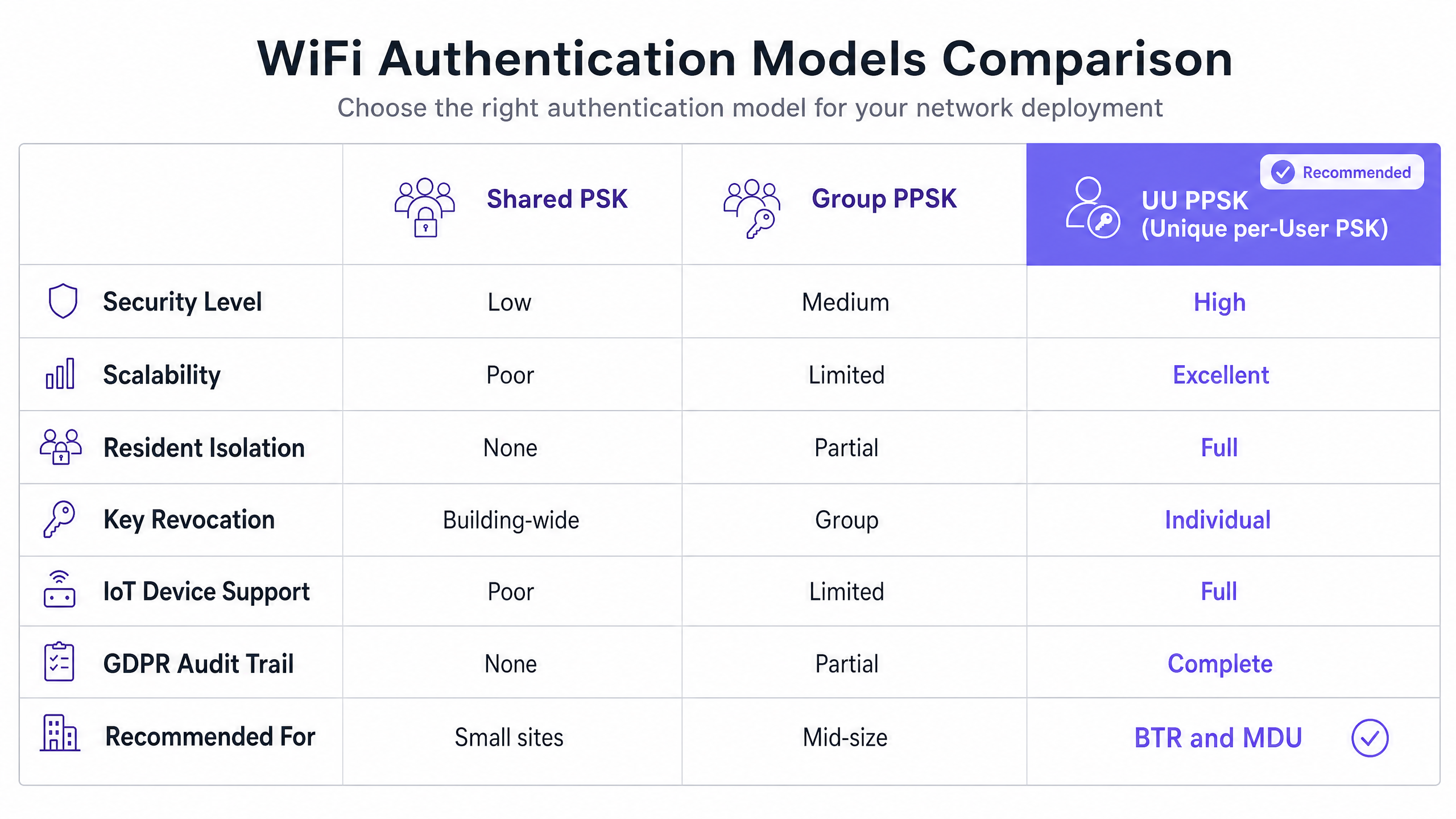
When designing WiFi for a multi-tenant residential or commercial property, the authentication architecture dictates the security, scalability, and resident experience. There are three distinct models to consider.
Model 1: Shared PSK
In a standard shared PSK deployment, all residents connect to a single SSID using the same password.
This model is simple to deploy but presents severe security and operational risks. It represents a single point of failure; if one resident shares the password, the network is compromised. Revoking access for a single user requires a building-wide password rotation, which is operationally unviable at scale. Furthermore, a shared PSK provides no network-layer isolation between residents, and it creates a compliance gap under GDPR, as network activity cannot be attributed to a specific individual.
Model 2: Group PPSK
Group PPSK assigns a unique key to specific groups of users, such as all residents on a specific floor or a specific tenancy type.
While an improvement over a single shared password, Group PPSK still suffers from a blast radius problem. If a group key is compromised, every resident in that group is affected. It also fails to provide individual household isolation at the network layer, making it unsuitable for modern BTR environments where residents expect private networks.
Model 3: UU PPSK (Unique per-User Pre-Shared Key)
UU PPSK, also referred to as iPSK by Cisco, DPSK by Ruckus, and MPSK by HPE Aruba, assigns a cryptographically unique key to every single resident or household.
This is the architecture that delivers a secure, home-like WiFi experience. Each unique key maps to a dedicated VLAN, creating an isolated network segment for that specific resident. The resident's devices can communicate with each other - enabling Chromecast, Apple TV, and Sonos functionality - but they remain completely invisible to other residents on the same physical infrastructure.
The PPSK 40 B2 Architecture
The PPSK 40 B2 designation refers to a specific, enterprise-grade deployment profile:
- 40: Denotes a minimum key length of 40 characters. Keys of this length, generated from a cryptographically random source, provide sufficient entropy to make offline dictionary and brute-force attacks computationally infeasible.
- B2: Refers to the deployment model. B1 indicates controller-local storage, which struggles to scale. B2 indicates RADIUS-backed PPSK with cloud orchestration, which is the required architecture for deployments exceeding 50 units.
Authentication Flow
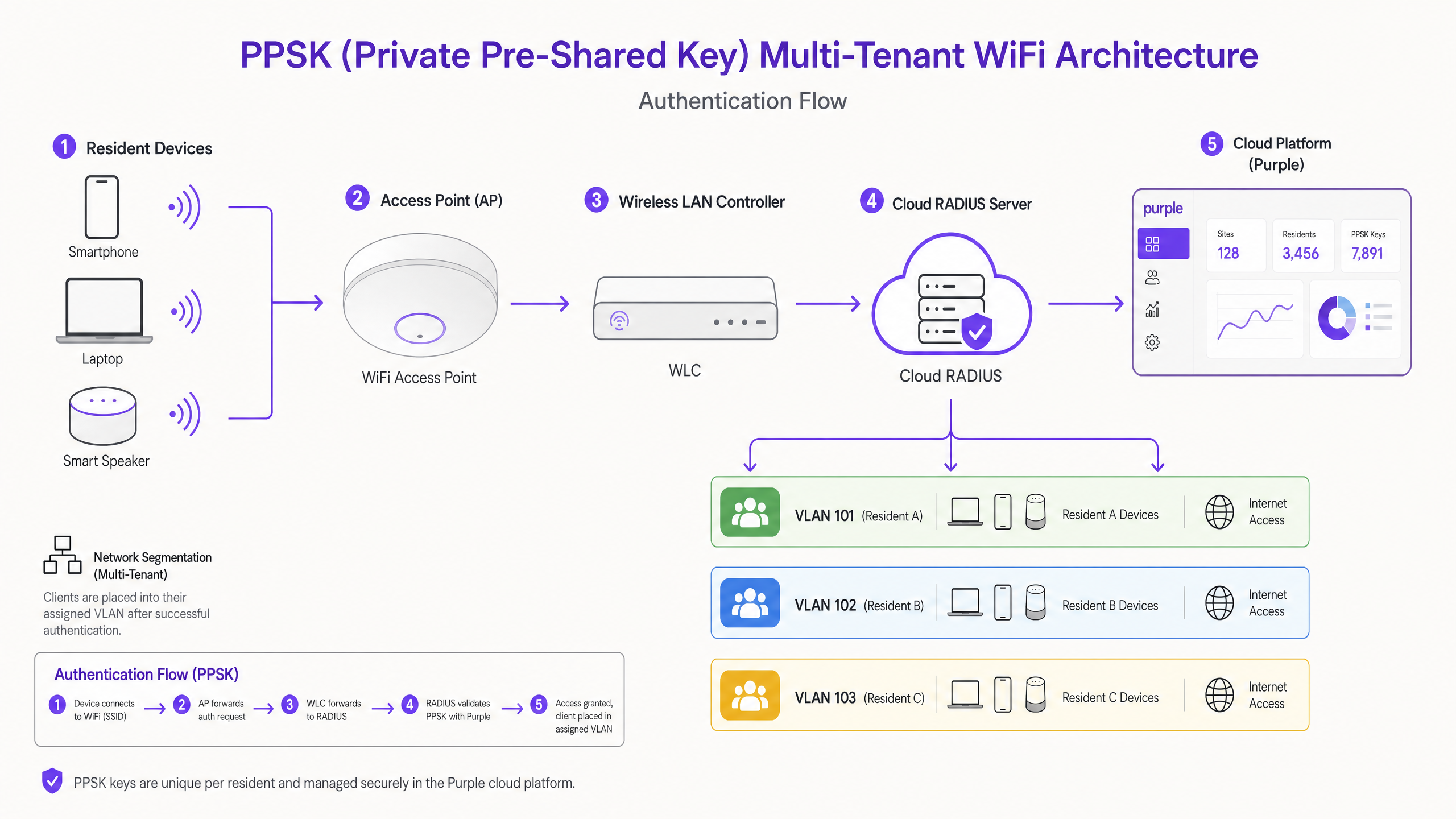
The technical authentication flow for RADIUS-backed UU PPSK operates as follows:
- A resident's device attempts to connect to the building-wide SSID.
- The Wireless LAN Controller (WLC) or Access Point intercepts the connection and forwards the device's MAC address to the cloud RADIUS server via an Access-Request message.
- The RADIUS server looks up the MAC address in its identity store.
- The RADIUS server returns an Access-Accept response containing the unique pre-shared key assigned to that specific resident, along with the resident's assigned VLAN ID.
- The controller validates the key presented by the device against the key returned by RADIUS.
- If the keys match, the device is authenticated and dynamically placed onto the resident's dedicated VLAN.
This flow ensures that a single SSID can support hundreds of isolated private networks, eliminating SSID proliferation and beacon overhead.
Implementation Guide
Deploying PPSK 40 B2 requires careful planning, particularly regarding device behaviour and protocol limitations. Follow these vendor-neutral implementation steps.
1. Address MAC Address Randomisation
Modern operating systems (iOS 14+, Android 10+, Windows 11) use randomised MAC addresses by default to prevent tracking. Because RADIUS-backed PPSK relies on MAC address lookups to assign the correct key and VLAN, randomisation will cause authentication failures.
You must implement a pre-registration workflow where residents register their devices before connecting, or configure your captive portal to instruct users to disable MAC randomisation for the building's SSID. Purple's platform handles this automatically during the resident onboarding flow.
2. Enable mDNS Reflection
Multicast DNS (mDNS) is the protocol used by consumer smart devices (Chromecast, AirPlay, Sonos) for discovery. By default, mDNS traffic does not cross VLAN boundaries. If you isolate residents into separate VLANs without configuring mDNS reflection, their smart devices will not function.
You must ensure your wireless controller or cloud overlay supports per-VLAN mDNS reflection and enable it during the initial configuration.
3. Automate Key Lifecycle Management
The operational viability of UU PPSK depends entirely on automation. Manually provisioning and revoking keys for hundreds of residents is not scalable and introduces security risks.
You must integrate your RADIUS infrastructure with your Property Management System (PMS) or Student Management System. When a tenancy begins, the integration should automatically provision a key. When the tenancy ends, the key must be instantly revoked.
Best Practices
- Deploy Cloud RADIUS-as-a-Service: For deployments above 50 units, use a cloud-hosted RADIUS service rather than relying on controller-local storage. This ensures scalability and centralises lifecycle management across multiple sites.
- Standardise Hardware: Ensure your deployment uses enterprise-grade hardware capable of supporting dynamic VLAN assignment and RADIUS integration. We recommend Cisco Meraki, HPE Aruba, Ruckus, Juniper Mist, Ubiquiti UniFi, Cambium, Extreme, or Fortinet.
- Maintain a Single SSID: Do not deploy multiple SSIDs to segment traffic. Use a single building-wide SSID and rely on the RADIUS server to dynamically assign VLANs based on the authenticated key.
Troubleshooting & Risk Mitigation
| Failure Mode | Root Cause | Mitigation Strategy |
|---|---|---|
| Device fails to authenticate | MAC address randomisation is enabled on the client device. | Implement a pre-registration portal that guides users to disable private MAC addresses for the building SSID. |
| Smart speaker cannot be discovered by phone | mDNS reflection is not enabled on the wireless controller. | Enable per-VLAN mDNS reflection in the controller configuration to allow discovery protocols to function within the resident's isolated network. |
| Controller memory exhaustion | Attempting to store too many unique keys locally on the controller (B1 profile). | Migrate to a RADIUS-backed architecture (B2 profile) where keys are stored externally and queried dynamically. |
| Former resident retains network access | Lack of automated key revocation. | Integrate the RADIUS platform with the Property Management System to automate key revocation upon tenancy termination. |
ROI & Business Impact
Implementing PPSK 40 B2 delivers measurable business impact for property operators:
- Reduced Support Overhead: By providing a home-like WiFi experience where smart devices function correctly, operators typically see a 70% reduction in WiFi-related support tickets compared to shared PSK deployments.
- Enhanced Security and Compliance: Per-resident network isolation protects against lateral movement by malicious actors. The ability to attribute network traffic to specific keys ensures full compliance with GDPR accountability requirements.
- Increased Asset Value: Reliable, secure, and resident-friendly WiFi is a primary driver of tenant retention in BTR and student accommodation sectors.
Purple's Multi-Tenant WiFi solution provides the cloud RADIUS infrastructure and PMS integrations required to deploy PPSK 40 B2 securely and efficiently, supporting Hospitality and residential operators globally.
Key Definitions
UU PPSK
Unique per-User Pre-Shared Key. An authentication architecture where every individual user or household receives a cryptographically unique password that connects them to a dedicated, isolated network segment.
The recommended deployment model for multi-tenant environments requiring per-resident security and smart device support.
RADIUS
Remote Authentication Dial-In User Service. A networking protocol that provides centralised authentication, authorisation, and accounting management for users connecting to a network service.
The server infrastructure required to validate unique MAC addresses and assign specific VLANs in a scalable PPSK deployment.
VLAN
Virtual Local Area Network. A logical subnetwork that groups a collection of devices from different physical LANs, isolating their traffic from other devices.
Used in multi-tenant WiFi to ensure Resident A's devices cannot communicate with or intercept traffic from Resident B's devices.
mDNS Reflection
A network configuration that allows Multicast DNS discovery packets to cross VLAN boundaries in a controlled manner.
Essential for allowing consumer smart devices like Apple TV and Chromecast to function correctly when isolated within a resident's dedicated VLAN.
MAC Address Randomisation
A privacy feature in modern operating systems that generates a temporary, random hardware address when connecting to a WiFi network.
A critical implementation pitfall for PPSK deployments, as RADIUS servers rely on stable MAC addresses to identify devices and assign the correct key.
SSID Proliferation
The negative impact on network performance caused by broadcasting too many network names (SSIDs) from a single access point.
UU PPSK solves this by allowing hundreds of isolated resident networks to operate underneath a single building-wide SSID.
Key Lifecycle Management
The automated process of generating, distributing, and revoking network access keys based on a user's tenancy status.
Required to maintain security in high-turnover environments like student accommodation without creating unmanageable IT overhead.
802.1X
An IEEE standard for port-based network access control that provides an authentication mechanism to devices wishing to attach to a LAN or WLAN.
The enterprise gold standard for corporate devices, but generally too complex to configure on the consumer IoT devices prevalent in BTR environments.
Worked Examples
A 250-unit Build to Rent development requires a network architecture that provides per-resident isolation, supports 15-25 smart devices per household, and allows same-day move-in readiness. The developer has specified Cisco Meraki access points.
Deploy a single building-wide SSID using UU PPSK backed by a cloud RADIUS service. Integrate the RADIUS platform with the building's Property Management System. When a resident signs their lease, the integration automatically generates a cryptographically unique 40-character key and delivers it via the resident app. The RADIUS server maps this key to a dedicated VLAN with a private subnet. Enable mDNS reflection on the Meraki controller for each VLAN to ensure Chromecast and Sonos functionality.
A 400-bed purpose-built student accommodation block experiences severe network congestion and high support ticket volumes every September when 400 new students attempt to connect their smart TVs and gaming consoles using a shared building password.
Replace the shared PSK architecture with UU PPSK using Ruckus SmartZone and a cloud RADIUS overlay. Integrate with the student management system to automate key provisioning. Email each student their unique key during pre-arrival registration. Configure the RADIUS server to automatically expire the keys on the contract end date. Implement a device pre-registration workflow to capture permanent MAC addresses and bypass randomisation issues.
Practice Questions
Q1. A property developer wants to deploy WiFi across a 300-unit BTR block using Ubiquiti UniFi hardware. They plan to use controller-local PPSK to avoid ongoing RADIUS licensing costs. What is the primary risk of this approach?
Hint: Consider the operational requirements of managing 300 unique households and the hardware limitations of local storage.
View model answer
The primary risk is scalability and lifecycle management. A 300-unit deployment exceeds the practical limits of controller-local PPSK storage. More importantly, without an external RADIUS server integrated with the Property Management System, the IT team will have to manually provision and revoke keys for every resident move-in and move-out, creating an unmanageable operational burden and significant security risks.
Q2. During the commissioning phase of a new UU PPSK deployment, the on-site team reports that residents can connect their smartphones to the network, but their Apple TVs and wireless printers are failing to authenticate. What is the most likely cause?
Hint: Think about how modern smartphones handle MAC addresses compared to static IoT devices.
View model answer
The most likely cause is MAC address randomisation. The residents' smartphones are likely presenting a randomised MAC address that does not match the permanent hardware MAC address registered in the RADIUS database during onboarding. The IoT devices (Apple TVs, printers) typically use static MAC addresses and are therefore authenticating successfully, but the smartphones are being rejected.
Q3. A landlord is concerned about GDPR compliance following an incident where illegal content was downloaded over the building's shared WiFi network. They want to know how UU PPSK solves this issue.
Hint: Focus on the relationship between the authentication key and the network traffic.
View model answer
UU PPSK solves this by assigning a cryptographically unique key to every household. Because each key is tied to a specific resident's identity in the RADIUS database, all network traffic generated using that key can be definitively attributed to that specific household. This provides a complete audit trail, allowing the landlord to comply with law enforcement requests and demonstrate accountability under GDPR.
Continue reading in this series
Uu PPSK pdf: comparing features and deployment models
This technical reference guide compares Private Pre-Shared Key (PPSK) WiFi architecture against traditional 802.1X and standard PSK deployments. It provides network architects and IT managers with vendor-neutral implementation strategies for multi-tenant residential, IoT, and BTR environments.
Uu PPSK pdf: comparing features and deployment models
This technical reference guide compares Private Pre-Shared Key (PPSK) WiFi architecture against traditional 802.1X and standard PSK deployments. It provides network architects and IT managers with vendor-neutral implementation strategies for multi-tenant residential, IoT, and BTR environments.
Uu PPSK 2023: comparing features and deployment models
This technical reference guide compares Unique per-User Private Pre-Shared Key (UU PPSK) WiFi architecture against traditional shared PSK and 802.1X deployments, with a specific focus on the 2023 landscape of vendor implementations and platform capabilities. It provides property developers, BTR operators, and MDU landlords with actionable deployment strategies, VLAN architecture guidance, and automated lifecycle management workflows. The guide covers three deployment models, real-world case studies, and the compliance implications of each authentication approach.